

Note: This article contains affiliate links. If you click on these links and make a purchase, I may earn a small commission at no extra cost to you. This helps support my research and content. Read my full affiliate disclosure here.
Starting cuttings reliably depends more on the medium than many gardeners expect. The right potting soil for cuttings holds enough moisture to feed tender stems while providing enough air and drainage to encourage fine root growth rather than rot. This guide looks at the top shortlisted mixes suited specifically for cuttings, focusing on how texture, drainage, and nutrient profile affect rooting success in pots, trays, or small propagation setups. Below you will find the top picks and straightforward notes on why each mix works for different cuttings and conditions. Read on to understand the criteria we used to select these options and how to match a mix to your propagation method.
Top Picks at a Glance
| Best Overall The best all-around choice for most situations | Espoma Organic Seed Starter Premium Potting Mix, 16 qt |  |
| Best Quality Built to a higher standard if you want something more solid | FoxFarm Ocean Forest Potting Soil, 12 Quart |  |
| Best Value The sweet spot between price and what you get | Back to the Roots Organic Indoor Potting Mix, 6 Quart |  |
| Best Budget The cheapest option that still gets the job done reliably | Doter Plant Propagation Potting Mix (1 qt) |  |
| Highest Rated A top-rated pick with lots of positive feedback | Old Potters Germination Mix (24 qt) — Peat Moss with Fine Perlite & Vermiculite |  |
| Most Popular A crowd favorite that many people choose with confidence | Miracle-Gro Indoor Potting Mix for Seed Starting, 8 qt. (2-Pack) |  |
| Best Seller A high-volume bestseller chosen again and again | Back to the Roots Organic Expanding Coco Coir Potting Soil Brick (10 lb) |  |
Espoma Organic Seed Starter Premium Potting Mix, 16 qt

| Brand Name | Espoma |
|---|---|
| Volume | 16 quarts |
| Unit Count | 598.4 Ounce |
| Model Number | SS16 |
Espoma Organic Seed Starter is a peat-based, lightweight potting mix designed specifically for germinating seeds and rooting cuttings. The blend of sphagnum peat moss and perlite gives good aeration and drainage while the formula includes yucca extract to improve wetting and lime to balance pH. It also contains Myco-tone mycorrhizae to help early root establishment and improve nutrient access during the seedling stage. Typical use is filling trays, cells, or small pots for seeds and softwood cuttings; its fine texture and moisture retention reduce damping-off risk when used with proper sanitation and watering. Because it contains no synthetic fertilizers, it is appropriate for organic growing but you will need to begin light feeding once true leaves form or when transplanting. The bag size covers routine home-seed-starting needs, and the product is straightforward to handle and mix for small-scale propagation projects.
Best for: Gardeners focused on reliable seed germination and strong early root development who want an organic, ready-to-use mix for trays and small pots.
Less Ideal for: Growers wanting a peat-free or pre-fertilized seed mix or those starting very large volumes commercially should consider alternatives tailored to those needs.
- Formulated for seedlings with peat and perlite for balanced aeration and moisture retention
- Includes Myco-tone mycorrhizae to support early root development
- Organic ingredients with no synthetic fertilizers, suitable for organic growing
- Contains yucca extract to improve wetting and lime to help stabilize pH
- No starter nutrients included so plants need feeding after true leaves appear
- Peat-based mix is not the most sustainable choice for gardeners preferring peat-free media
Verdict: Choose this organic seed starter when you want a ready-to-use mix that promotes rapid root development and reliable germination for home seedlings and cuttings.
FoxFarm Ocean Forest Potting Soil, 12 Quart

| Item Form | Granules |
|---|---|
| Specific Uses For Product | Dry Fertilizer |
| Coverage | 4.8 sq ft |
| Mixing Ratio | 1:1 |
FoxFarm Ocean Forest is a pre-mixed potting soil that combines aged forest products, sandy loam and sphagnum peat moss with organic amendments like fish meal, crab meal and earthworm castings. It is sold ready to use straight from the bag for planting in containers, seed starting or top dressing; the manufacturer recommends no additional nitrogen fertilizer for the first 30 days. The mix has a light, aerated texture that promotes drainage while still retaining moisture, and the built-in micronutrients make it practical for growers who want strong early growth without immediate feeding. Practical benefits include easy pot filling, good root zone aeration for roses in containers, and built-in organic fertility to support blooms. Limitations to consider are that the bag is best for containers or small beds only and heavier feeders may need supplemental feeding after the initial month; users should also follow handling precautions to avoid skin or eye irritation.
Best for: Gardeners who want a high-quality, nutrient-rich potting medium to get container roses or plant starts off to a strong, flowering start and prefer a ready-made organic blend.
Less Ideal for: Large in-ground rose beds or landscapers needing bulk soil amendments should look for bulk garden soil or custom rose mixes instead.
- Ready-to-use out of the bag so you can pot immediately
- Organic amendments (fish meal, crab meal, earthworm castings) supply early nutrients
- Light, aerated texture that supports drainage and root development
- pH adjusted for optimal nutrient uptake per product description
- Pack size (12 qt) covers a small area and may require multiple bags for several roses
- No long-term feeding provided after the first 30 days so additional fertilizer is needed for sustained heavy bloom
Verdict: Choose this soil if you want a ready-made, organically amended potting mix that jump-starts container roses and seedlings with good drainage and early fertility.
Back to the Roots Organic Indoor Potting Mix, 6 Quart

| Unit Count | 192 Fluid Ounces |
|---|---|
| Item Type Name | Indoor Potting Mix 6qt |
| Item Highlight | Peat-free, 100% organic, made in the USA |
| Ingredients | Coconut Coir, Yucca, Mycorrhizae, Perlite, Horticultural Sand |
This Back to the Roots indoor potting mix is a ready-to-use, 6-quart blend designed for common houseplants such as pothos, monstera and ferns. It combines coconut coir, yucca extract, mycorrhizae, perlite and horticultural sand to improve moisture retention, drainage and root development without peat. In practice it feels light and friable, so it is easy to pot seedlings or repot mature plants and it reduces compaction that can suffocate roots. The added mycorrhizae helps young roots establish and take up nutrients more efficiently while yucca extract helps the mix hold water between waterings, which is convenient for forgetful or busy plant owners. Because it is peat-free and made in the USA, it is a more sustainable choice versus traditional peat-based mixes. Limitations are the small 6-quart size, which means frequent repurchasing for larger collections, and the bag does not include fertilizer so you will need to feed plants separately as they grow.
Best for: Buyers who prioritize low-risk, easy-care houseplant solutions and want an organic, ready-to-use potting mix that reduces watering hassles and supports healthy root growth.
Less Ideal for: Not ideal for gardeners who need large-volume soil for many pots or for those expecting a mix that includes built-in fertilizer for long-term feeding.
- Peat-free organic formula that reduces environmental impact
- Yucca extract improves moisture retention between waterings
- Contains mycorrhizae to support root development and nutrient uptake
- Light, well-draining texture suitable for repotting seedlings and houseplants
- Small 6-quart volume may require frequent repurchasing for larger plant collections
- Does not include fertilizer so additional feeding is necessary
Verdict: A compact, peat-free potting mix that simplifies indoor plant care by holding moisture and boosting root establishment.
Doter Plant Propagation Potting Mix (1 qt)

| Brand Name | Doter |
|---|---|
| Unit Count | 32 Ounce |
| Item Type Name | Garden soil |
| Volume | 1 quarts |
This 1 quart Doter propagation mix is built for starting cuttings and seedlings. It blends perlite and vermiculite to create a loose, sterile medium that holds moisture without staying waterlogged, which helps roots form quickly while reducing the risk of rot. The mix is very lightweight and easy to handle in small trays or individual pots, and its clean composition makes it convenient for indoor work where disease-free media matters. Typical use is filling small propagation pots, inserting cuttings to about one-third their length, and keeping the substrate slightly moist until roots appear. Practical benefits include improved oxygen around developing roots and simpler handling compared with heavier potting soils. Limitations are the small 1 qt volume, which means frequent repurchasing for larger projects, and the product may require added nutrients once cuttings are rooted and moved to longer-term pots.
Best for: Home gardeners who want an affordable, ready-to-use propagation medium for small batches of cuttings and who prioritize a clean, easy-to-handle mix over bulk quantity.
Less Ideal for: Gardeners propagating large numbers of cuttings, nurseries, or projects that need nutrient-rich potting soil for long-term growth should consider larger or richer mixes.
- Formulated with perlite and vermiculite for balanced drainage and moisture retention
- Lightweight and loose texture makes inserting cuttings and checking roots easy
- Sterile, clean medium reduces risk of soil-borne contaminants during propagation
- Suitable for a wide range of plants including flowers, herbs, and vegetables
- Only 1 quart per package so not cost-effective for large batches of cuttings
- No built-in nutrients so cuttings need feeding after rooting
Verdict: A compact, inexpensive propagation mix that gives beginner and budget-focused gardeners a reliable, sterile medium for rooting cuttings.
Old Potters Germination Mix (24 qt) — Peat Moss with Fine Perlite & Vermiculite

| Volume | 24 quarts |
|---|---|
| Unit Count | 768 Fluid Ounces |
| pH range | 5.4 – 6.3 |
| Electrical conductivity | 1.0 – 1.5 mmhos/cm |
This germination mix is built for starting seeds and propagating cuttings with consistent results. Its formula is 80–90% finely milled Canadian sphagnum peat moss combined with fine horticultural perlite and vermiculite to provide a balance of moisture retention and aeration that promotes uniform root development. Calcitic and dolomitic limestone are added to hold the pH in the 5.4–6.3 range and a wetting agent helps the medium rehydrate evenly so you avoid dry pockets in small cells or trays. A mild starter nutrient charge and a modest EC (1.0–1.5 mmhos/cm) give seedlings a gentle early feed without burning young roots. The fine texture makes it well suited to both sub-irrigation and overhead watering systems and to use in seed flats, plug trays, and small pots. Be aware the mix is peat-based, so it will compress over time and may hold more water than soilless mixes with higher perlite content, requiring attention to drainage for long-term potting. For reliable, repeatable seed starts this is a practical, no-nonsense choice.
Best for: Gardeners who prioritize consistent, predictable seed starts and propagation results and want a ready-to-use medium that performs across trays and small pots.
Less Ideal for: Growers looking for an entirely peat-free or very fast-draining mix for succulents or long-term container culture should consider alternatives.
- High peat content for even moisture retention and fine texture ideal for seeds and cuttings
- Added fine perlite and vermiculite improve aeration and uniform water holding in trays
- pH balanced with calcitic and dolomitic limestone for consistent nutrient availability
- Wetting agent promotes quick, even rehydration to reduce dry spots in small cells
- Peat-based formulation can compress and retain more water over time compared with higher-drainage mixes
- Contains a light starter charge but not a complete fertilizer for longer-term growth
Verdict: Choose this germination mix when you need a dependable, fine-textured medium that gives repeatable, uniform seed and cutting starts.
Miracle-Gro Indoor Potting Mix for Seed Starting, 8 qt. (2-Pack)
| Brand Name | Miracle-Gro |
|---|---|
| Item Type Name | Potting Mix |
| Number of Packs | 2 |
| Volume | 8 quarts |
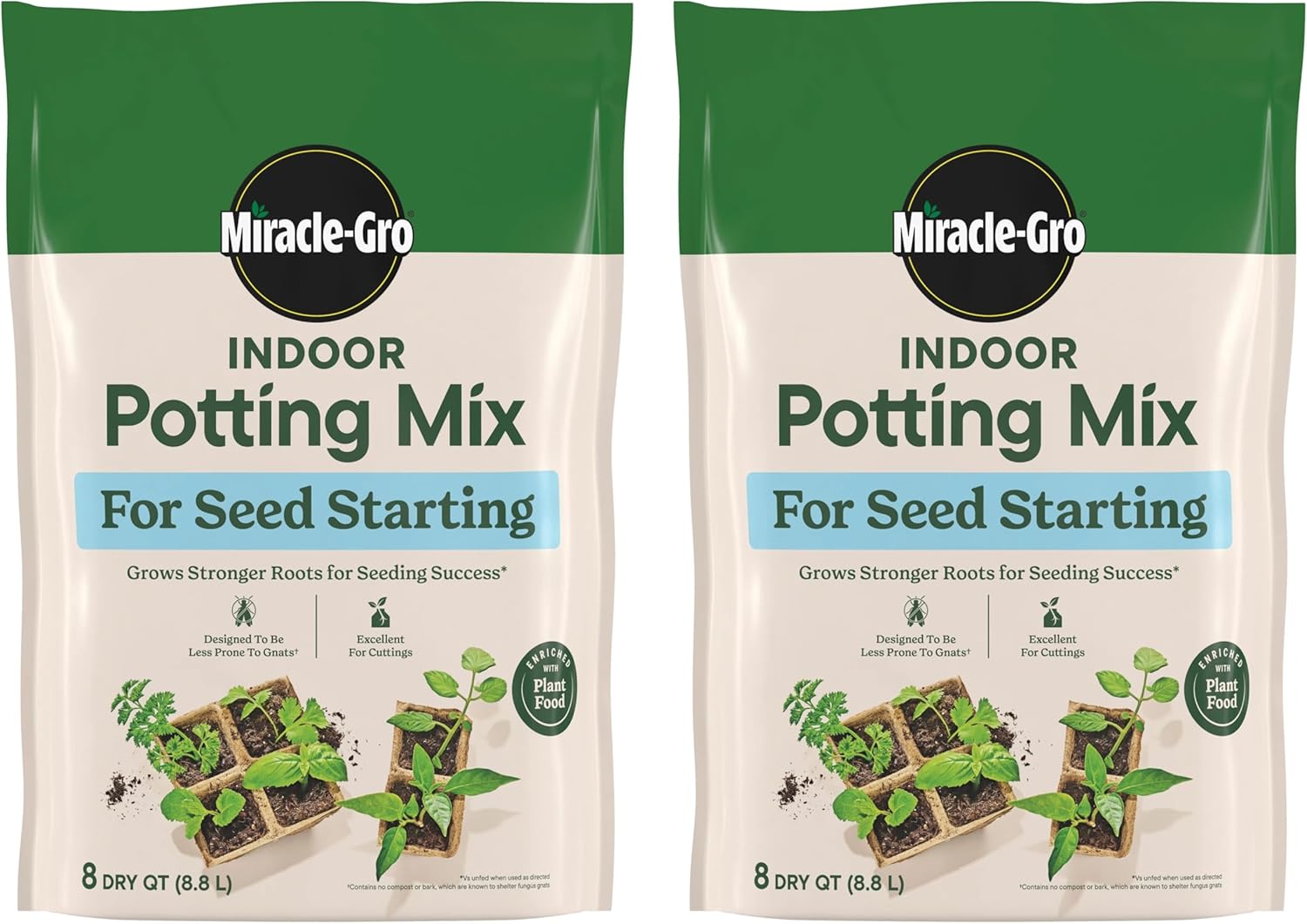
This two-pack of Miracle-Gro Indoor Potting Mix is designed specifically for starting seeds and rooting cuttings indoors. The blend is lightweight and pre-enriched with plant food so seedlings get a nutrient boost during early root development, and the manufacturer says it yields stronger roots compared with unfed mixes when used as directed. It is intended for vegetables, flowers, and herbs and works well in cell trays and small containers; one 8 qt. bag will fill roughly three 72-cell trays. Notably, the formula omits compost and bark, which helps lower the chance of fungus gnat infestations in damp seed-starting setups. Use it by filling trays or pots, keeping the mix evenly moist, and shielding newly sown seeds from direct sun until germination. Important limitations are standard for enriched mixes: it contains fertilizer (so handle carefully) and it is a seed-starting medium rather than an all-purpose potting soil for mature plants, so you will likely transplant seedlings into a different mix or amend soil later.
Best for: Buyers who want a low-effort, indoor seed-starting medium that supports faster root development and reduces common pest risks while following proven seed-starting practices.
Less Ideal for: Gardeners who need a permanent potting soil for mature container plants or who prefer fully organic, compost-rich mixes should consider alternatives.
- Lightweight, ready-to-use formula tailored for seed germination and cuttings
- Pre-enriched with plant food to support early root and seedling growth
- Excludes compost and bark to reduce habitat for fungus gnats
- Comes as a two-pack so you have enough mix for multiple trays
- Contains fertilizer which requires careful handling and storage
- Intended for seed starting so not formulated as long-term potting soil for mature plants
Verdict: A practical, low-risk seed-starting mix that boosts early root growth and reduces fungus gnat risk, making it a reliable choice for indoor vegetable seedlings.
Back to the Roots Organic Expanding Coco Coir Potting Soil Brick (10 lb)

| Item Highlight | 10 lb compressed coco coir brick; peat-free; OMRI Listed |
|---|---|
| Item Type Name | Coconut Coir |
| Volume | 2 cubic feet |
| Ingredients | Coconut Coir |
| Style Name | Expanding Potting Soil |
This compressed coco coir brick provides a lightweight, peat-free potting medium that expands when you add water to create loose, airy substrate for containers and seed flats. It is typically used by hydrating the 10 lb block to about 2 cubic feet of coir and then using it alone for potted plants, mixing it into garden soil to improve drainage and aeration, or blending with compost for starting seeds. Notable features include OMRI listing for organic use, a balanced pH suited to a wide range of plants, and compact storage before expansion which saves space. Practical benefits are improved root aeration and water retention compared with heavy garden loam, easier handling than bulky bags, and versatility across vegetables, herbs, and ornamentals. Important limitations are that coco coir is a soilless substrate and does not supply significant nutrients on its own so you will need to add fertilizer or compost for long-term potted herbs like rosemary, and the product requires time and a water source to expand before use.
Best for: Buyers who prioritize low-risk, easy-to-handle, organic potting media and want a versatile base for container herbs and seed starting without dealing with heavy bags.
Less Ideal for: Gardeners who want a ready-to-plant, nutrient-rich potting mix out of the box or those who prefer soil with built-in slow-release fertilizer.
- Peat-free OMRI listed organic coco coir suitable for organic growing
- Expands from a compact brick to about 2 cubic feet for easy storage and transport
- pH balanced and airy texture that improves drainage and root aeration
- Versatile use: can be used alone, for seed starting, or mixed into existing soil
- Provides little inherent fertility so supplemental feeding or compost is needed for nutrient-hungry plants
Verdict: A compact, peat-free coco coir brick that expands into an airy, pH-balanced base ideal for low-risk organic container gardening and seed starting when paired with fertilizer or compost.
Choosing the Right Potting Soil for Cuttings: Key Factors to Consider
Drainage and Aeration
Cuttings need oxygen at the root zone to initiate new root tips. A mix with coarse components such as perlite, pumice, or fine grit creates air pockets and prevents saturation that leads to rot. If a medium compacts or holds waterlogged pockets, cuttings struggle to breathe and are prone to fungal problems.
When evaluating mixes, look for visible, stable coarse particles and avoid blends made only from fine peat or compost. Good drainage does not mean drying out too quickly; it means water moves through evenly while leaving enough humidity at the cutting base to encourage root formation.
Moisture Retention
While aeration is crucial, cuttings also require a consistent, gentle supply of moisture to support cell division at the cut end. Materials such as coco coir, fine peat, or well-aged compost can hold moisture without becoming soggy when combined with drainage components.
A propagation medium should strike a balance so the surface stays humid and the lower zone is slightly damp. Too dry a mix forces frequent misting and stress, while too wet a mix suffocates new roots. Choose a blend that retains moisture in the fine fraction while coarse particles maintain airflow.
Sterility and Low Pathogen Risk
Cuttings are highly vulnerable to damping-off and fungal infections because they lack established roots and immune response. Sterile or pasteurized mixes reduce the chance of pathogens that cause rot. Look for blends labeled for propagation or those described as sterilized, and prefer inert bases when starting high-value or slow-rooting cuttings.
Using a clean medium reduces the need for chemical treatments and makes environmental controls easier. Even with sterile soil, maintain clean tools, disinfect containers, and avoid overwatering to keep disease risk low.
Particle Size and Stability
Particle size affects how a mix behaves when watered and handled. Very fine particles can compact and block air exchange, while extremely large particles may not hold enough moisture for delicate cuttings. Stable particles that retain their structure through watering cycles give consistent rooting conditions.
Consider whether the mix will be used in small cells, plug trays, or open pots. Smaller propagation modules benefit from a slightly finer but stable texture, while larger containers can tolerate chunkier components. Stability also matters if you intend to reuse the medium for multiple propagation rounds.
Nutrient Balance for Early Rooting
Most cuttings root best in a low to moderate nutrient environment. Excess soluble fertilizer salts can dehydrate young root initials or burn tender tissues. A base mix with light, slow-release nutrients or low initial fertility gives cuttings energy without overwhelming them.
For many gardeners, a mostly inert propagation mix supplemented with a mild starter feed after roots appear is the safest approach. Consider the species you are propagating; some woody cuttings tolerate leaner mixes while soft-stem cuttings may benefit from slightly richer, but low-salt, media.
pH and Water Quality Compatibility
The pH of a propagation medium influences nutrient availability once roots form. Many common cuttings do well in a slightly acidic to neutral range. If your water source is very alkaline or has high dissolved salts, choose a mix that buffers pH and does not accumulate salts quickly.
Soft or buffered media can help reduce transplant shock when cuttings move into regular potting soil. Test water and consider pre-rinsing or using filtered water for sensitive species to avoid unexpected nutrient lockout or tip burn when roots develop.
Best Mix Types by Cutting Type
Different species and cutting types root under different conditions. Soft-stem annuals and herbaceous cuttings often prefer a moister, finer-textured medium that keeps the cutting hydrated. Semi-hardwood and hardwood cuttings typically need better drainage and coarser mixes that emulate outdoor soil pore space.
Match the mix texture to the cutting woodiness and expected rooting time. Faster-rooting cuttings tolerate finer, wetter mixes because roots appear quickly; slow-rooting specimens benefit from coarser, drier-leaning blends to reduce rot risk during long establishment periods.
- Soft-stem cuttings: finer, moisture-holding blends with good aeration
- Semi-hardwood: balanced mixes with moderate pumice or perlite
- Hardwood: chunkier media with larger aggregate and stable structure
Propagation Containers and Drainage Setup
The container you use influences how a mix performs. Shallow trays and plug cells dry faster than deeper pots. Ensure trays have adequate drainage holes and consider a mesh or coarse layer to prevent fine particles from clogging outlets.
Elevate trays slightly to allow water to escape freely. If using humidity domes or plastic covers, monitor moisture closely; domes reduce evaporation and can cause mixes to remain too wet unless ventilation is provided.
- Use plug trays for small cuttings and deeper pots for larger woodier cuttings
- Provide bottom drainage and avoid water pooling under cells
- Vent covers daily to prevent condensation buildup
How to Condition and Prepare Soil for Propagation
Moisten the mix before inserting cuttings so the medium is damp but not saturated. A pre-moistened medium reduces air pockets around stem bases and gives immediate contact for root initials. Break up any clumps and ensure a uniform texture in trays or pots.
If a mix seems heavy or prone to compaction, incorporate additional coarse material such as horticultural grit or perlite. For sterile propagation, bake or steam small batches if you suspect contamination, but follow safe heating guidelines for the material type.
- Pre-moisten and mix thoroughly before use
- Adjust coarse fraction if the mix compacts
- Sterilize questionable mixes with heat when appropriate
Aftercare: Watering, Humidity, and Transitioning
After inserting cuttings, keep humidity steady and avoid waterlogging. Mist surfaces lightly when the mix starts to dry, and use bottom-watering sparingly to maintain even moisture without disturbing stems. Reduce humidity gradually once roots are visible to acclimate new plants.
When roots are established, transition cuttings to a richer potting mix or larger containers in stages. Avoid sudden increases in fertility. Harden off by increasing airflow and slightly lowering humidity before transplanting outdoors or into regular houseplant media.
- Maintain consistent, gentle moisture without saturating
- Lower humidity gradually after visible root development
- Stage transplanting to prevent shock
DIY Mixes Versus Ready-Made Propagation Blends
Many gardeners mix their own propagation media to control texture and cost. Typical DIY bases combine an inert component like perlite or sand with a moisture-holding fraction such as coco coir or peat. This approach allows you to fine-tune drainage and water retention for specific cuttings.
Ready-made blends designed for cuttings are convenient and often sterile out of the bag. They save time but may not match the exact particle size you prefer. Consider using ready mixes as a baseline and adjusting with coarse material if needed.
- DIY mixes give control over particle size and drainage
- Commercial mixes offer sterility and convenience
- Adjust any mix to match your propagation containers and species
How We Chose the Best Potting Soil for Cuttings
We prioritized mixes and blends that directly address what matters for propagating cuttings: a balance of moisture retention and aeration, a sterile or low-pathogen base, and a texture that supports fine root development. Our selection filtered for potting soils and propagation mixes with explicit mention of rooting support, visible coarse components such as perlite or fine pumice for drainage, and organic matter that does not compact quickly. We also checked for stable particle size that remains consistent when watered and for low-salt nutrient profiles to avoid burning delicate new roots. Excluded items included heavy garden soils, straight compost, and mixes designed primarily for long-term container growth rather than short-term rooting. We did not consider fertilizers or root hormones as standalone products; instead we focused on the physical medium. Key evaluation dimensions were drainage and aeration, moisture-holding capacity, sterility and pathogen risk, texture and particle stability, and nutrient balance for early root growth. These criteria guided the shortlist and align with the scoring metrics used in the product cards.
FAQ
Can I use regular potting soil for cuttings?
Often regular potting soil is too rich or fine for many cuttings and can retain excess moisture, increasing rot risk. If you use it, amend with perlite or grit to improve drainage and reduce compaction.
How damp should propagation soil be when inserting cuttings?
The medium should be evenly damp but not dripping. Squeeze a handful; a few drops may come out, but water should not stream. This provides immediate moisture without suffocating the stem base.
Is sterilizing potting soil necessary for propagation?
Sterility reduces risk of fungal diseases, especially for slow-rooting or valuable cuttings. It is not always required for quick-rooting annuals, but it is recommended when starting many cuttings in close quarters or when disease has been a problem.
When should I fertilize newly rooted cuttings?
Wait until a healthy root system is visible and the plant shows new growth before applying fertilizer. Start with a weak, balanced feed and increase gradually to avoid burning young roots.
Can I reuse propagation soil after a previous batch?
Reusing soil is possible but assess for compaction, residual salts, and pathogens. Refresh by adding coarse material and composted organic matter, and consider sterilizing if there were disease issues in the prior batch.
Final Verdict
Choosing the right potting soil for cuttings comes down to balancing aeration, moisture retention, and cleanliness. Prioritize mixes that keep the root zone oxygenated while holding enough moisture to support root initials, and prefer sterile or propagation-labeled media when working with vulnerable or slow-rooting cuttings. Match texture to your cutting type and container size, and be prepared to adjust with coarse material or moisture-holding components. By focusing on those tradeoffs you can select a propagation medium that reduces rot, supports steady root development, and makes transitioning cuttings into finished plants far more reliable. Aim for consistent moisture, good airflow, and low initial fertility as you start new plants from cuttings.
