

Note: This article contains affiliate links. If you click on these links and make a purchase, I may earn a small commission at no extra cost to you. This helps support my research and content. Read my full affiliate disclosure here.
A well-timed pre emergent crabgrass killer can be the difference between a tidy lawn and a sea of grassy weeds by midseason. You want a product that prevents crabgrass seed from germinating without harming desirable turf or ornamentals. This guide covers seven shortlisted pre emergent options chosen for common home lawn situations, from cool-season grasses to warm-season turf. We evaluated products on application timing, distribution control, and how long the barrier lasts in real yard conditions. Read on to understand the practical tradeoffs and find the best fit for your turf type and maintenance routine.
Top Picks at a Glance
| Best Overall The best all-around choice for most situations | Scotts Turf Builder Halts Crabgrass Preventer with Lawn Food (covers 5,000 sq. ft.) |  |
| Best Quality Built to a higher standard if you want something more solid | Quali-Pro Prodiamine 65 WDG Pre-Emergent Herbicide, 5 lb |  |
| Best Value The sweet spot between price and what you get | The Andersons Barricade Granular Pre-Emergent Weed Control (18 lb) |  |
| Best Budget The cheapest option that still gets the job done reliably | GreenView Crabgrass Control Plus Lawn Food, 13.5 lb |  |
| Highest Rated A top-rated pick with lots of positive feedback | LebanonTurf Prodiamine 0.58% Granular Pre-Emergent Crabgrass Preventer (covers 20,000 sq. ft.) |  |
| Most Popular A crowd favorite that many people choose with confidence | The Andersons Barricade Granular Pre-Emergent Weed Control (40 lb) |  |
| Best Seller A high-volume bestseller chosen again and again | Scotts Halts Crabgrass & Grassy Weed Preventer, 10.06 lb |  |
Scotts Turf Builder Halts Crabgrass Preventer with Lawn Food (covers 5,000 sq. ft.)

| Item Form | Granule |
|---|---|
| Coverage | 5000 square feet |
| Unit Count | 213.6 Ounce |
| Fertilizer analysis | 30-0-4 |
Scotts Turf Builder Halts is a one-application granular product that creates a pre-emergent barrier to stop crabgrass and several listed grassy and broadleaf weeds while also delivering a boost of fertilizer. It is applied to a dry, established lawn in early spring before peak soil temperatures and should be watered in within a few days to activate the barrier. The package covers 5,000 sq. ft. and is formulated to promote fast green-up and stronger root development in common turf grasses such as fescue, bluegrass, rye, bermuda, zoysia, and St. Augustine. Practical benefits include combining weed prevention and feeding in a single step and clear spreader settings recommended for consistent application. Important limitations are that it will not kill mature or existing weeds and must be applied at the correct timing for effectiveness. It is not suitable for dichondra or bentgrass lawns and works only as a preventative, not a curative, which means missed timing requires follow-up with other products or manual weed removal.
Best for: Homeowners who want a straightforward seasonal solution to prevent crabgrass while also feeding their lawn and who plan maintenance around early-spring application windows.
Less Ideal for: Lawns dominated by dichondra or bentgrass or gardeners who need a product to remove established weeds rather than prevent them.
- Pre-emergent formula prevents crabgrass and several listed grassy and broadleaf weeds
- Includes fertilizer for fast spring green-up and improved root strength
- Covers 5,000 sq. ft. in a single bag, suitable for small to medium yards
- Clear application instructions and recommended spreader settings for even coverage
- Does not control existing or mature weeds
- Must be applied within a narrow early-spring timing window to be effective
Verdict: Buy this if you want a simple early-spring, combine-and-apply product that prevents crabgrass while feeding and strengthening established lawns.
Quali-Pro Prodiamine 65 WDG Pre-Emergent Herbicide, 5 lb

| Item Form | Granule |
|---|---|
| Coverage | Pre-emergent grass and broadleaf weed control, season long crabgrass control |
| Active Ingredients | Prodiamine 65% |
Quali-Pro Prodiamine 65 WDG is a concentrated pre-emergent granular herbicide designed to prevent annual grassy and broadleaf weeds before they emerge. Applied to turf or landscape beds in spring or fall, it forms a protective barrier in the soil that inhibits germination of crabgrass, annual bluegrass, chickweed and similar species. The 65% prodiamine formulation makes it a strong performance choice for commercial or serious home turf care and it mixes readily with fertilizers and iron products for streamlined applications. Key practical benefits are long residual control through the growing season and flexible timing for spring or fall use. Limitations to keep in mind are that it prevents seed germination, so it will also stop desirable grass seed from establishing until the product degrades, and it must be applied before weed seeds germinate rather than as a post-emergent treatment. Users should follow label rates for the intended use site to avoid phytotoxicity to sensitive ornamentals.
Best for: Buyers who prioritize reliable, season-long prevention of crabgrass and other annual weeds and who manage lawns or landscapes with professional or high-performance expectations.
Less Ideal for: Homeowners planning to overseed or establish new lawns shortly after treatment or those needing a product to kill already emerged weeds should consider alternatives.
- High active ingredient concentration (Prodiamine 65%) for strong residual control
- Works for both grassy and some broadleaf annuals including season-long crabgrass control
- Compatible with fertilizers and iron solutions for combined applications
- Prevents establishment of any grass seed sown after application until it breaks down
- Not effective on weeds that have already emerged since it is not post-emergent
Verdict: Choose this product when you need a high-strength, season-long pre-emergent for dependable crabgrass prevention.
The Andersons Barricade Granular Pre-Emergent Weed Control (18 lb)

| Item Form | Granule |
|---|---|
| Coverage | 5800 square feet |
| Active Ingredients | Herbicide (0.48% prodiamine) |
| Unit Count | 288 Ounce |
Barricade by The Andersons is a granular pre-emergent formulated to stop weeds such as crabgrass, poa annua, goosegrass and several broadleaf species when applied in early spring or fall. It uses 0.48% prodiamine and a dispersible granule technology so the particles dissolve quickly with watering and move the active ingredient into the soil where it can block weed germination. Typical use is broadcast application over turf to cover up to 5,800 sq ft from one 18 pound bag, followed by irrigation to activate the product. The small particle size improves surface coverage and helps the material blend into soil without heavy clumping. Important limitations are that it will not control weeds already established and it must be applied at the correct timing and rate for best results. Also follow safety directions to keep children and pets away until the product is watered in. For someone wanting a reliable, large-coverage pre-emergent, Barricade is a practical, high-coverage option.
Best for: Homeowners who want a single, high-coverage pre-emergent to prevent crabgrass and other annual weeds across medium to large lawns and prioritize efficiency and predictable results.
Less Ideal for: People needing a post-emergent solution for existing weed infestations or gardeners who avoid synthetic herbicides should consider alternative approaches.
- Covers up to 5,800 sq ft from a single 18 lb bag, reducing trips to refill
- Contains 0.48% prodiamine, a proven active ingredient for pre-emergent control
- Dispersible granule (DG) formulation dissolves quickly with watering for faster soil incorporation
- Small particle size gives more uniform coverage per square inch
- Does not control existing or established weeds
- Requires correct seasonal timing and irrigation to be effective
Verdict: A high-coverage, DG granule pre-emergent that is practical for preventing crabgrass and other annual weeds across medium to large lawns.
GreenView Crabgrass Control Plus Lawn Food, 13.5 lb

| Coverage | 5000 sq ft |
|---|---|
| NPK | 26-0-4 |
| Form | Granules |
| Controlled release duration | Up to 8 weeks |
GreenView Crabgrass Control Plus Lawn Food is a spring-focused granular product that combines pre-emergent crabgrass prevention with a slow-release 26-0-4 fertilizer to feed lawns for up to eight weeks. It is applied with a rotary or drop spreader to a dry lawn, then activated by rainfall or irrigation; follow label timing by applying before crabgrass germinates or within four weeks after germination. The MESA controlled-release nitrogen helps steady green-up without causing a surge of growth and supports deeper root development for improved drought tolerance. Practical benefits include one-pass coverage for about 5,000 square feet and a zero-phosphate formula to reduce runoff concerns. Important limitations are that it must be watered in to perform reliably and you should avoid reseeding or overseeding for at least 10 weeks after application, so it is not suitable when establishing new turf. For gardeners who want simple spring crabgrass prevention and steady feeding in established lawns, this product simplifies the job, but timing and activation by rain or irrigation are essential for effectiveness.
Best for: Homeowners with an established lawn who want a budget-friendly, single-application spring product that prevents crabgrass while providing multiweek feeding.
Less Ideal for: People establishing new lawns, frequently overseeding, or those who need immediate post-application germination for seed; also not the best choice if you cannot water the lawn after application.
- Pre-emergent crabgrass control combined with fertilizer for one-step spring treatment
- Controlled-release MESA nitrogen feeds the lawn for up to 8 weeks for steady green-up
- Covers up to 5,000 sq ft, suitable for medium to large established lawns
- Zero phosphate formula reduces risk of nutrient runoff impacting waterways
- Requires activation by rainfall or irrigation for reliable weed control
- Not safe to use when reseeding or overseeding for at least 10 weeks
Verdict: A cost-effective one-step crabgrass preventer and slow-release lawn food for established lawns needing simple spring weed control and steady feeding.
LebanonTurf Prodiamine 0.58% Granular Pre-Emergent Crabgrass Preventer (covers 20,000 sq. ft.)

| Item Form | Granule |
|---|---|
| Coverage | 20,000 sq. ft. |
| Active Ingredients | Prodiamine |
This granular pre-emergent uses 0.58% prodiamine on a BIODAC carrier to prevent crabgrass and other listed grassy weeds from germinating across turf and landscaped areas. It is applied with a spreader in early spring and a follow-up application in late May or June, and the label cautions against seeding for 3 to 4 months after treatment. The product is designed for professional-style maintenance and covers up to 20,000 square feet per unit, so it suits large yards and routine annual weed-prevention schedules. Practical benefits include long-lasting pre-emergent control that reduces the need for post-emergent spot treatments and a granular formulation that is easy to broadcast. Limitations are that it is not a post-emergent solution so it will not remove existing crabgrass and it is restricted from sale in several states, so check local applicability before planning treatments.
Best for: Buyers who prioritize reliable, preventative lawn care for large or regularly maintained yards and who follow scheduled seasonal treatments to avoid grassy weed germination.
Less Ideal for: Homeowners needing a post-emergent solution for existing crabgrass or those with small lawns who prefer smaller, consumer-focused packaging.
- Contains 0.58% prodiamine, a proven pre-emergent for crabgrass prevention
- Granular formulation on BIODAC carrier makes even broadcast application straightforward
- Large coverage of 20,000 sq. ft. per unit suitable for big lawns or multiple applications
- Clear, label-directed timing for spring application and follow-up to maximize effectiveness
- Not effective on existing weeds because it is a pre-emergent only
- Restricted availability in multiple states which limits where it can be used
Verdict: Choose this if you want a proven, large-coverage granular pre-emergent to reliably prevent crabgrass before it starts.
The Andersons Barricade Granular Pre-Emergent Weed Control (40 lb)

| Item Form | Granule |
|---|---|
| Coverage | 12880 square_feet |
| Active Ingredients | Herbicide |
| Unit Count | 640 Ounce |
The Andersons Barricade is a 40 lb granular pre-emergent formulated with 0.48% prodiamine to prevent weeds such as crabgrass, poa annua, goosegrass, and other common turf invaders. It is applied to established lawns, ornamental beds, and landscapes in early spring or fall to form a protective barrier in the soil that stops weed seedlings from emerging. The product uses a dispersible granule technology so particles dissolve quickly when watered, helping the active ingredient move into the root zone for consistent coverage. Practical benefits include very large labeled coverage per bag and small granules that increase coverage per square inch, which reduces the number of passes when spreading. Important limitations are that it will not kill existing weeds and must be applied at the correct timing and rate on the label for best results; users should also follow safety guidance because the herbicide can be harmful if ingested or contacts skin or eyes. For typical lawn care programs this is best used as a seasonal preventative step rather than a curative treatment.
Best for: Homeowners who want a reliable seasonal preventive treatment for crabgrass and lawn weeds and who value products with demonstrated field use and manufacturer credibility.
Less Ideal for: Gardeners seeking a product to remove existing weeds or those who prefer non‑chemical weed control methods should consider alternative solutions.
- Professional‑grade active ingredient (prodiamine) for proven pre-emergent control of crabgrass and other turf weeds
- Dispersible granule technology that dissolves quickly with watering for reliable soil incorporation
- Large coverage per bag suitable for treating extensive lawns without multiple purchases
- Small particle size increases coverage efficiency when broadcasting
- Not effective on established weeds because it only prevents seed germination
- Contains herbicide that requires careful handling and adherence to label safety instructions
Verdict: Choose this product when you need a proven, large‑coverage pre‑emergent to prevent crabgrass and other turf weeds across a big lawn.
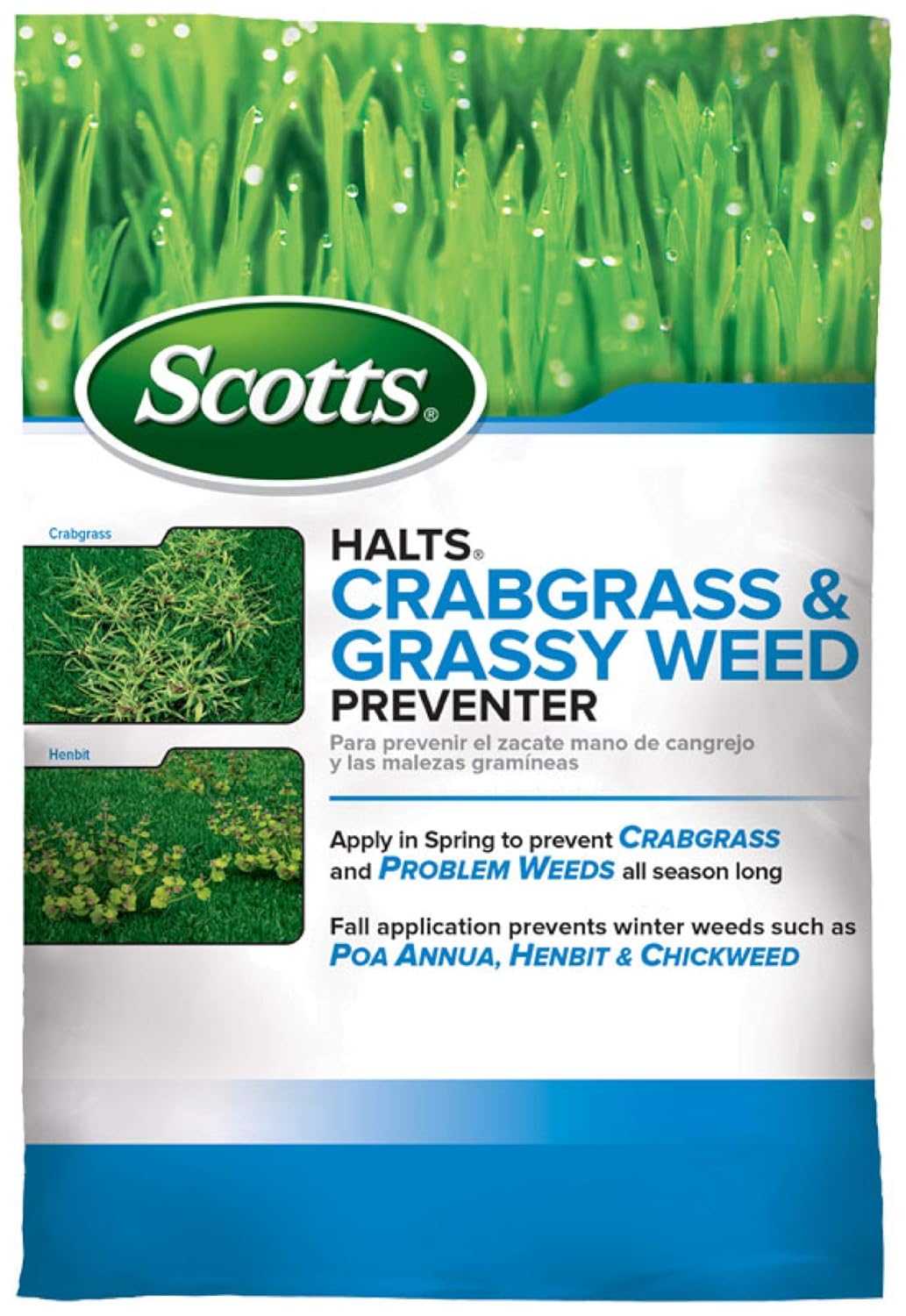
Scotts Halts Crabgrass & Grassy Weed Preventer, 10.06 lb
| Item Form | Granule |
|---|---|
| Coverage | 5000 square_feet |
| Active Ingredients | Pendimethalin 1.71% |
Scotts Halts is a granular pre-emergent designed to stop crabgrass and other grassy weeds from germinating across established lawns. You apply it to a dry lawn with a broadcast spreader, water it in as directed, and it forms a chemical barrier in the soil that prevents seeds such as crabgrass, foxtail, henbit and chickweed from sprouting through the season. It is formulated for all common turf types except Dichondra and Bentgrass and covers up to 5,000 square feet per bag. Notable features include a single active ingredient (pendimethalin 1.71%), weather resistance after application and clear label guidance on timing and overseeding restrictions. Practical benefits are straightforward: simple broadcast application, season-long prevention without repeated weekly treatments, and suitability for typical homeowner lawns. Important limitations are that it does not kill existing mature weeds, must not be used on newly seeded or sprigged lawns for several months, and you should avoid raking or aerifying after use because that disturbs the protective barrier.
Best for: Homeowners who prioritize a low-risk, proven prevention strategy to keep established lawns free of crabgrass and common grassy weeds without ongoing weekly intervention.
Less Ideal for: People renovating lawns, seeding new turf, or needing to remove existing mature weeds should choose seeding-safe options or a post-emergent treatment instead.
- Pre-emergent action prevents crabgrass and several common grassy weeds before they germinate
- Covers up to 5,000 sq ft per bag, suitable for average residential lawns
- Granular form applied with a spreader provides even, controllable coverage
- Resistant to rain, snow, or freezing after application so timing is forgiving
- Clear usage guidance for spring and fall application and reapplication intervals
- Does not control existing or mature weeds so a separate post-emergent may be needed
- Not safe for newly seeded or newly sprigged lawns for several months after application
Verdict: Buy this if you want a straightforward, weather-tolerant pre-emergent that reliably prevents crabgrass across a typical 5,000 sq ft lawn.
Choosing the Right Pre Emergent Crabgrass Killer: Key Factors to Consider
Timing and Local Germination Cues
Pre emergent chemistry prevents seeds from establishing only while the barrier is active, so applying at the right moment is crucial. In many regions you time applications to soil temperatures or phenological cues such as forsythia bloom rather than calendar dates. If you apply too early the active ingredient may degrade before crabgrass seeds germinate; apply too late and the seeds will already have sprouted.
Different products give specific soil temperature ranges and window lengths on the label. Match the timing guidance to your local conditions and err toward slightly later within the recommended window if you are uncertain about soil warmth. For repeat applications, plan around your turf type and the expected length of residual control so you do not leave gaps that allow a late flush of seedlings.
Residual Longevity and Reapplication Needs
Residual longevity determines how long seeded weeds are prevented from germinating and affects whether you need one or multiple applications each season. Longer residual control can reduce follow-up treatments but may interfere with overseeding or early spring planting projects where seed needs to germinate.
Consider your lawn calendar: if you overseed in fall, choose a product whose persistence will not impede desired grass establishment. Also account for local rainfall and irrigation schedules because heavy precipitation can shorten effective duration or necessitate earlier reapplication. Read label guidance on maximum cumulative applications to avoid overuse.
Application Method and Coverage Uniformity
Pre emergents come as granules or liquids/suspensions; each behaves differently during application. Granular products are often easier for homeowners with a broadcast spreader, but spreader settings and multiple passes are critical for even coverage. Liquids give more uniform distribution on tricky slopes or narrow beds but require accurate sprayer calibration.
Uneven coverage creates weak spots where crabgrass can emerge, so choose a delivery form you can apply consistently across your lawn. Think about nozzle type, spreader calibration, and whether you need a handheld sprayer or a push spreader to treat the entire area precisely. Also plan how you will protect adjacent planting beds or ornamentals during application.
Turf Compatibility and Plant Safety
Some pre emergent formulas are safe on a wide range of turf species while others are labeled only for certain grass types. Misapplication or using an off-label product can stress or injure desirable grasses, especially newly established lawns. Confirm label compatibility with cool-season or warm-season turf, and follow any temperature or moisture restrictions outlined.
Consider proximity to flower beds, vegetable patches, and newly sodded or seeded areas. If you expect to seed or transplant within the residual window, select a treatment that allows safe seeding intervals or choose mechanical weed control instead.
Environmental Persistence and Runoff Risk
Manage runoff risk by choosing formulations and application rates that minimize movement off-target. Heavy rain soon after application can reduce efficacy or carry active ingredient into storm drains, streams, or garden beds. Labels will include rainfastness periods and buffer zone recommendations for water bodies.
If your lawn slopes toward aquatic areas or you irrigate frequently, prefer products with lower runoff potential and follow best practices for pre- and post-application watering. Use only the labeled rate and avoid applying before forecast heavy storms to reduce environmental impact.
Ease of Use and Safety Precautions
A product that is theoretically effective is less useful if you cannot apply it safely and accurately. Look for clear label instructions, straightforward calibration tables, and practical safety gear recommendations. Consider how easy the product is to measure, mix, and clean up.
Personal protective equipment needs, re-entry intervals, and recommended handling procedures affect whether a homeowner or a hired service is the better choice. Also check whether the formulation leaves visible residue or requires special disposal steps so you can plan the job accordingly.
When to Apply Based on Your Region
Local climate and soil temperature drive the best timing for pre emergent applications. In cooler climates the ideal window often occurs later in spring when soil reaches the label-specified temperature for crabgrass germination. In warmer regions the window shifts earlier and may even require multiple applications to maintain control through the peak germination period.
Use a soil thermometer to confirm the recommended soil temperature range described on the product label. If you do not have a soil thermometer, use plant phenology as a proxy such as early-blooming shrubs or consistent local extension service advice for your area.
- Measure soil at 1 to 2 inches depth for accuracy
- Apply during dry weather when no heavy rain is forecast for 24 to 48 hours, unless the label specifies otherwise
- Adjust timing for shaded yards, where soils warm more slowly
Preparing Your Lawn Before Application
Mow and remove debris before treatment so granules or spray contact the soil surface. Thatch thicker than a half-inch can interfere with granule contact and should be addressed with dethatching or vertical mowing prior to application.
Water management matters: some products require light watering after application to activate the barrier, while others are rainfast and should not be watered immediately. Read label directions and plan irrigation accordingly to avoid reducing effectiveness.
- Rake or blow leaves and cuttings off treated areas
- Avoid seeding for the interval specified on the label
- Mark treated zones so you avoid disturbing soil until the product has settled
Overseeding, Lawn Repair, and Timing Conflicts
If you plan to overseed or repair bare patches, check the seeding interval on the product label. Many pre emergents prevent desirable grass seed from germinating for weeks to months, forcing a tradeoff between weed prevention and lawn renovation.
In seeded areas consider spot-treating around established turf and holding off broad applications until after new grass has matured. For larger renovation projects, delay pre emergent use until after seedlings are established or choose a product with a shorter residual period.
- Delay overseeding for the label-recommended interval
- Use mechanical control or post-emergent traction on small patches if needed
- Plan major repairs outside the active residual window
Safety Around Garden Beds and Water Features
Protect flower beds, vegetable plots, and water features by creating buffer zones and using shields during application. Avoid broadcasting granules directly onto impervious surfaces where runoff could occur. For sprayer use, point nozzles away from sensitive plants and reduce spray drift on windy days.
If your yard drains to ponds or streams, follow label buffer guidance and avoid treating directly before heavy rains. Consider using targeted edging and hand application near sensitive areas to reduce off-target exposure.
- Establish a no-application buffer around water bodies
- Cover or remove exposed soil in planting beds during treatment
- Clean equipment away from drains and garden beds
Integrating Pre Emergents Into Ongoing Lawn Care
Pre emergents are one component of an integrated lawn program that includes proper mowing, fertilization, and spot control for escaped weeds. Healthy, dense turf is the best long-term defense against crabgrass because it reduces open space for weed seeds to establish.
Coordinate treatments with your fertilization schedule and cultural practices to avoid stressing the lawn. Overreliance on chemical prevention without addressing soil fertility or compaction will limit long-term success.
- Maintain recommended mowing heights for your grass type
- Core aerate compacted lawns to improve turf vigor
- Use spot post-emergent controls only where pre emergents fail to prevent patches
How We Chose the Best Pre Emergent Crabgrass Killer
We prioritized practical, garden-focused criteria that matter when preventing crabgrass before it starts. Timing accuracy and label timing windows were a primary filter because a pre emergent only works if applied at the correct stage of seed germination. Residual control length was essential since longer persistence reduces reapplication frequency but can affect overseeding or spring planting schedules. Application method and spread consistency were judged because granular and liquid products behave differently across uneven turf and slopes. Selectivity and turf safety were evaluated to ensure the material controls grassy weeds without damaging common lawn grasses when used per label. Ease of calibration and application safety were included so typical homeowners can apply the product effectively. Environmental persistence and runoff risk were considered to avoid solutions that pose high non-target impacts. We excluded post-emergent-only products and any formulations lacking clear timing instructions or label turf compatibility. Final selections reflect those that balance residual performance, usable application patterns, and acceptable environmental profiles for typical residential lawn care.
FAQ
Can I apply a pre emergent after I already see crabgrass seedlings?
A pre emergent prevents seed germination and will not control visible seedlings. Once crabgrass has emerged you need a post-emergent control or physical removal. Plan applications so the barrier is active before the typical germination window in your region.
How does rain after application affect performance?
Rain can either help activate a product that requires watering or reduce efficacy if heavy runoff occurs too soon. Follow the label: some formulas need light irrigation to move the chemical into the soil, while others advise waiting to avoid washing the material away.
Is a granular pre emergent better than a liquid?
Neither is universally better; granules are often easier for homeowners with spreaders and work well on level lawns, while liquids can give more even coverage on slopes and narrow areas. Choose the form you can apply accurately and evenly for your yard.
Will pre emergents harm flower beds or vegetable gardens nearby?
Potential harm depends on the product and how carefully you apply it. Many pre emergents are labeled with buffer recommendations and application methods to minimize off-target movement. Keep a safe distance, shield sensitive plants, and avoid drift or runoff into garden beds.
How long after applying can I seed my lawn?
Seeding intervals vary by formulation; some products block germination for several weeks to months. Check the label for the minimum waiting period before overseeding or planting desirable grasses so your new seed can establish successfully.
Can I use a pre emergent on newly sodded turf?
Many pre emergents advise waiting after installation of new sod until roots are established. The label will state appropriate waiting periods and any restrictions to avoid stressing the new sod.
Final Verdict
A successful pre emergent program balances precise timing, appropriate residual length, and careful application to match your lawn goals. Prioritize products that fit your local germination timing, are compatible with your turf type, and you can apply evenly across the landscape. Accept the tradeoffs between long-lasting control and limitations on seeding or planting. When timing, safety, and coverage align with your maintenance schedule, a pre emergent becomes a reliable tool to keep crabgrass from ever getting started.
