

Note: This article contains affiliate links. If you click on these links and make a purchase, I may earn a small commission at no extra cost to you. This helps support my research and content. Read my full affiliate disclosure here.
A push string trimmer is a practical tool for homeowners who want a faster, more controlled way to tidy lawn edges, small patches of tall grass, and tight spots around paths and beds. Choosing the right push-style trimmer matters because weight distribution, head design, and cutting system affect how long you can work without fatigue and how clean your finished edges look. This guide covers seven shortlisted push string trimmers that perform well in typical yard and suburban garden situations. We evaluated machines for cut consistency, ergonomics, and everyday durability so you can pick a trimmer that matches your yard size, vegetation type, and comfort needs. Read on for the factors that shaped our selections and practical advice for using and maintaining these trimmers.
Top Picks at a Glance
| Best Overall The best all-around choice for most situations | Earthquake Walk-Behind String Mower with 160cc Viper 4-Cycle Engine, 22-inch Cut |  |
| Best Quality Built to a higher standard if you want something more solid | EARTHQUAKE Walk-Behind String Mower with 160cc Viper Engine, 22" Cutting Width (Model 47325) |  |
| Best Value The sweet spot between price and what you get | PROYAMA 170cc Walk-Behind String Trimmer Mower (22" Cutting Width) |  |
| Best Budget The cheapest option that still gets the job done reliably | SENIX 22" High-Wheel Gas Walk-Behind Brush Cutter and String Trimmer (160 cc) |  |
| Highest Rated A top-rated pick with lots of positive feedback | YARDMAX YL2250 22 in. 170cc Gas Walk-Behind String Trimmer Mower |  |
| Most Popular A crowd favorite that many people choose with confidence | BILT HARD 22-Inch Walk-Behind 170cc 4-Cycle Gas String Trimmer |  |
| Best Seller A high-volume bestseller chosen again and again | AMERISUN 22-Inch 170cc Walk-Behind String Trimmer |  |
Earthquake Walk-Behind String Mower with 160cc Viper 4-Cycle Engine, 22-inch Cut

| Power Source | Gas Powered |
|---|---|
| Cutting width | 22 inches |
| Maximum Adjustable Cutting Height | 3 inches |
| Minimum Adjustable Cutting Height | 1.5 inches |
| Number of Positions | 5 |
The Earthquake Walk-Behind String Mower is a purpose-built machine for clearing thick grass, brush and tight paths where conventional rotary mowers cannot go. You push the unit along like a small mower while the 160cc Viper four-cycle engine drives a 22-inch string cutting head that accepts 0.155 line. Key usability features include a Grab-N-Go engagement bail that stops the cutting head without killing the engine, wide airless wheels that float over uneven ground, and an adjustable handlebar for operator comfort. The one-piece steel deck and oversized debris deflector help direct clippings away from the operator and let the head reach under low obstacles. Typical use is trimming long grass, reopening overgrown trails, or mowing around fences and trees where a wheeled mower would not fit. Expect easier starting and lower vibration from the 4-cycle engine compared with two-stroke trimmers, but know this is a handheld-string-mower alternative that still requires fuel, regular line replacement, and routine engine maintenance. It is a strong choice when you need a more stable, walk-behind solution for heavy trimming jobs rather than a handheld trimmer.
Best for: Gardeners and property owners who want a stable, walk-behind solution to clear thick grass and brush where a handheld trimmer or standard mower cannot reach and who prioritize reliable gas power and operator comfort.
Less Ideal for: People seeking a lightweight electric or battery tool for small yards or those who prefer near-silent, low-maintenance equipment for frequent light trimming.
- Powerful 160cc four-cycle Viper engine for reliable starting and sustained cutting power
- 22-inch cutting head covers wide swaths and reduces passes compared with handheld units
- Grab-N-Go engagement bail lets you stop the cutting head without restarting the engine
- Extra-wide airless wheels and adjustable handlebar improve balance and reduce operator fatigue
- Requires gasoline and routine engine maintenance unlike electric alternatives
- Cutting height range is limited to 1.5 to 3 inches which may not suit very low-mow finishes
Verdict: Choose this walk-behind string mower when you need reliable gas-powered cutting power and a wider 22-inch clearing path to tackle thick grass and brush where handheld trimmers fall short.
EARTHQUAKE Walk-Behind String Mower with 160cc Viper Engine, 22" Cutting Width (Model 47325)

| Power Source | Gas Powered |
|---|---|
| Cutting width | 22 inches |
| Engine | 160cc 4-cycle Viper |
| Wheel Size | 2.5 inches |
| Number of Positions | 4 |
This Earthquake walk-behind string mower turns handheld trimming tasks into a productive, wheeled operation for overgrown areas and brush. The 160cc Viper 4-cycle engine provides reliable power so the Hurricane cutting head keeps momentum through thick grass without frequent bogging. The cutting head is designed to resist weed wrap and accepts heavier line for tough jobs, while the Grab-N-Go engagement bail lets you stop the head without killing the engine to clear obstacles quickly. Extra-wide airless wheels and an adjustable handlebar improve balance and reduce operator fatigue when pushing across uneven terrain. Tool-less height adjustment from about 1" to 4" and a one-piece long steel deck let you trim under low branches and fences more easily than a handheld trimmer. Expect the machine to be heavier and bulkier than hand tools and best used where a wheeled unit can be pushed; it is not intended for tight, highly landscaped beds or precision edging. Overall this model is built for straightforward, heavy-duty trimming and brush clearing where power and uptime matter most.
Best for: Buyers who need a powered wheeled trimmer to clear overgrown yards, trails, or brush quickly and prefer uptime and cutting power over fine control.
Less Ideal for: Homeowners focused on manicured lawns, narrow beds, or detailed edging should choose a handheld trimmer or a dedicated mower for precision work.
- 160cc 4-cycle Viper engine provides consistent starting and strong torque for thick grass
- Hurricane cutting head resists weed wrap and supports single or multiple line loading for variable cutting power
- Grab-N-Go engagement bail stops the cutting head without shutting off the engine for quick obstacle clearing
- Extra-wide 2.5" x 14.5" airless wheels improve flotation and control on uneven terrain
- Tool-less height adjustment and foldable handlebar make set up and storage simpler
- Bulkier and less maneuverable than handheld trimmers in tight or highly landscaped areas
- Not suited for precision edging or fine-detail lawn work
Verdict: If you need a robust wheeled string trimmer to power through thick grass and brush with minimal stoppages, this Earthquake model delivers dependable power and easy on-the-fly controls.
PROYAMA 170cc Walk-Behind String Trimmer Mower (22" Cutting Width)

| Power Source | Gas Powered |
|---|---|
| Cutting width | 22 inches |
| Speed | 3600 rpm |
This PROYAMA walk-behind string trimmer is built to tackle large areas of overgrowth that handheld trimmers struggle with. The 170cc 4-cycle OHV engine delivers steady power at 3600 rpm and 6.64 ft-lb of torque, while the heavy-gauge 0.155–0.16 inch nylon line and 22-inch cutting path let you clear dense weeds and brush in fewer passes. It is a push-style unit with large 14-inch flat-free rear wheels for stability on uneven ground and an adjustable, foldable handle for easier storage and transport. The 4-cycle design accepts straight fuel so you do not need to mix oil, and the package includes spare line, a side bag, and engine oil to get started. Expect a unit that favors power and coverage over precision edging; it is heavier and less nimble than handheld trimmers and requires routine small-engine maintenance. For large yards and rough patches it speeds work significantly, but it is more machine to store and maintain than simple consumer trimmers.
Best for: Buyers who prioritize efficient clearing of large yards or overgrown fields and want a powerful, walk‑behind alternative to handheld trimmers for saving time and effort.
Less Ideal for: Gardeners with very small lawns, tight beds, or frequent precision edging needs should consider a handheld or dedicated edging tool instead.
- High-power 170cc 4-cycle engine for reliable cutting of thick weeds and brush
- Wide 22-inch cutting width reduces passes on large areas
- Heavy-gauge 0.155–0.16 inch line designed for dense vegetation
- Large 14-inch flat-free rear wheels improve stability on rough terrain
- Foldable handle for more compact storage
- Push-behind format is bulkier and less maneuverable for tight spaces
- Requires regular small-engine maintenance and fuel
- Not suited for fine edging or close trimming near plant beds
Verdict: Choose this PROYAMA if you need a powerful, walk‑behind string trimmer that clears heavy weeds and large areas much faster than handheld models.
SENIX 22" High-Wheel Gas Walk-Behind Brush Cutter and String Trimmer (160 cc)

| Power Source | gasoline-powered |
|---|---|
| Cutting width | 22 inches |
| Size | 22-Inch |
| Recommended Uses For Product | Maintaining large lawns, trimming around edges, clearing brush |
The SENIX walk-behind brush cutter is a high-capacity wheeled string trimmer built to clear heavy weeds, overgrowth, and large lawn edges without pushing a full mower. It uses a 160 cc 4-cycle engine to drive a .155-inch line across a 22-inch cutting swath, so you cover wide passes quickly while the 14-inch rubber wheels smooth movement over uneven ground. Height is adjustable via a five-position steel deck so you can set cut height between about 1.6 and 3 inches, and the ergonomic, fold-down handle makes operation more comfortable and storage simpler. The unit arrives with engine oil and extra line and emphasizes durability with a steel deck and large wheels that resist rough terrain. Expect typical gas-tool maintenance such as fuel management, spark plug and air-filter care, and louder operation than electric alternatives. It is heavier and bulkier than handheld trimmers, so storage space and occasional tuning are required to keep peak performance when used frequently on big yards or brush areas.
Best for: Buyers who need a cost-effective, powerful wheeled trimmer to clear heavy weeds or maintain large yards and who are willing to perform basic gas-engine upkeep.
Less Ideal for: People with small yards, strict noise restrictions, or those who prefer low-maintenance electric or battery tools should consider lighter, quieter options.
- Large 22-inch cutting swath covers wide areas faster than handheld trimmers
- 160 cc 4-cycle engine provides steady power for heavy weeds and brush
- Five-position height adjustment for controllable cutting heights
- 14-inch rubber wheels improve maneuverability on uneven terrain
- Includes engine oil and replacement trimmer line out of the box
- Requires regular gas-engine maintenance and storage considerations
- Louder and heavier than electric or battery-powered alternatives
Verdict: If you want an affordable, gas‑powered wheeled trimmer that clears heavy brush and large areas quickly, this SENIX 22" walk‑behind unit delivers strong cutting power and durability.
YARDMAX YL2250 22 in. 170cc Gas Walk-Behind String Trimmer Mower

| Cutting width | 22 inches |
|---|---|
| Power Source | gasoline-powered |
| Number of Positions | 5 |
| Wheel Size | 14 inches |
The YARDMAX YL2250 is a wheeled, gas-powered string trimmer mower built to cover large areas and reach edges that a regular mower misses. You push it like a lawn mower while the offset head and 22-inch cutting width let you trim close to fences, beds, and structures without awkward angling. It stores extra pre-cut string in an onboard cord caddy and offers tool-free height adjustment across five positions from 1.5 to 3.5 inches, so you can adapt quickly between light touch-ups and heavier cuts. Rugged 14-inch ball-bearing wheels and a one-piece seamless metal deck reduce vibration and help it roll over uneven ground. Because it is gasoline-powered and manually operated, expect louder operation and the usual maintenance for small engines, and it is heavier to move than a battery model. For routine yard maintenance where fuel range and continuous power matter, this unit is a practical, no-frills performer.
Best for: Buyers who want a dependable, gas-powered wheeled trimmer to handle larger yards and frequent edge work with minimal refilling downtime and straightforward controls.
Less Ideal for: People who need a lightweight, quiet, low-maintenance solution for very small yards or who prefer cordless electric tools for zero-emission operation.
- Wide 22-inch cutting width covers more ground per pass than handheld trimmers
- Offset head design helps trim close to fences and landscaping without repositioning
- Onboard cord caddy stores extra pre-cut string for quick replacements
- Tool-free adjustment with five cutting heights from 1.5 to 3.5 inches
- 14-inch ball-bearing wheels and seamless metal deck reduce vibration and improve roll
- Gasoline engine requires regular maintenance and produces noise and emissions
- At over 60 pounds it is heavier to maneuver than battery-powered alternatives
Verdict: A robust gas walk-behind string trimmer mower that lets you trim wide swaths and finish edge work efficiently without frequent recharging.
BILT HARD 22-Inch Walk-Behind 170cc 4-Cycle Gas String Trimmer
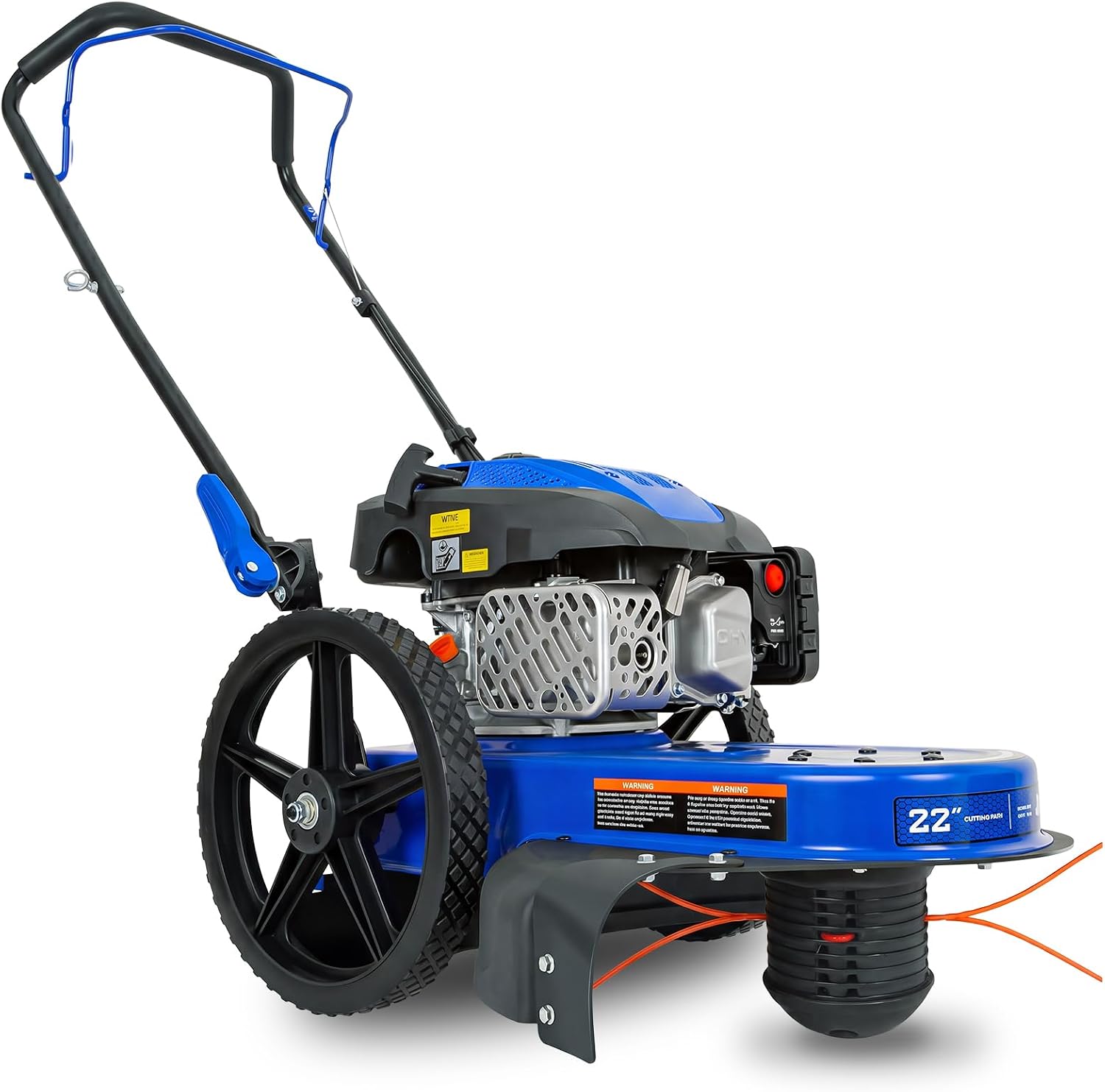
| Power Source | Gasoline-Powered |
|---|---|
| Cutting width | 22 inches |
| Wheel Size | 14 inches |
| Material Type | Alloy Steel |
| Operation Mode | Manual |
This BILT HARD walk-behind string trimmer is designed to clear heavy grass and weeds where a standard mower or handheld trimmer struggles. It uses a 170cc 4-cycle OHV engine with a manual recoil start to power a heavy-duty nylon line across a 22-inch cutting width, and a one-piece steel deck improves strength and reduces vibration while you work. Large 14-inch flat-free wheels make it easier to push over uneven ground and the foldable ergonomic handle helps with control and compact storage. Typical uses include edging along fences, clearing overgrown patches, and cutting through dense, tall grass or light brush around obstacles. Important limitations are the manual start and small 0.2 gallon fuel tank, which mean occasional refueling and some effort starting compared with electric or e-start models, and regular engine maintenance is required. For buyers who want a robust gas-powered solution for heavy trimming, this machine delivers straightforward performance without complex electronics.
Best for: A buyer who prefers a straightforward, durable gas-powered tool for heavy-duty backyard trimming and values reliability over advanced features. Good for homeowners who want a machine that tackles thick grass and tight spots where a lawn mower cannot reach.
Less Ideal for: Not the best choice for users who prioritize low-noise, zero-emissions operation or who need electric push-button starting; consider electric or e-start gas models instead.
- Powerful 170cc 4-cycle OHV engine for cutting dense grass and weeds
- 22-inch cutting width covers wide swaths and reduces passes
- One-piece steel deck increases durability and reduces vibration
- 14-inch flat-free wheels improve maneuverability on uneven terrain
- Foldable ergonomic handle for improved control and compact storage
- Manual recoil start requires physical effort and may be harder for some users
- Small 0.2 gallon fuel tank means more frequent refueling during long jobs
Verdict: Buy this if you want a no-frills, heavy-duty gas walk-behind trimmer that reliably clears thick grass and overgrown areas.
AMERISUN 22-Inch 170cc Walk-Behind String Trimmer

| Power Source | Gas Powered |
|---|---|
| Cutting width | 22 inches |
The AMERISUN walk-behind string trimmer is built for clearing tall grass, thick weeds, and brush across larger yards and rough terrain. It uses a 170cc 4-stroke OHV engine so you do not need to mix oil and gas, and the 22-inch cutting path covers more ground per pass than handheld trimmers. Large 14-inch wheels and an offset trimmer head make it easier to maneuver over uneven ground and trim close to fences or trees. The handle folds for compact storage and the cutting height adjusts from about 1.9 to 4.0 inches for different vegetation heights. Practical benefits include faster work on fence lines, trails, and fields and reduced fatigue from the wheeled design. Important limitations are typical for gas units: it requires regular maintenance and fuel, it is heavier than handheld models, and it may be more than needed for small, tidy lawns. For buyers seeking a reliable, non-electric machine for heavy-duty trimming this is a sensible, straightforward choice.
Best for: Buyers who prioritize reliable gas power and want a wheeled trimmer to clear large or overgrown areas with minimal fuss and straightforward operation.
Less Ideal for: If you only maintain a small tidy lawn, prefer low-maintenance electric tools, or need a lightweight handheld unit for tight spaces, choose a different trimmer.
- 170cc 4-stroke OHV engine avoids fuel-oil mixing and delivers steady power for thick vegetation
- 22-inch cutting width covers more ground per pass for faster trimming of large areas
- 14-inch high wheels improve mobility and stability on rough or uneven terrain
- Offset trimmer head and adjustable cutting height allow precise trimming along edges and different plant heights
- Foldable handle simplifies storage and transport
- Heavier and bulkier than handheld or electric trimmers, making it less convenient for small yards
- Requires regular gas engine maintenance and fuel handling
- May be overpowered for light trimming or very small, well-kept lawns
Verdict: Choose this walk-behind trimmer if you need a no-nonsense, gas-powered machine that clears large, overgrown areas faster than handheld models.
Choosing the Right Push String Trimmer: Key Factors to Consider
Cut Consistency and Line Capacity
How consistently a trimmer slices through grass and weeds determines how much time you spend retracing work. A head that feeds line smoothly and keeps a steady diameter during use gives even cuts and fewer missed patches. For yards with mixed vegetation you want a system that accepts slightly thicker line or variable-diameter options so the trimmer can handle both fine turf and tougher stems.
Line capacity also matters because a larger spool or easier reloading reduces downtime. Consider how often you will need to replace or refill line based on yard size and typical task length. Spools that are easy to open and feed without specialty tools are a real convenience for routine maintenance.
Ergonomics and User Comfort
Push trimmers are often used standing up and moving along borders, so handle shape, shaft length, and weight distribution affect how long you can work before fatigue sets in. A cushioned, angled handle that allows a natural wrist position will reduce strain over extended sessions. Adjustable shafts and handle positions let multiple household members find a comfortable reach.
Vibration damping is another ergonomic factor. Excessive vibration transfers into the hands and arms and becomes uncomfortable quickly. Evaluate mounts and handle materials that absorb vibration to maintain control and comfort for longer edging tasks.
Balance and Maneuverability
Good balance helps you guide the cutting head smoothly along edges, around posts, and through narrow gaps. A trimmer that feels head-heavy or rear-heavy will bump and require constant compensation, which slows work and increases effort. Consider the center of gravity when the tool is powered and when it is idle.
Maneuverability also includes how easily the head tilts for vertical edging, whether the shaft allows for close-to-ground angles, and how compact the unit is for working near fences, planters, and garden ornaments. Lighter units are easier to pivot, but too-light tools may lack the momentum to power through denser stems.
Head Design and Line Reloading Ease
The cutting head is the part you interact with most. Bump-feed heads, quick-change spools, and tap-to-advance systems each have tradeoffs in reliability and simplicity. Bump-feed designs can be fast to use but sometimes tangle; quick-change cartridges reduce mess and are easier for gardeners who reload frequently.
Also consider what line diameters the head accepts. A head that allows thicker line options will chew through coarse weeds while still letting you choose thinner line for delicate turf. Tool-free access to the spool and clear instructions for winding line will save time and frustration during regular maintenance.
Durability and Component Materials
Outdoor power tools see dust, moisture, and knocks. Shafts, gearbox housings, and head attachments should be made of materials that resist bending and corrosion. Metal gear housings and reinforced shafts tend to last longer than thin plastics in regular backyard use.
Check seals around moving parts and the quality of fasteners and guard mounts. Replaceable wear parts such as guards and drive components extend a trimmer's service life and make repairs simpler when damage does occur. Durability also ties into long-term value: a unit that lasts several seasons with normal upkeep reduces waste and repair time.
Power Source and Maintenance Needs
Push string trimmers come in multiple power-source styles, and your choice affects daily maintenance and long-term convenience. Electric corded models offer consistent power with minimal maintenance but require access to extension cords. Battery-powered options free you from cords but require battery care, charging cycles, and occasionally replacing cells after years of use.
Maintenance needs differ across types. Corded and battery electric trimmers generally need only head and guard upkeep. Gas models require fuel and engine maintenance and were excluded from our shortlist for small-homeowner use. Consider how much time you want to spend on upkeep when choosing a model.
Best Uses by Yard Size and Vegetation
Different push string trimmers suit different yard sizes and plant types. For small suburban yards with mostly turf, a lighter, lower-power trimmer that prioritizes maneuverability and fine-diameter line is often best. For medium yards with flower beds and mixed weeds, choose a trimmer with a balance of power and head capacity so it can handle both edging and occasional brushier spots. For yards with dense growth or frequent tough stems, seek a head that accepts thicker line or a sturdier spool system to avoid frequent reloads.
- Small city yards: prioritize weight, trimming finesse, and easy storage.
- Medium suburban yards: seek balanced power and comfortable ergonomics for longer sessions.
- Overgrown patches: choose heads that accept thicker line and robust gear housings.
Tips for Clean Edging and Efficient Passes
The technique matters as much as the tool. Keep a slight forward motion and let the cutting line do the work rather than forcing the head through stems. For straight edges, use a steady pace and a consistent angle so you do not scalp turf or leave uneven strips. When working around borders or planters, make short, controlled passes and avoid angling the head too steeply, which can damage edging and root crowns.
- Set a consistent walking speed to match line feed and cut rate.
- Overlap passes slightly to avoid missed strips.
- Trim when grass is dry for cleaner cuts and less clogging.
Maintenance Schedule and Simple Repairs
Regular maintenance keeps a push trimmer reliable. Inspect the guard, spool, and fasteners after every few uses. Clean debris from the head and gearbox area to prevent line buildup. Replace line before it becomes brittle and inspect the guard and handle mounts for cracking or loosened bolts. Simple repairs such as replacing a spool, tightening the shaft clamp, or switching a worn guard are usually straightforward and extend the tool's usable life. Keep a small kit of common replacement parts and the correct spool or line diameter on hand for quick field fixes.
- Check and clean the head after each use.
- Store battery packs separately and keep them charged according to manufacturer guidelines.
- Tighten fasteners and check guards monthly during heavy-use seasons.
Safety Practices for Routine Trimming
Wear eye and ear protection and close-toed shoes when operating a push string trimmer. Clear the work area of rocks, sticks, and other debris that can become projectiles. Maintain a safe distance from bystanders and pets and shut the trimmer off when moving across gravel drives or stepping over obstacles. Use the guard as intended and replace it if damaged. Follow safe line-reloading procedures to avoid cuts and keep hands away from the cutting area when the trimmer is powered. Regularly inspect the switch and wiring or battery compartment for signs of wear before each use.
- Wear protective eyewear and hearing protection.
- Clear work area of debris before starting.
- Turn off power before servicing the head.
Storing and Preparing for Off-Season
Proper storage extends the life of any push trimmer. For battery models, store cells in a cool, dry place at the recommended charge level. For corded units, coil cords neatly to avoid kinks. Clean the cutting head and remove excess grass build-up before storing to prevent corrosion and line degradation. If you go months between uses, check the spool, guard, and fasteners before the first run of the season. Lubricate moving joints as recommended and replace any brittle line. Make a short test run in a spare area to confirm proper feed and balance before working in the main garden.
- Store batteries at recommended charge in a cool place.
- Clean and dry the head before long-term storage.
- Run a short test before seasonal use to check operation.
How We Chose the Best Push String Trimmer
We focused on real-world gardener needs when narrowing candidates for this list. Primary evaluation criteria included cutting effectiveness on common garden vegetation, ergonomics and user comfort during extended use, overall balance and maneuverability in tight spaces, and head and line systems that affect run time between reloads. For cutting effectiveness we looked for consistent line feed and the ability to handle both thin turf and thicker weeds without bogging down. Ergonomics covered handle shape, shaft reach, and vibration control to limit fatigue. Balance and maneuverability assessed weight distribution and ease of pivoting around beds, fences, and walkways. Head and line systems considered how simple it is to replace or advance line, compatibility with different line diameters, and how often you need to service the head. We excluded gas two-stroke heavy-duty brushcutters and multi-tool power heads that require add-on attachments because they suit larger properties or pros rather than the typical homeowner. We also filtered out models with clearly inadequate safety features or poor line-advance designs. The result is a set of push string trimmers that meet practical home garden workflows while scoring well on the concrete dimensions gardeners care about.
FAQ
How often should I replace the trimmer line?
Often it depends on how much you use the tool and the vegetation you cut. For regular suburban mowing and edging, inspect and replace line every few weeks of heavy use. Replace sooner if the line becomes brittle or frays frequently, or if you notice reduced cutting performance.
Can I use thicker line for tougher weeds?
Usually yes if the trimmer head accepts thicker diameters. Check the head specifications and choose a line size the spool supports. Thicker line improves durability on coarse stems but may need a more powerful motor to maintain cutting speed.
Is a corded model better than battery for a small yard?
It depends on your priorities. Corded trimmers provide continuous power and minimal maintenance, which is convenient for very small yards near an outlet. Battery models give freedom of movement and are typically fine for small to medium yards if you have adequate battery capacity.
How can I reduce vibration while trimming?
Choose a trimmer with vibration-damping handle mounts and maintain the cutting head to prevent imbalances. Keep line spools evenly wound and replace worn heads or spools. Shortening session length or alternating hands can also reduce fatigue from vibration.
What maintenance will prolong the gearbox life?
Keep the gearbox and head area clean of grass and grit and avoid striking hard objects that can damage gears. Inspect seals and fasteners regularly and replace any worn components. If the gearbox is exposed to moisture, dry it after use to discourage corrosion.
Final Verdict
Selecting the right push string trimmer means balancing cutting needs, comfort, and maintenance expectations. Prioritize cut consistency and head design if you have mixed vegetation, and favor ergonomics and balance if you often work longer edging runs. Consider power source and maintenance time when settling on a model so the tool matches your routine and storage conditions. Ultimately, choose the trimmer that aligns with the yard size and vegetation you face, and plan for regular simple maintenance to keep the tool effective season after season. With the right balance of features you can reduce fatigue and get cleaner edges with less effort.
