

Note: This article contains affiliate links. If you click on these links and make a purchase, I may earn a small commission at no extra cost to you. This helps support my research and content. Read my full affiliate disclosure here.
A Ranch Chainsaw is a cornerstone tool on working acreage. Whether you are clearing fence lines, bucking firewood, or limbing trees near pastures, the right chainsaw reduces fatigue and keeps projects moving reliably. This guide gathers the top shortlisted options suited to ranch conditions and explains the practical tradeoffs you should weigh. We focus on cutting power, engine or battery runtime, durability under repeated use, and ease of maintenance to help you pick a saw that fits your workload and skill level. Below you will find the top five ranch chainsaws we considered, along with the evaluation criteria used and buying factors to help you match a saw to your typical ranch tasks.
Top Picks at a Glance
| Best Overall The best all-around choice for most situations | Husqvarna 450 Rancher 20" Gas Chainsaw |  |
| Best Quality Built to a higher standard if you want something more solid | Husqvarna 555 Professional Gas Chainsaw, 24-inch Bar |  |
| Best Value The sweet spot between price and what you get | EGO POWER+ 20" Cordless Chainsaw with 6.0Ah Battery and Charger (CS2005) |  |
| Highest Rated A top-rated pick with lots of positive feedback | Milwaukee M18 FUEL 16 in. Cordless Chainsaw (Tool Only) |  |
| Most Popular A crowd favorite that many people choose with confidence | Husqvarna 460 Rancher 24-Inch Gas Chainsaw |  |
Husqvarna 450 Rancher 20" Gas Chainsaw

| Power Source | Gas Powered |
|---|---|
| Chain Length | 20 inches |
| Included Components | Chainsaw, Bar &Chain |
| Manufacturer Warranty Description | 2 Year Warranty |
The Husqvarna 450 Rancher is a workhorse 20-inch gas chainsaw built for homeowners and light pros who need a reliably powerful saw. Its 50.2-cc X-Torq two-stroke engine produces strong cutting power while reducing emissions and improving fuel efficiency, and features such as Smart Start and air purge make starting and routine use straightforward. LowVib anti-vibration design, an ergonomic rear handle with soft inlay, and an inertia-activated chain brake improve comfort and control during extended cutting sessions. The centrifugal Air Injection system helps keep the air filter cleaner for longer, reducing maintenance frequency. It comes with bar and chain and supports standard 18–20 inch bars, so swapping or replacing cutting parts is simple. Expect typical gas-saw maintenance: fuel mixing, periodic filter and spark plug checks, and more vibration and noise than electric alternatives. Its weight and gas engine complexity make it less convenient for casual users who prefer low-maintenance or quieter tools, but for balanced buyers wanting power, durability, and professional features, it is a capable all-rounder.
Best for: For buyers who want a durable, powerful 20-inch chainsaw that balances professional features with homeowner usability for regular pruning, storm cleanup, and firewood cutting.
Less Ideal for: Not a great fit for users who need a near-silent, low-maintenance saw for occasional light yard tasks or who prefer cordless convenience.
- Robust 50.2-cc X-Torq engine delivers strong cutting performance for firewood and tree work
- Smart Start and air purge make starting easier and reduce fuss during use
- LowVib and ergonomic rear handle improve comfort for longer jobs
- Air Injection centrifugal system reduces debris reaching the air filter, extending service intervals
- Compatible with standard 18–20 inch bars and chains for easy parts replacement
- Requires regular gas/oil mixing and routine two-stroke maintenance typical of gas chainsaws
- Heavier and louder than battery or corded electric alternatives
Verdict: Choose the Husqvarna 450 Rancher if you need a powerful, dependable 20-inch gas chainsaw that balances pro-level features with everyday usability.
Husqvarna 555 Professional Gas Chainsaw, 24-inch Bar

| Power Source | Gas Powered |
|---|---|
| Horsepower | 4.16 hp |
| Engine Displacement | 59.8 CC |
| Chain Length | 24 inches |
| Sound Level | 106 dBA |
The Husqvarna 555 is built for demanding cutting work like felling small to midsize trees, limbing, bucking, and cutting firewood. It pairs a 59.8 cc, 4.16 HP X-Torq engine with a 24-inch recommended bar and an X-Cut chain to deliver strong, consistent cutting power and efficient fuel use. Features such as Smart Start, side-mounted chain tensioning, Air Injection pre-cleaning, AutoTune carburetor, and an adjustable chain oiler reduce downtime and keep performance stable across different conditions. The slim body and anti-vibration system make long tasks easier to handle, while the inertia-activated chain brake helps reduce kickback risk. Expect professional-level durability from the magnesium crankcase and three-piece crankshaft, but note that this is a loud, gas-powered machine and it requires regular fuel, oil mixing, and basic maintenance. At its size and power it is less suitable for casual yard trimming or users seeking an electric or low-noise option.
Best for: Experienced users, landscapers, and pros who prioritize raw cutting performance and durability for heavy felling, bucking, and firewood processing in outdoor settings.
Less Ideal for: Casual homeowners who need a low-noise, low-maintenance tool or users who prefer cordless or electric models for small yard tasks.
- High power output from a 59.8 cc X-Torq engine for demanding cutting tasks
- 24-inch bar and X-Cut chain for extended reach and efficient cutting
- AutoTune and Air Injection systems for consistent performance and reduced air filter maintenance
- Smart Start and side-mounted tensioning for easier startup and quick chain adjustments
- Loud 106 dBA sound level makes hearing protection essential and limits use in noise-sensitive areas
- Requires regular two-stroke fuel/oil mixing and routine maintenance common to gas chainsaws
Verdict: Buy this if you need a professional, high-power gas chainsaw that delivers reliable cutting performance for heavy-duty timber work.
EGO POWER+ 20" Cordless Chainsaw with 6.0Ah Battery and Charger (CS2005)
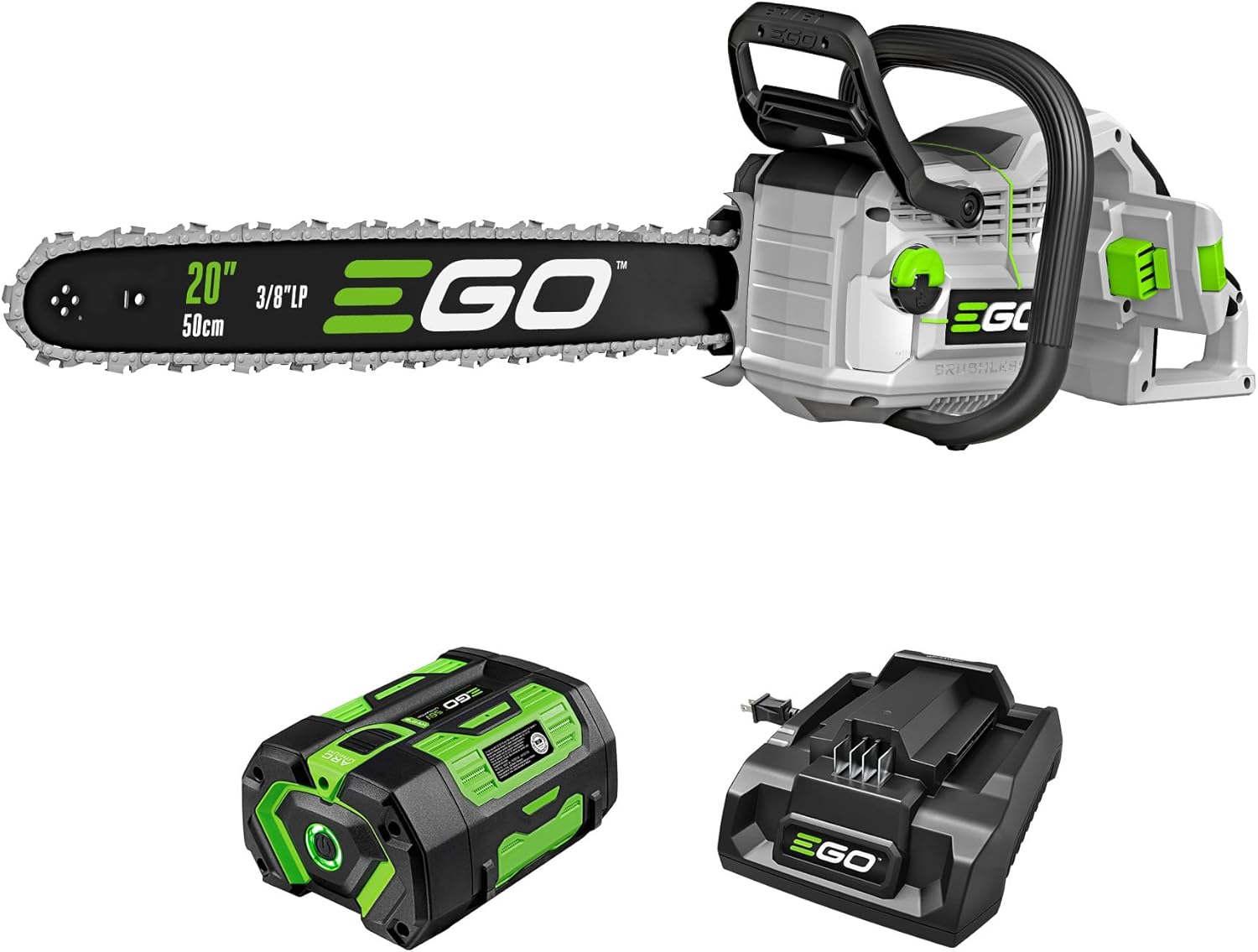
| Power Source | Battery Powered |
|---|---|
| Horsepower | 2 hp |
| Chain Length | 20 inches |
The EGO POWER+ 20" cordless chainsaw is designed to replace a mid-size gas saw for homeowners who need serious cutting power without fumes or extra maintenance. It uses a brushless motor and the included 56V 6.0Ah ARC Lithium battery to deliver the maker's claimed gas-equivalent performance and chain speeds up to 25 m/s, making it suited for cutting large branches, felling medium trees, and breaking down stumps. Practical features include a digital display with speed modes and battery level, an omnidirectional auto chain brake plus kickback protection, automatic oiling, tool-free tensioning on similar models in the lineup, and a bright front LED for low-light work. The cordless design greatly reduces noise and vibration compared with gas, and the stated run times (up to 135 cuts on 6×6 lumber with the included battery) are competitive for property maintenance tasks. Important trade-offs are battery-powered run time limits for extended professional jobs and a heavier overall unit compared with some lighter cordless options, so plan for battery rotation if you expect long cutting sessions.
Best for: Buyers who want a 20-inch saw that balances near-gas power with quieter, low-maintenance cordless operation for regular property and acreage work.
Less Ideal for: Professional arborists or crews who need uninterrupted multi-hour operation without battery swaps should consider a gas saw or a system with multiple high-capacity batteries.
- Brushless motor with performance comparable to a 55cc gas chainsaw for powerful, efficient cutting
- Includes 56V 6.0Ah ARC Lithium battery and charger for immediate use and long run per charge
- 20-inch bar and full chisel tooth chain suitable for large branches, stumps, and medium trees
- Digital display with speed modes and battery status plus LED work light for visibility
- Automatic chain oiling and omnidirectional chain brake improve ease of use and safety
- Battery run time can limit continuous heavy-duty use compared with gas saws
- Overall unit weight is on the heavier side for a cordless chainsaw class
Verdict: If you want a 20-inch chainsaw that delivers near-gas power with cordless convenience and an included 6.0Ah battery, this EGO model is a top all-round choice.
Milwaukee M18 FUEL 16 in. Cordless Chainsaw (Tool Only)
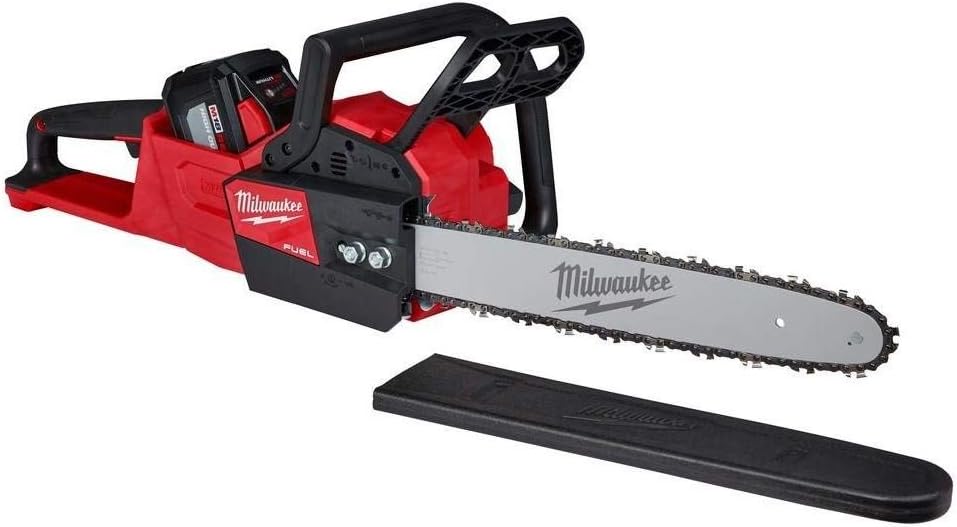
| Power Source | Battery Powered |
|---|---|
| Horsepower | 5.3 hp |
| Chain Length | 16 inches |
The Milwaukee M18 FUEL 16 in. cordless chainsaw is a tool-focused model that brings high power and convenient cordless operation to homeowner cutting tasks. It uses the M18 battery platform (battery and charger sold separately) and is built around a 16-inch Oregon bar and chain with an automatic oiler and variable speed trigger so you can control cut speed for different wood types. In practice this saw handles hardwood and mid-size logs quickly and is reported to deliver many cuts per charge with higher-capacity M18 packs. Notable features include the brushless FUEL motor for stronger acceleration and reduced maintenance compared with brushed motors, and a compact build that makes limbing and pruning easier in tight spaces. Important limitations are that the battery and charger are not included so you must already own or purchase compatible M18 batteries to realize the reliability benefits, and run time depends heavily on battery capacity. For homeowners who want near-professional cutting performance without gas fuss, this is a dependable cordless option when paired with a robust M18 battery.
Best for: Homeowners who prioritize a reliable, high-performance cordless saw and either already own M18 batteries or are prepared to invest in them for consistent, gas-free cutting around the yard.
Less Ideal for: Casual users who want an all-in-one package with battery and charger included or people needing very long continuous cutting sessions without spare batteries.
- Powerful brushless motor claims faster cuts than gas models for efficient work
- Automatic oiler maintains chain lubrication for consistent cutting performance
- Variable speed trigger gives precise control for pruning or larger cuts
- Compatible with the M18 battery ecosystem so higher-capacity packs boost runtime
- Battery and charger are not included so additional purchase is required
- Run time and cutting output depend on which M18 battery you use
Verdict: Choose this Milwaukee M18 FUEL 16 in. cordless chainsaw if you want near-professional cordless cutting performance and already use or plan to buy M18 batteries for dependable, gas-free operation.
Husqvarna 460 Rancher 24-Inch Gas Chainsaw

| Power Source | Gas Powered |
|---|---|
| Horsepower | 3.6 |
| Chain Length | 24 inches |
The Husqvarna 460 Rancher is a workhorse 24-inch gas chainsaw designed for heavy cutting jobs like felling medium to large trees and preparing firewood on acreage. It uses a 60.3-cc, 3.6-HP X-Torq two-stroke engine with Smart Start for easier ignition and an Air Injection centrifugal system that helps keep the air filter cleaner for longer service intervals. Ergonomic touches such as LowVib anti-vibration, a 7-degree offset front handle, side-mounted chain tensioning and an inertia-activated chain brake make long sessions more manageable and adjustments quicker in the field. Practical benefits include strong cutting power at low RPM, replaceable bar and chain, and an adjustable oil pump for proper lubrication during heavy use. Expect typical gas-saw care needs such as fuel mixing, periodic filter and spark plug maintenance, and the added noise and emissions of a gas engine. This is a substantial saw that performs well for owners who need sustained power and durability rather than a lightweight occasional-use option.
Best for: Landowners, small farm operators, and homeowners with extensive woodcutting needs who want a durable, high‑power saw for sustained felling and firewood preparation.
Less Ideal for: Casual users with light pruning or occasional cutting needs and those who prefer low-noise, low-maintenance electric or battery options.
- High power 60.3-cc X-Torq engine delivers strong cutting performance for large logs
- Smart Start and combined choke/stop control make starting quicker and reduce flooding
- Air Injection centrifugal system helps extend air filter life under dusty conditions
- Ergonomic design with LowVib technology and offset front handle reduces user fatigue
- Gas engine requires fuel mixing and regular maintenance compared with battery models
- Large 24-inch bar makes the saw heavier and less maneuverable for tight or overhead work
Verdict: Choose the 460 Rancher if you need a powerful, durable gas chainsaw built to handle large logs and sustained heavy-duty cutting.
Choosing the Right Ranch Chainsaw: Key Factors to Consider
Engine Type and Power
Engine displacement or motor power directly affects how a chainsaw performs on large logs and dense wood. Higher displacement two-stroke engines and higher-voltage brushless electric motors deliver more torque for starting cuts and maintaining speed under load. On a ranch you will often face stubborn knots and wet wood, so prioritize power ratings that match the diameter of timber you routinely process.
Power also ties into maintenance and fuel needs. Gas engines require regular fuel mixing, spark plug care, and carburetor attention, while electric models trade field refueling for battery management and charging logistics. Consider how often you can recharge batteries or refuel on the ranch when choosing between engine types.
Runtime and Refuel Logistics
How long a saw runs between refuels or recharges dictates workflow on a ranch. Long runtime reduces stoppages during fence clearing, storm cleanup, or firewood processing. Gas models let you carry spare fuel for quick swaps, while battery saws need spare batteries or access to charging. Think about whether you work near buildings with power or far out on pasture where quick refueling is easier than recharging.
Also consider how fuel efficiency changes under load. A high-power saw that chews fuel quickly may be less practical than a slightly lower-power model with much better runtime if you frequently need all-day operation without resupply.
Bar and Chain Durability
Bar quality, chain grade, and tensioning systems affect lifespan and cutting consistency. Thicker, hardened bars resist bending and wear when dragging across ground or cutting through dirt-dirtied wood. Chains with robust cutters and good heat treatment retain sharpness longer and reduce filing frequency. For ranch use where chains may hit soil, rocks, or abrasive bark, prioritize features that make field sharpening and replacement straightforward.
A saw with easy-access chain tensioning and a spare-chain storage option saves time in the field. Think about how often you sharpen and whether you can bring sharpening tools with you during longer jobs.
Serviceability and Parts Availability
On a ranch, downtime is costly. Choose saws with straightforward service procedures and wide availability of replacement parts like spark plugs, bars, chains, air filters, and starter assemblies. Models that allow basic repairs in the field with common hand tools are preferable. Consider whether local dealers, small engine shops, or regional suppliers stock consumables and common wear parts.
Also assess how easy routine maintenance tasks are: cleaning the air intake, adjusting the carburetor, replacing the chain, and accessing the fuel and oil systems. Simpler service routines mean less time off the job and longer productive life for the saw.
Comfort and Vibration Control
Operator comfort matters for long cutting days. Anti-vibration systems, ergonomic handle placement, and balanced weight distribution reduce fatigue and improve control. Lighter saws are easier to maneuver for overhead or limbing work, but too light a saw may lack the mass needed to steady longer bars. Balance this with power: a well-balanced midweight saw with good vibration damping can be more productive overall than a heavier, more powerful tool that fatigues the operator.
Also consider throttle responsiveness, grip materials, and handle spacing for gloved hands. Comfortable controls lower the risk of mistakes during repetitive tasks.
Safety Features and Ease of Use
Reliable safety systems are essential when working around livestock, fences, and uneven ground. Effective chain brakes, low-kickback chain options, good hand guards, and visible inertia-activated stops protect operators during sudden binds or kickback events. Easy-to-reach stop switches and an intuitive starter system reduce fumbling during emergency stops.
Ease-of-use features such as tool-free chain tensioning, transparent fuel or oil windows, and accessible air filters keep routine tasks from becoming time-consuming, which matters when you are juggling multiple jobs on a ranch.
Choosing the Right Bar Length for Ranch Work
Bar length determines cut capacity and saw handling. Shorter bars under 18 inches are quicker for limbing and close-in tasks around fences, while longer bars up to 24 inches or more let you cut through large-diameter logs without multiple passes. On a ranch, a practical compromise is a mid-length bar that lets you tackle bigger rounds without making the saw unwieldy.
If you routinely process large fallen trees, prioritize a longer bar and a powerplant that can keep the chain under load. For frequent one-handed or elevated cuts, choose a shorter bar with a lighter overall saw to reduce strain and increase control.
- Short bars: better maneuverability, lighter weight
- Mid-length bars: versatile for logs and limbing
- Long bars: needed for large rounds, require more power
Field Maintenance Tips for Longer Service Life
Regular maintenance extends uptime and reduces unexpected failures. Carry a compact sharpening kit, spare chains, and a basic multi-tool to adjust tension, tighten bar nuts, and clear debris. Clean the intake and cooling fins after dusty tasks and inspect the bar rails for gouges that can affect chain tracking.
Keep a small supply of appropriate bar oil and fuel mixes in sealed containers. Simple habits like checking chain tension before each start and sharpening the chain at the first sign of dulling will prevent excessive wear and make cuts safer and faster.
- Sharpen chain at first dull sign to avoid overloading the engine
- Check and adjust chain tension before each job
- Clean air intake and cooling fins after dusty or muddy work
Battery Versus Gas for Remote Ranch Tasks
Battery saws offer quieter operation, less routine mechanical maintenance, and instant starting without choke adjustments. They are attractive for ranch chores near livestock or buildings where noise matters. However, battery runtime and the practicality of carrying spare batteries are critical considerations if you work far from power.
Gas saws remain the default for extended remote operation because you can carry extra fuel and keep working as long as needed. They demand more mechanical familiarity for tuning and maintenance but typically provide the consistent power needed for heavy, continuous cutting.
- Battery saws: quiet, low vibration, need spare batteries
- Gas saws: longer continuous runtime with fuel, require more maintenance
- Consider hybrid workflows: battery for light tasks, gas for heavy or remote work
Transporting and Storing a Ranch Chainsaw
Safe transport and proper storage protect both the saw and the operator. Use a lockable toolbox or dedicated saw case to prevent damage to the bar and chain and to keep fuel or batteries secure. When transporting on trailers, secure the saw flat or in a cradle to avoid impacts to the chain and bar tip.
For storage, drain fuel or use a fuel stabilizer to avoid gum-up over months of inactivity. Keep chain oil topped up and protect the bar with a scabbard. Regularly inspect stored equipment for pests and moisture that can accelerate corrosion.
- Use scabbards or cases to protect the bar and chain
- Secure saws to prevent shifting during transport
- Drain or stabilize fuel for long-term storage
Accessories That Make Ranch Life Easier
A small set of accessories increases field efficiency. Carry a compact chainsaw file and depth gauge to keep chains cutting sharply. A spare chain and spare battery or a lightweight fuel can reduce downtime. A dedicated log jack or cant hook eases positioning heavy rounds for stable cutting.
Personal protective equipment is also an accessory you cannot skip. A comfortable helmet with a face shield, chaps rated for chainsaw use, and hearing protection improve safety and let you work longer with confidence.
- Carry spare chain and sharpening tools
- Keep a log jack or cant hook for safer cuts
- Always use helmet, face shield, chaps, and hearing protection
How We Chose the Best Ranch Chainsaw
We selected ranch chainsaws using criteria that reflect heavy outdoor work and frequent use. Key evaluation dimensions included sustained cutting power and torque for handling large-diameter logs and dense hardwood, runtime or fuel economy to keep work moving without long interruptions, and durability of the bar, chain, and drive components for repeated operation in rough conditions. We also prioritized ease of maintenance and serviceability since ranch tools need quick field repairs, plus operator comfort and anti-vibration features to reduce fatigue during long jobs. Safety features such as chain brake responsiveness and effective chain catchers were required for inclusion. Excluded items included lightweight hobbyist models and small homeowner saws that lack the power or construction to tolerate ranch workloads. We filtered out saws with poor access to replacement parts or limited dealer/service support histories. The remaining selections were assessed on the concrete dimensions above and on real-world usability details that matter on a working ranch.
FAQ
What bar length should I keep on a ranch chainsaw?
Bar length depends on the largest logs you plan to cut. Mid-length bars offer the best balance for general ranch tasks, while longer bars are useful if you routinely handle very large-diameter timber. Choose a length that your saw power can handle without bogging down.
How often should I sharpen the chain during heavy use?
Often. Sharpen at the first sign of decreased cutting speed or more frequent kickback. Frequent light sharpening keeps the chain safer and reduces strain on the engine compared with letting it become very dull.
Are battery chainsaws practical for remote pasture work?
They can be practical for short to moderate tasks near buildings or with spare batteries. For extended remote work without access to charging, gas models are usually more practical because you can carry spare fuel.
What maintenance should I do after cutting dirty or buried wood?
Clean the bar rails, remove debris from the sprocket and chain area, inspect the chain for nicks, and sharpen if needed. Check the air intake and cooling fins for clogging and service the air filter promptly to prevent engine damage.
How important is vibration reduction on a ranch chainsaw?
Very important for long shifts. Reduced vibration lowers fatigue and improves control, which decreases the chance of mistakes. Look for anti-vibration mounts and well-balanced designs if you expect to use the saw frequently.
Final Verdict
Prioritize the capabilities that match the scale and remoteness of your ranch tasks. Focus on a powerplant and bar length that can handle the largest logs you expect to process, paired with solid durability and accessible service parts. Consider runtime logistics and operator comfort as equally important tradeoffs: a powerful saw that is uncomfortable or spends time waiting for refueling will slow work more than a slightly less powerful but more reliable option. Choose a saw that fits your daily workflow, carry the right spare parts and safety gear, and maintain the tool regularly to keep it available when the job requires it.
