

Note: This article contains affiliate links. If you click on these links and make a purchase, I may earn a small commission at no extra cost to you. This helps support my research and content. Read my full affiliate disclosure here.
If you want to take mowing off your to-do list without sacrificing lawn health, a remote lawn mower can change how you manage grass. These machines vary widely in cutting system, navigation method, and how well they handle slopes, obstacles, and wet grass. Choosing the right one affects cut quality, safety, and how often you still need to intervene. This guide shortlists the top remote lawn mowers for typical home lawns and explains the factors we used to evaluate them. We focus on cutting performance, navigation reliability, battery life, and durability so you can choose a hands-off option that fits your yard. Read on for the practical details gardeners need before comparing specific models.
Top Picks at a Glance
| Best Overall The best all-around choice for most situations | HOOKII Neomow X SE Robotic Lawn Mower (3D LiDAR Navigation) |  |
| Best Quality Built to a higher standard if you want something more solid | LYMOW One Plus Robot Lawn Mower with RTK+VSLAM Navigation and Tracked Drive |  |
| Best Value The sweet spot between price and what you get | roborock RockNeo Q110H Robot Lawn Mower |  |
| Best Budget The cheapest option that still gets the job done reliably | RoboUP Raccoon 2 SE Robot Lawn Mower (Wire-Free, for up to 0.15 Acre) |  |
| Highest Rated A top-rated pick with lots of positive feedback | dreame A3 AWD LiDAR Robot Lawn Mower (Bundle C) |  |
| Most Popular A crowd favorite that many people choose with confidence | Mammotion LUBA mini 2 AWD 1500H Robot Lawn Mower |  |
| Best Seller A high-volume bestseller chosen again and again | Mowrator S1 4WD Remote Control Lawn Mower (21-Inch, 12Ah) |  |
HOOKII Neomow X SE Robotic Lawn Mower (3D LiDAR Navigation)

| Cutting Width | 11 in |
|---|---|
| Cutting Height Range | 1.18–3.35 in |
| Battery Capacity | 13,000 mAh |
| Mowing Time Per Charge | Approx. 120 minutes |
| Max. Mowing Area | 0.75 Acre |
The HOOKII Neomow X SE is a high-end robotic lawn mower built for large yards that need reliable autonomous mowing with minimal setup. It uses 360° 3D LiDAR combined with AI vision to map lawns, avoid more than 200 obstacle types, and deliver centimeter-level positioning without boundary wires or RTK stations. Typical use is set-and-forget: you map zones and no-go areas in the app, schedule mowing, and the mower repeatedly follows U-shaped or grid routes, returning to charge when needed. Notable features include an 11-inch cutting deck with floating design to handle uneven ground, adjustable cutting heights across seven positions, a 13,000 mAh battery that runs about two hours per charge, IPX5 water resistance for outdoor use, and multiple connectivity options (Wi-Fi, Bluetooth, 4G). Practical benefits are thorough coverage (claimed ≥95%), precise avoidance of small objects, and breakpoint resume so it finishes after charging. Limitations to consider are the stated maximum coverage per unit for continuous operation (about 0.17 acre per charge) which means larger properties will require longer or multiple charging cycles, and the product complexity which may require some app setup and occasional maintenance.
Best for: Homeowners with larger lawns who want a reliable, low-hands-on autonomous mower that navigates complex yards and prioritizes safe obstacle avoidance and precise mapping.
Less Ideal for: People who prefer the simplest possible plug-and-play solution or who need nonstop single-pass mowing of very large properties without periodic recharging.
- 3D LiDAR plus AI vision provides precise mapping and obstacle avoidance without external RTK hardware
- Supports mapping, multi-zone management, and no-go zones through app with Wi‑Fi, Bluetooth, and 4G
- Floating 11-inch cutting deck and adjustable heights adapt to uneven terrain for consistent cut
- IPX5 waterproofing and breakpoint resume let it operate in varied outdoor conditions and continue after charging
- Two-hour runtime covers about 0.17 acre per charge, so larger yards may need longer total mowing time
- Advanced sensors and app features add setup complexity compared with simple boundary-wire mowers
Verdict: Choose the Neomow X SE if you want a feature-rich, LiDAR-guided robotic mower that reliably maps and avoids obstacles for large, complex yards.
LYMOW One Plus Robot Lawn Mower with RTK+VSLAM Navigation and Tracked Drive

| Cutting width | 16 inches |
|---|---|
| Minimum Adjustable Cutting Height | 1.2 inches |
| Maximum Adjustable Cutting Height | 4 inches |
| Power Source | Battery Powered |
The LYMOW One Plus is a purpose-built robotic mower for large, hilly properties that combines high-precision RTK positioning with VSLAM visual mapping and a tracked drive system to handle very steep terrain. Setup is wire-free via smartphone and you define virtual boundaries and no-go zones in the app; once configured it runs autonomously, auto-recharges, and resumes tasks. Notable hardware includes a 16-inch dual-rotary blade deck with adjustable heights from 1.2 to 4 inches, a high-capacity LiFePO4 battery that supports multiple daily cycles, and a heavy-duty track drive that claims 45° slope capability and good obstacle-crossing. The onboard AI vision and ultrasonic sensors provide real-time obstacle detection, while the cyclone airflow and dual blades aim for even cuts and mulching of clippings. Trade-offs are its size and complexity: this is a premium, robust machine intended for large or challenging lawns rather than small plots, and initial mapping plus occasional maintenance of blades and tracks will be required to keep performance consistent.
Best for: Buyers who need a capable, low-supervision mower for large properties with steep slopes and complex boundaries and who value precise mapping and hands-off operation.
Less Ideal for: Those with small, simple lawns or buyers seeking a minimal-maintenance, budget entry-level robotic mower should consider simpler wheeled models instead.
- Tracked drive and reinforced motor enable climbing and stable operation on slopes up to 45°
- RTK plus VSLAM navigation provides precise, wire-free mapping and consistent coverage
- Large-capacity LiFePO4 battery supports multiple cycles per day for wide area coverage
- 16-inch dual rotary blades with airflow lift and mulching reduce missed cuts and return fine clippings to the lawn
- Designed for large, complex lawns so it may be oversized for small yards
- Higher mechanical complexity means more maintenance on tracks and blades than a basic wheeled mower
Verdict: If you need a robust, wire-free robot that can reliably mow steep, uneven lawns with high precision, the LYMOW One Plus is built for that job.
roborock RockNeo Q110H Robot Lawn Mower

| Power Source | Battery Powered |
|---|---|
| Operation Mode | Automatic |
| Maximum Adjustable Cutting Height | 3.1 inches |
| Battery Average Life | 130 minutes |
| Minimum Adjustable Cutting Height | 1.6 inches |
The roborock RockNeo Q110H is a feature-rich robotic mower designed to handle complex, uneven yards without perimeter wires. It uses full-band RTK combined with VSLAM for stable positioning under trees and near fences, while dual-camera AI vision helps it detect and avoid people, pets, and garden obstacles so mowing runs with minimal human supervision. Setup relies on app-controlled mapping or an AI auto-mapping mode, letting you define multiple zones and custom schedules from the Roborock app. A floating cutting deck and large wheels let the mower follow ground contours, climb steep slopes up to 45 percent, and roll over low obstacles for continuous coverage. Battery life is rated around 130 minutes, which suits medium-sized properties up to roughly a quarter acre in a single session with efficient routing. Important trade-offs are the unit weight and complexity: heavier construction and advanced navigation add installation and learning curve compared with simpler models, and high-end sensors mean repairs or replacements could be costlier. This model targets yards with uneven terrain and many features, not buyers who want the simplest, lowest-cost solution.
Best for: Best for homeowners with uneven, complex lawns who want a hands-off, high-capability mower that handles slopes, narrow passages, and frequent obstacles while offering advanced mapping and scheduling.
Less Ideal for: Not a great fit for buyers prioritizing the lowest possible upfront cost or those with only a very small, simple lawn who prefer a basic plug-and-play robotic mower.
- Wire-free dual mapping with AI auto-mapping or manual app mapping for flexible boundary setup
- Full-band RTK plus VSLAM navigation for precise positioning in shaded or complex layouts
- Stereo AI vision obstacle avoidance that detects and steers clear of people, pets, and garden objects
- Floating cutting deck and large-diameter wheels for contour-following and slope capability up to 45%
- App control with multi-zone scheduling and a real-time progress dashboard
- Relatively heavy and feature-dense, which raises complexity for initial setup and maintenance
- Battery life of about 130 minutes may require return-to-base cycles on larger properties
Verdict: Pick the RockNeo Q110H if you need a heavy-duty, wire-free robot mower that reliably navigates complex, sloped lawns with advanced obstacle avoidance and multi-zone app control.
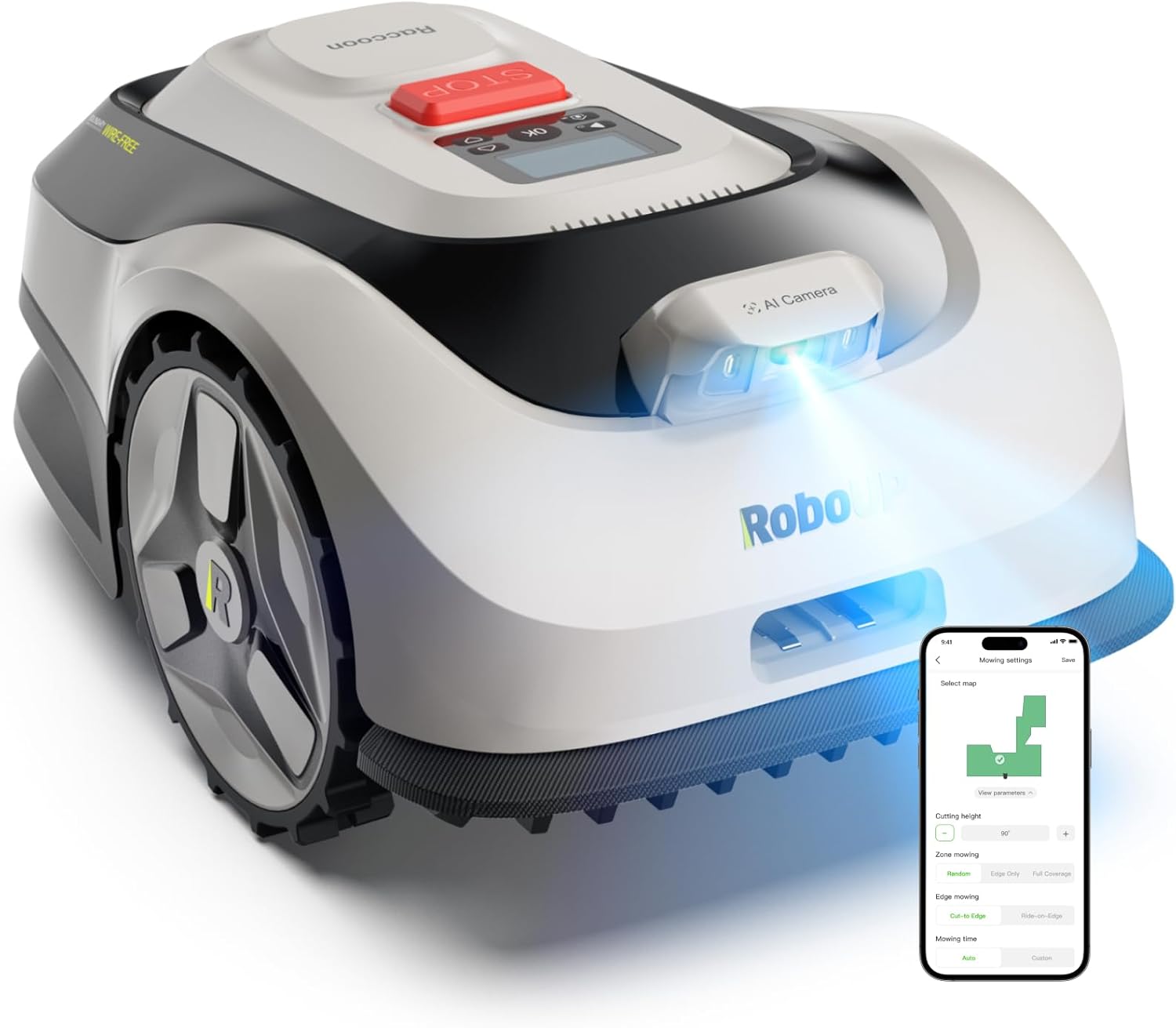
RoboUP Raccoon 2 SE Robot Lawn Mower (Wire-Free, for up to 0.15 Acre)
| Power Source | Battery Powered |
|---|---|
| Operation Mode | Automatic |
| Maximum Adjustable Cutting Height | 3.15 inches |
| Minimum Adjustable Cutting Height | 1.18 inches |
| Number of Positions | 5 |
The Raccoon 2 SE is a wire‑free robot mower built for small yards and straightforward layouts. It auto‑maps your lawn and can start with a single button press or be managed via app, offering scheduled mowing, multi‑zone support and electric height adjustment for a cleaner, more consistent cut. The mower uses AI vision and bumper sensors to avoid people, pets and common obstacles, handles slopes up to 36 percent, and will climb modest obstacles and navigate narrow passages. A 5Ah battery delivers long runtime and fast 70‑minute recharge cycles while the unit automatically returns to its dock when the battery is low or rain is detected. Practical benefits include quiet operation, OTA updates, and safety features such as lift and tilt detection and IPX6 water protection. Limitations to consider are the small coverage area limited to about 0.15 acre, the relatively narrow 7.9‑inch cutting width which increases run time on larger lawns, and the expectation that clearly defined boundaries or optional stakes are needed for optimal guidance on open edges.
Best for: Buyers who want a budget‑minded, low‑effort upgrade from push mowers for a small, well‑defined yard and value simple setup, quiet operation and app scheduling.
Less Ideal for: Owners of larger, irregular or heavily landscaped properties who need wider cutting decks, higher coverage area, or advanced RTK navigation for complex boundaries.
- Wire‑free auto mapping and one‑touch start for quick setup on simple lawns
- AI vision plus bumper sensors for obstacle avoidance and safe operation
- Long runtime from a 5Ah battery with 70‑minute fast recharge
- Handles steep slopes up to 36 percent and can climb small obstacles
- App control, scheduling and OTA updates for ongoing improvements
- Designed for small lawns only with a maximum recommended area of about 0.15 acre
- Narrow 7.9‑inch cutting width increases time needed on larger or complex yards
- May require optional boundary stakes for reliable edge control in open areas
Verdict: A practical, feature‑focused robotic mower for small yards that minimizes setup and hands‑on mowing while delivering quiet, app‑controlled performance.
dreame A3 AWD LiDAR Robot Lawn Mower (Bundle C)

| Power Source | Battery Powered |
|---|---|
| Operation Mode | Automatic |
| Maximum Adjustable Cutting Height | 4 inches |
| Minimum Adjustable Cutting Height | 1 inches |
| Battery Average Life | 1 days |
The dreame A3 AWD is a high-capability robotic lawn mower aimed at hands-off, reliable lawn care. It uses 360° 3D LiDAR plus binocular AI vision to map yards quickly without perimeter wire and avoid more than 300 obstacles, while AWD hub motors give it traction on steep slopes and uneven terrain. Typical use is set-it-and-forget-it scheduling via the Dreamehome app and 4G/HDR monitoring for anti-theft and real-time alerts. Notable features include edge-to-edge cutting modes, multiple mowing patterns, an adjustable cutting height range, fast charging that shortens recharging time, and IPX6-rated cleaning for low-maintenance upkeep. Practical benefits are consistent coverage on complex properties, quiet operation that permits night scheduling, and integrated security and app control that reduce hands-on intervention. Important limitations are its relatively narrow cutting width compared with walk-behind mowers and the need to purchase some accessories such as the optional trimmer module separately for tighter edging; it is also a significant one-time equipment investment. For a homeowner prioritizing dependable, autonomous mowing on hilly or multi-zone lawns, this mower minimizes ongoing labor and oversight.
Best for: Homeowners who value a dependable, low-touch solution for maintaining multi-zone or sloped lawns and want a mower that can run reliably with minimal daily supervision.
Less Ideal for: People with very small lawns who prefer a simpler, lower-cost mower or homeowners who need very wide single-pass cutting for large acreage.
- 360° 3D LiDAR with binocular AI vision enables wire-free yard mapping and strong obstacle avoidance
- All-wheel drive hub motors handle steep slopes and rough terrain for reliable traction
- Fast 45-minute charging reduces downtime between mowing sessions
- Built-in 4G and HDR camera provide real-time monitoring and anti-theft protection
- IPX6 cleaning protection and removable bundle tools simplify maintenance
- Relatively narrow 7.87-inch cutting width compared with larger commercial or walk-behind mowers
- Some edging and trimming capabilities require optional accessories sold separately
- Higher upfront cost than basic robotic models
Verdict: Buy this if you want a robust, wire-free robotic mower that reliably maps, navigates, and mows complex or hilly yards with minimal hands-on upkeep.
Mammotion LUBA mini 2 AWD 1500H Robot Lawn Mower

| Power Source | Battery Powered |
|---|---|
| Operation Mode | Automatic |
| Cutting Height | 2.2-4.0 inches |
| Number of Positions | 7 |
| Cutting width | 7.9 inches |
The Mammotion LUBA mini 2 AWD 1500H is a purpose-built robotic mower for small residential yards with steep or complex terrain. It uses 360° LiDAR and dual‑camera AI vision to detect obstacles early and plan smoother routes, and its AWD drivetrain with two independent motors can climb slopes up to 80 percent while negotiating curbs and roots. Dual cutting discs including a dedicated edge blade deliver closer trimming along borders, and the main disc height can be adjusted from the app for seasonal or turf changes. The mower supports up to 20 independent mowing zones and a DropMow mode for quick one‑off jobs without mapping. Battery features such as custom charge limits and off‑peak charging help preserve battery life and cut energy costs. Practical limitations to expect are modest coverage per model (about 0.37 acre) so larger properties will need a bigger unit, and being a sophisticated autonomous machine it requires initial setup and occasional app management and blade replacements. For homeowners prioritizing safe, hands‑free mowing on slopes, this model balances power and smart navigation.
Best for: Homeowners who need a reliable, autonomous mower that can handle steep, uneven lawns and prefer safety‑focused features and simpler hands‑off operation.
Less Ideal for: Owners of large lawns significantly bigger than 0.37 acre or those who want a purely plug‑and‑play pushbutton mower with no app or setup work.
- 360° LiDAR plus dual‑camera AI vision for improved obstacle detection and navigation.
- All‑wheel drive with independent motors and adaptive suspension for climbs up to 80% and better traction on uneven terrain.
- Dual cutting discs including a dedicated edge blade for cleaner margins and automatic height adjustment via app.
- Multi‑zone support and DropMow mode handle complex lawns and quick temporary jobs without permanent mapping.
- Battery management options (custom charge limit and off‑peak charging) to extend battery life and reduce running costs.
- Rated for about 0.37 acre coverage per charge, so not suited for larger properties.
- Advanced features require initial setup and occasional app interaction and maintenance.
Verdict: Choose the LUBA mini 2 AWD 1500H when you want a compact, safety‑oriented robot mower that confidently handles very steep slopes and complex residential lawns.
Mowrator S1 4WD Remote Control Lawn Mower (21-Inch, 12Ah)

| Power Source | Battery Powered |
|---|---|
| Battery Type | LiFePO4 |
| Cutting Height | 1.5-4.3 inches |
| Mowing Modes | Bagging, Mulching, Rear Discharge |
| Maximum Climbing Ability | 75% Slope (37°) |
The Mowrator S1 4WD is a remote-control lawn mower built to handle steep, challenging yards while removing the physical effort of pushing a mower. It uses a 56V 12Ah LiFePO4 battery and a 21-inch cutting deck to cover up to about 0.75 acre per charge; the included 600W charger tops the battery in roughly 70 minutes. You operate the machine with a low-latency remote to drive, adjust blade speed, and switch between mulching, bagging, or rear discharge. Notable features include a four-wheel drive system and wide-wheel options that let the mower climb slopes up to 75% with standard tires, plus ultrasonic sensors, an impact bumper, and blade auto-stop for safety. Practical benefits are quieter, emission-free mowing, fast recharges between sessions, and multi-season capability with optional accessories. Expect a substantial, assembly-required unit and a heavier machine that may be cumbersome to move by hand for maintenance or storage. Buyers should also factor in optional accessories for snow or towing tasks if they need those functions.
Best for: Buyers who prioritize a low-effort, safety-focused solution for maintaining medium-sized to hilly lawns and who want remote control operation without complex setup.
Less Ideal for: People who need a lightweight push mower for small, flat yards or who prefer a fully autonomous robot mower with app-based mapping and scheduling.
- 4WD traction and wide-wheel options for stable operation on very steep slopes
- 21-inch cutting deck with mulching, bagging, and rear discharge modes for versatile lawn care
- 56V LiFePO4 battery provides about 1.5 hours runtime and fast 70-minute recharge with the included charger
- Multiple safety layers including ultrasonic obstacle sensors, blade auto-stop, and an impact bumper
- Heavy and bulky unit that can be awkward to lift or maneuver for maintenance and storage
- Runtime and area coverage depend heavily on terrain, blade choice, and grass height
Verdict: Choose the Mowrator S1 4WD if you want a remote-controlled, safety-minded mower that confidently tackles steep and medium-sized lawns while eliminating manual pushing.
Choosing the Right Remote Lawn Mower: Key Factors to Consider
Cutting System and Deck Width
The cutting system determines how the mower slices and disperses clippings. A wider deck covers more ground per pass, reducing run time, but very wide decks can struggle in tight beds or narrow pathways. Blade type, blade speed, and how clippings are discharged affect the finish: mulching blades return fine clippings that feed the soil, while side-discharge systems may leave a rougher look.
Blade maintenance also matters. Blunt blades tear rather than cut, which can stress grass and invite disease. Consider how easy it is to access and replace or sharpen blades without specialized tools, since remote mowers are still maintained manually.
Navigation Technology and Obstacle Handling
Remote lawn mowers use a range of navigation approaches such as GPS waypointing, internal mapping, boundary wire, and onboard sensors. The choice affects how much prep your yard needs and how well the mower avoids flower beds, trees, and toys. GPS-based systems reduce the need for boundary wire but can have trouble under dense canopy or near tall structures. Boundary systems provide predictable limits but add installation work.
Obstacle handling influences how often you must intervene. Look for reliable bumper or vision sensors and a clear procedure for how the mower backs out and re-plans when it meets an obstacle. If your yard has many tight spaces, choose a navigation setup that supports fine-grain maneuvers and easy virtual no-go zones.
Battery Life and Charge Cycle
Battery capacity defines how much area a mower can cover per charge. Run-time estimates are often given under ideal conditions; wet grass, uphill runs, and thicker lawns shorten that number. Also consider the time it takes to recharge and whether the mower supports quick top-ups for partial rescues.
Battery type affects longevity and replacement cost. A unit with swappable batteries or an easy battery-access hatch makes it simpler to maintain long-term. Think about the typical size of your lawn and whether the stated run time actually covers a full cut or requires multiple recharge cycles.
Terrain and Slope Capability
Not all remote mowers handle slopes or uneven ground the same way. Traction systems, wheel size, and weight distribution determine how well a mower climbs inclines and avoids slipping. Steeper lawns require a mower rated for higher slope angles; otherwise, you risk reduced traction, stalling, or uneven cutting heights across contours.
Also evaluate how the mower deals with seams, transitions, and soft ground. Large wheels and a lower center of gravity help stabilize the unit on bumpy turf, and durable tires resist punctures from garden debris.
Durability and Weather Resistance
Remote mowers spend long periods outside, so corrosion resistance, sealed electronics, and UV-resistant plastics matter. Check for IP ratings or clear manufacturer statements about water ingress protection. A well-sealed unit will resist rain and dew and protect electrical components in variable spring and fall conditions.
Consider the quality of the chassis and mounting points. Regular exposure to clippings and grit can accelerate wear, so easily cleanable troughs and removable guards simplify upkeep and extend service life.
Safety Features and User Controls
Safety is crucial because these machines operate without a human on board. Look for reliable emergency stop methods, remote kill switches, lift and tilt sensors that stop blades, and child lock features. The clarity and responsiveness of the remote control or app also determine how comfortably you can supervise runs from a distance.
Audit the mower's warning and diagnostic feedback; clear alerts for low battery, stuck conditions, or blade faults let you act before a small issue becomes a problem. Also verify whether the unit keeps a log of runs and errors to help troubleshoot recurring issues.
Preparing Your Lawn for Autonomous Mowing
To get the best results from a remote mower, spend a little time preparing the lawn. Remove toys, sticks, and other debris that could trip sensors or tangle blades. Mark unusual obstacles or unstable terrain with temporary flags until you observe how the mower behaves around them.
- Trim long grass edges and make initial passes manually if grass is overgrown.
- Secure or remove low-hanging branch segments that could confuse vision sensors.
- Install temporary boundary markers if the mower uses perimeter guidance.
Common Installation Methods and What They Mean
Different navigation systems require different installation steps. A boundary wire system needs a buried or pegged wire around the area to be mowed and around obstacles you want to protect. GPS or camera-based systems usually need less physical setup but benefit from an initial mapping run to learn yard features.
- Boundary wire gives predictable limits but adds time to install and can be affected by root growth or digging.
- GPS mapping is cleaner but may need re-mapping after major landscape changes.
- Hybrid systems combine wire and sensors to reduce false boundaries while keeping predictable containment.
Routine Maintenance Tasks to Keep Performance High
Even though operation is remote, maintenance is hands-on. Regular blade inspections, cleaning of wheel wells, and electronics housings are essential. Clear out grass buildup after each run period and inspect blades weekly during the growing season.
- Sharpen or replace blades every few months depending on use and turf type.
- Check tire treads and wheel bearings for wear to maintain traction.
- Store the mower under cover or in a shed when not in active season to protect batteries and controls.
Dealing with Slopes, Wet Grass, and Challenging Turf
If your yard has steep areas or soggy sections, test how the mower performs on a short run before relying on it for a full cut. Wet grass increases slip risk and can cause clumping that reduces cutting consistency. Some units reduce blade speed or skip steep zones to avoid stalling.
- Avoid scheduling runs immediately after heavy rain to prevent turf damage and wheel ruts.
- Consider using the mower on a higher deck setting when grass is wet to avoid scalping.
- For steep yards, prefer units with higher slope ratings and grippy tires.
Integrating Remote Mowers Into Regular Lawn Care
Treat a remote mower as part of an overall care plan. Use it for routine, frequent passes to keep grass at an even height, then supplement with targeted manual trimming, edging, and aeration as needed. Regular fertilization and weed control remain important to maintain a healthy cut appearance.
- Plan monthly checks of battery health and firmware updates for navigation improvements.
- Rotate manual edging and trimming tasks to maintain crisp borders that remote units cannot reach.
- Use shorter, more frequent cuts in the growing season to reduce clippings and stress on grass.
How We Chose the Best Remote Lawn Mower
We shortlisted remote lawn mowers by focusing on the features and performance attributes that matter in everyday yard work. Key evaluation criteria included cutting system effectiveness and deck width to assess how evenly and quickly a mower can cut grass; navigation accuracy and obstacle avoidance to determine how autonomously the unit can operate in complex lawns; battery capacity and recharge time to estimate actual run time between charges for common yard sizes; build quality and weather resistance since these machines remain outdoors and must resist corrosion and moisture; safety systems and remote controls to judge user control and emergency stop behavior; and ease of maintenance for tasks like blade replacement and blade height adjustment. We excluded experimental prototypes, units without clear navigation solutions, and machines intended only for commercial fleet operators. We prioritized products that demonstrated practical reliability in a typical residential setting and that provided clear specifications for battery runtime, cutting width, and navigation method. The evaluation emphasized real-world usability over single laboratory metrics, and we filtered out options that required excessive manual intervention or special yard preparation.
FAQ
How large a lawn can a remote mower realistically cover on one charge?
It depends on the battery capacity and terrain. Manufacturers often quote runtime in ideal conditions; real-world coverage usually decreases with slopes, dense grass, and frequent obstacle avoidance. Expect to cover less area than the ideal runtime suggests, or plan for a recharge cycle on larger parcels.
Do I need to install a boundary wire for every remote mower?
Not always. Some models use GPS or onboard sensors instead of a boundary wire. Boundary wire systems are more predictable and useful in yards with complex shapes, while GPS or vision systems reduce installation but may struggle under heavy canopy or near structures.
Are remote lawn mowers safe around children and pets?
Most modern units include safety features such as emergency stops, lift and tilt sensors, and child lock modes. However, supervision is still recommended, and creating physical or virtual no-go zones around play areas adds a layer of safety.
Will a remote mower work on very uneven or hilly yards?
Some are designed for slopes and uneven terrain, but each model has a slope rating. Steeper grades and very uneven ground can reduce traction and cutting consistency, so choose a unit with suitable slope capability and larger wheels for those conditions.
How often do I need to maintain blades and wheels?
Blade inspection and cleaning should be done weekly during active use, with sharpening or replacement every few months depending on wear. Wheels and bearings should be checked monthly for wear, debris, and proper alignment to maintain smooth navigation.
Final Verdict
For most homeowners, the best remote lawn mower balances cutting consistency, reliable navigation, and battery runtime for the size and shape of their yard. Prioritize navigation and obstacle handling if your lawn has many trees, beds, or tight spots. If you have a larger parcel, battery capacity and recharge options become the most important considerations. Accept tradeoffs: wider decks speed up mowing but reduce maneuverability, and GPS-based navigation lowers installation work but can be less predictable near structures. Use the factors in this guide to match a mower's strengths to your lawn so you get consistent, low-effort results with minimal intervention.
