

Note: This article contains affiliate links. If you click on these links and make a purchase, I may earn a small commission at no extra cost to you. This helps support my research and content. Read my full affiliate disclosure here.
If you maintain multiple properties, large lawns, or commercial landscapes, picking the right riding commercial zero-turn mower affects productivity, finish quality, and operating costs. These machines spend long hours in the field, so durability, deck stability, and ease of routine service matter more than creature comforts. This guide covers our top shortlisted picks across typical commercial applications and outlines the practical traits that matter in daily use. We evaluated build durability, cutting performance, serviceability, fuel and hydraulic systems, and operator comfort to choose the most reliable options for high-hour mowing. Read on for the specifics and guidance to match a mower to your workload and maintenance capabilities.
Top Picks at a Glance
| Best Quality Built to a higher standard if you want something more solid | Ariens Ikon XD Zero Turn Tractor with Kawasaki FR691 23‑HP Engine, 60-inch Deck |  |
| Best Value The sweet spot between price and what you get | EGO Power+ 52" Z6 Zero-Turn Riding Mower with Six 56V 12.0Ah Batteries |  |
| Highest Rated A top-rated pick with lots of positive feedback | Ariens Zenith 60" 23.5 HP Kawasaki Zero Turn Lawn Mower |  |
| Most Popular A crowd favorite that many people choose with confidence | Husqvarna Z254F 54 in. Zero-Turn Riding Mower, 23 HP Kawasaki |  |
| Best Seller A high-volume bestseller chosen again and again | Husqvarna MZ61 61-inch Zero-Turn Lawn Mower with ROPS |  |
Ariens Ikon XD Zero Turn Tractor with Kawasaki FR691 23‑HP Engine, 60-inch Deck

| Power Source | manual, gasoline |
|---|---|
| Cutting width | 60 inches |
| Maximum Adjustable Cutting Height | 6 inches |
| Material Type | Alloy Steel, Metal |
The Ariens Ikon XD is a heavy-duty zero-turn tractor built to cover large lawns quickly. It pairs a 23‑HP Kawasaki FR691 engine with a 60‑inch cutting deck, delivering wide swaths that reduce pass count on a 5‑acre property. The machine uses a professional-grade transmission tuned for higher torque and load capacity, which improves responsiveness when cutting varied turf and working around obstacles. Controls are familiar to zero‑turn users, and the robust alloy steel construction gives a stable ride and long service life. Adjustable cutting height from low to 6 inches provides flexibility for different grass types and seasonal needs. Expect straightforward operation for routine mowing and the ability to handle heavier growth occasionally, though the tractor’s large footprint and weight make it less maneuverable in very tight beds or narrow gates. Maintenance will require typical commercial care for engine and transmission components. For a balanced buyer seeking a durable, time‑saving mower for multiple acres, this model delivers the core performance needed for regular large‑lot maintenance.
Best for: A pragmatic owner who needs a durable, efficient mower to maintain several acres on a regular schedule and values uptime and straightforward performance.
Less Ideal for: Not a good choice for urban properties, very small yards, or buyers who need a compact mower for frequent tight‑space maneuvering.
- 60‑inch cutting deck reduces passes and mowing time on multi‑acre lots
- 23‑HP Kawasaki FR691 engine offers reliable, commercial‑grade power
- Professional‑grade transmission improves torque and control under load
- Alloy steel construction and commercial components built for durability
- Adjustable cutting height up to 6 inches for different turf conditions
- Large weight and footprint limit access through narrow gates and tight landscape areas
- Designed for open acreage rather than intricate trimming or very small yards
Verdict: Choose the Ariens Ikon XD if you want a durable, commercial‑style zero‑turn that cuts large areas fast and reliably.
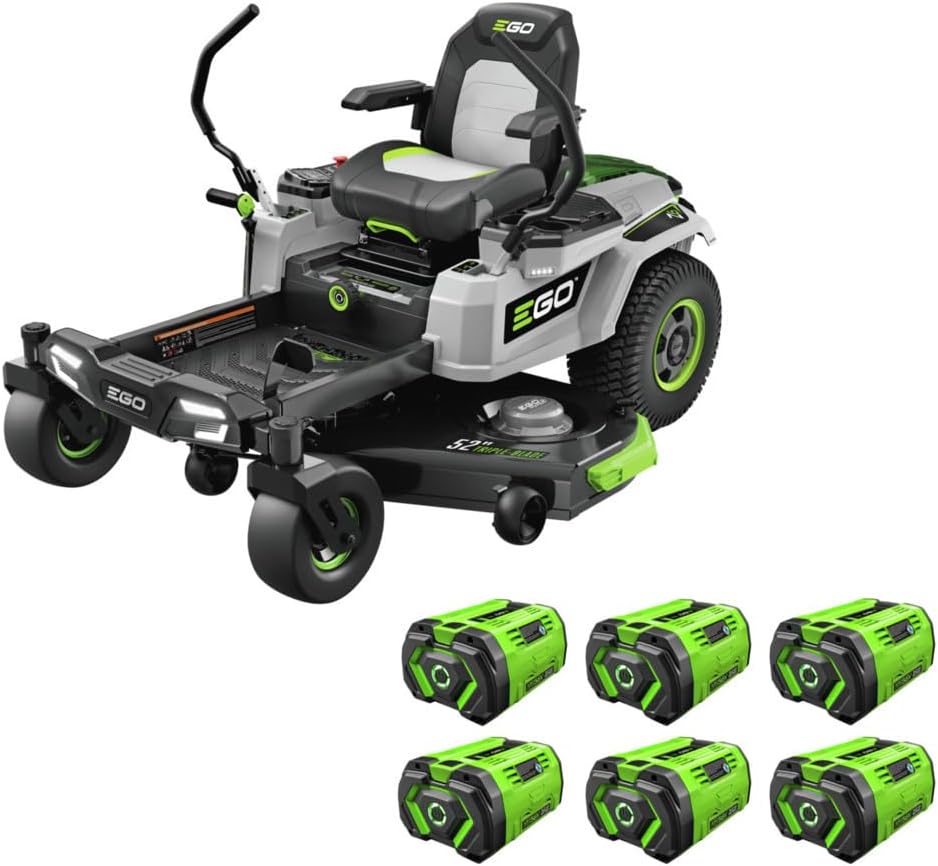
EGO Power+ 52" Z6 Zero-Turn Riding Mower with Six 56V 12.0Ah Batteries
| Power Source | Battery Powered |
|---|---|
| Cutting width | 52 inches |
| Maximum Adjustable Cutting Height | 4.5 inches |
| Minimum Adjustable Cutting Height | 1.5 inches |
| Number of Positions | 10 |
The EGO Power+ 52" Z6 is a full-size battery zero-turn mower designed to replace a gas ZTR for medium to large yards. It pairs a fabricated 52-inch steel deck with five brushless motors and Peak Power+ technology that can draw from up to six included 56V 12.0Ah batteries to deliver roughly 25 horsepower equivalent and a top speed around 8 MPH. Typical use is mowing open lawns and properties up to several acres where zero-turn maneuverability speeds the job. Notable features include an LCD with three drive modes, adjustable seat suspension, LED lights, USB port and a very fast 1600W charger that can refresh all six batteries in about four hours. Practical benefits are quiet operation, low vibration, strong hill and cutting performance comparable to gas, and the ability to cover up to about 4 acres on a single charge with the supplied batteries. Important limitations are the large battery system and charger footprint to store and maintain, the mower's substantial weight which affects storage and transport, and the reliance on the proprietary ARC battery platform if you want the claimed run times.
Best for: Buyers who want a low-noise, low-maintenance zero-turn mower that can handle roughly 2 to 4 acres with gas-comparable power and prefer a proven, safer-for-operators electric alternative.
Less Ideal for: People who need a lightweight, easily trailered machine or who expect the simplest possible ownership without managing multiple high-capacity batteries.
- Battery system (six 56V 12.0Ah batteries included) provides long run time—up to about 4 acres per charge
- Brushless motors and Peak Power+ deliver gas-like 25 HP equivalent performance for cutting and driving
- 52-inch fabricated steel deck gives wide, even cutting for medium-to-large lawns
- Fast 1600W charger can fully charge the six included batteries in roughly four hours
- Comfort and convenience extras such as adjustable seat suspension, LCD drive modes, LED lights and USB port
- Very heavy and bulky, which makes storage and towing more demanding
- Dependence on EGO ARC battery platform increases ongoing storage and maintenance needs
Verdict: For a risk-averse buyer who wants gas-level performance without fumes or constant engine maintenance, this 52" electric zero-turn delivers comparable power and multi-acre range on a single charge.
Ariens Zenith 60" 23.5 HP Kawasaki Zero Turn Lawn Mower

| Power Source | gasoline-powered |
|---|---|
| Cutting width | 60 inches |
| Operation Mode | Automatic |
| Number of Positions | 3 |
The Ariens Zenith 60 is built for fast, efficient mowing of large properties where ride comfort and cut speed matter. It pairs a 23.5 HP Kawasaki FX730 V-twin with a wide 60-inch deck to reduce passes and finish acres quickly. The machine is designed around a robust, commercially proven frame and includes a plush seat and isolators to smooth vibration during long sessions, which helps reduce operator fatigue. Operation is automatic with three-position settings that simplify control, and the heavy-duty construction suggests long-term durability under frequent use. Trade-offs are its substantial heft and footprint which require storage space and make it unsuitable for tight, obstacle-filled yards, and gasoline operation means routine engine maintenance and fuel handling. For users prioritizing speed, a smooth ride, and a professional cut on expansive lawns, this mower delivers the core performance features those tasks demand.
Best for: Serious homeowners or small-grounds managers who need a fast, comfortable mower for large lawns and value a professional, smooth ride during extended mowing sessions.
Less Ideal for: People with small yards, many tight beds or obstacles, or those who need a compact, easily stored mower are better served by smaller residential models.
- Powerful 23.5 HP Kawasaki V-twin engine for consistent mowing performance
- Large 60-inch cutting deck reduces passes and speeds up mowing on big lawns
- Commercially proven frame and heavy-duty construction for durability under frequent use
- Comfort-oriented seating and isolators that reduce vibration for smoother long rides
- Very heavy and large footprint limits storage options and maneuverability in tight spaces
- Gasoline engine requires regular maintenance and fuel management
Verdict: Choose the Ariens Zenith 60 when you want a smooth-riding, high-speed zero-turn that covers large lawns quickly with commercial-grade durability.
Husqvarna Z254F 54 in. Zero-Turn Riding Mower, 23 HP Kawasaki

| Power Source | gasoline |
|---|---|
| Engine Power | 23 HP |
| Cutting width | 54 inches |
| Operation Mode | Automatic |
| Number of Positions | 6 |
The Husqvarna Z254F is a purpose-built zero-turn mower for homeowners who need wide cutting coverage and reliable power. It uses a 23 HP Kawasaki engine and a hydrostatic, no-maintenance transmission to deliver smooth, variable speed control and a reported top speed around 6.5 MPH. The 54 inch ClearCut deck is designed for good airflow and a clean cut, and it supports discharge, mulching or bagging with optional attachments. Operator comfort and usability are addressed with an ergonomic control panel, comfortable seat and anti-slip foot area, while a simple deck lift and outward parking of the steering levers make daily use straightforward. Practical limitations include the mower's large footprint and weight, which make it best suited to medium to large lawns with clear access rather than tight, obstacle-dense yards, and optional mulching and bagging hardware must be bought separately. For buyers prioritizing proven components and ease of operation, the Z254F provides a dependable mowing platform.
Best for: Homeowners with medium to large lawns who value reliable components and efficient, fast mowing and who prefer a low-maintenance hydrostatic drive.
Less Ideal for: If your property is small, has many tight turns, steep slopes, or requires frequent trailer transport, a compact zero-turn or walk-behind mower will be a better fit.
- Powerful 23 HP Kawasaki gasoline engine for reliable starts and consistent turf performance
- Hydrostatic transmission requires no regular maintenance and provides smooth speed control
- 54 in. ClearCut deck covers large areas quickly and is designed for good airflow and cutting quality
- Comfort-focused operator station with ergonomic controls and anti-slip foot area for longer mowing sessions
- Large weight and footprint limit maneuverability in tight yards and make transport more difficult
- Mulching kit and bagger are sold separately rather than included
Verdict: Choose the Z254F if you want a dependable, wide-cut hydrostatic zero-turn that speeds up mowing on medium to large lawns with proven engine and transmission components.
Husqvarna MZ61 61-inch Zero-Turn Lawn Mower with ROPS

| Cutting width | 61 inches |
|---|---|
| Power Source | gasoline |
| Operation Mode | Automatic |
| Maximum Adjustable Cutting Height | 11.4 centimeters |
| Minimum Adjustable Cutting Height | 38.1 millimeters |
The Husqvarna MZ61 is designed for high-performance mowing on large lawns and light commercial sites. It pairs a 24 HP Kawasaki FR730V V-twin engine with a fabricated 61-inch, 3-blade deck to cut wide swaths and reduce pass count on multi-acre properties. The commercial-grade Hydro Gear ZT-3100 hydrostatic transmission provides smooth speed control and precise zero-turn maneuvering, while large tires and an 11-gauge steel deck give a durable, stable ride over uneven ground. Standard ROPS improve operator safety during use and the 5-gallon fuel tank helps extend run time between fills. Practical limits include its size and weight, which make storage, transport, and operation around tight obstacles more challenging, and the machine is best suited to owners comfortable with servicing a gasoline V-twin engine. For someone managing about three acres who prioritizes fast, professional-quality cuts, this mower delivers the power and deck width to get the job done efficiently.
Best for: Buyers who need a powerful, time-saving mower for roughly three-acre properties and value commercial-grade components and strong cutting performance.
Less Ideal for: Not a good fit for small yards, shared storage spaces, or users who prefer electric or low-maintenance machines.
- Wide 61-inch fabricated 3-blade deck cuts large areas quickly to reduce mowing time
- 24 HP Kawasaki FR730V V-twin engine provides strong, reliable power for thick grass and slopes
- Commercial-grade Hydro Gear ZT-3100 hydrostatic transmission offers smooth, precise zero-turn control
- Heavy 11-gauge steel deck and large tires improve durability and ride stability
- ROPS standard for added operator safety during heavier-duty use
- Large footprint and heavy weight make storage and maneuvering around tight obstacles difficult
- Requires regular maintenance typical of gasoline V-twin engines for reliable long-term performance
Verdict: If you need fast, commercial-caliber mowing on about three acres, the Husqvarna MZ61 delivers the power and 61-inch deck to finish the job quickly.
Choosing the Right Riding Commercial Zero-Turn Mower: Key Factors to Consider
Deck Construction and Stability
The mower deck is the heart of the cut. Heavier gauge steel and full welds resist flexing when you encounter rough ground or repeated impacts. A deck that stays flat across its span produces an even cut and reduces the need for repeated height adjustments. Look for reinforced leading edges and properly braced discharge openings, because thin, poorly supported decks tend to warp under commercial loads and create scalping or uneven stripes.
Deck mounting and anti-scalping systems matter too. Floating or properly tensioned mounts allow the deck to follow contours without dragging, while anti-scalp wheels or skids protect delicate turf edges. Spindle quality and bearing access also influence long-term performance, since worn spindles are a common source of vibration and poor cut quality.
Powertrain and Hydraulic Capacity
Commercial workloads demand engines with sustained torque and cooling systems sized for long runs. Engines tuned for steady PTO and consistent rpm under load reduce belt slip and maintain blade tip speed for a cleaner cut. Equally important is the hydraulic drive system. Heavy-duty pumps, appropriately sized motors, and accessible filters help preserve traction and steering responsiveness on long shifts.
Consider cooling layout and airflow. Commercial machines often operate in hot or dusty environments, so easy-to-service radiators, clear airflow paths, and debris screens can dramatically affect uptime. Also think about fuel system capacity and filtration when planning long days away from refueling.
Service Access and Routine Maintenance
Frequent, fast maintenance is essential when a fleet needs to stay productive. Mowers with tool-free or simple access to engine oil filters, air filters, belt paths, and grease fittings reduce service time between jobs. Components that are modular or bolt-on simplify repairs in the field, while clearly routed belts and labeled service points minimize errors during routine checks.
Also evaluate maintenance intervals and availability of common replacement parts like belts and spindles. A machine that needs complex teardown for routine filter changes will cost more in labor over its life than one with well-placed service points.
Cut Quality and Blade System
Blades, spindle geometry, and deck airflow determine the finish you get on turf. A well-designed blade system lifts clippings cleanly and provides even discharge or mulching, depending on the configuration. Look at blade overlap, spindle spacing, and deck chamber shaping because these control clumping and stripe definition.
Blade retention and ease of blade changes matter in commercial use. Single-bolt systems may save time, but they must also secure blades against heavy impacts. Consider blade material, sharpening cadence, and whether the deck supports mulching inserts or baffles for flexible mowing strategies.
Operator Comfort and Control Layout
Comfort affects operator performance during long shifts and can reduce errors. A supportive, adjustable seat with good vibration damping keeps the operator focused and decreases fatigue. Control placement should be intuitive, with smooth levers or hydro controls that require predictable input.
Visibility and reach to key controls, a clear instrument cluster, and platform space for shifting weight during turns also contribute to safer, faster mowing. Small comforts like cup holders, tool trays, and accessory power points are useful, but the primary focus should be on ergonomics that keep the operator steady and alert over multi-hour jobs.
Common Commercial Mower Deck Configurations
Commercial zero-turn mowers typically use three main deck styles: side-discharge, mulching-ready, or enclosed chamber designs optimized for airflow. Each configuration affects how clippings are managed and how the deck performs on thick or wet turf.
Side-discharge decks move material quickly away from blades, which reduces clogging on heavy growth. Mulching-ready decks include baffles or inserts that recirculate clippings for finer cuttings, but they require higher blade tip speed and clean airflow. Enclosed chambers focus on consistent lift and are often favored where striping and finish quality are primary concerns.
- Side-discharge for heavy-summer growth and quick throughput
- Mulching-ready for nutrient return and finer finish
- Enclosed-chamber for consistent lift and stripe definition
Matching Mower Size to Property and Workload
Choose deck width based on how much turf you need to cover and the terrain access. Wider decks reduce pass count on open fields but can be harder to maneuver in tight landscapes or through gates. For properties with frequent obstacles, a slightly narrower deck may save time overall because it reduces repositioning and missed spots.
Also consider transport and storage. Commercial machines take more space on trailers and in sheds, so plan for secure storage and routine servicing space. For very large turf areas, consider machines with larger fuel tanks and quick-change blade systems to minimize downtime.
- Wider decks cut faster but need more turning room
- Narrower decks improve access around obstacles
- Account for transport, storage, and service space
Routine Maintenance Checklist for Commercial Use
Establish a daily, weekly, and monthly inspection routine. Daily checks should include oil level, air filter visual, tire pressure and condition, blade security, and a quick look for loose hardware. Weekly tasks typically cover grease points, belt tension, and a more thorough air filter clean or swap depending on conditions.
Monthly or hourly-interval service should inspect spindle bearings and deck flatness, hydraulic oil levels and filters, and coolant system integrity. Keeping a log of service intervals and simple in-field repairs will extend machine life and reduce fleet downtime.
- Daily: oil, tires, blade security, visual checks
- Weekly: grease, belts, air filter service
- Monthly/hour-based: spindles, hydraulics, cooling
Operators and Training for Efficient Commercial Mowing
Operator technique influences cut quality and machine longevity. Train operators on correct ground speed for different grass conditions, blade engagement practices, and safe turning to avoid deck stress. Proper throttle and PTO use prevents lugging the engine and reduces belt wear.
Encourage routine pre-start walkthroughs and a culture of reporting small issues before they grow. Well-trained operators recognize early signs of deck wear, unusual vibrations, or cooling problems and can take corrective action or schedule service to avoid bigger repairs.
- Teach correct ground speed for different turf conditions
- Instruct on safe turning and blade engagement practices
- Promote pre-start checks and issue reporting
Fuel, Emissions, and Operating Regulations
Commercial equipment often faces local emissions rules and fuel-quality considerations. Confirm local regulations for commercial mowing fleets, especially if operating in multiple jurisdictions. Choosing engines with appropriate emissions controls and easy-to-service aftertreatment components reduces regulatory risk and maintenance surprises.
Fuel handling matters too. Plan for secure fuel storage, filtration, and transfer procedures to avoid contamination that can result in downtime. For high-hour operations, using recommended fuel filtration practices extends injector and pump life.
- Check local emissions and fuel regulations
- Plan for safe, clean fuel handling and storage
- Maintain recommended filtration to protect the fuel system
How We Chose the Best Riding Commercial Zero-Turn Mower
We focused on features and build attributes that matter for commercial mowing workloads. Key evaluation criteria included deck construction and mounting stability, powertrain robustness and hydraulic performance, service access and routine maintenance points, and operator ergonomics that reduce fatigue during long shifts. We also checked safety features and parts availability as practical indicators of long-term operability. For deck construction we prioritized welded deck shells, reinforced leading edges, and reliable spindle designs that resist warping under heavy use. Powertrain assessment emphasized commercial-grade engines, cooling capacity, and hydraulic systems sized for consistent traction and lift. Serviceability looked at access to filters, grease points, belt routing, and modular components that keep downtime low. Operator factors considered seat support, control layout, and vibration isolation that affect daily comfort and control. We excluded light-duty residential models and machines designed primarily for homeowner use. Units without clear commercial-spec materials or with limited service access were not considered. The resulting list includes machines that meet rigorous durability, maintainability, and commercial performance standards.
FAQ
How wide a deck should I choose for commercial properties?
Deck width depends on property size and access. Wider decks reduce pass count on open turf but can limit maneuverability around obstacles and through gates. For mixed sites, a mid-width deck often balances speed and access.
How often do blades and spindles typically need service in commercial use?
Service intervals depend on hours and conditions. Blades often need inspection and sharpening after every few days of heavy cutting, while spindles are checked on monthly or hourly-based schedules. Dusty, sandy, or wet conditions shorten service intervals.
What maintenance tasks most reduce unexpected downtime?
Regular checks of air filters, hydraulic filters, belt condition, and coolant system integrity prevent many common failures. Quick daily inspections and timely replacement of wear items are the most effective ways to reduce unexpected breakdowns.
Are there specific features that make a mower easier to service in the field?
Yes. Tool-free access panels, clearly routed belt paths, easily reachable grease points, and centralized filter locations save time. Modular components and common fastener types simplify field repairs.
Should operator comfort influence a commercial purchase?
Often yes. Comfortable operators stay productive longer and make fewer mistakes. Good seats, vibration isolation, and intuitive controls reduce fatigue during long shifts, which indirectly lowers operating costs.
Final Verdict
For commercial mowing, prioritize deck durability, service accessibility, and a powertrain that handles sustained loads. Expect tradeoffs between deck width and maneuverability, and plan maintenance routines that match your operating hours and environmental conditions. Choose the machine whose construction and service layout align with your route shape, operator practices, and maintenance capacity. That alignment will deliver the best combination of uptime, consistent cut quality, and predictable lifecycle costs.
