

Note: This article contains affiliate links. If you click on these links and make a purchase, I may earn a small commission at no extra cost to you. This helps support my research and content. Read my full affiliate disclosure here.
If you have about an acre with rolling terrain, choosing the right riding lawn mower matters for safety, cut quality, and how much effort you expend. Mowers that perform well on hills combine strong low-end torque, good traction, and reliable braking so you can tackle slopes without scalping or stalling. This guide shortlists five top choices suited to a 1-acre property with hills and explains the tradeoffs between engine size, drivetrain, and deck design. We evaluated each candidate on torque and hill-handling, cut consistency, and maintenance demands so you can pick a machine that fits your landscape and comfort level. Read on for the factors that matter and practical tips for mowing sloped ground safely and efficiently.
Top Picks at a Glance
| Best Overall The best all-around choice for most situations | Husqvarna TS 140X 48" Riding Lawn Tractor with 24 HP Briggs V-Twin |  |
| Best Quality Built to a higher standard if you want something more solid | EGO Power+ 52" Z6 Zero Turn Riding Mower with Six 56V 12.0Ah Batteries |  |
| Best Budget The cheapest option that still gets the job done reliably | GIYI Electric Riding Lawn Mower with 42" Deck and Six 40V Batteries |  |
| Most Popular A crowd favorite that many people choose with confidence | EGO Power+ ZT4204L 42" Electric Zero-Turn Riding Mower with (4) 56V 10.0Ah Batteries |  |
| Best Seller A high-volume bestseller chosen again and again | EGO Power+ TR4204 42" Electric Riding Lawn Tractor |  |
Husqvarna TS 140X 48" Riding Lawn Tractor with 24 HP Briggs V-Twin

| Cutting width | 48 inches |
|---|---|
| Power Source | Gas Powered |
| Operation Mode | Manual |
The Husqvarna TS 140X is built for homeowners who need a robust, straightforward riding tractor for mowing roughly an acre, including moderate slopes. It pairs a 24 HP Briggs & Stratton V-twin engine with a 48-inch stamped steel deck and pedal-operated transmission so you can keep both hands on the wheel while changing speed. The reinforced deck and Air Induction technology aim to improve cut quality and reduce clumping, while an upgraded seat and ergonomic steering wheel increase comfort during longer jobs. Typical use will be regular property maintenance: striping driveways, cutting large open areas, and handling rolling terrain where a wider deck reduces passes. The tractor’s strengths are engine power, simple mechanical controls, and a roomy cutting width that shortens mowing time. Important limitations are its manual operation and gas power, which require fuel and routine engine maintenance, and the stamped deck is durable but less serviceable than heavier fabricated decks for extreme commercial use. For homeowners seeking a capable, no-frills machine, this balances performance and ease of use.
Best for: Homeowners with about an acre of lawn who want a powerful, easy-to-operate riding tractor that speeds up mowing and handles modest hills while prioritizing comfort during longer jobs.
Less Ideal for: Users who need a commercial-grade mower for daily heavy use or those seeking a zero-emission electric option should look elsewhere.
- Powerful 24 HP Briggs & Stratton V-twin engine provides strong performance on hills and larger lawns
- 48-inch stamped steel cutting deck reduces mowing time on an acre-sized property
- Pedal-operated transmission lets you keep both hands on the wheel for better control
- Ergonomic seat and steering wheel improve comfort for longer mowing sessions
- Gas engine requires regular fuel, oil changes, and tune-ups
- Stamped deck is less heavy-duty than fabricated commercial decks for extreme, frequent use
Verdict: A practical, comfortable gas tractor that cuts large yards quickly and handles modest hills for homeowners who want dependable performance and simple controls.
EGO Power+ 52" Z6 Zero Turn Riding Mower with Six 56V 12.0Ah Batteries
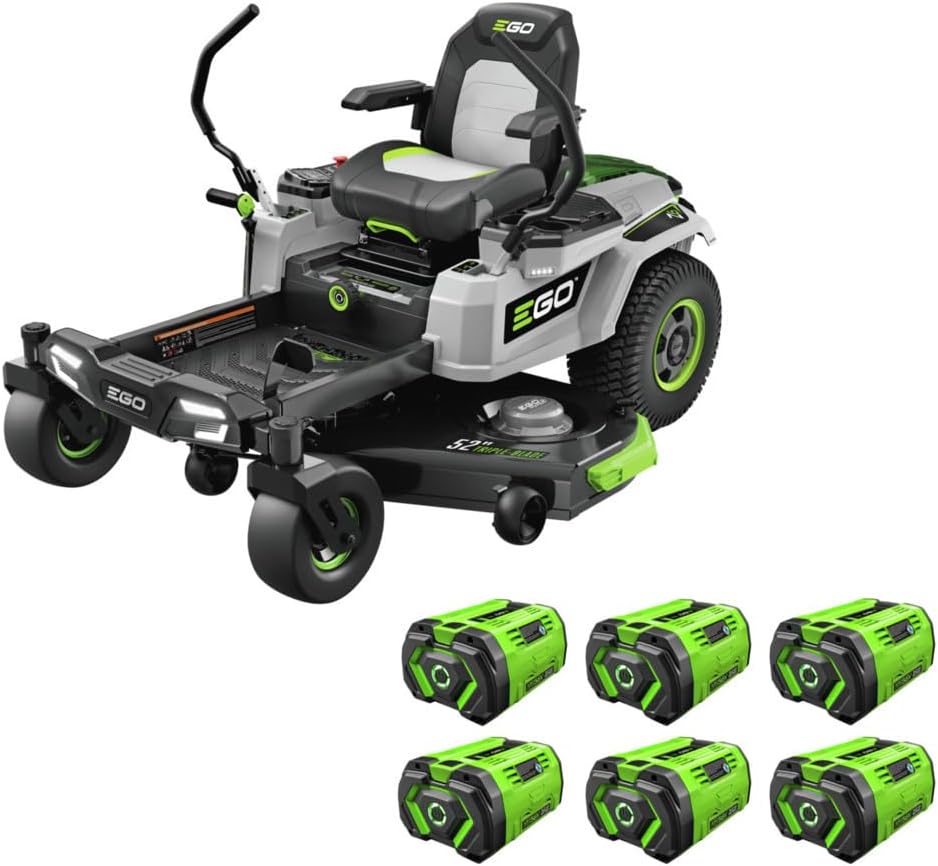
| Power Source | Battery Powered |
|---|---|
| Cutting width | 52 inches |
| Maximum Adjustable Cutting Height | 4.5 inches |
| Minimum Adjustable Cutting Height | 1.5 inches |
| Number of Positions | 10 |
The EGO Power+ 52" Z6 is a battery-powered zero-turn mower built for heavy-duty yards that need speed and runtime without a gas engine. It uses up to six 56V ARC Lithium batteries and five independent brushless motors to produce the equivalent of roughly 25 horsepower, a top speed up to 8 MPH, and a 52" fabricated steel deck for wide, efficient cuts. Typical use is fast mowing of larger properties and rolling terrain where zero-turn maneuverability saves time. Notable features include multiple driving modes accessed via an LCD, an industry-fast charger that replenishes the six included 12.0Ah batteries quickly, LED lights, a USB port, and adjustable seat suspension for a more comfortable ride. Practical benefits are strong acceleration and the ability to cover several acres on a single charge while avoiding gas maintenance. Important limitations are the mower's substantial weight and the complexity of managing multiple high-capacity batteries and charging, which mean storage, transport, and long-term battery care require planning.
Best for: Buyers who prioritize high performance and fast mowing on larger lawns and hilly properties and want a zero-turn rider that matches gas-like power without fuel maintenance.
Less Ideal for: Small-lot owners, infrequent mowers, or anyone without secure storage and a plan for battery charging and maintenance should consider simpler or lighter options.
- Battery system sized to cut up to 4 acres on a single charge with six included 12.0Ah batteries
- Brushless motor design and Peak Power+ tech that deliver power comparable to a 25 HP gas engine
- 52-inch fabricated steel deck for wide, efficient passes
- Fast charger included to recharge six batteries in about 4 hours and reduce downtime
- Premium comfort and controls with adjustable seat suspension, LCD drive modes, LED lights, and USB port
- Heavy and large unit that requires ample storage space and effort to transport
- Managing, charging, and eventually replacing multiple high-capacity batteries adds long-term cost and complexity
Verdict: If you want gas-equivalent performance and long runtime on hilly, acre-plus properties without gasoline, this battery-powered zero-turn delivers the speed and coverage to get the job done.
GIYI Electric Riding Lawn Mower with 42" Deck and Six 40V Batteries

| Power Source | Battery Powered |
|---|---|
| Cutting width | 42 inches |
| Number of Positions | 9 |
| Maximum Adjustable Cutting Height | 4.52 inches |
| Minimum Adjustable Cutting Height | 1.37 inches |
This GIYI electric riding mower is built as a cordless alternative to small gas tractors, pairing a 42-inch stamped-steel deck with six 40V 6.0Ah batteries and a brushless motor for extended runtime and low maintenance. It is typically used for mowing medium-sized residential properties; the spec sheet and manufacturer notes suggest 60–80 minutes per charge, a top mowing speed up to 6 mph, and coverage around 1.2 acres on a single charge. Notable features include a multi-position cutting height adjustment with nine settings from about 1.5 to 4.5 inches, a belt-free brushless drive for reduced upkeep, and an ergonomically low-back seat for rider comfort. Practical benefits are quiet operation, simplified servicing compared with gas engines, and the ability to handle slopes up to 15 degrees. Important limitations are the bulky weight and reliance on battery capacity for runtime, which means longer or very hilly lawns may require recharging or spare batteries, and transport or storage will need equipment rated for heavy items.
Best for: Homeowners with roughly an acre of lawn who prioritize quieter, low-maintenance electric operation and want a single-charge mowing run on moderately hilly property.
Less Ideal for: Large properties significantly over an acre, professional landscapers, or users who need long continuous runtime on very steep or heavily overgrown terrain.
- Comes with six 40V 6.0Ah batteries providing extended runtime suitable for about an acre per charge under typical conditions
- Brushless, belt-free motor reduces routine maintenance compared with gas-drive systems
- 42-inch stamped steel deck with nine adjustable cutting heights for versatile cut lengths
- Designed to handle moderate slopes (up to 15 degrees) and a top mowing speed of about 6 mph
- Ergonomic seating and simple automatic operation improve rider comfort and ease of use
- Heavy unit that will require a suitable trailer or lift for transport and may be awkward to store
- Runtime depends on battery condition and terrain so very steep or overgrown properties may need additional charging or batteries
Verdict: If you want a low-maintenance, battery-powered riding mower that can comfortably mow about an acre including moderate hills on a single charge, this GIYI 42" model is a strong electric choice.
EGO Power+ ZT4204L 42" Electric Zero-Turn Riding Mower with (4) 56V 10.0Ah Batteries

| Power Source | Battery Powered |
|---|---|
| Cutting width | 42 inches |
| Maximum Adjustable Cutting Height | 4.5 inches |
| Minimum Adjustable Cutting Height | 1.5 inches |
| Number of Positions | 10 |
The EGO Power+ ZT4204L is a battery-driven zero-turn mower designed to give gas-like power without fumes or routine engine maintenance. It uses up to six 56V ARC Lithium batteries (four are included) and four independent brushless motors to deliver roughly 22 horsepower and a top travel speed around 8 MPH, making it capable of mowing up to about 2 acres per charge with the supplied battery pack. The 42-inch stamped-steel deck offers 3-in-1 cutting (mulch, bag, side discharge) and 10 height settings from 1.5 to 4.5 inches, while an LCD interface provides three driving modes for tuning performance on slopes or tight areas. Practical benefits include quieter operation, minimal vibration from the brushless motors, onboard USB and LED lights for convenience, and a roughly two-hour recharge with the included Z6 charger. Important limitations are its 2-acre stated range with only four batteries and the need to buy extra batteries to reliably handle larger properties or extended steep-hill work, which raises total ownership cost and charging logistics.
Best for: Best for a homeowner who wants zero-turn maneuverability and gas-comparable power on roughly one to two acre lots with hilly terrain and who values quieter, low-maintenance operation.
Less Ideal for: Not a good fit for buyers who need to mow large expanses well beyond 2 acres per session without planning extra batteries or for those who cannot accommodate a heavy, full-size riding mower in storage or transport.
- Battery-powered with brushless motors for quieter operation and reduced maintenance compared with gas engines
- 42-inch stamped-steel deck with 3-in-1 cutting and 10 height positions for versatile turf care
- Includes four 56V 10.0Ah batteries and a 1600W Z6 charger for about two-hour recharge time
- LCD interface with three driving modes lets you tune performance for hills, control, or speed
- Stated single-charge range is about 2 acres with the included four batteries, so additional batteries are needed for larger properties
- Large machine weight and battery system require consideration for transport and storage
Verdict: Choose the ZT4204L if you want a near-gas performance zero-turn mower with quiet, low-maintenance battery power that handles hilly 1-acre yards comfortably when planned around its battery range.
EGO Power+ TR4204 42" Electric Riding Lawn Tractor

| Power Source | Battery Powered |
|---|---|
| Cutting width | 42 inches |
| Battery Average Life | 60 minutes |
| Number of Positions | 12 |
| Maximum Adjustable Cutting Height | 4 inches |
The EGO Power+ TR4204 is a battery-electric 42-inch riding lawn tractor designed to replace a gas machine on lawns up to about 1.5 acres. It uses up to six 56V ARC Lithium batteries and dual brushless cutting motors to deliver what the manufacturer rates as the equivalent of a 21-horsepower gas engine, and the stamped-steel deck adjusts across 12 heights from 1.5 to 4.5 inches. In practice the tractor is quiet, low maintenance, and easy to operate with a digital display that controls blade settings, drive speeds, and cruise control. Premium touches like LED lights, a USB port, Bluetooth, anti-scalp wheels, and a tow hitch add convenience for property tasks beyond mowing. Important limits to note are the battery runtime and recharge planning for hilly or dense turf since cutting capacity is specified as up to 1.5 acres on a single charge with the included six 6.0Ah batteries; steep, wet, or very thick grass will reduce range. The machine's electric drivetrain removes belt and engine maintenance but requires access to the EGO battery ecosystem and periodic battery care.
Best for: A cautious buyer who wants a near-gas replacement for a small to mid-size property and values low noise, reduced maintenance, and predictable performance when mowing up to about an acre and a half.
Less Ideal for: Not the best choice for owners who need to regularly mow large properties well over 1.5 acres without adding extra batteries or who lack convenient access to charging between sessions.
- Battery system delivers gas-equivalent power without noise or fumes
- Dual brushless, belt-free cutting motors reduce mechanical maintenance
- Digital controls with multiple blade and speed settings plus cruise control for consistent mowing
- Included six 6.0Ah batteries provide up to 1.5 acres of cutting on a single charge under typical conditions
- Premium features such as LED lights, USB port, Bluetooth, tow hitch, and anti-scalp wheels increase utility
- Actual runtime varies with terrain and grass conditions so full-acre mowing on hills may require recharge or extra batteries
- Machine is heavy and large which can make transport and storage more demanding
Verdict: Choose the EGO TR4204 if you want a quiet, low-maintenance electric riding mower that delivers gas-like power for mowing around an acre with the option to add batteries for longer runs.
Choosing the Right Riding Lawn Mower for 1 Acre with Hills: Key Factors to Consider
Engine Torque and Low-End Power
Torque and low-end power determine how confidently a mower will climb inclines without bogging down. On a 1-acre lot with hills you will frequently need power at low ground speed to push through thicker patches, wet grass, or short climbs. A higher-rated horsepower number is only part of the story; look for engines that produce usable torque at low RPM and transmissions that allow smooth, controlled throttle response.
If the engine struggles on moderate grades you will find yourself mowing in low gear, making the job slower and increasing wear. Adequate torque also reduces the chance of stalling when you turn or encounter a dense patch, improving safety and cut quality.
Hillside Traction and Stability
How a mower transfers power to the ground and manages lateral forces affects safety on slopes. Traction depends on tire tread, tire width, and weight distribution between front and rear. Machines with better rear traction and a lower center of gravity resist sliding and maintain steering control. Features such as differential locks or limited-slip designs can improve uphill grip but are less common on basic residential models.
Stability also includes braking performance and the mower's tendency to roll on side slopes. A mower that feels twitchy or light on the uphill side increases the risk of wheel slip. Consider turf-friendly tires with deeper tread for better bite on wet or uneven hills, and assess whether added ballast or weight distribution options are available for your model.
Deck Design and Cut Consistency
Deck width, deck shape, blade overlap, and deck flotation influence how even your lawn looks after mowing sloped terrain. Wider decks cover more ground but can be harder to maneuver around obstacles and may be more prone to scalping on undulating ground if the deck does not float independently. Blades and spindles that allow for slight deck articulation help keep cutting height consistent.
A deck that resists clogging and sheds clippings effectively prevents ruts and uneven mowing lines on hills. Consider whether the deck allows cutting-height adjustments that are easy to operate from the operator's seat so you can fine-tune height as the terrain changes.
Transmission Type and Brake Control
Transmission responsiveness and the available braking system change how you manage speed and control on inclines. Hydrostatic drives let you modulate ground speed smoothly, which is helpful when navigating slopes and obstacles. Manual or gear-driven transmissions can be economical but may require more clutching or shifting that interrupts flow on hilly ground.
Braking needs to be effective without locking wheels abruptly, which can cause sliding. Some models offer integrated parking brakes that are easy to engage on inclines. Evaluate whether the controls are intuitive to reach and operate while maintaining secure footing and visibility.
Operator Comfort and Control Layout
Comfort affects how long you can mow safely and accurately. On a 1-acre property with hills you will be seated for longer periods and need good support, vibration damping, and an ergonomically placed steering wheel, throttle, and brake. A comfortable seat with shocks or springs reduces fatigue, which helps maintain consistent attention when working on slopes.
Good control layout reduces the chance of accidental inputs when shifting weight to compensate for slope. Clear sightlines forward and to the deck edges are important so you can anticipate terrain changes and obstacles.
Maintenance Access and Long-Term Durability
A mower that is easy to service will keep its hill-handling and cut quality longer. Accessible oil and filter points, simple deck-cleaning access, and easy blade removal reduce downtime. Corrosion-resistant deck finishes and robust spindle bearings stand up to the extra stress placed on components when driving over uneven ground.
Regular checks of belts, tire condition, and brake adjustment are more critical for machines used on slopes because those systems experience higher loads. Choose a design with straightforward routine maintenance so you can keep the mower in safe, reliable condition.
Safe Mowing Techniques for Slopes
Approach slopes cautiously and follow a consistent mowing pattern that minimizes side slopes. When possible, mow up and down steep inclines rather than across them to reduce the risk of tipping and to help maintain traction and control.
Reduce ground speed on inclines and avoid sudden turns or sharp speed changes. Keep the deck height slightly higher than on flat ground to prevent scalping when the wheels travel over bumps and hollows.
- Check tire pressure for even traction before each mowing session.
- Avoid mowing wet grass when traction is poor.
- Use a spotter on unfamiliar or very steep terrain.
Tire Choices and Adding Traction
Tire selection affects how the mower grips both uphill and downhill. Wider rear tires distribute weight and can reduce sinking in softer soils, while deeper tread patterns improve purchase on wet or loose surfaces.
If you need extra traction, ballast options such as wheel weights or rear ballast kits can help. Only add ballast according to manufacturer guidance to avoid overloading the axle or negatively affecting steering.
- Consider turf-specific tires for lawns and multi-surface tires if you traverse gravel or dirt.
- Inspect tires routinely for cracks, uneven wear, or embedded objects.
Deck Width and Maneuverability Tradeoffs
A larger deck reduces mowing time on an acre but can make turning near trees, flower beds, and fences harder. On a hilly acre the extra width also increases the chance of scalp marks where the ground falls away quickly.
Balance deck width with the complexity of your landscape. For tightly contoured yards, a slightly narrower deck can save time repositioning and reduce scalping risk while still being efficient for a 1-acre lot.
- Match deck width to your typical mowing pattern and obstacle density.
- Look for decks with good airflow and discharge design to prevent clumping on slopes.
Routine Maintenance Checklist for Hilly Use
Routine maintenance prevents failures that are more likely on slopes, such as belt slippage and overheating. After each mowing season inspect belts, blade sharpness, spindle bearings, and brake adjustments.
Keep the deck clear of built-up clippings, check tire pressure before use, and tighten any loose fasteners that can loosen under the strain of uneven ground. Regular grease points and accessible filters reduce the time the machine is out of service.
- Sharpen blades at least once per season or more often if you notice tearing.
- Change oil and filters on the manufacturer-recommended schedule and inspect air filters frequently when working dusty terrain.
When to Consider Professional Servicing or Upgrades
If you notice persistent clutch slip, frequent belt wear, or vibration that is not resolved by routine service, professional diagnosis can prevent unsafe failure on slopes. Technicians can also advise on upgrades like heavier-duty spindles or upgraded tires that improve lifespan and performance.
Consider professional setup for larger engine swaps or transmission changes. Small modifications done incorrectly can change handling characteristics and compromise safety on hills.
- Schedule annual professional inspections if you mow steep acres frequently.
- Ask a technician about safe ballast options and whether your chassis can accept them.
How We Chose the Best Riding Lawn Mower for 1 Acre with Hills
Our shortlist focused on machines that match the real demands of mowing roughly one acre with noticeable slopes. We prioritized engine torque and transmission responsiveness because low-end power determines whether a mower can climb without lugging. Hill stability and traction were treated as separate essentials, including tire type, weight distribution, and availability of differential or limited-slip features. Cutting performance considered deck width, blade overlap, and deck flotation to avoid scalping on uneven ground. Operator comfort and control ranked highly since longer mowing sessions on slopes increase fatigue; we looked at seat support, steering feedback, and brake placement. Finally, routine maintenance needs and access to service points mattered because a mower that is hard to maintain often performs worse over time. We excluded mowers designed solely for flat, large acreage or for commercial heavy-duty use; this guide concentrates on residential machines sized for about an acre with hills. We also excluded zero-turns unless they explicitly offered hill-stability features that make them safe for slopes. The final picks balanced torque, traction, cut quality, comfort, and serviceability.
FAQ
What maximum slope is safe for a typical residential riding mower?
Most residential riding mowers handle moderate slopes safely when operated up and down the incline, often around 10 to 15 degrees. Exact safe limits vary by model and depend on traction, center of gravity, and tire condition, so consult the manufacturer's guidelines for the specific machine.
Are zero-turn mowers suitable for a 1-acre yard with hills?
Zero-turns can be efficient on flat to gently rolling terrain but often lack the same lateral stability and braking predictability as conventional tractors on side slopes. They are usually best avoided on sustained steep hills unless the model includes hill-stability features.
How should I adjust cutting height when mowing slopes?
Raise the cutting height slightly compared with flat-ground mowing to minimize scalping where the deck may dip into hollows. Adjust in small increments and observe results over a test pass so you maintain a consistent, even finish.
Can I improve traction with simple upgrades?
Yes. Swapping to turf or multi-terrain tires with deeper tread, adding wheel weights, or fitting approved ballast can improve traction. Make changes conservatively and follow guidance to avoid overloading axles or altering handling unpredictably.
How often should I sharpen blades and check belts when mowing hilly ground?
Sharpen blades more often than you might for flat lawns, typically at least once per season and sooner if you see tearing. Check belts and spindles before the season and midseason because slopes impose higher stress that accelerates wear.
What transport or storage practices help mowers used on hills last longer?
Store the mower on a level surface to avoid long-term stress on the transmission and parking brake. Before storage, clean the deck thoroughly, top off fluids, and inspect tires and belts so the machine is ready for the next season.
Final Verdict
Choosing the right riding mower for a 1-acre property with hills means prioritizing low-end torque, traction, and operator control over headline deck width. Tradeoffs are inevitable: wider decks save time but can increase scalping risk, while heavier machines offer stability but may stress components more quickly. Focus on a balanced machine with good hillside traction, smooth transmission control, and easy maintenance access. Ultimately, pick the machine whose torque, stability features, and comfort level match the steepest areas and obstacle density of your property. That approach keeps mowing safer, faster, and more consistent across hilly ground.
