

Note: This article contains affiliate links. If you click on these links and make a purchase, I may earn a small commission at no extra cost to you. This helps support my research and content. Read my full affiliate disclosure here.
If you face large amounts of fallen leaves each autumn, the right riding lawn mower for picking up leaves changes the chore from a full-day slog into a single pass. You want a machine that handles dense leaf loads, maneuvers around trees and beds, and deposits clippings and leaves where you need them. This guide shortlists top-performing options gardeners choose for leaf pickup and evaluates them on collection systems, capacity, and handling. Read on for practical notes on what makes some mowers better at leaf collection, and how to match machine features to the size and layout of your property.
Top Picks at a Glance
| Best Overall The best all-around choice for most situations | Greenworks PRO 80V 42" Electric Riding Lawn Tractor with Six 5.0Ah Batteries |  |
| Best Quality Built to a higher standard if you want something more solid | EGO Power+ 52" Z6 Zero-Turn Riding Mower with Six 56V 12.0Ah Batteries |  |
| Best Budget The cheapest option that still gets the job done reliably | EGO Power+ TR4204 42" Electric Riding Lawn Tractor |  |
| Highest Rated A top-rated pick with lots of positive feedback | GIYI Electric Riding Lawn Mower with 42" Deck and (6) 40V 6.0Ah Batteries |  |
| Most Popular A crowd favorite that many people choose with confidence | EGO Power+ ZT4204L 42" Z6 Electric Zero-Turn Riding Mower with Four 56V 10.0Ah Batteries |  |
Greenworks PRO 80V 42" Electric Riding Lawn Tractor with Six 5.0Ah Batteries

| Power Source | Battery Powered |
|---|---|
| Cutting width | 42 inches |
| Battery Average Life | 40 minutes |
| Number of Positions | 7 |
This Greenworks PRO 80V 42" electric riding mower is built to replace a gas tractor for medium-to-large yards by combining strong brushless motor torque with a large battery pack. In use it functions like a conventional ride-on mower: you sit in the padded high-back seat, select cutting height across seven positions, and drive a 42" steel deck that handles wide swaths. The six included 80V 5.0Ah batteries are the headline feature and deliver long runtimes suitable for an acre or more on many properties while keeping noise, fumes, and routine engine maintenance away. Practical extras include LED headlights for low-light mowing, an integrated cargo bed for hauling up to 200 pounds, and app/GPS tracking for status monitoring. Important limitations are size and weight that make storage and transport more demanding and the reliance on a large battery bank that requires charging time between long sessions. Overall it is a capable electric tractor for buyers wanting gas-like performance with lower upkeep and emissions.
Best for: Buyers who want a low-maintenance, gas-free ride-on mower that can handle an acre or slightly more while prioritizing runtime, comfort, and hauling ability.
Less Ideal for: Small-lot owners who need a compact, easily stored mower or users who require continuous day-long mowing without access to fast recharging.
- High-capacity six 80V 5.0Ah batteries provide extended runtime suitable for large lawns
- 42-inch reinforced 12-gauge steel cutting deck covers ground quickly
- Brushless high-torque motor and rear-wheel drive handle hills up to 15 degrees
- Integrated cargo bed hauls up to 200 pounds for hauling debris or supplies
- LED headlights and a padded high-back seat with armrests improve comfort and visibility
- Substantial weight and overall size make storage and trailering more difficult
- Charging the full battery pack takes time and may interrupt long mowing days
Verdict: If you want a near–gas-level riding mower for an acre that minimizes noise, fumes, and upkeep, this 80V Greenworks tractor delivers strong runtime and practical features.
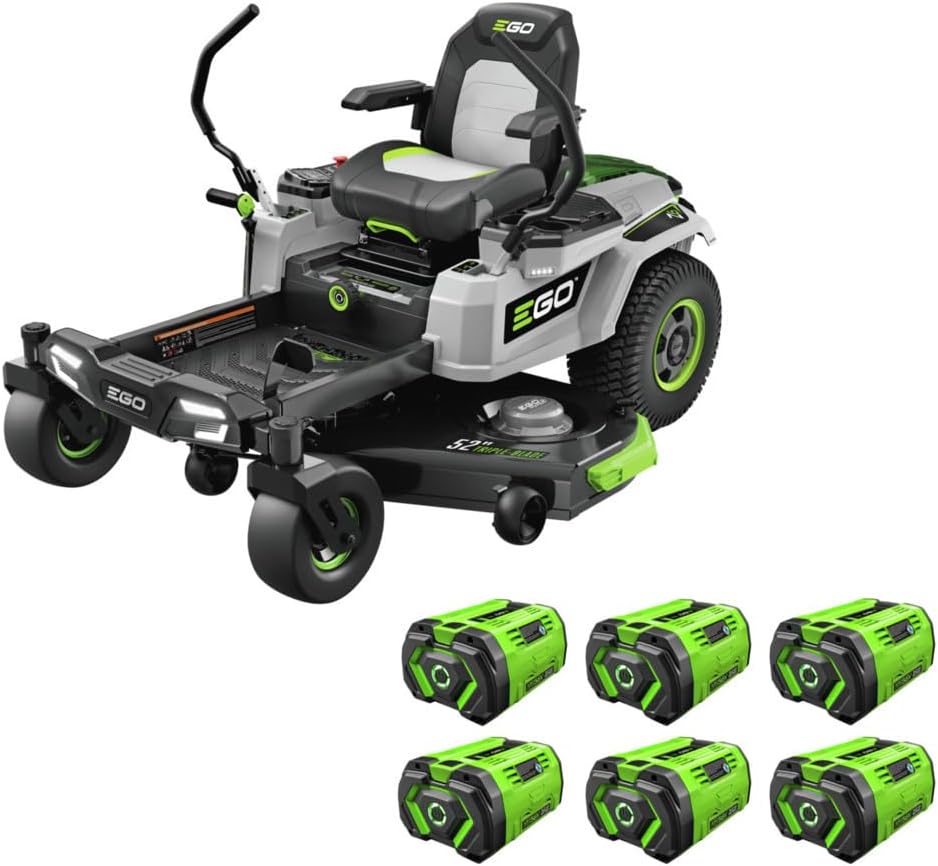
EGO Power+ 52" Z6 Zero-Turn Riding Mower with Six 56V 12.0Ah Batteries
| Power Source | Battery Powered |
|---|---|
| Cutting width | 52 inches |
| Maximum Adjustable Cutting Height | 4.5 inches |
| Minimum Adjustable Cutting Height | 1.5 inches |
| Number of Positions | 10 |
The EGO Power+ 52" Z6 is a full-size battery zero-turn mower designed to replace a gas ZTR for medium to large yards. It pairs a fabricated 52-inch steel deck with five brushless motors and Peak Power+ technology that can draw from up to six included 56V 12.0Ah batteries to deliver roughly 25 horsepower equivalent and a top speed around 8 MPH. Typical use is mowing open lawns and properties up to several acres where zero-turn maneuverability speeds the job. Notable features include an LCD with three drive modes, adjustable seat suspension, LED lights, USB port and a very fast 1600W charger that can refresh all six batteries in about four hours. Practical benefits are quiet operation, low vibration, strong hill and cutting performance comparable to gas, and the ability to cover up to about 4 acres on a single charge with the supplied batteries. Important limitations are the large battery system and charger footprint to store and maintain, the mower's substantial weight which affects storage and transport, and the reliance on the proprietary ARC battery platform if you want the claimed run times.
Best for: Buyers who want a low-noise, low-maintenance zero-turn mower that can handle roughly 2 to 4 acres with gas-comparable power and prefer a proven, safer-for-operators electric alternative.
Less Ideal for: People who need a lightweight, easily trailered machine or who expect the simplest possible ownership without managing multiple high-capacity batteries.
- Battery system (six 56V 12.0Ah batteries included) provides long run time—up to about 4 acres per charge
- Brushless motors and Peak Power+ deliver gas-like 25 HP equivalent performance for cutting and driving
- 52-inch fabricated steel deck gives wide, even cutting for medium-to-large lawns
- Fast 1600W charger can fully charge the six included batteries in roughly four hours
- Comfort and convenience extras such as adjustable seat suspension, LCD drive modes, LED lights and USB port
- Very heavy and bulky, which makes storage and towing more demanding
- Dependence on EGO ARC battery platform increases ongoing storage and maintenance needs
Verdict: For a risk-averse buyer who wants gas-level performance without fumes or constant engine maintenance, this 52" electric zero-turn delivers comparable power and multi-acre range on a single charge.
EGO Power+ TR4204 42" Electric Riding Lawn Tractor

| Power Source | Battery Powered |
|---|---|
| Cutting width | 42 inches |
| Battery Average Life | 60 minutes |
| Maximum Adjustable Cutting Height | 4 inches |
| Number of Positions | 12 |
The EGO Power+ TR4204 is a cordless riding lawn tractor built to replace small gas tractors for yards up to about 1.5 acres. It combines up to six 56V ARC Lithium batteries to produce the equivalent of a 21-horsepower gas engine and runs dual brushless, belt-free cutting motors under a 42-inch stamped steel deck. Typical use is straightforward: charge the included batteries, set one of three blade speeds and one of three drive speeds on the digital display, and mow with cruise control engaged for consistent passes. Notable features include LED lights, USB charging, Bluetooth, anti-scalp wheels, and a rear tow hitch for light hauling. Practical benefits are quiet operation, reduced maintenance from no belts or gas engine upkeep, and modular battery compatibility with other EGO tools. Important limitations are the runtime ceiling—advertised at up to 1.5 acres with six 6.0Ah batteries—which means larger properties will require additional batteries or more frequent charging, and the tractor’s heavier weight and battery system make it less suitable for tight, steep, or highly maneuvered lawn work compared with compact zero-turns.
Best for: Buyers who want to replace a small gas tractor with a low-maintenance, quiet electric riding mower for regular care of roughly one to one and a half acre lawns and who value battery ecosystem flexibility.
Less Ideal for: Those with larger properties well over 1.5 acres or who need high-speed, tight-turning commercial zero-turn capability should consider other options.
- Battery platform compatibility with all EGO 56V ARC Lithium batteries for flexibility and tool ecosystem sharing
- Dual brushless cutting motors and a stamped steel 42-inch deck for gas-like cutting performance with lower maintenance
- Customizable digital controls including three blade settings, three drive speeds, and cruise control for consistent results
- Premium conveniences such as LED lights, USB charging port, Bluetooth, and rear tow hitch for utility beyond mowing
- Advertised single-charge coverage tops out at about 1.5 acres with the included batteries, limiting use on larger properties without extra batteries
- Heavier battery package increases vehicle weight and may be less nimble in very tight or steep yards
Verdict: A practical electric alternative to small gas tractors that delivers gas-like power and low maintenance for lawns up to about 1.5 acres.
GIYI Electric Riding Lawn Mower with 42" Deck and (6) 40V 6.0Ah Batteries

| Power Source | Battery Powered |
|---|---|
| Cutting width | 42 inches |
| Number of Positions | 9 |
| Maximum Adjustable Cutting Height | 4.52 inches |
| Minimum Adjustable Cutting Height | 1.37 inches |
This GIYI electric riding mower is a cordless lawn tractor built to cover roughly an acre per charge using six 40V 6.0Ah lithium-ion batteries and a brushless, belt-free drive. It is typically used for medium to large residential yards where a 42-inch deck and nine cutting-height positions (about 1.5 to 4.5 inches) speed up mowing runs. Notable features include a stamped steel 42" deck, an ergonomically designed low-back seat, a brushless motor that lowers maintenance compared with gas models, and claimed run times of 60 to 80 minutes. In practice the combination of multiple batteries and a 6 mph top mowing speed makes it effective for rolling lawns and modest slopes up to about 15 degrees. Important limitations are its large footprint and weight that require storage space and may complicate transport, and the reliance on multiple battery packs means replacement cost and charging setup should be considered. For buyers prioritizing quiet, low-maintenance cordless operation, it delivers strong coverage; buyers needing commercial runtime or tight zero-turn maneuverability will want different platforms.
Best for: Homeowners with roughly one-acre lawns who want a quiet, low-maintenance cordless riding mower that covers ground quickly and tolerates mild slopes.
Less Ideal for: Commercial users, owners of very steep or tightly contoured properties, or buyers who need tight zero-turn maneuverability and extended continuous runtime.
- Large 42-inch stamped steel deck for faster passes across medium to large yards
- Includes six 40V 6.0Ah batteries providing 60–80 minutes of runtime on a full charge
- Brushless, belt-free motor design reduces routine maintenance and increases durability
- Nine adjustable cutting heights to handle different grass conditions and seasons
- Heavy and bulky unit that needs significant storage space and may be difficult to transport
- Dependence on multiple battery packs increases long-term replacement costs and charging logistics
Verdict: If you want a quiet, low-maintenance cordless riding mower that can cover about an acre per charge, this 42" GIYI model delivers strong residential performance.
EGO Power+ ZT4204L 42" Z6 Electric Zero-Turn Riding Mower with Four 56V 10.0Ah Batteries

| Power Source | Battery Powered |
|---|---|
| Cutting width | 42 inches |
| Number of Positions | 10 |
| Maximum Adjustable Cutting Height | 4.5 inches |
| Battery Included | (4) 10.0Ah |
The EGO Power+ ZT4204L is a full-size electric zero-turn mower designed to replace a gas ZTR for typical residential use. It uses the Z6 platform and ships with four 56V 10.0Ah ARC Lithium batteries and a 1600W charger so you can cut up to about 2 acres per charge out of the box, with the option to add more batteries for longer runs. The mower features four independent brushless motors, a 42-inch stamped-steel deck with 3-in-1 mulching/bagging/side-discharge, and 10 cutting-height positions from 1.5 to 4.5 inches. A user-friendly LCD offers three driving modes and on-board creature comforts such as LED lights, a USB port, and adjustable seat suspension. Practical benefits are quiet operation, little routine maintenance compared with gas, and instant torque that handles typical lawns and moderate inclines. Important limitations are the need to manage battery charging for larger properties and the heavier unit weight compared with small walk-behinds, which affects transport and storage planning.
Best for: Buyers who want a near-gas performance zero-turn for residential yards and value low maintenance, quiet operation, and modern controls backed by visible customer feedback.
Less Ideal for: Not a good fit for buyers who need to cover more than several acres per outing without planning additional batteries or those who frequently need a lightweight, trailer-friendly mower.
- Real gas-equivalent performance via Peak Power+ and four included ARC Lithium batteries
- Zero-turn maneuverability with a 42-inch stamped-steel deck for faster passes on medium to large lawns
- Brushless motors reduce maintenance and deliver consistent torque
- Included charger and four batteries let you mow up to about 2 acres without additional purchases
- User-focused controls and comforts like an LCD with drive modes, LED lights, and USB port
- Upfront weight and footprint make it less convenient to move or store than compact mowers
- Two-hour recharge and battery management are required for larger properties
- Not ideal for properties with very tight storage or frequent trailered transport
Verdict: A full-featured electric zero-turn that delivers gas-like power and residential convenience for homeowners who prefer low-maintenance, battery-powered mowing.
Choosing the Right Riding Lawn Mower for Picking Up Leaves: Key Factors to Consider
Collection Capacity and Hopper Size
How much leaf volume a mower can hold between dumps has a dramatic effect on how quickly you finish a cleanup. Larger hoppers let you make fewer stops to empty, which is especially important on medium and large properties where travel time to a dump spot cuts into productivity. Capacity also influences overall weight and handling when full, so consider whether the machine remains stable and steerable with a full load.
Think about realistic leaf volume for your yard. Wet, compacted leaves take up less space but increase weight, while dry, fluffy leaves fill hoppers faster. Choose capacity based on the amount you typically collect rather than theoretical maximums.
Collection System Design
Different systems move leaves from the deck into the hopper in different ways. Suction-style collectors and impeller-driven blowers can pull a lot of material quickly, while chute-into-trailer setups rely on belt and fan speed. The effectiveness of the system determines how much raking or follow-up passes you will need.
Also consider whether the system handles wet leaves, twigs, and small branches without clogging. Designs that allow easy access for clearing blockages and that minimize wet-leaf compaction will save time and reduce frustration during fall cleanup.
Maneuverability and Turning Radius
Leaf pickup often requires navigating around trees, flower beds, and tight corners. A mower with a tight turning radius, responsive steering, and good visibility from the operator seat will let you follow lawn edges and collect close to obstacles without repeated repositioning.
Steering geometry and wheelbase affect how the machine behaves when the hopper is full. Test or evaluate how steering feels under load because some machines track fine empty but become sluggish when carrying a heavy leaf load.
Engine Power and Torque
Pulling large volumes of leaves into a collection system or operating auxiliary blowers places sustained demands on the engine. Peak horsepower matters less than steady torque at low revs, which keeps fans, belts, and collectors moving without stalling or bogging down.
Look for engines and drivetrains rated for accessory loads and frequent starts and stops. On slopes or with heavy, wet leaf loads, extra torque prevents slowdowns and helps maintain throughput across the yard.
Maintenance, Clearing, and Durability
Leaf collection exposes decks, chutes, and hoppers to damp plant material that can accelerate wear and corrosion. Consider how easy it is to access and clean collection passages, replace belts or impellers, and inspect the underside of the deck. Simple, tool-free access to commonly clogged areas shortens downtime.
Also factor in build quality of the hopper and fasteners. Corrosion-resistant materials and replaceable wear items extend service life through multiple seasons of heavy leaf work.
Best Use Cases by Yard Size
Different machine features suit different property sizes. For small yards with scattered trees, tight maneuverability and a small but quick-to-empty hopper often beat sheer capacity. On medium-sized lawns, look for a balance between capacity and steering responsiveness so you can cover ground without frequent unloads. Large properties benefit from the largest practical hopper and robust collection systems to keep stops to a minimum and maintain a steady workflow.
Think about access and storage. A very large hopper may be ideal for acreage but can make the machine harder to store or transport. Match the mower to the scale of your leaf problem and the physical constraints of your property.
- Small yards: prioritize tight turning radius and easy-empty hoppers
- Medium yards: balance capacity with maneuverability
- Large yards: favor larger collection capacity and durable collection systems
Attachment and Collection Options
Riding lawn mowers accept different attachment types for leaf pickup. Integrated collection hoppers, rear-mounted carts, and vacuum/blower attachments each have tradeoffs in capacity, clogging risk, and ease of mounting. Rear carts provide simple, high-volume storage but may require repositioning for emptying. Vacuum attachments can be more efficient at pulling leaves from the deck but are susceptible to clogging with wet material.
Choose attachments that match the typical leaf conditions in your yard. If you regularly deal with wet leaves and twigs, prefer designs with larger passages and easy-clear access. Consider how attachments mount and whether you can add or remove them without tools.
- Rear carts: large volume, simple but bulkier
- Vacuum/impeller systems: efficient pickup, higher clog risk
- Mulching decks: reduce volume but may require multiple passes
Operating Tips to Improve Leaf Pickup
Adjust cutting height and speed for best pickup. Raising the deck slightly can help the airflow pull leaves into the collection system rather than chopping them into the turf. Slower ground speed increases collection efficiency but lengthens total job time; find the sweet spot where the hopper fills steadily without excessive stops.
Work with wind direction and in narrower swaths when leaves are deep. Overlapping passes and avoiding abrupt turns while unloading reduce spillage. Regularly clear chutes and check impellers to prevent buildup that will reduce suction and slow progress.
- Raise deck slightly in heavy-leaf conditions
- Match ground speed to collection rate
- Clear chutes frequently to avoid clogs
Storage and Winter Care After Leaf Season
After heavy use, clean the hopper, chutes, and deck to remove damp, decomposing leaf matter. Allow components to dry before storage to limit corrosion. Lubricate linkages and inspect belts and fasteners for wear that may have been accelerated by abrasive leaf debris.
Consider storing removable attachments under cover and away from moisture. If you used a collection attachment with screens or filters, inspect and replace any damaged elements so the system is ready next fall.
- Thoroughly clean and dry collection components
- Inspect belts, impellers, and fasteners
- Store removable attachments indoors if possible
Safety Considerations When Collecting Leaves
Leaves can hide hazards such as rocks, branches, and garden tools. Walk the area first and remove visible obstructions to protect blades, impellers, and collectors. Wear hearing and eye protection when operating vacuum or blower attachments because they can eject debris at high speed.
Be mindful of slope and load distribution. A full hopper raises the center of gravity and can change the stability of the mower on slopes. If your yard has steep sections, empty more frequently and avoid carrying a full hopper on steep grades.
- Inspect area before mowing to remove hidden hazards
- Use personal protective equipment when operating attachments
- Empty hoppers more often on slopes to maintain stability
How We Chose the Best Riding Lawn Mower for Picking Up Leaves
We focused on features and performance that matter specifically when using a riding lawn mower for picking up leaves. Selection began by filtering for machines with dedicated collection options or efficient mulching/discharge setups that handle high-volume leaf loads. We prioritized collection capacity and the quality of the collection system, since frequent unloading undermines productivity on larger properties. Maneuverability around beds, trees, and tight turns received heavy weight because leaf pickup often requires careful routing and frequent direction changes. Engine and transmission choices were considered for consistent power when pulling heavy leaf loads and attachments. Durability of chassis and decks was included because leaf collection can add corrosive moisture and debris exposure. We excluded machines that lack any practical collection method or that are underspecified for medium to large yards. The final list balances capacity, handling, durability, and practical maintenance needs so gardeners can pick machines that actually make leaf collection faster and less labor intensive.
FAQ
Can a riding lawn mower pick up wet leaves effectively?
Wet leaves are heavier and more likely to compact, which reduces hopper capacity and can increase clogging risk. Some collection systems handle wet leaves better than others, but you will usually need to slow down, empty more often, and clear chutes more frequently when conditions are damp.
Is a dedicated vacuum attachment necessary for good leaf pickup?
A vacuum attachment can improve pickup efficiency, especially for dense leaf layers, but it is not strictly necessary. Large-capacity hoppers and efficient deck-to-hopper routing can also perform well. The best choice depends on leaf volume, debris type, and how often you want to stop to empty.
How often should I empty the hopper during a typical fall cleanup?
Emptying frequency depends on hopper capacity and leaf density. Small hoppers may need emptying every few minutes on heavy days, while large systems can run much longer. Expect to empty more often with wet or compacted leaves and plan routes to minimize travel time to dumping points.
Will leaf pickup damage the lawn if I use a riding mower?
Proper deck height and moderate ground speed reduce turf damage. Avoid running too low in leaf-covered lawns and take care on wet grass, where blades and turf are more prone to scalping. Good technique prevents damage while still collecting leaves efficiently.
What maintenance matters most after a season of leaf collection?
Cleaning and drying collection components, inspecting belts and impellers for wear, and lubricating exposed linkages are the priority tasks. Removing trapped leaf material and addressing any corrosion early prevents bigger repairs and keeps the system reliable for the next season.
Final Verdict
When choosing a riding lawn mower for picking up leaves, prioritize collection capacity and the efficiency of the collection system for your yard size. Balance those needs with maneuverability and an engine capable of maintaining airflow and impeller speed under load. Expect tradeoffs: the largest hoppers reduce stops but add weight and storage needs, while compact systems are easier to maneuver but require more frequent emptying. Focus on the factors discussed here to match a machine to your leaf volume and property layout so fall cleanup becomes faster and less physically demanding.
