

Note: This article contains affiliate links. If you click on these links and make a purchase, I may earn a small commission at no extra cost to you. This helps support my research and content. Read my full affiliate disclosure here.
Choosing the right rolling compost bin makes backyard composting less work and more consistent. A well-designed tumbling or rolling composter speeds decomposition, reduces odors, and cuts the physical effort of turning. This guide covers six shortlisted rolling compost bins suited to patios, small yards, and larger home gardens. We evaluated capacity, aeration, durability, and ease of use so you can pick a unit that fits your space and composting routine. Read on for practical buying details and what to expect in everyday garden use.
Top Picks at a Glance
| Best Overall The best all-around choice for most situations | Maygrove 53-Gallon Dual-Chamber Outdoor Compost Tumbler |  |
| Best Quality Built to a higher standard if you want something more solid | VIVOSUN Outdoor Tumbling Composter, Dual-Chamber 43 Gallon |  |
| Best Value The sweet spot between price and what you get | F2C 43‑Gallon Dual‑Chamber Rotating Compost Bin with Steel Frame |  |
| Best Budget The cheapest option that still gets the job done reliably | Saicool 43-Gallon Dual-Chamber Rotating Compost Tumbler with Sliding Door |  |
| Highest Rated A top-rated pick with lots of positive feedback | Cozurra 45‑Gallon Dual‑Chamber Compost Tumbler |  |
| Most Popular A crowd favorite that many people choose with confidence | Miracle-Gro Dual Chamber Compost Tumbler (2 × 18.5 gal) |  |
Maygrove 53-Gallon Dual-Chamber Outdoor Compost Tumbler

| Capacity | 53 gallons |
|---|---|
| Material Type | Polypropylene + Steel |
The Maygrove 53-gallon dual-chamber compost tumbler is built for continuous backyard composting and frequent use. Its 360-degree rotating drum with internal mixing bars makes turning effortless and more thorough than manual raking, while the gear-assist handle and dual-direction braking keep rotation smooth and stable when loaded. Adjustable air vents and a sturdy steel frame with UV-resistant polypropylene drum allow you to manage airflow, moisture, and temperature to speed decomposition and reduce odors. Large sliding doors simplify loading kitchen scraps and harvesting finished compost, and the included waterproof thermometer plus 3-in-1 soil tester help you track pile conditions and readiness. Assembly is mostly snap-together with only a few screws, so setup is quick. Expect a durable, low-maintenance system that produces usable compost in typical backyard cycles, though the unit is a fixed-capacity tumbler so very large households or sites producing heavy volumes of yard waste may need multiple units or a larger system. The design prioritizes ease of use, monitoring, and steady performance for routine home gardening needs.
Best for: A gardener who wants a low-effort, continuous composting solution that emphasizes easy turning, monitoring, and regular backyard use. Ideal for homeowners who value convenience and producing consistent compost for flower beds or vegetable plots.
Less Ideal for: Not the best choice for community composting sites or very large properties that need higher volume or open-windrow systems.
- Dual-chamber design lets you add fresh material to one side while the other finishes composting for continuous use.
- 360-degree tumbling with internal mixing bars and gear-assist handle reduces manual turning and improves mixing.
- Adjustable vents plus included waterproof thermometer and 3-in-1 soil tester let you monitor and control compost conditions.
- Large sliding doors and reinforced legs make loading and harvesting straightforward and stable.
- Durable construction combining steel frame and UV-resistant polypropylene resists weathering and drum sagging.
- Fixed 53-gallon capacity may be limiting for very large gardens or households producing high volumes of waste.
- Made primarily of plastic components that could degrade over many years in harsh climates despite UV resistance.
Verdict: If you want a fuss-free, continuously usable tumbler that simplifies turning and monitoring, this 53-gallon dual-chamber Maygrove composter is a strong choice.
VIVOSUN Outdoor Tumbling Composter, Dual-Chamber 43 Gallon
| Material Type | galvanized steel |
|---|---|
| Capacity | 43 gallons |
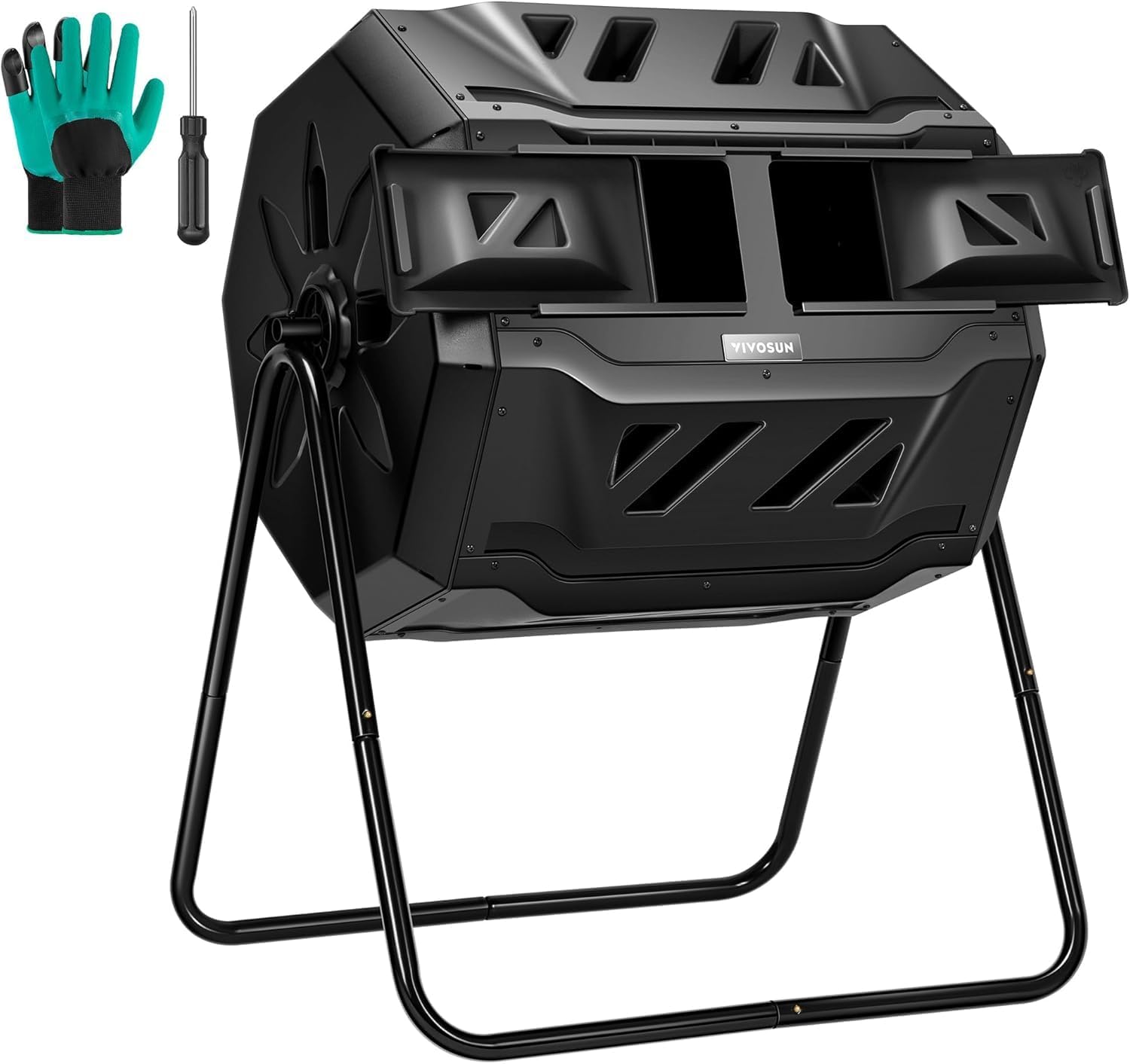
This VIVOSUN tumbling composter is a practical backyard unit built around two rotating chambers so you can add fresh waste to one side while the other finishes breaking down. The 360 degree tumbling design with deep internal fins makes turning the pile simple and helps break up clumps without digging. Ventilation slots around the drum promote airflow for aerobic decomposition, and the metal frame with a PP plastic barrel is designed to resist corrosion and outdoor weathering. It comes with waterproof garden gloves and small digging claws to make loading and aerating easier. At 43 gallons it is sized for a family garden or vegetable patch but is compact enough for a patio or small yard. Limitations to note are that it requires occasional manual turning to maintain activity and that the plastic drum means it will warm less in cold climates than insulated models, so composting speed will vary by season. Assembly and placement on a level spot are also important for smooth rotation.
Best for: Gardeners who want a hands-on, efficient system to produce regular batches of compost without digging a pile and who prioritize continuous output and easy turning.
Less Ideal for: People who need a completely hands-off hot composter or who compost only very large volumes; those in very cold climates seeking year-round rapid breakdown should consider insulated or electric options.
- Dual chambers let you load new material while another batch finishes, ensuring continuous compost production
- 360 degree tumbling with deep fins makes mixing and aeration easy without manual digging
- Galvanized steel frame and PP plastic barrel designed for outdoor durability and corrosion resistance
- Ventilation slots support aerobic breakdown for faster, less smelly composting
- Plastic drum offers less insulation than insulated or fully metal units, slowing composting in cold weather
- Requires manual turning and regular management to maintain heat and moisture for fast results
Verdict: If you want steady, manageable batches of compost with easy tumbling and continuous use, this dual-chamber VIVOSUN tumbler delivers practical, durable performance.
F2C 43‑Gallon Dual‑Chamber Rotating Compost Bin with Steel Frame

| Capacity | 43 gallons |
|---|---|
| Material Type | PP and powder-coated steel |
This F2C 43‑gallon dual‑chamber tumbler is built to make backyard composting more efficient and less fussy. The two separate chambers let you keep finished compost on one side while adding fresh scraps to the other, so you do not need to wait to harvest usable material. The barrel has aeration holes and internal fins to break up clumps and introduce oxygen while the black exterior helps absorb heat to speed decomposition. Assembly is straightforward with included hardware and basic tools, and the powder‑coated steel frame plus interlocking PP panels provide decent stability when spinning. The sliding access doors make it simple to add or remove material without disassembling the barrel. Expect faster results than a stationary bin, but plan to turn the tumbler and monitor moisture for best performance. It is compact enough for typical yards but not suited for large-scale or heavy wet loads, and moving a full chamber requires effort despite the rotating design.
Best for: Home gardeners who want a compact, efficient system to speed backyard composting and prefer a practical setup that reduces downtime between batches.
Less Ideal for: People managing large quantities of yard waste or those who need a low‑effort, stationary hot compost system for commercial or very large‑scale beds.
- Dual chambers let you harvest finished compost while continuing to add new material
- Aeration holes and internal fins improve oxygen mixing and reduce clumping
- Powder‑coated steel frame with interlocking PP panels gives stable construction
- Sliding doors provide easy access for adding scraps and removing finished compost
- Rotating a full chamber can be physically demanding for some users
- Capacity (43 gallons) may be small for very large gardens or heavy organic waste streams
Verdict: Choose this dual‑chamber rotating tumbler if you want a space‑saving, faster backyard composter that lets you produce usable compost more continuously.
Saicool 43-Gallon Dual-Chamber Rotating Compost Tumbler with Sliding Door

| Capacity | 43 gallons |
|---|---|
| Material Type | PP, Steel |
This Saicool 43-gallon dual-chamber compost tumbler is designed to give gardeners a simple, low-maintenance way to turn yard and kitchen scraps into usable compost. The rotating barrels and dual-chamber layout let you load one side while the other side finishes breaking down, so you get a near-continuous supply of finished compost without mixing wet piles on the ground. Construction combines UV-protected polypropylene drums with a steel frame for weather resistance and stability. A sliding door and latch make adding material and removing finished compost straightforward, and the tumbling action improves aeration so decomposition proceeds faster than a static bin. It is sized for small to medium gardens and handles a meaningful amount of waste without taking up much space. Expect to manage occasional odor or moisture by balancing greens and browns, and know that assembly and periodic tumbling require some effort compared with passive bins. For buyers watching their budget, this model delivers core composting performance without specialty extras.
Best for: For gardeners who want an affordable, space-efficient way to convert kitchen scraps and garden trimmings into usable compost and prefer a faster, active system over passive piles.
Less Ideal for: Not a good fit for landscapers or very large properties that need to process bulk yard waste or for buyers who want a maintenance-free, no-turn bin.
- Dual-chamber design enables continuous composting by letting one side cure while the other is loaded
- Rotating tumbler improves aeration and speeds up decomposition compared with static bins
- UV-protected polypropylene drum and steel frame offer reasonable weather resistance
- Sliding door and latch simplify adding materials and harvesting finished compost
- Requires periodic manual tumbling and assembly effort
- Not suitable for very large volumes of yard waste from big properties
Verdict: A budget-friendly dual-chamber tumbler that gives small and medium gardens continuous, faster composting without costly extras.
Cozurra 45‑Gallon Dual‑Chamber Compost Tumbler

| Capacity | 45 gallons |
|---|---|
| Material Type | Polypropylene (PP) |
This Cozurra compost tumbler is a dual‑chamber, 45‑gallon spinner built to make backyard composting straightforward. You use one chamber for fresh scraps while the other side breaks down, so you can produce compost continuously without waiting to empty a single bin. Rotation is easy thanks to the 360° tumbling system and interior mixing ribs that break up clumps and improve aeration; adjustable vents further help control moisture and odors. The unit snaps together for tool‑free assembly and sits on a reinforced steel frame for stability when turning. Constructed from BPA‑free polypropylene, it resists weathering and is sized to handle kitchen waste, grass clippings, and leaves for an average household. Limitations to note are that plastic construction can feel less heavy‑duty than metal alternatives and the two smaller 22.5‑gallon chambers may require frequent turning in very large gardens to keep decomposition active. The tumbler works best when you follow recommended turning and moisture guidelines to speed composting and avoid smells.
Best for: A gardener who wants an easy, low‑effort system to convert kitchen and yard waste into usable compost on a regular schedule and values continuous output over maximum single‑load capacity.
Less Ideal for: Large properties or commercial users who need very high single‑batch capacity or a metal industrial tumbler should consider heavier duty alternatives.
- Dual 22.5‑gallon chambers allow continuous composting without downtime
- 360° tumbling with internal mixing ribs makes turning simple and improves breakdown
- Adjustable vents and airflow control reduce odors and help regulate moisture
- Snap‑together assembly and ergonomic openings simplify setup and loading
- Weather‑resistant BPA‑free polypropylene on a reinforced steel frame for year‑round outdoor use
- Plastic body is less robust than heavy gauge metal and may be more prone to UV wear over many years
- Total capacity split across two chambers means each chamber fills faster than a single large drum
Verdict: Choose this dual‑chamber Cozurra tumbler if you want a simple, weather‑resistant spinner that makes continuous home composting easy and low maintenance.
Miracle-Gro Dual Chamber Compost Tumbler (2 × 18.5 gal)

| Capacity | 37 gallons |
|---|---|
| Material Type | Alloy Steel (frame) and UV-protected plastic (barrel) |
This dual-chamber Miracle-Gro tumbler is a user-friendly solution for gardeners who want a steady supply of finished compost without manual turning. Each chamber holds 18.5 gallons, so you can load one side while the other finishes curing; the barrel rotates on a galvanized steel frame for easy turning and faster aeration. The molded, UV-protected plastic and side-locking seals are designed to resist weather and help keep pests out, and the maker claims finished compost in roughly 4 to 6 weeks under good conditions. Typical use is adding balanced green and brown materials, rotating the tumbler every few days, then unlocking the sliding door to remove cured compost. Practical benefits include reduced physical labor compared with pile turning and a continuous workflow from dual chambers. Limitations to note are modest total capacity for very large gardens and reliance on correct moisture and feedstock balance to hit the faster decomposition times; very cold winters will slow processing. Assembly and placement on a level spot are important for smooth rotation.
Best for: Gardeners who value steady, low-effort compost production backed by a well-known brand and want the assurance of a proven dual-chamber system for regular use.
Less Ideal for: People needing very large-volume commercial composting or those who prefer an open windrow or in-ground hot compost system for maximum throughput.
- Dual-chamber design lets you add fresh material while another batch cures for continuous compost supply
- Rotating barrel on a galvanized steel frame makes aeration easy with minimal physical effort
- UV-protected plastic and tight side locks help resist weather and reduce pest access
- Produces finished compost relatively quickly when fed and moistened correctly
- 37-gallon combined capacity may be small for very large or heavy-production gardens
- Performance depends on proper moisture, material mix, and ambient temperature to reach claimed speed
Verdict: Choose this dual-chamber tumbler if you want a simple, low-labor way to produce a steady stream of finished garden compost with reliable pest protection.
Choosing the Right Rolling Compost Bin: Key Factors to Consider
Container Capacity
Capacity determines how much organic material you can compost in a single batch and how often you must empty or turn the bin. Larger containers let you build sizeable hot compost piles that maintain heat longer, which speeds decomposition and kills weed seeds. However, very large drums can be heavy to move when full and may be harder to turn without a good axle or handle design.
Think about the volume of kitchen scraps and yard trimmings you produce each week. If you have a small household or limited space, a modest capacity helps maintain manageable batches. For families or gardeners producing more waste, a larger capacity reduces the frequency of emptying but requires sturdier rolling mechanisms and a stable base.
Aeration and Mixing Design
Good airflow and reliable mixing are essential to keep compost active and odor-free. Look for rolling bins with internal vanes, perforations, or a design that forces materials to tumble and exchange outer and inner layers as the drum rotates. Passive vents are helpful, but active mixing from tumbling usually produces faster, more uniform decomposition.
Poor aeration leads to anaerobic pockets and unpleasant smells, while overly large or poorly placed vents can allow pests or excessive moisture loss. A balanced design will allow oxygen in without exposing the pile to the elements or rodents.
Materials and Weather Resistance
Materials affect longevity and maintenance. UV-stabilized plastics resist cracking and fading when exposed to sun, while powder-coated or galvanized metals provide structural strength but can corrode over time if not treated. Joints and fastenings should be robust enough to withstand repeated rolling and the weight of a full batch.
Consider how exposed your bin will be to sun, wind, and winter conditions. If you live in an area with freezing winters, choose materials and seals that tolerate temperature swings without splitting. Removable parts should remain functional after repeated cleaning and moisture exposure.
Ease of Access and Maintenance
Routine access to add scraps, check moisture levels, and remove finished compost should be straightforward. Wide openings, hinged lids, and accessible chutes or doors for finished compost make life easier. A bin that requires awkward lifting to empty will discourage regular use.
Maintenance includes cleaning out residue, unclogging vents, and replacing small parts. Simple fasteners and accessible panels reduce the time you spend on upkeep. Consider whether you can operate lid locks and turning handles comfortably while wearing gardening gloves.
Stability and Turning Effort
How easily the bin rolls and how stable it remains when full are practical safety and usability concerns. A smooth, well-supported axle with low-friction bearings reduces the effort required to tumble a batch. Look for stoppers or footings that hold the drum steady during loading and when parked.
If a unit wobbles or tips when partially full, it can spill material and be difficult to manage. Consider whether two people will be required to turn larger drums or if the mechanism allows one-person operation.
Choosing the Right Size for Your Space
Match bin volume to both your waste output and the available footprint. A rolling bin that fits through gates and onto a patio is more likely to be used regularly than one that needs disassembly to move.
If you garden intensively and collect yard trimmings, choose a larger capacity and check that the turning mechanism remains operable when the drum is full. For balcony or small-patio composting, compact tumblers with smaller batches are a better fit and keep odors under control.
- Measure gate and storage area width before choosing a unit.
- Factor in clearance for turning handles and lid access.
Placement and Microclimate Considerations
Placement affects decomposition speed. A spot with morning sun and afternoon shade helps maintain warmth without drying the pile out. Avoid low, soggy areas where water can pond around the base.
Good airflow around the bin helps aeration, and placing it on a firm, level surface improves stability. If rodents are a local problem, keep the unit away from dense brush and seal gaps at the base.
- Elevate the bin slightly on a paved or gravel pad to improve drainage.
- Allow space for turning and for loading green and brown materials.
Managing Moisture and Carbon-to-Nitrogen Balance
Rolling compost bins are less forgiving of very wet inputs because the tumbling action can pack materials and create anaerobic patches. Balance wet kitchen scraps with dry carbon sources like shredded cardboard, straw, or dry leaves to keep the mix crumbly.
Check moisture by squeezing a handful; it should feel like a damp sponge, not dripping. If the drum is too wet, open vents and add dry material. If it is too dry, add small amounts of water and continue tumbling to distribute moisture.
- Aim for a 25-30:1 carbon-to-nitrogen ratio by volume; adjust with browns when adding many food scraps.
- Turn more frequently if you add a high proportion of wet materials.
Winter Use and Cold-Climate Tips
Composting slows in cold weather, but a well-insulated, full drum can retain heat. In winter climates, keep the bin sheltered from wind and consider increasing batch size to retain warmth. Adding more brown material helps maintain structure and reduces freezing of wet pockets.
If you need compost year-round, position the bin where it gets maximum midday sun and avoid opening it on the coldest days to preserve internal temperature. Frequent turning may be less effective when temperatures are low, so patience is required.
- Use darker-colored drums or place the unit in sun to capture thermal gain.
- Avoid leaving exposed wet material on top that can freeze and block vents.
Pest Prevention and Hygiene
A rolling compost bin can reduce pest access compared with open piles, but pests still take advantage of gaps. Secure lids, tight-fitting access doors, and fine-mesh vents keep rodents out while allowing airflow. Avoid adding meat or dairy to most home bins to reduce attraction.
Routine cleaning of collection trays and wiping down high-contact parts prevents residue buildup. If you suspect pests, inspect seals and vent openings and adjust placement away from hedges or compost-attracting areas.
- Use a layer of browns on top after adding food scraps to mask odors.
- Inspect seals seasonally and replace worn gaskets if available.
How We Chose the Best Rolling Compost Bin
We focused on features that affect how a rolling compost bin performs in a real home garden. Primary evaluation criteria included container capacity and turnover efficiency, which determine how much kitchen and yard waste you can process and how quickly materials reach usable compost. Aeration and mixing design were judged for their contribution to oxygen flow and how much manual work is needed to keep a batch active. Materials and construction assessed resistance to weather, cracking, and pest entry during seasons of use. Ease of access and maintenance covered how simple it is to add scraps, remove finished compost, and clean the unit. Stability and mounting addressed how steadily the bin rolls and whether it resists accidental tipping when full. We excluded units that are essentially static bins without a rolling or tumbling mechanism, and any designs intended strictly for industrial or large-farm use. We prioritized options that are practical for home gardeners, patio users, and small-yard situations. The resulting list highlights models that balance capacity, turning ease, and weatherproof materials while remaining manageable for one or two people to operate.
FAQ
How often should I roll a compost drum?
Often depends on batch size and materials. For small household batches, tumbling two to three times per week keeps materials aerobic. Larger or densely packed drums may benefit from daily short turns to maintain mixing and prevent clumping.
Can I compost meat or dairy in a rolling bin?
Usually it is best to avoid meat and dairy in most home rolling bins because they attract pests and create strong odors. Some dedicated systems designed for more aggressive decomposition can handle small amounts, but for safety and cleanliness, stick to plant-based scraps when possible.
What should I do if my bin smells bad?
Bad odors usually mean anaerobic conditions or too much wet nitrogen-rich material. Add dry carbon-rich materials like shredded cardboard or leaves, open vents if possible, and increase tumbling frequency to reintroduce oxygen. Avoid adding more wet scraps until balance returns.
How do I remove finished compost from a rolling bin?
Many rolling designs include a bottom hatch or removable drum end for easy access. Let the batch cool and settle, then open the access panel and shovel or scoop out finished compost. For units without bottom access, rotate the drum so the finished material rests against the opening before removing it.
Will a rolling bin work on a balcony or patio?
Yes, compact rolling tumblers are well suited to balconies and patios because they contain material and control odors. Choose a model sized for limited space, check weight limits for decking, and place it on a stable surface that can handle occasional moisture.
Final Verdict
A rolling compost bin can transform kitchen scraps and yard trimmings into usable soil amendment with less physical effort than manual turning. Prioritize the capacity and aeration design that match how much waste you produce and how often you will manage the batch. Durable materials and easy access make regular use and maintenance straightforward. Balance the tradeoffs between size, turning effort, and placement so you end up with a practical, reliable composter that fits your garden routine.
