

Note: This article contains affiliate links. If you click on these links and make a purchase, I may earn a small commission at no extra cost to you. This helps support my research and content. Read my full affiliate disclosure here.
Moss growing on a roof can trap moisture, shorten shingle life, and make walkways beneath slippery after rain. Choosing the right roof moss killer matters because products differ in active chemistry, contact time, and how gently they affect shingles, gutters, and nearby plants. This guide covers six shortlisted roof moss killer options gardeners and homeowners commonly consider, and explains the practical tradeoffs between speed, safety, and how long control lasts. Below you will find the top picks and a clear explanation of why each type of product might suit your roof, plus the application and safety details we used to evaluate them.
Top Picks at a Glance
| Best Overall The best all-around choice for most situations | Wet & Forget Outdoor Cleaner Concentrate, 128 oz |  |
| Best Quality Built to a higher standard if you want something more solid | Wash Safe Roof Wash Concentrated Powder Roof Cleaner, 10 lb |  |
| Best Value The sweet spot between price and what you get | Wet & Forget Xtreme Reach Hose-End Cleaner, 48 oz |  |
| Best Budget The cheapest option that still gets the job done reliably | Lilly Miller Moss Out for Roofs, 27 fl oz Ready-to-Spray |  |
| Most Popular A crowd favorite that many people choose with confidence | 30 SECONDS Outdoor Cleaner 64 fl oz (Pack of 3) with Hose-End Sprayer |  |
| Best Seller A high-volume bestseller chosen again and again | 30 SECONDS Outdoor Cleaner 2-Pack with Hose-End Sprayer |  |
Wet & Forget Outdoor Cleaner Concentrate, 128 oz

| Volume | 128 oz |
|---|---|
| Mix ratio | 1 part product to 5 parts water |
| Coverage (approx.) | 750 – 2,250 sq. ft. depending on surface |
| Application method | Garden sprayer; no rinsing required |
Wet & Forget Outdoor Cleaner is a gallon concentrate intended for treating green and black stains caused by moss, mold, mildew, and algae on outdoor surfaces without scrubbing or pressure washing. You dilute one part concentrate to five parts water in a pump-up garden sprayer, saturate a dry surface on a cool day, and leave it to work with wind and rain; green stains often clear in a few days to weeks while older black stains can take months. It is advertised as safe on many surfaces including roofs, siding, decks, patios, brick, and concrete and contains no bleach, so it avoids the harsh odor and immediate surface damage that some bleach-based products cause. The long working window and no-rinse approach make it low-effort for large areas, and a gallon concentrate makes multiple gallons of working solution to cover hundreds to a couple thousand square feet depending on porosity. The main limitation is patience: heavy or long-established stains require repeated applications and many months to fully disappear, and results depend on weather and surface porosity.
Best for: Buyers who want a low-effort, wide-area solution for moss and algae that relies on gradual, weather-assisted cleaning and prefer proven user experiences when choosing a product.
Less Ideal for: People who need immediate, visible results or who require a one-time, fast solution for stubborn stains should consider faster-acting mechanical or bleach-based treatments instead.
- Concentrated formula mixes 1:5 to treat large areas from a single bottle
- Works without scrubbing, rinsing, or pressure washing
- Non-bleach formulation reduces risk of immediate surface discoloration or odor
- Safe for a wide range of outdoor surfaces including roofs, siding, decks, and concrete
- Slow to fully remove heavy or long-established black stains, sometimes taking several months
- Effectiveness depends on rainfall and weather so results are variable
- Requires patience and occasional reapplication to maintain results
Verdict: Choose Wet & Forget when you want a low-effort, non-bleach concentrate that slowly eliminates moss and algae across large outdoor surfaces with minimal labor.
Wash Safe Roof Wash Concentrated Powder Roof Cleaner, 10 lb

| Item Form | Powder |
|---|---|
| Specific Uses For Product | Roof, Tile |
| Material Features | Biodegradable |
| Special Features | Concentrated |
| Scent | Cedar |
Wash Safe Roof Wash is a concentrated, oxygen-based powder intended for large-scale roof cleaning where strong stain removal is required. You dissolve the powder in warm water, let the solution activate, then apply with a pump sprayer or mechanical applicator and rinse with a pressure washer for fastest results. The formula is bleach-free and biodegradable, so it is safe around plants, pets and people and breaks down within hours after application. Coverage claims are generous — the 10 lb bucket makes up to 40 gallons of solution and is sized for roofs up to about 10,000 sq ft — which makes this product useful for contractors and homeowners with large roofs. Practical limitations are that it requires mixing and consistent stirring to activate, a sprayer or pump for even coverage, and a pressure washer or sufficient rainfall to complete rinsing; it is not a one-step liquid ready-to-use product. Follow safety directions for masking windows and avoid mixing with other chemicals.
Best for: Buyers who prioritize effective, contractor-grade stain and algae removal on large roofs and who are comfortable mixing concentrates and using sprayers and pressure washers.
Less Ideal for: Casual DIYers looking for a ready-to-use spray or those with very small roofs who want minimal setup and no chemical mixing.
- Concentrated powder covers large areas (10 lb treats up to 10,000 sq ft) for contractor-scale jobs
- Oxygen-based, bleach-free formula that is biodegradable and safer around plants and pets
- Works on a wide range of roofing materials including asphalt, metal, tile, wood shake and composite
- Can be applied with common equipment (pump sprayer and pressure washer) for fast, visible results
- Requires mixing, stirring and correct dilution to activate which adds prep time
- Best results rely on a pressure washer or multiple applications rather than simple spray-and-wait
Verdict: A concentrated, contractor-grade, bleach-free roof cleaner designed to remove moss, algae and black streaks on large roofs while being safer for plants and people.
Wet & Forget Xtreme Reach Hose-End Cleaner, 48 oz

| Item Form | Liquid |
|---|---|
| Item Volume | 48 fluid ounces |
| Surface Recommendation | Glass |
| Specific Uses For Product | All Purpose |
Wet & Forget Xtreme Reach is a 48 oz hose‑end cleaner made for treating moss, mold, mildew, and algae on roofs and other exterior surfaces without scrubbing. The bottle attaches to a garden hose and has a jet tip that can spray up to 30 feet for high or hard‑to‑reach areas and a fan tip for large flat surfaces like driveways and patios. It is bleach‑free and formulated to work gradually as wind and rain carry the product and lift stains; green growth often fades within a few weeks while darker or long‑established stains can take months to fully clear. One bottle covers up to about 2,000 sq ft depending on surface porosity and stain severity. The main advantages are easy application and reduced ladder work, but the gradual action means you need patience and may require repeat yearly treatments for persistent infestations. Also take care to avoid runoff into water features and follow surface and weather recommendations for best results.
Best for: Homeowners who want a low‑effort, ladder‑minimizing way to control roof and siding moss and algae and who prioritize easy application over fast results.
Less Ideal for: People needing immediate, dramatic removal of deeply rooted stains or professional roof restorers who require fast, aggressive treatments.
- Hose‑end nozzle sprays up to 30 ft for treating second‑story siding and roofs without ladders
- Bleach‑free formula safe for common outdoor surfaces including roofs, siding, decks, and concrete
- Fan tip option speeds coverage of large surfaces like driveways and patios
- Covers up to 2,000 square feet per bottle under typical conditions
- Works gradually so heavy or long‑standing black stains can take many months to disappear
- Effectiveness depends on weather and may require repeat annual applications
Verdict: Choose this hose‑end treatment if you want a bleach‑free, easy application that reduces ladder work and keeps roofs and siding clear over time.
Lilly Miller Moss Out for Roofs, 27 fl oz Ready-to-Spray
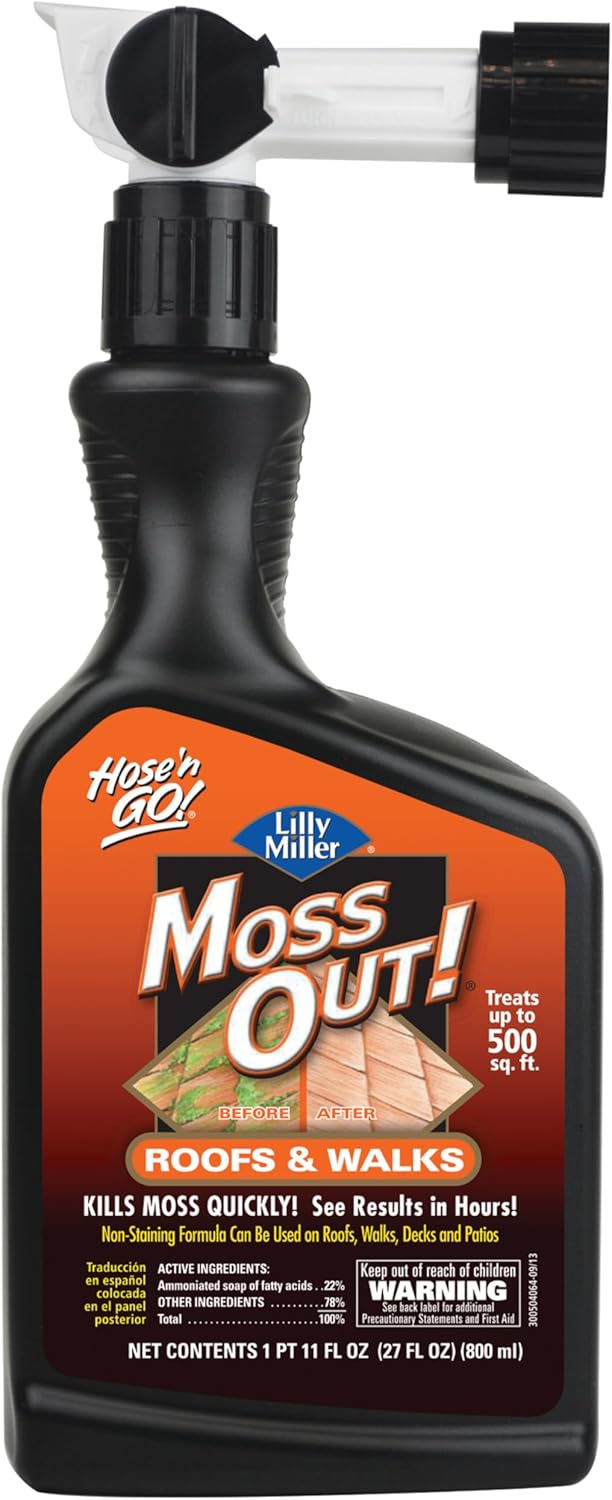
| Unit Count | 27 Ounce |
|---|---|
| Coverage | 500 square feet |
| Item Form | Liquid |
| Application reach | Sprays up to 25 feet |
This ready-to-spray Lilly Miller Moss Out is a convenient option for treating moss on roofs, walkways, decks and other outdoor surfaces. The bottle connects to a garden hose and sprays up to about 25 feet, so you can cover up to 500 square feet with a single 27 fl oz bottle. The manufacturer’s non-staining formula is made for composition shingles, wood, gravel, brick and unpainted concrete and claims visible killing of moss within hours. In practice the hose-end applicator makes application quick and keeps you off ladders for extended periods, and dead moss can be rinsed or swept away once it dies. Important limitations are the safety precautions and runoff risk to nearby plants and lawns, so careful masking and avoiding spray drift are necessary. Also a single application treats a modest area so larger roofs will need multiple bottles. For routine seasonal moss control this product is an easy, low-effort choice with clear application instructions.
Best for: Homeowners who want a straightforward, low-effort way to remove moss from roofs and hard surfaces and prefer a ready-to-use spray they can apply from the ground.
Less Ideal for: People with large roof areas seeking a concentrated product for fewer applications or those who need an organic or plant-safe moss control method.
- Ready-to-spray hose-end applicator covers up to 500 sq ft without mixing
- Non-staining formula formulated for shingles, wood, brick and unpainted concrete
- Sprays up to 25 feet so you can apply from ground level in many cases
- Claims quick visible moss killing allowing dead material to be removed within hours
- Contains chemicals that can harm plants and requires careful avoidance of runoff
- 27 fl oz only covers a modest area so multiple bottles may be needed for large roofs
Verdict: A convenient ready-to-spray treatment that quickly kills roof moss and is ideal for small to medium roofs when you want a low-effort, no-mixing solution.
30 SECONDS Outdoor Cleaner 64 fl oz (Pack of 3) with Hose-End Sprayer

| Unit Count | 192 Ounce |
|---|---|
| Number of Packs | 3 |
| Included Components | 3 Refill Bottles, 1 Hose End Sprayer Attachement |
| Item Form | Spray |
| Coverage | 900 square feet |
30 SECONDS Outdoor Cleaner is a liquid concentrate sold as three 64 fl oz refill bottles with a hose-end sprayer attachment for easy application. It is formulated to remove organic stains from moss, algae, mold and mildew on surfaces such as siding, decks, concrete and patio furniture. Use is straightforward: attach the sprayer, dilute according to surface type if directed, spray the affected area and rinse with a hose — the product is designed to eliminate the need for pressure washing. Notable features include a high coverage claim (up to 900 sq ft listed for the package) and labeling that says it is safe around lawns and plants when used as directed. Practical benefits are quick visible results on visible staining and the convenience of a hose-end applicator for homeowners who want a low-effort cleanup. Limitations to consider are that this is a surface cleaner, not a long-term systemic moss killer for roofs, and repeated applications may be necessary to prevent regrowth; users should follow safety instructions to protect nearby plants and finishes.
Best for: Homeowners who want a low-effort, rinse-off solution to remove visible moss and algae from exterior surfaces and prefer a straightforward, safety-minded product.
Less Ideal for: People seeking a one-time, permanent moss eradication solution for roofs or professional roof treatment where systemic control and long-term prevention are required.
- Cleans common organic stains from many exterior surfaces without scrubbing
- Includes a hose-end sprayer for simple, low-effort application
- Pack of three 64 fl oz bottles provides extended coverage for multiple jobs
- Label states it is safe for lawns and plants when used as directed
- Not marketed as a long-term, systemic roof moss killer so regrowth may occur
- Effectiveness can vary by surface porosity and extent of moss buildup
Verdict: Choose this kit if you want a simple, plant-safe hose-on cleaner that quickly removes visible moss and staining from exterior surfaces without pressure washing.
30 SECONDS Outdoor Cleaner 2-Pack with Hose-End Sprayer

| Unit Count | 128 Fluid Ounces |
|---|---|
| Included Components | 64oz bottles with hose-end attachment (2 pack) |
| Item Form | Spray |
| Coverage | 600 square feet |
| Active Ingredients | Vinyl |
30 SECONDS Outdoor Cleaner is a ready-to-use concentrate supplied in a two-pack with a hose-end attachment that makes treating large exterior areas straightforward. You mix the concentrate 1:1 with water in the refill bottle, attach the included sprayer to a garden hose and sweep the solution over roofs, siding, decks, patios and driveways. The formula is presented as safe for lawns and plants when used according to the label, and the product claims coverage around 600 square feet per bottle, which helps with whole-roof touch-ups or repeat treatments. The clear upside is easy application without a power washer and no scrubbing required for visible stain reduction. Important limitations are that it is a surface cleaner rather than a systemic moss killer, so thick, established moss may need repeat applications or mechanical removal, and you must follow safety directions to avoid contact with skin and eyes. For homeowners who prefer a conservative, low-effort option for routine moss, algae and mildew maintenance, this simplifies treatment and reduces the need for specialty equipment.
Best for: Homeowners who want a low-effort, conservative solution to remove moss, algae and mildew from roofs and other exterior surfaces without renting a pressure washer and who prioritize safety and predictable application.
Less Ideal for: Users seeking a chemical that kills moss at the root or a one-time cure for very thick moss mats should consider more aggressive moss-control methods or mechanical removal.
- Includes hose-end sprayer for fast, low-effort application from a garden hose
- Ready-to-use concentrate that treats multiple areas with a single two-pack
- Label states safe for lawns and plants when used as directed
- Works on a wide range of exterior surfaces including roofing materials, siding and driveways
- Not described as a systemic moss killer so heavy, established moss may require additional removal
- Contains active ingredients that require careful handling to avoid skin and eye contact
Verdict: If you want an easy, plant-safe spray application to clear surface moss and algae from a roof without a pressure washer, this two-pack with a hose-end sprayer is a practical choice.
Choosing the Right Roof Moss Killer: Key Factors to Consider
Active Ingredient and Plant Safety
The active ingredient determines how moss is killed and how hazardous the product is to nearby plants and surfaces. Some chemistries act quickly by breaking down moss cells on contact, while others work more slowly but persist longer. Knowing the active chemistry helps you plan protection for lawns, shrubs, and downspouts before applying product from a ladder.
Products with clearer, lower-risk active ingredients will usually include specific dilution rates and runoff guidance. If you have delicate roof-mounted plants, rooftop containers, or vulnerable landscaping under eaves, select an option with explicit safe-use directions to reduce plant damage risk.
Application Method and Accessibility
How a product is applied affects both effectiveness and safety. Ready-to-spray bottles, hose-end applicators, pump sprayers, and pour-and-rinse concentrates all behave differently on a sloped roof. Pump sprayers and hose-end tools let you reach higher areas from a ladder or extended pole, but you must control spray drift and runoff.
Consider whether you can safely access the roof to wet the moss thoroughly. Products that require even wetting across the patch are less forgiving if you cannot apply slowly and uniformly. If mobility or ladder work is a concern, look for formulations that cling to vertical surfaces or that come in low-drift spray options to reduce overspray.
Speed of Control and Visible Results
Some roof moss killers show visible browning or sloughing within days, while others take several weeks to fully break down matting and spores. Faster-action options are useful when you need quick aesthetic improvement or when moss is creating immediate leak risks. Slower, systemic-acting formulations may take longer to show results but sometimes offer more thorough suppression.
Think about how quickly you need moss removed and whether a staggered treatment schedule is feasible. Fast-acting products are helpful before a scheduled roof cleaning, while slower-acting choices can be better for long-term maintenance plans.
Residual Protection and Reapplication Frequency
Residual control describes how long a treatment continues to suppress regrowth after the initial kill. Some products leave a short-lived residue that requires seasonal retreatment, while others claim longer suppression that can reduce applications to once a year or less. Residual effectiveness depends on product chemistry, local climate, and how shaded or moisture-retentive your roof is.
When evaluating options, factor in the typical moss pressure where you live. In damp, heavily shaded conditions you may need a product with stronger residual action or a scheduled maintenance plan that includes periodic cleaning and retreatment.
Roof Material Compatibility
Different roofing materials-composition shingles, cedar shakes, metal panels, tile, and slate-react differently to chemical contact and mechanical cleaning. A product that is safe for asphalt shingles might be too aggressive for cedar or can tug finish from metal panels. Some formulations can stain porous tiles or alter the appearance of weathered wood.
Check manufacturer guidance for material compatibility and test a small, inconspicuous area when in doubt. Choosing a roof-friendly option reduces the risk of cosmetic or structural damage and preserves the integrity of flashing and sealants.
Environmental Runoff and Site Protection
When you spray a roof, runoff can reach gutters, downspouts, and the landscape below. Products with clear instructions for minimizing runoff and protecting plants, ponds, or water features give you practical steps to reduce environmental impact. Mixing, dilution, and rinse recommendations are important for safe use.
Plan application on a dry day without imminent rain to limit immediate runoff. Use berms, cover plants, or divert downspouts during treatment if guidance suggests doing so. Picking a product with explicit runoff mitigation guidance helps protect nearby soil and aquatic habitats.
When to Treat Roof Moss
Treat moss when it becomes a persistent mat that traps moisture or when clumps start lifting shingles and creating pathways for water. Early-stage green growth on a few tiles can sometimes be brushed away, but widespread dark green or black mats indicate established moss that will likely need a chemical treatment plus follow-up maintenance.
Seasonally, the best time for most treatments is a stretch of several dry days with mild temperatures. Avoid treating right before heavy rain, as runoff will reduce contact time and increase risk to plants below.
- Treat in dry weather for better contact time
- Address heavily shaded areas first where moisture lingers
- Consider treatment before scheduled gutter cleaning to avoid clogging with sloughed material
Preparing Your Roof and Garden
Preparation reduces risks and improves results. Remove debris and loose moss by hand or with a soft brush before applying a moss killer so the product contacts living tissue. Protect downspouts and vegetation by temporarily covering or diverting runoff according to product directions.
Wear appropriate personal protective equipment and secure any ladders. If you have rooftop planters or solar panels, shield them from spray and avoid directing product onto those surfaces unless the product label allows it.
- Clear gutters and check flashings before treatment
- Cover or water nearby plants to reduce chemical uptake if recommended
- Test a small area for discoloration on unusual roofing materials
Post-Application Care and Removal
After the moss has browned and loosened, gently remove the dead material using a soft brush or a low-pressure rinsing method. Avoid aggressive scraping that can damage shingles or underlayment. Keeping gutters clear of sloughed moss prevents water backup and staining.
Plan for periodic maintenance. Even with effective treatment, high-moisture sites often need follow-up applications at intervals recommended by the product to prevent re-establishment.
- Use low-pressure rinsing and avoid power washing that strips granules
- Dispose of removed moss away from garden beds to prevent reintroduction
- Schedule inspections in shaded sections of the roof where regrowth is likeliest
Safe Alternatives and Nonchemical Options
If you prefer to avoid chemicals, mechanical removal combined with improved roof drainage and increased sun exposure can manage moss over time. Pruning overhanging branches to increase light and airflow reduces the damp conditions moss prefers. Copper or zinc strips installed near the ridge can slowly release metal ions that inhibit moss growth when wetted by rain.
Nonchemical approaches often require more frequent physical maintenance and may take longer to achieve an aesthetic result, but they reduce chemical runoff and can be effective as part of an integrated strategy.
- Improve ventilation and sun exposure by trimming trees
- Consider copper or zinc passive controls for long-term reduction
- Combine mechanical removal with targeted treatments if needed
Safety Tips for Ladder Work and Roof Access
Working on a roof carries fall risks in addition to chemical exposure. Use a stable ladder, wear slip-resistant footwear, and avoid stepping on wet or moss-covered shingles which are slippery. Consider using an extension spray wand from the ground when full coverage is possible from a safe distance.
If the roof pitch or condition makes access hazardous, hire a professional for application and removal to avoid personal injury and inadvertent roof damage.
- Check weather and surface conditions before climbing
- Use fall protection when appropriate for steep roofs
- Have a helper hold the ladder and pass tools to reduce time on the roof
How We Chose the Best Roof Moss Killer
We focused on factors that matter for treating moss on roofs rather than general yard moss control. Key evaluation criteria included active ingredient profile and plant safety, since rooftop applications can run into gutters and garden beds. We assessed ease of application, looking at spray systems, ready-to-use liquids, and concentrates that gardeners can dilute and apply from a ladder or extended pole. Longevity of control was another major filter, gauging how long moss suppression typically lasts before retreatment is needed. Roof friendliness and material compatibility were evaluated to minimize shingle, metal flashing, and gutter damage. We also considered runoff and environmental risk, favoring products with clear guidance for protecting downspouts and vegetation. Products were excluded if they lacked clear roof-use instructions, had no guidance on dilution or contact time, or presented unusually high risk to common garden plants when used as directed. The final list emphasizes options that balance effective moss kill with safe rooftop practices, consistent application methods, and predictable retreatment intervals.
FAQ
How often should I reapply a roof moss killer?
Reapplication frequency depends on product residual and local conditions. Many homeowners treat annually in damp climates, while drier areas may only need treatments every few years. Check product guidance and inspect shaded roof sections more often.
Will roof moss killers harm my garden plants?
Some formulations can harm sensitive plants if runoff reaches root zones. Products with lower plant toxicity or that include runoff mitigation instructions reduce risk. Always protect or water nearby plants before application if the label recommends it.
Can I pressure wash moss off after treatment?
Gentle rinsing to remove loosened moss is appropriate, but high-pressure washing can strip shingle granules and shorten roof life. Use a soft brush or low-pressure hose to remove dead growth after it has loosened.
Are metal ridge strips effective for moss control?
Copper or zinc strips can help reduce moss over time by releasing metal ions during rain events. They are a preventative measure rather than an immediate cure and work best combined with other maintenance steps.
Is it safe to apply moss killer from a ladder?
Applying from a ladder is common, but take safety precautions. Use an applicator with an extension wand if possible, avoid overreaching, and follow ladder safety practices. If access is risky, hire a professional.
Will moss control products stain roofing materials?
Some formulations or sloughed moss residues can temporarily discolor certain tiles or shakes. Test a small area when in doubt and follow label advice about rinsing or cleaning treated surfaces.
Final Verdict
Choose a roof moss killer based on how much moss you have, how quickly you need results, and how sensitive your roof and nearby landscaping are to chemicals. Prioritize a product with clear roof-compatibility guidance and practical instructions for limiting runoff and protecting plants. Balance speed of kill against residual control and safety. For steep or fragile roofs, favor gentler approaches and professional help. With the right product and proper application, you can remove moss effectively while preserving your roof and landscape health.
