

Note: This article contains affiliate links. If you click on these links and make a purchase, I may earn a small commission at no extra cost to you. This helps support my research and content. Read my full affiliate disclosure here.
Finding a safe carpenter ant killer matters when you have children, pets, or edible plants near treated areas. Carpenter ants can damage wood and establish nests inside walls, so effective control is important, but many conventional treatments use harsh chemicals you may want to avoid. This guide focuses on low-toxicity, targeted solutions that reduce risk while still addressing colony control. We shortlisted five top options that perform well in real home and garden settings. The picks were evaluated for colony control effectiveness, application safety, bait attractiveness, and ease of use so you can choose a solution that fits your household and property. Read on to understand how these approaches behave in practice and which tradeoffs to expect before the product reviews below.
Top Picks at a Glance
| Best Quality Built to a higher standard if you want something more solid | Syngenta Advion Ant Gel (4 Tubes, 30 g each) |  |
| Best Value The sweet spot between price and what you get | Terro Outdoor Liquid Ant Bait Stakes, 12-Pack |  |
| Best Budget The cheapest option that still gets the job done reliably | Raid Ant Killer Baits, 8 Count (Child-Resistant) |  |
| Highest Rated A top-rated pick with lots of positive feedback | ROUTADE 48-Pack Slow-Acting Ant Gel Bait Stations |  |
| Best Seller A high-volume bestseller chosen again and again | TERRO Liquid Ant Killer Bait Stations, 12-Pack (T300B) |  |
Syngenta Advion Ant Gel (4 Tubes, 30 g each)

| Unit Count | 4.23 Ounce |
|---|---|
| Included Components | 4 Tubes x 30-Grams, 1 Plunger and 2 Tips |
| Item Form | Gel |
| Active Ingredients | 0.05% indoxacarb |
| Target Species | Insects |
Advion Ant Gel is a user-friendly gel bait intended to control common household and structural ant species by exploiting worker foraging behavior. You apply small spots or short lines of the odorless gel along active trails, in cracks and crevices, and near entry points; foraging workers consume the bait and carry it back to the nest where it is shared, helping to eliminate the queen and other nestmates. The kit ships with four 30 g tubes plus an applicator plunger and tips for precise placement, which makes targeting tight spaces straightforward. Its non-repellent formula with 0.05% indoxacarb is formulated to be attractive to a range of species including Argentine and carpenter ants, and it is labeled for both indoor and outdoor use. Limitations to note are that it is a chemical bait so safety precautions are needed around children and pets and efficacy depends on ants accepting the bait matrix versus other available food sources.
Best for: Homeowners and renters who want a targeted, easy-to-apply solution to eliminate established ant infestations and prefer a bait that works via worker-mediated transfer to treat whole colonies.
Less Ideal for: People seeking non-chemical or immediate-contact kill methods or those who need a one-time spray rather than ongoing baiting strategies should consider other options.
- Non-repellent gel formulation designed for worker ants to feed and transfer bait to the colony
- Includes four 30 g tubes plus a plunger and application tips for precise placement
- Labelled for both indoor and outdoor use, suitable for common pest species
- Odorless formula that is easy to place along trails, cracks, and crevices
- Contains a chemical active ingredient so it must be kept away from children and pets
- Effectiveness depends on ants preferring the bait over other available food sources
Verdict: Choose Advion Ant Gel when you want a precise, bait-based solution that encourages workers to carry poison back to the nest for colony-level control.
Terro Outdoor Liquid Ant Bait Stakes, 12-Pack

| Unit Count | 12 Count |
|---|---|
| Material Type | Plastic |
| Target Species | Ant |
| Power Source | manual |
These Terro Outdoor Liquid Ant Bait Stakes are simple, low-effort bait stations designed to intercept ant colonies outdoors before they reach the house. Each stake contains a sweet liquid bait with borax that worker ants feed on and carry back to the nest, which can eliminate the queen and much of the colony over a 2 to 4 week period. They are weather-resistant, see-through so you can monitor bait consumption, and install by cutting a tab and pushing the stake into soil or mulch near ant trails. For homeowners dealing with small common species such as little black, odorous house, pavement, and ghost ants, the stakes provide targeted perimeter protection without sprays or direct contact. Limitations are that baiting takes days to weeks to fully work and you may see increased ant activity at first as foragers discover the bait. Also they must be placed where children and pets cannot access them and replaced periodically to maintain protection.
Best for: Homeowners who want a low-effort, evidence-based way to stop small common outdoor ants at the source and prefer baiting over sprays, using visual confirmation of activity before replacing units.
Less Ideal for: People needing an immediate knockdown or single-visit solution for heavy indoor infestations or those who cannot place bait stations out of reach of children and pets.
- Colony-level control via borax bait that foraging ants share with the nest
- Ready-to-use stakes are easy to deploy by cutting the tab and inserting in soil
- See-through design lets you monitor bait consumption and know when to replace
- Weather-resistant stations suitable for yards, patios, and garden perimeters
- Works gradually and can take 2–4 weeks for complete colony control
- Not child- or pet-proof if placed in accessible areas and requires careful placement
Verdict: A practical, easy-to-use baiting solution that stops small outdoor ant colonies by getting worker ants to carry borax bait back to the nest.
Raid Ant Killer Baits, 8 Count (Child-Resistant)
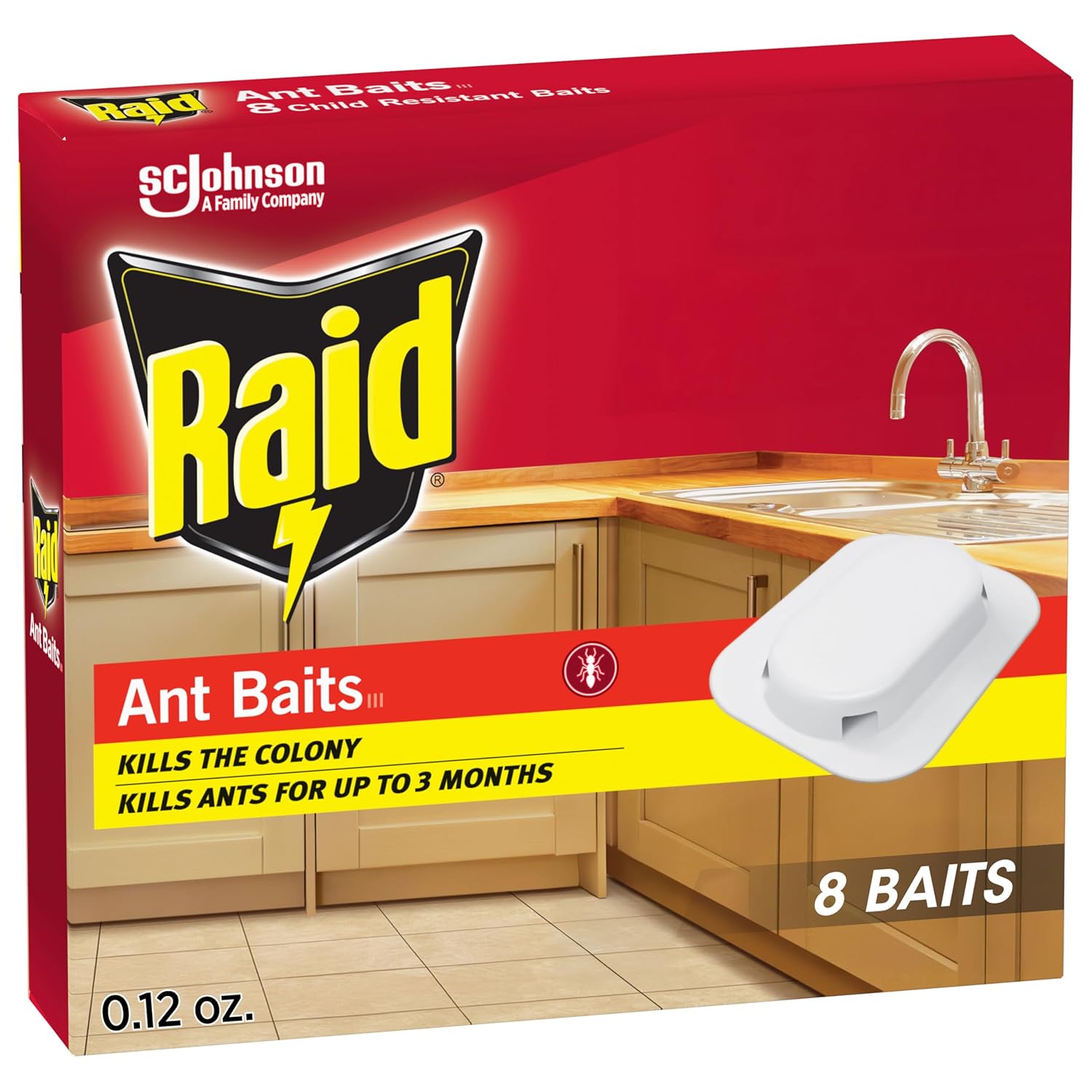
| Package quantity | 8 Count |
|---|---|
| Child safety | Child-resistant |
| Intended use | Indoor |
| Effect duration | Up to 3 months |
These Raid Ant Killer Baits are small, ready-to-use indoor stations that dispense an attractive liquid bait ants carry back to the colony, which can eliminate the nest over time. You place the bait along walls, in corners, and near entry points where small ants forage; after ants feed, the active ingredient is shared with other colony members, including the queen, and protection can last for weeks. The child-resistant design reduces accidental access in homes with children while the compact stations are low-profile and easy to position. Because they are prefilled and disposable, there is no mixing or measuring, which makes them convenient for quick treatment in kitchens, pantries, and baseboards. Limitations are that the product is for indoor use only and may be less effective if competing food sources are left available or if multiple heavy infestations require broader perimeter treatment. For someone looking for a simple, no-fuss bait to try first, these are a practical option.
Best for: Budget-minded homeowners or renters who want an easy, low-effort indoor solution to control small ant trails and try baiting before calling for broader treatments.
Less Ideal for: People needing immediate knockdown for very large or outdoor ant colonies or those who prefer non-chemical mechanical control methods.
- Ready-to-use prefilled bait stations that require no setup
- Child-resistant design reduces accidental access
- Bait formula is transferred through the colony to target the queen
- Compact, low-profile stations are easy to place along walls and entry points
- Intended for indoor use only, not suited for outdoor colony control
- May be less effective if other food sources are available or in very large infestations
Verdict: A low-cost, no-fuss indoor bait station that effectively targets small ant colonies by having foragers carry bait back to the nest.
ROUTADE 48-Pack Slow-Acting Ant Gel Bait Stations

| Unit Count | 48 Count |
|---|---|
| Item Form | Gel |
| Target Species | Ants |
| Included Components | Ant gel bait |
This 48-pack of ROUTADE slow-acting ant gel bait stations is built for systematic, long-term ant control in and around the kitchen. Each station contains a gel formula that worker ants consume and carry back to the nest, which helps reduce the entire colony rather than only visible foragers. The product is supplied in ready-to-use stations with adhesive tape so you can place them along baseboards, in cabinets, near sinks, and on entry thresholds without messy sprays or frequent repositioning. The large pack lets you deploy multiple stations in high-traffic areas and replace them over time for continuous coverage. Because the formula is slow-acting, it is effective against a range of common household species including carpenter ants and sugar ants, but it requires several days to weeks to knock down a colony and will not give instant removal of visible ants. Also the stations are small and contain gel rather than a tamper-resistant hard block, so keep them away from children and pets. For someone wanting a low-maintenance, colony-focused approach to kitchen ant problems, this kit makes it easy to set and forget while the bait works.
Best for: Homeowners who prioritize reliable, long-term elimination of ant colonies in kitchens and want a low-maintenance bait they can deploy across multiple hotspots.
Less Ideal for: People who need an immediate knockdown of visible ants or who require childproof solid bait stations should consider alternatives.
- Slow-acting gel designed for worker ants to carry bait back to the nest for colony-level control
- Ready-to-use bait stations with adhesive for easy placement along baseboards and in cabinets
- 48-count pack provides broad coverage around a kitchen and enough replacements for extended use
- Versatile for indoor and outdoor placement to block entry points and high-traffic ant routes
- Slow-acting formula takes days to weeks to eliminate a colony so visible results are not immediate
- Gel in small stations may require careful placement to keep away from children and pets
Verdict: A practical, deploy-and-forget gel bait kit for reliable colony-level control of kitchen ant infestations.
TERRO Liquid Ant Killer Bait Stations, 12-Pack (T300B)

| Unit Count | 12 Count |
|---|---|
| Item Form | Liquid |
| Target Species | Insects |
| Active Ingredients | Sodium Tetraborate Decahydrate (Borax), 5.40% |
Terro Liquid Ant Killer bait stations are prefilled, single-use traps designed for indoor control of common sugar-loving ants. You place the small stations along baseboards, in corners, under appliances, or on countertops where you see ant activity. Worker ants are drawn to the sweet liquid, feed on it, and take it back to the nest so the borax-based active ingredient can eliminate the colony over days to weeks. The product is easy to use with no mixing or setup and the 12-pack gives coverage for several rooms. Because the bait is contained inside a low-profile plastic station, it reduces incidental contact risk compared with loose sprays or powders and lasts for weeks while ants continue to visit. Limitations are that the formula targets sugar-preferring species so very protein- or grease-attracted ants may ignore it, and control can take 2 to 4 weeks for larger infestations. Also stations should be placed away from pets and children despite the contained design since the bait contains borax.
Best for: Homeowners who prioritize an easy, low-hassle indoor solution and want a bait that works at the colony level with minimal hands-on pest handling.
Less Ideal for: People who need immediate knockdown of ants or who have pets or children that frequently access treated areas and cannot reliably keep them away from placed stations.
- Ready-to-use stations require no mixing or setup
- Designed to be carried back to the nest for colony-level control
- Low-profile enclosed bait reduces messy exposure compared with loose liquids or sprays
- 12 stations provide coverage for multiple rooms or hotspots
- Formulation is sugar-based so less effective on ants that prefer protein or grease
- Control can take 2–4 weeks for large or established colonies
Verdict: A simple, low-contact indoor bait system that reliably reduces sugar-loving ant infestations by getting worker ants to carry borax back to the colony.
Choosing the Right Safe Carpenter Ant Killer: Key Factors to Consider
Toxicity Profile And Active Ingredient
Understand the active ingredient and its toxicity profile before use. Low-toxicity formulations rely on slower-acting actives or biologicals that let foraging workers take bait back to the nest. These require patience but reduce immediate exposure risk to children and pets.
High-toxicity contact sprays produce faster knockdown but carry greater inhalation and dermal risks and can contaminate surfaces. Read labels for signal words and follow safe storage and disposal instructions to limit accidental exposure.
Bait Versus Contact Treatment
Baits work by exploiting worker foraging to transfer toxicant to the colony, which can eliminate the queen and reduce the need for broad surface treatments. They are generally safer because baits are placed in tamper-resistant stations or small drops that limit access.
Contact treatments give quick results on visible ants but do not reliably eliminate hidden nests. For homes with pets and children, favor baits or targeted dusts placed where non-targets cannot reach, and reserve contact sprays for outdoor perimeters away from play areas.
Placement And Accessibility
Where you place the product determines both effectiveness and safety. Interior baits should go in corners, behind appliances, or inside bait stations where ants forage but children and pets cannot access. Outdoor perimeter treatments should be applied to foundation lines and voids rather than broadcast across lawns or garden beds.
Consider seasonal foraging routes and inspection of entry points. Sealing entry cracks and removing wood-to-soil contact are complementary steps that reduce reinfestation and lower the need for repeated chemical use.
Formulation Longevity And Environmental Persistence
Some active ingredients persist longer in the environment, which can increase secondary exposure risk and affect beneficial insects. Shorter-lived baits and products with low mobility reduce contamination of soil and water.
If the treatment area is near vegetable gardens, pollinator habitat, or stormwater drains, choose products labeled for low runoff potential and follow buffer distance recommendations. Reapply only as label directions allow.
Household Safety Features And Labeling
Look for child-resistant packaging, clear restrictions on indoor use, and instructions for emergency measures in case of accidental contact. Labels that specify where to place baits, how long to keep pets and children away, and how to secure leftover product help minimize risk.
Regulatory signal words and first-aid statements are important cues; products labeled with milder signal words and concrete handling steps are easier to use safely in busy homes.
Integration With Nonchemical Measures
Effective long-term control pairs any chemical or low-toxicity option with habitat modification. Removing decaying wood, trimming vegetation away from siding, and fixing moisture problems reduce nesting opportunities and make baiting more successful.
Sanitation to remove food sources and regular inspections of vulnerable wood reduce reliance on treatments and increase the chance that targeted baits will reach the colony.
How Carpenter Ant Behavior Affects Choice Of Treatment
Carpenter ants nest in moist or decaying wood and send workers out at night to forage. Because nests can be inside wall voids or structural timbers, treatments that rely on worker-mediated transfer of bait are often more effective at reaching the queen than simple contact sprays.
Expect delayed results from baiting: it can take days to weeks to see colony decline because workers must consume and distribute the active agent. In contrast, contact treatments reduce visible worker numbers quickly but may not stop the hidden nest, leading to reappearance.
- Foraging patterns determine bait placement; observe trails at dusk when ants are most active.
- Outdoor colony locations often require perimeter bait stations or targeted dust in voids.
- Combining sanitation and exclusion increases bait effectiveness and reduces retreatment.
Tamper-Resistant Bait Stations And Safe Placement Tips
Use tamper-resistant stations when placing baits indoors or near high-traffic areas. These stations keep bait inaccessible to children and pets while allowing worker ants to access the bait inside.
Place stations along ant trails, behind baseboards, and near entry points. Avoid placing bait directly on countertops, on top of soil in potted plants, or where pets can chew them out of curiosity.
- Label stations by date and location to track effectiveness.
- Keep an eye out for non-target species like roly-polies that can take bait away from ants.
Nonchemical And Mechanical Options To Reduce Chemical Use
Physical exclusion, moisture management, and removing nesting material reduce the scale of any chemical intervention needed. Repairing leaks, improving ventilation in crawl spaces, and replacing water-damaged wood are practical steps that address the root cause of carpenter ant nesting.
Sticky barriers, caulking entry points, and placing wood off the ground prevent new colonies from establishing. When combined with targeted baiting, these measures often allow less frequent treatment and lower overall chemical load.
- Trim branches and vegetation away from siding to reduce ant highways into structures.
- Store firewood elevated and away from the house to limit nearby nest sites.
Seasonal Timing And Expectation Management
Carpenter ant activity peaks in warmer months when workers forage more actively. Baiting is most successful when ants are actively looking for food. In cooler seasons ants may forage less, which can delay bait uptake and visible results.
Set realistic timelines: expect immediate reductions in worker sightings with contact products, but allow several weeks for baits to eliminate colonies. Reassess and reapply according to label directions rather than treating on a fixed calendar.
- Monitor activity with glue boards or non-toxic monitors to know when to refresh baits.
- Avoid over-application; repeated heavy treatments can increase household exposure without improving control.
Protecting Pollinators And Beneficial Insects
Many low-toxicity carpenter ant strategies are inherently friendlier to pollinators because they rely on contained baits or targeted dusts rather than broadcast sprays. Preventing runoff and avoiding treatment directly on flowering plants reduces risk to bees and other beneficials.
If treating near gardens, place baits in weather-protected stations away from blooms and follow label buffer zones. Where possible, use mechanical measures and sanitation first, and reserve chemical options for verified infestations.
- Do not apply any bait or dust directly to flowers or nectar-producing plants.
- Rinse tools and protective gear away from storm drains or vegetable beds after applying treatments outdoors.
How We Chose the Best Safe Carpenter Ant Killer
We selected products and approaches that emphasize reduced toxicity and targeted delivery without compromising necessary control of carpenter ant colonies. Evaluation prioritized real-world performance metrics that matter to homeowners with children, pets, or nearby edible plants. Our filters included only products intended for indoor or perimeter use with documented low-risk active ingredients or physical barriers and excluded broad-spectrum high-toxicity aerosols and whole-structure fumigants. Key evaluation criteria were bait efficacy against colony members and the queen, application safety in mixed-use spaces, environmental persistence and runoff risk, and clarity of labeling for safe household use. We also considered formulation form factor for accuracy of placement and potential for accidental exposure, and compatibility with integrated nonchemical measures such as sanitation and habitat modification. Products lacking clear safety guidance, those requiring professional-only equipment, or treatments known to present significant vapor or dermal risks were excluded from this roundup.
FAQ
Are bait stations safe to use around toddlers and pets?
Often yes, when you use tamper-resistant stations and place them out of reach. Stations limit access to the bait but you should still position them where curious hands or paws cannot dislodge them and follow label precautions.
How long does it take for baiting to eliminate a carpenter ant colony?
It usually takes days to several weeks for colony decline after baiting because workers must take the product back to the nest. Results depend on bait attractiveness, colony size, and how readily workers find the bait.
Can I use low-toxicity options outdoors near vegetable gardens?
Yes, but place baits in stations and respect label buffer recommendations. Avoid broadcast sprays over garden beds and keep any application off edible surfaces to minimize contamination risk.
When should I use a contact treatment instead of a bait?
Use contact treatments to quickly reduce a large number of visible workers or when you need immediate knockdown. For long-term control of the nest, follow up with baiting or targeted nest treatments because contact sprays rarely eliminate hidden queens.
Will sealing entry points stop carpenter ants completely?
Sealing helps reduce new workers from entering but will not remove an existing nest inside the structure. Use exclusion alongside baiting and nest removal to get lasting control.
Final Verdict
When choosing a safe carpenter ant killer, prioritize products and methods that let you target nests while minimizing household exposure. Baits and tamper-resistant stations often offer the best balance between colony-level control and safety for kids, pets, and nearby gardens. Pair any chemical approach with sanitation, moisture control, and exclusion to reduce retreatment needs. Decide based on where ants nest, how active they are, and who uses the treated spaces. If immediate knockdown is required, combine careful perimeter contact measures with indoor baiting. For routine household use, favor low-toxicity baits placed in secure stations and monitor results before escalating treatments.
