

Note: This article contains affiliate links. If you click on these links and make a purchase, I may earn a small commission at no extra cost to you. This helps support my research and content. Read my full affiliate disclosure here.
If you share your yard or patio with curious dogs or indoor-outdoor cats, choosing a safe fertilizer matters for their health and for a thriving garden. Pet-safe fertilizers are formulated to lower acute toxicity, reduce harmful residues, and often use slower-release or organic nutrient sources that are less likely to cause immediate harm if a pet sniffs or ingests small amounts. This guide covers six top contenders selected for low pet exposure risk and reliable plant nutrition. We'll explain the practical differences in ingredients, application methods, and how to keep animals out of treated areas while nutrients do their work. Read on for a concise, gardener-focused overview before browsing our shortlisted picks.
Top Picks at a Glance
| Best Quality Built to a higher standard if you want something more solid | Renew Organics 100% Organic Worm Castings (12 lb) |  |
| Best Value The sweet spot between price and what you get | Earth Science Moorganite All-Purpose Slow-Release Lawn and Garden Fertilizer, 5 lb |  |
| Best Budget The cheapest option that still gets the job done reliably | ENVY 20-20-20 All-Purpose Water Soluble Plant Fertilizer, 8 oz |  |
| Highest Rated A top-rated pick with lots of positive feedback | lawnbright Cold Snap Liquid Lawn Winterizer, 32 oz |  |
| Most Popular A crowd favorite that many people choose with confidence | Dr. Earth Flower Girl Bud & Bloom Booster 4-10-7 Organic Fertilizer, 4 lb |  |
| Best Seller A high-volume bestseller chosen again and again | Eco Solutions Slow Release Lawn Fertilizer 25-5-10 (44 lb) |  |
Renew Organics 100% Organic Worm Castings (12 lb)

| Brand | Renew Organics |
|---|---|
| Ingredients | Organic Worm Castings |
| Style Name | Nutrient-rich |
Renew Organics worm castings are a straightforward, pet-safe organic soil amendment that improves soil structure, moisture retention, and microbial activity without added chemicals or odor. Use it as a top-dress, mix-in with potting soil, or brew into compost tea for seedlings, containers, beds, and lawns. The product delivers plant-available nitrogen, phosphorus, potassium, and trace minerals that support root development and steady growth while posing no burning risk to tender plants. Practical benefits include easy application from a resealable pouch, suitability for edible crops, and compatibility with indoor use thanks to its lack of smell. The main limitation is that worm castings are a low-release, balanced amendment rather than a fast-acting synthetic fertilizer, so gardeners seeking immediate, high-N results will need to supplement or apply more frequently. For performance-focused growers who prioritize steady plant health and safe use around pets and children, this product supports stronger roots and healthier soil microbiology over time.
Best for: Pet owners and household gardeners who want a safe, chemical-free amendment that improves long-term plant health and soil biology for containers, houseplants, and edible beds.
Less Ideal for: Growers who need quick, high-dose fertilization for rapid vegetative push or commercial crops that require precise, fast-acting nutrient schedules.
- 100% organic worm castings that are safe for pets and children
- Improves soil structure, aeration, and moisture retention to reduce watering frequency
- Contains plant-available N, P, K and trace minerals to support root development
- Odorless formula suitable for indoor use and edible crops
- Provides slow, low-release nutrition so it may not deliver rapid high-nitrogen effects
Verdict: Choose this worm castings bag if you want a pet-safe, odorless organic amendment that steadily builds soil health and supports safer indoor and edible gardening.
Earth Science Moorganite All-Purpose Slow-Release Lawn and Garden Fertilizer, 5 lb

| Item Form | Granules |
|---|---|
| Specific Uses For Product | Lawn |
| Coverage | 500 |
| Unit Count | 80 Ounce |
Moorganite is an all-purpose granular fertilizer from Earth Science formulated to slowly feed lawns and garden beds while improving soil health. It is applied by broadcasting on actively growing turf one to two times in spring and fall or worked into garden soil when preparing beds, with an extra application as buds form. The product lists slow-release delivery and organic-rich formulation, which helps sustain steady nutrient availability and supports soil biology rather than forcing rapid growth. Packaged as a 5 lb pouch covering roughly 500 square feet, it is easy to store and handle for small to medium yards and planting areas. Limitations include modest coverage per pouch, so larger lawns will require multiple bags, and the product information does not list an exact N-P-K ratio on the label which may matter to users tracking precise nutrient inputs. Safety instructions recommend protective equipment and keeping the product away from children and pets during handling. For gardeners who prefer gentler, soil-building fertilizer that avoids fast-acting chemical spikes, Moorganite is a sensible option.
Best for: Buyers who prioritize long-term soil health and want a gentler, slow-release fertilizer for small to medium lawns or mixed garden beds, especially those who avoid fast-acting chemical feeds.
Less Ideal for: People who need rapid green-up, exact nutrient ratios for fertilization plans, or who manage large turf areas where a higher-coverage product is more efficient.
- Slow-release formula that supports steady nutrient delivery and soil biology.
- Suitable for both lawns and garden beds so one product covers multiple uses.
- Organic-rich approach aimed at improving long-term soil health rather than quick green-up.
- Coverage per 5 lb pouch is limited, requiring multiple bags for larger yards.
- No explicit N-P-K ratio provided in the visible product details for precise nutrient planning.
Verdict: Choose Moorganite when you want a pet-safer, slow-release, soil-building fertilizer for small to medium lawns and garden beds.
ENVY 20-20-20 All-Purpose Water Soluble Plant Fertilizer, 8 oz

| Item Form | Granules, Powder |
|---|---|
| Mixing Ratio | 1 tsp per gallon |
| Included Components | All-Purpose 20-20-20 |
| Unit Count | 8 Ounce |
| Target Species | Plants |
ENVY 20-20-20 is a water-soluble, all-purpose plant fertilizer formulated as granules that dissolve easily for routine feeding of houseplants, vegetables, container plants, and ornamentals. You mix the powder at the recommended rate (about 1 teaspoon per gallon) and apply as a regular liquid feed, which makes it convenient for weekly or biweekly watering routines. Notable features include a balanced NPK ratio that supports foliage, root and flower development, a broad micronutrient package for common garden and houseplant needs, and a resealable pouch with a measuring scoop for tidy storage and accurate dosing. Because it is labeled pet safe and made in the USA, it fits households that need a lower-toxicity option around animals when used as directed. Limitations are the small 8 ounce unit size for heavy users and the need to accurately follow dilution instructions to avoid overfeeding; it is a general-purpose blend rather than a crop-specific formula for extreme flowering or heavy fruit set.
Best for: Budget-conscious indoor and container gardeners who want a simple, pet-friendly all-purpose fertilizer for regular feeding of houseplants and vegetables.
Less Ideal for: Growers who need large-volume supplies for lawns or extensive beds or who prefer highly specialized bloom-boosting or high-phosphorus formulations.
- Balanced 20-20-20 NPK suitable for general indoor and outdoor plant feeding
- 100% water soluble for easy mixing and application
- Includes a resealable pouch and measuring scoop for convenient storage and dosing
- Contains micronutrients and chelates to support a range of common houseplants and vegetables
- Label indicates pet safe formulation when used as directed
- Small 8 ounce unit may be consumed quickly by frequent or large-scale gardeners
- General-purpose formula may not meet specialized needs for heavy bloom or fruit production
Verdict: A compact, pet-friendly, water-soluble 20-20-20 fertilizer that gives budget-minded indoor gardeners an easy, balanced feed for most houseplants and veggies.
lawnbright Cold Snap Liquid Lawn Winterizer, 32 oz

| Item Form | Liquid |
|---|---|
| Application Method | hose-on |
| Target Species | Lawn Grass |
| Unit Count | 32 Fluid Ounces |
| Item Highlight | Covers 2,500 sq ft — Late-fall root feeding for cool-season lawns |
This 32 oz Cold Snap liquid winterizer is a hose-end fertilizer designed for a quick late-fall root feeding on cool-season grasses. You attach the bottle to a garden hose and spray — the manufacturer says one bottle covers up to 2,500 sq ft and application takes about 15 minutes, so it removes the need for a spreader or granular handling. The formula combines low-rate nitrogen with phosphate, potassium, hydrolyzed fish and sea kelp to support root strength and carbohydrate storage before dormancy. In practice that means an easy, even application that is kid- and pet-safe once dry and aims to promote quicker spring green-up and denser turf. Limitations are that nutrient levels are relatively low compared with concentrated granular winterizers, so heavier-feeding lawns or large properties may need multiple bottles or supplemental products, and the hose-on delivery requires access to a water source and even spraying technique to avoid missed spots. For homeowners who want a simple, low-fuss fall feed, it does the job without specialized equipment.
Best for: Homeowners who prioritize an easy, reliable late-fall treatment and want a no-spreader, low-fuss way to boost cold hardiness for cool-season turf.
Less Ideal for: Large properties, professional landscapers, or lawns needing a high-rate nutrient program should consider concentrated granular products or commercial options instead.
- Hose-on liquid makes application fast and removes need for a broadcast spreader
- Includes potassium and sea kelp to support cold hardiness and root development
- Kid- and pet-safe formula once dried, suitable for family yards
- Covers up to 2,500 sq ft per 32 oz bottle for small to medium lawns
- Lower nutrient concentrations than concentrated granular winterizers, so may require multiple bottles for larger or nutrient-depleted lawns
- Requires a hose and even spraying technique to ensure full coverage
Verdict: If you want a fast, no-spreader late-fall feed to strengthen cool-season lawns, this hose-on liquid winterizer delivers simple, reliable application.
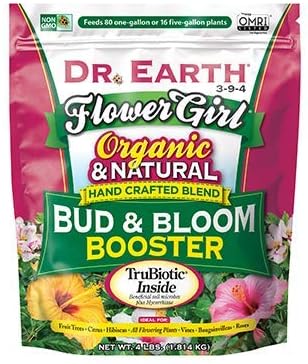
Dr. Earth Flower Girl Bud & Bloom Booster 4-10-7 Organic Fertilizer, 4 lb
| N-P-K | 4-10-7 |
|---|---|
| Volume | 4 liters |
| Unit Count | 64 Ounce |
| Brand Name | Dr. Earth |
Dr. Earth Flower Girl Bud & Bloom Booster is a ready-to-use organic fertilizer designed to promote flowering and fruit set in annuals, perennials, vegetables, and potted plants. It is typically applied as a granular or soluble feed according to package directions to boost bud formation and flowering during the growing season. Notable features include an N-P-K ratio of 4-10-7, organic and non-GMO ingredients, and certification claims emphasizing safety for people and pets. In practice this product gives plants a noticeable bloom push without relying on synthetic salts, and its organic blend makes it suitable for use around family gardens and containers. Because it is concentrated for flowering, you may need to pair it with a balanced fertilizer for overall plant growth early in the season. Also follow label rates closely since stronger bloom formulas can cause leggy growth if overapplied. For gardeners who value organic inputs and want a pet-friendly bloom booster, this is a solid, easy-to-use option.
Best for: Gardeners who prioritize organic, family- and pet-safe inputs and want a targeted bloom booster for flower beds, vegetable flowers, or container plants.
Less Ideal for: Growers who need a general-purpose, all-season fertilizer or those managing large lawns and turf where a balanced high-nitrogen feed is required.
- Organic, handcrafted blend reduces reliance on synthetic fertilizers
- Formulated with higher phosphorus to encourage bud set and flowering
- Labeled as people and pet safe, suitable for family gardens and containers
- Higher phosphorus ratio means it is not a balanced all-purpose feed and may need pairing with a nitrogen source
- Package does not list detailed micronutrient breakdown in the provided data
Verdict: Choose this organic bloom booster if you want a pet-safe, phosphorus-focused fertilizer to reliably increase flowering in home gardens.
Eco Solutions Slow Release Lawn Fertilizer 25-5-10 (44 lb)

| Item Form | Granules |
|---|---|
| Specific Uses For Product | Lawn Fertilizer |
| Coverage | 5 lbs / 1000 sq ft, 2-4 times per yr |
| Target Species | turf grass |
| Mixing Ratio | 25-5-10 |
This granular fertilizer is formulated for steady lawn feeding rather than quick, high‑risk bursts of nutrients. The 25-5-10 NPK blend with 65% slow‑release nitrogen feeds turf for up to about 110 days, so you can apply fewer treatments during the growing season and expect more consistent green-up and root development. It is supplied as a granular product intended for broadcast application at 5 lbs per 1,000 sq ft, applied two to four times a year following package directions. The formula includes sulphate of potash to support root health and soil function, and the brand markets it as safe for families and pets when used as directed. Practical advantages are less frequent feeding and predictable turf response, but it requires accurate spreading and adherence to rates to avoid overapplication. It is not a liquid or quick‑fix treatment, so results build over weeks rather than days. For homeowners who prioritize a low‑maintenance, pet‑friendly approach to lawn care, this product gives reliable, long‑lasting nutrition when used correctly.
Best for: Homeowners who want a low‑maintenance, family‑ and pet‑friendly lawn fertilizer that reduces application frequency and delivers predictable, long‑lasting feeding.
Less Ideal for: People seeking a fast corrective treatment for severely damaged or patchy lawns or gardeners who prefer liquid or foliar feeds for immediate results.
- Slow‑release nitrogen provides up to about 110 days of steady feeding
- High nitrogen ratio helps promote quick green‑up and sustained turf growth
- Granular form is compatible with standard broadcast spreaders for even coverage
- Includes sulphate of potash to support root health and soil function
- Requires careful measuring and spreading to avoid overapplication
- Effects are gradual and not suitable if you need immediate turf recovery
Verdict: Choose this granular slow‑release 25-5-10 fertilizer if you want a pet‑friendly, low‑maintenance way to keep turf green with fewer seasonal applications.
Choosing the Right Safe Fertilizer for Pets: Key Factors to Consider
Ingredient Safety Profile
Know what is actually in the fertilizer and how those materials behave around animals. Simple, clearly listed ingredients let you research toxicity and make a safer choice. Organic sources such as composted manures, bone meal, or kelp are not automatically harmless to pets, but they are generally less likely to contain concentrated salts or solvent carriers that can cause immediate toxicity. Avoid formulations with unlabeled proprietary blends when possible because unknown additives increase uncertainty.
Pay attention to common acute hazards like high salt levels, urea, or soluble nitrogen salts that can cause stomach upset, vomiting, or worse if ingested in significant amounts. Also be aware of added herbicides, insecticides, or growth regulators; a fertilizer that includes pesticides introduces additional risk and should be treated differently than a straight fertilizer.
Nutrient Release Rate
How quickly nutrients become available affects short-term exposure risk. Quick-release, water-soluble fertilizers deliver nutrients fast but can leave concentrated residues on surface grass and soil that a pet might lick or ingest. Slow-release coatings or organic matrices break nutrients down more gradually, lowering the chance that an animal encounters a highly concentrated dose.
For pet households, slow-release options are usually safer because they reduce the need for frequent reapplication and limit peak concentrations. Consider how often you will treat the area and whether you can enforce a temporary exclusion period after application; these practical choices interact with release rate when assessing overall safety.
Residue Persistence Outdoors
Persistence means how long potentially hazardous material stays accessible on grass blades, mulched beds, or potted soil. Some granules dissolve quickly and are diluted by rain or irrigation, while others leave persistent dust or sticky residues. Persistent surface residues increase the window of opportunity for pets to encounter them.
Look for products that recommend simple post-application practices such as light watering-in or waiting for residues to settle. Also consider the typical weather in your area; frequent rain can wash residues down but can also move nutrients into areas pets might dig. Think about how persistence interacts with your pets' behavior, like digging or rolling, which can prolong contact.
Application Method and Ease
How you apply fertilizer strongly affects the risk to pets. Granular spreaders and drop applicators give you more control than tossing unmeasured amounts by hand. Pelleted products that are easy to see and pick up reduce accidental ingestion by pets and children. Liquid concentrates and spray-on formulas can be harder to confine to a treated area and may leave residues on foliage that a pet can lick.
Practical features such as clear dosing instructions, resealable packaging, and pellet sizes that are large enough to be noticed and removed if needed all matter. Also consider whether the product needs incorporation into soil or an immediate watering-in step; products that require irrigation can be safer because you can plan a short exclusion period until surfaces are dry.
Post-Application Safety Steps
Even the safest products need basic handling to reduce exposure. A responsible routine includes keeping pets away from treated areas for the recommended time, watering in when advised, and storing fertilizer out of reach. Some formulations recommend returning pets to the area once the granules are wetted and no longer easily transferable; others suggest longer wait times.
Consider whether your household can reliably enforce an exclusion window. If not, prefer products with minimal surface residue and quick dissipation. Also factor in pets that groom themselves outdoors or have access to treated potted plants, since ingestion pathways vary with animal behavior.
Labeling and Transparency
Clear labeling matters for safety and for emergency decisions. Products that list all active and inert ingredients, provide first aid guidance, and include explicit pet-safety recommendations make it easier to assess risk and respond if exposure occurs. Lack of transparency increases uncertainty and can complicate treatment if you need to speak with a vet or poison control.
Check labels for recommended exclusion times, irrigation guidance, and any warnings about specific animal species. Good labels also explain proper storage and disposal to prevent future accidental exposures.
Simple Steps to Reduce Pet Exposure During Fertilizing
Plan the timing of fertilizer applications to align with times when pets are indoors, such as early morning or when you can keep them confined for several hours. If a product recommends watering in, do so immediately and keep pets off the area until the surface is dry and granules are dissolved or settled.
Use visible, larger granules if you have pets that might eat small items. Sweep or rake to remove any stray pellets from patios or pathways where animals can access them. For spray or liquid products, avoid treating areas where pets rest or groom and consider spot-treating problem zones rather than broadcasting across the whole yard.
- Schedule applications when pets are contained
- Water in granules when recommended
- Remove stray pellets from hard surfaces
- Avoid treating pet rest and grooming sites
Using Barriers and Training to Protect Animals
Temporary barriers, such as exercise pens or baby gates, can be effective for keeping pets out of treated garden beds while nutrients settle. For larger yards, use portable fencing or put food and water stations away from recently treated areas to encourage animals to stay elsewhere.
Training helps too. Teaching a reliable recall or 'leave it' cue reduces the chance a pet will investigate fresh mulch or fertilizer. Combine behavioral steps with physical barriers for the most dependable protection, especially with high-value or sensitive plants.
- Portable fencing for small beds
- Move pet amenities during treatment
- Reinforce recall and 'leave it' commands
Managing Indoor Plants and Containers
Potted plants and indoor-outdoor containers can be a hidden exposure route. Avoid using dusting powders or fine-grain fertilizers on pots that sit where pets nap or play. Choose slow-release pellets that are buried in the potting mix, and wipe any spilled material off pot rims and saucers immediately.
When feeding houseplants that live in pet-accessible rooms, consider liquid feeds applied sparingly and allowed to dry completely before pets re-enter the area. Always store all fertilizers and feeding tools on high shelves or locked cabinets.
- Use buried slow-release pellets in pots
- Clean spilled fertilizer from saucers
- Let liquid feeds dry fully before pet access
What to Do If a Pet Contacts Fertilizer
If a pet sniffs or gets granules on its fur, remove loose material quickly and prevent ingestion by restraining licking. Rinse paws and fur with water to remove residue and call your veterinarian or local poison control for guidance if ingestion is suspected. Monitor for symptoms such as vomiting, excessive drooling, lethargy, or changes in behavior.
Keep the product label or a photo of the label handy; clear ingredient information speeds up professional advice. In many cases small incidental exposures result in mild stomach upset only, but prompt cleaning and professional consultation are the safe path when you are unsure.
- Remove loose granules and prevent licking
- Rinse affected fur and paws with water
- Have label information ready for vets
Natural Soil-Building Alternatives
If you prefer minimizing chemical inputs entirely, consider building soil health through compost, compost teas, and mulches. These practices supply nutrients slowly and improve soil structure, which supports plant health without concentrated chemical residues. Pet exposure risk is lower with well-composted materials, though fresh manures or uncomposted amendments can still present pathogens or strong odors that attract animals.
Regular mowing, targeted overseeding, and selective soil testing can also reduce the need for routine fertilization. By addressing soil deficiencies directly and improving root health, you can sometimes skip frequent fertilizing and lower the frequency of potential pet exposure events.
- Use finished compost and mulch
- Avoid fresh manure in pet areas
- Test soil before adding nutrients
How We Chose the Best Safe Fertilizer for Pets
We prioritized products and formulations that minimize the chance of pet exposure and acute toxicity while still delivering consistent plant nutrition. Evaluation focused on ingredient safety, mode of nutrient release, residual toxicity risk after application, and practical application controls that reduce animal contact. Ingredient safety looked at whether fertilizers rely on synthetic salts, volatile solvents, or proprietary additives that are known to be more hazardous to animals. Formulations with inert, well-characterized organic nutrients or coated slow-release granules scored higher. Mode of nutrient release examined how quickly nutrients become bioavailable; fast-release soluble salts can present higher short-term risk if pets ingest treated turf while slow-release and organic sources generally reduce acute exposure. Residual risk included how long potentially harmful residues remain on grass blades or soil surface and whether post-application irrigation or weathering lowers danger. Application controls assessed packaging, pellet size, and whether the product recommends simple post-application steps, such as watering in or restricting pet access. We excluded any product lacking clear ingredient information or safety guidance, and we did not consider specialist agricultural formulations intended for non-residential use. The final shortlist emphasizes real-world garden use, clear labeling about safety, and manageable application steps for pet households.
FAQ
Are organic fertilizers always safe for pets?
Not always. Many organic inputs are lower in concentrated chemicals, but some organic materials like bone meal or fish emulsion can still cause stomach upset if ingested and attract animals with strong odors. Always check labels and follow handling recommendations.
How long should I keep pets off the lawn after fertilizing?
It depends on the product. Many slow-release granules are safe to return to once they have been watered in and are no longer loose on the surface, often a few hours. Some products advise waiting until the grass is dry and residues are not visible. Follow the label guidance and err on the side of caution for pets that lick or roll in grass.
Can I use a regular fertilizer if I keep pets indoors during application?
Keeping pets indoors during application reduces exposure but does not eliminate residue risk once they return. Regular fertilizers with high salt or pesticide additives can leave residues that are risky if ingested. Prefer formulations labeled as pet-safe or follow strict watering-in and exclusion protocols.
Is watering in necessary for pet safety?
Watering in usually reduces surface residues and helps dissolve granules, lowering the chance of pets picking up concentrated particles. It also helps move nutrients into the root zone. When a product recommends watering-in, it is a useful step for both plant performance and reducing pet exposure.
What should I do if my pet eats a handful of fertilizer?
Contact your veterinarian or local poison control immediately and have the product label information ready. Remove any remaining material from the pet and prevent further access. Monitor symptoms, including vomiting, drooling, lethargy, or tremors, and seek emergency care if advised.
Final Verdict
Choose a pet-safe fertilizer by prioritizing clear ingredient lists, slow or controlled nutrient release, and application methods you can realistically follow. Think about how long residues remain accessible, how easily you can restrict pet access, and whether your household can follow recommended watering-in or exclusion steps. A slightly slower-acting product with good labeling and simple post-application guidance is usually the most reliable choice for homes with curious animals. Use barriers and basic hygiene steps to further reduce risk and keep both pets and plants healthy.
