

Note: This article contains affiliate links. If you click on these links and make a purchase, I may earn a small commission at no extra cost to you. This helps support my research and content. Read my full affiliate disclosure here.
When fleas appear in a home or on a pet, you need a solution that eliminates pests without introducing undue risk to animals, family members, or indoor plants. Choosing the right safe flea spray matters because formulations and application methods determine how quickly fleas are removed, how long protection lasts, and how safe the product is around sensitive pets or short-term exposures. This guide shortlists the top Safe Flea Sprays for home use and indoor treatment and explains the practical tradeoffs between ingredient types, runtimes, and pet reentry times. The picks below were evaluated on real-world safety and effectiveness criteria gardeners and pet owners care about, including active ingredient profiles and ease of applying treatments safely. Read on to see what mattered in our selection and which product types fit different household needs.
Top Picks at a Glance
| Best Overall The best all-around choice for most situations | Vet's Best Flea & Tick Home Spray for Cats, Cotton Spice, 32 oz |  |
| Best Quality Built to a higher standard if you want something more solid | Wondercide Flea, Tick & Mosquito Spray for Pets & Home, Lemongrass, 32 oz |  |
| Best Value The sweet spot between price and what you get | Premo Guard 128 oz Pet Spray — Natural Flea, Tick, Mite & Lice Treatment |  |
| Best Budget The cheapest option that still gets the job done reliably | Vet's Best Flea & Tick Easy Spray for Cats, Cotton Spice, 14 oz |  |
| Highest Rated A top-rated pick with lots of positive feedback | TropiClean Natural Flea & Tick Home & Dog Spray, 32 oz |  |
| Most Popular A crowd favorite that many people choose with confidence | Vet's Best Flea & Tick Home Spray for Dogs, Cotton Spice, 32 oz |  |
| Best Seller A high-volume bestseller chosen again and again | Vet's Best Flea & Tick Easy Spray for Dogs, 14 oz (Cotton Spice) |  |
Vet's Best Flea & Tick Home Spray for Cats, Cotton Spice, 32 oz

| Unit Count | 32 Fluid Ounces |
|---|---|
| Item Form | Spray |
| Scent Name | Cotton Spice |
| Target Species | Cat |
| Active Ingredients | Clove Oil 0.05% Cottonseed Oil 0.05% |
This 32 oz Vet's Best home spray uses a plant-powered formula (cottonseed and clove oils) to target fleas, flea eggs, ticks and mosquitoes on contact and can be applied lightly to a cat's coat or sprayed on bedding, carpets and furniture. Typical use is a short patch test on the cat, then two weekly applications for active infestations or once weekly for maintenance; the label includes directions for treating surfaces without staining. Practical benefits include a gentler alternative to chemical treatments, a pleasant cotton spice scent, and versatility to treat both pets and their environment so you can break the flea life cycle. Important limitations are that active ingredients are present at very low concentrations so it is best used alongside veterinary prevention for robust, long-term control, and the product can cause sensitivity in some animals or mild eye and skin irritation in people if misused. Follow label guidance for kittens, pregnant or medicated cats and consult your veterinarian for severe infestations.
Best for: Buyers who want a veterinarian-formulated, gentler alternative to chemical sprays and who prioritize treating both the pet and the home as part of an integrated flea control plan.
Less Ideal for: Owners dealing with a severe, established infestation who need a single, high-potency medical treatment or those who prefer systemic prescription options for long-term prevention.
- Plant-based formula that kills fleas, flea eggs, ticks and mosquitoes on contact
- Can be used on cats 12 weeks and older and on bedding, carpets and furniture for environment treatment
- 32 fluid ounce size suitable for multi-room or multi-cat use
- Cotton spice scent leaves a pleasant aroma and is formulated to be non-staining
- Active ingredients are low concentration so may be less effective as a standalone solution for heavy infestations
- Some cats or household members may show sensitivity or irritation after use
Verdict: A vet-formulated, plant-based indoor spray that lets you treat cats and their environment for routine flea and tick control while avoiding harsher chemicals.
Wondercide Flea, Tick & Mosquito Spray for Pets & Home, Lemongrass, 32 oz
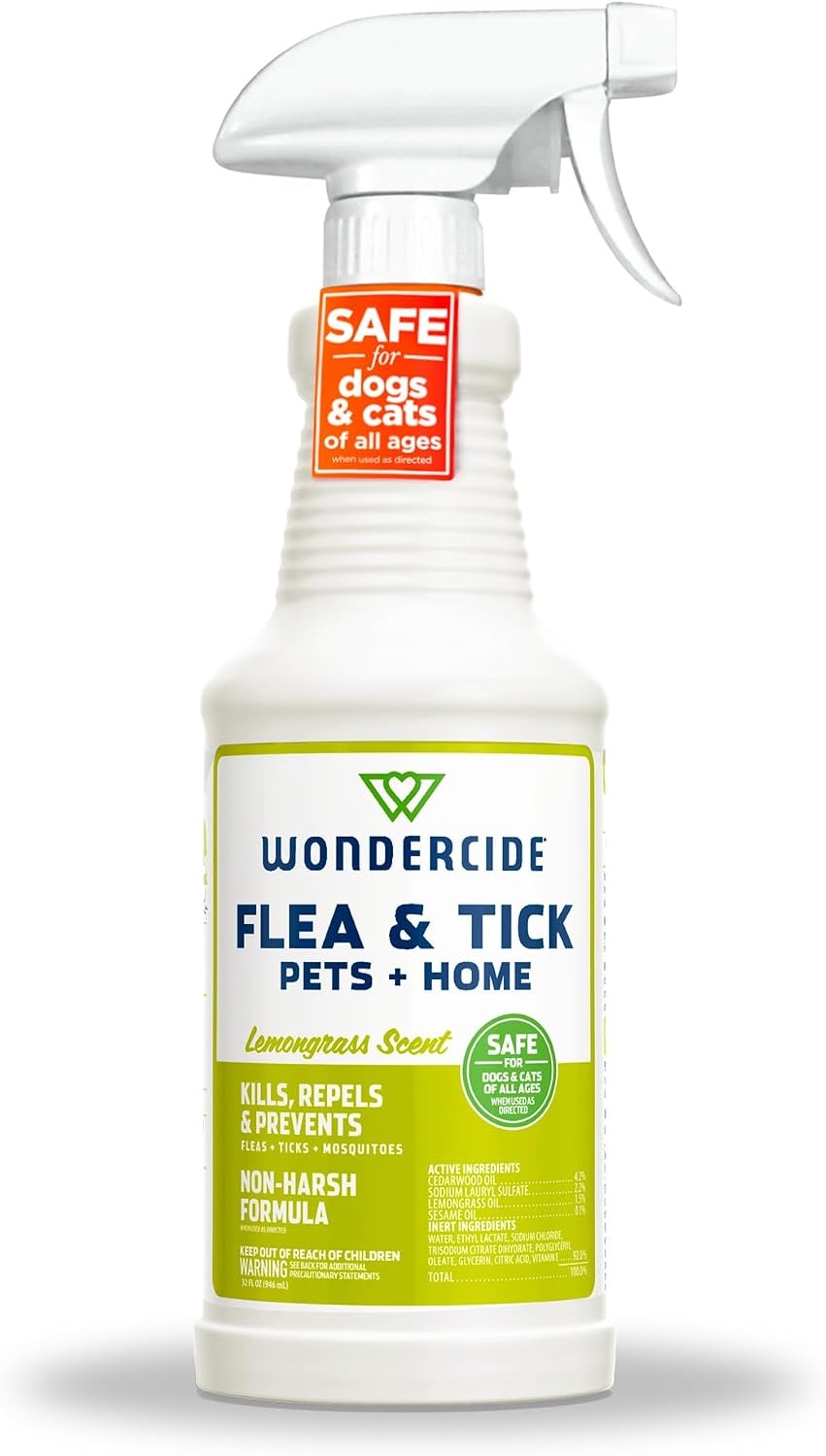
| Unit Count | 32 Ounce |
|---|---|
| Active Ingredients | Lemongrass Oil, Cedar Oil |
| Target Species | Dog |
| Age Range Description | All Life Stages |
Wondercide Lemongrass Flea, Tick & Mosquito Spray is a 32 oz plant-powered topical and household spray designed to kill by contact and repel common pests on dogs and cats and in pet environments. You use it like a conventional spray: mist pets (avoiding eyes and mucous membranes) for spot treatments or spray around bedding, carpets, kennels, and furniture to reduce fleas and ticks in the home. The formula lists cedar oil, lemongrass oil and mild surfactants and is labeled safe for all life stages when directions are followed, making it suitable for frequent use and for households with puppies or kittens. Practical benefits include a non-harsh scent that freshens rooms and a multiuse application that can break the flea life cycle by targeting eggs, larvae and adults. Limitations are that efficacy claims are based on lab testing rather than field guarantees, it is a topical/contact product so full-season control may require repeated applications, and users should follow label guidance and spot-test for skin sensitivity.
Best for: Buyers who want a practical, plant-based spray to manage fleas, ticks, and mosquitoes on pets and in the home and who prioritize a non-chemical alternative they can apply themselves.
Less Ideal for: Owners facing heavy or persistent infestations who need fast, guaranteed whole-animal or systemic control should consult veterinary options instead.
- Plant-based active ingredients (cedar oil and lemongrass) suitable for households preferring natural options
- Works as both a pet topical and household spray to target fleas, ticks, and mosquitoes
- Safe for use on all life stages when directions are followed, including puppies and kittens
- Large 32 oz size supports repeated applications around pets and the home
- Effectiveness is reported from laboratory testing and may require repeated applications in real-world infestations
- Not a systemic treatment so it may not replace monthly oral or topical veterinary preventives for heavy infestations
Verdict: A practical, plant-powered spray for pet owners who want a multiuse, gentle option to reduce fleas, ticks, and mosquitoes around pets and the home.
Premo Guard 128 oz Pet Spray — Natural Flea, Tick, Mite & Lice Treatment

| Unit Count | 128 Ounce |
|---|---|
| Item Form | Spray |
| Scent Name | Clove |
| Target Species | Cat, Dog, Rabbit |
| Active Ingredients | Cotton Seed Oil, Clove Oil |
Premo Guard is a plant-based spray sold in a 128-ounce bottle for routine control of fleas, ticks, mites, and lice on pets and in living areas. You use it by attaching the included spray nozzle, shaking, and misting an even, light coating onto pet coats, bedding, carpets, kennels, and other areas where animals frequent. Its active ingredients include clove oil and cottonseed oil, so the product is marketed as non-staining, odorless, and gentle enough for all life stages and multiple species. The large volume is convenient for multi-pet households or for treating both indoor and outdoor zones without frequent repurchasing. Practical benefits are that it can be applied directly to animals and to surfaces, it advertises egg and larval control, and the formula avoids synthetic pesticides. Important limitations are that it is for external use only and users should follow directions to avoid over-saturating; because it relies on essential oils rather than veterinary insecticides, results may require more frequent application and could be slower or less persistent against heavy infestations compared with prescription or chemical treatments.
Best for: Buyers who prioritize a gentle, non-chemical approach and want a single, large-volume spray to treat multiple pets and their living spaces routinely.
Less Ideal for: Owners facing an active, heavy flea or tick infestation who need fast, long-lasting prescription-strength control should consider veterinary treatments instead.
- Large 128 fl oz bottle reduces repurchase frequency for multi-pet homes
- Plant-based active ingredients (clove oil and cottonseed oil) provide a non-chemical alternative
- Safe for use on multiple species and life stages when applied externally as directed
- Non-staining and fragrance-free formula suitable for bedding, carpets, and furniture
- Essential-oil formulation may require more frequent applications and may be less persistent than veterinary chemical treatments
- Not intended for internal use and requires careful application to avoid over-saturating pets or surfaces
Verdict: Choose this large, plant-based spray if you want a gentle, non-staining option to protect multiple pets and household areas from fleas and mites on a routine basis.
Vet's Best Flea & Tick Easy Spray for Cats, Cotton Spice, 14 oz

| Unit Count | 14 Fluid Ounces |
|---|---|
| Item Form | Spray |
| Target Species | Cat |
| Active Ingredients | Clove Oil 0.05%, Cottonseed Oil 0.05% |
Vet's Best Flea & Tick Easy Spray for Cats is a 14 oz plant-powered spray intended for routine flea and tick control on cats 12 weeks and older and for treating bedding and soft surfaces in the home. The formula uses small amounts of clove oil and cottonseed oil to act on adult fleas, larvae, eggs, and ticks on contact while leaving a mild cotton spice scent. Typical use is a light spray on the cat followed by brushing so the product reaches the skin, or a light, non-saturating application to carpets, bedding, and furniture to reduce environmental infestations. Its main advantages are a non-chemical, non-staining formulation and clear label directions for weekly maintenance or more frequent application during infestations. Limitations are that active ingredients are present at low concentrations, so it is best used as part of a broader control plan rather than a standalone substitute for veterinary prescription treatments for heavy infestations. Users should follow the sensitivity test and drying instructions to minimize grooming ingestion.
Best for: Buyers who want an affordable, natural flea-control option to use regularly on cats and in the home as part of a preventive routine.
Less Ideal for: Owners facing a severe or persistent infestation or cats requiring veterinary prescription treatments should choose stronger veterinary-recommended options.
- Plant-based formula designed to kill fleas, flea eggs, larvae, ticks, and mosquitoes on contact
- Labeled safe for use on cats 12 weeks and older and for application on bedding and soft surfaces
- Non-staining formula with a mild cotton spice scent suitable for indoor use
- Clear directions for short-term treatment and weekly maintenance applications
- Active ingredients are low-percentage essential oils, so performance can be limited against heavy infestations
Verdict: A budget-friendly, plant-based spray that provides safe, routine flea and tick control for cats and household surfaces when used as part of a broader prevention plan.
TropiClean Natural Flea & Tick Home & Dog Spray, 32 oz

| Unit Count | 32 Fluid Ounces |
|---|---|
| Item Form | Spray |
| Target Species | Dog, Cat |
| Active Ingredients | Clove Oil 0.17%, Lemongrass Oil 1.53%, Cedarwood Oil 0.13%, Cinnamon Oil 0.18%, Sodium Lauryl Sulfate 2.50% |
TropiClean Natural Flea & Tick Home & Dog Spray is an all-purpose spray that targets adult fleas, ticks, larvae and eggs on dogs and in indoor spaces. You use it as a direct coat spray for dogs 12 weeks and older or as a surface spray for bedding and carpets; the label recommends twice-weekly applications while fleas are present and weekly for maintenance. Its active ingredients are plant-derived oils including lemongrass, clove, cedarwood and cinnamon combined with a surfactant base, which delivers a pleasant lemongrass-cedar scent and avoids synthetic pesticides. Practical benefits include multi-surface use so you can treat both pets and sleeping areas, a large 32 oz volume for multiple treatments, and clear safety guidance for households with kids and puppies when allowed to dry. Important limitations are that it is not recommended for very young kittens, it can irritate eyes or sensitive skin in some people or animals, and results rely on repeat applications and home cleaning to eliminate all life stages of fleas rather than providing a single long-term chemical control.
Best for: Buyers who want a plant-based, multi-use flea spray to treat dogs and indoor areas as part of a regular prevention routine and prefer gentler, naturally derived ingredients.
Less Ideal for: Owners seeking a one-time long-lasting chemical treatment or a veterinary prescription-strength product should consider alternative systemic or topical options.
- Uses naturally derived essential oils effective for repelling fleas and ticks on contact
- Formulated for both pet coat and home surfaces so you can treat bedding and carpets
- Large 32 fl oz bottle supports multiple treatments across pets and rooms
- Requires repeated applications and household cleaning to address all flea life stages
- Not recommended for kittens under 12 weeks and caution advised for cats and sensitive individuals
Verdict: Choose this spray if you want a large-volume, plant-oil based product to treat dogs and indoor areas as part of a routine flea and tick prevention plan.
Vet's Best Flea & Tick Home Spray for Dogs, Cotton Spice, 32 oz

| Unit Count | 32 Fluid Ounces |
|---|---|
| Item Form | Spray |
| Scent Name | Cotton Spice |
| Target Species | Dog |
| Active Ingredients | Clove Oil 0.05%, Cottonseed Oil 0.05% |
Vet's Best Flea & Tick Home Spray is a plant-powered spray intended for use on dogs 12 weeks and older and on household surfaces like bedding, carpets, crates, and furniture. The formula uses small amounts of clove oil and cottonseed oil to kill fleas, flea eggs, ticks, mosquitoes and several common household pests on contact. Typical use is to spot-test fabrics, then apply a light, even spray to pet bedding and low-traffic areas one to two times per week for prevention and two times per week for active infestations, and to mist dogs lightly when treating pets directly. Practical benefits include a gentle cotton spice scent, a non-staining formula for most fabrics, and clear label directions with safety precautions for children, pregnant or nursing animals and sensitive pets. Important limitations are that results are contact-based so repeated applications may be needed to break an infestation and the active ingredients are low-percentage essential oils rather than conventional pesticides, which some users may find slower to control heavy infestations. Follow label warnings carefully to avoid eye or skin irritation and do not use on animals under 12 weeks without veterinary advice.
Best for: Pet owners who prefer a gentler, plant-derived approach and want a product safe enough to use around the home while still treating pets directly, and who will use it regularly as part of an integrated prevention routine.
Less Ideal for: Households confronting a severe, fast-moving flea or tick outbreak that need immediate knockdown from stronger synthetic insecticides or veterinary-prescribed systemic treatments.
- Plant-based formula that targets fleas, ticks, mosquitoes and other household pests
- Can be applied to both dogs (12 weeks and older) and household surfaces including bedding and carpets
- Non-staining formulation with a mild cotton spice scent
- Clear usage instructions and safety guidance for monitoring sensitivity on pets
- Low concentrations of active oils mean it works by contact and may require repeated applications for heavy infestations
- Not recommended for puppies under 12 weeks or for use on species not listed on the label
- May cause eye or skin irritation in some people or pets if misapplied
Verdict: Choose this plant-based home and dog spray if you want a gentler, family-safe option to manage fleas and ticks that can be used on pets and around the house when used consistently.
Vet's Best Flea & Tick Easy Spray for Dogs, 14 oz (Cotton Spice)

| Unit Count | 14 Fluid Ounces |
|---|---|
| Item Form | Spray |
| Scent Name | Cotton Spice |
| Target Species | Cat, Dog |
| Active Ingredients | Clove Oil 0.05%, Cottonseed Oil 0.05% |
Vet’s Best Flea & Tick Easy Spray is a 14 oz plant‑powered spray designed to treat dogs 12 weeks and older and nearby surfaces like bedding and carpets. The formula uses small amounts of clove oil and cottonseed oil plus common inert ingredients to repel and kill fleas, flea eggs, ticks, and mosquitoes on contact. You use it by lightly spraying the dog’s coat and brushing so the product reaches the skin, or by applying light sprays to pet bedding and rugs; directions call for twice‑weekly use for active infestations and weekly for maintenance. Notable features include a pleasant cotton spice scent and a trigger spray bottle for even coverage. Practical benefits are that it offers a non‑synthetic alternative to conventional pesticides, can be used around the home and pet environments, and fits into a multi‑product prevention routine. Important limitations are the low concentrations of active oils, which means it is best suited as part of an integrated approach rather than a standalone solution for severe infestations, and you must follow label precautions and test fabrics for colorfastness.
Best for: A buyer who prioritizes natural, veterinarian‑formulated options and looks for products with strong user feedback for regular household use and prevention.
Less Ideal for: Owners facing a severe or fast‑spreading flea infestation who need rapid, high‑potency chemical control should consider veterinary treatments or stronger insecticides instead.
- Plant-based formula targets fleas, flea eggs, ticks, and mosquitoes on contact
- Safe for use on dogs 12 weeks and older and on household surfaces when used as directed
- Pleasant cotton spice scent that is milder than strong peppermint or citrus options
- Trigger spray design allows for even, targeted application to coat and fabrics
- Active ingredients are present at very low concentrations, so heavy infestations may require veterinary treatment or stronger products
- Not recommended for animals younger than 12 weeks or for off‑label species without veterinary approval
Verdict: Choose this spray if you want a plant‑based, home‑and‑pet safe option for routine flea and tick prevention that fits into a multi‑product control strategy.
Choosing the Right Safe Flea Spray: Key Factors to Consider
Active Ingredient and Toxicity Profile
Different flea sprays use different active ingredients, and those choices determine both effectiveness and safety. Low-toxicity options typically rely on botanical extracts, insect growth regulators, or pyrethrins in carefully measured concentrations. Each class has tradeoffs: botanical ingredients may be gentler but sometimes require more frequent application, while insect growth regulators interrupt flea life cycles but may not kill adult fleas instantly.
Read labels for information about mammalian toxicity, warnings for pregnant or young animals, and recommended wait times before allowing pets back into treated areas. Knowing the ingredient class helps you match the product to your household: homes with kittens, elderly pets, or allergy-prone family members often need milder profiles, while severe infestations might necessitate products with stronger active components applied with extra precautions.
Intended Use and Application Method
Sprays are formulated either for direct pet application, surface and upholstery treatment, or general indoor space spray. Trigger-spray bottles give more control and are better for spot treating furniture, pet bedding, and baseboards. Aerosol or fog-type sprays can cover larger areas quickly but increase the risk of airborne exposure and require stricter ventilation and reentry timing.
Match the application method to the treatment area. For treating a single couch or pet bed, a trigger bottle reduces overspray. For whole-room treatments, choose a product with clear instructions on room evacuation and ventilation to limit inhalation risk for people and animals.
Label Directions and Pet Reentry Timing
Clear, specific label directions are one of the most important safety features. Good labels state how long treated areas must remain empty, whether pets should be removed during application, and when it is safe for animals to return. They also detail dilution rates, contact times, and any rinsing steps needed after pet application.
If a product has ambiguous or overly broad instructions, it raises the chance of misuse. Prioritize sprays that provide measurable wait times and step-by-step directions for both spot and broad treatments so you can plan safe application and minimize re-exposure for sensitive animals.
Surface Compatibility and Residue
Household surfaces and pet items vary. Upholstery fabrics, wool rugs, hardwood floors, and pet bedding react differently to chemical sprays. A safe flea spray should list compatible surfaces and note materials to avoid; some formulations can stain or degrade delicate fabrics or finish on wood floors.
Consider how easily residues can be removed. If a pet sleeps on treated bedding, you may prefer a spray that requires laundering after a set period. For households with indoor plants or aquariums, check whether treated rooms should be ventilated thoroughly and whether plants should be covered or moved before application.
Residual Activity Versus Treatment Frequency
Residual activity indicates how long a spray continues to affect fleas after application. Longer residuals reduce the number of treatments required but may prolong low-level exposure for sensitive pets. Shorter-acting sprays might require repeated applications but are useful when minimal residue is desired.
Decide which matters more for your situation. In heavy infestations, a longer residual may be practical. For homes with very young animals or small children, choosing a lower-residue approach with careful follow-up cleaning can reduce ongoing exposure risks.
Ease of Use and Safety Features
Practical features influence how safely and effectively you will apply a flea spray. Look for trigger grips that allow single-handed control, no-drip foam applicators for targeted treatment, or measured dilution markings on concentrate bottles. Childproof caps and clear hazard icons also reduce accidental exposure.
User-friendly packaging that makes it simple to follow label instructions lowers misuse risk. If a product requires mixing, choose bottles with clear ratios or premeasured packets to avoid measurement errors that can increase toxicity or reduce efficacy.
Choosing a Spray for Homes with Sensitive Pets
If you have kittens, senior dogs, or animals with respiratory issues, prioritize sprays with explicit low-toxicity labeling and short reentry requirements. Botanical formulations and products that rely on insect growth regulators often present fewer acute exposure signs, but you must still follow dilution and ventilation instructions carefully.
When applying anywhere near sleeping areas or food preparation zones, remove items and ventilate until odor dissipates. Consider treating bedding by laundering on a hot cycle when possible rather than relying solely on on-site spray residues.
- Spot treat rather than broadcast spraying when pets share specific resting areas
- Avoid aerosol foggers in small, poorly ventilated rooms
- Keep pets out of treated rooms for the full labeled reentry time
How to Treat Upholstery and Carpets Safely
Upholstery and carpets hide flea adults and larvae inside fibers and seams. Use a spray designed for fabrics and test a small, inconspicuous area first for staining or color change. Work from top to bottom and focus on baseboards, under furniture edges, and along carpet edges where flea activity concentrates.
Combine spot application with mechanical control such as vacuuming. Vacuuming before and after treatment removes eggs and larvae and improves spray contact with remaining adults. Empty vacuum bags or canisters outdoors after use to prevent reinfestation in the home.
- Test fabric compatibility before broad application
- Vacuum thoroughly to reduce organic material that shelters flea life stages
- Target seams, edges, and pet resting spots for best results
Safe Protocols for Direct Pet Application
Not all sprays are formulated for direct use on animals. If the label permits pet application, follow all concentration and exposure guidance. Apply in a well-ventilated area, avoid the face and eyes, and keep application light to minimize inhalation. After spraying, allow the pet to air dry in a ventilated space and prevent grooming until the product is fully dry or until the label allows.
For multi-pet households, treat animals sequentially and avoid crowding during application. Monitor treated pets for any signs of irritation, drooling, or behavior changes in the hours after treatment and contact a veterinarian if symptoms persist.
- Confirm the spray is labeled for direct pet use before applying
- Protect eyes and mucous membranes during application
- Prevent pets from licking treated fur until product dries or label permits
Managing Re-treatment and Follow-up Cleaning
Flea life cycles mean follow-up treatments and cleaning are usually necessary. Schedule reapplications according to label residual claims and life-cycle targeting. In most cases, combining targeted spraying with repeated vacuuming and laundering of bedding provides the best long-term control.
Keep an activity log of treatment dates and areas treated to avoid over-application in the same spot and to track when follow-up is due. Always adhere to maximum treatment frequency stated on the label to stay within safe exposure limits.
- Coordinate spraying with thorough vacuuming and washing of pet linens
- Record treatment intervals to avoid exceeding recommended frequencies
- Inspect commonly used pet areas weekly for resurgence
Indoor Safety Around Children, Plants, and Aquariums
When treating indoor spaces, remove children, cover or move houseplants, and secure open aquariums. Some sprays can harm aquatic life if residues enter water systems, and sensitive plants may respond poorly to sprays that include solvent carriers or fragrances.
Ventilate treated rooms well and follow any rinsing instructions for surfaces where food is prepared. Use temporary barriers or closed doors to keep children and pets away until the area is safe to reenter.
- Cover aquariums and move small potted plants from treatment zones
- Follow label instructions for surface rinsing near food prep areas
- Ensure treated rooms are fully ventilated before reentry
How We Chose the Best Safe Flea Spray
We prioritized sprays that balance flea control with minimized risk to pets and people. Editorial selection focused on active ingredient profiles known for lower mammalian toxicity, clear pet reentry or wait-time instructions, and formulations designed for indoor surfaces or direct pet use depending on label guidance. We also assessed application methods, including trigger-spray precision versus aerosol distribution, because control over spray location reduces unnecessary exposure. Practical performance was a factor: products needed documented efficacy against adult fleas or life stages commonly targeted by sprays and reasonable residual activity to reduce repeat treatments. Safety information clarity and accessible instructions were essential; labels that list precautions, dilution rates, and reentry times are easier for owners to use properly. Product availability for indoor-safe formats and non-irritating fragrance or oatmeal-based soothe additives were considered where relevant. We excluded treatments intended solely for yard broadcast, flea collars, or systemic veterinary prescriptions. The list does not include veterinary-only medications or products requiring professional application. Items that lacked transparent safety instructions or had active ingredients with high mammalian toxicity were removed from consideration.
FAQ
Are natural ingredient flea sprays safer for kittens and puppies?
Natural ingredient sprays often have lower acute toxicity, but safety depends on formulation and concentration. Some botanical extracts can still irritate sensitive animals. Always check the label for age restrictions and follow reentry and application instructions closely.
How long should I keep pets out of a room after spraying?
Reentry times vary by product and application method. Many sprays recommend keeping pets out until the product is dry and any specified ventilation period has passed. Consult the label for exact timing and follow the longest recommended waiting period if unsure.
Can I use a flea spray on my pet's bedding and toys?
Yes if the product is labeled for fabric and pet areas, but laundering bedding on a hot cycle is often the safest option. Hard toys that pets lick may require rinsing or choosing products with explicit rinsing guidance before allowing pets to reuse them.
Will a spot treatment be enough for a whole-house infestation?
Spot treatments help reduce localized infestations but often do not eliminate widespread problems because flea eggs and larvae can be distributed throughout a home. Combine spot spraying with vacuuming, laundering, and targeted whole-room treatments per label guidance for heavier infestations.
Are foggers or aerosols better than trigger sprays for indoor use?
Trigger sprays give more control and lower airborne exposure, making them preferable for many indoor situations. Foggers cover larger areas but increase inhalation risk and require stricter evacuation and ventilation procedures.
Final Verdict
Pick a spray that matches the needs of your household and the severity of infestation while respecting safety instructions. Prioritize clear label directions, compatible application methods, and active ingredients suited to your pets' ages and sensitivities. Balance residual activity against the desire to limit ongoing exposure, and pair any spray treatment with mechanical cleaning like vacuuming and laundering to interrupt the flea life cycle. When in doubt, choose the option that offers the clearest safety guidance and allows precise application. That approach reduces unnecessary exposure and gives you a reliable path to controlling fleas without compromising household or pet health.
