

Note: This article contains affiliate links. If you click on these links and make a purchase, I may earn a small commission at no extra cost to you. This helps support my research and content. Read my full affiliate disclosure here.
Selecting the right safe insect killer matters when you want to protect plants, people, and pollinators in and around your home. A well-chosen option reduces pest damage while minimizing harm to beneficial insects, children, pets, and soil life. This guide shortlists seven top-rated safe insect killers suited to typical home and garden situations and explains the practical tradeoffs gardeners face. We evaluate each pick on how well it controls common pests, how low the risk is to non-target species, and how easy the product is to use and maintain. Read on for a clear sense of which features matter most before you choose.
Top Picks at a Glance
| Best Overall The best all-around choice for most situations | Wondercide Indoor Pest Control Spray, Peppermint, 32 oz |  |
| Best Quality Built to a higher standard if you want something more solid | Wondercide Indoor Pest Control Spray, Peppermint, 16 fl oz |  |
| Best Value The sweet spot between price and what you get | Safer Home Indoor Pest Control Multi-Insect Spray, 24 fl oz |  |
| Best Budget The cheapest option that still gets the job done reliably | STEM Plant-Based Bug Spray for Flies, Mosquitoes & Gnats, 10 oz |  |
| Highest Rated A top-rated pick with lots of positive feedback | Geomust Diatomaceous Earth with Peppermint Oil, Food Grade Insect Killer, 1 lb |  |
| Most Popular A crowd favorite that many people choose with confidence | STEM Plant-Based Bug Spray for Ants, Roaches and Flies, 12 fl oz |  |
| Best Seller A high-volume bestseller chosen again and again | ZEVO Compact Flying Insect Trap with 3 Refill Cartridges |  |
Wondercide Indoor Pest Control Spray, Peppermint, 32 oz

| Unit Count | 32 Fluid Ounces |
|---|---|
| Item Form | Spray |
| Target Species | Ants, Roaches, Spiders, Flies, Fleas, Ticks, Mosquitoes, Silverfish, Moths, Gnats |
| Active Ingredients | 4.2% Cedar Oil; 2.2% Sodium Lauryl Sulfate; 1.5% Peppermint Oil; 0.1% Sesame Oil |
Wondercide Indoor Pest Control is a ready-to-use peppermint-scented spray designed to kill and repel common indoor pests while remaining gentle enough for homes with pets when used as directed. You use it like a conventional spray: shake, select mist or targeted stream, and spray visible insects, baseboards, entry points, and areas where pets spend time. The formula combines cedar oil, peppermint oil, and plant-derived surfactant to provide both contact kill and repellent action against ants, roaches, spiders, flies, fleas, ticks, mosquitoes, moths, and more. Practical benefits include multi-surface application around kitchens, bathrooms, furniture, and pet bedding and a non-staining, plant-powered approach that avoids synthetic pesticides. The spray is versatile for spot treatments and routine preventive use, and the 32 ounce bottle offers multiple applications. Important limitations are standard for contact sprays: it must hit flying insects to kill them, repeat applications are needed for prevention, and the label warns of possible eye and skin irritation in sensitive individuals. Follow the directions for use around food surfaces and pets.
Best for: Buyers who want an effective, plant-powered indoor pest spray that they can use regularly around a household with pets and family members and who prioritize safer ingredient choices over conventional pesticides.
Less Ideal for: People needing a long‑lasting residual professional treatment or whole-house extermination solution should consider alternative products or services.
- Plant-based active ingredients provide kill and repellent action against many common household pests
- Safe for routine indoor use around people and pets when label directions are followed
- Versatile multi-surface application for kitchens, bathrooms, baseboards, furniture, and pet areas
- Available in a 32 oz ready-to-use spray bottle that supports repeated spot treatments
- Requires direct contact to kill flying insects rather than providing area-wide aerosol knockdown
- May cause eye or skin irritation in some users and requires caution during handling
Verdict: Choose this spray if you want a pet-safe, plant-powered indoor pest control you can use frequently for spot treatments and prevention.
Wondercide Indoor Pest Control Spray, Peppermint, 16 fl oz

| Unit Count | 16 Fluid Ounces |
|---|---|
| Item Form | Spray |
| Target Species | Ants, Roaches, Spiders, Flies, Fleas, Ticks, Mosquitoes, Silverfish, Moths, Gnats |
| Active Ingredients | 4.2% Cedar Oil; 1.5% Peppermint Oil; 2.2% Sodium Lauryl Sulfate; 0.1% Sesame Oil |
Wondercide Indoor Pest Control is a ready-to-use peppermint-scented spray designed to kill and repel flying and crawling household pests including ants, roaches, spiders, flies, fleas, ticks, mosquitoes, moths, and gnats. It is typically used around baseboards, windows, doors, under sinks, in cabinets, on furniture and carpets, or sprayed directly on visible insects from 8 to 12 inches. Key features include a plant-derived active blend led by cedarwood and peppermint oils, a multi-surface sprayer with adjustable nozzle, and labeling that emphasizes safe use around people and pets when directions are followed. In practical terms this makes it a straightforward option for spot treatments and routine preventative spraying in kitchens, bathrooms, pet areas and living spaces. Limitations to keep in mind are that it must contact flying insects to kill them, surfaces can be slippery when wet, and some people may experience mild skin or eye irritation if misused. For someone looking to reduce reliance on synthetic pesticides while keeping indoor pest problems under control, this product delivers an easy, plant-based approach.
Best for: Buyers who prioritize practical, lower-toxicity solutions and want a versatile, easy-to-use indoor spray for routine spot treatment and prevention around the home and pet areas.
Less Ideal for: People who need long-duration residual control or professional-grade pesticide strength for large infestations should consider stronger or specialized treatments.
- Plant-powered formula with cedarwood and peppermint oils as primary active ingredients
- Kills and repels a broad list of common indoor pests including fleas, ants, roaches and flies
- Ready-to-use spray with adjustable nozzle for targeted or mist application
- Labeled safe for use around people and pets when directions are followed
- Must directly contact flying insects to be effective against them
- Can cause mild skin or eye irritation and surfaces may be slippery when wet
Verdict: A practical, plant-based indoor spray for homeowners who want an easy, lower-toxicity way to kill and repel common household pests while using a product safe for family and pets when used as directed.
Safer Home Indoor Pest Control Multi-Insect Spray, 24 fl oz

| Item model number | SH110 |
|---|---|
| Ingredients | Clove Oil 0.05%, Cottonseed Oil 0.05%, Inert Ingredients 99.90% |
| Volume | 24 fl oz |
| Manufacturer | Woodstream Corporation |
Safer Home Indoor Pest Control Spray is a ready-to-use contact insecticide formulated with natural oils like clove and cottonseed to tackle ants, roaches, flies, spiders, fleas, mosquitoes, ticks, wasps and many other indoor pests. You use it by switching the nozzle between a spray setting for general areas and a stream setting for crack-and-crevice work, holding the bottle about 8 to 12 inches from the target. The formula claims fast knockdown, killing ants, flies, and roaches within minutes, and it dries without leaving a residue so no wiping is required. Its main practical benefit is offering a broad-spectrum, easy application for spot treatments around kitchens, baseboards, windows, doors and crawl spaces while relying on naturally derived active ingredients that are presented as safer for homes with children and pets when directions are followed. The limitations are that it is a contact killer rather than a residual barrier product and effectiveness against heavy infestations may be slower than synthetic insecticides, so repeated or complementary measures may be needed for persistent problems.
Best for: Households that prioritize practical, lower-toxicity solutions for spot-treating common indoor pests and want an easy, no-mess spray safe for use around kids and pets when directions are followed.
Less Ideal for: Homes facing severe or persistent infestations that need long-lasting residual control or professional-strength treatments should consider stronger or specialized options.
- Made with naturally derived oils (clove oil and cottonseed oil) instead of harsh synthetic chemicals
- Ready-to-use spray with adjustable nozzle for both general spray and crack-and-crevice stream
- Fast contact kill for common pests with no residue to wipe up after application
- Broad-spectrum label covering many common indoor insects including ants, roaches, flies, spiders, fleas and mosquitoes
- Contact-only action offers limited residual protection, so repeat applications may be necessary
- May be less effective than conventional synthetic insecticides on heavy infestations
Verdict: A convenient, low-toxicity indoor spray for quick spot control of common household pests in pet-friendly homes.
STEM Plant-Based Bug Spray for Flies, Mosquitoes & Gnats, 10 oz

| Net volume | 10 oz |
|---|---|
| Active ingredients | Geraniol 1.47%, Lemongrass oil 0.10% |
| Intended use | Indoor and outdoor spot treatment |
STEM's 10 oz aerosol bug spray is a plant-based insecticide formulated to kill flies, mosquitoes and gnats around the home and patio. You use it like most aerosols: shake well, hold the nozzle 6–12 inches from target areas or visible insects, and mist surfaces or airspace where flying pests congregate. Notable features include geraniol and lemongrass oil as the active ingredients, no added dyes or harsh chemical odors, and directions that allow both indoor and outdoor spot treatments. In practice it is convenient for quick spot kills and temporary control around doorways, windowsills, potted areas and patios. Because it is formulated for people- and pet-occupied spaces when used as directed, it is a reasonable option for households that prefer botanical actives. Limitations are typical for short‑acting aerosols: protection is not long lasting so repeat applications are needed after rain or cleaning, and it is not for direct application to people, pets or edible plants.
Best for: Buyers who want an affordable, plant-based aerosol for quick spot control of gnats and other flying pests around living spaces and patios.
Less Ideal for: People seeking season-long residual protection or professional-grade control should consider products with longer-lasting actives or different application formats.
- Uses plant-based active ingredients (geraniol and lemongrass oil) rather than harsh synthetic chemicals
- Formulated for both indoor and outdoor spot treatments when used as directed
- No added dye or strong chemical fragrance, making indoor use less obtrusive
- Entomologist-tested formulation and clear directions for application
- Effect is short lived compared with long‑lasting residual insecticides
- Not intended for direct use on people, pets or edible plants
Verdict: A budget-friendly, plant-based aerosol that delivers fast, convenient knockdown of gnats and other flying pests for short-term control.
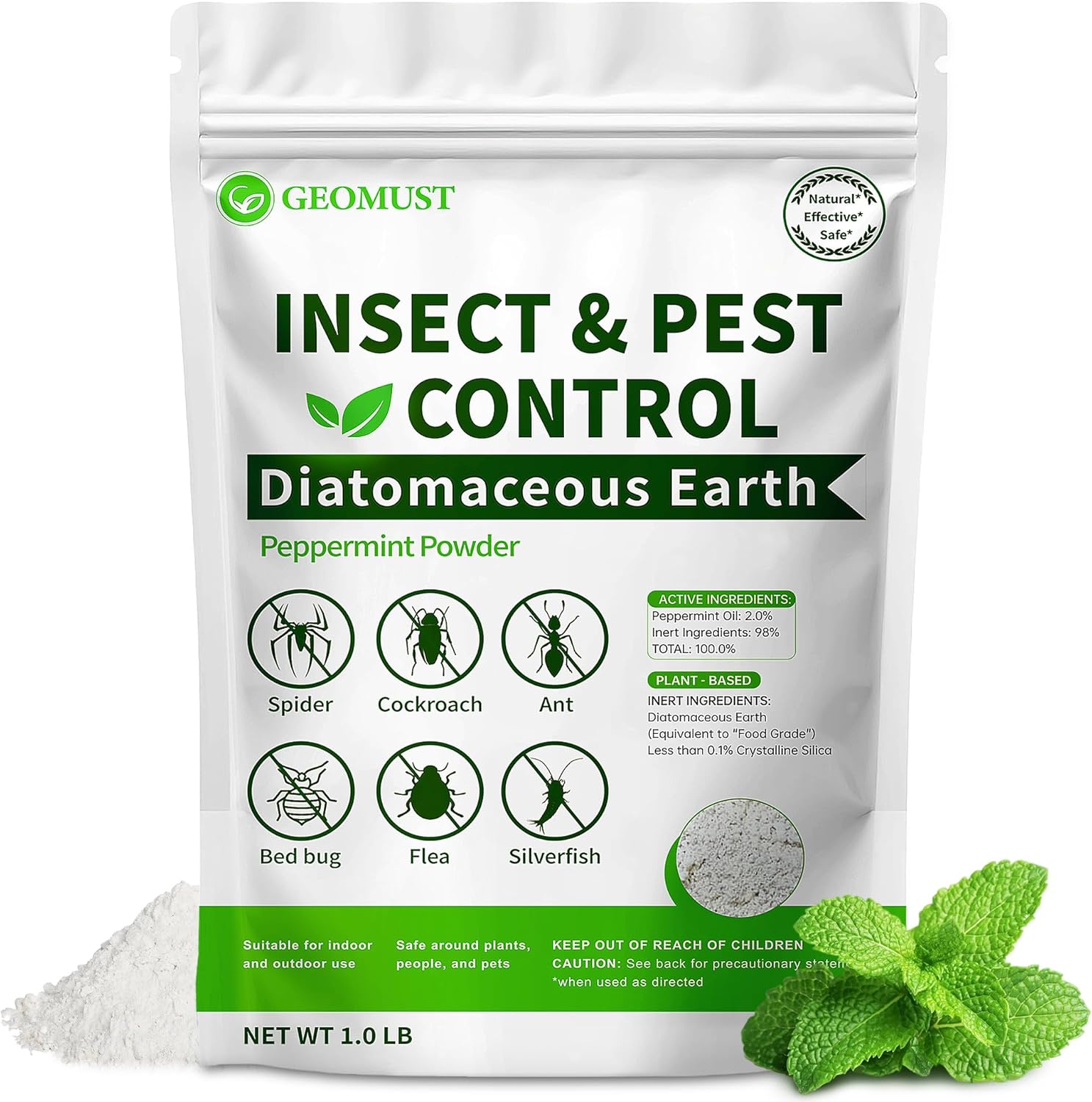
Geomust Diatomaceous Earth with Peppermint Oil, Food Grade Insect Killer, 1 lb
| Item Form | Powder |
|---|---|
| Target Species | Ants; Cockroaches; Fleas; Bed Bugs; Silverfish; Insects |
| Unit Count | 16 Ounce |
| Ingredients | Diatomaceous Earth; Peppermint Oil |
This Geomust product is a food-grade diatomaceous earth powder mixed with peppermint oil intended to control ants, roaches, fleas, bed bugs, silverfish and other crawling pests. You apply the dry powder to cracks, baseboards, entry points and around foundations or garden areas where insects travel; it works by dehydrating and abrading insect exoskeletons rather than poisoning them. The added peppermint oil gives a fresh scent and may help deter insects in treated zones. Because the formula is inert and labeled food grade it is suitable for use where households want a nonchemical option and safer handling around people and pets when used as directed. It must be kept dry to remain effective and its effects are contact-based, so it requires placement where insects will cross and occasional reapplication after cleaning or moisture exposure. For heavy, established infestations you may need repeated treatments or to combine this with exclusion and sanitation measures.
Best for: Homeowners who prioritize a low-toxicity, maintenance-friendly approach to crawling pests and want a straightforward, preventive product to use around living spaces and garden edges.
Less Ideal for: People needing a fast-acting or broad-spectrum solution for large, active infestations where immediate reduction is required.
- Food-grade diatomaceous earth provides a nonchemical, physical mode of kill safe for many home environments when used as directed
- Peppermint oil adds a pleasant scent and may increase deterrent effect in treated areas
- Versatile for indoor and outdoor use around baseboards, entry points, and garden perimeters
- Long-lasting when kept dry and simple to apply as a powder barrier
- Needs to stay dry and only works on insects that contact the powder, so wet areas reduce effectiveness
- Not an instant knockdown for heavy infestations and may require repeated applications or complementary controls
Verdict: Choose this if you want a simple, food-grade, nonchemical powder to prevent and reduce crawling pests with safe indoor and outdoor use when kept dry.
STEM Plant-Based Bug Spray for Ants, Roaches and Flies, 12 fl oz

| Active ingredients | Geraniol 6.2%, Lemongrass Oil 0.5% |
|---|---|
| Other ingredients | White Mineral Oil, Isopropyl Myristate, (+)-Ethyl Lactate 93.9% |
| Form | Trigger spray |
| Use | Indoor and outdoor spot treatments |
This STEM bug spray is a trigger-spray insecticide formulated with plant-derived actives such as geraniol and lemongrass oil to kill ants, roaches and flies on contact. It is intended for targeted indoor and outdoor spot treatments: shake, hold about a foot from the insect and spray directly on or where insects congregate. The product’s botanical formula and absence of added dyes or strong chemical fragrances make it a reasonable choice for homes where users prefer less synthetic-smelling options. The trigger bottle gives control for spot application and repeated short bursts, and the directions note it is oil-based so spills should be cleaned promptly. Important limitations are that it is not for spraying on people, pets or plants and requires direct hits for best effect rather than long-range fogging. For persistent infestations you may need supplemental measures because this is designed for surface and contact kills rather than residual baiting or area-wide control.
Best for: Buyers who want an affordable, low-odor botanical spray for quick spot control of common household pests and who prioritize a simple, easy-to-use trigger bottle for targeted treatments.
Less Ideal for: People facing large or hidden infestations who need long-lasting residual control or bait-style solutions should consider professional products or integrated pest control approaches.
- Plant-based active ingredients (geraniol and lemongrass oil) that reduce strong chemical odor
- Trigger-spray bottle for controlled, targeted application
- Labeled for both indoor and outdoor spot treatments when used as directed
- No added dye or fragrance listed, which minimizes residue and scent
- Oil-based formula can leave slippery residue if spilled
- Requires direct spraying of insects for effectiveness and offers limited residual control
- Not safe to spray on people, pets or plants
Verdict: A budget-friendly, low-odor plant-based trigger spray that provides quick, targeted kills of ants, roaches and flies for everyday spot treatments.
ZEVO Compact Flying Insect Trap with 3 Refill Cartridges

| Target Species | Fly, Fruit Fly, Gnat |
|---|---|
| Power Source | Electric |
| Unit Count | 4 Count |
| Material Type | Plastic |
The ZEVO Compact Flying Insect Trap is a plug-in indoor unit that attracts fruit flies, gnats, and house flies with blue and UV light and holds them on disposable adhesive cartridges so you can remove and replace refills without touching the insects. Typical use is to place the unit near problem areas such as fruit bowls, trash cans, or houseplants and leave it powered continuously for around-the-clock catch. Notable features include a no-mess adhesive cartridge with a tab for easy disposal, a compact profile for tight spaces, and a quiet, spray-free operation that avoids chemical odors and zapping sounds. In practice it provides consistent passive control for small flying pests and is family-friendly when used as directed. Limitations are that it is designed for indoor spot control of small flies rather than large infestations, and effectiveness depends on correct placement and periodic cartridge replacement roughly every six weeks. The unit requires an outlet and ongoing refill purchases to maintain performance.
Best for: Buyers who want a discreet, low-maintenance indoor solution for everyday small flying pests and prefer nonchemical, quiet options with easy cleanup.
Less Ideal for: People needing fast knockdown for heavy infestations or outdoor/large-area pest control should consider more powerful or whole-home treatments.
- Chemical-free, quiet operation suitable for homes with children or pets
- No-mess disposable adhesive cartridges with tab for easy removal
- Compact plug-in design fits tight indoor spaces near problem sources
- Blue and UV light provides continuous attraction day and night
- Not intended for large infestations or outdoor use
- Requires regular purchase and replacement of proprietary refills
Verdict: Choose this compact plug-in trap if you want a discreet, chemical-free way to reduce fruit flies and gnats in indoor problem spots with minimal fuss.
Choosing the Right Safe Insect Killer: Key Factors to Consider
Target Pest Effectiveness
Know which pests you most need to control. Different safe insect killers vary in their effectiveness against chewing insects, sap-sucking pests, soft-bodied pests like aphids and mites, or nuisance insects such as flies and mosquitoes.
Matching the product to the pest biology saves time and reduces unnecessary applications. For example, contact-focused options work best when you can hit the insect directly, while systemic or long-lasting contact treatments are more useful for pests hidden in foliage or soil. Confirm labeled target pests and typical response time before you buy.
Risk to Beneficial Insects and Pollinators
Evaluate how selective the treatment is and when it is safe to apply around flowering plants. Many low-toxicity products can still harm bees and predatory insects if sprayed on blooms or used during foraging times.
Choose options with low bee toxicity, apply in the evening or early morning when pollinators are less active, and prefer methods that limit contact with flowers. Maintaining habitat for beneficial insects often reduces the need for repeated treatments.
Child and Pet Safety
Consider formulation and residual activity where children and pets play. Granules, baits, and concentrated liquids have different exposure risks depending on where they are placed and how they are diluted.
Look for clear label instructions on re-entry intervals, allowable application areas, and recommended storage. Lower-odour, fast-degrading options reduce incidental exposure, while physical traps and exclusion methods eliminate chemical exposure entirely.
Environmental Persistence and Breakdown
Understand how long the active ingredient remains active in soil, on foliage, or on surfaces. Products that break down quickly reduce long-term exposure to non-target organisms but may require more frequent reapplication.
Prefer materials with documented rapid degradation under sunlight and soil microbes when minimizing environmental accumulation is a priority. If persistent control is needed for a serious infestation, balance persistence against the potential ecological cost.
Application Practicality
Assess whether the product fits your garden routines and abilities. Ready-to-use sprays, concentrates, dusts, and bait stations each have different application skills and equipment requirements.
Choose formats that allow accurate placement of product where pests are active. Simple spray patterns and measured dosing reduce overuse. Consider whether you can safely store, mix, and dispose of the formulation according to label directions.
Integration With Cultural Controls
Think about how the insect control method complements other practices such as crop rotation, sanitation, resistant plant varieties, and habitat for predators.
Using a safe insect killer as one element of an integrated approach often yields longer-term pest suppression with fewer interventions. Consider timing treatments to support beneficial insects and to avoid disrupting biological control agents already at work in the garden.
When to Use a Safe Insect Killer
Not every pest presence requires a treatment. Use safe insect killers when pest density threatens plant health, production, or human comfort and when nonchemical options are impractical. Monitor plants regularly and identify pests so you can pick a targeted approach.
Apply treatments based on threshold levels rather than at the first sight of insects. Early morning or dusk applications reduce pollinator exposure, and spot-treating affected plants limits overall environmental load.
- Inspect new plants and isolate infested specimens before introducing them to beds or containers
- Use sticky traps and beat-sheet sampling to assess population levels before treating
- Combine physical removal with targeted treatment to reduce overall product use
Application Timing and Technique
Correct timing and technique maximize effectiveness while minimizing non-target harm. Apply treatments when pests are active but pollinators are not, and direct sprays to the undersides of leaves for sap-sucking pests.
Avoid broad broadcast spraying across a garden. Instead, focus on hotspots and follow label dilution rates and coverage instructions closely to avoid phytotoxicity or unnecessary exposure.
- Spray in calm weather to prevent drift
- Wear gloves and eye protection during mixing and application
- Rinse equipment thoroughly after use and follow disposal guidance
Nonchemical Alternatives and Complementary Methods
Physical controls such as row covers, sticky barriers, and hand-picking reduce reliance on chemical interventions. Beneficial insects, trap cropping, and microbial controls can keep pest pressure low when established properly.
Using these methods alongside safe insect killers often allows lower doses and less frequent reapplication, which supports pollinators and soil organisms while managing pests effectively.
- Introduce or conserve predators such as lady beetles and lacewings
- Use insecticidal soaps or horticultural oils as short-residual contact options
- Rotate control tactics so pests do not build tolerance to a single method
Safe Disposal and Storage Practices
Store all treatments in original containers with labels intact, in a locked, dry area away from food and feed. Secure storage prevents accidental access by children and pets.
Dispose of unused product and empty containers according to local regulations. Rinse equipment and containers as directed and never pour concentrated materials into drains or soil where they could affect non-target organisms.
- Keep a log of application dates and treated areas
- Do not reuse pesticide containers for other household uses
- Follow municipal hazardous waste guidance for disposal
Common Mistakes Gardeners Make
Overapplying 'safe' products because they feel less hazardous can still cause plant damage and harm beneficials. Read label directions and apply only as needed.
Treating at the wrong time of day or on blooming plants often exposes pollinators unnecessarily. Another common error is mixing multiple products without confirming compatibility, which can reduce effectiveness or increase plant injury.
- Avoid treating healthy, undamaged plants as a preventive habit
- Do not neglect follow-up monitoring after treatment
- Confirm re-entry and harvest intervals for edible crops
How We Chose the Best Safe Insect Killer
We focused on practical, safety-forward criteria that matter to gardeners who need pest control without high ecological or household risk. Evaluation prioritized proven modes of action that reduce non-target harm, clear application guidance, and visible reductions in pest pressure in ordinary garden settings. We also weighed persistence and breakdown rates to favor products that do not linger in soil or on flowers, plus ease of use so home gardeners can apply treatments accurately. Our selection filters excluded products that rely on indiscriminate broad-spectrum contact toxins, materials with long soil residency, and any treatment lacking clear labeling for safe use around people, pets, and pollinators. We favored options with targeted activity, lower environmental persistence, and straightforward safety instructions. Additional selection dimensions included formulation stability, compatibility with integrated pest management practices, and availability of supporting application guidance. These criteria align with the scoring metrics used throughout the guide.
FAQ
Are safe insect killers effective against large infestations?
Safe insect killers can reduce pest numbers, but very large or established infestations may need a combination of tactics. For severe outbreaks, integrate physical removal, habitat adjustments, and multiple targeted treatments rather than relying on a single low-toxicity product.
How soon can I harvest edible plants after treatment?
Harvest intervals vary by formulation and label instructions. Many low-residue options permit short intervals, but always check the specific guidance for the product used and follow the longest recommended waiting period for safety.
Will safe insect killers protect pollinators?
They reduce risk when used correctly, but no insect control is without potential impact. Minimize pollinator exposure by avoiding sprays on open flowers, applying at times of low pollinator activity, and favoring targeted spot treatments.
Can I use safe insect killers in container gardens and greenhouses?
Yes, but ensure good ventilation in enclosed spaces and follow label restrictions for greenhouse use. Container gardens may need gentler doses because roots and soil volumes are smaller, which affects persistence and plant sensitivity.
How often should I reapply a safe insect killer?
Reapplication depends on the product's residual life, pest pressure, and environmental conditions. Many low-persistence options require more frequent checks and spot treatments, while materials designed for longer control will have longer intervals indicated on the label.
Will safe insect killers harm predatory insects that help control pests?
Some treatments can harm predators if they contact treated surfaces. To protect beneficials, apply treatments selectively, avoid blanket sprays, and time applications when predators are less active.
Final Verdict
Prioritize products that match the pest you need to control while minimizing exposure to pollinators, children, and pets. Balance residual activity against ecological impact and choose application formats that allow targeted placement. By integrating safe insect killers with cultural and biological controls, you can reduce overall chemical use while keeping pests at manageable levels. Make choices that reflect your garden layout, the pests present, and the level of ongoing monitoring you can commit to.
