

Note: This article contains affiliate links. If you click on these links and make a purchase, I may earn a small commission at no extra cost to you. This helps support my research and content. Read my full affiliate disclosure here.
Picking the right seed spreader changes how quickly and evenly you can renovate lawn areas, overseed thin patches, or broadcast cover crops in large beds. The right tool saves seed, limits gaps, and reduces the time you spend reworking missed strips. This guide collects seven top seed spreaders shortlisted for common garden and yard situations: small lawns, large turf areas, vegetable beds, and mixed-seed mixes. We evaluated each option for how accurately it distributes different seed sizes, how durable it is in real outdoor conditions, and how easy it is to calibrate and operate. Read on to understand which features matter for the kind of tasks you do and to find a spreader suited to your garden workflow.
Top Picks at a Glance
| Best Overall The best all-around choice for most situations | Scotts Turf Builder EdgeGuard DLX Broadcast Spreader |  |
| Best Quality Built to a higher standard if you want something more solid | EarthWay 2150 Commercial 50 lb Broadcast Fertilizer Spreader |  |
| Best Value The sweet spot between price and what you get | WORX 20V Cordless Broadcast Spreader WG869 |  |
| Best Budget The cheapest option that still gets the job done reliably | CHAPIN 8740A 64 oz Hand Shaker Spreader |  |
| Highest Rated A top-rated pick with lots of positive feedback | John Deere 130 lb Push Broadcast Spreader |  |
| Most Popular A crowd favorite that many people choose with confidence | Scotts Whirl Hand-Powered Spreader |  |
| Best Seller A high-volume bestseller chosen again and again | Agri-Fab 130 lb Pull-Behind Broadcast Spreader (Model 45-0463) |  |
Scotts Turf Builder EdgeGuard DLX Broadcast Spreader

| Brand | Scotts |
|---|---|
| Item Type | EdgeGuard DLX Broadcast Spreader |
| Additional Features | EdgeGuard Technology, Pre-calibrated |
| Capacity Coverage | Up to 15,000 sq. ft. |
The Scotts Turf Builder EdgeGuard DLX is a straightforward broadcast spreader for homeowners who need even coverage across medium to large lawns. It arrives pre‑calibrated and uses a curved hopper with a dual‑bladed agitator to keep granular seed and fertilizer flowing smoothly while the EdgeGuard side shield blocks product from driveways, flower beds, and sidewalks. Settings are matched to Scotts product recommendations so setup is quick: pick the dial setting, pour in the product, and walk at a steady pace. The large capacity covers up to 15,000 sq. ft. per fill, and the robust hopper and agitator help prevent clumping with common lawn products. Downsides are that it is a broadcast spreader, so fine tuning application rate beyond the preset settings is limited and it requires steady walking speed for uniform results. It is also a single‑model design without specialty attachments for precision corridors or narrow strips. For routine seeding, fertilizing, or winter ice melt, it delivers consistent, reliable performance for the typical homeowner.
Best for: Homeowners who want a reliable, easy-to-use spreader for regular seeding, fertilizing, and winter salt tasks and who value convenience and consistent coverage across medium to large lawns.
Less Ideal for: Users who need highly precise application rates, professional landscapers, or those who work mainly in very tight or narrow planting areas.
- Pre-calibrated dial matched to Scotts product settings for quick setup
- EdgeGuard side shield prevents spread onto sidewalks, driveways, and beds
- Curved hopper and dual-bladed agitator reduce clumping and ensure smooth flow
- Large capacity covers up to 15,000 sq. ft. per fill for fewer refills
- Limited fine-tune control beyond preset calibration for precise application
- Not optimized for very narrow strips or beds where a drop spreader is better
Verdict: A user-friendly, pre-calibrated broadcast spreader that delivers consistent coverage and protects borders, making it a strong all-round choice for home lawn care.
EarthWay 2150 Commercial 50 lb Broadcast Fertilizer Spreader

| Brand | EarthWay |
|---|---|
| Model Number | 2150 |
| Item Type Name | lawn-and-garden-fertilizer-spreaders |
| Warranty Description | 5-Year Limited Warranty |
The EarthWay 2150 is a professional-grade walk-behind broadcast spreader built for precise, repeatable application across small to medium lawns. It uses EarthWay's patented 3-hole drop system plus side spread control to deliver a near 50/50 pattern and feathered edging, which makes seeding and fertilizing more consistent than typical consumer spreaders. The 50 lb poly hopper is rustproof and easy to wash, while the clog-free slide-in grate helps keep material flowing without frequent interruptions. Large 13 inch pneumatic tires and a sealed gearbox make it easy to push over uneven turf and tolerate damp conditions. Height-adjustable handles and a T-handle lever let operators of different sizes maintain good control. On the downside this is a purpose-built, heavier unit that takes more storage space than handheld seeders and may be more than needed for tiny yards. It also lacks tow or motorized options for very large properties. For users focused on reliable, accurate spreading and who value durability, the 2150 performs like a small commercial machine.
Best for: Gardeners and small-scale professionals who prioritize accuracy and durability when broadcasting seed or fertilizer across lawns and need consistent, stripe-free results.
Less Ideal for: People with very small lawns who want a lightweight, compact hand seeder or owners of large commercial acres who need tow-behind or powered spreaders.
- Patented 3-hole drop system with side spread control for an even, feathered spread pattern
- 50 lb rustproof poly hopper that is impact resistant and simple to rinse clean
- Large 13 inch pneumatic tires improve travel over uneven or rough turf
- Fully enclosed, factory-sealed gearbox and stainless-steel linkage for long-term reliability
- Bulkier and heavier than handheld or bag seeders, requiring more storage space
- Not motorized or tow-capable, so it can be slow to use on very large properties
Verdict: Choose the EarthWay 2150 if you want a rugged, precision broadcast spreader that delivers consistent, professional-grade seeding and fertilizing on small to medium lawns.
WORX 20V Cordless Broadcast Spreader WG869

| Power | 20V battery |
|---|---|
| Max coverage per load | 4600 sq. ft. |
| Max spread distance | 5 ft. |
| Flow settings | 8 flow-rate levels |
| Speed settings | 6 speed levels |
The WORX 20V Cordless Broadcast Spreader is a battery-powered handheld tool designed to make seeding and light-duty spreading tasks faster and less physical than manual options. You fill the tub, set one of six speeds and eight flow-rate positions, then walk at a steady pace while the motor propels material out to a claimed 5 foot distance and covers up to 4,600 sq ft per load. The built-in anti-clog agitator and edge-control deflector keep output consistent and reduce mess near driveways and beds. Its one-handed trigger and 3 lb weight make it easy to use for spot seeding, lawn fertilizing, ice-melt application, or broadcasting feed. Practical users will appreciate compatibility with the WORX Power Share battery platform and the granular flow guidance for different material sizes. Limitations are its small tub capacity, which means more refills on larger lawns, and suitability only for granular materials rather than liquids or very large pelletized products.
Best for: Buyers who want a quick, low-effort way to seed or spot-treat small to medium yards and who value tool interoperability within a cordless battery system.
Less Ideal for: Homeowners with multiple-acre lawns or commercial users who need high-capacity, continuous spreading should look at larger tow-behind or walk-behind models.
- Cordless motorized broadcast action reduces physical effort compared with manual crank spreaders
- Six speed settings and eight flow-rate positions let you match distance and rate to material size
- Anti-clog agitator promotes even distribution without frequent jams
- Lightweight one-handed design and edge-control deflector for controlled, mess-free application
- Works with WORX Power Share 20V battery compatible across many tools
- Small hopper capacity requires frequent refills on larger lawns
- Not suitable for non-granular materials or very large pellets
Verdict: A lightweight, cordless solution that speeds up seeding and small-area spreading while fitting into an existing 20V battery tool ecosystem.
CHAPIN 8740A 64 oz Hand Shaker Spreader

| Capacity | 1.8 kg |
|---|---|
| Bottle Type | Shaker Bottle |
| Reusability | Reusable |
| Material Type | Plastic |
The CHAPIN 8740A is a compact hand shaker that lets you apply seed, fertilizer, salt or sand to small areas where larger spreaders cannot reach. You fill the wide-mouth 64-ounce plastic bottle, choose one of three openings by twisting the lid, and shake or scoop to distribute material with one hand even when wearing gloves. Notable features include a large handle for easy filling and carrying, a screw-top lid that stands upright on a shelf for storage, and a reusable, lightweight construction that is easy to hand-wash. In practice it is best for patching lawn spots, treating short walkways, or broadcasting seed in tight beds and around planting holes. The small footprint and simple controls make it fast to use for short jobs and keep cleanup minimal. The main limitations are that it is a manual, hand-held tool so it is slower than wheeled spreaders for large lawns and it requires occasional refilling for bigger tasks.
Best for: Buyers who want an inexpensive, no-frills tool to accurately seed or salt small patches, sidewalks, and tight spots without the bulk of a wheeled spreader.
Less Ideal for: Not a good fit for users who need to cover large lawns or commercial areas quickly or who prefer a mechanized or broadcast spreader for uniform coverage.
- 64-ounce wide-mouth bottle holds a useful amount for spot jobs
- Three twist-to-select openings for small, large, or wide particulate flow
- Large handle makes filling and one-handed use easy even with gloves
- Reusable plastic construction is lightweight and simple to clean
- Manual shaking is slower than push or tow spreaders for large areas
- Plastic body may wear faster than metal options under heavy use
Verdict: A budget-friendly handheld shaker that makes quick, precise spot spreading of seed, fertilizer and ice melt easy for small jobs.
John Deere 130 lb Push Broadcast Spreader

| Capacity | 130 lbs |
|---|---|
| Approximate coverage | Up to 25,000 sq ft |
| Spread width | 10 – 12 ft |
| Wheels | 13" x 4" pneumatic tires |
The John Deere 130 lb Push Broadcast Spreader is a heavy-duty walk-behind unit built to handle broad lawn tasks with fewer refills. It is used by filling the rust-proof poly hopper with seed, fertilizer, or ice melt and pushing the unit while the direct rod control opens the gate to regulate flow. Notable features include a large 130 lb hopper that covers roughly a half acre per fill, an adjustable flow stop for more consistent output, a broadcast plate that can spread up to 12 feet depending on speed and material, and large turf-tread pneumatic tires that make it easier to push across uneven turf. The enclosed gearbox with heat-treated gears and a stainless steel axle is aimed at longevity when working with corrosive materials. Practical benefits are reduced downtime from refilling, quicker coverage of larger lawns, and straightforward controls for adjusting application rate. Limitations are that some assembly is required and performance depends on walking speed and material type, so achieving perfectly uniform seed distribution may still require attention to calibration and overlap technique.
Best for: Buyers who prioritize a dependable, low-maintenance spreader for regular lawn care on medium to large yards and who want components built to resist corrosion and wear.
Less Ideal for: People with very small lawns or those who need extremely precise row-by-row application should consider a smaller handheld or drop-style spreader instead.
- Large 130 lb rust-proof poly hopper reduces refill frequency for up to 25,000 sq ft per fill
- Direct rod control with adjustable flow stop allows precise material output for less waste
- Enclosed gearbox with heat-treated gears and stainless steel axle improves durability against corrosive materials
- Wide broadcast spread pattern up to 12 ft speeds coverage and reduces passes
- Turf-tread pneumatic tires improve maneuverability on uneven lawns
- Requires some assembly out of the box
- Spread uniformity varies with walking speed and material type, so careful calibration is needed
Verdict: Choose this spreader if you need a robust, corrosion-resistant push broadcast unit that covers a half acre per fill and is built for long-term, reliable lawn maintenance.
Scotts Whirl Hand-Powered Spreader

| Material Type | Poly |
|---|---|
| Capacity coverage | Holds up to 1,500 sq. ft. |
| Included Components | Scotts – 71060 |
The Scotts Whirl is a simple handheld spreader aimed at small yards and spot treatments. It dispenses seed, fertilizer, salt, and ice melt through a rotating aperture so you can target thin areas or cover up to about 1,500 sq. ft. per fill. The unit arrives fully assembled and uses an adjustable arm support to reduce fatigue during repeated passes, and its poly construction keeps it lightweight and easy to maneuver. For routine overseeding, patch repair, or winter salt runs this gives noticeably more even coverage than hand-scattering and is quicker for tidy lawns. The limitations are its modest capacity and manual operation, which mean more frequent refills and slower work on larger properties compared with a broadcast or tow-behind spreader. It also lacks precise metering dials found on higher-end models, so calibration takes a few test passes to dial in the correct feed rate.
Best for: Gardeners with small lawns or those who need a compact tool for spot seeding, fertilizing, or seasonal salting who prefer a straightforward, proven product with many user reviews.
Less Ideal for: Homeowners with larger yards or professionals who need faster coverage and larger capacity should consider wheeled or tow-behind spreaders instead.
- Even distribution for small-area tasks compared with hand scattering
- Lightweight, poly construction makes it easy to carry and use
- Adjustable arm support reduces arm strain during extended use
- Comes fully assembled so it is ready to use out of the box
- Limited capacity requires frequent refills on medium to large lawns
- Manual operation is slower than wheeled broadcast spreaders for big areas
Verdict: A lightweight, ready-to-use hand spreader that delivers better, more consistent coverage than tossing seed by hand for small lawns and spot fixes.
Agri-Fab 130 lb Pull-Behind Broadcast Spreader (Model 45-0463)
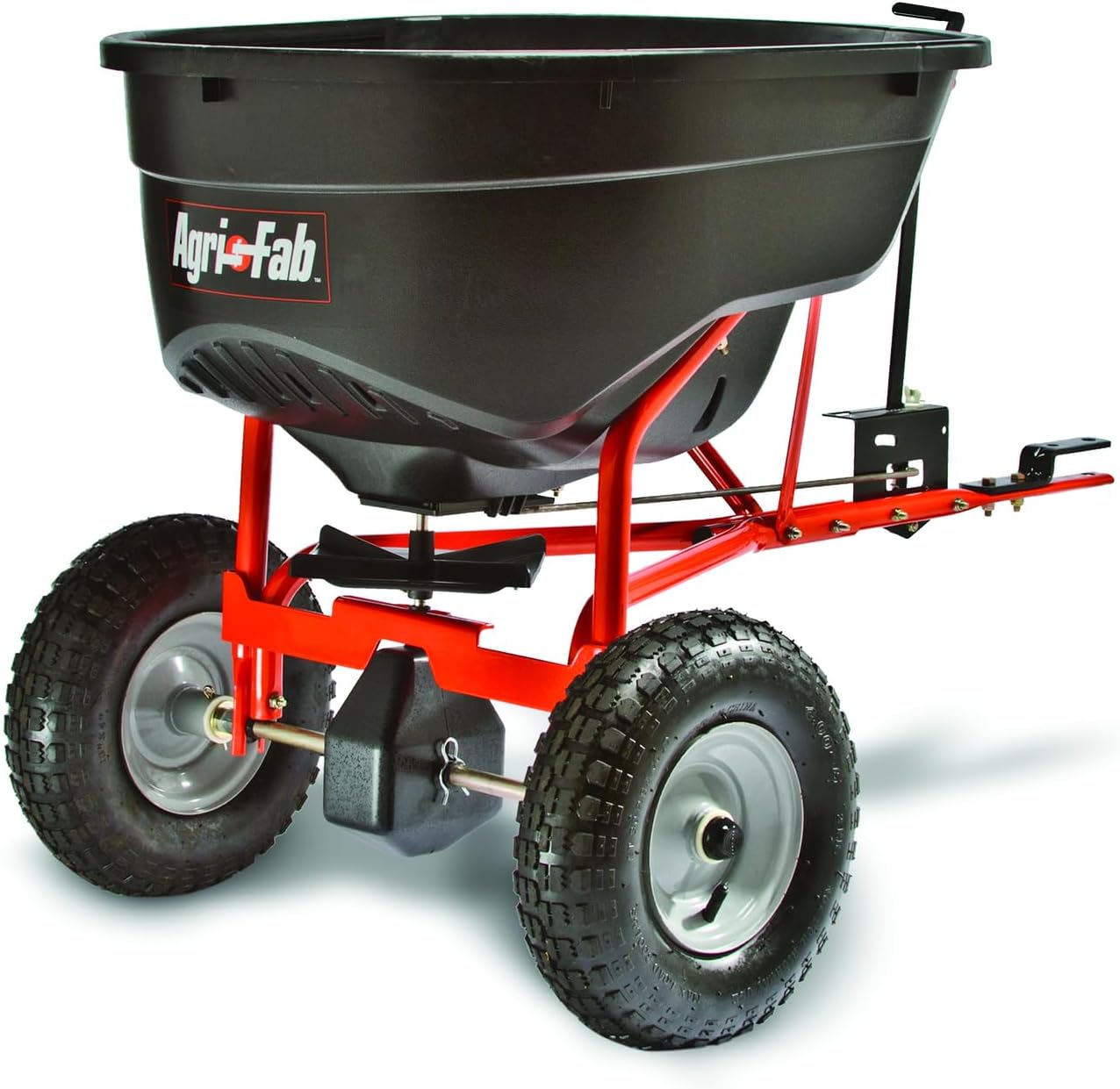
| Weight Capacity Maximum | 130 pounds |
|---|---|
| Spread Width | 10–12 ft |
| Tire Type | Pneumatic |
| Frame Material | Alloy Steel |
The Agri-Fab 130 lb Pull-Behind Broadcast Spreader is built to make seeding and fertilizing larger lawns faster and more consistent. You tow it behind a riding mower or lawn tractor using the universal hitch, fill the large poly hopper once and cover roughly a half acre before refilling, and use the steel rod flow control to change application rate from the tractor seat. Pneumatic tires and an enclosed gear housing help it roll smoothly and resist wear, while the spreader plate produces a 10 to 12 foot pattern so you make fewer passes. The heavy-gauge steel frame and polypropylene hopper are practical for seasonal outdoor use, and the design supports spreading seed, fertilizer, lawn treatments, salt, and ice melt. It does require assembly and a tow vehicle, so it is not as convenient for handheld or small-plot work, and its size makes precise edging in tight spaces more awkward. For buyers who prioritize dependable, low-maintenance operation on medium to larger lawns, this model is a straightforward, reliable choice.
Best for: Buyers who want a dependable, low-maintenance spreader for seeding and treating medium to larger lawns and prefer equipment that reduces refill frequency and effort.
Less Ideal for: People who only have small lawns, need a handheld or walk-behind solution, or want a tool for tight, precise edging and tiny beds.
- Large 130 lb hopper reduces refills and covers about 1/2 acre per fill
- Universal hitch fits most riding mowers and lawn tractors for easy towing
- 10–12 ft spread width yields more even coverage and fewer passes
- Enclosed gear housing and steel frame improve durability and reduce maintenance
- Requires a riding mower or tractor to operate so not suitable for small yards
- Assembly is required before first use
Verdict: Choose this spreader if you need a rugged, high-capacity tow-behind that covers larger lawns with consistent, wide spreading and minimal refills.
Choosing the Right Seed Spreader: Key Factors to Consider
Seed Type Compatibility
Different seed types behave very differently when broadcast. Fine grass or clover seed can drift and require a spreader with fine metering settings, while larger seeds like wildflower mixes, cover crop seed, or some vegetable seed need wider openings and a sturdier metering plate. Matching the spreader's calibration range to the seed sizes you use minimizes over-application and seed bounce.
If you plan to use mixes that include both fine and coarse seeds, look for spreaders with adjustable gates and recommended rate charts. That flexibility preserves seed viability and ensures a uniform stand after germination.
Distribution Accuracy and Pattern
Uniform seed distribution determines how even your stand will be and how much reseeding you must do later. Accuracy is affected by the metering design, the spinner or drop mechanism, and how consistently the unit distributes seed across the swath. A spreader with an even pattern reduces gaps, avoids heavy bands, and lessens the need for hand-seeding.
Test pattern consistency on a small swath before large jobs. Wind and walking speed affect distribution, so a spreader that is forgiving to moderate speed variation is useful for home gardeners.
Hopper Capacity and Refill Workflow
Hopper size matters because it affects how often you must stop to refill. Larger yards benefit from bigger hoppers to maintain steady progress, while small yards or beds often do fine with compact units that are easier to store. Consider how easy the hopper is to pour into and whether it has a clear fill-line or built-in handle for carrying.
Also evaluate how the unit balances when full and how straightforward it is to clean out leftover seed. A spreader that is awkward to refill or prone to spilling defeats the time savings a larger hopper promises.
Calibration Controls and Rate Precision
Good calibration controls let you dial in an accurate application rate for the seed weight and desired pounds per acre or per square foot. Look for spreaders with marked settings or a chart that ties settings to common seed sizes. A metering gate that adjusts smoothly and locks in place prevents mid-run drift in application rate.
If you need to switch between seed types regularly, test how fast and repeatable the calibration steps are. Units with intuitive controls reduce mistakes and wasted seed.
Durability and Weather Resistance
Seed spreading happens outdoors and often in damp conditions. Durable materials for the hopper, metering parts, and drive components resist cracking, rust, and degradation from UV exposure. Metal parts should be treated or stainless where possible, and plastics should be thick and UV-stabilized to avoid brittle failures.
Maintenance is part of longevity. Consider whether wear parts are replaceable and how easy it is to clear clogged gates or spinners after use.
Terrain and Handling
How a spreader behaves on your actual terrain affects application quality. Wheel diameter and tread, handle ergonomics, and overall balance influence how steadily you can push or tow the unit. Rough, sloped, or uneven yards need a spreader with stable wheels and a low center of gravity to keep the pattern consistent.
For tight garden beds or around obstacles, a compact push unit with a responsive gate is easier to maneuver. For broad, flat turf, a wider swath and smooth-rolling wheels speed coverage.
Matching Spreader Style to Job Size
Broadcast spreaders come in styles that suit different scales of work. Handheld or small push units are ideal for tight spaces, edging, and small lawns; they are lightweight and easy to store. Walk-behind drop or broadcast spreaders cover larger areas faster and reduce fatigue for medium to large yards.
Consider how often you will use the spreader. If you will overseed annually on a modest lawn, a compact push spreader may be the most practical choice. For frequent larger jobs, a heavier-duty tow-behind or large walk-behind unit reduces trips and speeds application.
- Small yards: compact push spreader, simple calibration
- Medium yards: walk-behind broadcast for balance of speed and control
- Large properties: tow-behind units or large-capacity walk-behinds
How Weather and Timing Affect Application
Wind and moisture change how seed behaves during spreading. Light wind can blow fine seed off-course, so start in calm conditions or choose a lower application height and slower walking speed. Moist soil reduces bounce and can allow for slightly higher spreader settings, while dry ground can increase bounce and create gaps.
Timing matters for germination success. Overseed or broadcast in the window recommended for your grass or crop type so seed lands where soil temperatures and moisture favor rapid establishment. The spreader only places seed; good timing and seed-to-soil contact complete the job.
- Avoid windy days for fine seeds
- Adjust calibration for ground conditions
- Work in short, overlapping passes for uniform coverage
Maintenance Tips to Keep a Spreader Accurate
Simple maintenance extends accuracy and life. After each use, empty the hopper of leftover seed and brush out the metering area to prevent caking or corrosion. If the spreader has metal parts, dry them before storage to limit rust.
Lubricate moving parts per the manufacturer's guidance and replace worn seals or gaskets that let moisture into the mechanism. Store the unit under cover to protect from UV and prolonged moisture exposure, and check calibration settings before each use.
- Empty and brush hopper after use
- Dry metal parts to prevent rust
- Check and recalibrate before large jobs
Using Overlap and Walk Speed to Improve Uniformity
Even with a well-calibrated spreader, correct technique matters. Overlap each pass by a modest amount to cover edges where the spread pattern tapers off. Maintain a steady walking speed and consistent gate setting to avoid bands of dense or thin seed.
Practice on a small patch to learn how your chosen spreader behaves at different speeds. Mark a walking pace that produces the most even pattern and stick to it during larger jobs.
- Use consistent walking speed
- Overlap passes to avoid gaps
- Test settings on a trial swath
Calibrating Without a Scale
If you do not have a precision scale, you can still calibrate for approximate rates. Use a measured area, apply seed with a chosen setting, and collect seed in a container over a fixed pass length to estimate pounds per area. Compare that result to the recommended rate on the seed bag and adjust accordingly.
Keep a simple calibration log for your seed-types and typical walking speed. That record saves time the next season and reduces guesswork when switching seed types.
- Measure a test swath and collect seed
- Adjust gate and retest until rates align
- Record successful settings for future use
How We Chose the Best Seed Spreader
We selected these seven seed spreaders using practical, garden-focused filters that favor reliable field performance over marketing claims. Key evaluation criteria included distribution accuracy for a range of seed sizes and rates, build durability and weather resistance for repeated outdoor use, calibration range and ease to match fine to coarse seeds, hopper capacity and refill convenience for different job sizes, and handling ergonomics for steady application across long passes. We also considered maintenance needs such as rust-prone parts or clog-prone metering systems. Excluded from the shortlist were specialty units designed only for fertilizer or salt, devices with unclear calibration mechanisms, and products with poor reported durability in outdoor settings. The final selections balance accuracy, longevity, and ease of use so gardeners can choose a spreader that fits their yard size and seed types.
FAQ
Can I use a seed spreader for fertilizer and seed at the same time?
You can physically spread fertilizer and seed with the same unit if the metering and hopper can handle both materials, but it usually requires careful calibration and thorough cleanup between uses. Avoid mixing unless the spreader manufacturer confirms compatibility, because different particle shapes and weights spread differently.
How do I stop small seeds from blowing away during spreading?
Choose a calm day, walk at a steady slower pace, and use a lower opening setting to reduce loft. Applying seed in the early morning or late evening when winds are lighter and humidity is higher can also reduce drift.
Is it better to use a broadcast pattern or a drop spreader for overseeding?
Broadcast spreaders typically cover more ground faster and are fine for lawns where a dispersed pattern is acceptable. Drop spreaders deliver seed directly below and give narrower, more controlled coverage, which is useful for precise seeding in rows or narrow strips. The best choice depends on the planting pattern you need.
How often should I recalibrate my spreader?
Recalibrate whenever you change seed type, adjust application rate, or suspect the unit has been bumped or modified. It is good practice to test calibration at the start of each season and before any large job.
What maintenance extends the life of a spreader used in damp climates?
Rinse and fully dry the spreader after exposure to moisture, remove any seed or fertilizer residue, and lubricate moving parts with appropriate products. Store the unit indoors or under cover and inspect for corrosion regularly to catch issues early.
Final Verdict
Choosing the right seed spreader means balancing how much area you cover, the seed types you use, and how much time you want to spend on calibration and maintenance. Prioritize distribution accuracy and calibration ease if you work with fine seeds or mixes, and favor hopper capacity and terrain handling for large properties. Durable materials and simple maintenance features reduce long-term headaches. Decide first on the scale of the jobs you do and the seed sizes you will spread. Use that decision to narrow choices by the criteria above, and you will find a spreader that delivers consistent results and makes reseeding and overseeding far less work.
