

Note: This article contains affiliate links. If you click on these links and make a purchase, I may earn a small commission at no extra cost to you. This helps support my research and content. Read my full affiliate disclosure here.
Starting seeds successfully depends as much on the medium as on light and water. The right seed starting mix helps tiny roots grow quickly, holds even moisture without waterlogging, and offers enough nutrients for the first true leaves. In this guide we shortlisted seven top seed starting mixes suited to small flats, windowsill trays, and heated germination setups. We evaluated mixes for drainage, moisture retention, and the nutrient profile gardeners need for reliable early development. Read on to find mixes that match your sowing method and follow-up care.
Top Picks at a Glance
| Best Overall The best all-around choice for most situations | Espoma Organic Seed Starter Premium Potting Mix (16 qt) |  |
| Best Quality Built to a higher standard if you want something more solid | FoxFarm Ocean Forest Potting Soil, 12 qt |  |
| Best Value The sweet spot between price and what you get | SunGro Seedling Mix — Organic Seed Starting Mix (8 qt) |  |
| Best Budget The cheapest option that still gets the job done reliably | Back to the Roots 3-in-1 Seed Starting Mix, 6 Quart, Organic, Peat-Free |  |
| Highest Rated A top-rated pick with lots of positive feedback | Premier Horticulture Pro-Mix HP Mycorrhizae High Porosity Growing Medium |  |
| Most Popular A crowd favorite that many people choose with confidence | Miracle-Gro Indoor Potting Mix for Seed Starting, 8 qt. (2-Pack) |  |
| Best Seller A high-volume bestseller chosen again and again | Back to the Roots Organic Seed Starting Mix — Expanding 12 Quart Block |  |
Espoma Organic Seed Starter Premium Potting Mix (16 qt)

| Brand Name | Espoma |
|---|---|
| Unit Count | 598.4 Ounce |
| Manufacturer Part Number | SS16 |
| Volume | 16 quarts |
Espoma Organic Seed Starter is a lightweight, peat-based mix designed for germinating seeds and rooting cuttings. It combines sphagnum peat moss and perlite with yucca extract and lime to balance pH and improve moisture management, plus a mycorrhizae blend (Myco-Tone) to support early root development. Typical use is filling trays or small pots, sowing seeds, and keeping consistently moist until seedlings establish; it can also help with stem and leaf cuttings. The mix is free of synthetic fertilizers, so it suits organic growers and avoids burning delicate roots. Practical benefits include good aeration from perlite, consistent moisture retention from peat, and potential root vigor from mycorrhizae. Limitations are that it contains no long-term nutrients, so transplants will need potting soil or fertilizer later, and peat-based mixes are not the best choice for growers who prefer peat-free blends for environmental reasons. The 16 quart bag is convenient for small batches of seedlings but may be small for large-scale starting operations.
Best for: Gardeners who want an easy-to-use organic mix for trays and small pots and prioritize healthy root development for seeds and cuttings.
Less Ideal for: Large-scale growers needing bulk volumes or gardeners who prefer peat-free or pre-fertilized seed mixes.
- Formulated specifically for seed starting and cuttings with good moisture retention
- Includes mycorrhizae to support early root growth
- Lightweight, airy texture from perlite aids oxygenation of roots
- Organic ingredients with no synthetic fertilizers suitable for organic gardening
- Contains no starter nutrients so seedlings will need feeding or potting up later
- Peat-based composition may be undesirable for gardeners seeking peat-free mixes
Verdict: Choose this mix if you want an organic, seed-focused starter mix that promotes strong early root growth.
FoxFarm Ocean Forest Potting Soil, 12 qt

| Item Form | Granules |
|---|---|
| Specific Uses For Product | Dry Fertilizer |
| Coverage | 4.8 sq ft |
| Mixing Ratio | 1:1 |
FoxFarm Ocean Forest is a premixed potting soil designed to give seedlings and container plants a strong start without extra preparation. The mix combines aged forest products, sandy loam and sphagnum peat moss for a light, aerated texture that drains well while holding moisture. It is enriched with organic amendments such as fish meal, crab meal and earthworm castings so young plants get available nutrients for several weeks and often do not need added fertilizer for the first 30 days. Typical use is straight from the bag for filling seed trays, small pots or for top-dressing established containers; the listing also recommends a 1:1 mixing ratio when blending with other soils. Practical benefits are quicker root development from good aeration, easy transplanting because roots encounter a friable medium, and fewer early fertilizing steps. Limitations to note are that the bagged mix is relatively heavy for its volume and may be more nutrient-rich than needed for very delicate microgreens or plants that require a lean starting medium.
Best for: Growers who prioritize vigorous early growth and want a plug-and-play potting medium that supplies nutrients and good drainage without extra mixing.
Less Ideal for: People focused on ultra-light, sterile seed-starting mixes for microgreens or growers who need a strictly inert medium for hydroponic propagation.
- Ready-to-use mix with balanced aeration and drainage for seedlings and containers
- Contains organic amendments (fish meal, crab meal, earthworm castings) to feed plants for the first month
- Designed pH for nutrient uptake which reduces the need for immediate fertilization
- Works well straight from the bag for seed starting, transplanting, or top dressing
- Heavier and denser per bag than loose seed-starting mixes, making handling and shipping bulkier
- Nutrient level may be too rich for very small or delicate seedlings that prefer a lean starting mix
Verdict: Choose this ready-to-use, nutrient-rich potting soil when you want a proven, no-fuss medium that promotes fast root development and strong early growth.
SunGro Seedling Mix — Organic Seed Starting Mix (8 qt)

| Brand Name | SUN GRO |
|---|---|
| Style Name | Peat Moss |
| Volume | 8 quarts |
| OMRI Listed | Yes |
This SunGro seedling mix is formulated specifically for starting vegetables, herbs, and flowers from seed. It has a fine, water-retentive texture that helps maintain even moisture across flats and plug trays, making germination more reliable and producing uniform seedlings. The mix includes an organic wetting agent for consistent water absorption and a silicon-enriched additive called RESiLIENCE intended to support seedling vigor and reduce wilting. Because it is OMRI listed, it is suitable for organic edible and ornamental starts. Typical use is to fill trays or small pots, sow seed at the recommended depth, and keep evenly moist until true leaves develop. Practical benefits are predictable moisture control, a light texture that encourages root growth, and organic certification for growers prioritizing clean inputs. Limitations are inherent to concentrated seed mixes: it contains little in the way of long-term nutrients so seedlings will need potting soil or fertilizer before transplanting, and the small 8 quart bag means frequent replenishing for gardeners starting many flats.
Best for: Gardeners who prioritize reliable germination and organic inputs and who start seeds in flats, trays, or small pots and want predictable moisture control for uniform seedlings.
Less Ideal for: Gardeners starting large numbers of seeds or those who want an all-in-one mix that supports long-term growth without additional fertilization.
- Fine, water-retentive texture that promotes even germination and uniform seedlings
- Includes an organic wetting agent for consistent moisture absorption
- Contains RESiLIENCE silicon additive aimed at improving seedling resistance to wilting
- OMRI listed for use in organic seed starting
- Limited nutrient content so seedlings require potting mix or fertilizer before transplanting
- Small 8 quart volume may not be economical for large-scale seed starting
Verdict: Choose this OMRI-listed mix if you want a fine, moisture-retentive seed starter that produces uniform, vigorous seedlings for organic gardens.
Back to the Roots 3-in-1 Seed Starting Mix, 6 Quart, Organic, Peat-Free

| Unit Count | 192 Fluid Ounces |
|---|---|
| Style Name | 3-in-1 Seed Starting Mix |
| Organic | 100% Organic |
This 3-in-1 Seed Starting Mix is designed to give beginners and budget gardeners an easy, ready-to-use medium for germinating seeds and potting up seedlings. The bag combines coconut coir, mycorrhizae, worm castings and yucca extract to support root development, nutrient uptake and moisture control so small pots stay evenly damp without becoming waterlogged. Typical uses are filling seed trays, small pots, and transplant cells for herbs, annual vegetables and flowers. Practical benefits include a peat-free formula for eco-minded buyers, pre-mixed nutrients that reduce the need for early fertilizing, and a light texture that encourages root growth and drainage. Limitations are the modest 6 quart volume, which means one bag covers only a few trays or pots at a time, so larger projects will need multiple bags. Also the packaged unit is aimed at starts and small containers rather than large-scale potting or raised beds.
Best for: Gardeners who want an affordable, eco-friendly ready mix for starting seeds and growing small numbers of herbs, flowers or veggie seedlings with minimal fuss.
Less Ideal for: Gardeners planning large-scale seed starting, filling many trays at once, or potting up large containers should choose a larger-volume or bulk mix instead.
- Peat-free, organic blend with coconut coir and worm castings for sustainable seed starting
- Includes mycorrhizae and yucca extract to support root establishment and water uptake
- Light, well-aerated texture that encourages drainage and healthy seedling roots
- Ready-to-use mix with built-in nutrients reduces need for early feeding
- Small 6 quart volume is limited for gardeners starting many trays or larger projects
- Not formulated for filling large pots or raised beds without mixing into bulk soil
Verdict: A compact, peat-free organic seed starting mix that simplifies getting healthy seedlings started on a budget.
Premier Horticulture Pro-Mix HP Mycorrhizae High Porosity Growing Medium

| Item Form | Loose Fill |
|---|---|
| Specific Uses For Product | Plant Growth, Root Development |
| Coverage | Medium |
| Target Species | crops, plants |
| Mixing Ratio | 75:25 |
This Pro-Mix HP with mycorrhizae is a loose, high-porosity peat-based medium designed for seed starting, rooting cuttings, and water-sensitive or low-light crops. You use it like a standard potting mix: fill trays or containers, water thoroughly, and plant seeds or transplants. Notable features include added Glomus intraradices mycorrhizal inoculum to support early root establishment and a formulation that emphasizes air capacity and extra drainage, which helps prevent damping off in overwatered starts. The mix is practical for small-scale greenhouse or indoor seed starting where reliable drainage and oxygenation at the root zone matter. Limitations are that it is peat-based, so it will dry out faster than heavier mixes and requires regular monitoring of moisture and feeding since it is not a complete long-term potting soil. Also the package size is large, so it is best for gardeners who will use it across many flats rather than a single small project.
Best for: Growers who prioritize reliable, fast-rooting starts and need a consistent, well-draining medium for seed trays, cuttings, or low-light seedlings.
Less Ideal for: Casual gardeners who want a low-maintenance all-in-one potting soil for long-term container plants or those who prefer peat-free blends.
- Contains mycorrhizal inoculum to support early root growth
- High porosity provides excellent air capacity and extra drainage
- Formulated for water-sensitive crops and rooting cuttings
- Peat-based mix dries faster and needs more frequent watering
- Not a complete long-term potting soil so requires supplemental fertilization
Verdict: Choose this high-porosity, mycorrhizae-enhanced mix when you need a dependable, well-draining medium that promotes fast, healthy root development for seed starting and cuttings.
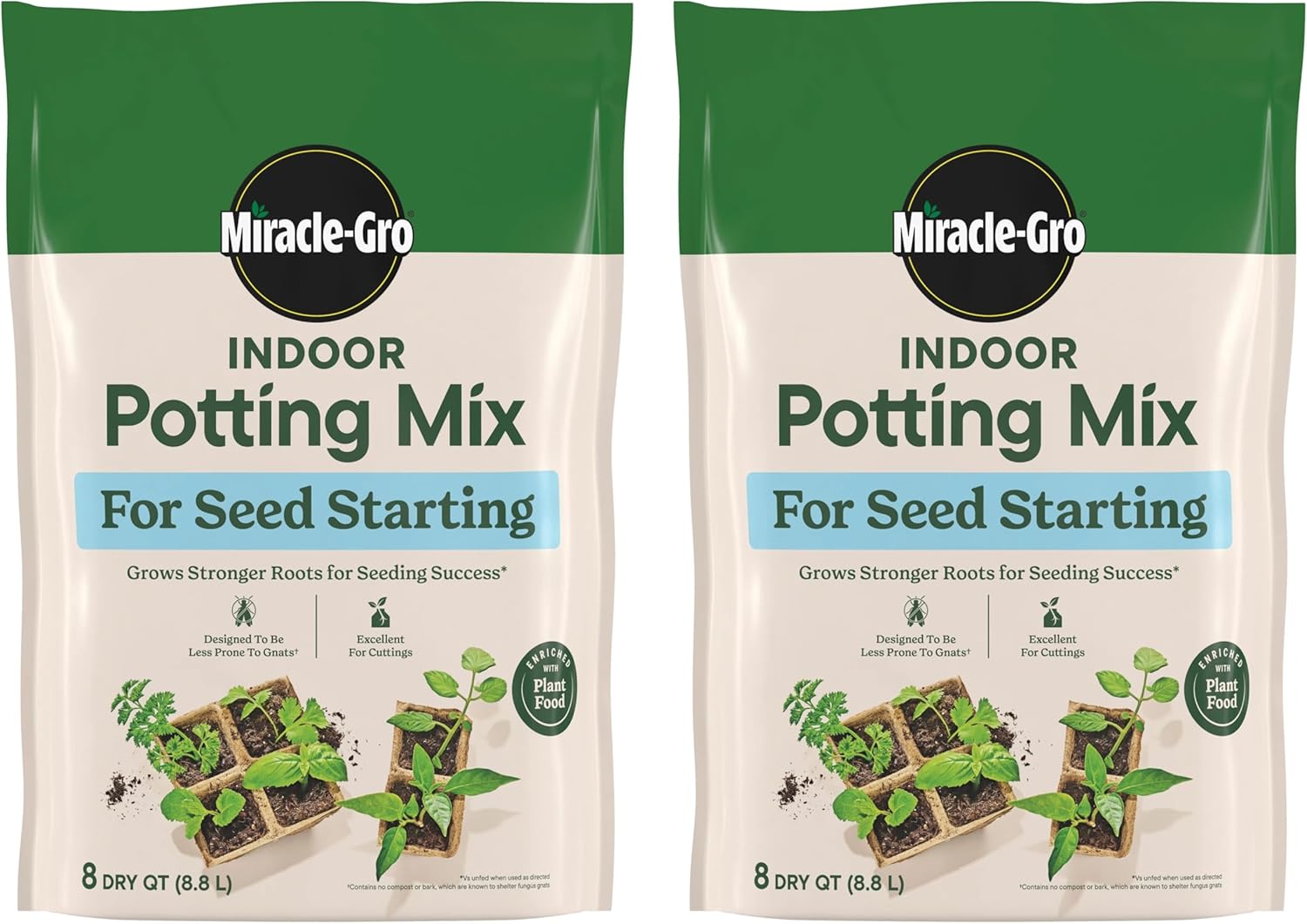
Miracle-Gro Indoor Potting Mix for Seed Starting, 8 qt. (2-Pack)
| Number of Packs | 2 |
|---|---|
| Item Type Name | Potting Mix |
| Item Highlight | For Starting Vegetable, Flower, and Herb Seeds Indoors |
| Volume | 8 quarts |
Miracle-Gro Indoor Potting Mix for Seed Starting is a ready-to-use, lightweight medium designed specifically for germinating seeds and rooting cuttings indoors. You typically fill cell trays or small containers with the mix, follow seed packet depth and moisture instructions, and keep trays out of direct sun until seedlings emerge. The formula includes plant food to help seedlings develop stronger roots compared with unfed controls and intentionally omits compost and bark to reduce habitat for fungus gnats. Practical benefits include ease of use straight from the bag, good moisture retention for tiny seedlings, and enough volume in this two-pack to fill multiple 72-cell trays for a season of starts. Important limitations are that it contains fertilizer so it is not appropriate for prolonged use on very young seedlings without following dilution or transplant guidance, and like any bagged mix it will compact over time if overwatered. For growers who prefer sterile, fuss-free seed starting media this is a convenient option, but plan to transplant into a longer-term potting mix as plants grow.
Best for: Gardeners who want a convenient, ready-to-use seed-starting medium that helps seedlings establish quickly and prefer a lower-risk mix for indoor propagation backed by broad user approval.
Less Ideal for: Growers seeking a completely organic or compost-based seed mix or those who want to reuse the same medium long-term without transplanting into a standard potting soil.
- Lightweight formula makes filling trays and pots easy and promotes root development
- Enriched with plant food to help seedlings grow stronger roots vs unfed when used as directed
- Formulated without compost or bark to reduce chances of fungus gnat infestation
- Sold as a two-pack with enough volume to fill multiple 72-cell seed trays
- Contains fertilizer which requires careful use around very young seedlings and cuttings
- Can compact or retain too much moisture if overwatered, requiring careful watering
Verdict: A convenient, low-gnat seed-starting mix that helps seedlings build stronger roots and comes in a two-bag bundle to cover multiple trays.
Back to the Roots Organic Seed Starting Mix — Expanding 12 Quart Block

| Volume | 12 quarts |
|---|---|
| Item Type Name | Seed Starting Mix |
| Unit Count | 384 Fluid Ounces |
| OMRI Listed | Yes |
This compressed seed starting mix arrives as a compact block that expands to 12 quarts of fluffy, peat-free potting medium when you add water. It is formulated for starting herbs, vegetables, and flowers and is OMRI listed for organic use. In practice the block is easy to store and handle compared with loose bagged soil: add water, break it up, and fill seed trays or small pots. The mix advertises a balanced pH and low electrical conductivity, which helps young roots take up nutrients without shocking seedlings. Because it is coir-based it retains moisture while remaining airy enough to encourage root development. Practical benefits include reduced mess, convenience for beginners, and suitability as a standalone starter medium or as an amendment for potting mixes. Limitations are that the product is a single compressed block so you must rehydrate and fluff it before use and you may want to add fertilizer later for longer-term container growth since seed mixes are typically low in sustained nutrients.
Best for: Buyers who want a low-mess, beginner-friendly organic seed starting medium and value convenience and predictable, gentle performance for seedlings.
Less Ideal for: Gardeners who need a ready-to-use, nutrient-rich potting mix for long-term container plants or very large planting projects that require multiple blocks without rehydration work.
- Expands to 12 quarts from a compact block for easy storage and transport
- Peat-free and OMRI listed for organic gardening
- Balanced pH and low electrical conductivity suitable for sensitive seedlings
- Light, fluffy texture that improves aeration and water retention for young roots
- Arrives compressed so requires rehydration and manual breaking up before use
- Does not include long-term nutrients so additional feeding is advisable for plants beyond the seedling stage
Verdict: A convenient, peat-free organic coir block that expands to 12 quarts and makes low-mess, beginner-friendly seed starting simple.
Choosing the Right Seed Starting Mix: Key Factors to Consider
Drainage and Moisture Retention
Seedlings need constant gentle moisture, but the medium must also drain excess water to prevent anoxic roots. A seed starting mix should wick and hold enough water to keep the seed coat and radicle hydrated while allowing air pockets to remain in the root zone.
In practical terms this means a balance of fine particles and porous components. Too fine and the mix compacts and suffocates roots; too coarse and it dries out quickly and requires frequent watering. Consider your watering habits and the microclimate where you start seeds. Heated germination mats and warm windowsills speed drying, so mixes with higher moisture retention help. For cold, humid spaces a faster-draining mix reduces damping-off risk.
Particle Size and Texture
Texture affects seed-to-soil contact, sowing accuracy, and how easily small seeds can push through the surface. A uniform, fine texture helps very small seeds make consistent contact with moisture and reduces the need to press or cover seeds deeply.
Coarser textures with visible perlite or vermiculite pieces improve aeration and drainage for larger seeds and transplantable plugs. When choosing, match particle size to seed size: tiny seeds prefer a superfine, nearly dust-free surface while larger seeds and transplantlings tolerate chunkier mixes that provide more structure for root development.
Nutrient Content and Starter Fertility
Most seeds carry the nutrients they need until the first true leaves; excessive initial fertilizer can burn delicate roots. A good seed starting mix either has low starter fertility or a gentle, controlled nutrient charge designed for the first one to two weeks.
If you prefer to control feeding precisely, choose mixes labeled low-fertility or no-added-fertilizer and plan a light liquid feed once true leaves appear. If you want less early fuss, pick a mix with modest starter nutrients but avoid anything intended for mature container plants because that will be too strong for young seedlings.
Disease Suppression and Sterility
Damping-off and other early seedling diseases can wipe out flats quickly. Commercial seed starting mixes are often heat-treated or formulated to be free of weed seed and common pathogens. This lowers risk but does not eliminate the need for good sanitation.
Use clean trays, avoid overwatering, and provide airflow to reduce disease pressure. For organic-minded gardeners, look for mixes produced with sterilized components and clear labeling about pathogen control rather than ones relying on raw compost.
pH and Salt Levels
Seedlings are sensitive to extremes. Ideal pH helps nutrient availability once you start fertilizing, and low soluble salt levels prevent seedling scorching and poor germination. Many seed starting mixes aim for a neutral to slightly acidic pH and low electrical conductivity.
If you plan to sow sensitive species or cuttings, check product guidance for pH range and avoid mixes that list high amendments or concentrated fertilizers. For tap water with high salts, choose mixes that buffer or wick salts away from newly forming roots.
Handling Convenience and Compatibility
Practical handling matters when you are filling many cells or small trays. Lightweight, dust-minimized mixes are faster to work with and reduce mess around seedlings and grow lights. Also consider whether the mix is designed for direct sowing into larger containers versus starting in small cells and later potting up.
Compatibility with your sowing method matters too. Some blends compress slightly when watered and hold shape for transplanting, which suits cell trays. Others remain loose and are easier to reuse as a top dressing for plugs. Think about storage, rehydration characteristics, and whether you want an all-in-one mix or a base you amend yourself.
Best Mixes for Tiny Seeds and Microgreens
Tiny seeds need a superfine, uniform surface so they do not get buried and can draw moisture evenly. Mixes formulated for very small seeds are often peat-free or peat-lite with finely milled coir or sterilized composted material to reduce fines that hold too tightly.
For microgreens, look for a blend that supports rapid root expansion in a shallow bed and drains well enough to avoid surface fungal issues. A light dusting of fine vermiculite on the surface can help keep consistent moisture without smothering the seeds.
- Prefer mixes labeled superfine or seed-grade for very small seeds
- Choose light surface amendments to maintain moisture for dense sowings
- Ensure adequate airflow to prevent surface mold
Options for Larger Seeds and Plug Production
Larger seeds and plug seedlings benefit from mixes with more structure. Coarser particles and a bit more starter fertility help support rapid root thickening and earlier potting on.
When producing plugs you also want a mix that maintains form when removed from cells and that allows roots to hold its shape briefly. This reduces transplant shock when moving seedlings into bigger pots or into the garden.
- Seek blends with visible perlite or larger coir chunks for structure
- Moderate starter nutrients help larger seedlings establish quickly
- Avoid mixes that collapse completely when watered if you need to lift plugs
Peat-Free and Sustainable Mixes
Gardeners avoiding peat should look for mixes made from coir, composted bark, or vetted recycled materials. These can offer comparable drainage and moisture retention but vary in salt content and water-holding capacity.
Sustainable mixes sometimes require rinsing or rehydration steps to remove excess salts from coir or to settle fibers. Read handling notes and adjust watering frequency since peat-free blends often drain more quickly.
- Check for salt levels and recommended rehydration procedures
- Match water retention characteristics to your sowing environment
- Consider blends labeled low-salt if you use sensitive species
Preparing and Using Mixes Successfully
Pre-moistening a seed starting mix before sowing creates better seed-to-soil contact and prevents seeds from floating or clumping. Moisten the mix until it is evenly damp but not dripping and then fill trays or cells.
Use a shallow sowing depth appropriate to seed size, firm the surface lightly, and cover very fine seeds with a dusting of vermiculite. Keep covers or humidity domes on until most seeds germinate and then introduce air gradually to harden seedlings.
- Pre-wet the mix for uniform moisture
- Match sowing depth to seed size and firmness
- Use humidity control during germination, then increase airflow
Common Troubleshooting Tips
If seedlings are slow to emerge, check moisture and temperature first. Underwatering and cool soils are common causes of delayed germination. For damping-off, reduce moisture, increase airflow, and use sterile tools and trays.
If seedlings show brown edges or burning after first feed, suspect high soluble salts or an overly rich starter mix. Flush trays lightly with water and switch to a lower-fertility medium for future sowings if needed.
- Adjust moisture and temperature for slow germination
- Improve airflow and sanitation to prevent fungal problems
- Flush and change media when salt damage or fertilizer burn appears
How We Chose the Best Seed Starting Mix
We looked for mixes that give reliable germination, easy handling, and predictable seedling growth. Primary evaluation criteria included moisture retention and drainage balance, particle texture and consistency, nutrient content and starter fertility, pathogen control and sterility, and ease of use for different sowing methods such as broadcast sowing, cell trays, or peat pots. We prioritized mixes with a fine, uniform texture that allow small seeds to contact moisture without compacting, and materials that wick water evenly across a tray. Sterility mattered to reduce damping-off risk while mild starter nutrients or a clear unlabeled low-fertility profile were preferred so gardeners can control feeding later. Exclusions included heavy potting soils, blends designed for mature plants, and any product formulations that rely solely on uncomposted raw manures or large bark chunks. The final list represents mixes suited to a variety of indoor and protected-surface seed-starting scenarios across common garden vegetables, herbs, and ornamentals.
FAQ
Can I use regular potting soil to start seeds?
Often regular potting soil is too heavy and contains larger particles or fertilizers that can overwhelm seedlings. It may also retain too much moisture and increase damping-off risk. Use a light seed starting mix or a sifted portion of potting soil blended with perlite for better results.
How soon should I feed seedlings started in a seed mix?
Usually wait until the first true leaves appear. At that point a dilute, balanced liquid feed is appropriate depending on the mix's starter fertility. If the mix is labeled low-fertility, begin feeding lightly soon after true leaves develop.
Is peat necessary in a seed starting mix?
Peat is common because it holds moisture and has a fine texture, but it is not necessary. Many peat-free mixes using coir or composted bark perform well. Be aware peat-free alternatives can differ in salt content and dry faster, so adjust watering accordingly.
How do I prevent damping-off when starting seeds?
Use a sterile, well-draining mix, avoid overwatering, and provide good air circulation. Clean trays and tools, do not over-densify sowings, and remove any infected seedlings promptly. Some gardeners also use bottom heat or a light fungicide as a last resort.
Should I moisten mix before sowing seeds?
Yes, pre-moistening ensures consistent seed-to-moisture contact and prevents seeds from being displaced when watering. The mix should be evenly damp but not waterlogged before you sow.
Final Verdict
Choose a seed starting mix that matches your seed size, watering habits, and whether you prefer low initial fertility or a mild starter charge. Prioritize drainage and a fine, uniform texture for tiny seeds, and more structure for plugs and larger seedlings. Balance disease control and moisture retention to reduce early losses. With the right mix and simple cultural care you will get faster germination and sturdier seedlings ready for transplant.
