

Note: This article contains affiliate links. If you click on these links and make a purchase, I may earn a small commission at no extra cost to you. This helps support my research and content. Read my full affiliate disclosure here.
Mowing on slopes changes how a mower behaves more than flat yards do. You need a machine that keeps traction, controls speed downhill, and delivers an even cut across uneven terrain. This guide looks at six shortlisted self-propelled lawn mowers for hills and explains the practical tradeoffs gardeners face when working on slopes. We evaluated each mower for traction management, downhill control, cut consistency, and ease of handling so you can pick an option that fits your yard's steepness and surface conditions. Read on for what to expect from these top choices and which features matter most for slope work.
Top Picks at a Glance
| Best Overall The best all-around choice for most situations | SENIX 201cc 22" 3-in-1 Variable Speed Self-Propelled Gas Lawn Mower |  |
| Best Quality Built to a higher standard if you want something more solid | EGO Power+ 21" Self-Propelled Electric Lawn Mower with Touch Drive (Includes 56V 7.5Ah Battery & Rapid Charger) |  |
| Best Budget The cheapest option that still gets the job done reliably | Smalibal 131cc Self-Propelled 3-in-1 Gas Lawn Mower with 50L Grass Bag |  |
| Highest Rated A top-rated pick with lots of positive feedback | Greenworks 80V 21in Self-Propelled Lawn Mower with 8.0 Ah Battery |  |
| Most Popular A crowd favorite that many people choose with confidence | Greenworks 60V 21in Self-Propelled Lawn Mower with (2) 4.0Ah Batteries |  |
| Best Seller A high-volume bestseller chosen again and again | Greenworks 40V 21" Self-Propelled Lawn Mower with 5.0 Ah Battery and Charger |  |
SENIX 201cc 22" 3-in-1 Variable Speed Self-Propelled Gas Lawn Mower

| Power Source | Gas Powered |
|---|---|
| Cutting width | 22 inches |
| Number of Positions | 6 |
| Maximum Adjustable Cutting Height | 4 inches |
| Minimum Adjustable Cutting Height | 1.25 inches |
This SENIX mower pairs a 201cc OHV gas engine with a 22-inch steel cutting deck to tackle medium to large yards efficiently. It is rear-wheel self-propelled with 11-inch rear wheels, which helps when pushing across uneven ground or gentle slopes and reduces fatigue compared with a push-only mower. The 3-in-1 system lets you switch between bagging, mulching, and side discharge depending on grass length and yard cleanup preferences. A single-lever, six-position height adjuster (1.25 to 4 inches) makes changing cut height quick for seasonal needs. Practical strengths include the wider-than-average deck for fewer passes and the strong engine for thicker turf. Expect routine maintenance like oil changes, spark plug checks, and occasional blade sharpening typical of gas mowers. It is heavier and bulkier than electric alternatives and produces engine noise and emissions, so it is less suitable where quieter or emission-free operation is a priority. Assembly and initial tuning may also take some time for first-time mower owners.
Best for: Buyers who want a reliable gas mower that balances power, cutting width, and versatility for medium to larger yards and who prioritize efficient mowing and flexibility over quieter operation.
Less Ideal for: Not a good choice for users who need a quiet, low-emission solution for small yards or those who prefer low-maintenance electric or battery mowers.
- Powerful 201cc OHV engine for strong performance on medium to large lawns
- 22-inch steel deck covers more ground per pass than standard 20-inch mowers
- Rear-wheel self-propelled drive with large 11-inch wheels improves traction on slopes and uneven terrain
- 3-in-1 bagging, mulching, and side discharge offers flexible grass-handling options
- Single-lever six-position height adjustment makes changing cut height quick and convenient
- Gas engine requires regular maintenance and produces noise and emissions
- Heavier and bulkier than electric or battery mowers, making storage and lifting harder
Verdict: A robust, versatile gas mower that delivers wide cutting coverage and self-propelled traction for owners who need efficient, no-compromise mowing on medium to large lawns.
EGO Power+ 21" Self-Propelled Electric Lawn Mower with Touch Drive (Includes 56V 7.5Ah Battery & Rapid Charger)

| Power Source | Battery Powered |
|---|---|
| Battery Average Life | 60 minutes |
| Cutting width | 21 inches |
| Number of Positions | 3 |
| Material Type | Metal |
The EGO Power+ 21" self-propelled mower is built to give gas-level performance without fumes or constant maintenance. It uses a brushless motor and included 56V 7.5Ah ARC Lithium battery to deliver strong cutting torque and up to 60 minutes of runtime for typical suburban lawns. Touch Drive puts variable self-propel control on the handle so you can set walking speed with a fingertip dial, and the seven height settings plus a select-cut mulching blade make it easy to switch between mulching, bagging, or side discharge. Bright LED lights help with low-light starts and the deck folds for compact storage. Practical benefits include quick push-button start, one-hand deck height adjustment, and a two-bushel collection bag for less frequent emptying. Expect the usual electric limitations: runtime depends on grass conditions and terrain, and heavier or very tall grass may require slower passes or a second battery for larger lots. The mower is a good match for buyers who want strong cutting performance with quieter, low-maintenance operation compared with gas engines.
Best for: A buyer who prioritizes cutting performance and low-maintenance operation and wants a cordless mower that handles typical suburban lawns with the convenience of self-propulsion and fingertip speed control.
Less Ideal for: Not the best choice for very large properties or commercial mowing where continuous multi-hour runtime is required or for buyers needing an ultra-light transportable push mower.
- Self-propelled Touch Drive with variable speed for easier control on slopes and long runs
- Brushless motor that delivers strong cutting torque comparable to gas mowers
- Included 56V 7.5Ah battery and rapid charger for up to 60 minutes of runtime on a single charge
- Seven cutting height positions and three-in-one mulching, bagging, or side discharge versatility
- Folds flat for compact storage and has LED headlights for early morning or dusk use
- Run time will decrease under heavy-thatch, tall grass, or continuous uphill work and may require an extra battery for larger yards
- Heavier unit weight makes it less convenient to lift or transport despite folding handles
Verdict: Buy this mower if you want near-gas cutting power and fingertip self-propel control in a quieter, low-maintenance cordless package.
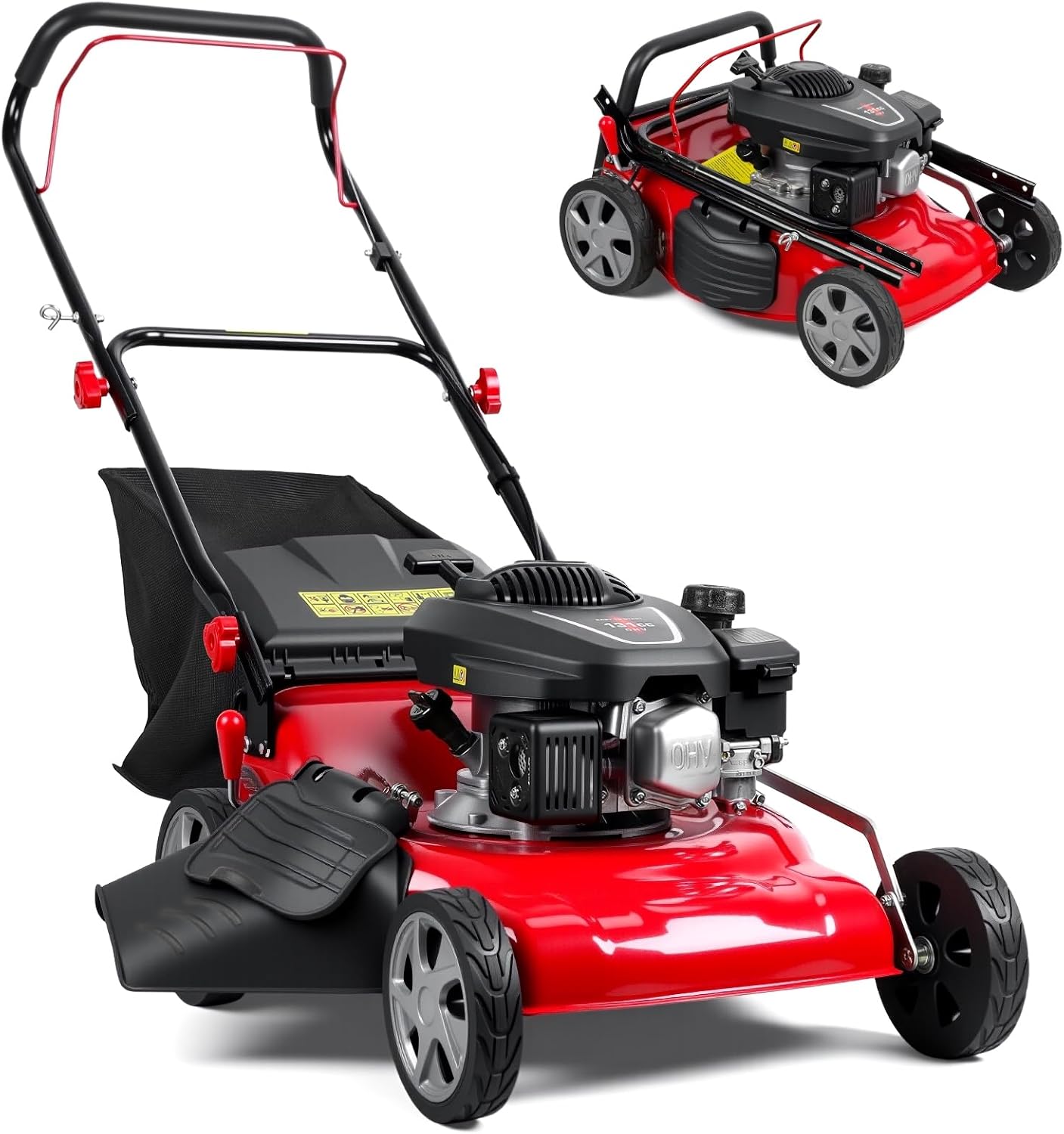
Smalibal 131cc Self-Propelled 3-in-1 Gas Lawn Mower with 50L Grass Bag
| Power Source | Gas Powered |
|---|---|
| Cutting width | 18 inches |
| Maximum Adjustable Cutting Height | 3 inches |
| Operation Mode | Manual |
| Material Type | Metal, Plastic |
This Smalibal 131cc self-propelled lawn mower is a basic gas-powered machine aimed at straightforward yard maintenance. It uses a 131cc engine to drive a rear-wheel self-propel system that helps on gentle slopes and uneven ground, and the 18-inch steel blade and reinforced deck deliver one-pass cutting for small to medium lawns. The mower offers three cutting modes—rear bag collection, mulching, and side discharge—plus an eight-position height adjustment to tune the cut between 1 and 3 inches. A large 50L grass bag and wide-mouth opening make emptying reasonably easy, and foldable handles reduce storage footprint. Practical limitations are its lighter consumer construction and manual operation, which mean it will suit occasional use rather than heavy commercial workloads; assembly and long-term durability may vary. For buyers focused on basic, cost-conscious lawn care this unit gives useful features like self-propel and mulching without premium pricing, but those wanting long service life or advanced features should consider higher-end alternatives.
Best for: Practical homeowners who need an affordable gas mower for small to medium yards and want basic conveniences like self-propulsion and a large collection bag without paying for premium durability.
Less Ideal for: Landscapers or users who mow large areas frequently or need a robust, long-lasting commercial mower should look for heavier-duty models with proven reliability.
- Self-propelled rear-wheel drive improves traction on slopes and uneven lawns
- 3-in-1 functionality (bagging, mulching, side discharge) adapts to different yard needs
- 50L grass bag with wide mouth simplifies collection and emptying
- Foldable handle design reduces storage space when not in use
- Consumer-grade construction may not hold up to heavy or commercial use
- Maximum cutting height limited to 3 inches which may be short for some turf conditions
Verdict: A cost-conscious, self-propelled gas mower that packs basic 3-in-1 functionality and a large grass bag for straightforward yard work.
Greenworks 80V 21in Self-Propelled Lawn Mower with 8.0 Ah Battery

| Power Source | Battery Powered |
|---|---|
| Number of Positions | 7 |
| Maximum Adjustable Cutting Height | 10.2 centimeters |
| Minimum Adjustable Cutting Height | 35 millimeters |
| Item Highlight | Self-propelled mower with 8.0Ah battery; brushless power |
This Greenworks 80V mower is built as a cordless, self-propelled walk-behind designed for homeowners who want reliable, gas-free mowing without frequent recharges. It uses an 80V brushless motor and an 8.0 Ah battery that the manufacturer rates to handle up to about half an acre per charge, and the push-button start makes it simple to operate. The 4-in-1 cutting system lets you mulch, bag, side-discharge, or use a turbo mode for leaves, while seven height positions give precise control over lawn appearance. Metal deck construction and an intelligent brushless motor point to long-term durability and quieter operation compared with brushed motors. Foldable handles and compatibility with other Greenworks 80V tools add convenience for storage and ecosystem expansion. Expect a heavier unit to move and store, and performance on very tall, wet, or thick grass will depend on battery charge and walking speed; extremely large properties may require a second battery or slower passes. Routine maintenance like blade sharpening and battery care is still needed to maintain peak performance.
Best for: Buyers who prioritize dependable, low-maintenance cordless performance for small to medium lawns and who value long-term durability and a common battery platform.
Less Ideal for: Those with very large properties who need long continuous run time without swapping batteries or users who prefer ultralight push-only mowers for occasional trimming tasks.
- Brushless 80V motor for stronger torque, longer motor life, and quieter operation.
- 8.0 Ah battery capable of mowing roughly up to 1/2 acre on a single charge for cordless convenience.
- 4-in-1 cutting system for mulching, bagging, side discharge, and turbo leaf pickup.
- Self-propelled drive and seven cutting-height positions simplify mowing varied terrain and grass lengths.
- Heavier unit which can be more cumbersome to maneuver and store.
- Performance on very large or dense lawns may require an extra battery or slower work pace.
Verdict: Choose this mower if you want a durable, brushless 80V cordless machine that reliably handles routine mowing on small to medium yards with the convenience of a shared battery platform.
Greenworks 60V 21in Self-Propelled Lawn Mower with (2) 4.0Ah Batteries

| Power Source | dc |
|---|---|
| Number of Positions | 7 |
| Maximum Adjustable Cutting Height | 4 inches |
| Minimum Adjustable Cutting Height | 1 inches |
| Item Highlight | Brushless motor with 4-in-1 system; self-propelled drive handles up to 3/4 acre |
This Greenworks 60V self-propelled mower brings gas-like cutting power without gas maintenance by pairing a brushless motor with two 4.0Ah 60V batteries and a dual-port turbo charger. It is typically used for weekly yard maintenance on medium to large residential lawns where you want quiet starts and lower upkeep. Notable features include seven cutting-height positions, rear-wheel drive self-propulsion for easier handling on slopes, LED headlights for low-light mowing, and a 4-in-1 deck that supports mulching, bagging, side discharge, and a turbo leaf pickup mode. Practical benefits are long runtime with automatic battery switchover, compatibility with the broader 60V Greenworks battery ecosystem, and reduced noise compared with gas mowers. Important limitations are its relatively heavy weight compared with push-only electric mowers and reliance on battery runtime that will vary with thick grass or hilly terrain; users who need continuous commercial-level runtime will want spare batteries or a different power solution. Assembly and storage are straightforward thanks to folding handles, but waterproof and rust-resistant claims still benefit from basic offseason care.
Best for: Buyers who want a low-maintenance, noise-conscious alternative to gas mowers for medium to large home lawns and who value system-level battery compatibility and proven user satisfaction.
Less Ideal for: Not the best choice for commercial landscapers or homeowners who need uninterrupted all-day runtime without buying extra batteries or for those prioritizing the lightest possible mower for frequent lifting or tight storage.
- Brushless 60V motor with dual 4.0Ah batteries delivers strong, gas-like cutting performance for medium to large yards
- Self-propelled rear-wheel drive and seven height settings make mowing slopes and varied turf easier to control
- 4-in-1 deck (mulch, bag, side discharge, turbo leaf pickup) adds versatility for different yard cleanup tasks
- LED headlights and EZ-fold handles improve low-light use and compact storage
- Batteries are compatible with the Greenworks 60V ecosystem so you can share power across tools
- Heavier than many push mowers, which can make transport and maneuvering off the lawn more cumbersome
- Actual runtime depends on grass density and terrain so longer jobs may require additional batteries
Verdict: A powerful, low-noise cordless mower that delivers near-gas performance and versatile cutting modes for homeowners maintaining medium to large yards.
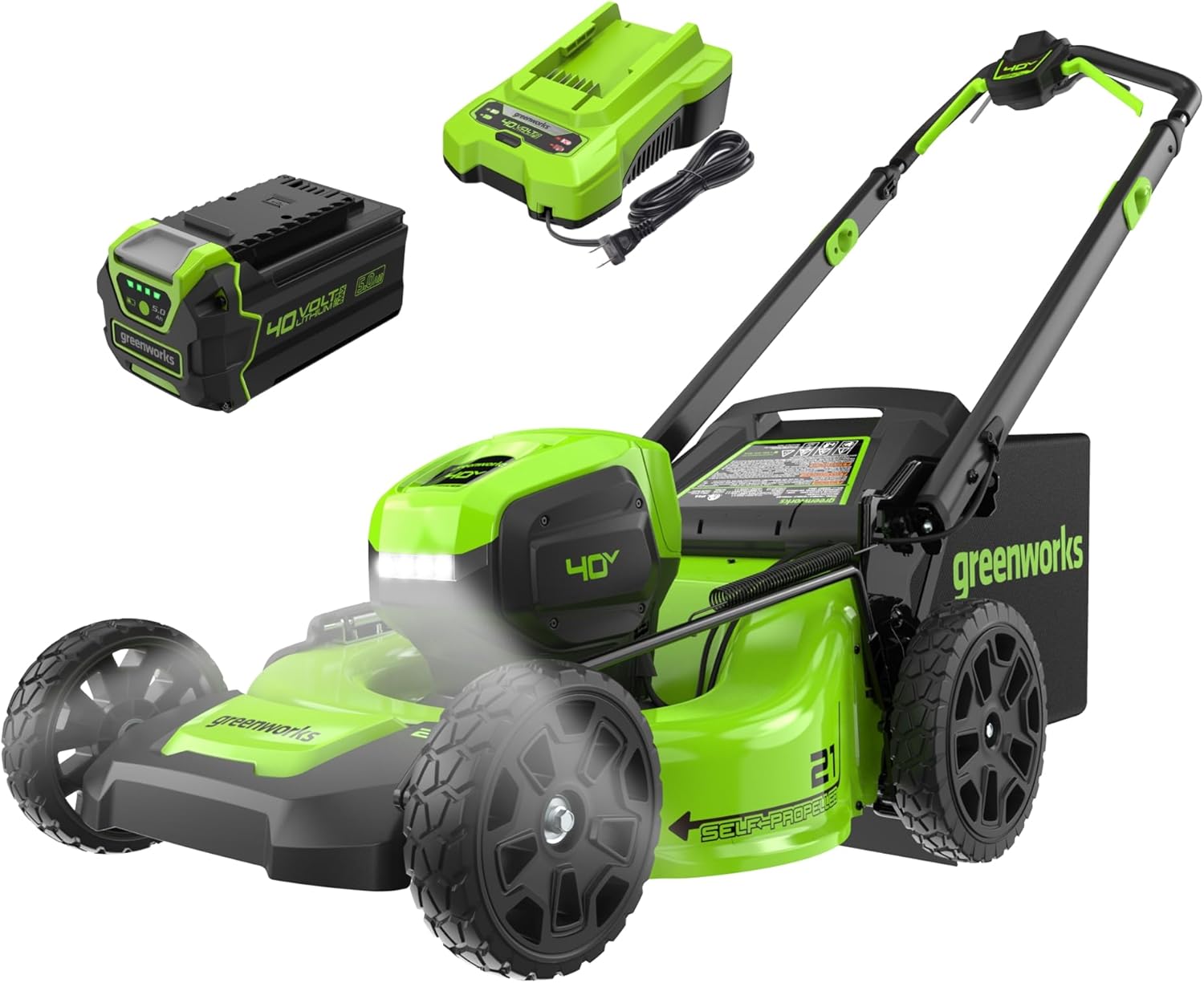
Greenworks 40V 21" Self-Propelled Lawn Mower with 5.0 Ah Battery and Charger
| Power Source | Battery Powered |
|---|---|
| Battery Average Life | 5 hours |
| Number of Positions | 7 |
| Operation Mode | Semi-Automatic |
This Greenworks 40V 21" self-propelled mower is designed to replace small gas mowers with a quieter, low-maintenance battery alternative. It arrives with a 5.0 Ah battery and charger and uses a brushless motor under a 21-inch steel deck to deliver steady cutting power for typical suburban lawns. The rear-wheel drive and variable speed make it easier to push on slopes and over uneven ground, and the 4-in-1 system gives you mulching, bagging, side discharge, or turbo leaf pickup without extra tools. LED headlights let you mow near dawn or dusk, and foldable handles simplify storage. Practical limits to note are the electric runtime and overall weight; a single included 5.0 Ah battery is suitable for small to medium yards but may require a second battery for larger properties, and the mower is relatively heavy to lift or move for transport. Assembly and routine upkeep are simpler than gas models, and compatibility with other Greenworks 40V batteries and tools adds flexibility if you already have that ecosystem.
Best for: Homeowners who prefer a quiet, low-maintenance alternative to gas mowers and want a ready-to-run cordless option for small to medium yards with occasional slopes.
Less Ideal for: Large properties or professional users who need long continuous runtime without swapping batteries should consider higher-voltage or dual-battery commercial mowers.
- Includes 5.0 Ah battery and charger so it is ready to use out of the box
- Brushless motor and 21-inch steel deck provide consistent cutting performance with lower noise
- Self-propelled drive with variable speed reduces effort on slopes and larger lawns
- 4-in-1 system (mulch, bag, side discharge, turbo leaf pickup) offers versatile finishing options
- LED headlight extends usable mowing hours for early morning or evening work
- Single included battery may not provide enough runtime for larger properties
- Unit is fairly heavy to lift or transport despite being cordless
Verdict: Buy this if you want a quieter, fuss-free cordless mower that handles small to medium lawns with versatile cutting options and included battery power.
Choosing the Right Self Propelled Lawn Mower for Hills: Key Factors to Consider
Traction and Tire Design
How tires are patterned and sized matters more on slopes than on flat lawns. Aggressive tread patterns and wider rear tires increase the contact patch and reduce slipping on wet or loose surfaces.
Tire diameter affects rollover over bumps and small ruts. A slightly larger rear wheel helps maintain forward momentum uphill while tread compound and pattern determine how the tire bites into grass and soil. Consider pneumatic tires with deeper lugs if your hill sees frequent dampness or loose topsoil because they shed mud better and keep traction when you need it most.
Downhill Control and Braking
Descending a slope requires reliable control to prevent runaway speed. Integrated downhill speed regulation, controlled transmission engagement, or effective engine braking help you maintain a steady, safe pace without constantly riding the brake.
A responsive hand or foot-operated brake and a transmission that resists freewheeling are important. If the mower lacks explicit downhill control, you will need to rely on mechanical braking and careful throttle management, which increases operator fatigue and risk on steeper grades.
Power Delivery and Torque
Mowing uphill demands steady torque more than peak top speed. Engines or electric motors that deliver consistent low-end torque will keep forward progress without stalling or repeatedly laboring through the cut.
Consider how the drive system transmits power to the wheels. Hydrostatic or well-geared transmissions that allow variable speed under load reduce the chance of bogging down. For battery-electric machines, check continuous power specifications and expect shorter runtimes when working on sustained inclines.
Cut Quality and Deck Stability
On slopes the deck can rock or pitch, causing uneven cutting and scalping if the mower does not track level. A well-supported deck with anti-scalp wheels and a stable mounting system helps hold a consistent cutting height across undulating ground.
Deck width affects how many passes you need and how quickly weight shifts when turning on a grade. A narrower deck can be easier to control on steep contours, while a wider deck reduces time on the hill but may require more attention to avoid scalping.
Operator Controls and Ergonomics
How easy it is to modulate speed and braking while standing on an incline affects safety and comfort. Controls should be reachable and allow fine adjustments without requiring awkward shifts in body position.
Handle ergonomics, throttle placement, and single-handed drive engagement options reduce strain during long slope jobs. Consider whether the mower allows you to disengage the drive quickly and whether the control levers are intuitive when your footing is uneven.
Weight, Balance, and Maneuverability
Overall weight influences traction but also affects how easy a mower is to turn and recover if it starts to slide. A balanced weight distribution that favors rear traction without making the front too light is ideal for slope work.
Maneuverability relates to wheelbase and turning radius as well as how the mower responds to quick steering inputs on a grade. A machine that is too long or has poor balance will be harder to control around obstacles on a hillside.
Slope Safety Best Practices
Mower capability matters, but safe technique reduces risk on any hill. Walk across slopes rather than straight up and down where possible to reduce the chance of a roll-over. Keep the engine speed down on steep declines and avoid abrupt turns or stops that can upset traction.
Inspect the mowing path first for hidden obstacles, ruts, or wet patches that could cause slips. If the ground is very wet or recently fertilized, consider waiting until conditions improve. Wearing non-slip footwear and keeping a firm stance will make controlling the machine easier.
- Mow across the slope for better lateral stability when terrain allows
- Avoid mowing on slopes above the manufacturer's recommended angle
- Clear sticks, rocks, and holes before starting to reduce sudden jolts
When to Choose Gas, Battery, or Electric Drive
Gas engines typically provide longer runtime and steady torque for prolonged uphill work, but modern battery systems can supply ample torque for many residential slopes with lower vibration and easier maintenance. Electric corded models usually lack the mobility for steep or uneven terrain.
If your slope mowing is frequent and involves sustained climbs, prioritize power delivery and runtime. For occasional slope tasks on smaller hills, a battery-powered machine with good torque and quick recharge may be a quieter, lower-maintenance choice.
- Gas: consistent power and longer runtime for extended slope jobs
- Battery: quieter, lower maintenance, but watch runtime on heavy loads
- Corded electric: limited mobility-best for small, gentle inclines
Maintaining Traction Over the Season
Tire condition and ground surface change with seasons. Check tire pressure regularly; underinflation can reduce traction while overinflation lowers contact area. Replace or service tires that show significant wear or bald spots before the wet season.
Keep the mowing path free of thatch build-up that makes the surface slick. Aeration and light topdressing can improve turf stability on steep areas and reduce slippage during mowing.
- Keep tires properly inflated and inspect for wear
- Avoid mowing wet grass when possible
- Manage thatch and soil compaction to increase ground grip
Adjusting Cutting Technique for Uneven Ground
On tilted terrain, raise the cutting height slightly to reduce scalping risk. Take narrower passes and overlap slightly to maintain an even finish. Reduce forward speed and let the blade do the work rather than pushing a high gear.
When encountering bumps or dips, slow down and allow the mower to traverse the change rather than forcing a fast pass. Anti-scalp wheels can be adjusted to support the deck on abrupt transitions and protect turf from damage.
- Raise deck height to prevent scalping on slopes
- Use slower forward speed and tighter control inputs
- Overlap passes to maintain a consistent appearance
Storage and Winter Preparation for Slope Mowers
Preparing a mower for off-season protects traction components and power systems. Clean grass and debris from tires and decks to prevent corrosion and service the drive system before storage. For battery units, store at the manufacturer-recommended state of charge to preserve cell life.
Consider a sheltered, level storage spot to avoid prolonged exposure to moisture that can degrade tire treads and brakes. During winter, lift anti-scalp wheels and secure controls so the mower cannot accidentally engage while stored.
- Clean and dry the machine before long-term storage
- Store batteries at recommended charge and temperature
- Inspect and service drive and braking systems before spring
How We Chose the Best Self Propelled Lawn Mower for Hills
We prioritized features and real-world performance details that matter when mowing slopes. Key evaluation criteria included traction control systems and tire design for grip on wet or dry grass, braking and downhill speed regulation for safety on declines, engine or motor torque and power delivery for maintaining forward motion uphill, cutting deck stability and suspension to preserve a consistent height across uneven ground, and user controls for easy engagement and fine speed adjustment while standing on a slope. We also looked at maneuverability and weight distribution because a mower that is too light can slide while one that is too heavy can be hard to steer on a hillside. Noise and vibration were considered where they affect operator fatigue during longer slope jobs. Exclusions included mowers intended exclusively for commercial heavy-duty landscaping, zero-turn models not designed for steep slopes, and units without explicit slope-safety features. Products that passed these filters were those with clear traction or downhill control designs, adequate power delivery for moderate to steep yards, and ergonomic controls that let gardeners manage speed and braking without losing balance. Those are the models presented in the shortlist.
FAQ
How steep is too steep to use a self-propelled mower?
Safe slope limits depend on the mower's design and manufacturer's guidance, but many residential mowers are not intended for very steep grades. If a slope feels unstable or requires constant braking, a different approach to mowing that area is advisable.
Can I improve traction on a slope with aftermarket tires?
Upgrading to tires with deeper lugs or different tread compounds can help in some cases. However, compatibility with the mower, wheel size, and loading balance must be considered, and extreme slope problems may not be solved by tires alone.
Is it safer to mow uphill or downhill on a hill?
Walking across the hill is often safest for lateral stability. When paths require it, ascend and descend carefully with control engaged and avoid sudden speed changes. Many operators find maintaining a steady, moderate pace downhill with braking control is safer than rushing.
Do electric mowers struggle more on hills than gas models?
Electric mowers vary. Modern battery-electric units with good torque can handle moderate slopes well, but runtime decreases under heavy load. Gas engines usually sustain longer continuous power, which can be advantageous on long, steep climbs.
What maintenance tasks improve slope performance?
Keep tires inflated and in good condition, sharpen blades to reduce load on the drive system, and maintain the drive transmission and brakes. Removing debris from the deck and checking anti-scalp wheels also preserves cut quality and reduces slip risks.
Final Verdict
Prioritize traction, downhill control, and steady torque when choosing a self-propelled lawn mower for hills. Tradeoffs are common: heavier machines and aggressive tires improve grip but can reduce maneuverability, while lighter electric units offer convenience at the cost of reduced runtime under load. Pick a mower that matches the steepness and surface of your yard, focus on operator controls that let you modulate speed safely, and use responsible mowing technique. With the right combination of features and handling, you can mow slopes with greater confidence and a more even finish.
