

Note: This article contains affiliate links. If you click on these links and make a purchase, I may earn a small commission at no extra cost to you. This helps support my research and content. Read my full affiliate disclosure here.
If you have uneven ground, tall grass, or compacted patches, choosing the right self-propelled lawn mower changes how often and how hard you need to work. A mower built for rough terrain keeps wheels gripping, the cutting deck stable, and the engine from bogging down when you hit brush, slopes, or ruts. This guide covers seven shortlisted self-propelled lawn mowers for rough terrain. We focus on real garden use: how machines handle slopes, how they cope with long or wet growth, and which control features reduce fatigue. Below you'll find the evaluation criteria and practical notes to help you match a mower to your yard and maintenance routine.
Top Picks at a Glance
| Best Overall The best all-around choice for most situations | YARDMAX 22 in. 201cc Select PACE CVT High-Wheel FWD Self-Propelled Lawn Mower (YG2860) |  |
| Best Quality Built to a higher standard if you want something more solid | Honda HRN-BV 21-Inch Battery Self-Propelled Lawn Mower |  |
| Best Value The sweet spot between price and what you get | SENIX 22-inch 201cc Rear-Wheel Self-Propelled Gas Lawn Mower |  |
| Best Budget The cheapest option that still gets the job done reliably | Smalibal 131cc Self-Propelled 3-in-1 Gas Lawn Mower with 50L Grass Bag |  |
| Highest Rated A top-rated pick with lots of positive feedback | EGO POWER+ LM2135SP 21" Self-Propelled Cordless Lawn Mower with 7.5Ah + 5.0Ah Batteries |  |
| Most Popular A crowd favorite that many people choose with confidence | Greenworks 60V 21" Self-Propelled Lawn Mower with (2) 4.0Ah Batteries |  |
| Best Seller A high-volume bestseller chosen again and again | Greenworks 80V 21" Self-Propelled Lawn Mower with 4.0 Ah Battery and Charger |  |
YARDMAX 22 in. 201cc Select PACE CVT High-Wheel FWD Self-Propelled Lawn Mower (YG2860)

| Engine displacement | 201cc OHV |
|---|---|
| Cutting width | 22 in. |
| Drive | Front-wheel drive (FWD) with CVT |
| Cutting positions | 7 heights |
| Deck type | 3-in-1 MaxFlow volute deck |
This YARDMAX YG2860 is a straightforward gas-powered walk-behind mower designed to make regular lawn care easier for homeowners. It uses a 201cc OHV engine with an automatic choke for easier starting and a continuously variable transmission that adapts mowing speed to your walk for comfortable, controlled operation. The high-rear-wheel design and aggressive spiked-tread rubber tires improve traction on uneven yards, while a single lever adjusts seven cutting heights to suit different turf conditions. The MaxFlow volute deck helps keep clippings airborne for better mulching or efficient transfer to the rear bag, and the deck washout port lets you flush the underside with a hose for faster cleanup. The mower ships fully assembled and folds compactly for storage. Expect reliable, user-friendly performance, though the unit is a traditional gas mower so it requires routine fuel and oil maintenance and is heavier than battery models, which may affect handling and lifting for storage or transport.
Best for: Homeowners who want a dependable, easy-starting gas mower with user-friendly controls and good traction for uneven yards, and who prioritize proven mechanical reliability over battery convenience.
Less Ideal for: People who prefer near-silent operation, minimal maintenance, or very light weight should consider cordless electric mowers instead.
- Automatic choke simplifies starting with no priming required
- Continuously variable transmission offers smooth speed control to match walking pace
- Seven-position single-lever height adjustment for quick turf height changes
- High-rear-wheel design and aggressive tread tires improve traction on uneven lawns
- Deck washout port makes underside cleaning fast and tool-free
- Gas engine requires routine fueling, oil changes, and louder operation compared with electric models
- Relatively heavy unit that may be harder to lift or maneuver for some users
Verdict: A practical, easy-starting gas mower with CVT speed control and strong traction that delivers reliable, low-fuss mowing for mainstream homeowners.
Honda HRN-BV 21-Inch Battery Self-Propelled Lawn Mower

| Power Source | Battery Powered |
|---|---|
| Cutting width | 21 inches |
| Number of Positions | 7 |
| Includes battery | 8Ah lithium-ion |
| Bag capacity | 1.9 bushel |
The Honda HRN-BV is a battery-powered, self-propelled 21-inch mower built to deliver gas-like performance for demanding yards. It uses a high-torque Honda motor and a variable-speed Smart Drive so you can push through thick turf and adjust walking speed up to 3.8 mph while keeping the cutter engaged. The twin-blade MicroCut system produces finer clippings for better mulching and fills the 1.9-bushel easy-off bag efficiently; a Clip Director lets you switch between mulching, bagging, and side discharge. The mower includes an 8Ah lithium-ion battery that Honda rates for about 30 minutes per charge and offers optional larger battery choices for longer runs. Height adjusts across seven positions for rough or uneven terrain, and safety features like blade control interlocks and automatic shutoff add protection. Expect solid build quality and dealer support for long-term service, but note the included battery limits continuous acreage per charge and the machine is relatively heavy, which can affect handling on very steep slopes.
Best for: Buyers who need near-gas power and reliable cut quality on rough, thick lawns and value a self-propelled platform with dealer support for long-term ownership.
Less Ideal for: Small yards where long run time and light weight are the priority or properties with many long steep slopes where a lighter mower or a tracked solution would be safer.
- High-torque Honda motor mimics gas performance for thick or tall grass
- Variable-speed self-propel system for controlled traction and comfortable pace
- MicroCut twin-blade system improves mulching and produces finer clippings
- Seven-position height adjustment for handling uneven or rough turf
- Easy-off 1.9 bushel grass bag and Clip Director for quick mode changes
- Standard 8Ah battery yields about 30 minutes per charge limiting continuous coverage
- Heavy overall weight which can make maneuvering by hand more tiring on very steep terrain
Verdict: If you want near-gaspower cutting performance and reliable mulching on rough, overgrown lawns with the convenience of battery operation, this Honda delivers.
SENIX 22-inch 201cc Rear-Wheel Self-Propelled Gas Lawn Mower
| Power Source | Gas Powered |
|---|---|
| Cutting width | 22 inches |
| Operation Mode | Automatic |
| Number of Positions | 6 |
| Material Type | Metal |
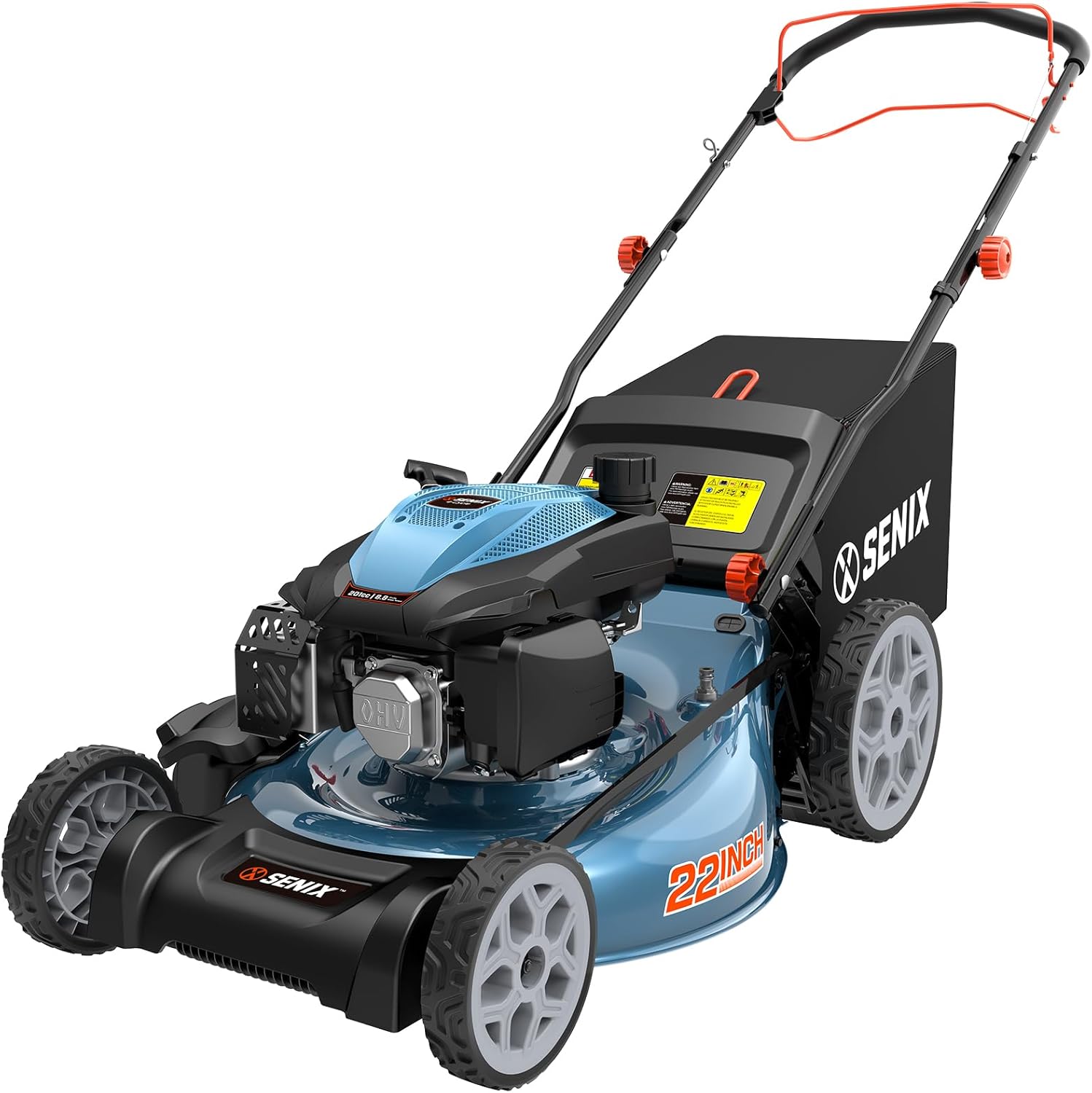
This SENIX mower is built for homeowners who want gas-powered performance without complexity. Its 201cc OHV 4-cycle engine produces enough torque for thick grass while the rear-wheel single-speed self-propelled drive (up to about 2.9 MPH) reduces fatigue on larger yards. The 22-inch steel deck and hardened manganese blades give efficient coverage and clean cuts, and the mower supports three modes — mulching, side discharge, and rear bagging — so you can adapt to seasonal conditions. Central six-position height adjustment (1.25 to 4 inches) makes switching cutting heights quick. The steel deck and vortex-style airflow aim to improve discharge and collection, and the folding handle helps store the mower in tighter spaces. Expect routine gas-engine upkeep and occasional tuneups, and note the single-speed drive limits control on steep slopes compared with variable-speed models. Assembly and break-in will be required before peak performance is realized.
Best for: Buyers who prioritize strong, gas-powered cutting performance and want a low-complexity self-propelled mower for medium to larger suburban lawns.
Less Ideal for: People who need very fine speed control for steep or highly uneven terrain or those who prefer battery-electric zero-emission options.
- Powerful 201cc OHV 4-cycle engine for consistent cutting through thicker turf
- 22-inch cutting deck covers ground quickly for medium to large yards
- 3-in-1 mowing (mulch, bag, side discharge) for seasonal versatility
- Durable steel deck and hardened manganese blades for long wear and reliable grass flow
- Central 6-position height adjustment for fast changes to cutting height
- Single-speed self-propelled drive offers less speed control than variable-speed models
- Gas engine requires regular maintenance and fuel storage
Verdict: Choose this mower if you want a solid, gas-powered 22-inch self-propelled machine that delivers reliable cutting power and 3-in-1 versatility for performance-focused lawn care.
Smalibal 131cc Self-Propelled 3-in-1 Gas Lawn Mower with 50L Grass Bag

| Power Source | Gas Powered |
|---|---|
| Cutting width | 18 inches |
| Maximum Adjustable Cutting Height | 3 inches |
| Operation Mode | Manual |
| Material Type | Metal, Plastic |
This Smalibal 131cc self-propelled lawn mower is a basic gas-powered machine aimed at straightforward yard maintenance. It uses a 131cc engine to drive a rear-wheel self-propel system that helps on gentle slopes and uneven ground, and the 18-inch steel blade and reinforced deck deliver one-pass cutting for small to medium lawns. The mower offers three cutting modes—rear bag collection, mulching, and side discharge—plus an eight-position height adjustment to tune the cut between 1 and 3 inches. A large 50L grass bag and wide-mouth opening make emptying reasonably easy, and foldable handles reduce storage footprint. Practical limitations are its lighter consumer construction and manual operation, which mean it will suit occasional use rather than heavy commercial workloads; assembly and long-term durability may vary. For buyers focused on basic, cost-conscious lawn care this unit gives useful features like self-propel and mulching without premium pricing, but those wanting long service life or advanced features should consider higher-end alternatives.
Best for: Practical homeowners who need an affordable gas mower for small to medium yards and want basic conveniences like self-propulsion and a large collection bag without paying for premium durability.
Less Ideal for: Landscapers or users who mow large areas frequently or need a robust, long-lasting commercial mower should look for heavier-duty models with proven reliability.
- Self-propelled rear-wheel drive improves traction on slopes and uneven lawns
- 3-in-1 functionality (bagging, mulching, side discharge) adapts to different yard needs
- 50L grass bag with wide mouth simplifies collection and emptying
- Foldable handle design reduces storage space when not in use
- Consumer-grade construction may not hold up to heavy or commercial use
- Maximum cutting height limited to 3 inches which may be short for some turf conditions
Verdict: A cost-conscious, self-propelled gas mower that packs basic 3-in-1 functionality and a large grass bag for straightforward yard work.
EGO POWER+ LM2135SP 21" Self-Propelled Cordless Lawn Mower with 7.5Ah + 5.0Ah Batteries

| Power Source | Battery Powered |
|---|---|
| Cutting width | 21 inches |
| Battery Average Life | 60 minutes |
| Number of Positions | 8 |
| Material Type | Metal Alloys |
The EGO POWER+ LM2135SP is a battery-powered, self-propelled 21-inch mower designed for homeowners who want gas-like performance without fumes or tune-ups. It uses a brushless motor and a Select Cut multi-blade system that includes mulching, high-lift bagging, and extended-runtime lower blades plus an upper blade, so you can switch blade setups to prioritize fine mulching, strong bagging suction, or longer runtime. Touch Drive variable-speed self-propel control and an at-hand dial make it easy to change pace on slopes or around obstacles. The included 56V 7.5Ah battery delivers up to about 60 minutes of runtime and the extra 5.0Ah battery extends that for larger yards or back-to-back jobs. Practical additions like LED lights, a two-bushel collection bag, and foldable handles for compact storage improve usability. Important limitations are that runtime depends on blade choice and grass conditions and heavier jobs will reduce the advertised operating time, so larger properties may require charging or spare batteries. For a reliability-minded buyer this mower delivers predictable, low-maintenance mulching performance with the flexibility to adapt to different mowing needs.
Best for: Homeowners who prioritize a dependable, low-maintenance mower that consistently produces good mulching results and can handle typical residential yards without the hassles of gas engines.
Less Ideal for: Users with very large properties who need continuous multi-hour runtime without swapping or recharging multiple batteries should consider commercial-grade or plug-in alternatives.
- Select Cut multi-blade system allows mulching, bagging, or extended runtime by swapping lower blades
- Brushless motor claiming up to 7.0 ft-lbs of torque for gas-comparable cutting performance
- Includes two batteries (7.5Ah and 5.0Ah) to increase continuous runtime
- Touch Drive self-propel and fingertip speed dial simplify control on slopes and uneven terrain
- Advertised runtime (up to 60 minutes) varies significantly with blade choice and grass conditions
Verdict: Choose this mower if you want a reliable, low-maintenance cordless model that delivers gas-like cutting power and versatile mulching performance with included spare battery support.
Greenworks 60V 21" Self-Propelled Lawn Mower with (2) 4.0Ah Batteries

| Power Source | dc |
|---|---|
| Operation Mode | Manual |
| Maximum Adjustable Cutting Height | 4 inches |
| Minimum Adjustable Cutting Height | 1 inches |
| Number of Positions | 7 |
The Greenworks 60V 21" self-propelled mower delivers gas-like cutting power with a brushless motor and dual 4.0Ah batteries that together provide roughly 60+ minutes of runtime, enough to cover up to about 3/4 acre under typical conditions. It is used like a conventional walk-behind mower but with rear-wheel self-propulsion that you can adjust on the go for slopes or thick grass. Notable features include seven height positions for precise cutting, LED headlights for low-light work, a 4-in-1 discharge system for bagging, mulching, side-discharge and turbo leaf pickup, and foldable handles for compact storage. Practical benefits are quiet operation compared with gas mowers, simple electric starts, and battery compatibility across the Greenworks 60V ecosystem so you can share batteries with other tools. Important limitations are that runtime will vary with terrain and grass height, the included batteries are mid-capacity so very large properties may require spare packs or higher-capacity options, and the mower uses plastic and aluminum components that require reasonable care to avoid damage over time.
Best for: Buyers who want a quieter, low-maintenance alternative to gas mowers for medium-size lawns and value proven features and compatibility with a 60V battery ecosystem.
Less Ideal for: Those with very large properties who need continuous runtime without swapping batteries or buyers who prefer fully metal, commercial-grade construction.
- Brushless 60V motor provides strong, quiet cutting performance similar to gas models
- Two 4.0Ah batteries with auto switchover deliver about 60+ minutes runtime for up to 3/4 acre
- Self-propelled rear-wheel drive with adjustable pace makes slopes and thick grass easier to manage
- 7-position height adjustment and 4-in-1 deck versatility (mulch, bag, side discharge, turbo)
- LED headlights and foldable handles improve usability and storage
- Included 4.0Ah batteries may be undersized for very large yards without spare high-capacity packs
- Certain structural parts use plastic which can be less durable than full-metal alternatives
Verdict: A capable, quiet 60V self-propelled mower that covers medium lawns well while sharing batteries with a broad 60V tool ecosystem.
Greenworks 80V 21" Self-Propelled Lawn Mower with 4.0 Ah Battery and Charger

| Power Source | Battery Powered |
|---|---|
| Battery Average Life | 2 hours |
| Number of Positions | 7 |
| Material Type | Plastic, Stainless Steel |
| Cutting width | 20.28 inches |
This Greenworks 80V 21" self-propelled mower is built for homeowners who want the power of gas without the noise and maintenance. It uses a brushless motor and a 4.0 Ah 80V battery to run a durable 21-inch steel deck and offers a 4-in-1 cutting system for mulching, bagging, side discharge, and rear discharge. The self-propelled rear-wheel drive and variable speed control make it easier to manage larger yards and slopes, while the seven-position height adjustment handles different grass lengths. LED headlights extend usable mowing hours and the mower is noticeably quieter than gas models. Practical benefits include compatibility with the 80V battery ecosystem, so the battery can be shared with other Greenworks tools, and a rapid charger that reduces downtime. Important limitations are that runtime will vary with grass conditions and the included 4.0 Ah pack is sized for about a half acre per charge under ideal conditions, so very large properties may need spare batteries for continuous work. Assembly and storage require some space because of the mower's footprint.
Best for: Homeowners who want a low-maintenance, quieter alternative to gas mowers for medium to large yards and who value sharing batteries across outdoor tools to optimize cost and convenience.
Less Ideal for: People with very large properties who need continuous runtime without swapping batteries or users who must store equipment in very small sheds or garages.
- Brushless motor delivers higher torque with quieter operation and longer motor life
- Self-propelled rear-wheel drive with variable speed eases mowing on larger lawns and slopes
- Compatible with Greenworks 80V battery ecosystem so batteries work across 75+ tools
- Seven-position height adjustment and 4-in-1 cutting options for flexible grass management
- Included 4.0 Ah battery is sized for roughly a half acre under ideal conditions, so very large lawns may need additional batteries
- Relatively large footprint requires adequate storage space
Verdict: A practical, gas-beating cordless mower for medium to large lawns that reduces noise and maintenance while letting you share batteries across an 80V tool ecosystem.
Choosing the Right Self Propelled Lawn Mower for Rough Terrain: Key Factors to Consider
Traction and Wheel Size
Traction determines whether a mower can move steadily across soft spots, gravel, or ruts without slipping. Larger rear wheels roll over obstacles more smoothly and reduce hopping on uneven ground. Deep, aggressive tread channels help in wet or loose soil, while smooth tires struggle when mud or thatch builds up.
Think about wheel diameter and width together. Bigger diameter improves rollover and reduces resistance when climbing small humps. Wider tires spread weight to lower ground pressure, which can prevent sinking in soft areas. For steep banks or highly irregular lawns, differential or independent wheel systems may improve stability.
Engine or Motor Torque Under Load
A mower's ability to maintain blade speed when hitting heavy grass, weeds, or wet clippings comes down to available torque and how it is delivered. Higher torque keeps the blade turning and reduces clogging, which is vital when cutting tall or damp growth commonly found on rough sites.
Consider machines that specify torque, power curve, or that use gearing to multiply torque at the blade. Engines with higher displacement or electric motors rated for continuous heavy load will hold speed better. Consistent torque reduces the need for multiple passes and lowers the chance of stalling on slope or through brush.
Cutting Deck Construction and Stability
A rigid, well-braced cutting deck resists flex when crossing gullies or ruts, maintaining an even cut and protecting the blade spindle from shock. Deck material and reinforcement influence how the deck sheds debris and resists denting from rocks or roots.
Deck width matters too. Narrower decks are easier to maneuver between obstacles but require more passes. Deck mounting and suspension affect how well the deck follows ground contours; floating or anti-scalp wheel options help keep cut height consistent across uneven surfaces.
Drive System Type and Reliability
Drive systems vary from simple gear-driven axle units to hydrostatic or variable-speed transmissions. On rough terrain, a durable drive that resists slipping and can handle sudden load changes matters. Hydrostatic drives give smooth speed control and strong low-speed torque, while belt-and-gear systems may be simpler and easier to service.
Durability of belts, pulleys, and transmission housings is important because rough conditions increase shock loading. Look for service access to replace wear items and for sealed components that resist mud and dust. Simple, proven drivetrains can reduce long-term maintenance headaches.
Operator Comfort and Control Layout
Cutting across rough ground is physically demanding, so ergonomic controls and a comfortable stance matter. Handlebar height, control placement, and vibration isolation affect how long you can work without fatigue. Ease of engaging drive, speed control, and blade engagement without awkward reaches improves safety and control on slopes.
Features like cruise control, variable speed levers, vibration-dampening grips, and accessible maintenance points make regular mowing less tiring. Consider how quickly you can change cutting height or fold handles for storage, especially if you will be transporting the mower between different areas.
Why Rough Terrain Changes Your Priorities
Rough yards combine factors that flat, manicured lawns do not: variable grade, hidden obstacles, dense patches of weeds, and often inconsistent soil conditions. Those variables change what you need from a mower. Stability, torque, and dependable traction become more important than sheer cutting width.
Expect to trade off some maneuverability for durability. Wider decks cover more ground but can snag on uneven ground. A slightly narrower but more robust machine often finishes faster on a rough plot because it spends less time stalled or clearing clogs.
- Rough terrain increases shock to the chassis and drive components.
- Hidden obstacles raise the value of reinforced decks and accessible blade spindles.
- Consistent blade speed is more important than a large cutting swath.
Electric Vs Gas Options on Uneven Ground
Electric mowers bring instant torque from the motor and low maintenance, which helps when power delivery under load matters. Battery systems with sustained continuous output will keep blades turning through heavy growth, but runtime and battery life should be matched to your yard size and expected conditions.
Gas engines often offer longer runtime and easier refueling for large or remote properties. Choose engines with proven torque delivery and easy-access filters and spark plugs to simplify maintenance after working in dusty or brushy terrain.
- Battery capacity dictates whether a single charge will finish the job on rough, dense grass.
- Gas engines are less limited by runtime but require more routine maintenance in dirty conditions.
Slope and Safety Considerations
Mowing on slopes adds roll and traction concerns. Self-propelled systems should provide stable, predictable drive engagement and allow speed modulation without sudden surges. For steep angles, choose a unit designed with slope operation in mind and use proper mowing technique: cross-slope passes where safe and avoid sudden direction changes.
Safety features like blade-brake systems that stop the blade quickly and reliable operator-presence controls reduce risk when traction is compromised. Use wheel chocks for storage and inspect drive components frequently after slope work for unusual wear.
- Operate across slopes when possible to reduce downhill speed.
- Inspect brake and clutch linkages after heavy slope use.
Maintenance Tips for Rough Conditions
After mowing rough areas, check the deck, spindles, and wheels for damage and debris. Remove built-up grass and mud from under the deck to prevent rust and cooling issues. Grease fittings, check belt tension, and look for cracked pulleys regularly.
Keep air filters and cooling fins clean to prevent overheating, especially after cutting tall or damp vegetation. Replace blades and belts at the first sign of excessive wear to maintain cutting performance and reduce strain on the engine or motor.
- Clean the underside of the deck after each heavy-use session.
- Schedule frequent inspections of belts, spindles, and wheel bearings.
Attachments and Accessories That Help
Certain accessories extend the usefulness of a mower on rough sites. Mulching kits reduce clumping in tall grass, while robust side-discharge chutes limit clogs when grass is wet or fibrous. Grass bags with larger capacity cut down on stops to empty, which matters when walking over rough ground.
Consider using heavy-duty tires or tire chains for improved traction in very soft or uneven patches. Anti-scalp wheels and deck skids can also prevent gouging the turf or damaging the deck when crossing dips and rises.
- Mulcher inserts for fine clippings in dense growth.
- Heavy-duty tires and skids for improved durability.
How We Chose the Best Self Propelled Lawn Mower for Rough Terrain
We selected mowers using criteria that reflect real-world demands on rough, uneven lawns. Key filters included delivery of usable torque under load, traction and wheel design for soft or rutted ground, cutting deck stability across uneven surfaces, and control ergonomics that reduce operator fatigue on longer jobs. We also considered durability of driveline components, ease of routine maintenance, and adaptability for different grass heights and debris. Excluded from the list were machines intended only for flat, manicured turf, lightweight models lacking robust drivetrains, and any unit without adequate safety features for slope and rough-terrain operation. We prioritized models that offered clear specifications on engine or motor torque, wheel tread and size, deck construction, and drive system type. Final selections came from devices that combined strong uphill and through-thick-growth performance with reasonable serviceability and operator comfort.
FAQ
Can I use a self-propelled mower on steep slopes?
You can use some self-propelled mowers on slopes, but capability depends on traction, drive type, and the specific slope angle. Operate across the slope where safe and follow manufacturer guidance for maximum slope. If slopes are steep, prioritize models with strong traction and reliable operator controls.
How often should I sharpen blades when mowing rough, overgrown areas?
Sharpness matters more in rough or thick growth because dull blades tear grass and increase engine load. Inspect blades after heavy sessions and sharpen or replace them when you notice ragged cuts or increased vibration. For frequent rough mowing, this may be every few weeks.
Do electric self-propelled mowers have enough power for long, tough grass?
Many modern electric mowers deliver strong torque, but runtime is the limiting factor. If your yard is large or the grass is consistently heavy, check continuous power ratings and battery capacity. For prolonged heavy use, multiple batteries or a gas option may be more practical.
What wheel features reduce getting stuck in soft ground?
Larger diameter wheels with deeper tread and wider footprints reduce sinking and improve grip. Look for tires designed for turf or off-road use, and consider wider rear wheels to lower ground pressure. Tire ballast or chains help in extremely soft conditions.
How do I prevent clogs when cutting tall, wet grass?
Cut at a higher deck setting on the first pass to reduce load, and use a slower ground speed to allow the blade to chew through material. Mulching or side-discharge setups that move clippings quickly reduce buildup. Regularly clear under-deck debris during the job to maintain airflow.
Final Verdict
For rough terrain, prioritize machines that maintain blade speed under load and deliver dependable traction. Durable deck construction, a robust drive system, and operator-friendly controls reduce downtime and make routine maintenance easier. Expect tradeoffs: the most rugged mowers may be heavier and less nimble but will finish rough jobs faster and with fewer interruptions. Choose based on the specific challenges of your yard: if you have lots of soft spots and obstacles, favor larger wheels and reinforced decks; if you face long, dense growth, focus on torque and cooling. Use the evaluation criteria above to match a mower to your landscape and mowing rhythm.
