

Note: This article contains affiliate links. If you click on these links and make a purchase, I may earn a small commission at no extra cost to you. This helps support my research and content. Read my full affiliate disclosure here.
Installing the right soaker hose for foundation keeps soil near footings evenly moist while preventing excess runoff against a building. For foundation planting beds and perimeter watering you need a hose that soaks slowly, resists kinks, and holds up to seasonal exposure. This guide covers seven top-rated soaker hoses chosen for foundation use. We explain the practical differences that matter in a yard or planting strip and outline the performance, durability, and ease-of-use factors that influenced our short list.
Top Picks at a Glance
| Best Overall The best all-around choice for most situations | ZGWDrip 150 ft 1/2" Water-Saving Soaker Hose with Solid Brass Connectors and Accessory Kit |  |
| Best Quality Built to a higher standard if you want something more solid | Water Right 700 Series Polyurethane Soaker Hose, 25 ft (1/2" ID) |  |
| Best Value The sweet spot between price and what you get | Gilmour 75' Flat Weeper Soaker Hose |  |
| Best Budget The cheapest option that still gets the job done reliably | Gilmour 25' Flat Weeper Soaker Hose |  |
| Highest Rated A top-rated pick with lots of positive feedback | Pine Tree Tools Linkable Flat Soaker Hose, 50 ft |  |
| Most Popular A crowd favorite that many people choose with confidence | Gilmour 50' Flat Weeper Soaker Hose |  |
| Best Seller A high-volume bestseller chosen again and again | Suneed Flat Soaker Hose 25 ft (4-Pack) |  |
ZGWDrip 150 ft 1/2" Water-Saving Soaker Hose with Solid Brass Connectors and Accessory Kit

| Material Type | Rubber |
|---|---|
| Unit Count | 150 Feet |
| Maximum Pressure | 100 psi |
| Included Components | Hose Body |
This ZGWDrip 150 ft 1/2" soaker hose is built as a straightforward drip-irrigation solution for lawns, foundation planting beds, and larger landscapes. It delivers uniform seepage along the hose to target root zones and reduce evaporation compared with overhead sprinklers. The rubber construction is described as flexible and kink-resistant so it is easy to lay out around foundations and bed edges or to tuck slightly below the soil for hidden drip irrigation. Solid brass connectors and a maximum pressure rating of 100 psi give a sturdier, more leak-resistant connection than molded plastic fittings, and the included accessory kit and ground stakes simplify joining runs and holding the hose in place. Practical limitations to note are that installation still requires planning for flow and row layout to avoid over- or under-watering, and performance will depend on water pressure at your spigot. For foundation watering this length and the accessory set make it simple to cover long runs without needing many extra parts.
Best for: Buyers who want a balanced, reliable soaker hose to irrigate foundation plantings or long garden beds with minimal fuss and a complete set of connectors to get started.
Less Ideal for: People who need precise flow control for small container gardens or those who require permanent buried drip systems with emitters rated for extremely low flow per plant.
- Even, continuous seepage that targets root zones to reduce surface evaporation
- Solid brass connectors for more reliable, corrosion-resistant connections
- Long 150 ft length covers extensive foundation runs or large beds without many joins
- Included accessory kit and 20 stakes make layout and basic installation faster
- Requires planning for proper flow and spacing to avoid uneven watering
- Rubber hose and fittings may still need seasonal protection in freezing climates
Verdict: A long, ready-to-install soaker hose with brass fittings and a full accessory kit that makes covering foundation beds and long runs quick and dependable.
Water Right 700 Series Polyurethane Soaker Hose, 25 ft (1/2" ID)

| Material Type | Polyurethane |
|---|---|
| Unit Count | 25 Feet |
| Inner Diameter | 1/2" |
| Maximum Pressure | 150 psi |
| Included Components | End cap, fittings, strain reliefs |
The Water Right 700 Series soaker hose is built for steady, root-level irrigation in vegetable beds and compact garden plots. Install it along rows or weave it through raised beds and connect to a faucet or timer for long, low-pressure runs that soak soil rather than spray foliage. Its 1/2" inner diameter and porous wall produce a consistent weep from end to end, which reduces runoff and promotes deep root growth for vegetables. Polyurethane construction makes the hose light to handle, resistant to kinks and UV damage, and safe for edible gardens because it is free of lead, phthalates, and BPA. The hose comes with end fittings and an end cap so you can section beds and control flow, and the manufacturer recommends a filter if you have hard water to avoid mineral clogging. The main limitations are that a 25 ft length suits small to medium beds only and soaker hoses require careful placement and occasional unclogging compared with emitters or drip tubing for very long runs or precision single-plant feeding.
Best for: Gardeners who prioritize reliable, plant-safe irrigation and want a simple low-pressure solution for small to medium vegetable beds that promotes deep root watering.
Less Ideal for: Large-scale vegetable plots or gardeners who need precise per-plant emitters or very long continuous runs without connectors should consider alternative drip systems.
- Consistent end-to-end seep for even root-zone watering
- Made from drinking-water-safe polyurethane with no lead, phthalates, or BPA
- Resists kinking, cracking, and UV damage for season-to-season durability
- Includes end cap, fittings, and strain reliefs for straightforward installation
- 25-foot length may be too short for larger gardens without joining multiple sections
- Porous wall can clog with hard water minerals if an inline filter is not used
Verdict: Choose this hose if you want a durable, drinking-water-safe soaker hose that delivers consistent, root-focused watering for small to medium vegetable beds.
Gilmour 75' Flat Weeper Soaker Hose

| Material Type | Vinyl |
|---|---|
| Item Length | 75 inches |
| Item Weight | 2 pounds |
| Included Components | Pack of 1 Gilmour 870751-1001 Hose Flat Soaker, 75' |
The Gilmour 75' flat weeper soaker hose is a lightweight, flexible soaker that distributes water through a fabric-covered jacket so moisture seeps into the soil rather than spraying the surface. It is typically laid along foundation beds, under mulch, or at the base of shrubs and vegetables and can be left in place for seasonal irrigation. The flat profile makes it easy to position in tight beds and to roll up for compact storage. Its vinyl construction and fabric cover are described as clog resistant and durable for repeated seasonal use, and multiple lengths can be linked to extend coverage for longer foundation runs. Expect slow, steady water delivery that can save water compared with overhead watering and reduce runoff near foundations. Limitations include the need to monitor pressure and run time to avoid overwatering in clay soils and the lack of built-in emitters for precise, measured flow per foot, so spacing and layout require some trial and adjustment for uniform moisture.
Best for: Buyers who want a simple, low-maintenance method to water foundation plantings and garden beds efficiently and who prefer a solution that is easy to install and store seasonally.
Less Ideal for: Those seeking a precision drip system with rated emitters per foot or homeowners who need a heavy-duty hose to withstand frequent foot traffic or burial without protective sleeving.
- Delivers water directly to root zone for efficient, low-evaporation watering
- Flat, flexible design is easy to lay in narrow foundation beds and rolls up compactly for storage
- Clog-resistant fabric cover helps maintain consistent seepage
- Can be linked to additional hoses to extend coverage for longer runs
- No integrated flow regulation or per-foot emitter specification for exact uniformity
- Made of vinyl which can wear faster than reinforced rubber in high-traffic areas
Verdict: A straightforward, easy-to-install soaker hose that efficiently waters foundation beds with minimal fuss and compact storage.
Gilmour 25' Flat Weeper Soaker Hose

| Material Type | Vinyl |
|---|---|
| Item Length | 25 feet |
| Unit Count | 1 Count |
| Item Type Name | Hose |
The Gilmour 25' Flat Weeper Soaker Hose is a thin, flexible soaker hose that delivers water through a fabric jacket so it seeps directly into soil rather than spraying above ground. It is typically laid along foundation edges, flower beds, or vegetable rows and connected to a standard hose bib; the flat design makes it easy to roll up and store when not in use. The vinyl construction and clog-resistant fabric cover promote consistent soaking and the hose can be linked with others to extend coverage or create a simple DIY drip line. Practical benefits include water-efficient root watering that can reduce runoff and avoid wetting foundations excessively when positioned carefully, plus lightweight handling for quick seasonal setup. Limitations are that pressure must be regulated for even output and the thin flat profile is less durable against foot traffic or sharp edges than heavy rubber hoses, so it requires some protection or burying in mulch for long-term use.
Best for: Homeowners who want an inexpensive, water-efficient way to keep foundation planting strips and garden beds consistently moist without complex irrigation equipment.
Less Ideal for: People who need a heavy-duty hose for exposed high-traffic areas or automated irrigation with precise pressure control should consider sturdier drip tubing or commercial drip systems.
- Delivers water directly to root zone for efficient watering
- Flat, lightweight design is easy to roll up and store
- Clog-resistant fabric jacket helps maintain even seepage
- Can be linked to other hoses to extend coverage
- Thin flat profile is vulnerable to damage from foot traffic or sharp objects
- Requires low, steady water pressure and occasional flushing to prevent uneven output
Verdict: An affordable, easy-to-store soaker hose that puts water at the roots for simple, water-saving foundation and bed irrigation.
Pine Tree Tools Linkable Flat Soaker Hose, 50 ft

| Item Length | 50 feet |
|---|---|
| Included Components | Flat Drip Hose |
| Brand Name | Pine Tree Tools |
This flat soaker hose supplies slow, steady water directly at the soil line to reduce runoff and evaporation and keep root zones consistently moist. It is typically laid along rows, around plants, or through narrow beds and can be used above ground or lightly covered with mulch to hide the line. The hose is flexible and flat for easy placement and storage, and it is linkable to standard garden fittings so you can extend runs or add timers and end caps for hands-free watering. Practical benefits include targeted watering for vegetables, flower borders, tree rings, and raised beds, simpler setup than buried drip lines, and compact roll-up storage between seasons. Important limitations are that it relies on surface placement so it is more exposed to sun and mechanical damage than buried tubing, and output depends on your water pressure so very long linked runs may need pressure regulation for even flow.
Best for: Gardeners who prioritize dependable, low-maintenance irrigation for beds and raised planters and want a simple, extendable system they can set up quickly.
Less Ideal for: People who need fully concealed or professional subsurface drip systems or those who want precision emitters for individual plants.
- Delivers slow, uniform drip watering along the length to reduce evaporation and runoff
- Flat, flexible design lays neatly in narrow beds and rolls up compactly for storage
- Linkable to standard fittings so runs can be extended or combined with timers
- Durable construction intended to resist kinks and leaks for season-long use
- Surface placement leaves the hose exposed to sunlight and physical wear compared with buried drip tubing
- Water distribution over long linked runs can become uneven without proper pressure management
Verdict: Choose this hose if you want a reliable, easy-to-install surface soaker that delivers consistent root-zone watering and can be expanded with standard fittings.
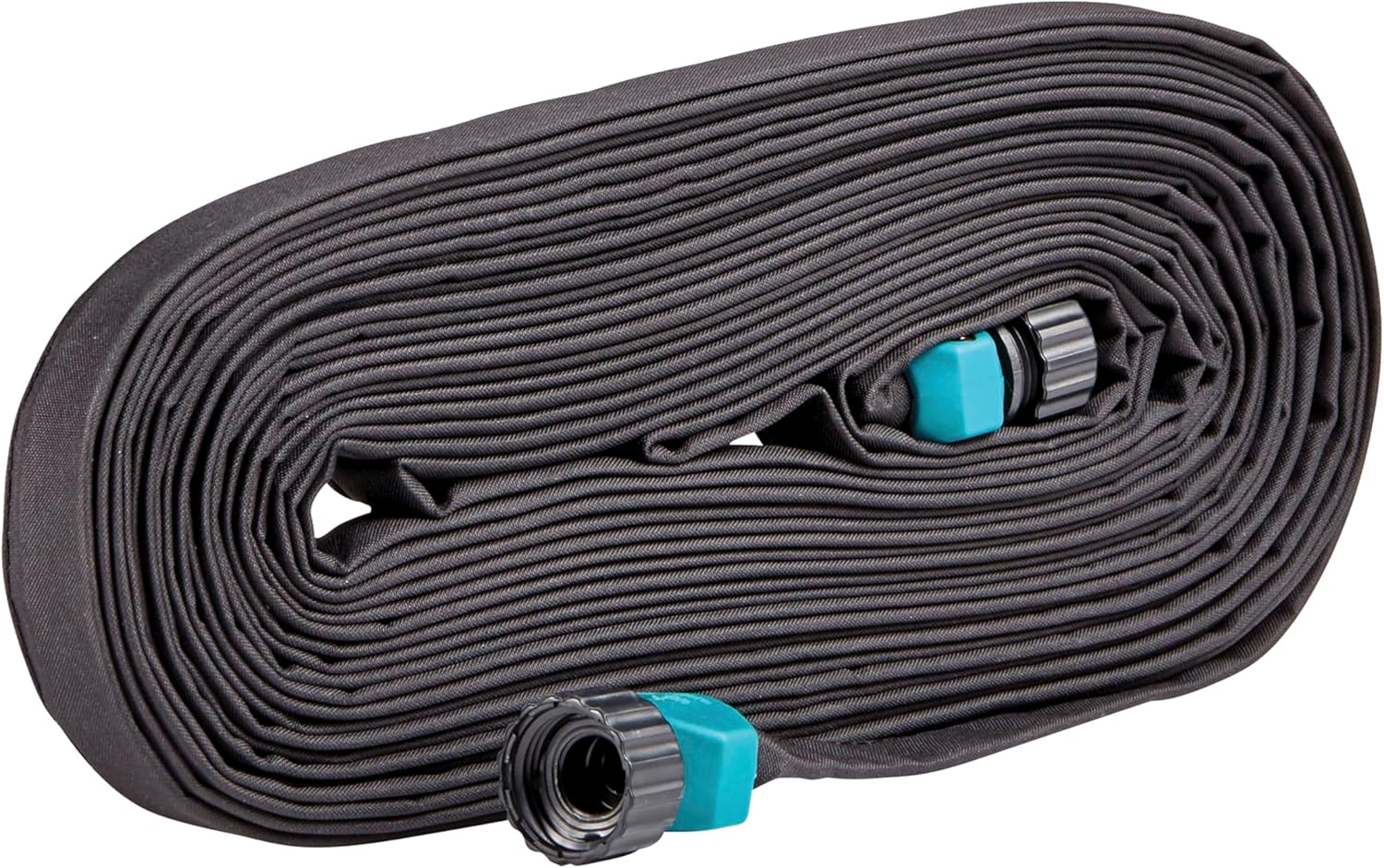
Gilmour 50' Flat Weeper Soaker Hose
| Material Type | Vinyl |
|---|---|
| Item Length | 50 feet |
| Nominal Wall Thickness | 0.0625 inches |
| Outside Diameter | 0.63 inches |
The Gilmour 50' Flat Weeper Soaker Hose is a lightweight, vinyl soaker hose that waters plants by seeping moisture through a fabric jacket directly into the soil. It is typically laid along planting rows or buried shallowly under mulch so water reaches roots without wetting foliage or pathways. Notable features include a clog-resistant fabric cover and a flat profile that makes rolling and winter storage simple. Being made from 100% recycled vinyl and described as UV resistant, it is intended for repeated seasonal use and can be linked to additional hoses to create a longer DIY drip system. Practical benefits are water savings from targeted delivery and easier placement in narrow beds where sprinklers would waste water. Limitations to expect are the usual for vinyl soaker hoses: it is not intended for high-pressure use and can be punctured by sharp tools or heavy foot traffic, and performance depends on even water pressure along the length so very long runs may deliver uneven soaking without splitters or a faucet regulator.
Best for: Gardeners who prioritize reliable, water-efficient irrigation for beds and vegetable rows and who prefer a simple, low-tech solution that is easy to install and store.
Less Ideal for: People who need high-pressure irrigation, frequent heavy-duty use, or a permanent buried drip system should consider reinforced or commercial-grade drip tubing instead.
- Delivers water directly to roots through a fabric jacket for efficient, low-waste watering
- Clog-resistant fabric cover helps maintain consistent seepage over time
- Flat, flexible design rolls up for compact, easy seasonal storage
- Made from recycled vinyl and marketed as UV resistant for seasonal durability
- Not designed for high-pressure applications and can give uneven watering on very long runs
- Vinyl construction can be damaged by sharp objects or heavy foot traffic
Verdict: A straightforward, water-saving soaker hose that makes efficient root watering and seasonal storage easy for home garden beds.
Suneed Flat Soaker Hose 25 ft (4-Pack)

| Material Type | Vinyl |
|---|---|
| Maximum Pressure | 60 psi |
| Item Length | 100 feet |
This Suneed flat soaker hose is built to provide slow, consistent watering by letting water seep along the hose length, which is useful for foundation plantings and narrow beds. Its flat, lightweight vinyl construction makes it easy to lay out along foundation lines and roll up for compact storage when not in use. The hose is described as tear resistant and rated for up to 60 psi, and the flat profile helps reduce trip hazards and keeps the hose tucked against a foundation or mulch. In practice it works best at low to moderate household water pressure where it evenly wets root zones and cuts evaporation compared with overhead watering. Limitations to note are that the material is vinyl rather than reinforced rubber, so it may be vulnerable to prolonged UV exposure or punctures in high-traffic areas, and hole spacing and flow rate are not adjustable so you may need to experiment with pressure or spacing for truly uniform coverage along long runs.
Best for: Homeowners who want a low-effort, water-efficient way to irrigate foundation plantings or narrow beds and prefer a product that is easy to install and store.
Less Ideal for: People needing a heavy-duty, puncture-resistant mainline hose for areas with frequent foot traffic or contractors who require adjustable flow control and commercial-grade durability.
- Flat profile stays close to soil and reduces tripping and visibility along foundations
- Delivers slow, even seepage to root zones which reduces evaporation and runoff
- Lightweight and easy to coil for compact storage
- Rated for up to 60 psi so it tolerates typical residential water pressure
- Vinyl construction may degrade faster than heavier reinforced hoses under long-term sun exposure
- Fixed seepage pattern cannot be tuned without adjusting water pressure or layout
Verdict: Choose this flat soaker hose when you want an easy-to-use, low-profile way to provide steady, water-saving irrigation for foundation beds.
Choosing the Right Soaker Hose for Foundation: Key Factors to Consider
Soak Uniformity and Emit Rate
How evenly water seeps from the hose determines whether the soil near the foundation becomes uniformly moist or develops dry and wet spots. A consistent emit rate reduces the risk of oversaturating one area while leaving another too dry.
For foundations, a lower emit rate is often better because it lets water soak into the root zone without running down and pooling at the foundation wall. Consider the soil type in the bed: sandy soils need a different emit pace than clay soils to avoid deep percolation or surface runoff.
Material Durability and UV Resistance
Hoses used near foundations sit in sun and contact soil and mulch that abrade the surface. Materials that resist UV degradation, cracking, and abrasion will last several seasons and reduce the chance of leaks developing along the length.
Look for thicker-walled constructions or reinforced weaves that resist splitting when bent around corners or when stepped on. Durability also matters for winterizing; a hose that resists brittleness is less likely to develop stress cracks during freeze-thaw cycles.
Connector Quality and Leak Prevention
Leaks at connectors or splices can waste water and create localized saturation against the foundation. Reliable fittings, good barbs, and tight compression-style connectors reduce the need for frequent adjustments.
If you plan to join segments or attach timers, choose hoses with standard-size ends and consider threaded adapters that create a secure seal. Proper connector quality also simplifies seasonal removal and reattachment for maintenance.
Flexibility, Kink Resistance, and Layout Fit
Foundation beds are often narrow and can include tight corners or irregular shapes. A hose that bends easily without kinking lets you run continuous lengths without breaks in watering coverage.
Stiffer hoses can create pressure points and open pores unevenly. Flexible construction makes it easier to tuck the hose against the foundation and route around obstacles while maintaining steady water release.
Ease of Installation and Maintenance
Time spent installing, adjusting, and winterizing a soaker hose adds to the real cost of the system. Hoses with clear markings, simple connectors, and manageable weight speed installation in long perimeter runs.
Maintenance matters too: hoses that are easy to lift, flush, and store reduce the chance of damage during seasonal changes. Consider how simple it will be to flush sediment, repair small tears, or replace sections without disturbing planted roots.
Compatibility with Water Pressure and Timers
Soaker hoses are sensitive to supply pressure. Too much pressure forces water out of pores too quickly and shortens soak time; too little leads to uneven delivery. Choose hoses that perform well across typical garden tap pressures or can be paired with a simple pressure regulator.
If you plan to automate with a timer, verify that connectors and fittings work with your timer and that the hose emit rate matches the run time needed to wet the root zone without creating runoff.
Placement Strategies Near Foundation Walls
For best results, position the soaker hose slightly away from the foundation base rather than pressed directly against a foundation wall. Leaving a small gap lets water spread laterally into the planting bed and reduces concentrated wetting that could affect shallow footings.
If the bed is narrow, run the hose in a single continuous line parallel to the wall. For wider beds use two offset lines spaced to create even coverage. Mark out the planned routing before installing and test with a short run to check for low spots or pooling.
- Slope the bed surface away from the foundation to encourage drainage.
- Use mulch above the hose to slow evaporation and keep water moving into soil.
- Avoid burying the hose deeply; shallow coverage improves soak effectiveness and makes winter removal easier.
Seasonal Care and Winterizing
Drain and store hoses that are prone to cracking before freezing weather. If removal is impractical, disconnect the supply, flush the line, and store fittings indoors to prevent freeze damage to connectors. Inspect for soft spots or brittleness each spring.
During active growing months, periodically lift sections to check for clogging from sediment or root intrusion and flush the hose with water run at low pressure. Replace small damaged sections rather than leaving leaks in place.
- Flush lines at low pressure to clear sediment.
- Store hoses coiled in a shaded area when not in use.
- Check connectors yearly for corrosion or loosening.
Integrating Soaker Hoses with Timers and Valves
Soaker hoses work well with simple mechanical or digital timers, but you must match the timer run length to the hose emit rate and soil type. Short automated runs often lead to patchy wetting; longer, slower fills are usually better for foundation beds.
Add a pressure regulator if your tap pressure exceeds what the hose is rated for. Use a filter if your water supply carries sediment to reduce clogging and extend the life of porous hoses.
- Set timers for multiple short cycles with soak intervals rather than one long run when soils are compacted.
- Install a pressure regulator and filter when using municipal or well water with high sediment load.
Repair Tips for Small Tears and Leaks
Small tears can often be patched with self-fusing repair tape or a short coupling that bypasses the damaged section. Clean and dry the area before applying any patch to ensure a tight seal.
For leaks near a connector, replace the fitting and inspect the hose end for fraying. When splicing, use a sleeve or compression fitting designed for porous hoses to maintain consistent flow through the joint.
- Keep a small repair kit with clamps, couplings, and tape.
- Replace heavily weathered sections rather than repeatedly patching them.
Soil and Mulch Pairings That Improve Performance
Mulch slows surface evaporation and evens soil moisture from a soaker hose. Apply a 2 to 3 inch layer of organic mulch over the hose to help water move downward and protect the hose from UV exposure and foot traffic.
Amend compacted soils before installing a soaker hose. Improving soil structure increases water infiltration and reduces surface pooling, making the hose's emit rate more effective.
- Avoid placing mulch directly against foundation walls; leave a small gap for air circulation.
- Choose coarse mulches that allow water penetration rather than dense mats that repel moisture.
How We Chose the Best Soaker Hose for Foundation
We focused on traits that directly affect foundation watering performance and longevity. Key evaluation criteria included soak uniformity and emit rate to ensure moisture reaches the root zone without pooling against the foundation; hose material durability and UV resistance for seasonal exposure; connection and fitting reliability to avoid leaks at splices and tap points; kink resistance and flexibility to fit narrow beds and curves; and ease of installation and maintenance so the hose can be adjusted or winterized without damage. Products were evaluated for how well they distribute low-pressure water over extended runs, the consistency of flow across varied supply pressures, and the ability to withstand abrasive soil contact and sunlight. We excluded specialty drip systems that require complicated emitters or pressurized tubing because they fall outside the simple, porous-hose use case. Also excluded were hoses designed only for decorative aboveground use that lack the porosity and durability needed for foundation irrigation.
FAQ
How close should a soaker hose be to the foundation wall?
Place the hose a few inches to several inches away from the foundation, depending on bed width. A slight gap helps water spread laterally into planting roots and avoids concentrated wetting directly against the wall.
Will a soaker hose cause moisture problems for a foundation?
Used correctly, a soaker hose reduces runoff and concentrates water in the root zone rather than against the foundation. Proper placement, soil slope, and controlled emit rates minimize risk of excess moisture at the foundation.
Can I leave a soaker hose in place year-round?
Many gardeners remove or store hoses in freezing climates to prevent cracking. In milder climates, leave the hose in place but inspect annually for UV damage and flush to remove sediment before the dormant season.
How do I prevent clogging in a soaker hose?
Use a coarse filter on the supply line, flush the hose periodically at low pressure, and avoid using fertilizers or amendments through the hose that could build up deposits. Regular inspection and occasional replacement of short sections also help.
Is a pressure regulator necessary for foundation soaker hoses?
Often it is. If your tap pressure is above the hose's recommended range, a regulator ensures the emit rate remains slow and even, reducing the chance of surface runoff or uneven wetting.
Final Verdict
For foundation watering, prioritize hoses that deliver steady, low emit rates and durable construction that withstands sun, soil, and seasonal handling. Focus on soak uniformity, connector reliability, and flexibility to fit narrow beds while avoiding concentrated wetting at the wall. Balance ease of installation and maintenance with material longevity. When you match hose performance to soil type and use proper placement and seasonal care, a soaker hose can provide reliable foundation irrigation without creating moisture problems.
