

Note: This article contains affiliate links. If you click on these links and make a purchase, I may earn a small commission at no extra cost to you. This helps support my research and content. Read my full affiliate disclosure here.
Choosing the right soaker hose for raised beds matters because these compact growing spaces need steady, gentle moisture without washing out soil or drowning roots. The right hose delivers even drip distribution along narrow bed rows, conserves water, and reduces the time you spend hand-watering. This guide covers seven shortlisted options well suited for raised-bed situations. We focus on how each hose performs in flow consistency, durability, ease of installation in tight bed layouts, and compatibility with common irrigation fittings. Read on to see the criteria we used and what matters most when matching a soaker hose to your raised beds.
Top Picks at a Glance
| Best Overall The best all-around choice for most situations | Secbulk 200 ft Flat Soaker Hose — Linkable Dual-Layer Drip Hose with Stakes |  |
| Best Quality Built to a higher standard if you want something more solid | MIXC 100ft Thickened Soaker Hose with Copper Connector |  |
| Best Value The sweet spot between price and what you get | Hourleey Flat Soaker Hose 100 ft – Linkable Dual-Layer Drip Hose |  |
| Best Budget The cheapest option that still gets the job done reliably | Gilmour 25 ft Flat Weeper Soaker Hose |  |
| Highest Rated A top-rated pick with lots of positive feedback | Pine Tree Tools Linkable Flat Soaker Hose, 50 ft |  |
| Most Popular A crowd favorite that many people choose with confidence | Gilmour 50' Flat Weeper Soaker Hose |  |
| Best Seller A high-volume bestseller chosen again and again | Rocky Mountain Goods Round Rubber Soaker Hose, 25 ft |  |
Secbulk 200 ft Flat Soaker Hose — Linkable Dual-Layer Drip Hose with Stakes

| Item Length | 200 feet |
|---|---|
| Material Type | Vinyl |
| Maximum Pressure | 90 psi |
| Item Weight | 3.75 kg |
This Secbulk flat soaker hose is built for consistent low-flow watering across long runs, making it a practical choice for raised beds and long garden rows. The hose uses a fabric-covered recycled vinyl with a dual-layer design that resists sun damage and delivers a clog-resistant, slow seep along its length so you can target roots instead of foliage. It connects end-to-end with rust-resistant end caps and fits standard garden hose threads, so it works with timers and existing fittings for a simple DIY irrigation layout. The flat, kink-resistant profile lies close to the soil surface and rolls up compactly for off-season storage, and the manufacturer recommends a working pressure range for best performance. Limitations to consider are the maximum pressure rating and the fact that very hot water is not suitable, and occasional checks are still needed to ensure emitters are not blocked or buried too deeply under mulch where flow can be reduced.
Best for: Gardeners who want a reliable, low-maintenance drip-style solution for raised beds and long planting rows and who prioritize even root-zone watering over spray irrigation.
Less Ideal for: People who need adjustable point emitters or very high-pressure systems, or those who prefer buried drip tubing with built-in emitters for permanent installations.
- Provides even, slow seep watering along the entire length to reduce runoff and wet foliage
- Fabric-covered dual-layer vinyl improves UV resistance and durability for seasonal use
- Linkable ends and standard hose thread compatibility make it easy to expand and attach timers or fittings
- Flat, kink-resistant profile stores compactly and can be snaked under plants or mulch
- Not rated for very hot water and performance depends on keeping pressure within the recommended range
- May require occasional clearing if debris or heavy mulch blocks the fabric cover
Verdict: A long, flat soaker hose that delivers consistent root-zone watering across raised beds while staying easy to connect, store, and integrate into simple timer-based systems.
MIXC 100ft Thickened Soaker Hose with Copper Connector

| Unit Count | 100 Feet |
|---|---|
| Nominal Wall Thickness | 1 millimeters |
| Material Type | Brass, Polyvinyl Chloride (PVC) |
| Maximum Pressure | 50 psi |
This MIXC soaker hose is built for steady, low-flow irrigation of vegetable beds and other planted areas. It uses a doubled wall thickness (1 mm) compared with many economy hoses, which reduces punctures and wear when dragged across rough ground. The hose includes brass/copper-style metal connectors and aluminum locking rings that hold fittings tightly and help prevent leak-prone plastic joints. A longer swivel handle on the connector makes attaching and turning the hose easier in tight spaces. In practice you lay it through rows or around raised beds and run low pressure water into it; the built-in seepage holes wet soil slowly and evenly without runoff. Important limitations to plan for are water-pressure sensitivity and recommended run length: the manufacturer advises keeping pressure below 50 psi and testing in 50 ft sections because flow falls off toward the far end. The hose is aimed at routine garden irrigation rather than high-pressure use or very long continuous runs, and you should use the included washers and a pressure regulator for the most reliable performance.
Best for: Gardeners who prefer a durable, low-maintenance soaker hose for regular vegetable bed irrigation and value reliability over lowest cost.
Less Ideal for: People who need to irrigate very large areas from a single long continuous hose run or who require frequent high-pressure flushing for emitters.
- Thicker 1 mm wall resists punctures and abrasion compared with typical 0.5 mm soaker hoses
- Metal (brass/copper) connector and aluminum locking rings reduce connection leaks and breakage
- Long swivel-handle connector eases attachment and prevents hose twisting during use
- Designed for slow, even seepage that minimizes runoff and conserves water
- Recommended maximum pressure and run length limit suitability for long continuous runs without additional supply/pressure management
- Flow can decrease toward the far end of a long lay so multiple sections or splitters may be needed for larger gardens
Verdict: Choose this hose if you want a tougher, leak-resistant soaker hose built for dependable vegetable garden irrigation.
Hourleey Flat Soaker Hose 100 ft – Linkable Dual-Layer Drip Hose

| Material Type | Nylon |
|---|---|
| Item Length | 100 feet |
| Maximum Pressure | 150 psi |
| Included Components | Soaker Hose, Stake |
The Hourleey Flat Soaker Hose is a 100 foot, linkable drip hose intended for garden beds and landscaped rows where steady, low-volume watering is needed. It delivers water through evenly spaced holes along a dual-layer PVC and nylon construction so moisture soaks into the root zone instead of spraying the surface. Typical use is laying the hose along beds, staking it in place, connecting multiple lengths end-to-end, and running at the recommended working pressure for even output. Notable features include a kink-resistant flat profile that tucks under mulch, a fabric cover to resist clogging, and stakes for straightforward placement. Practical benefits are clear water savings when compared with open hoses and less hand-watering for seedlings and vegetables. Important limitations are that it is meant for cold water only and performs best within the suggested 60–80 PSI range; pressure outside that range can affect drip consistency. Also the flat profile may be harder to repair than standard round soaker hoses if punctured.
Best for: Gardeners who prioritize efficient, low-maintenance irrigation for beds or vegetable rows and want a product that can be extended and tucked under mulch for consistent root watering.
Less Ideal for: People who need a hose for frequent high-pressure or hot-water tasks or who prefer a round, easily repairable soaker hose for heavy-duty rough use.
- Delivers water directly to roots for efficient irrigation and reduced evaporation
- Linkable end-to-end design makes it easy to extend coverage across beds
- Dual-layer PVC and nylon construction offers kink resistance and durability
- Fabric-covered design helps reduce clogging and allows under-mulch placement
- Requires appropriate water pressure to maintain even drip performance
- Not rated for use with hot water
Verdict: Choose this hose if you want a water-saving, linkable soaker system that delivers steady root-zone irrigation across long garden beds.
Gilmour 25 ft Flat Weeper Soaker Hose

| Material Type | Vinyl |
|---|---|
| Item Length | 25 feet |
| Unit Count | 1 Count |
| Manufacturer | Lawn and Garden LLC |
The Gilmour 25 ft Flat Weeper Soaker Hose is a simple, budget-friendly soaker designed to deliver water at the root zone. Its fabric-covered vinyl body seeps water from all sides, making it useful for foundation watering, garden beds, and narrow planting strips where targeted, low-volume irrigation is needed. The flat profile makes it easy to lay along foundation lines or tuck under mulch and convenient to roll up and store when the season ends. Made from recycled vinyl with a clog-resistant jacket, it resists UV exposure and can be linked to other hoses to extend coverage for longer runs. Because it relies on system pressure and surface placement, expect slower soak rates than pressurized drip tubing and occasional pressure variability along long lengths. It is not a timed automatic system by itself, so pairing it with a simple timer or a pressure-regulating valve is recommended for consistent foundation watering. Overall this hose gives reliable, water-efficient root watering on a modest budget with straightforward setup and storage.
Best for: Buyers wanting an inexpensive, easy-to-use solution for watering foundation beds and narrow planting strips who prioritize straightforward installation and low water waste.
Less Ideal for: Those who need precise, pressurized drip irrigation for long runs or fully automated commercial-style systems should consider professional drip tubing or emitters instead.
- Delivers water directly to roots for efficient foundation and bed watering
- Flat, flexible design is easy to position and rolls up compactly for storage
- Clog-resistant fabric jacket provides more consistent seepage
- Can be linked with additional hoses to expand coverage
- Water output varies with house pressure and hose length, so long runs may water unevenly
- Requires manual setup or an external timer for automated schedules
Verdict: A no-frills, cost-conscious soaker hose that delivers targeted root watering along foundations and beds with simple setup and compact storage.
Pine Tree Tools Linkable Flat Soaker Hose, 50 ft

| Item Length | 50 feet |
|---|---|
| Included Components | Flat Drip Hose |
| Brand Name | Pine Tree Tools |
This flat soaker hose supplies slow, steady water directly at the soil line to reduce runoff and evaporation and keep root zones consistently moist. It is typically laid along rows, around plants, or through narrow beds and can be used above ground or lightly covered with mulch to hide the line. The hose is flexible and flat for easy placement and storage, and it is linkable to standard garden fittings so you can extend runs or add timers and end caps for hands-free watering. Practical benefits include targeted watering for vegetables, flower borders, tree rings, and raised beds, simpler setup than buried drip lines, and compact roll-up storage between seasons. Important limitations are that it relies on surface placement so it is more exposed to sun and mechanical damage than buried tubing, and output depends on your water pressure so very long linked runs may need pressure regulation for even flow.
Best for: Gardeners who prioritize dependable, low-maintenance irrigation for beds and raised planters and want a simple, extendable system they can set up quickly.
Less Ideal for: People who need fully concealed or professional subsurface drip systems or those who want precision emitters for individual plants.
- Delivers slow, uniform drip watering along the length to reduce evaporation and runoff
- Flat, flexible design lays neatly in narrow beds and rolls up compactly for storage
- Linkable to standard fittings so runs can be extended or combined with timers
- Durable construction intended to resist kinks and leaks for season-long use
- Surface placement leaves the hose exposed to sunlight and physical wear compared with buried drip tubing
- Water distribution over long linked runs can become uneven without proper pressure management
Verdict: Choose this hose if you want a reliable, easy-to-install surface soaker that delivers consistent root-zone watering and can be expanded with standard fittings.
Gilmour 50' Flat Weeper Soaker Hose
| Material Type | Vinyl |
|---|---|
| Item Length | 50 feet |
| Nominal Wall Thickness | 0.0625 inches |
| Outside Diameter | 0.63 inches |
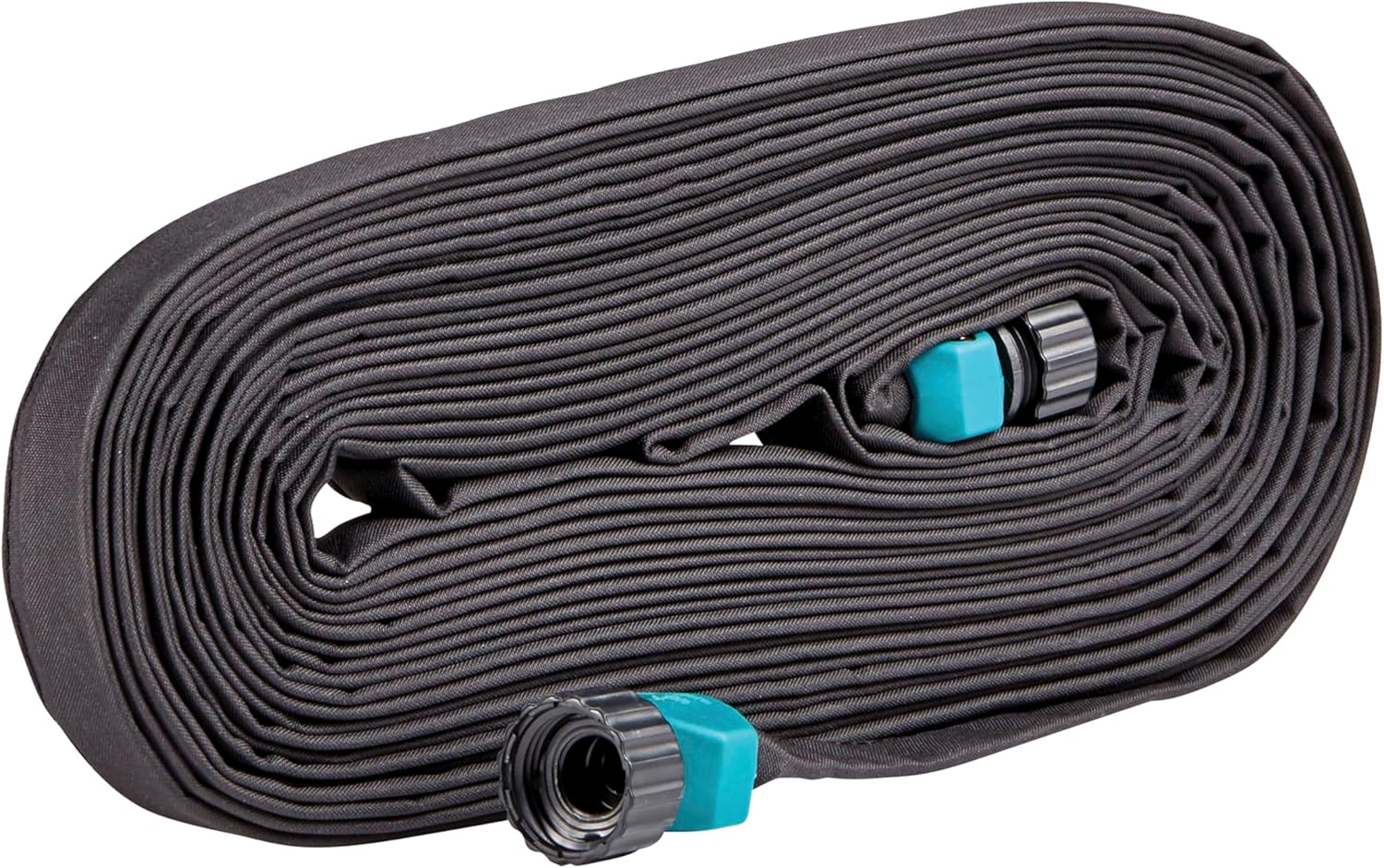
The Gilmour 50' Flat Weeper Soaker Hose is a lightweight, vinyl soaker hose that waters plants by seeping moisture through a fabric jacket directly into the soil. It is typically laid along planting rows or buried shallowly under mulch so water reaches roots without wetting foliage or pathways. Notable features include a clog-resistant fabric cover and a flat profile that makes rolling and winter storage simple. Being made from 100% recycled vinyl and described as UV resistant, it is intended for repeated seasonal use and can be linked to additional hoses to create a longer DIY drip system. Practical benefits are water savings from targeted delivery and easier placement in narrow beds where sprinklers would waste water. Limitations to expect are the usual for vinyl soaker hoses: it is not intended for high-pressure use and can be punctured by sharp tools or heavy foot traffic, and performance depends on even water pressure along the length so very long runs may deliver uneven soaking without splitters or a faucet regulator.
Best for: Gardeners who prioritize reliable, water-efficient irrigation for beds and vegetable rows and who prefer a simple, low-tech solution that is easy to install and store.
Less Ideal for: People who need high-pressure irrigation, frequent heavy-duty use, or a permanent buried drip system should consider reinforced or commercial-grade drip tubing instead.
- Delivers water directly to roots through a fabric jacket for efficient, low-waste watering
- Clog-resistant fabric cover helps maintain consistent seepage over time
- Flat, flexible design rolls up for compact, easy seasonal storage
- Made from recycled vinyl and marketed as UV resistant for seasonal durability
- Not designed for high-pressure applications and can give uneven watering on very long runs
- Vinyl construction can be damaged by sharp objects or heavy foot traffic
Verdict: A straightforward, water-saving soaker hose that makes efficient root watering and seasonal storage easy for home garden beds.
Rocky Mountain Goods Round Rubber Soaker Hose, 25 ft

| Material Type | Rubber |
|---|---|
| Item Length | 25 feet |
| Outside Diameter | 0.63 inches |
| Manufacturer Warranty Description | 7 Year Warranty |
The Rocky Mountain Goods 25-foot rubber soaker hose is designed to provide slow, consistent watering directly to plant roots, which makes it well suited for raised beds and densely planted flower or vegetable rows. It uses thousands of tiny pores to release water evenly along its length, reducing surface evaporation and runoff and helping maintain steady soil moisture without spraying foliage. The rubber construction is flexible and lightweight enough to weave between plants and tuck under mulch, yet robust compared with thinner vinyl soakers. Included reinforced fittings and an end cap let you connect multiple sections or seal the line for perimeter runs. Because it is porous, pressure regulation and periodic flushing are needed to prevent clogging in hard-water areas, and the fixed 25-foot length means you may need connectors for longer runs. For gardeners who prefer straightforward, low-tech irrigation for raised beds, this hose delivers reliable, water-saving performance season after season.
Best for: Gardeners who want a dependable, low-maintenance irrigation option for raised beds and densely planted vegetable or flower rows and prefer predictable, gentle root-zone watering.
Less Ideal for: Those who need adjustable spray patterns, very long continuous runs without connectors, or a fully automated drip system with emitters and pressure compensation.
- Porous design delivers slow, even water directly to roots, reducing evaporation
- Rubber construction is flexible and more durable than thin vinyl soaker hoses
- Lightweight and easy to position under mulch or around plants in raised beds
- Reinforced fittings and end cap allow connection of multiple lengths
- Pores can clog over time, especially with hard water, requiring occasional flushing
- Fixed 25-foot length may require additional connectors for larger raised beds
Verdict: A durable rubber soaker hose that provides dependable, water-efficient root-zone irrigation ideal for raised beds.
Choosing the Right Soaker Hose for Raised Beds: Key Factors to Consider
Soak Rate and Flow Uniformity
How quickly water releases through the hose and how evenly that water is distributed along the bed determine plant health. In raised beds, fast output can wash soil and expose roots, while slow, steady seepage encourages deep rooting and reduces runoff. Consider the hose pore size or emitter spacing and look for products that specify gallons per hour or feet-per-pressure metrics when available.
Flow uniformity also affects how long you must run the water. A hose that delivers consistent output from end to end reduces the need for moving or overlapping runs, which simplifies irrigation scheduling and helps prevent overwatering at the faucet end.
Material and UV Resistance
Hose material affects longevity and how it weathers being placed on soil, tucked around plants, or stored between seasons. Reinforced rubber or durable polymer blends resist cuts from trowels and abrasion when moved during bed maintenance. UV-stabilized materials resist brittleness and cracking when the bed is in full sun.
Longevity matters because replacing hoses inside planted beds disturbs established roots and can be time-consuming. Choose hoses with a reputation or stated construction that balances flexibility with puncture resistance.
Clog Resistance and Maintenance
Soaker hoses draw from household water supplies that often contain mineral deposits or particulate matter. Hoses with larger internal passages, screen filters at connectors, or emitter designs less prone to mineral buildup will need less maintenance. Consider how easy the hose is to flush or disconnect for cleaning.
If you use untreated water sources like rain barrels, factor in pre-filtration or a mesh screen to protect the hose. Regular seasonal flushing is still a practical upkeep step even with hoses designed to resist clogging.
Ease of Installation and Connector Compatibility
Raised beds are narrow and sometimes arranged in long runs or blocks. Hoses that are easy to trim, bend, and connect reduce installation time. Standard threading or simple barb fittings let you attach to timers, splitters, or soaker-specific adapters without extra converters.
Look for hoses that accept common garden connectors and that can be joined reliably if you need longer reaches. A hose that kinks easily or resists tight curves will be harder to lay neatly along bed edges and around supports.
Flexibility and Shape Retention
A hose needs enough flexibility to follow bed contours, loop around trellises, and be coiled for offseason storage. At the same time, it should retain shape so emitters do not twist inward and block flow. Thicker-walled hoses can resist flattening under soil or mulch, while very soft hoses may kink and create dry spots.
Balance flexibility with enough body so the hose sits where you position it. Consider whether you prefer hoses that sit on top of the soil surface under mulch, or those that can be buried slightly for stealth and evaporation control.
Operating Pressure and Water Source Compatibility
Raised beds are often watered from low-pressure sources like rain barrels, gravity-fed tanks, or household spigots at modest pressure. Check the hose's recommended pressure range to ensure it performs at the output you have available. Some soaker hoses require higher pressure to distribute water evenly, which makes them a poor match for gravity systems.
Also consider whether you plan to use a timer, splitter, or pump. Hoses that deliver predictable output across a range of pressures are more versatile and easier to schedule for consistent soil moisture.
Layout Tips for Narrow and Small Beds
Plan the hose run to follow the bed rows so every plant receives similar wetting. For narrow raised beds, a single central run can be enough if plants are densely spaced, while beds with multiple crop rows often benefit from two parallel runs a few inches apart to reduce dry bands.
- Leave a small gap between the hose and plant crowns to prevent constant wet foliage contact.
- Use U-shaped stakes or landscape staples every 2 to 3 feet to hold the hose in place and prevent displacement when mulching or harvesting.
- Trim hose ends cleanly and cap or tie to prevent soil intrusion.
Installing Under Mulch or On The Surface
Soaker hoses can be laid on top of the soil and covered with mulch to reduce evaporation, or slightly buried for a cleaner look. Covering the hose with 1 to 2 inches of mulch improves efficiency and hides the hose while still allowing water to seep to roots. Avoid burying too deep because heavy soil contact may increase clogging risk over time.
- Use organic mulch like straw or shredded bark to help retain moisture and prevent hose exposure.
- Avoid placing the hose directly under heavy rock or paver edges that can crush it.
Adapting Soaker Hoses To Irregular Bed Shapes
Raised beds are rarely perfect rectangles. Flexible soaker hoses let you trace curves and fit into corner pockets. For very tight turns, use short connector pieces or small-radius loops rather than forcing the hose into an acute bend that can collapse its lumen and block flow.
- When joining two pieces, create a small overlap and secure with a barbed connector plus a hose clamp for a leak-free joint.
- Test runs of five to ten minutes reveal obvious low-flow spots before plants are stressed.
Winter Care and Offseason Storage
Drain hoses after the growing season and coil them loosely for storage to prevent kinks and freeze damage. If you live where ground freezes, remove hoses from beds or ensure they are fully drained and insulated to avoid rupture. A dry, shaded storage spot extends material life.
- Label hose lengths or keep remnants for quick repairs the next season.
- Inspect for small pinholes or brittle sections during storage and repair with short replacement pieces.
Using Timers, Splitters, and Low-Pressure Sources
Pair soaker hoses with a simple battery timer for consistent scheduling. If you have multiple beds, use a splitter or manifold at the spigot to serve several hoses, but avoid over-pressurizing small-diameter soaker lines. For rain barrels and gravity feeds, choose hoses rated to operate well at low pressure and test output before planting.
- Run each new hose install with a pressure gauge or short timed test to establish run times.
- If output is low at the far end, consider adding a second parallel hose or relocating the water source to centralize pressure.
How We Chose the Best Soaker Hose for Raised Beds
We selected these seven soaker hoses by applying practical garden-focused filters that matter in raised-bed use. First, we prioritized flow consistency along 2 to 10 foot bed lengths because uneven output leads to dry spots or runoff in shallow raised beds. Second, we evaluated hose material and construction for puncture resistance and UV tolerance to survive soil contact, repeated handling, and seasonal sun exposure. Third, we looked at connector compatibility and ease of customizing lengths and fittings so a hose can be trimmed, joined, or fed from a common spigot without complex adapters. Fourth, we considered internal pore and emitter design that determines soak rate and helps prevent clogging from hard water or particulates. Fifth, we considered recommended operating pressure and whether the hose performs well at low-pressure gravity or rain barrel setups common in small-scale raised beds. We excluded products intended primarily for large landscape drip systems, micro-spray tapes, or hoses that require specialty emitters not easily adapted to raised beds. We also excluded items with no clear durability specs or limited compatibility with standard garden spigots and fittings. The result is a practical shortlist focused on steady delivery, longevity, and easy installation for raised-bed gardens.
FAQ
How long should a soaker hose run be for a raised bed?
Runs of 2 to 10 feet are common in raised beds. Shorter runs maintain more even flow; very long single runs may show diminished output at the far end, so use parallel lines or splitters for longer beds.
Can I bury a soaker hose fully under soil?
You can bury a soaker hose slightly, but placing it just under mulch or 1 to 2 inches below the surface is usually best. Deeper burial increases the risk of clogging from soil and makes maintenance harder.
Will a soaker hose work with a rain barrel or low-pressure source?
Many hoses work at low pressure, but performance varies. Check the hose's recommended pressure range and run a short test with your water source to confirm even output before planting.
How do I prevent soaker hoses from clogging?
Use a fine mesh filter or screen at the water source, flush the hose periodically, and avoid using untreated water with heavy sediment. Choosing hoses with larger internal passages or clog-resistant emitter designs also helps.
How often should I water raised beds with a soaker hose?
Frequency depends on soil type, weather, and crops. A common approach is short, regular runs that keep the top several inches consistently moist, adjusting timing during hot spells or rainy periods.
Final Verdict
For raised beds, prioritize steady flow and practical durability. Focus on hoses that deliver even seepage at the pressure you have available, resist punctures and UV damage, and work with standard connectors so installation is straightforward. Tradeoffs are inevitable: softer hoses are easier to shape but may kink, while heavier hoses last longer but can be harder to store. Match the hose pore design, material, and compatibility to your water source and bed layout to get reliable, low-effort watering season after season.
