

Note: This article contains affiliate links. If you click on these links and make a purchase, I may earn a small commission at no extra cost to you. This helps support my research and content. Read my full affiliate disclosure here.
If you grow shrubs in beds, borders, or foundation plantings, a dedicated soaker hose can simplify watering while targeting roots and reducing run-off. The right soaker hose for shrubs delivers steady, low-pressure seepage that soaks root zones deeply without wetting foliage or compacting soil. This guide covers the top seven options for shrub watering, shortlisted for real garden use. We evaluate durability, flow control, emitter consistency, and ease of installation so you can pick a hose that fits your shrub spacing and seasonal routine. Read on for practical setup tips and what to expect from different construction types.
Top Picks at a Glance
| Best Overall The best all-around choice for most situations | Hourleey Flat Soaker Hose 100 ft – Linkable Dual-Layer Drip Hose |  |
| Best Quality Built to a higher standard if you want something more solid | Araiozora 100 ft 1/2" Soaker Hose Kit with Solid Brass Connectors |  |
| Best Value The sweet spot between price and what you get | Suneed Flat Soaker Hose 25 ft (4-Pack) |  |
| Best Budget The cheapest option that still gets the job done reliably | LINEX Garden Flat Soaker Hose, 1/2" x 25 ft |  |
| Highest Rated A top-rated pick with lots of positive feedback | MHMHM 5/8" Soaker Hose for Garden Irrigation with Solid Brass Fittings, 50 ft |  |
| Most Popular A crowd favorite that many people choose with confidence | Gilmour 50' Flat Weeper Soaker Hose |  |
| Best Seller A high-volume bestseller chosen again and again | MIXC Thickened Flat Soaker Hose — 200 ft with Brass/Copper Connectors |  |
Hourleey Flat Soaker Hose 100 ft – Linkable Dual-Layer Drip Hose

| Material Type | Nylon |
|---|---|
| Item Length | 100 feet |
| Maximum Pressure | 150 psi |
| Included Components | Soaker Hose, Stake |
The Hourleey Flat Soaker Hose is a 100 foot, linkable drip hose intended for garden beds and landscaped rows where steady, low-volume watering is needed. It delivers water through evenly spaced holes along a dual-layer PVC and nylon construction so moisture soaks into the root zone instead of spraying the surface. Typical use is laying the hose along beds, staking it in place, connecting multiple lengths end-to-end, and running at the recommended working pressure for even output. Notable features include a kink-resistant flat profile that tucks under mulch, a fabric cover to resist clogging, and stakes for straightforward placement. Practical benefits are clear water savings when compared with open hoses and less hand-watering for seedlings and vegetables. Important limitations are that it is meant for cold water only and performs best within the suggested 60–80 PSI range; pressure outside that range can affect drip consistency. Also the flat profile may be harder to repair than standard round soaker hoses if punctured.
Best for: Gardeners who prioritize efficient, low-maintenance irrigation for beds or vegetable rows and want a product that can be extended and tucked under mulch for consistent root watering.
Less Ideal for: People who need a hose for frequent high-pressure or hot-water tasks or who prefer a round, easily repairable soaker hose for heavy-duty rough use.
- Delivers water directly to roots for efficient irrigation and reduced evaporation
- Linkable end-to-end design makes it easy to extend coverage across beds
- Dual-layer PVC and nylon construction offers kink resistance and durability
- Fabric-covered design helps reduce clogging and allows under-mulch placement
- Requires appropriate water pressure to maintain even drip performance
- Not rated for use with hot water
Verdict: Choose this hose if you want a water-saving, linkable soaker system that delivers steady root-zone irrigation across long garden beds.
Araiozora 100 ft 1/2" Soaker Hose Kit with Solid Brass Connectors

| Length | 100FT |
|---|---|
| Inner diameter | 1/2 Inch |
| Connector material | Solid Brass |
This Araiozora 100 ft 1/2" soaker hose kit is built for steady deep-root watering of shrubs and landscape beds. It releases water slowly along its length to target root zones, which reduces evaporation and keeps soil evenly moist without wetting foliage. The flexible hose is easy to snake around individual shrubs and through tight planting areas, and the heavy-duty solid brass connectors resist corrosion and create a reliable, leak-resistant connection to a standard faucet or inline hose. Stakes included in the kit help lock the hose in place along drip lines so it stays positioned at the root zone. Practical benefits for performance-minded gardeners are efficient water use, consistent watering for deeper root growth, and a durable connection that tolerates outdoor exposure. Limitations are that flow rate and soak pattern depend on water pressure and soil type so you may need to test layout and runtime to achieve uniform coverage, and a 1/2" diameter may deliver slower output than larger soaker lines for very large shrub beds.
Best for: Gardeners focused on efficient, performance-driven irrigation for shrub beds who want a durable soaker solution that delivers consistent root-zone moisture with minimal fuss.
Less Ideal for: Those needing high-volume coverage for extensive landscapes or commercial irrigation projects should consider larger-diameter drip or emitter systems instead.
- Slow, even water release targets root zones to promote deeper shrub root growth
- Solid brass connectors resist rust and form a secure, leak-resistant hookup
- Flexible hose profile makes it easy to route around individual plants and tight beds
- Included stakes help keep the hose positioned at the root line for consistent watering
- Soak distribution and flow depend on water pressure and soil conditions, requiring setup testing
- 1/2" diameter produces slower output than larger lines, so large areas may need longer run times
Verdict: Choose this hose when you want a durable, easy-to-place soaker line that delivers efficient, deep-root watering for shrubs and garden beds.
Suneed Flat Soaker Hose 25 ft (4-Pack)

| Material Type | Vinyl |
|---|---|
| Maximum Pressure | 60 psi |
| Item Length | 100 feet |
This Suneed flat soaker hose is built to provide slow, consistent watering by letting water seep along the hose length, which is useful for foundation plantings and narrow beds. Its flat, lightweight vinyl construction makes it easy to lay out along foundation lines and roll up for compact storage when not in use. The hose is described as tear resistant and rated for up to 60 psi, and the flat profile helps reduce trip hazards and keeps the hose tucked against a foundation or mulch. In practice it works best at low to moderate household water pressure where it evenly wets root zones and cuts evaporation compared with overhead watering. Limitations to note are that the material is vinyl rather than reinforced rubber, so it may be vulnerable to prolonged UV exposure or punctures in high-traffic areas, and hole spacing and flow rate are not adjustable so you may need to experiment with pressure or spacing for truly uniform coverage along long runs.
Best for: Homeowners who want a low-effort, water-efficient way to irrigate foundation plantings or narrow beds and prefer a product that is easy to install and store.
Less Ideal for: People needing a heavy-duty, puncture-resistant mainline hose for areas with frequent foot traffic or contractors who require adjustable flow control and commercial-grade durability.
- Flat profile stays close to soil and reduces tripping and visibility along foundations
- Delivers slow, even seepage to root zones which reduces evaporation and runoff
- Lightweight and easy to coil for compact storage
- Rated for up to 60 psi so it tolerates typical residential water pressure
- Vinyl construction may degrade faster than heavier reinforced hoses under long-term sun exposure
- Fixed seepage pattern cannot be tuned without adjusting water pressure or layout
Verdict: Choose this flat soaker hose when you want an easy-to-use, low-profile way to provide steady, water-saving irrigation for foundation beds.
LINEX Garden Flat Soaker Hose, 1/2" x 25 ft

| Material Type | Vinyl |
|---|---|
| Unit Count | 25 Feet |
| Maximum Pressure | 60 psi |
| Nominal Wall Thickness | 0.5 inch |
The LINEX 25 ft flat soaker hose is a simple, budget-friendly way to water beds and vegetable rows with low-pressure, consistent seepage. Lay it along planting rows, tuck it under mulch, or weave it through containers to deliver slow, even moisture directly to roots; the hose’s fabric construction and inner kink-resistant core let water seep along the entire length rather than spraying. It is lightweight and easy to move or roll up for storage, and the rated 60 psi maximum pressure and 1.8 gallons-per-minute seepage at about 50 psi mean it performs reliably for typical garden pressures. Because it is vinyl, the hose is affordable but less abrasion- and UV-resistant than premium rubber alternatives, so expect shorter lifespan if left exposed to intense sun or sharp edges. The hose is best for steady drip-style irrigation across flower beds, raised beds, and vegetable rows where water conservation and simple installation matter most.
Best for: Gardeners who want an inexpensive, easy-to-use drip watering solution for beds, containers, or raised rows and who prioritize water savings and simple setup.
Less Ideal for: Growers who need a heavy-duty, long-lived hose for exposed or high-traffic installations should consider more rugged rubber or reinforced options.
- Delivers slow, even seepage along the entire length for efficient root watering
- Lightweight and easy to position, roll up, and store
- Kink-resistant inner core supports consistent flow
- Designed to reduce water use compared with sprinklers
- Vinyl construction is less durable under prolonged sun exposure or abrasive conditions
- Not as puncture- or wear-resistant as heavier-duty rubber soaker hoses
Verdict: A cheap, easy-to-use soaker hose that delivers steady root-level watering and saves water for budget-focused gardeners.
MHMHM 5/8" Soaker Hose for Garden Irrigation with Solid Brass Fittings, 50 ft

| Material Type | Rubber |
|---|---|
| Outside Diameter | 0.63 inches |
| Unit Count | 50 Feet |
| Included Components | soaker hose |
This 50-foot MHMHM soaker hose is built for steady, low-pressure irrigation of shrubs, flower beds, and foundation planting. Made from recycled rubber and fitted with solid brass connectors, it lays along drip lines or looped around root zones to release water slowly and directly into the soil, cutting surface runoff and evaporation. The round 5/8-inch design resists kinking and can be arranged in straight runs or curves to follow shrub beds. The hose is rated to endure extreme temperatures from -40°F to 140°F, which helps it remain reliable through seasonal use. Practical benefits include simple installation with standard hose connections, water savings compared with sprinkler watering, and better root hydration for established shrubs. Limitations are that pressure regulation or an inline emitter is necessary for very long runs to keep even distribution, and the rubber construction is heavier than thin vinyl tubing which can make handling and storage a bit more cumbersome.
Best for: Gardeners who prioritize a durable, year-round watering solution for established shrubs and beds and want a low-maintenance system that delivers water directly to roots.
Less Ideal for: People who need a lightweight, highly portable temporary setup or those planning very long distributed irrigation runs without a pressure regulator should consider alternative tubing or drip systems.
- Solid brass fittings improve connection durability and reduce leak points
- Recycled rubber construction resists wear and extreme temperatures
- Slow seepage design delivers water directly to shrub root zones, reducing waste
- Round hose resists kinking and can be routed in curves around plantings
- May require pressure regulation for uniform output on longer runs
- Heavier rubber material makes handling and storage less convenient than lightweight tubing
Verdict: A sturdy, brass-fitted rubber soaker hose built for reliable, year-round root-level watering of shrubs and garden beds.
Gilmour 50' Flat Weeper Soaker Hose
| Material Type | Vinyl |
|---|---|
| Item Length | 50 feet |
| Nominal Wall Thickness | 0.0625 inches |
| Outside Diameter | 0.63 inches |
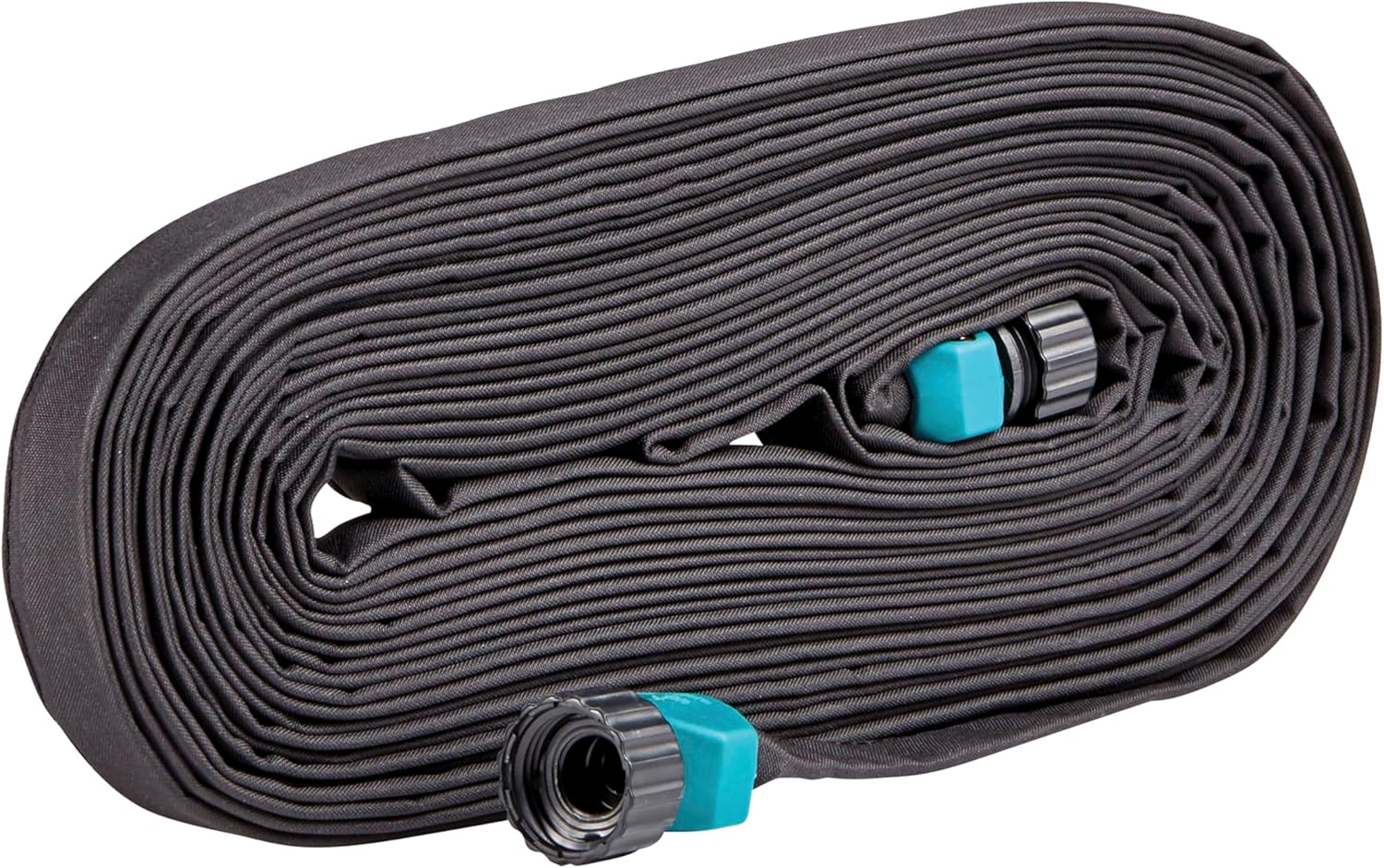
The Gilmour 50' Flat Weeper Soaker Hose is a lightweight, vinyl soaker hose that waters plants by seeping moisture through a fabric jacket directly into the soil. It is typically laid along planting rows or buried shallowly under mulch so water reaches roots without wetting foliage or pathways. Notable features include a clog-resistant fabric cover and a flat profile that makes rolling and winter storage simple. Being made from 100% recycled vinyl and described as UV resistant, it is intended for repeated seasonal use and can be linked to additional hoses to create a longer DIY drip system. Practical benefits are water savings from targeted delivery and easier placement in narrow beds where sprinklers would waste water. Limitations to expect are the usual for vinyl soaker hoses: it is not intended for high-pressure use and can be punctured by sharp tools or heavy foot traffic, and performance depends on even water pressure along the length so very long runs may deliver uneven soaking without splitters or a faucet regulator.
Best for: Gardeners who prioritize reliable, water-efficient irrigation for beds and vegetable rows and who prefer a simple, low-tech solution that is easy to install and store.
Less Ideal for: People who need high-pressure irrigation, frequent heavy-duty use, or a permanent buried drip system should consider reinforced or commercial-grade drip tubing instead.
- Delivers water directly to roots through a fabric jacket for efficient, low-waste watering
- Clog-resistant fabric cover helps maintain consistent seepage over time
- Flat, flexible design rolls up for compact, easy seasonal storage
- Made from recycled vinyl and marketed as UV resistant for seasonal durability
- Not designed for high-pressure applications and can give uneven watering on very long runs
- Vinyl construction can be damaged by sharp objects or heavy foot traffic
Verdict: A straightforward, water-saving soaker hose that makes efficient root watering and seasonal storage easy for home garden beds.
MIXC Thickened Flat Soaker Hose — 200 ft with Brass/Copper Connectors

| Item Length | 200 feet |
|---|---|
| Nominal Wall Thickness | 1 millimeters |
| Material Type | Brass, Polyvinyl Chloride (PVC) |
| Maximum Pressure | 50 psi |
This MIXC soaker hose is built for heavy garden use where durability and reliable seepage matter. It delivers slow, even irrigation through built-in pore holes while its 1 mm wall thickness and reinforced aluminum rings around the connector reduce punctures and connection leaks common to thinner hoses. Typical use is laying the flat hose along beds or under mulch and running water at moderated pressure so moisture seeps out evenly; the long swivel handle makes attaching and turning the hose easier without kinking. Practical benefits include resistance to sun damage and abrasion, sturdier metal joints that outlast plastic fittings, and compatibility with standard watering setups when pressure is kept within the recommended range. Limitations are that the manufacturer advises shorter runs for consistent flow so you may need multiple sections or a splitter for large areas, and performance depends on keeping pressure near the suggested 30–50 psi to avoid reduced flow at the far end or risk of burst under sustained high pressure. Installers should use the provided washers and consider a regulator for best results.
Best for: Gardeners who prioritize durable, maintenance‑free irrigation for vegetable beds and flower borders and want a soaker hose that stands up to rough use and sun exposure while providing steady seepage.
Less Ideal for: Those who need a single long uninterrupted run beyond 100–200 feet or have very high water pressure without a regulator should consider alternative drip systems or pressure-rated tubing.
- Thicker 1 mm wall resists punctures and UV degradation compared with thinner soaker hoses
- Metal (brass/copper) connector assemblies reduce leak-prone failures at joints
- Long swivel handle eases connection and prevents twisting or kinking during use
- Flat profile lays neatly along beds and under mulch for discreet, even watering
- Manufacturer recommends limiting continuous run length which may require extra hose or splitters for larger gardens
- Maximum recommended pressure (50 psi) means you should use a pressure regulator to avoid damage
Verdict: Choose this hose if you want a heavier‑duty soaker line with metal connectors that reduces leaks and holds up to sun and abrasion for reliable garden irrigation.
Choosing the Right Soaker Hose for Shrubs: Key Factors to Consider
Emitter Consistency and Line Uniformity
How evenly a soaker hose releases water along its length directly affects shrub health. Inconsistent emitters can overwater one section while leaving another dry, causing uneven root development and stress. For shrub beds you want a hose that delivers predictable seepage from end to end so you can space lines and bury or mulch over them with confidence.
Pay attention to stated emitter spacing and any manufacturer notes about start-up flushing. Lines that require high pressure to open or that have variable pore sizes are harder to calibrate for mixed shrub sizes. Consistent output reduces the need to adjust watering times frequently and makes it easier to pair the hose with a simple timer or manual routine.
Material Durability Against Sun and Soil Contact
Soaker hoses sit on or under mulch and endure UV exposure, abrasion from soil and mulch movement, and occasional foot traffic. A robust outer material resists cracking and pinholes that create leaky spots. Durability matters especially for perennial shrub plantings where replacing hoses each season is inconvenient.
Look for hose constructions that call out UV resistance, reinforced fibers, or multilayer builds. Thicker walls and abrasion resistance minimize accidental tears when planting or weeding. Even if a hose is rated for several seasons, consider how easy it is to patch small punctures without replacing the entire line.
Flow Control and Compatibility With Timers
Shrubs vary in water needs by species and season, so being able to control flow is valuable. Some hoses are easy to pair with inline valves, adjustable connectors, or simple shutoff clips that let you modulate seepage per zone. If you plan to use an automatic timer, ensure the hose performs well at the timer's pressure range and does not require hand cranking to get consistent output.
Flow control also affects how long you run the hose. A line that drips slowly may need long run times, while one with greater throughput can water more quickly but needs shorter cycles to avoid saturation. Assess whether you will split runs or use multiple short runs for different shrub groups to tailor flow across a planting.
Ease of Installation and Layout Flexibility
Installing soaker hose for shrubs should be straightforward: laying lines, cutting to fit corners, and connecting to a faucet or splitters. Hoses that are easy to bend around root balls, compatible with standard barbed fittings, and simple to splice save time and minimize trenching. Flexibility matters when you retrofit into existing beds or work around irrigation heads.
Consider whether the hose can be buried a few inches under mulch without crushing the pores and whether it holds its shape when turned around plant stems. Quick-connect fittings or readily available connectors make expansion or reconfiguration simpler for seasonal changes.
Resistance to Clogging and Maintainability
Mineral deposits and organic matter can clog tiny pores over time, reducing output and causing uneven watering. Hoses that tolerate periodic flushing or are designed with larger, well-distributed pores are easier to maintain. For gardeners with hard water, the ability to remove and soak lines or run clear water at higher pressure to flush deposits is important.
Maintainability also includes how easy it is to repair small leaks and whether replacement fittings are standard. A hose that can be snipped and rejoined without specialty tools keeps upkeep simple and extends useful life.
Storage, Winter Care, and Longevity
Seasonal climates require winterizing soaker hoses to prevent freeze damage. Hoses that are lightweight enough to drain and coil easily reduce the risk of cracking during cold months. Longevity depends on materials and how the hose stands up to repeated coiling and uncoiling each season.
Think about where you will store lines and whether you have space to keep them off the ground. Hoses that resist kinking and retain flexibility after cold storage are less likely to develop stress points that leak in the next season.
Planting Layouts and Hose Placement for Shrub Beds
Place soaker lines to match the shrub root spread rather than the canopy dripline. For newly planted shrubs, run the hose close to the root ball so new roots receive moisture. For established shrubs with wider root zones, layout parallel lines or a single loop around the root zone to encourage deeper, outward root growth.
Buried a few inches beneath mulch, a soaker hose reduces surface evaporation and keeps water concentrated where roots can access it. Avoid running lines directly against trunks or stems; allow a small gap to prevent excess moisture on bark that can invite disease.
- Use short runs for irregularly spaced shrubs to maintain even pressure.
- Loop or serpent lines around larger shrubs rather than crossing stems.
- Label or map underground runs to avoid accidental damage during future planting.
Timing and Scheduling for Shrub Watering
Soaker hoses are best run slowly and long enough to allow deep infiltration. For many shrub types, early morning runs once or twice a week during dry periods encourage deep root activity. Adjust frequency based on soil type: sandy soils need shorter, more frequent runs; clay soils need longer, less frequent irrigation to avoid surface ponding.
If you use a timer, program runs when evaporation is low and when the soil can absorb water-typically early morning. Check soil moisture at root depth rather than surface wetness to assess whether schedules need tweaking.
- Test-run new installations and monitor for pooling or dry spots.
- Increase frequency for newly installed shrubs until they establish robust roots.
- Reduce runs during rainy periods and in cool seasons to prevent overwatering.
Repair and Winterizing Tips
Small punctures are common in garden beds. Keep basic repair materials on hand so you can patch holes or replace short segments without redoing an entire line. Many repairs work with standard barbed couplers and clamps that compress the cut ends together.
Before the first frost, drain lines by elevating an end and letting water run clear. Coil hoses loosely and store in a dry, sheltered spot to prevent UV and freeze damage. Avoid sharp bends during storage that can set permanent kinks.
- Flush the line before storing to clear sediment.
- Inspect connections and clamps each spring for wear.
- Replace small damaged lengths rather than discarding whole runs.
Pairing Soaker Hoses With Mulch and Soil Types
Mulch improves moisture retention and hides soaker lines, but the mulch depth and type affect seepage. Coarser mulches allow faster surface drying; place the hose slightly deeper under thicker mulch to keep moisture at root depth. Fine mulches can trap moisture near the surface, so monitor root wetness for signs of over-saturation.
Soil texture determines run time. Sandy soils will pass water quickly and need shorter, more frequent cycles. Heavy soils require slower, longer applications to let water move downward without pooling on top.
- Adjust hose placement when changing mulch or soil amendments.
- Re-check moisture after mulching to ensure the hose still reaches root zones.
- Use soil probes to evaluate moisture at the root zone rather than relying on surface wetness.
When to Use Multiple Lines or Split Zones
Large beds or mixed-species plantings often benefit from multiple soaker lines or split zones. This lets you tailor run times for drought-tolerant shrubs separately from thirstier specimens. Use simple splitters and individual valves to control runs without buying complex irrigation controllers.
Multiple shorter runs maintain better pressure and more uniform seepage. If a single long line shows variable output, divide it into two or more runs to equalize flow and make repair or reconfiguration easier.
- Group shrubs by water need and run separate lines for each group.
- Shorter lines help maintain consistent emitter output throughout the run.
- Plan valve placement for easy access and seasonal adjustments.
How We Chose the Best Soaker Hose for Shrubs
We focused on features that matter in shrub beds and foundation plantings rather than abstract ratings. Evaluation centered on emitter consistency, hose material durability, connection and layout flexibility, ease of seasonal storage, and the ability to regulate flow for mixed shrub sizes. We favored hoses that produce uniform seepage along a predictable length so root zones receive even moisture and plants avoid surface runoff. We filtered out options that lack adequate connection fittings for common spigots or cannot be cut and joined without special tools. Hoses designed only for decorative or single-season use were excluded. Final selections were based on published construction specs, user-install considerations for shrub rows, and typical homeowner irrigation setups. The criteria reflect what gardeners actually need: reliable seepage patterns, rugged materials for moving mulch and soil contact, simple flow adjustment, and hassle-free winter storage.
FAQ
Can I bury a soaker hose under mulch near shrubs?
Yes. Burying a soaker hose a few inches under mulch reduces evaporation and directs moisture to the root zone. Leave a small gap from stems to prevent prolonged wetness on trunks or crowns.
How long should I run a soaker hose for shrubs?
Run times depend on soil type and flow rate. Generally, long, slow runs work best: short cycles several times a week on sandy soil or longer, less frequent runs on clay. Check moisture at root depth to fine-tune timing.
Will a soaker hose clog with hard water?
Hard water can deposit minerals in tiny pores over time. Hoses with larger or well-distributed pores are easier to flush. Periodic flushing and occasional soaking in vinegar or running high-pressure water through the line can reduce buildup.
Can I attach a timer to a soaker hose?
Yes. Most soaker hoses work with basic mechanical or battery timers, but check that the timer operates within the pressure range your hose needs. Some hoses perform better at lower pressure, so test a timer-run to confirm uniform seepage.
How do I repair a puncture in a soaker hose?
Small punctures can be patched or the damaged segment cut out and rejoined with a barbed coupler and clamp. Keep spare connectors and clamps handy for quick fixes that avoid replacing long lengths.
Is a soaker hose suitable for newly planted shrubs?
Soaker hoses are effective for new plantings when placed close to the root ball to encourage establishment. Use shorter runs and slightly more frequent watering until roots spread outward.
Final Verdict
For shrub watering, prioritize consistent emitter output, durable materials, and simple flow control. Those factors determine how evenly water reaches root zones, how long lines last in contact with mulch and soil, and how easy the system is to adapt across seasons. Decide whether you need multiple short runs or a single longer loop based on shrub spacing and water needs. With attention to layout, timing, and winter storage, a good soaker hose for shrubs will reduce labor and give shrubs deeper, healthier root systems over time.
