

Note: This article contains affiliate links. If you click on these links and make a purchase, I may earn a small commission at no extra cost to you. This helps support my research and content. Read my full affiliate disclosure here.
Picking the right soil fertilizer for lawns makes a real difference in turf color, density, and resilience to drought and wear. The wrong formulation or application schedule can burn grass, waste effort, or fail to correct nutrient deficiencies. This guide covers seven top soil fertilizers for lawns shortlisted for common yard situations. We focus on how each option supplies nitrogen, phosphorus, and potassium, how long nutrients last in the soil, and how easy the product is to apply and maintain. Read on to match a fertilizer to your lawn type, season, and maintenance style.
Top Picks at a Glance
| Best Overall The best all-around choice for most situations | Scotts Turf Builder Lawn Food, 12.5 lb |  |
| Best Quality Built to a higher standard if you want something more solid | The Andersons Professional PGF Complete 16-4-8 Granular Lawn Fertilizer (covers 5,000 sq ft) |  |
| Best Value The sweet spot between price and what you get | Scotts Turf Builder Starter Food for New Grass, 15 lb |  |
| Best Budget The cheapest option that still gets the job done reliably | O.M. Scott & Sons Natural Grass Food, 12.72 lb |  |
| Highest Rated A top-rated pick with lots of positive feedback | Brut Worm Farms Organic Worm Castings, 30 lb |  |
| Most Popular A crowd favorite that many people choose with confidence | Scotts Turf Builder WinterGuard Fall Lawn Food, 10 lb. |  |
| Best Seller A high-volume bestseller chosen again and again | Scotts Turf Builder Lawn Food, 37.5 lb. |  |
Scotts Turf Builder Lawn Food, 12.5 lb

| Item Form | Powder |
|---|---|
| Specific Uses For Product | Lawn |
| Coverage | 5,000 sq. ft. |
| Mixing Ratio | 32:0:4 |
Scotts Turf Builder Lawn Food is a general-purpose granular fertilizer formulated for use on any grass type to thicken turf and improve root strength. You spread it with a broadcast or drop spreader (Scotts provides recommended settings) and can apply it to wet or dry lawns in spring, summer, or fall. The formula is pesticide-free and emphasizes building deeper roots so the lawn better absorbs water and nutrients, which helps turf resist stress over the season. One 12.5 lb bag covers about 5,000 sq. ft., making it a simple option for small to medium yards or spot treatments. Practical benefits include clear application guidance, compatibility with common spreaders, and the option to water in for faster greening. Limitations are that this single bag covers a modest area compared with larger homeowner bags and it does not include weed control or insect protection, so you may need additional products for comprehensive lawn care.
Best for: Buyers who want a reliable, easy-to-apply granular fertilizer to strengthen and green a small to medium lawn and prefer products with widespread user approval and clear instructions.
Less Ideal for: Homeowners needing one-step weed or pest control, or those with large properties who want a single bag to cover many thousands of square feet.
- Works on all common grass types so one product fits mixed lawns
- Builds stronger, deeper roots to improve water and nutrient uptake
- Clear spreader settings and can be applied to wet or dry turf for flexibility
- Pesticide-free formula suitable when you only want fertilization
- Covers only about 5,000 sq. ft. per bag, requiring multiple bags for larger yards
- Does not include weed or insect control so additional products may be needed
Verdict: A reliable, easy-to-use granular lawn food that builds stronger roots and is a solid choice for feeding small to medium lawns.
The Andersons Professional PGF Complete 16-4-8 Granular Lawn Fertilizer (covers 5,000 sq ft)

| Item Form | Granules |
|---|---|
| Specific Uses For Product | Soil Conditioning |
| Target Species | lawn grasses |
| Unit Count | 288 Ounce |
| Mixing Ratio | 4-1-2 ratio |
This granular fertilizer is built to boost turf performance with a 16-4-8 N-P-K ratio that delivers both immediate and extended nitrogen release for up to eight weeks. It is typically applied with a broadcast spreader at the recommended rate on dry foliage, then lightly watered to activate the Humic DG technology that helps nutrients move into the root zone. Notable features include super-fine particles for even coverage, added iron and micronutrients for richer color, and a mix of quick and slow-release nitrogen for steady growth without frequent reapplication. Practical benefits for a performance-focused buyer are visibly greener turf, reduced application frequency, and improved soil conditioning from humic acids. Important limitations are that it is a granular product so precise spreader calibration and steady walking are required for uniform results, and it is not labeled for sale in California which restricts availability in that state.
Best for: Gardeners focused on high-performance, visibly greener lawns who want a single application product that delivers both immediate and extended feeding and supports soil health.
Less Ideal for: Small container gardeners or people who prefer liquid or organic-only fertilizer programs should consider other formats or formulations.
- Balanced 16-4-8 N-P-K with both quick- and slow-release nitrogen for immediate color and sustained feeding
- Super-fine particles designed for even distribution across the lawn
- Includes iron and multiple micronutrients to improve turf color and overall plant nutrition
- Humic DG additive to help move nutrients into the soil and support soil conditioning
- Requires correct spreader settings and consistent walking speed to avoid streaking
- Not available for sale in California
Verdict: Choose this fertilizer when you want a performance-focused granular formula that delivers quick color boost plus up to eight weeks of sustained feeding for greener grass.
Scotts Turf Builder Starter Food for New Grass, 15 lb

| Item Form | Powder |
|---|---|
| Application Method | spreader |
| Specific Uses For Product | Starting |
| Coverage | 5000 square feet |
| Mixing Ratio | 24-25-4 |
Scotts Turf Builder Starter Food for New Grass is a powder starter fertilizer with a 24-25-4 NPK formulated specifically for new lawns. It is applied with a broadcast or drop spreader at planting and again 2 to 4 weeks later to encourage root development and faster, thicker turf. The high phosphate content is intended to fuel early root growth, which helps seedlings and newly laid sod establish more reliably than seed alone. Practical benefits include clear application guidance for Scotts spreaders, coverage of roughly 5,000 square feet per 15 lb bag, and compatibility with all grass types. Users should plan two timed applications and maintain consistent watering until seedlings are 2 inches tall, so it works best for owners willing to follow a short feeding schedule. Limitations are that it is a starter-only formula meant for initial establishment rather than ongoing maintenance and that proper spreader settings and watering are important for results, otherwise performance will be diminished.
Best for: Homeowners starting a lawn or reseeding patches who want a proven, easy-to-follow starter fertilizer to improve root establishment and germination success.
Less Ideal for: Gardeners looking for a year-round fertilizer or a combined weed-and-feed product should consider maintenance blends or targeted weed control options instead.
- High phosphate 24-25-4 formula designed to promote early root development
- Covers up to 5,000 sq. ft. per 15 lb bag, suitable for modest lawns
- Clear instructions for spreader settings and a recommended two-application schedule
- Safe for use on any grass type and applicable to seed, sod, plugs, or sprigs
- Starter-only formula so you must switch to a maintenance fertilizer after establishment
- Requires careful spreading and consistent watering to realize the claimed results
Verdict: Use this starter fertilizer if you want a straightforward, phosphate-rich feed to help new seed or sod establish stronger roots and fill in faster.
O.M. Scott & Sons Natural Grass Food, 12.72 lb

| Feeds up to | 10 weeks |
|---|---|
| Coverage | Up to 2,000 sq. ft. |
| Usage | Outdoor |
| Unit count | 203.52 Ounce |
O.M. Scott & Sons Natural Grass Food is a straightforward, natural lawn fertilizer meant for routine spring and seasonal feedings. You use it by filling a spreader, setting the dial per the bag directions, walking the lawn to apply, then lightly watering so the nutrients start working right away. The formula contains no added artificial ingredients or pesticides and is marketed as safe for people and pets when directions are followed. A single 12.72 lb. bag covers about 2,000 square feet and is formulated to feed for up to 10 weeks, so one bag can support a small-to-medium yard through the main growing season. The recyclable paper bag is a small eco-friendly plus. Limitations are its coverage and frequency: homeowners with larger lawns will need multiple bags and repeat applications every 8 to 10 weeks, and the product is not presented as a targeted solution for specific problems like weed control or soil pH correction. Still, for routine spring feeding on common grass types it delivers predictable, easy-to-follow results.
Best for: Homeowners who want a simple, natural spring feed for a small to medium lawn and prioritize easy application and pet-safe ingredients.
Less Ideal for: Those with large lawns, persistent weed issues, or who need specialty fertilizers for nutrient-deficient or pH-imbalanced soils should consider more targeted products.
- Natural formula without added artificial ingredients or pesticides
- Feeds immediately after watering and continues feeding up to 10 weeks
- Easy to apply with a standard spreader using bag dial settings
- Covers up to 2,000 sq ft per 12.72 lb. bag suitable for small to medium yards
- Recyclable paper packaging
- Limited coverage per bag so larger lawns require multiple purchases
- Not formulated to handle weeds or specific soil deficiencies
Verdict: A simple, pet-safe natural lawn food that makes spring feeding easy for small to medium yards.
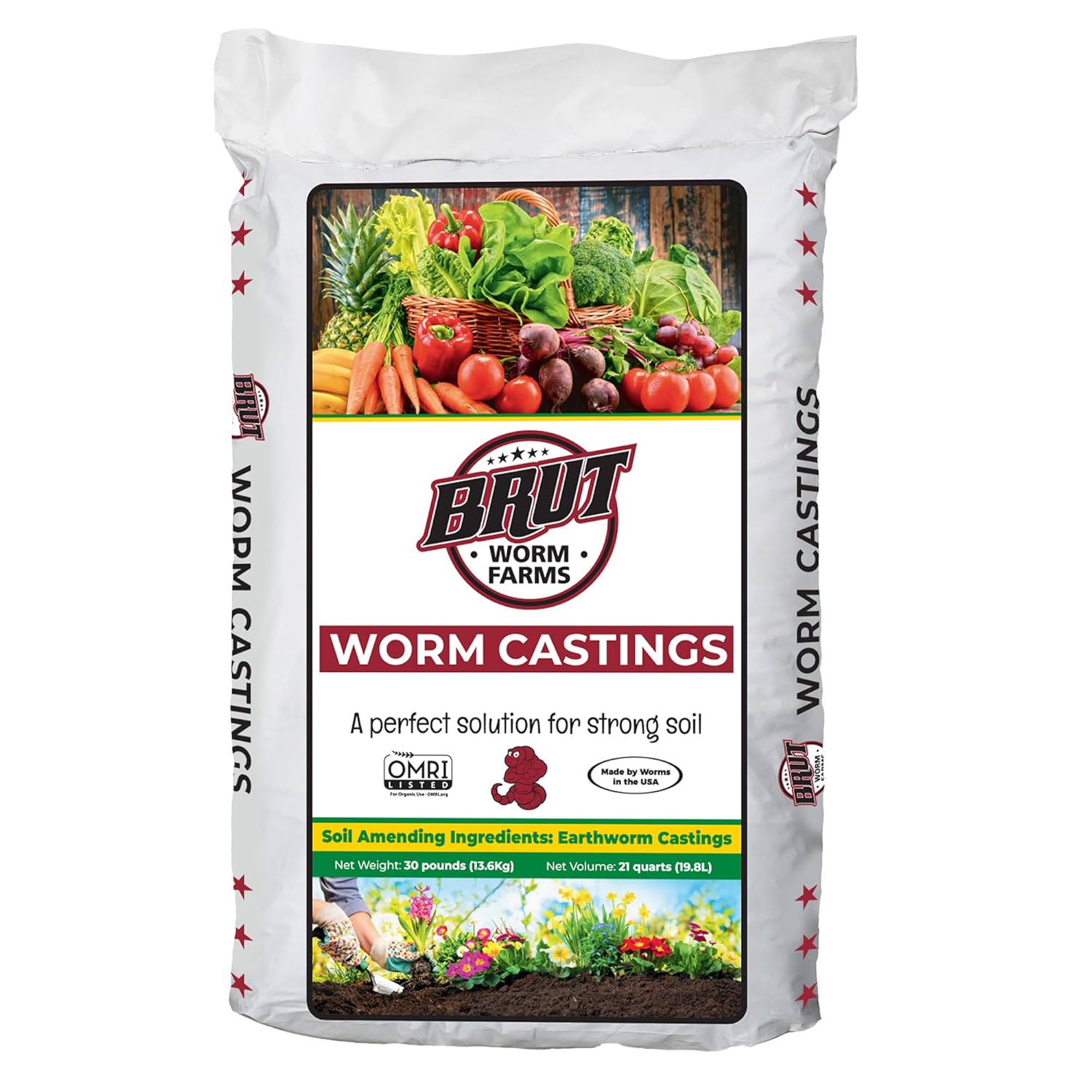
Brut Worm Farms Organic Worm Castings, 30 lb
| Item Form | bag |
|---|---|
| Specific Uses For Product | Gardening,Potting |
| Coverage | 30 |
| Target Species | houseplants, plants, shrubs, vegetables |
| Mixing Ratio | 1:5 |
Brut Worm Farms Organic Worm Castings are a ready-to-use soil amendment sold in a large 30 lb bag for gardeners who want to add nutrient-dense organic matter to potting mixes, containers, and garden beds. Use it as a top dressing, mix into potting soil at the recommended 1:5 ratio, or work a light amount into existing garden soil to improve aeration and water retention. The product is made from earthworm-processed organic material, so it delivers beneficial microbes and soluble nutrients without the risk of burning plants. Practical benefits include improved seedling vigor, healthier root development, and better moisture management in both indoor houseplants and outdoor vegetables or shrubs. Limitations are mostly logistical: a 30 lb bag is bulky to store and handle, and results are gradual since castings release nutrients slowly rather than providing a quick NPK spike. Also, users should follow handling guidance to avoid inhaling dust and keep the bag dry to preserve microbial life.
Best for: Gardeners seeking a reliable, organic soil amendment to steadily improve soil health and support a wide range of plants in containers and beds.
Less Ideal for: People who need a fast-acting chemical fertilizer for immediate greening or those who prefer small, easy-to-handle packages for occasional houseplant use.
- High in beneficial microbes and soluble nutrients that support root health
- Versatile application as a mix-in, top dressing, or soil amendment for indoor and outdoor plants
- Organic, slow-release nutrient profile that reduces risk of fertilizer burn
- Large 30 lb bag covers multiple containers or garden beds for season-long use
- Large bag can be heavy and awkward to move or store
- Nutrient delivery is gradual, so it is not a quick fix for severely deficient plants
Verdict: A large, organic worm-casting product that steadily builds healthier soil and stronger plants across indoor and outdoor gardens.
Scotts Turf Builder WinterGuard Fall Lawn Food, 10 lb.

| Item Form | Granules |
|---|---|
| Specific Uses For Product | Lawn Fertilizer |
| Application Method | spread |
| Coverage | 4000 |
| Target Species | lawn grasses |
Scotts Turf Builder WinterGuard is a granular fall lawn food designed to build strong, deep roots and help turf recover from summer heat, drought, and regular wear. It is applied with a broadcast or drop spreader over a lawn in autumn and can be used on any grass type. The bag covers about 4,000 sq. ft., and the package directions include recommended spreader settings and note that watering-in is optional for fast results. In practice this product provides a straightforward, DIY-friendly way to add nutrients before winter; the granules are easy to spread and work with standard spreaders. Notable features are its all-grass compatibility and clear application guidance. Limitations are that it is a single-season bag sized for small to medium yards and it does not include weed or insect control functions found in some other Scotts formulas, so you may need additional products if those issues are a concern. For homeowners wanting a simple autumn boost to root strength, this is an effective, no-frills option.
Best for: Homeowners who want a simple, reliable fall fertilizer to strengthen roots and help lawns recover from summer stress without complicated application steps.
Less Ideal for: People managing large lawns who need wide-coverage bulk fertilizer or those who want combined weed or insect control in the same product.
- Formulated specifically for fall to build deep, winter-ready roots
- Works on all grass types so it fits mixed lawns
- Clear application instructions and spreader settings for easy DIY use
- Covers 4,000 sq. ft. from a single 10 lb. bag for small to medium yards
- No built-in weed or insect control so additional products may be needed
- Single 10 lb. bag may be small for larger properties
Verdict: Choose this bag if you want an easy-to-apply fall fertilizer that strengthens roots and helps your lawn recover before winter.
Scotts Turf Builder Lawn Food, 37.5 lb.

| Item Form | Granules |
|---|---|
| Specific Uses For Product | Lawn |
| Coverage | 15000 |
| Mixing Ratio | 32:0:4 |
Scotts Turf Builder Lawn Food is a granular, all-purpose lawn fertilizer formulated to thicken and green lawns while building deeper roots. It is used by broadcasting with a spreader or dropping with a drop spreader; Scotts gives specific spreader settings for easy, repeatable application. The bag covers a large area so it is convenient for whole-yard spring feeding routines. Practical benefits include improved root strength and better nutrient and water uptake compared with unfed turf, plus flexible timing since it can be applied to wet or dry grass and lightly watered in for faster greening. The product is pesticide-free and intended for any grass type, so it can fit into a seasonal program for warm-season grasses like Zoysia. Limitations are that it is a straight lawn food without weed control or insect ingredients, so you will need separate products for weeds or pests, and handling a 37.5 lb bag can be bulky for small yards or single-application needs.
Best for: Homeowners who want a straightforward, high-coverage spring fertilizer to strengthen and green their Zoysia lawn as part of a planned feeding routine.
Less Ideal for: Gardners who need one-step weed and feed or combined pest control solutions or those with very small lawns who prefer smaller package sizes.
- Covers up to 15,000 sq. ft. from one 37.5 lb. bag
- Formulated to build stronger roots and improve nutrient uptake
- Can be applied to wet or dry lawns and used with common spreaders
- Pesticide-free lawn food suitable for any grass type
- Does not include weed or insect control so additional products may be required
- Large bag size may be awkward for small properties or single applications
Verdict: A simple, high-coverage lawn food that reliably builds root strength and greens Zoysia when used as part of a seasonal feeding plan.
Choosing the Right Soil Fertilizer for Lawns: Key Factors to Consider
Nutrient Ratio and NPK Balance
The ratio of nitrogen, phosphorus, and potassium directly affects what your lawn does after application. High nitrogen promotes rapid leaf growth and quick greening, while phosphorus helps root establishment and potassium supports stress tolerance. Choosing the right balance depends on soil test results, grass species, and the season.
A fertilizer with an appropriate NPK prevents waste and reduces the risk of overfeeding, which can burn grass or produce excessive top growth that invites disease. Look for clear guaranteed analysis and avoid products that hide exact nutrient percentages behind vague claims.
Release Profile and Longevity
Fertilizers come as quick-release, slow-release, or blended formulas. Quick-release feeds deliver immediate green-up but may require more frequent reapplications and can increase runoff risk. Slow-release formulations feed steadily over weeks or months, reducing labor and stabilizing growth.
Longevity affects scheduling and cost-per-season. For lawns where you want fewer passes, a reliable slow-release or controlled-release product is usually better. In spring when rapid greening is desired, mixing a small quick-release dose with a slow-release base can be effective.
Application Method and Ease of Use
How you apply fertilizer influences accuracy and lawn safety. Granular products are common for lawns and work with most broadcast or drop spreaders, but they require careful calibration to avoid streaking. Water-soluble or liquid soil feeds can be applied with hose-end sprayers or irrigation systems, offering even coverage but needing more frequent applications.
Consider packaging that reduces spills, clear mixing instructions, and whether measurements are easy to follow. A product that is confusing to apply is more likely to be misused, which reduces effectiveness and raises the chance of damage.
Compatibility With Lawn Type and Season
Cool-season grasses and warm-season grasses have different nutrient needs and growth cycles. Timing fertilizer to the grass calendar matters: cool-season lawns respond best to feeding in fall and spring, while warm-season lawns take up nutrients in late spring and summer.
Match the product to your grass species and seasonal plan. Some formulations are designed for spring green-up, others for fall rooting and winter hardiness. Using a seasonally inappropriate feed can cause unnecessary top growth or weak root systems.
Environmental Impact and Runoff Risk
Fertilizer applied improperly can run off into storm drains and nearby waterways, causing environmental harm. Products with low-solubility components or recommendations for buffer zones and irrigation timing reduce this risk.
Pay attention to local regulations and best practices like avoiding application before heavy rain, leaving untreated buffer strips near water, and following label guidance on maximum seasonal application rates. Environmentally sensitive choices help protect ponds, streams, and groundwater.
Soil Test Results and Adjustments
A simple soil test tells you which nutrients your lawn actually needs. Applying fertilizer without this information risks overuse of phosphorus or other nutrients that your soil already has in abundance.
Use test results to choose a product and to determine application rate. Adjustments based on pH, existing nutrient levels, and organic matter will lead to better long-term lawn health and reduce waste.
When to Feed Your Lawn
Timing fertilizer applications to your grass type and climate yields better green-up and root strength. For cool-season grasses, target early fall and a lighter tune-up in spring. Warm-season grasses benefit most from feeding in late spring through midsummer when they are actively growing.
Avoid fertilizing before heavy rain to reduce runoff. If you need quick green color for a short-term event, a small quick-release application will show results, but pair it with a slow-release product for sustained health.
- Feed cool-season turf mainly in fall and early spring.
- Feed warm-season turf during late spring and summer growth.
- Avoid applications immediately before forecasted heavy rain.
Calibrating Your Spreader
Accurate spreader calibration prevents streaks and patchy growth. Follow the application rate on the product label and test a small pass across a measured area to confirm coverage. Adjust settings and walk speed to match the recommended pounds per 1,000 square feet.
Mark off lanes and overlap slightly to avoid missed strips, and clean spreader parts after use to keep flow consistent. If you change brands or particle size, recalibrate before treating the whole lawn.
- Measure a test strip to confirm output.
- Match spreader settings to product particle size.
- Clean spreader components after each use.
Mending Thin Areas and Grubs
Thinner patches often indicate underlying issues such as compacted soil, pests, or nutrient imbalances rather than simply a lack of fertilizer. Address compaction with aeration, repair damaged turf by overseeding at the right time, and treat pest issues before relying on feeding alone.
Some fertilizers include modest amounts of micronutrients that help stressed turf recover, but feeding without fixing pests or soil structure will produce short-term results at best.
- Aerate compacted areas before fertilizing.
- Overseed bare spots with a compatible grass mix.
- Investigate pest or disease causes before repeated feeding.
Reducing Environmental Impact
Simple practices reduce runoff and nutrient loss. Apply during calm, dry weather and avoid overwatering immediately after spreading, unless the product requires light irrigation to move nutrients into the soil. Respect buffer zones around water features.
Choose slower-release formulas when runoff is a concern, and follow label limits for seasonal nitrogen to help protect waterways.
- Avoid application before heavy rain.
- Use slow-release products to lower runoff risk.
- Keep a buffer near ponds and streams.
How We Chose the Best Soil Fertilizer for Lawns
We shortlisted products that deliver predictable results in lawn settings rather than experimental or niche garden mixes. Selection began with formulations intended for turf use and products labeled for soil application. We prioritized nutrient balance and release profile because these determine immediate green-up and longer-term root development. Application method and spreader compatibility were included since a fertilizer that is hard to apply is unlikely to be used correctly. Residual effect and reapplication interval matter for maintenance planning and labor, so we favored products with clear release timing. We also considered physical form and handling safety for typical homeowners and landscapers, including dust, odor, and potential to stain. Environment and runoff risk influenced choices as well; products with recommendations to reduce nutrient loss scored higher. Exclusions included amendments intended only for potted plants, foliar sprays without soil feeding intent, and experimental blends without clear nutrient analysis. The resulting criteria reflect what actually matters to turf managers: nutrient ratios and release, ease of application, longevity, compatibility with common spreaders, and environmental guidance.
FAQ
How much fertilizer should I apply per 1,000 square feet?
Recommended rates vary with formulation and soil test results, but most labels give a pounds-per-1,000-square-foot guideline. Base your rate on your soil test and adjust frequency rather than exceeding a single-application limit.
Can I use a garden fertilizer on my lawn?
Garden or specialty plant fertilizers may have different NPK ratios and particle sizes, which can lead to uneven coverage or inappropriate nutrient balance. Use products formulated for turf for best results, or follow label guidance if you choose an alternative.
How soon will I see results after applying fertilizer?
Quick-release nitrogen can green turf within days, while slow-release products work over weeks. Visible improvement also depends on soil health, water, and temperature, so results vary.
Is it safe to fertilize during drought conditions?
Fertilizing during drought can stress grass if water is not available to support the growth stimulated by nutrients. Reduce rates or delay feeding until adequate moisture returns, and prioritize deep irrigation to support root recovery.
Do I need a soil test before fertilizing?
A soil test is highly recommended because it identifies specific deficiencies and prevents unnecessary or harmful applications. If you have not tested, choose a balanced product and use conservative rates until you can test.
Final Verdict
Choose a soil fertilizer for lawns by matching nutrient ratios and release profile to your grass type, season, and maintenance capacity. Prioritize products that are easy to apply accurately, compatible with your spreader, and clearly labeled for turf use. Balance the desire for quick green-up with the benefits of slow-release feeds and follow soil test recommendations to avoid overapplication. Final guidance: if you want fewer applications and steady growth, favor controlled-release formulas and plan seasonal feedings around your grass's peak growth windows. If rapid color is the goal, add a small quick-release dose but keep overall seasonal nutrient limits in mind.
