

Note: This article contains affiliate links. If you click on these links and make a purchase, I may earn a small commission at no extra cost to you. This helps support my research and content. Read my full affiliate disclosure here.
Picking the right soil for date palm planting matters more than many gardeners expect. Date palms prefer a mix that drains fast, resists compaction, and still supplies slow-release nutrients so roots can establish deep without sitting in water. Whether you are planting a young palm in a container or establishing a specimen in sandy yard soil, the wrong mix will stunt growth or invite root rot. This guide shortlists six top soil options suited for date palms and explains how each type behaves in a real garden setting. We evaluate mixes for drainage, nutrient retention, and ease of use so you can match a soil to your climate, container size, and watering habits.
Top Picks at a Glance
| Best Overall The best all-around choice for most situations | Espoma Organic Cactus Potting Soil Mix, 4 qt |  |
| Best Quality Built to a higher standard if you want something more solid | Espoma Organic Cactus Potting Soil Mix (4 qt, Pack of 2) |  |
| Best Value The sweet spot between price and what you get | Gardenera Palm Tree Potting Mix, 5 Quart Bag |  |
| Best Budget The cheapest option that still gets the job done reliably | Gardenera Palm Tree Potting Mix (1 Quart) |  |
| Highest Rated A top-rated pick with lots of positive feedback | E.B. Stone Organics Citrus & Palm Mix Potting Soil, 1.5 cu ft |  |
| Most Popular A crowd favorite that many people choose with confidence | Miracle-Gro Cactus, Palm & Citrus Potting Mix, 8 qt. |  |
Espoma Organic Cactus Potting Soil Mix, 4 qt

| Brand | Espoma |
|---|---|
| Volume | 4 quarts |
| Unit Count | 128 Ounce |
| Contains | Peat moss, humus, perlite, mycorrhizae |
Espoma Organic Cactus Potting Soil Mix is a lightweight, peat-based blend designed to improve drainage and root aeration for container plants. Typical uses include repotting succulents, cacti, and smaller container palms and citrus where fast drainage is important. The mix contains sphagnum peat moss, humus and perlite, plus a mycorrhizal inoculant to support root establishment. In practice this means soil that dries out more quickly than all-purpose mixes, reducing the risk of root rot in drought-tolerant species and helping young palms settle after repotting. Because it is organic and free of synthetic fertilizers, gardeners who prefer natural inputs can use it without adding immediate chemical feeds. Limitations are its small 4 quart volume and peat-heavy base, which may require mixing with coarser materials or regular feeding for larger palms or long-term container culture.
Best for: Buyers looking for an organic, fast-draining potting mix to repot succulents or small container palms and who prefer natural ingredients over synthetic additives.
Less Ideal for: Gardeners needing large volumes for big specimen palms or long-term container culture should choose a coarser, larger-volume mix or blend this with chunky amendments.
- Formulated for drainage and aeration with peat moss and perlite
- Includes mycorrhizae to encourage root growth and establishment
- Organic blend with no synthetic fertilizers or chemicals
- Suitable for repotting succulents, cacti and smaller container palms
- Small 4 quart bag may not be cost-effective for large pots or multiple palms
- Peat-heavy mix can compress over time and may need amendment for long-term container use
Verdict: A compact, organic, fast-draining mix that helps establish roots in succulents and small container palms when you need a natural potting medium.
Espoma Organic Cactus Potting Soil Mix (4 qt, Pack of 2)

| Number of Packs | 2 |
|---|---|
| Unit Count | 256 Ounce |
| Style Name | Peat Moss,Potting Soil |
| Volume | 4 quarts |
Espoma Organic Cactus Potting Soil is a ready-to-use mix designed to give container-grown succulents, cacti and citrus good drainage and root aeration. The blend of sphagnum peat moss, humus and perlite produces a lighter, faster-draining medium that helps prevent waterlogged roots and reduces the risk of root rot when repotting or planting in pots. It also contains Espoma’s Myco-tone mycorrhizal inoculant to support early root establishment. Typical uses are repotting small to medium citrus trees in containers, refreshing topsoil when plants become rootbound, or starting new container plantings where quick drainage is important. The 4 quart bags are convenient for spot re-potting but mean multiple bags are needed for larger pots. This is an organic, chemical-free mix well suited to gardeners who prioritize plant health and root performance, though heavy feeders or large citrus in very big containers may need additional fertility and more volume of soil than these two small bags provide.
Best for: Gardeners who want a performance-focused, ready-made organic mix to improve root health and drainage when potting citrus trees in containers.
Less Ideal for: Growers who need a high-volume base for very large pots or who prefer a long-term, moisture-retentive soil without periodic fertilization.
- Formulated for good aeration and drainage to reduce root rot risk in containers
- Contains sphagnum peat moss, humus and perlite for a light, well-draining texture
- Includes Myco-tone mycorrhizae to aid early root establishment
- Organic blend without synthetic chemical additives
- Small 4 quart bag size means multiple bags are required for larger citrus containers
- Peat-based mix holds less moisture than heavier soils so more frequent watering may be needed
Verdict: Choose this mix when you need a light, organic potting soil that prioritizes drainage and root establishment for potted citrus.
Gardenera Palm Tree Potting Mix, 5 Quart Bag

| Brand Name | Gardenera |
|---|---|
| Item Type Name | Palm Tree Potting Mix |
| Unit Count | 1 Count |
| Volume | 5 quarts |
This Gardenera Palm Tree Potting Mix is a ready-to-use blend aimed at potted and container palm varieties and similar tropical palms like date palms. The formulation pairs Canadian peat moss for organic matter with New Zealand bark for structure and Ukrainian perlite plus sand to improve drainage and aeration. In practice the mix makes repotting straightforward: loosen roots, place the palm in the new mix, and water to settle. The combination reduces the risk of waterlogging while still holding enough moisture for root uptake, which is useful for palms that need well-draining but not bone-dry media. Because it is sold in a 5 quart bag it is best for small to medium pots or for topping soil rather than full large-tree repots. The product notes standard safety precautions about dust and eye contact. If you want a palm-specific, hand-crafted potting media for potted date palms and similar species, this mix delivers good drainage and organic content in a small, convenient package.
Best for: Buyers who want a palm-specific, ready-to-use potting medium for potted or container date palms and prefer a small, convenient bag for repotting or refreshing soil.
Less Ideal for: Gardeners repotting large mature date palms or landscaping multiple trees should choose bulk or larger-volume soil options instead.
- Palm-focused formula combining peat moss, bark, perlite, and sand for balanced moisture and drainage
- Good aeration and structure from bark and perlite to help prevent root rot
- Suitable for both indoor and outdoor potted palms
- Small 5 quart bag is convenient for spot repotting or refreshing container soil
- 5 quart volume is limited for large date palms or full rootball repots
- Contains peat which can compress over time and may require periodic refresh or amendment
Verdict: A convenient palm-specific potting mix that gives potted date palms balanced drainage and organic matter for healthy root growth.
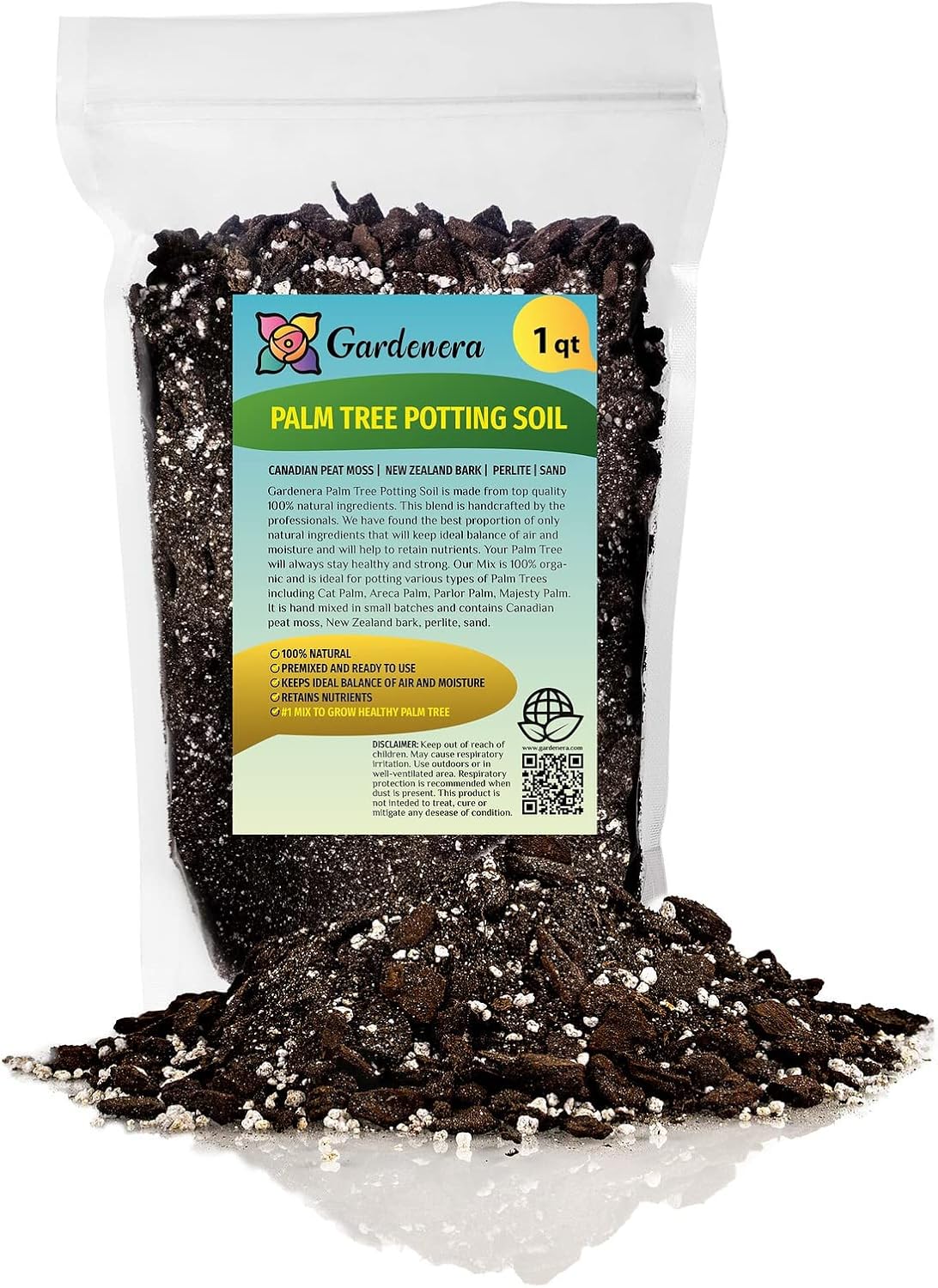
Gardenera Palm Tree Potting Mix (1 Quart)
| Unit Count | 1 Count |
|---|---|
| Item Type Name | Palm Tree Potting Mix |
| Volume | 1 quarts |
| Brand Name | Gardenera |
This Gardenera Palm Tree Potting Mix is a ready-to-use blend formulated for palm trees, combining Canadian peat moss, New Zealand bark, Ukrainian perlite, and sand to give a balance of moisture retention and drainage. It is typically used when repotting indoor or container palms or refreshing potting media for established potted specimens. The peat and bark add organic matter and structure while the perlite and sand increase aeration and reduce the risk of waterlogging. In practice this mix makes repotting straightforward: loosen roots, fill the new container, position the palm at the right height, and water to settle the soil. Because the bag is only 1 quart, it is best for single small pots, seedlings, or as a topdressing rather than filling large containers. The product notes safety precautions for handling dusty components, so wear a mask and gloves when working with it. If you want a palm-tailored, easy-to-use small bag for potting or small refreshes, this mix covers the bases; for larger jobs you will need multiple bags or a larger size option.
Best for: Buyers who need a small, palm-focused potting mix for repotting seedlings, small potted palms, or for topping up containers and who prioritize a product designed for palm root health.
Less Ideal for: Gardeners needing to fill large containers, multiple palm pots, or outdoor planting holes should avoid this size and choose bulk or larger-volume mixes instead.
- Formulated specifically for palms with peat, bark, perlite, and sand for balanced moisture and drainage
- Good aeration that helps prevent root rot in container palms
- Ready-to-use mix simplifies repotting and small pot top-ups
- Very small 1 quart volume limits use to seedlings or small pots
- Contains dusty components requiring gloves and a mask during handling
Verdict: A compact, palm-tailored potting mix that makes small repots and top-ups simple and effective.
E.B. Stone Organics Citrus & Palm Mix Potting Soil, 1.5 cu ft

| Brand Name | E.B. Stone Organics |
|---|---|
| Unit Count | 1536 Ounce |
| Volume | 1.5 cubic feet |
| Style Name | Potting Soil |
E.B. Stone Organics Citrus & Palm Mix is a ready-to-use organic soil blend designed for container and in-ground planting of citrus, palms, avocados and tropical foliage. The mix pairs aged fir bark and pumice to keep the root zone well aerated and fast-draining so plants that dislike soggy feet avoid root rot, while added mycorrhizae improve nutrient and water uptake. It is intended to be used straight from the bag for potting or worked into beds when planting, which simplifies planting and repotting tasks. For gardeners seeking reliability, this blend delivers consistent structure and moisture retention without heavy amendments, and the organic base supports longer-term soil biology. Limitations are the single bag volume of 1.5 cubic feet, which means larger projects will require multiple bags and mixing on site, and it does not list N-P-K numbers or slow-release fertilizer content so supplemental feeding may be needed for heavy-feeding specimens.
Best for: Gardeners who prioritize reliable, low-maintenance potting media for citrus and tropical plants and want a ready-made organic blend that supports healthy roots.
Less Ideal for: People who need large volumes for landscaping projects or who prefer a potting mix with specified fertilizer content and tailored nutrient ratios.
- Formulated specifically for citrus, palms and tropicals to match their root needs.
- Aged fir bark and pumice provide good drainage and aeration to reduce risk of root rot.
- Contains beneficial mycorrhizae to enhance root nutrient and water uptake.
- Ready-to-use bag simplifies repotting or planting without on-site blending.
- Single bag is only 1.5 cubic feet so multiple bags are required for larger trees or beds.
- No detailed fertilizer analysis provided so additional feeding may be necessary for heavy feeders.
Verdict: Choose this mix when you want a consistent, ready-to-use organic soil that promotes healthy, well-aerated roots for citrus and tropical plants.
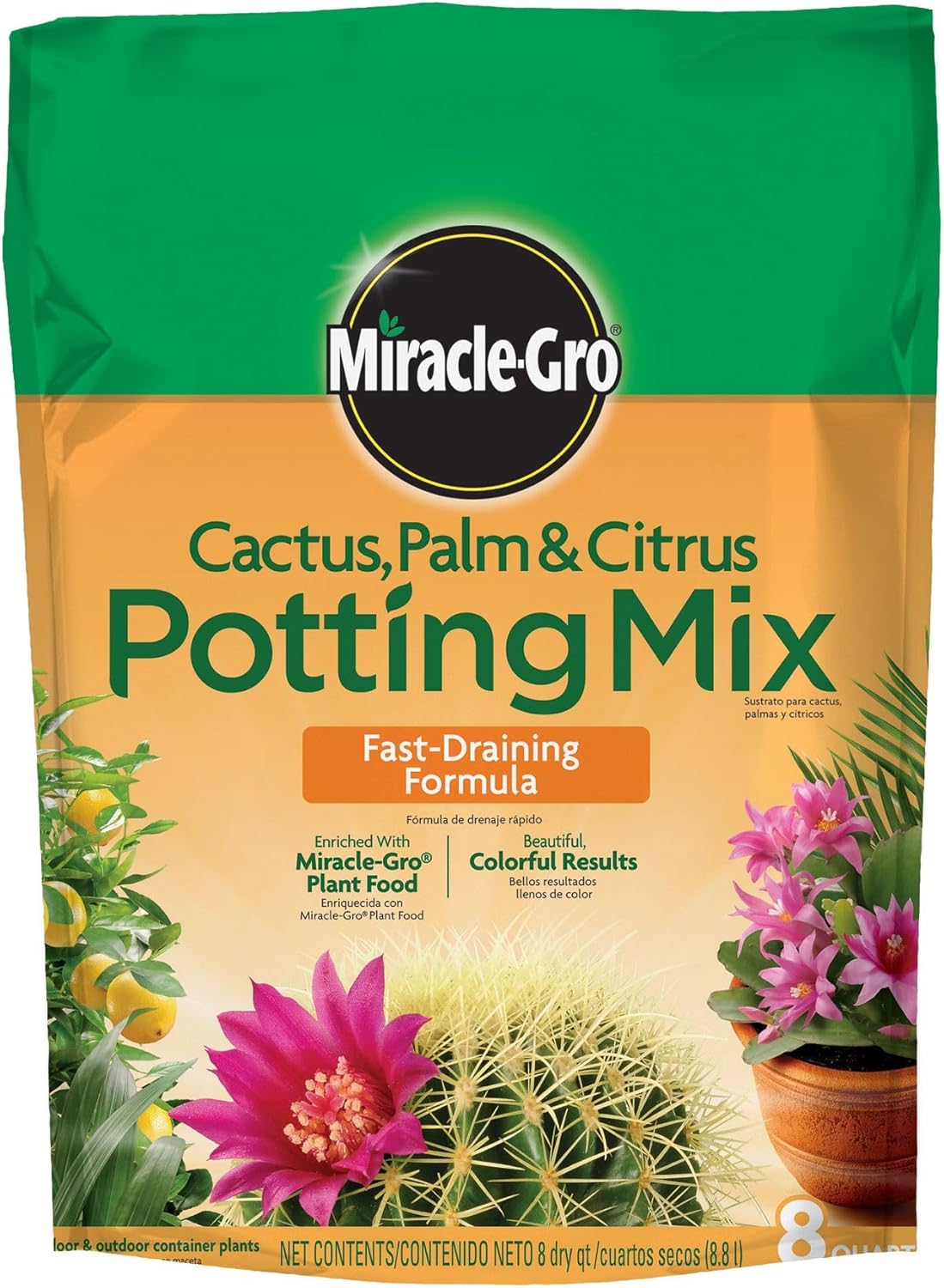
Miracle-Gro Cactus, Palm & Citrus Potting Mix, 8 qt.
| Brand Name | Miracle-Gro |
|---|---|
| Volume | 8 quarts |
| Unit Count | 1 Count |
This 8-quart Miracle-Gro potting mix is designed for container-grown cacti, palms, and citrus and combines peat moss, sand, perlite, and forest products for faster drainage and reduced compaction. It arrives ready to use and is enriched with Miracle-Gro plant food so newly potted citrus get an initial nutrient boost without immediate fertilizing. Typical use is straightforward: choose a pot with drainage, fill about one third, set the root ball and top up, then water and allow to drain. The formula helps soil dry between waterings, which is important for citrus root health in containers, and one bag is enough for two 8-inch pots. Limitations are the small volume for larger trees and the presence of peat moss if you prefer peat-free mixes; heavier or older citrus will need larger volumes and eventual repotting. For growers wanting a quick, reliable container medium that balances moisture retention with drainage, this mix performs as expected.
Best for: Growers who repot or maintain container citrus and want a ready-to-use mix that balances drainage and initial feeding for healthier root development.
Less Ideal for: Gardeners potting mature or large citrus specimens that need large volumes of soil or those seeking a peat-free or custom mineral-heavy citrus bonsai substrate.
- Fast-draining blend reduces risk of waterlogged roots for container citrus
- Pre-enriched with plant food to give newly potted plants an initial nutrient boost
- Contains perlite and sand to resist compaction and maintain aeration
- Formulated for indoor or outdoor containers so it works across sites
- 8-quart bag is small for larger or multiple citrus containers
- Contains peat moss which some buyers avoid for sustainability reasons
Verdict: A convenient, fast-draining, plant-food–enriched container mix that makes repotting small to medium citrus trees quick and reliable.
Choosing the Right Soil for Date Palm: Key Factors to Consider
Drainage and Aeration
Date palms need soil that moves water away from roots quickly while leaving air pockets intact. Poor drainage causes root rot and slow growth. Look for mixes with coarse components such as horticultural sand, pumice, or grit to break up fine particles and create stable pore space.
Aeration affects how easily roots explore the soil and access oxygen. Soils that compact with repeated watering will suffocate roots. For planting in pots or in-ground beds, choose media that maintain granular structure rather than collapsing into a dense mass.
Nutrient Retention and Feed Strategy
While drainage is critical, date palms still need a steady supply of macro- and micronutrients. A good soil balances drainage with materials that hold some nutrients, such as composted bark, coconut coir, or well-rotted compost. These components buffer fertilization, releasing nutrients slowly between feedings.
Decide whether you will rely on a slow-release fertilizer, liquid feedings, or annual topdressings. Soils with higher organic content store more nutrients but may require monitoring for salt buildup in arid regions.
Particle Size and Structure
Particle size determines how a mix behaves under watering and over time. Coarser particles create larger pores and better root penetration, while fine silt or clay fills pore space and increases compaction risk. For date palms, a blend that includes a range of particle sizes-coarse mineral grit, medium-sized organic pieces, and some fine component for water retention-gives balance.
Stable structure also means the soil resists breaking down season after season. Materials that decompose rapidly will change the mix characteristics and may require repotting or frequent amendment.
Salt and Alkalinity Management
Many date palms are grown in dry climates where irrigation water carries salts. Soil that accumulates salts will burn fine roots and reduce uptake of nutrients. Choose media with low soluble salt content and good leaching capacity so salts can be flushed through with occasional deep watering.
Pay attention to the soil's pH tendency. Date palms tolerate mildly alkaline conditions, but extreme alkalinity or acidity can limit nutrient availability. If your water is high in salts, plan a watering and leaching schedule to prevent buildup.
Container Versus In-Ground Use
Soil requirements shift when growing date palms in containers versus planting in the landscape. Containers need mixes that drain predictably and dry evenly to the pot edges, while in-ground soils can rely on native soil texture and require amendment primarily to improve drainage and structure.
For containers, choose lighter mixes with added grit or pumice and a proportion of moisture-holding organic material. For in-ground planting, improving a heavy bed often means adding coarse sand and organic matter to increase infiltration and create a root-friendly zone.
Longevity and Maintenance
Consider how long the soil will perform before you need to refresh it. Rapidly decomposing organics force more frequent repotting or topdressing. Durable mineral amendments like expanded clay, pumice, and coarse sand preserve structure for many years.
Also factor in ongoing maintenance: how often you will fertilize, flush salts, and repot young palms. A low-maintenance gardener may prefer a more inert, stable mix combined with scheduled fertilizer, while an active gardener can manage higher-organic mixes with regular topdressings.
Preparing a Planting Hole for Date Palms
When planting a date palm in the ground, do not simply drop the rootball into an unamended hole. Wider is better than deeper: dig a basin twice the width of the rootball to loosen surrounding native soil and allow roots to expand horizontally. If your native soil is clayey, mix coarse sand and grit into the backfill to create a transition layer that improves drainage.
Set the crown so the top of the rootball sits slightly above the finished grade. Backfill with your chosen soil blend, tamping lightly to remove large air pockets while preserving overall porosity. After planting, water deeply to settle the mix, then monitor for settling and add soil as needed.
- Aim for a wide, shallow planting basin rather than a narrow deep hole
- Amend heavy soils with coarse mineral material to improve drainage
- Avoid burying the trunk flare; keep it slightly exposed
Best Soil Components for Different Climates
In arid, hot climates prioritize drainage and salt leaching. Mixes with higher proportions of coarse sand, pumice, and gravel let water move through quickly and prevent evaporation from creating surface salt crusts. Include some stable organic matter for nutrient retention but avoid materials that hold excessive moisture.
In more humid or cooler climates, you can increase the organic fraction to help retain warmth and moisture. Use well-rotted compost or coarse bark to create a balance so that the soil still drains but does not stay saturated during prolonged wet periods.
- Arid climates: more mineral grit, less fine organic matter
- Humid climates: higher-quality compost or bark, but maintain coarse particles
- Mixed climates: aim for a middle ground with both drainage and moisture retention
Mixing Your Own Potting Medium
Mixing a custom medium gives control over drainage and nutrient behavior. A common starting point is one part coarse sand or grit, one part pumice or perlite, and one part high-quality compost or coconut coir. Adjust those proportions based on container size and local conditions.
For large containers, increase the coarse mineral fraction to improve long-term structure. For small pots, a slightly higher organic content helps retain moisture between waterings. Always wet-test a small batch: fill a pot, water thoroughly, and observe how quickly excess water drains.
- Start with 1:1:1 of coarse mineral:porous aggregate:organic material
- Use horticultural sand rather than builder's sand to avoid fines
- Pre-wet mixes to check drainage before planting
Watering and Leaching Practices
Healthy date palms need deep, infrequent waterings rather than daily surface wetting. Water until moisture reaches the deeper root zone, then allow the soil to dry slightly before the next irrigation. This encourages roots to grow deep and reduces surface salt accumulation.
Periodically leach containers and in-ground beds by applying extra water to flush salts from the root zone. In regions with saline irrigation, schedule leaching sessions more often and consider occasional use of fresh water if available.
- Water deeply and infrequently to encourage deep roots
- Leach salt-prone soils at intervals appropriate to water quality
- Adjust frequency seasonally as growth and evaporation rates change
Repotting and Refreshing Soil
Young palms in containers benefit from repotting every two to three years into a slightly larger pot to avoid root binding and replenish depleted nutrients. Mature palms in very large containers may only need surface topdressing and fertilizer additions.
When refreshing soil, remove the top third of the old medium and replace it with fresh mix rather than a full-rootball upheaval whenever possible. This preserves established roots while restoring structure and fertility.
- Repot juveniles every 2 to 3 years
- Topdress mature containers rather than complete soil replacement
- Check roots for circling or rot during any repotting
How We Chose the Best Soil for Date Palm
We assembled this list by applying practical, garden-focused filters that matter for date palms. First, drainage behavior was prioritized because these palms need air at the root zone; mixes that include coarse sands, grit, or pumice ranked higher. Second, nutrient retention and slow-release fertility were evaluated to ensure sustained growth without frequent feeding. Third, structure and resistance to compaction were considered so roots can penetrate and the soil stays workable over seasons. Fourth, salt tolerance and suitability for regions with saline irrigation were considered because many date palms are grown in arid zones. Finally, mix consistency and usability for both in-ground planting and container culture were weighed. We excluded blends formulated solely for acid-loving plants, heavy clay media, and mixes intended only for ephemeral annuals. Products that relied solely on peat without amendment were also filtered out because they compact too quickly for deep-rooting palms. The result reflects real-world performance factors gardeners can verify in the yard: drainage profile, particle size distribution, nutrient-holding components, salt management, and long-term structure.
FAQ
Can I use regular garden soil for a date palm in a container?
Regular garden soil is often too dense for containers and will compact, limiting oxygen to roots. It is better to use a well-draining potting mix amended with coarse sand or pumice for containers to maintain aeration and drainage.
How often should I fertilize a date palm grown in a pot?
Fertilizer frequency depends on the soil's organic content and the fertilizer type. In general, a slow-release formula or monthly balanced liquid feed during the growing season keeps palms vigorous. Monitor leaf color and growth to adjust frequency.
What is the ideal pH range for soil used with date palms?
Date palms tolerate a mildly alkaline to neutral pH range, commonly around 7.0 to 8.0. Extreme acidity or high alkalinity can reduce nutrient availability, so test soil if you notice deficiency symptoms.
How can I tell if my soil is holding too much salt?
Leaves may develop brown tips, margins, or stunted new growth when salts accumulate. A simple flush with extra water can help, and using a soil test or EC meter provides a clear measure of soluble salts for ongoing management.
Should I add compost to my date palm soil?
Compost adds nutrients and improves moisture-holding capacity, but use it in moderation. Too much compost increases water retention and can reduce drainage. Blend compost with coarse mineral additives to keep a balanced mix.
Is sand necessary in a date palm potting mix?
Coarse sand or grit improves drainage and prevents compaction, which is useful for palms. Avoid very fine sand that fills pore spaces. Use horticultural sand or grit combined with porous aggregates like pumice.
Final Verdict
Choose a soil that prioritizes drainage and stable structure while offering enough nutrient-holding capacity for steady growth. Balance coarse mineral components with a measured amount of organic matter so roots get oxygen, water moves through predictably, and nutrients remain available between feedings. Weigh tradeoffs based on whether you are planting in containers or in the landscape, and adjust mixes for local climate and water quality. Prioritize drainage, particle size, and salt management to make a confident choice for healthy date palms.
