

Note: This article contains affiliate links. If you click on these links and make a purchase, I may earn a small commission at no extra cost to you. This helps support my research and content. Read my full affiliate disclosure here.
Getting grass seed to sprout reliably starts with the soil you plant into. The right soil for grass seed germination improves contact with seeds, holds moisture without smothering young roots, and supplies starter nutrients that help seedlings push through the soil surface. This guide covers seven shortlisted soils chosen for common lawn situations, from patch repair to full reseeding. We evaluated each option for the characteristics that matter in a real yard: moisture retention, drainage, seed-soil contact, and nutrient availability. Read on to see practical notes that help you match soil choice to your planting method and site conditions.
Top Picks at a Glance
| Best Overall The best all-around choice for most situations | Scotts Turf Builder LawnSoil, 1 cu. ft. |  |
| Best Quality Built to a higher standard if you want something more solid | Old Potters Germination Mix (24 qt) — Peat Moss with Fine Perlite & Vermiculite |  |
| Best Value The sweet spot between price and what you get | SunGro Horticulture Organic Seedling Mix (8 Quart) |  |
| Best Budget The cheapest option that still gets the job done reliably | Back to the Roots 3-in-1 Seed Starting Mix, 6 Quart, Organic Peat-Free |  |
| Highest Rated A top-rated pick with lots of positive feedback | Premier Pro Mix BX with Mycorrhizae, 2.8 cu ft |  |
| Most Popular A crowd favorite that many people choose with confidence | Miracle-Gro Indoor Potting Mix for Seed Starting, 8 qt. (2-Pack) |  |
| Best Seller A high-volume bestseller chosen again and again | Back to the Roots Organic Expanding Coco Coir Potting Soil Brick (10 lb) |  |
Scotts Turf Builder LawnSoil, 1 cu. ft.

| Brand | Scotts |
|---|---|
| Volume | 1 cubic feet |
| Item Weight | 32.7 pounds |
Scotts Turf Builder LawnSoil is a ready-to-use topsoil blend formulated to help new grass establish faster and thicker. It combines premium soil ingredients with starter fertilizer so you can spread it over seed, sod or plugs to improve germination and early root growth. In practice it is easy to use: rake a thin layer over bare patches or rototill into the topsoil before overseeding, then water as directed. The product emphasizes moisture retention, which helps seedlings through dry periods, and the built-in nutrients remove the need to apply a separate starter feed right away. Limitations are its single-cubic-foot bag size, which means many bags are needed for larger yards, and it is a surface/establishment product rather than a long-term soil amendment for structural problems. Also follow the handling instructions for fertilizer-containing soils and use gloves when spreading.
Best for: Buyers who want a simple, low-risk way to thicken or repair a lawn with minimal extra products and hands-on soil mixing.
Less Ideal for: People managing large lawns who need bulk topsoil for wide coverage or gardeners needing to amend subsoil or resolve drainage and compaction problems.
- Contains starter fertilizer to support early root and shoot development
- Formulated to improve moisture retention for better seed germination
- Suitable for use with seed, sod and grass plugs
- Ready-to-use blend that removes the need for immediate separate fertilizing
- Sold in 1 cu ft bags which is inefficient for large-area projects
- Not designed to fix deep soil structure or drainage issues
Verdict: A convenient, fertilizer-enhanced topsoil ideal for homeowners who want an easy, reliable product to establish thicker grass in small to moderate lawn repairs.
Old Potters Germination Mix (24 qt) — Peat Moss with Fine Perlite & Vermiculite

| Volume | 24 quarts |
|---|---|
| Unit Count | 768 Fluid Ounces |
| pH range | 5.4 – 6.3 |
| Electrical conductivity | 1.0 – 1.5 mmhos/cm |
This germination mix is built for starting seeds and propagating cuttings with consistent results. Its formula is 80–90% finely milled Canadian sphagnum peat moss combined with fine horticultural perlite and vermiculite to provide a balance of moisture retention and aeration that promotes uniform root development. Calcitic and dolomitic limestone are added to hold the pH in the 5.4–6.3 range and a wetting agent helps the medium rehydrate evenly so you avoid dry pockets in small cells or trays. A mild starter nutrient charge and a modest EC (1.0–1.5 mmhos/cm) give seedlings a gentle early feed without burning young roots. The fine texture makes it well suited to both sub-irrigation and overhead watering systems and to use in seed flats, plug trays, and small pots. Be aware the mix is peat-based, so it will compress over time and may hold more water than soilless mixes with higher perlite content, requiring attention to drainage for long-term potting. For reliable, repeatable seed starts this is a practical, no-nonsense choice.
Best for: Gardeners who prioritize consistent, predictable seed starts and propagation results and want a ready-to-use medium that performs across trays and small pots.
Less Ideal for: Growers looking for an entirely peat-free or very fast-draining mix for succulents or long-term container culture should consider alternatives.
- High peat content for even moisture retention and fine texture ideal for seeds and cuttings
- Added fine perlite and vermiculite improve aeration and uniform water holding in trays
- pH balanced with calcitic and dolomitic limestone for consistent nutrient availability
- Wetting agent promotes quick, even rehydration to reduce dry spots in small cells
- Peat-based formulation can compress and retain more water over time compared with higher-drainage mixes
- Contains a light starter charge but not a complete fertilizer for longer-term growth
Verdict: Choose this germination mix when you need a dependable, fine-textured medium that gives repeatable, uniform seed and cutting starts.
SunGro Horticulture Organic Seedling Mix (8 Quart)

| Brand Name | SUN GRO |
|---|---|
| Style Name | Peat Moss |
| Volume | 8 quarts |
SunGro Horticulture Seedling Mix is a fine-textured, peat-based starting mix formulated to germinate seeds in flats, pots, and plug trays. It contains sphagnum peat moss, perlite for lightness and drainage, and an organic wetting agent to promote even water absorption, which helps maintain consistent moisture for small seeds. The mix also includes a silicon-enriched additive called RESiLIENCE intended to support stronger seedlings and reduce wilting during establishment. Typical use is filling trays or small pots, keeping the medium evenly moist but not waterlogged, then transplanting seedlings once roots are established. Practical benefits include predictable moisture retention, a clean fine texture that allows delicate roots to develop, and OMRI listing for organic onion transplants and other edible starts. Limitations are its small 8 quart volume for larger onion seed programs and that peat-based mixes dry out faster than heavier soils, so frequent monitoring is required; it also provides limited long-term nutrients so potting up into a richer mix or fertilizing before transplant is necessary.
Best for: Gardeners who want an organic, predictable seed starting medium for small to medium onion seed batches and who prioritize reliable germination over bulk volume.
Less Ideal for: Commercial growers or anyone starting very large quantities of onion seedlings should choose larger-volume or more nutrient-dense starting media.
- Fine, light texture suitable for delicate seed germination
- Organic wetting agent promotes uniform water absorption
- OMRI listed so safe for organic edible starts
- Contains perlite for improved drainage and root aeration
- Small 8 quart bag may not be cost-effective for starting large onion batches
- Peat-based mix has low long-term nutrient content and needs fertilizing before transplant
Verdict: A reliable OMRI-listed seed starting mix that delivers even moisture and a fine texture ideal for producing healthy onion seedlings in small home gardens.
Back to the Roots 3-in-1 Seed Starting Mix, 6 Quart, Organic Peat-Free

| Unit Count | 192 Fluid Ounces |
|---|---|
| Style Name | 3-in-1 Seed Starting Mix |
| Brand Name | Back to the Roots |
| UPC | 810667035822 |
This 6-quart Back to the Roots 3-in-1 Seed Starting Mix is a peat-free, organic blend aimed at making seed starting and early potting simple. You use it straight from the bag to fill trays, small pots, or starter cells; the mix includes coconut coir for water retention, dolomitic limestone to balance pH, mycorrhizae to support root uptake, and yucca extract for moisture control. Practically, that means fewer extra amendments for a new gardener and a more forgiving environment for delicate seedlings. The formula is designed to drain well while retaining enough moisture for even watering, and the included nutrients and worm castings can reduce early feeding. Limits to note are the small 6-quart volume, which is best for hobby-scale starting rather than large beds, and a lighter texture that may dry faster in very hot, exposed conditions. For budget growers who want an all-in-one starter mix without experimenting with multiple additives, this is a convenient choice.
Best for: Great for budget-minded home gardeners who want a single, ready-to-use seed starting mix that reduces extra amendments and simplifies starting herbs, vegetables, and flowers.
Less Ideal for: Not the best fit for landscapers or gardeners starting large numbers of plants or filling large containers where bulk bagged mixes would be more economical.
- Peat-free organic formula with coconut coir for moisture retention and aeration
- Includes mycorrhizae and worm castings to support early root development and nutrient uptake
- pH balancing with dolomitic limestone reduces the need for corrective amendments
- Ready-to-use blend suitable for seed trays, small pots, and indoor container starts
- Only 6 quarts per bag, so multiple bags are needed for larger projects
- Light, fast-draining texture can require more frequent watering in hot or windy conditions
Verdict: A convenient, peat-free all-in-one starter mix that saves time and extra purchases for home gardeners starting small batches of seeds.
Premier Pro Mix BX with Mycorrhizae, 2.8 cu ft

| Brand Name | Premier Horticulture |
|---|---|
| Included Components | Pro Mix Loose with Mycorrhizae, 2.8 Cubic Feet |
| Volume | 2.8 cubic feet |
This Premier Pro Mix BX is a peat-based professional growing medium formulated for greenhouse use and transplanting, and it arrives pre-inoculated with the mycorrhizal fungus Glomus intraradices. In practice it is used like a standard potting mix for container-grown plants and transplants; the mycorrhizae colonize roots and help plants access water and nutrients more efficiently, which can translate to stronger early growth and better establishment. The loose texture and peat base make it easy to fill pots and root balls, and it is suitable for a wide variety of horticultural species including bulbs and ornamentals. The primary benefit for performance-minded growers is improved nutrient and water acquisition without the need to apply a separate inoculant. Limitations are that it is peat-based so it will slowly compress and may require periodic reworking or refreshing for long-term containers, and it does not list added fertilizer content so growers should plan a feeding schedule for sustained bloom and development.
Best for: Gardeners focused on maximizing establishment and early growth of potted lilies and other ornamentals who want a ready-made mix that includes beneficial mycorrhizae.
Less Ideal for: Growers seeking a long-term container substrate with built-in slow-release fertilizer or those who avoid peat for environmental reasons should consider alternatives.
- Pre-inoculated with Glomus intraradices mycorrhizae to improve root nutrient and water uptake
- Loose, workable peat-based texture that is easy to fill pots and transplant with
- Formulated for greenhouse and transplanting applications suitable for many horticultural plants
- Generous 2.8 cubic feet volume suitable for multiple containers or larger bulbs
- Peat-based mix can compress over time and may need refreshing in long-term containers
- No fertilizer analysis listed so additional feeding is required for bloom-phase nutrition
Verdict: Choose this mix when you want a performance-focused, pre-inoculated growing media that helps lilies and other ornamentals establish and uptake nutrients faster.
Miracle-Gro Indoor Potting Mix for Seed Starting, 8 qt. (2-Pack)
| Brand Name | Miracle-Gro |
|---|---|
| Item Type Name | Potting Mix |
| Number of Packs | 2 |
| Volume | 8 quarts |
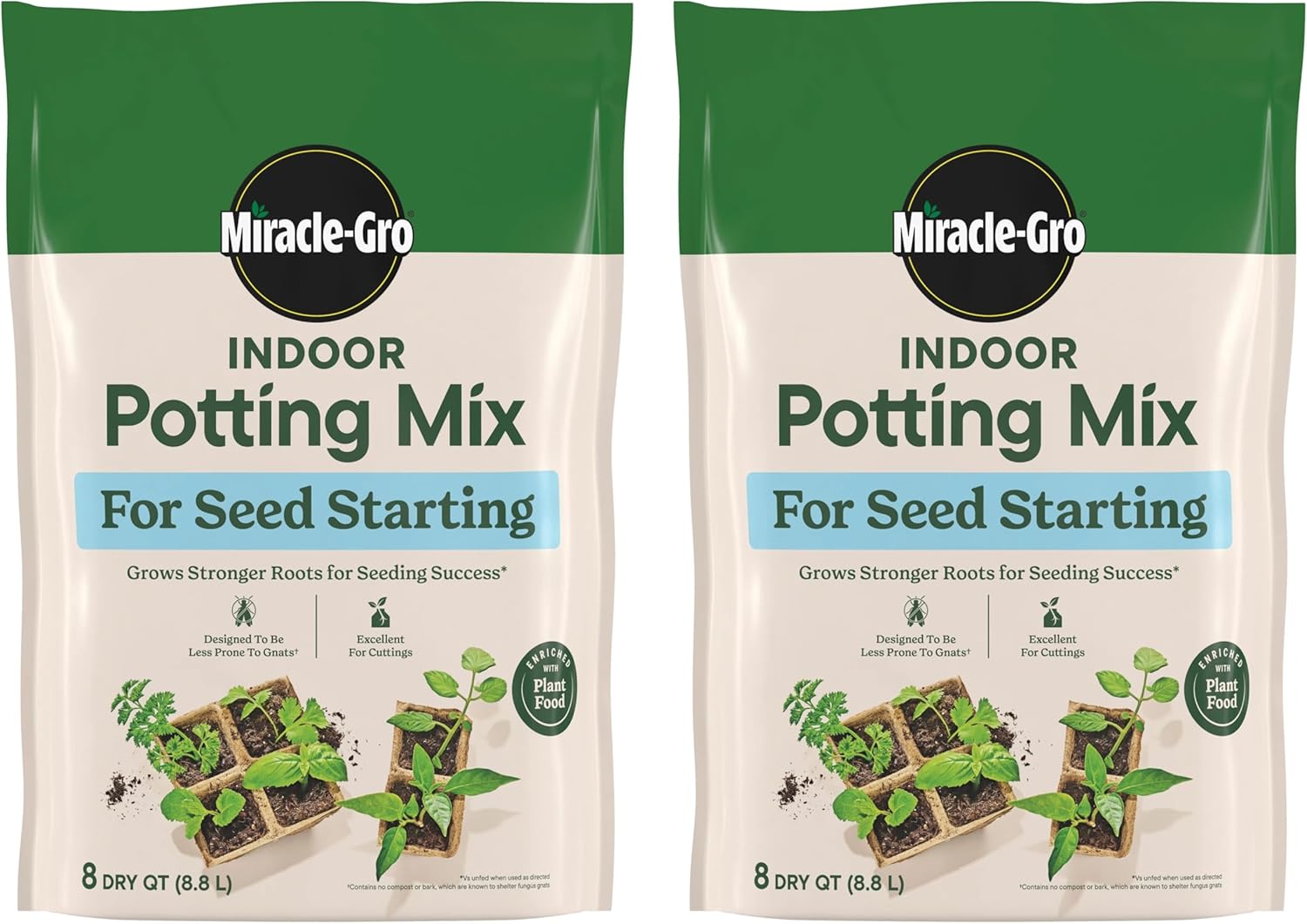
This two-pack of Miracle-Gro Indoor Potting Mix is designed specifically for starting seeds and rooting cuttings indoors. The blend is lightweight and pre-enriched with plant food so seedlings get a nutrient boost during early root development, and the manufacturer says it yields stronger roots compared with unfed mixes when used as directed. It is intended for vegetables, flowers, and herbs and works well in cell trays and small containers; one 8 qt. bag will fill roughly three 72-cell trays. Notably, the formula omits compost and bark, which helps lower the chance of fungus gnat infestations in damp seed-starting setups. Use it by filling trays or pots, keeping the mix evenly moist, and shielding newly sown seeds from direct sun until germination. Important limitations are standard for enriched mixes: it contains fertilizer (so handle carefully) and it is a seed-starting medium rather than an all-purpose potting soil for mature plants, so you will likely transplant seedlings into a different mix or amend soil later.
Best for: Buyers who want a low-effort, indoor seed-starting medium that supports faster root development and reduces common pest risks while following proven seed-starting practices.
Less Ideal for: Gardeners who need a permanent potting soil for mature container plants or who prefer fully organic, compost-rich mixes should consider alternatives.
- Lightweight, ready-to-use formula tailored for seed germination and cuttings
- Pre-enriched with plant food to support early root and seedling growth
- Excludes compost and bark to reduce habitat for fungus gnats
- Comes as a two-pack so you have enough mix for multiple trays
- Contains fertilizer which requires careful handling and storage
- Intended for seed starting so not formulated as long-term potting soil for mature plants
Verdict: A practical, low-risk seed-starting mix that boosts early root growth and reduces fungus gnat risk, making it a reliable choice for indoor vegetable seedlings.
Back to the Roots Organic Expanding Coco Coir Potting Soil Brick (10 lb)

| Item Highlight | 10 lb compressed coco coir brick; peat-free; OMRI Listed |
|---|---|
| Item Type Name | Coconut Coir |
| Volume | 2 cubic feet |
| Ingredients | Coconut Coir |
| Style Name | Expanding Potting Soil |
This compressed coco coir brick provides a lightweight, peat-free potting medium that expands when you add water to create loose, airy substrate for containers and seed flats. It is typically used by hydrating the 10 lb block to about 2 cubic feet of coir and then using it alone for potted plants, mixing it into garden soil to improve drainage and aeration, or blending with compost for starting seeds. Notable features include OMRI listing for organic use, a balanced pH suited to a wide range of plants, and compact storage before expansion which saves space. Practical benefits are improved root aeration and water retention compared with heavy garden loam, easier handling than bulky bags, and versatility across vegetables, herbs, and ornamentals. Important limitations are that coco coir is a soilless substrate and does not supply significant nutrients on its own so you will need to add fertilizer or compost for long-term potted herbs like rosemary, and the product requires time and a water source to expand before use.
Best for: Buyers who prioritize low-risk, easy-to-handle, organic potting media and want a versatile base for container herbs and seed starting without dealing with heavy bags.
Less Ideal for: Gardeners who want a ready-to-plant, nutrient-rich potting mix out of the box or those who prefer soil with built-in slow-release fertilizer.
- Peat-free OMRI listed organic coco coir suitable for organic growing
- Expands from a compact brick to about 2 cubic feet for easy storage and transport
- pH balanced and airy texture that improves drainage and root aeration
- Versatile use: can be used alone, for seed starting, or mixed into existing soil
- Provides little inherent fertility so supplemental feeding or compost is needed for nutrient-hungry plants
Verdict: A compact, peat-free coco coir brick that expands into an airy, pH-balanced base ideal for low-risk organic container gardening and seed starting when paired with fertilizer or compost.
Choosing the Right Soil for Grass Seed Germination: Key Factors to Consider
Moisture Retention
Soil that holds enough moisture near the seed improves germination rates because seeds need consistent hydration in the first days after planting. Too little retention causes uneven germination and patchy turf; too much retention leads to rot and poor oxygen availability.
Look for a soil that balances fine particles and organic matter so it can absorb water but still release it to the developing radicle. In practice, this means soils with modest loam or fine sandy loam textures and some stable organic matter perform best for most lawns.
Drainage and Aeration
Good drainage prevents standing water that suffocates seeds and promotes disease. Aeration in the seedbed is also critical so the tiny roots can access oxygen as they grow.
Soils with coarse sand content or larger aggregates create pore space that allows excess water to move away while keeping oxygen available. When selecting a soil, consider how it behaves after heavy rain and whether the site tends to stay wet; amendments or choosing a more open-textured soil can mitigate poor site drainage.
Seed-Soil Contact and Particle Size
Intimate contact between the seed and surrounding particles is essential for moisture transfer and successful germination. Particle size distribution matters because very coarse materials leave gaps and very fine materials can create crusting.
A mix of small aggregates and fine mineral particles gives seeds a stable bed to sit in and encourages even contact. Avoid soils that are overly dusty or that form a hard surface film when dry, as both reduce the chance that every seed will germinate at the same rate.
Starter Nutrient Profile
New seedlings need a mild, available nutrient supply to fuel initial leaf production, but excessive fertilizer can damage tender roots or encourage algae and weed competition. A soil suitable for germination offers modest levels of available nitrogen, phosphorus, and potassium, often from stable organic sources or low-release amendments.
Balance is key. Soils with clear nutrient analysis or labeled as starter blends help you avoid underfeeding or overfeeding seedlings in the crucial first few weeks after emergence.
Organic Matter Content and Microbial Activity
Organic matter provides slow-release nutrients, improves moisture buffering, and supports beneficial soil microbes that help young roots access resources. However, too much uncomposted material can immobilize nitrogen or create uneven settling.
Choose soils with well-decomposed organic matter or composted amendments. Healthy microbial activity aids early root establishment and disease suppression, but the source and maturity of organic inputs affect how they perform in the seedbed.
Texture Consistency and Batch Uniformity
Consistency matters when you are seeding larger areas. A soil that varies dramatically between bags can produce uneven germination and complicate leveling and raking.
Look for products that specify particle-size ranges or describe uniform processing. Consistent texture makes it easier to achieve even seeding depth and firm seed contact across the whole lawn area.
Preparing the Seedbed
Start by removing debris, dead grass, and stones so you can work the soil surface evenly. Lightly loosen the top inch or two of existing soil to improve contact and allow new roots to penetrate without creating a deep disturbance that dries out quickly.
After loosening, rake the surface smooth and level. If the existing soil is heavily compacted, consider a thin layer of a more open-textured soil to improve aeration where the seed will sit.
- Rake to a uniform surface to avoid pockets where seed can wash away.
- Avoid deep cultivations that expose subsoil and dry out the seedbed.
- Firm the surface gently to ensure seed-soil contact without creating compaction.
Matching Soil Choice to Seeding Method
Broadcast seeding and slit-seeding place seed on or near the surface, so choose a soil that will stay in place and maintain moisture at shallow depths. For overseeding, a finer textured top layer that promotes contact is preferable. For full re-seeding, a slightly thicker seedbed with better moisture buffering can give seedlings a head start.
If you are using hydroseed or mulch-assisted methods, select soils that bind well with tackifiers and do not float or separate when saturated.
- Overseeding benefits from thin, firm topdressings that protect seed without burying it.
- Full reseeding tolerates slightly deeper, more moisture-retentive soils for improved establishment.
Amending Poor Site Soils
If the existing yard soil is heavy clay or very sandy, plan targeted amendments rather than relying on a single product to fix the whole profile. Clay may need coarse sand and organic matter to open structure, while sandy sites benefit from organic matter that increases water-holding capacity.
Work amendments into the top few inches only, because deep incorporation can create a layer contrast that impedes root movement and water exchange. For patch repairs, apply a focused replacement where roots will grow rather than mixing broadly across the lawn.
- Clay soils: add coarse sand and well-rotted compost to improve drainage and structure.
- Sandy soils: add organic matter to boost moisture retention and nutrient-holding capacity.
Watering Strategy for Germination
Consistent, light watering keeps the seed zone evenly moist without washing seeds away. Start with short, frequent cycles several times per day if conditions are hot and dry, then reduce frequency and increase duration as seedlings develop deeper roots.
Avoid heavy hand watering that causes crusting or displaces seeds. A fine spray or sprinkler set to a mist pattern gives the best chance of uniform soil moisture in the top half-inch to inch where most seeds germinate.
- Maintain surface moisture until most seedlings show true leaves.
- Transition to deeper, less frequent watering to encourage root growth after establishment.
Timing and Temperature Considerations
Soil temperature influences germination speed more than air temperature alone. Choose a planting window when soil temperatures are within the recommended range for your grass species so seeds germinate quickly and uniformly.
Avoid seeding before prolonged heavy rains are forecast, and delay planting if the seedbed will remain waterlogged. Cooler soils slow germination and invite competition from weeds that can outpace slow seedlings.
- Check soil temperature with a probe for best results.
- Plan planting after the last expected hard freeze for spring or ahead of cooler months for fall seeding.
How We Chose the Best Soil for Grass Seed Germination
We focused on attributes that directly affect seed-to-soil performance and early seedling survival. Each candidate had to demonstrate a balance of water retention and drainage suitable for seed germination, a texture that promotes firm seed contact without compacting, and a nutrient profile appropriate for starter growth rather than long-term feeding. We also evaluated organic matter content and particle size distribution because these influence moisture buffering and root penetration. Ease of application and consistency across batches were considered to reflect real homeowner use. Products that primarily functioned as long-term topdressings, heavy potting mixes, or that lacked specification on particle size and OM content were excluded. The final shortlist favors soils whose specifications and typical garden behavior support predictable germination and early turf establishment.
FAQ
Can I use garden soil for grass seed germination?
Garden soil can work if it has the right texture and drainage, but many garden soils are heavy or inconsistent. If you use garden soil, loosen the top layer, remove debris, and amend with organic matter or sand as needed to improve seed contact and moisture balance.
How deep should I place grass seed in the soil?
Most grass seeds need to be at or just below the soil surface, typically no deeper than 1/4 to 1/2 inch. Too deep planting reduces oxygen and light exposure and slows emergence, while surface placement risks drying out unless you maintain consistent moisture.
When should I expect to see seedlings after seeding?
Germination timing depends on grass species and soil temperature, but many cool-season grasses appear in 7 to 21 days under favorable soil moisture and temperature. Warm-season grasses often take longer and need warmer soil to sprout reliably.
Should I add fertilizer at the time of seeding?
A mild starter nutrient supply can help seedlings, but avoid heavy feeding at sowing. Use a low-soluble starter or choose a soil with a modest nutrient profile to support early leaf growth without burning delicate roots or encouraging excessive weed competition.
How can I prevent soil crusting after watering?
Crusting happens when fine particles bind and dry into a hard surface. To reduce crusting, use a soil with balanced particle sizes and some stable organic matter, water gently with fine sprays, and lightly rake or roll the surface to break small crusts once seedlings are visible.
Final Verdict
Prioritize a seedbed that balances moisture retention and drainage, with a texture that ensures firm seed-soil contact. Consider site conditions-clay, sand, or compacted ground-and match your soil choice or amendments to correct those issues rather than relying on a one-size-fits-all product. Focus on consistent moisture management and a mild starter nutrient profile during the first weeks of growth. When you match soil characteristics to your seeding method and site, you increase the odds of quick, even establishment and a healthier lawn.
