

Note: This article contains affiliate links. If you click on these links and make a purchase, I may earn a small commission at no extra cost to you. This helps support my research and content. Read my full affiliate disclosure here.
Choosing the right soil for your lawn matters more than most gardeners realize. Soil determines how well seed or sod establishes, how water drains through the root zone, and whether nutrients stay available through dry spells. In this guide we narrowed the field to the top options suited for lawns, focusing on real-world performance in home yards and common turf situations. The shortlist covers soils suited to new seeding, topdressing, and renovating thin turf. We evaluated each option on practical criteria such as texture and drainage, organic matter and nutrient retention, and ease of use so you can pick the right product for your yard. Read on to find the best match for your lawn project and the conditions you manage.
Top Picks at a Glance
| Best Overall The best all-around choice for most situations | Scotts Turf Builder LawnSoil (1 cu. ft.) |  |
| Best Quality Built to a higher standard if you want something more solid | Coast of Maine Monhegan Blend Organic Topsoil (1 cu ft) |  |
| Best Value The sweet spot between price and what you get | Michigan Peat Garden Magic Organic Potting Top Soil Blend, 40 lb |  |
| Best Budget The cheapest option that still gets the job done reliably | Premium Topsoil 0.75 cu. ft. — Lawn and Garden Top Soil with Peat Moss |  |
| Highest Rated A top-rated pick with lots of positive feedback | The Andersons HumiChar Organic Soil Amendment with Humic Acid and Biochar (12 lb) |  |
Scotts Turf Builder LawnSoil (1 cu. ft.)

| Brand Name | Scotts |
|---|---|
| Unit Count | 1 Count |
| Volume | 1 cubic feet |
| Item Weight | 32.7 pounds |
Scotts Turf Builder LawnSoil is a pre-mixed garden soil formulated for establishing new turf, seeding, and laying sod. It combines premium soil ingredients with a built-in starter fertilizer to support early root development and faster seedling growth, which the manufacturer says produces thicker grass than untreated native soil. Typical use is topdressing or filling thin patches before seeding or installing sod; its improved moisture retention helps seeds germinate more consistently and reduces the need for overly frequent watering. The included fertilizer means you do not have to add a separate starter feed at installation, simplifying the first few weeks of establishment. Limitations are that this product is supplied in one-cubic-foot bags, so larger lawns require many bags and handling; also it is not a complete turf fertility program for long-term maintenance and will need follow-up fertilization. Handle with gloves and keep away from children and pets while applying.
Best for: Buyers who want an easy, all-in-one soil to repair bare spots, seed new lawns, or bed in sod and who value faster establishment without mixing their own amendments.
Less Ideal for: This is not the best choice for someone managing a large acreage lawn who needs bulk topsoil or for gardeners seeking an ongoing complete fertilizer plan without additional products.
- Contains starter fertilizer to support early root and shoot growth
- Formulated to improve moisture retention and germination compared with native soil
- Suitable for use with sod, plugs, and overseeding to thicken thin lawns
- Sold in 1 cu ft bags which can be labor intensive and costly for large areas
- Not a long-term fertilizer solution and requires follow-up feeding for ongoing lawn nutrition
Verdict: A convenient, starter-fertilizer–enhanced topsoil that speeds seedling establishment and simplifies small-area lawn repairs.
Coast of Maine Monhegan Blend Organic Topsoil (1 cu ft)
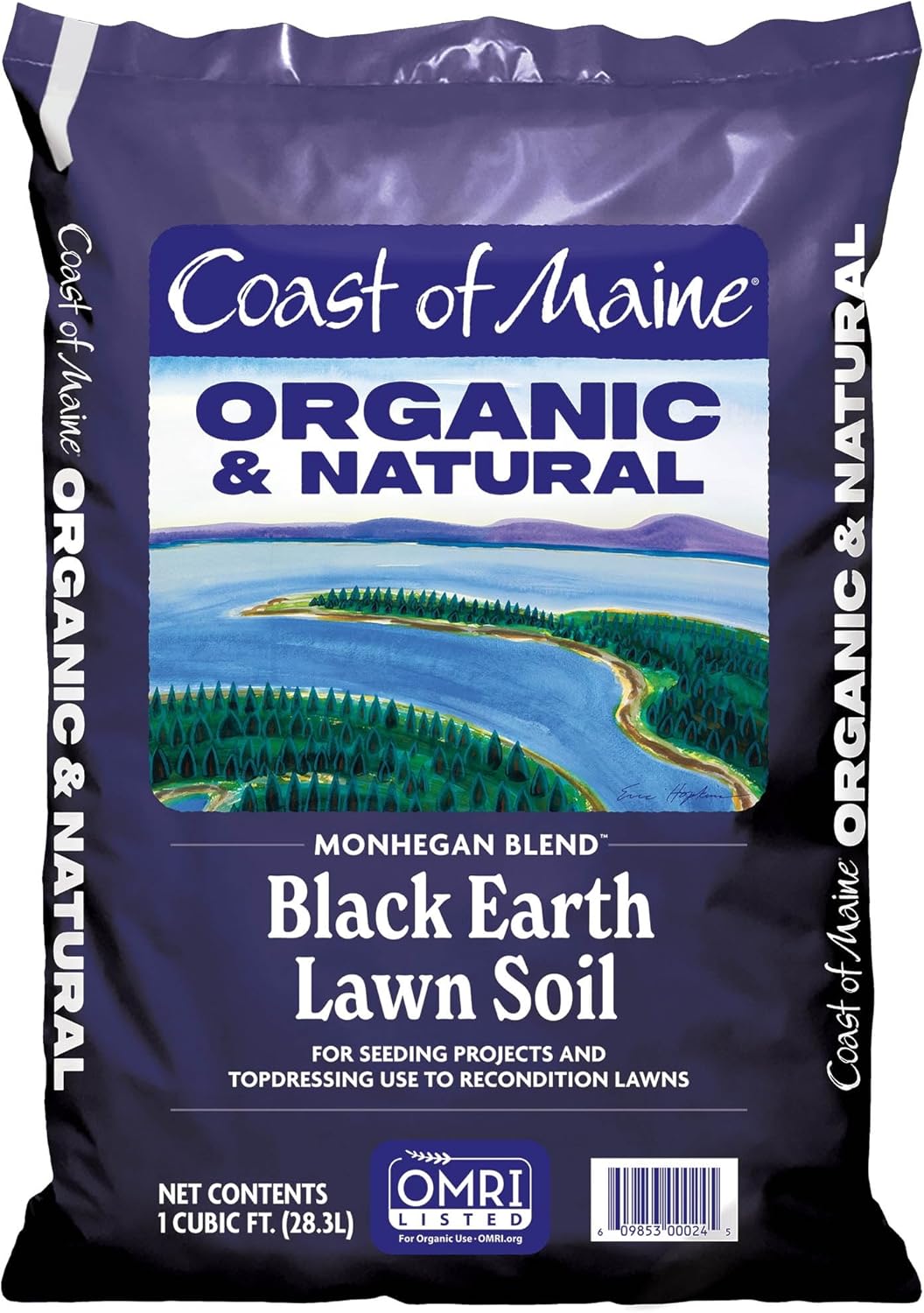
| Unit Count | 1 Count |
|---|---|
| Volume | 1 cubic feet |
| Ingredients | Composted farm manures, sphagnum peat moss, aged bark |
| Certification | OMRI Listed |
Coast of Maine Monhegan Blend is an organic topsoil mix formulated from composted farm manures, sphagnum peat moss, and aged bark to improve lawn health and soil structure. It is typically used as a topdressing across lawns, to repair bare patches, or to condition garden beds before planting; the manufacturer recommends roughly one bag per 10 to 15 square feet when topdressing. The peat and aged bark help retain moisture and improve aeration while the composted manures supply slow-release nutrients and support beneficial microorganisms. Being OMRI-listed and made in the USA, it suits gardeners who prefer certified organic inputs and want a product that supports long-term soil biology. Practical benefits include easy spreading because of the fine texture and noticeable improvement in seed-to-soil contact for overseeding. Limitations are its small one-cubic-foot bag size for larger lawns and the need to water in after application for best results; it is not a complete lawn fertilizer so you may still need targeted nutrient or lime applications depending on soil tests.
Best for: Homeowners and turf-focused gardeners who prioritize organic, performance-driven soil improvements and want a product that boosts seed contact, moisture retention, and microbial activity when topdressing or repairing lawns.
Less Ideal for: People restoring very large lawns who need bulk quantities or those seeking a complete fertilizer solution without additional soil testing and amendments.
- OMRI-listed organic blend supports biological soil health
- Contains peat moss and aged bark to improve moisture retention and aeration
- Composted manures provide slow-release nutrients and organic matter
- Fine texture makes it easy to spread for topdressing and overseeding
- Sold in single 1 cubic foot bags which is inefficient for large lawns
Verdict: Choose this OMRI-listed topsoil when you want an organic, performance-focused blend to improve lawn seed establishment, moisture retention, and long-term soil health.
Michigan Peat Garden Magic Organic Potting Top Soil Blend, 40 lb

| Brand | Garden Magic |
|---|---|
| Volume | 40 liters |
| Unit Count | 1 Count |
| Item Highlight | Dark Reed Sedge Peat and Sand – Moisture Retaining Mix |
This Garden Magic top soil is a general-purpose mix built from dark reed sedge peat and sand that you can use straight from the bag for lawns, raised beds, and potted plants. It is designed to hold moisture yet allow excess water to drain, which helps seedbeds, vegetable starts, and lawn repair patches establish without sitting water. The blend is useful as a top dressing to fill holes, loosen compacted clay, or improve light soils by increasing organic matter and moisture retention. Because it is a simple peat-and-sand formula there are no added fertilizers or specialized amendments, so you should plan to amend with lime or nutrients if your soil test indicates pH or fertility needs. Bags are a convenient 40 pound unit for small projects and targeted repairs, but covering large areas will require many bags or bulk soil for cost and labor efficiency.
Best for: Home gardeners who want a versatile, ready-to-use top soil for lawn patching, raised beds, and small repairs and who prefer a straightforward soil that improves moisture retention without specialist additives.
Less Ideal for: People planning to amend large lawn areas or who need an all-in-one fertilized turf mix should choose bulk topsoil or a formulated lawn soil instead.
- Ready to use out of the bag for planting, top dressing, and patching lawns
- Peat and sand mix balances moisture retention with adequate drainage
- Helps loosen heavy clay and improve moisture in light soils
- 40 pound bag size is convenient for spot repairs and small beds
- Contains no fertilizer or pH amendments so additional inputs may be needed
- Bagged format is impractical and costly for large lawn projects
Verdict: A practical, ready-to-use peat-and-sand top soil that makes small lawn repairs and bed improvements quick and reliable.
Premium Topsoil 0.75 cu. ft. — Lawn and Garden Top Soil with Peat Moss

| Unit Count | 1 Ounce |
|---|---|
| Number of Packs | 1 |
| Style Name | Garden |
| Manufacturer | Scotts |
This product is a compact 0.75 cu. ft. bag of topsoil mixed with peat moss designed to improve lawn and garden soil. It is typically used to top-dress patchy turf, level small dips, or mix into planting holes and raised beds to improve moisture retention and organic matter. The peat moss content helps the soil hold water and gives a finer texture useful when dressing seed or seedlings. Because the bag is small and easy to handle it is convenient for spot repairs, container gardening, and projects where hauling bulk soil would be impractical. Practical benefits include improved moisture retention and a ready-to-use soil blend so you can apply it straight from the bag. Limitations are the small volume per bag which means multiple bags are needed for larger lawns and the product listing provides minimal specification beyond weight and style so buyers should verify suitability for turf mixes if they need a specific sand or clay balance.
Best for: Homeowners or renters who need an inexpensive, easy-to-handle soil blend for small lawn repairs, patching bare spots, or container and raised bed projects.
Less Ideal for: People planning to renovate or resod large lawns or who need a specific soil texture or professional-grade turf mix should choose bulk topsoil or a specialized amendment instead.
- Contains peat moss to improve water retention and soil texture
- Small, manageable 0.75 cu. ft. bag makes spot repairs and container use easy
- Ready-to-use blend suitable for top-dressing and mixing into planting holes
- Small bag size requires many bags for larger lawn projects
- Product details are limited so exact soil composition and proportions are not specified
Verdict: A handy, peat-moss amended bag of topsoil that makes quick, small-scale lawn repairs and container projects simple and affordable.
The Andersons HumiChar Organic Soil Amendment with Humic Acid and Biochar (12 lb)

| Unit Count | 192 Ounce |
|---|---|
| Volume | 12 liters |
| Ingredients | Humic Acid, Coconut Husk Biochar, Leonardite, Proprietary Binding Agent, Water |
| OMRI Listed | Environmentally friendly, OMRI listed |
HumiChar is a granular organic soil amendment designed to boost soil structure and long-term fertility by combining high-concentration humic acid with granulated biochar. It is applied to lawns and garden beds either alone or blended with fertilizer to increase nutrient availability, improve moisture retention, and build soil carbon over time. The product's dispersible granule technology reduces dust and helps the particles break down more predictably in the soil, making it easier to apply evenly with a spreader. Because it contains both quickly available humic acid and persistent biochar, you get both near-term benefits for turf vigor and a durable improvement in soil tilth that can reduce reliance on repeat fertilizer applications. Important limitations are its chemical-safety notes and handling precautions and that measurable soil changes require repeated or follow-up applications for larger areas; it is not a one-time quick fix for heavily depleted soils. Overall this is a practical option for homeowners and groundskeepers seeking a reliable, low-dust organic amendment to improve lawn soil health.
Best for: Homeowners or lawn caretakers who prioritize consistent, long-term soil improvement and want a low-dust, organic amendment that fits into a routine fertilizing program.
Less Ideal for: People needing an immediate, dramatic correction for compacted or nutrient-depleted turf who require fast-acting chemical treatments or structural soil replacement.
- Combines 30% humic acid with 43% granulated biochar for both immediate and long-term soil benefits
- Dispersible granule formulation reduces dust and spreads evenly with common spreaders
- OMRI-listed organic ingredient set suitable for organic lawn programs
- Can be blended with fertilizers or used alone for flexible application
- Not a one-time solution for severely degraded soils because measurable changes take time and repeat applications
Verdict: Choose HumiChar when you want a dependable organic amendment that delivers both quick humic benefits and long-term soil-building biochar for healthier lawns over time.
Choosing the Right Soil for Lawns: Key Factors to Consider
Soil Texture and Particle Size
Texture controls water movement, seed contact, and root penetration. A lawn soil that is too sandy drains quickly and cannot hold moisture or nutrients well, leaving seedlings vulnerable in dry weather. Conversely, a mix with excessive silt or fine clay will compact under foot traffic and reduce oxygen flow to roots, increasing disease risk.
Look for a balanced particle distribution that allows firm but not dense seedbeds, improves root establishment, and resists crusting after light rain. Particle-size information and sieve grading on product labels can help predict how a soil will behave on your lawn.
Drainage and Compaction Resistance
Good drainage prevents waterlogging and helps roots access oxygen, while compaction resistance keeps the root zone porous after mowing and foot traffic. Lawns on heavy, poorly drained soils will develop shallow roots and patchy growth.
Consider the existing lawn grade and drainage patterns. When working on areas that hold water, choose a soil that improves percolation and can be worked into the top few inches without compacting. For high-traffic yards, prioritize mixes that include coarse particles or structural amendments that maintain pore space.
Organic Matter Content and Nutrient Holding
Organic matter feeds soil biology, improves structure, and increases cation exchange capacity, which helps the soil retain and release nutrients to grass roots. Too little organic matter leaves turf dependent on frequent fertilization, while excessive fresh organics can settle and cause uneven surface levels.
Aim for a balanced organic fraction that supports steady nutrient availability and biological activity without producing large amounts of uncomposted debris. Stable, composted organic matter is preferable to raw amendments for long-term turf resilience.
pH and Basic Nutrient Balance
Soil pH affects nutrient availability and microbial activity. Most turfgrasses thrive in a slightly acidic to neutral range. A soil that is far outside that range can lock up key nutrients and stunt growth even when organic matter and texture are appropriate.
Verify whether a soil or blend has been limed or acidified and consider your lawn's existing soil test results. A balanced starting nutrient profile reduces the need for corrective applications and helps seedlings get a consistent supply of nitrogen, phosphorus, and potassium.
Workability and Ease of Application
How a soil spreads and levels is important for both seeding and topdressing. Fine, dusty mixes may be hard to distribute evenly and can blow away, while very coarse or heavy mixes are difficult to rake and smooth.
Consider the equipment you will use and the thickness of each application. A soil that is easy to rake, grade, and incorporate into the upper few inches will deliver more consistent germination and a better-looking finished lawn.
Compatibility with Seed, Sod, and Topdressing
Different lawn projects demand different soil behaviors. New seeding benefits from a mellow, fine but well-structured seedbed, while topdressing requires a material that blends with existing turf without creating a layered look. Sod installation asks for uniform contact and modest settling behavior.
Pick a soil that aligns with your primary use case and that can be adjusted with modest amendments for other tasks. A versatile lawn soil will perform acceptably across seeding, sodding, and regular topdressing maintenance.
When to Improve Lawn Soil
Soil improvement is not always needed across the entire yard. Focus on thin, bare, or waterlogged areas and spots that show persistent poor growth despite proper mowing and fertilization.
Timing matters. The best windows for major topdressing or soil replacement are the active growth seasons for your grass type, when roots can quickly exploit improved conditions. Late summer for warm-season grasses and early fall for cool-season grasses are common choices.
- Assess problem areas after rain to locate poor drainage or compaction
- Plan work so seed or sod has several weeks of active growth to establish
Topdressing Vs Deep Soil Replacement
Topdressing with a compatible lawn soil is an efficient way to smooth minor low spots, improve thatch breakdown, and add organic matter. It uses modest volumes and integrates into existing turf when applied thinly over time.
Deep soil replacement or rebuilding the root zone is a larger undertaking reserved for persistent drainage problems, severe compaction, or complete lawn renovation. That approach replaces poor subsoil and provides a lasting root environment but requires more material and careful grading.
- Topdress in thin layers for best root integration
- Replace soil when drainage or contamination prevents recovery
How to Test Your Lawn Soil Before Buying
A simple home test and a formal soil lab test give different insights. A jar test or ribbon test can indicate texture class roughly, while a lab test tells you pH, nutrient levels, and organic matter percentage.
Collect multiple samples across representative areas and send them for analysis if you suspect nutrient imbalances or extreme pH. Use those results to choose a soil that complements existing conditions rather than working against them.
- Jar or ribbon tests for quick texture checks
- Lab tests for pH and nutrient planning
Seasonal Care After Soil Work
After installing new soil or topdressing, keep the surface consistently moist until turf establishes. Avoid heavy traffic during the first few weeks to reduce settling and damage to tender roots.
Plan follow-up feedings and mowing height adjustments to encourage deep rooting. Mulch mowing and modest fertilizer additions timed with active growth will help the new soil integrate and support thicker turf.
- Water lightly and frequently until seedlings are established
- Raise mower height initially to reduce stress on young turf
Environment and Sustainability Considerations
Choose soils with responsibly sourced components and stable composted organic matter to reduce leaching and support beneficial soil life. Locally produced blends cut transportation impact and often match regional soil challenges better.
Avoid mixes with excessive peat or non-renewable amendments when sustainable alternatives are available. Healthy soil biology reduces the need for chemical inputs over time and improves drought resilience.
- Prefer compost-stabilized organics over raw materials
- Look for local sourcing when possible
How We Chose the Best Soil for Lawns
We assembled candidates by looking for soils and soil blends commonly recommended for turf establishment and renovation, then applied practical filters a homeowner or landscaper would use. Key evaluation criteria included soil texture and particle sizing to ensure consistent seed-to-soil contact and predictable drainage; organic matter content and nutrient-holding capacity to support early root growth; pH suitability and basic nutrient balance for common cool- and warm-season grasses; ease of spreading and compaction resistance during topdressing; and microbial life and amendment friendliness for long-term soil health. We excluded specialty mixes designed solely for container gardening, decorative planters, or heavy clay remediation that alter grade substantially. Products without clear composition information or inconsistent particle grading were not considered. The final picks balance immediate planting performance with durability in typical lawn care routines, matching the scoring labels used in our per-product evaluations.
FAQ
How deep should I add new soil when topdressing my lawn?
Thin layers of about a quarter to a half inch per pass are typical for topdressing so the turf can grow through the material. Multiple applications over a season or two are better than a single thick layer, which can smother grass and delay recovery.
Can I use garden soil or compost from my yard for lawn repairs?
Garden soil and compost can work if they are well-aged and have an appropriate texture. Avoid raw compost or heavy garden soil that will settle excessively or create a different layer than the existing root zone. Blend and screen materials to match the lawn surface.
When is the best time to seed after adding new lawn soil?
Seed when the grass type is actively growing so roots can establish quickly. For cool-season grasses that is typically early fall; for warm-season grasses, late spring to early summer is common. Keep the seeded area consistently moist until germination and early growth.
Will new lawn soil change my mowing and fertilizing routine?
You may need to adjust mowing height and fertilization timing as the grass responds to improved growing conditions. Initially raise mowing height to reduce stress and follow a nutrient plan based on a soil test rather than fixed schedules.
How can I tell if my lawn soil is compacted?
Compaction often shows as thin turf, poor water infiltration, and shallow roots. A soil probe or screwdriver that is hard to push into the root zone is a practical test. Aeration and adding a structural topdressing can relieve compaction when necessary.
Final Verdict
The best soil for lawns balances texture, drainage, and organic matter to create a stable root zone that supports dense, resilient turf. Prioritize mixes that match your lawn project whether you are seeding, sodding, or topdressing, and use soil testing to guide choices around pH and nutrients. Expect tradeoffs between immediate workability and long-term structure. Thin, regular topdressing with a compatible soil often delivers the best combination of quick improvement and manageable labor for most home lawns.
