

Note: This article contains affiliate links. If you click on these links and make a purchase, I may earn a small commission at no extra cost to you. This helps support my research and content. Read my full affiliate disclosure here.
Getting seedlings off to a strong start depends more on the growing medium than many gardeners realize. The right soil for sowing seeds balances moisture retention, drainage, and gentle nutrient levels so delicate roots can establish without drowning or burning. This guide shortlists seven top soils chosen for seed starting and early-stage transplanting, and explains the practical reasons those mixes work in flats, cells, and small pots. We evaluate each option on seed-starting performance and how easy it is for you to manage water and nutrients during those critical first weeks. Read on to find the right mix for your sowing setup.
Top Picks at a Glance
| Best Overall The best all-around choice for most situations | Espoma Organic Seed Starter Premium Potting Mix, 16 qt |  |
| Best Quality Built to a higher standard if you want something more solid | FoxFarm Light Warrior Seed Starter Growing Medium, 12 Quart |  |
| Best Value The sweet spot between price and what you get | Burpee Organic Coconut Coir Seed Starting Mix (Coir Brick, expands to 8 qt) |  |
| Best Budget The cheapest option that still gets the job done reliably | SunGro Horticulture Organic Seedling Mix (8 Quart) |  |
| Highest Rated A top-rated pick with lots of positive feedback | Sol Soils Seedling & Propagation Mix (1 gal) |  |
| Most Popular A crowd favorite that many people choose with confidence | Miracle-Gro Indoor Potting Mix for Seed Starting, 8 qt. (2-Pack) |  |
| Best Seller A high-volume bestseller chosen again and again | Back to the Roots Organic Expanding Coco Coir Potting Soil Brick (10 lb) |  |
Espoma Organic Seed Starter Premium Potting Mix, 16 qt

| Brand Name | Espoma |
|---|---|
| Volume | 16 quarts |
| Unit Count | 598.4 Ounce |
| Model Number | SS16 |
Espoma Organic Seed Starter is a peat-based, lightweight potting mix designed specifically for germinating seeds and rooting cuttings. The blend of sphagnum peat moss and perlite gives good aeration and drainage while the formula includes yucca extract to improve wetting and lime to balance pH. It also contains Myco-tone mycorrhizae to help early root establishment and improve nutrient access during the seedling stage. Typical use is filling trays, cells, or small pots for seeds and softwood cuttings; its fine texture and moisture retention reduce damping-off risk when used with proper sanitation and watering. Because it contains no synthetic fertilizers, it is appropriate for organic growing but you will need to begin light feeding once true leaves form or when transplanting. The bag size covers routine home-seed-starting needs, and the product is straightforward to handle and mix for small-scale propagation projects.
Best for: Gardeners focused on reliable seed germination and strong early root development who want an organic, ready-to-use mix for trays and small pots.
Less Ideal for: Growers wanting a peat-free or pre-fertilized seed mix or those starting very large volumes commercially should consider alternatives tailored to those needs.
- Formulated for seedlings with peat and perlite for balanced aeration and moisture retention
- Includes Myco-tone mycorrhizae to support early root development
- Organic ingredients with no synthetic fertilizers, suitable for organic growing
- Contains yucca extract to improve wetting and lime to help stabilize pH
- No starter nutrients included so plants need feeding after true leaves appear
- Peat-based mix is not the most sustainable choice for gardeners preferring peat-free media
Verdict: Choose this organic seed starter when you want a ready-to-use mix that promotes rapid root development and reliable germination for home seedlings and cuttings.
FoxFarm Light Warrior Seed Starter Growing Medium, 12 Quart

| Volume | 12 quarts |
|---|---|
| Unit Count | 1 Count |
| Brand Name | FoxFarm |
| UPC | 752289790089 |
FoxFarm Light Warrior is a premixed seed-starting medium designed for growers who want a plug-and-play option for germination, cuttings, and young seedlings. The bag combines sphagnum peat moss and perlite for light, airy texture, plus added soil microbes, humic acid, and earthworm castings to encourage root efficiency and nutrient uptake. It arrives ready to use so you can sow seeds or pot cuttings immediately without blending amendments. In practice the mix stays well drained while retaining enough moisture for consistent germination, and the biological additives can help seedlings establish stronger root systems. Because it contains a fertilizer component, you may need to delay additional feeding for a few weeks to avoid overfertilizing delicate seedlings. The 12-quart bag is convenient for small-scale indoor seed flats or multiple pots, but larger growers will need multiple bags or a bulk option. If you want a performance-focused, no-fuss starter medium that supports fast rooting and healthy early growth, Light Warrior is a solid choice.
Best for: Growers who prioritize quick, reliable seed germination and healthy root development and want a convenient, preamended medium for indoor seed starting.
Less Ideal for: People seeking large-volume, unamended sterile mixes for commercial-scale propagation or those who prefer completely fertilizer-free starting media.
- Ready-to-use out of the bag so you can sow immediately
- Light, well-draining texture from sphagnum peat moss and perlite
- Contains soil microbes and humic acid to improve root efficiency and nutrient uptake
- Includes earthworm castings for gentle, natural seedling nutrition
- Contains fertilizer which may require delaying supplemental feeding for young seedlings
- Sold in a 12-quart size that may be small for larger or repeated sowing projects
Verdict: Choose Light Warrior when you want a ready-made, performance-focused seed starter that promotes fast rooting and healthier seedlings.
Burpee Organic Coconut Coir Seed Starting Mix (Coir Brick, expands to 8 qt)

| Brand Name | Burpee |
|---|---|
| Item Highlight | OMRI Listed coconut coir expands with water to 16 qts of growing mix; ideal for seed starting and seedlings. |
| Included Components | Coir |
| Ingredients | Coconut Coir |
Burpee’s compressed coconut coir brick is a simple, space-saving seed starting medium: add water and the brick expands into about 8 quarts of loose coir suitable for sowing seeds and potting seedlings. It is OMRI listed and made from recycled coconut husks, so it holds moisture well while maintaining good aeration around roots, which helps germination and early root development for vegetables, herbs, and flowers. The dehydrated brick is easy to store and transport compared with bulky bagged mixes, and it mixes readily with compost or a small amount of fertilizer when you need extra nutrients. Because it is essentially pure coir, you should plan to add starter nutrients or blend with organic potting mix for longer-term growth since it contains no built-in fertilizer. Some gardeners may find it slower to rehydrate if not broken apart first, and the product is a single concentrated brick so you must expand a full unit even when you need less volume. For someone optimizing space and wanting a reliable, low-mess seed-start medium, this is a practical choice.
Best for: Gardeners who value compact storage and a reliable, sterile medium for starting vegetable and herb seeds and who plan to amend or feed seedlings after germination.
Less Ideal for: Those who want an all-in-one potting mix with built-in fertilizer or growers who need small precise single-use portions without expanding a whole brick.
- OMRI listed organic coir made from recycled coconut husks
- Expands with water to about 8 quarts per brick for compact storage
- Good moisture retention with improved aeration for seed germination
- Mixes easily with compost or potting soil to tailor nutrient levels
- Contains no nutrients so you must add starter fertilizer for sustained growth
- Sold as a concentrated brick so you may over-expand when only a small amount is needed
Verdict: A compact, organic coir brick that gives practical gardeners an easy-to-store, moisture-retentive seed starting medium they can amend as needed.
SunGro Horticulture Organic Seedling Mix (8 Quart)

| Brand Name | SUN GRO |
|---|---|
| Style Name | Peat Moss |
| Volume | 8 quarts |
SunGro Horticulture Seedling Mix is a fine-textured, peat-based starting mix formulated to germinate seeds in flats, pots, and plug trays. It contains sphagnum peat moss, perlite for lightness and drainage, and an organic wetting agent to promote even water absorption, which helps maintain consistent moisture for small seeds. The mix also includes a silicon-enriched additive called RESiLIENCE intended to support stronger seedlings and reduce wilting during establishment. Typical use is filling trays or small pots, keeping the medium evenly moist but not waterlogged, then transplanting seedlings once roots are established. Practical benefits include predictable moisture retention, a clean fine texture that allows delicate roots to develop, and OMRI listing for organic onion transplants and other edible starts. Limitations are its small 8 quart volume for larger onion seed programs and that peat-based mixes dry out faster than heavier soils, so frequent monitoring is required; it also provides limited long-term nutrients so potting up into a richer mix or fertilizing before transplant is necessary.
Best for: Gardeners who want an organic, predictable seed starting medium for small to medium onion seed batches and who prioritize reliable germination over bulk volume.
Less Ideal for: Commercial growers or anyone starting very large quantities of onion seedlings should choose larger-volume or more nutrient-dense starting media.
- Fine, light texture suitable for delicate seed germination
- Organic wetting agent promotes uniform water absorption
- OMRI listed so safe for organic edible starts
- Contains perlite for improved drainage and root aeration
- Small 8 quart bag may not be cost-effective for starting large onion batches
- Peat-based mix has low long-term nutrient content and needs fertilizing before transplant
Verdict: A reliable OMRI-listed seed starting mix that delivers even moisture and a fine texture ideal for producing healthy onion seedlings in small home gardens.
Sol Soils Seedling & Propagation Mix (1 gal)

| Brand Name | sol soils |
|---|---|
| Style Name | Seedling & Propagation Mix |
| Unit Count | 128 Ounce |
| Volume | 1 gallons |
This Seedling & Propagation Mix is designed specifically for starting seeds and rooting cuttings. It combines calcined clay for moisture buffering and aeration, hardwood biochar to improve structure and microbial activity, coconut husk as a peat-free moisture-retentive medium, and earthworm castings to supply gentle nutrients. In practice the mix is fine-textured and holds water without becoming soggy, which helps delicate roots establish while reducing the risk of damping-off. It is sterile out of the bag and compatible with most plant types, so you can use it in trays, small pots, or plug cells for both indoor seed starting and greenhouse propagation. Bags are hand-mixed in small batches so texture varies slightly between bags, but the ingredients are chosen to extend time between waterings and resist compaction over a single growing cycle. Important limitations: the bag is one gallon so larger or repeated projects will require multiple bags, and users should soak coconut husk as recommended to remove tannins before heavy use.
Best for: Buyers who prioritize reliable, low-maintenance seed starting want a consistent, sterile medium that reduces overwatering risk and helps fragile roots establish. Ideal for hobbyists and small greenhouse growers focused on dependable results.
Less Ideal for: Not a good fit for growers who need large volumes for broadscale sowing or those who prefer DIY mixes tailored to specific crop nutrient profiles.
- Blend formulated for seedlings with calcined clay for moisture consistency and aeration
- Hardwood biochar and castings support beneficial microbes and gentle nutrient supply
- Peat-free coconut husk improves moisture retention while providing aeration
- Fine texture and sterile mix suitable for trays, small pots, and cuttings
- Small 1 gallon volume may be insufficient for larger seed-starting projects
- Batch-to-batch texture variability due to small-batch mixing
Verdict: A dependable, fine-textured peat-free propagation mix that helps seedlings and cuttings establish with less risk of overwatering.
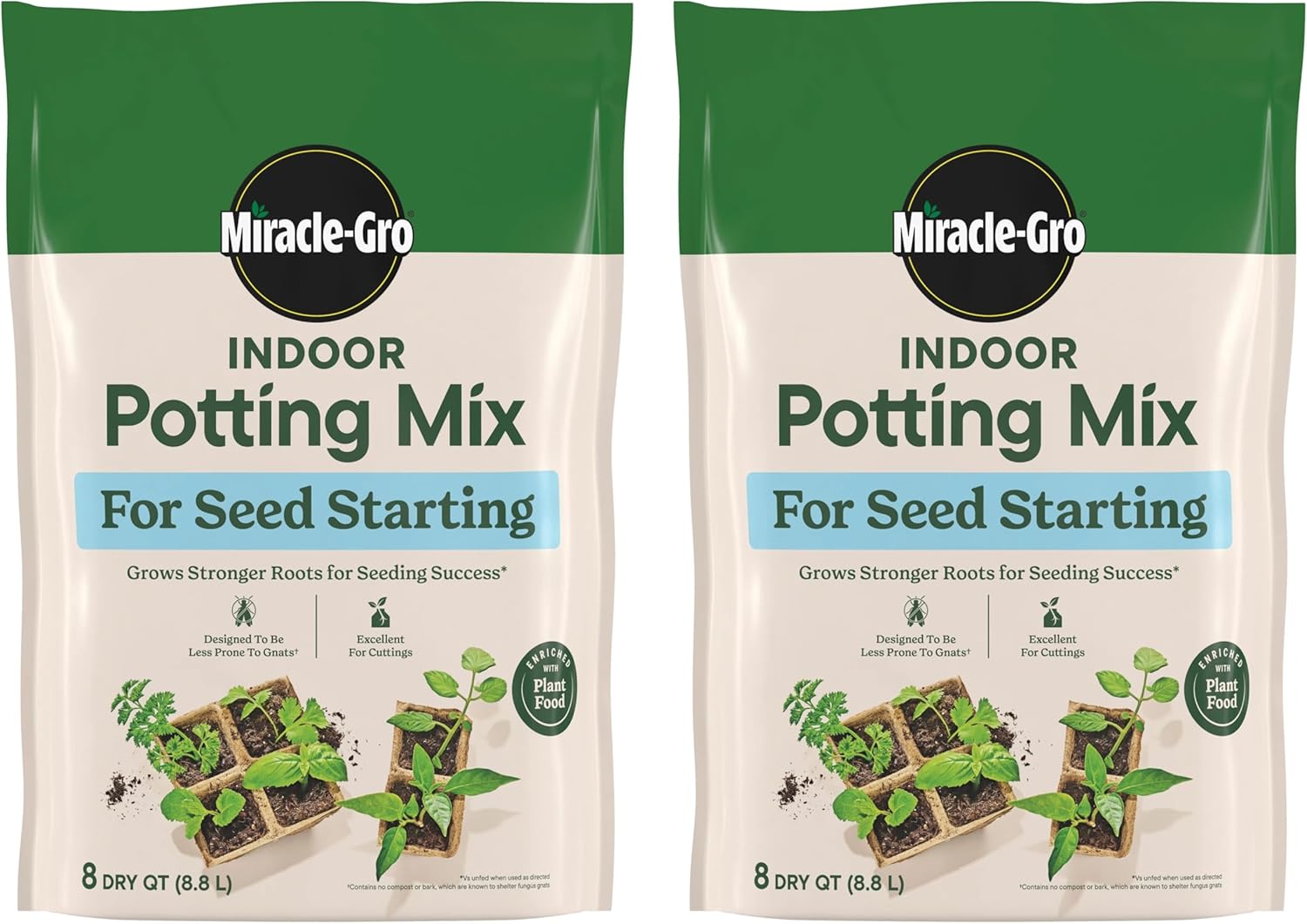
Miracle-Gro Indoor Potting Mix for Seed Starting, 8 qt. (2-Pack)
| Brand Name | Miracle-Gro |
|---|---|
| Item Type Name | Potting Mix |
| Number of Packs | 2 |
| Volume | 8 quarts |
This two-pack of Miracle-Gro Indoor Potting Mix is designed specifically for starting seeds and rooting cuttings indoors. The blend is lightweight and pre-enriched with plant food so seedlings get a nutrient boost during early root development, and the manufacturer says it yields stronger roots compared with unfed mixes when used as directed. It is intended for vegetables, flowers, and herbs and works well in cell trays and small containers; one 8 qt. bag will fill roughly three 72-cell trays. Notably, the formula omits compost and bark, which helps lower the chance of fungus gnat infestations in damp seed-starting setups. Use it by filling trays or pots, keeping the mix evenly moist, and shielding newly sown seeds from direct sun until germination. Important limitations are standard for enriched mixes: it contains fertilizer (so handle carefully) and it is a seed-starting medium rather than an all-purpose potting soil for mature plants, so you will likely transplant seedlings into a different mix or amend soil later.
Best for: Buyers who want a low-effort, indoor seed-starting medium that supports faster root development and reduces common pest risks while following proven seed-starting practices.
Less Ideal for: Gardeners who need a permanent potting soil for mature container plants or who prefer fully organic, compost-rich mixes should consider alternatives.
- Lightweight, ready-to-use formula tailored for seed germination and cuttings
- Pre-enriched with plant food to support early root and seedling growth
- Excludes compost and bark to reduce habitat for fungus gnats
- Comes as a two-pack so you have enough mix for multiple trays
- Contains fertilizer which requires careful handling and storage
- Intended for seed starting so not formulated as long-term potting soil for mature plants
Verdict: A practical, low-risk seed-starting mix that boosts early root growth and reduces fungus gnat risk, making it a reliable choice for indoor vegetable seedlings.
Back to the Roots Organic Expanding Coco Coir Potting Soil Brick (10 lb)

| Item Highlight | 10 lb compressed coco coir brick; peat-free; OMRI Listed |
|---|---|
| Item Type Name | Coconut Coir |
| Volume | 2 cubic feet |
| Ingredients | Coconut Coir |
| Style Name | Expanding Potting Soil |
This compressed coco coir brick provides a lightweight, peat-free potting medium that expands when you add water to create loose, airy substrate for containers and seed flats. It is typically used by hydrating the 10 lb block to about 2 cubic feet of coir and then using it alone for potted plants, mixing it into garden soil to improve drainage and aeration, or blending with compost for starting seeds. Notable features include OMRI listing for organic use, a balanced pH suited to a wide range of plants, and compact storage before expansion which saves space. Practical benefits are improved root aeration and water retention compared with heavy garden loam, easier handling than bulky bags, and versatility across vegetables, herbs, and ornamentals. Important limitations are that coco coir is a soilless substrate and does not supply significant nutrients on its own so you will need to add fertilizer or compost for long-term potted herbs like rosemary, and the product requires time and a water source to expand before use.
Best for: Buyers who prioritize low-risk, easy-to-handle, organic potting media and want a versatile base for container herbs and seed starting without dealing with heavy bags.
Less Ideal for: Gardeners who want a ready-to-plant, nutrient-rich potting mix out of the box or those who prefer soil with built-in slow-release fertilizer.
- Peat-free OMRI listed organic coco coir suitable for organic growing
- Expands from a compact brick to about 2 cubic feet for easy storage and transport
- pH balanced and airy texture that improves drainage and root aeration
- Versatile use: can be used alone, for seed starting, or mixed into existing soil
- Provides little inherent fertility so supplemental feeding or compost is needed for nutrient-hungry plants
Verdict: A compact, peat-free coco coir brick that expands into an airy, pH-balanced base ideal for low-risk organic container gardening and seed starting when paired with fertilizer or compost.
Choosing the Right Soil for Sowing Seeds: Key Factors to Consider
Texture and Particle Size
Texture determines how closely soil crumbles around tiny seeds. A fine, uniform particle size lets very small seeds make intimate contact with the medium so they can absorb moisture and germinate reliably. Conversely, coarse particles create air gaps that can cause erratic moisture levels and poor contact, which leads to missed germination or uneven stands.
For larger seeds, a slightly coarser but still well-graded texture can work, but most seed-starting soils aim for a uniform, peat-free or peat-reduced fine crumb that supports both moisture and oxygen at the seed surface. When choosing a soil, inspect for clumps, large chunks of wood, or very sandy feel; these will change germination outcomes and watering frequency.
Drainage Versus Moisture Retention
Seedlings are vulnerable to both drowning and drying out. The ideal mix holds moisture where seeds can access it but also drains excess water quickly so roots are not left in waterlogged conditions that cause rot. That balance is achieved by including materials that retain water at a micro level while leaving macropores for excess flow.
When evaluating soils, consider how often you can realistically water. A mix with stronger retention is helpful for busy gardeners or for heat mats that speed germination. Well-draining mixes are safer in cool, poorly ventilated environments because they lower damping-off risk. Choose a soil that matches your watering habits and germination environment rather than assuming one mix suits all conditions.
Starter Nutrient Balance
Seeds contain nutrients for germination, so starting mixes should not be heavily charged with fertilizers. Too much soluble nitrogen or salts can burn delicate radicles and cotyledons. At the same time, having a small, gentle reserve of nutrients helps seedlings transition to true leaves without immediate fertilization.
Look for soils described as low or moderate starter fertility or those formulated specifically for seed starting. These mixes provide modest nutrient availability and rely on follow-up feedings once roots and leaves develop. If you plan to transplant directly into the garden soon after true leaves appear, a very low-fertility mix is acceptable because outdoor soil will supply nutrients.
pH and Chemical Stability
Many common garden seeds prefer a slightly acidic to neutral pH. A stable pH in that range supports nutrient availability and prevents deficiencies that can stunt seedlings early on. Some mixes include lime or other amendments that alter pH; if you are sowing pH-sensitive crops, check that the mix is within the recommended range.
Chemical stability also means mixes should not release excessive salts or volatile compounds. Freshly bagged materials like uncomposted bark or certain manures can temporarily tie up nutrients or emit compounds that hinder germination. A properly processed seed mix minimizes such risks.
Cleanliness and Disease Risk
Seed-start mixes should be low in weed seed and free of common pathogens. Contaminated soil increases the chance of damping-off, fungal problems, and weed competition, which can ruin a tray of seedlings quickly. Professional seed mixes are often pasteurized or manufactured under conditions that lower these risks.
If you reuse containers or repurpose garden soil, sterilization and careful inspection are necessary. For many gardeners, choosing a clean, purpose-made seed soil reduces time spent troubleshooting mold, algae, or early-season pests.
Handling and Practical Use
How a soil behaves during filling, sowing, and transplanting affects everyday success. Dusty, overly dry mixes can be messy and make seed placement difficult. Very wet or compacted mixes are hard to level and can lead to uneven sowing depth. A good seed soil crumbles easily, is simple to moisten evenly, and fills trays and cells without compressing excessively.
Consider the container size you use most often. Some mixes are optimized for fine cells and small trays and will compress too much in larger pots. Others are made to bulk up for direct sowing in deeper containers. Choose a handling profile that matches your workflow to reduce transplant shock and labor.
Preparing Your Sowing Station
Set up seed trays, labels, and water source before opening bags of soil to keep the mix consistent and avoid overhandling. Use a flat surface and check that trays have adequate drainage. If you are sowing many small seeds, a tray with many shallow cells encourages even depth and simple management.
Pre-moisten the soil to field-moist texture before filling trays. Dry mixes can be difficult to settle around seeds and often cause uneven watering. Bring the medium to a uniform dampness, then fill and level cells so seeds sit at the intended depth.
- Use room-temperature water to avoid shocking seeds during wetting.
- Fill trays to a consistent height to keep sowing depth uniform.
- Label trays with seed variety and sowing date to track germination timing.
Sowing Depth and Seed-Soil Contact
Different seeds need different depths, but a guiding rule is to sow no deeper than twice the seed diameter. Tiny seeds often need only surface contact with a gentle press of soil to ensure moisture uptake. Larger seeds can be buried deeper in a slightly coarser pocket of the mix to encourage downward root growth.
Good seed-to-soil contact is critical. After placing seeds, pat the surface gently or apply a very light dusting of fine mix to stabilize them. Avoid packing the soil firmly over seeds; instead, aim for light contact that preserves oxygen around the seed.
- Very small seeds: surface sow or barely cover.
- Medium seeds: cover to a depth about equal to seed width.
- Large seeds: plant deeper to anchor emerging stems.
Moisture Management During Germination
Maintain steady moisture without saturating the medium. Bottom watering helps establish hydration at the root zone while reducing surface disturbance for tiny seeds. Use a shallow tray under pots and allow the soil to wick up water for a controlled approach.
Covering seeded trays with a clear dome or plastic wrap can preserve humidity and speed germination, but remove coverings as soon as true leaves appear to prevent fungal growth. Check trays daily; small changes in air temperature or ventilation can change moisture needs quickly.
- Use a spray bottle for gentle surface moisture on fragile seedlings.
- If using heat mats, reduce surface humidity to avoid damping-off.
- Rotate trays for even light and temperature exposure.
Transitioning Seedlings to Potting or Outdoors
Transplant when seedlings have developed a few true leaves and a healthy root ball. If the starting soil is very low in nutrients, plan to introduce diluted feed at first potting. If you will move seedlings outdoors, harden them off gradually over a week to acclimate light and wind conditions.
When lifting seedlings, preserve as much of the original soil around the roots as possible to minimize transplant shock. Using a fine seed mix that stays coherent around small root systems helps reduce root disturbance during transfer.
- Start hardening off with short exposures to wind and sun, increasing daily.
- Water seedlings before transplanting to ease removal and protect roots.
- Match potting mix texture to the next growth stage to avoid root binding.
Environmental Considerations for Indoor and Cold-Frame Sowing
Indoor sowing, heated benches, and cold frames create different moisture and temperature regimes. Heated environments speed germination but often increase the risk of fungal issues, so favor mixes with better drainage there. Cooler sowing locations benefit from mixes with slightly higher water retention so seeds do not dry out between checks.
Light levels and air circulation also shape your soil choice. In low-light indoor setups reduce organic fines that hold moisture at the surface and promote algae. In outdoor cold frames, choose soils that remain friable after freeze-thaw cycles and do not compact when damp.
- Heated germination: prioritize quick-draining mixes.
- Cool locations: prefer mixes with greater moisture-holding capacity.
- Ensure ventilation to reduce humidity-related diseases.
How We Chose the Best Soil for Sowing Seeds
We focused on characteristics that directly affect seed germination and seedling health. Our selection criteria prioritized particle size and texture because fine, even texture ensures close seed-to-soil contact and consistent moisture; drainage and water-holding capacity to prevent both drying and saturation; nutrient profile and starter fertility to avoid burning tender roots while supplying enough food for initial growth; and pH stability since many vegetable and flower seeds prefer a near-neutral range. We also considered contamination risk, preferring mixes with low weed seed and pathogen presence, and handling convenience such as dust control and ease of filling trays. Excluded from consideration were garden topsoil or heavy clay soils that are not formulated for seed starting, and mixes intended only for mature container plants because their higher fertilizer loads and coarse structure can harm seeds. The final shortlist balances lab-style seed-start mixes with lighter amended soils suitable for direct sowing in small containers and cold frames. Those dimensions – particle texture, drainage versus moisture retention, starter fertility, pH stability, and cleanliness – guided both inclusion and ranking.
FAQ
Can I use garden soil for sowing seeds?
Garden soil often contains weed seeds, pathogens, and variable texture that can inhibit germination. It can be used if sterilized and amended, but purpose-made seed soils are generally safer and more consistent for reliable starts.
Should seed starting soil contain fertilizer?
Seed mixes should have low to moderate starter nutrients. Too much fertilizer can burn seedlings, while none at all may require earlier feeding. A gentle, low-salt starter level is usually best until true leaves form.
How do I prevent damping-off in seeded trays?
Control moisture and airflow, avoid overwatering, and use a clean, disease-free seed mix. Removing covers once seedlings appear, using sterile containers, and not over-crowding trays all reduce damping-off risk.
When should I transplant seedlings from seed soil into potting mix?
Transplant after seedlings have a couple of true leaves and a visible, healthy root system. If the starting soil is low in nutrients, move to a nutrient-richer potting mix or begin light fertilization at transplant.
How do I moisten dry seed mix without compacting it?
Pre-moisten the mix in a bucket by adding water gradually and stirring until it reaches a uniformly damp, crumbly texture. Avoid packing when filling trays and use bottom-watering to settle the medium without compressing it.
Can I reuse seed-starting soil from last season?
Reusing soil is possible but risky if it harbors disease or weed seeds. Sterilize or refresh with new, clean components and consider adding starter nutrients. Many gardeners prefer fresh seed mix for the most predictable results.
Final Verdict
Choose a seed-starting soil that matches your sowing conditions and workflow: fine, uniform texture for reliable seed contact; the right balance of drainage and moisture retention for your environment; gentle starter fertility to protect tiny roots; and cleanliness to reduce disease and weeds. Tradeoffs are inevitable. If you need lower maintenance, favor a mix with higher retention; if you use heat or sow in cool, poorly ventilated areas, prefer faster-draining blends. Focus on the criteria outlined here and you will get more consistent germination and stronger seedlings ready for potting or planting out.
