

Note: This article contains affiliate links. If you click on these links and make a purchase, I may earn a small commission at no extra cost to you. This helps support my research and content. Read my full affiliate disclosure here.
Starting tomato seeds in the right medium makes a big difference in germination rates and early seedling vigor. The wrong soil holds too much water, lacks nutrients, or compacts, which can stunt roots and invite damping-off. This guide covers seven shortlisted soils for tomato seeds that are suited to indoor seed starting, small greenhouse trays, and heated propagators. We evaluated mixes for drainage, texture, nutrient balance, and disease resistance so you can pick a medium that helps seedlings grow into vigorous transplants. Read on to see how each option stacks up against the needs of tomato seedlings and which traits matter most when you plant your next batch of seeds.
Top Picks at a Glance
| Best Overall The best all-around choice for most situations | Espoma Organic Seed Starter Premium Potting Mix, 16 qt |  |
| Best Quality Built to a higher standard if you want something more solid | Burpee Premium Organic Potting Mix with Coco Coir (9 Quart) |  |
| Best Value The sweet spot between price and what you get | SunGro Horticulture Organic Seedling Mix (8 Quart) |  |
| Best Budget The cheapest option that still gets the job done reliably | Back to the Roots 3-in-1 Seed Starting Mix, 6 Quart, Organic Peat-Free |  |
| Highest Rated A top-rated pick with lots of positive feedback | Sol Soils Seedling & Propagation Mix (1 gal) |  |
| Most Popular A crowd favorite that many people choose with confidence | Miracle-Gro Indoor Potting Mix for Seed Starting, 8 qt. (2-Pack) |  |
| Best Seller A high-volume bestseller chosen again and again | ZeeDix 30mm Peat Seed Starter Pellets (55 pcs) |  |
Espoma Organic Seed Starter Premium Potting Mix, 16 qt

| Brand Name | Espoma |
|---|---|
| Volume | 16 quarts |
| Unit Count | 598.4 Ounce |
| Model Number | SS16 |
Espoma Organic Seed Starter is a peat-based, lightweight potting mix designed specifically for germinating seeds and rooting cuttings. The blend of sphagnum peat moss and perlite gives good aeration and drainage while the formula includes yucca extract to improve wetting and lime to balance pH. It also contains Myco-tone mycorrhizae to help early root establishment and improve nutrient access during the seedling stage. Typical use is filling trays, cells, or small pots for seeds and softwood cuttings; its fine texture and moisture retention reduce damping-off risk when used with proper sanitation and watering. Because it contains no synthetic fertilizers, it is appropriate for organic growing but you will need to begin light feeding once true leaves form or when transplanting. The bag size covers routine home-seed-starting needs, and the product is straightforward to handle and mix for small-scale propagation projects.
Best for: Gardeners focused on reliable seed germination and strong early root development who want an organic, ready-to-use mix for trays and small pots.
Less Ideal for: Growers wanting a peat-free or pre-fertilized seed mix or those starting very large volumes commercially should consider alternatives tailored to those needs.
- Formulated for seedlings with peat and perlite for balanced aeration and moisture retention
- Includes Myco-tone mycorrhizae to support early root development
- Organic ingredients with no synthetic fertilizers, suitable for organic growing
- Contains yucca extract to improve wetting and lime to help stabilize pH
- No starter nutrients included so plants need feeding after true leaves appear
- Peat-based mix is not the most sustainable choice for gardeners preferring peat-free media
Verdict: Choose this organic seed starter when you want a ready-to-use mix that promotes rapid root development and reliable germination for home seedlings and cuttings.
Burpee Premium Organic Potting Mix with Coco Coir (9 Quart)

| Item Form | Powder |
|---|---|
| Specific Uses For Product | Plant Growth, Root Development, Seed Development, Soil Conditioning |
| Coverage | 9 Qt Container |
| Liquid Volume | 9 quarts |
Burpee Premium Organic Potting Mix is a ready-to-use container soil designed for indoor and outdoor pots, seed starting, and raised bed containers. The mix combines coco coir for improved aeration and moisture retention with a nutrient blend that feeds plants for up to three months, making it useful for establishing seedlings or repotting established vegetables, herbs, and ornamentals. It is OMRI listed, which suits organic growers, and the bag is sold in a convenient 9-quart size that fits most small to medium containers. Practical benefits include reduced watering frequency thanks to the coir component and a balanced medium that promotes root development and germination. Limitations are the small bag size for larger projects and that it supplies nutrients for only a limited period, so longer-term containers will need supplemental fertilizer. The mix is powdery and light, so it is easy to handle but may compress over time in deep pots and benefit from occasional loosening.
Best for: Gardeners who want a compact, ready-made organic potting mix that reduces maintenance and supports reliable seed starting and container growth.
Less Ideal for: Those establishing large beds or filling many large containers at once should choose bulk soil or larger bags instead.
- OMRI listed organic blend suitable for organic container gardening
- Coco coir improves moisture retention while maintaining good aeration
- Includes slow-release nutrients that feed plants for up to three months
- Light, easy-to-handle texture ideal for seed starting and repotting
- 9-quart bag is small for larger containers or multiple pots
- Nutrient supply is temporary so additional fertilizer is required for long-season crops
Verdict: A compact OMRI-listed potting mix with coco coir that simplifies seed starting and short-term container growing by improving moisture balance and early root development.
SunGro Horticulture Organic Seedling Mix (8 Quart)

| Brand Name | SUN GRO |
|---|---|
| Style Name | Peat Moss |
| Volume | 8 quarts |
SunGro Horticulture Seedling Mix is a fine-textured, peat-based starting mix formulated to germinate seeds in flats, pots, and plug trays. It contains sphagnum peat moss, perlite for lightness and drainage, and an organic wetting agent to promote even water absorption, which helps maintain consistent moisture for small seeds. The mix also includes a silicon-enriched additive called RESiLIENCE intended to support stronger seedlings and reduce wilting during establishment. Typical use is filling trays or small pots, keeping the medium evenly moist but not waterlogged, then transplanting seedlings once roots are established. Practical benefits include predictable moisture retention, a clean fine texture that allows delicate roots to develop, and OMRI listing for organic onion transplants and other edible starts. Limitations are its small 8 quart volume for larger onion seed programs and that peat-based mixes dry out faster than heavier soils, so frequent monitoring is required; it also provides limited long-term nutrients so potting up into a richer mix or fertilizing before transplant is necessary.
Best for: Gardeners who want an organic, predictable seed starting medium for small to medium onion seed batches and who prioritize reliable germination over bulk volume.
Less Ideal for: Commercial growers or anyone starting very large quantities of onion seedlings should choose larger-volume or more nutrient-dense starting media.
- Fine, light texture suitable for delicate seed germination
- Organic wetting agent promotes uniform water absorption
- OMRI listed so safe for organic edible starts
- Contains perlite for improved drainage and root aeration
- Small 8 quart bag may not be cost-effective for starting large onion batches
- Peat-based mix has low long-term nutrient content and needs fertilizing before transplant
Verdict: A reliable OMRI-listed seed starting mix that delivers even moisture and a fine texture ideal for producing healthy onion seedlings in small home gardens.
Back to the Roots 3-in-1 Seed Starting Mix, 6 Quart, Organic Peat-Free

| Unit Count | 192 Fluid Ounces |
|---|---|
| Style Name | 3-in-1 Seed Starting Mix |
| Brand Name | Back to the Roots |
| UPC | 810667035822 |
This 6-quart Back to the Roots 3-in-1 Seed Starting Mix is a peat-free, organic blend aimed at making seed starting and early potting simple. You use it straight from the bag to fill trays, small pots, or starter cells; the mix includes coconut coir for water retention, dolomitic limestone to balance pH, mycorrhizae to support root uptake, and yucca extract for moisture control. Practically, that means fewer extra amendments for a new gardener and a more forgiving environment for delicate seedlings. The formula is designed to drain well while retaining enough moisture for even watering, and the included nutrients and worm castings can reduce early feeding. Limits to note are the small 6-quart volume, which is best for hobby-scale starting rather than large beds, and a lighter texture that may dry faster in very hot, exposed conditions. For budget growers who want an all-in-one starter mix without experimenting with multiple additives, this is a convenient choice.
Best for: Great for budget-minded home gardeners who want a single, ready-to-use seed starting mix that reduces extra amendments and simplifies starting herbs, vegetables, and flowers.
Less Ideal for: Not the best fit for landscapers or gardeners starting large numbers of plants or filling large containers where bulk bagged mixes would be more economical.
- Peat-free organic formula with coconut coir for moisture retention and aeration
- Includes mycorrhizae and worm castings to support early root development and nutrient uptake
- pH balancing with dolomitic limestone reduces the need for corrective amendments
- Ready-to-use blend suitable for seed trays, small pots, and indoor container starts
- Only 6 quarts per bag, so multiple bags are needed for larger projects
- Light, fast-draining texture can require more frequent watering in hot or windy conditions
Verdict: A convenient, peat-free all-in-one starter mix that saves time and extra purchases for home gardeners starting small batches of seeds.
Sol Soils Seedling & Propagation Mix (1 gal)

| Brand Name | sol soils |
|---|---|
| Style Name | Seedling & Propagation Mix |
| Unit Count | 128 Ounce |
| Volume | 1 gallons |
This Seedling & Propagation Mix is designed specifically for starting seeds and rooting cuttings. It combines calcined clay for moisture buffering and aeration, hardwood biochar to improve structure and microbial activity, coconut husk as a peat-free moisture-retentive medium, and earthworm castings to supply gentle nutrients. In practice the mix is fine-textured and holds water without becoming soggy, which helps delicate roots establish while reducing the risk of damping-off. It is sterile out of the bag and compatible with most plant types, so you can use it in trays, small pots, or plug cells for both indoor seed starting and greenhouse propagation. Bags are hand-mixed in small batches so texture varies slightly between bags, but the ingredients are chosen to extend time between waterings and resist compaction over a single growing cycle. Important limitations: the bag is one gallon so larger or repeated projects will require multiple bags, and users should soak coconut husk as recommended to remove tannins before heavy use.
Best for: Buyers who prioritize reliable, low-maintenance seed starting want a consistent, sterile medium that reduces overwatering risk and helps fragile roots establish. Ideal for hobbyists and small greenhouse growers focused on dependable results.
Less Ideal for: Not a good fit for growers who need large volumes for broadscale sowing or those who prefer DIY mixes tailored to specific crop nutrient profiles.
- Blend formulated for seedlings with calcined clay for moisture consistency and aeration
- Hardwood biochar and castings support beneficial microbes and gentle nutrient supply
- Peat-free coconut husk improves moisture retention while providing aeration
- Fine texture and sterile mix suitable for trays, small pots, and cuttings
- Small 1 gallon volume may be insufficient for larger seed-starting projects
- Batch-to-batch texture variability due to small-batch mixing
Verdict: A dependable, fine-textured peat-free propagation mix that helps seedlings and cuttings establish with less risk of overwatering.
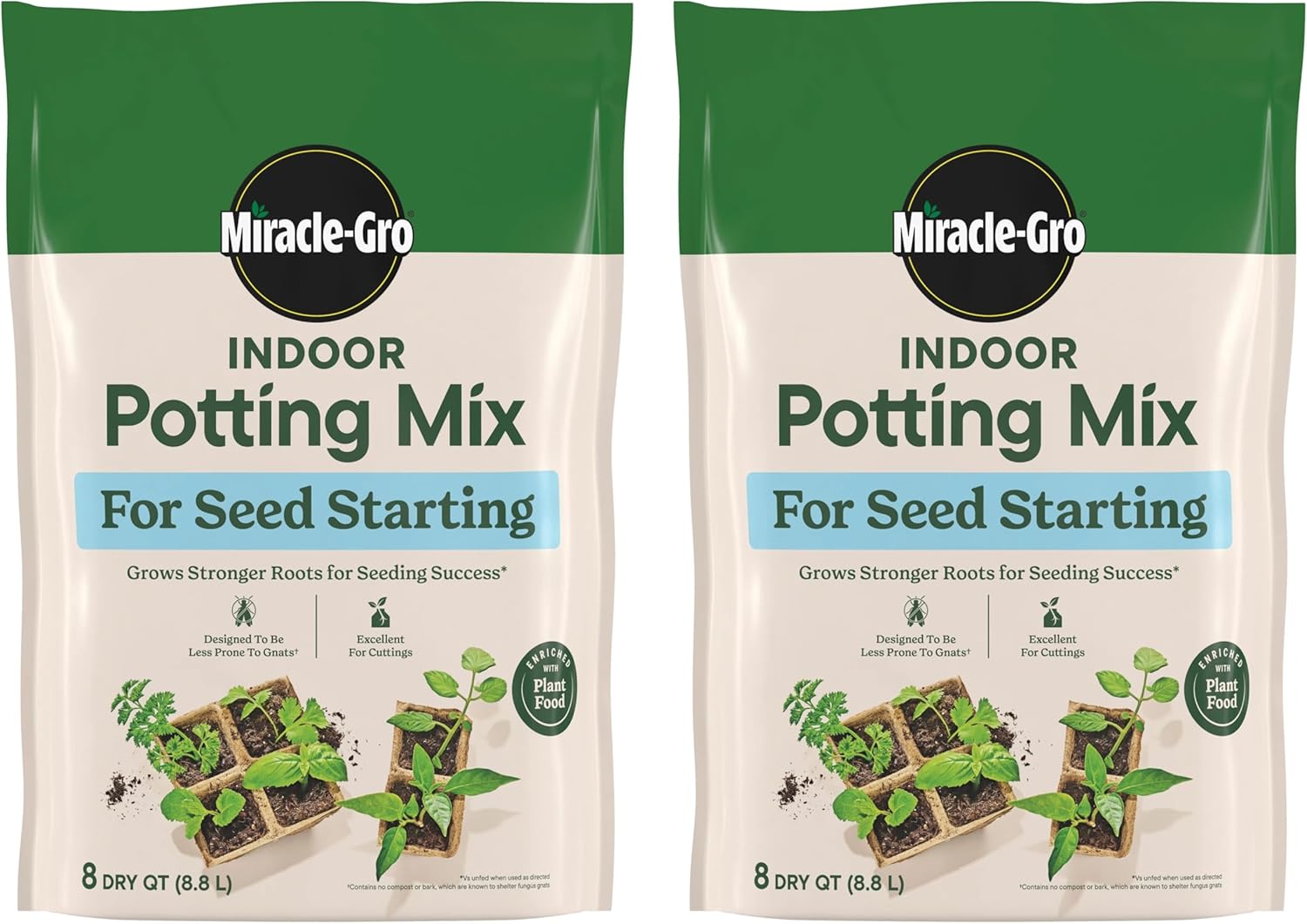
Miracle-Gro Indoor Potting Mix for Seed Starting, 8 qt. (2-Pack)
| Brand Name | Miracle-Gro |
|---|---|
| Item Type Name | Potting Mix |
| Number of Packs | 2 |
| Volume | 8 quarts |
This two-pack of Miracle-Gro Indoor Potting Mix is designed specifically for starting seeds and rooting cuttings indoors. The blend is lightweight and pre-enriched with plant food so seedlings get a nutrient boost during early root development, and the manufacturer says it yields stronger roots compared with unfed mixes when used as directed. It is intended for vegetables, flowers, and herbs and works well in cell trays and small containers; one 8 qt. bag will fill roughly three 72-cell trays. Notably, the formula omits compost and bark, which helps lower the chance of fungus gnat infestations in damp seed-starting setups. Use it by filling trays or pots, keeping the mix evenly moist, and shielding newly sown seeds from direct sun until germination. Important limitations are standard for enriched mixes: it contains fertilizer (so handle carefully) and it is a seed-starting medium rather than an all-purpose potting soil for mature plants, so you will likely transplant seedlings into a different mix or amend soil later.
Best for: Buyers who want a low-effort, indoor seed-starting medium that supports faster root development and reduces common pest risks while following proven seed-starting practices.
Less Ideal for: Gardeners who need a permanent potting soil for mature container plants or who prefer fully organic, compost-rich mixes should consider alternatives.
- Lightweight, ready-to-use formula tailored for seed germination and cuttings
- Pre-enriched with plant food to support early root and seedling growth
- Excludes compost and bark to reduce habitat for fungus gnats
- Comes as a two-pack so you have enough mix for multiple trays
- Contains fertilizer which requires careful handling and storage
- Intended for seed starting so not formulated as long-term potting soil for mature plants
Verdict: A practical, low-risk seed-starting mix that boosts early root growth and reduces fungus gnat risk, making it a reliable choice for indoor vegetable seedlings.
ZeeDix 30mm Peat Seed Starter Pellets (55 pcs)

| Unit Count | 50 Count |
|---|---|
| Item Highlight | Easy Transplant & High Expansion, Ideal Seedling Soil for Vegetables, Herbs, Flowers, Succulents & Cacti, Cat Grass, Bonsai |
| Material | Organic sphagnum peat moss |
| Style Name | Indoor & Outdoor Gardening |
These ZeeDix peat pellets are ready-made seed-starting plugs designed for indoor germination. Each compressed pellet expands when watered into a loose, peat-based plug held in a non-woven net so you can sow seeds directly into the pellet, keep them moist while they germinate, then transplant the whole plug into a pot or garden without disturbing roots. The sphagnum peat composition provides good water retention and aeration that helps delicate seedlings and improves transplant survival. The netting keeps the medium intact and reduces mess on trays, which is handy for windowsill setups and beginner-friendly seed trays. They are simple to use for vegetables, herbs, flowers, succulents and grass, making them suitable for quick projects or parent-child planting activities. Limitations are that these are peat-based rather than a balanced potting mix so you may want to fertilize seedlings before long-term potting, and peat can compact if overwatered or used for very slow-growing plants that need more volume. For cautious indoor seed starting they offer a low-effort, low-mess option with reliable germination performance.
Best for: Buyers who want a simple, low-mess indoor seed-starting solution that minimizes handling of fragile seedlings and prioritizes reliable germination over tinkering with custom mixes.
Less Ideal for: Gardeners who prefer peat-free or DIY seed mixes, or those who need larger-volume plugs for slow-growing seedlings or extended nursery periods.
- Ready-to-use compressed plugs that expand with water for quick setup
- Non-woven netting allows transplanting the whole plug without root disturbance
- Peat-based medium holds moisture and supports early root development
- Compact and tidy for indoor trays and windowsill seed starting
- Made from sphagnum peat which may need supplemental fertilization for longer-term growth
- Smaller 30mm size offers limited growing volume for larger or slow-growing seedlings
Verdict: If you want a low-effort, low-mess indoor seed-starter that makes transplanting easy, these preformed peat pellets are a practical choice.
Choosing the Right Soil for Tomato Seeds: Key Factors to Consider
Drainage and Aeration
Tomato seeds and young seedlings need a medium that drains freely while still holding some moisture. Good drainage prevents waterlogged conditions that reduce oxygen at the root zone and invite root rot. Aeration keeps the tiny roots healthy and encourages fine feeder root development, which is critical for nutrient uptake after transplanting.
Look for mixes with coarse components such as perlite, vermiculite, or aged bark that create pore space. A seed-starting layer that compacts easily will reduce pore space after a few waterings, so consider how the mix behaves when wet as well as dry.
Nutrient Balance and Starter Fertilizer
Tomato seeds do not need heavy feeding to germinate, but seedlings require a gentle, balanced nutrient supply once the first true leaves appear. A good seed-starting soil often contains a light, slow-release starter nutrient or a low-dose soluble feed designed not to burn delicate roots.
Avoid mixes overloaded with high-strength fertilizers intended for mature plants. The right balance supports steady, healthy growth and reduces the need for early transplant shock treatments.
Cleanliness and Disease Prevention
Damping-off and seedling fungal infections are common problems in indoor propagation. Sterile or heat-treated mixes greatly reduce the microbial load that causes these issues. Packaging that protects the mix from contamination during storage is also important, since a contaminated bag will spread pathogens to every tray.
Even clean mixes can pick up pathogens from dirty trays or tools, so pair a sterile medium with good sanitation practices. Consider mixes labeled for disease resistance or those produced under controlled conditions if damping-off has been a past problem.
Texture, Particle Size, and Consistency
Uniform texture and consistent particle size make sowing and root development predictable. Very fine, dusty mixes can form a crust on the surface that inhibits emergence, while overly coarse mixes may not retain enough moisture for tiny seeds.
A well-graded mix balances fine particles for seed contact with larger particles for airflow. Consistency between batches also matters if you start seeds across multiple seasons; look for manufacturers that list ingredients and particle characteristics.
Moisture Retention Versus Watering Frequency
Different growers prefer different watering rhythms. Some mixes retain more moisture and reduce how often you need to water, which is helpful for busy gardeners or unheated propagators. Other mixes prioritize fast drainage and require more frequent monitoring, which can be advantageous under warm, well-ventilated conditions.
Consider your propagation setup and schedule. If you use bottom watering or humid domes, a faster-draining mix paired with those methods can deliver steady moisture without saturation.
Why Seed-Starting Mixes Differ From Garden Soil
Garden soil contains living organisms, mineral particles, and variable organic matter that make it excellent in beds but unpredictable in trays. Seed-starting mixes are formulated to be lighter and cleaner, which helps tiny seedlings access oxygen and avoid pathogens.
Using a purpose-made mix reduces transplant shock and gives you a more consistent environment across trays, so germination rates and early growth are easier to manage.
- Seed-starting mixes emphasize sterility and uniform texture.
- Garden soil can compact and hold too much moisture for seedlings.
- Starter mixes are designed to support the first set of true leaves rather than sustained, long-term fertility.
How to Prepare Soil for Sowing Tomato Seeds
Fill clean trays or pots with your chosen mix and gently firm it to remove large air pockets while preserving porosity. Moisten the medium before sowing so seeds sit against a consistently damp surface without being waterlogged.
Sow seeds at the recommended depth, generally shallow for tomato seeds, and cover lightly. Use a spray bottle or fine mister to avoid displacing seeds. Cover trays with a clear dome or plastic wrap until germination to maintain humidity, then remove promptly once seedlings emerge to reduce disease risk.
- Pre-moisten mix to uniform dampness before filling trays.
- Sow seeds shallow and avoid burying too deep.
- Use gentle bottom or mist watering to avoid disturbance.
Light, Temperature, and Soil Interaction
Soil temperature and light work together to influence germination and stretch. Tomato seeds germinate best when the medium is warm, typically in the mid-60s to mid-70s Fahrenheit, and adequate light after emergence prevents leggy seedlings.
Choose a mix that responds predictably to warming mats and that does not retain excessive cold or heat. Warm, well-draining media support consistent germination times across trays.
- Warm the medium for faster germination when needed.
- Provide bright, even light after emergence to avoid stretching.
- Match watering to temperature: warmer conditions dry mixes faster.
When to Pot Up and When to Transplant
Transplant seedlings into larger pots when roots begin to circle the cell or when the first true leaves appear and growth slows in cramped cells. Repotting into a slightly richer potting mix can give the young plant the extra nutrients it needs before moving outdoors.
Avoid long-term growth in thin seed-starting mixes alone; they are optimized for early stages. Harden off transplants gradually and ensure the final bed or container soil is well prepared to accept the young tomato plants.
- Watch root development, not just top growth, to time potting up.
- Move seedlings to a balanced potting mix before final transplant.
- Harden off gradually to reduce shock when moving outdoors.
Common Problems and Fixes in Seed-Starting Soil
If seeds fail to germinate uniformly, check moisture, seed age, and soil temperature first. Patchy germination often comes from uneven moisture or cold spots in the tray rather than the mix itself.
Damping-off shows as collapsed stems near the soil line. Improve airflow, avoid overwatering, and choose a sterile mix next season. For nutrient deficiencies after emergence, use a diluted soluble feed rather than dumping heavy fertilizer into the seed mix.
- Uneven germination: check moisture and temperature consistency.
- Damping-off: increase airflow and use sterile mixes.
- Yellowing true leaves: use light, balanced feeds rather than heavy fertilizer.
How We Chose the Best Soil for Tomato Seeds
We prioritized traits that affect the earliest and most vulnerable stage of tomato production: seed germination and seedling establishment. Our editorial filters favored mixes with consistent particle size and drainage to avoid waterlogged roots, a measured nutrient profile that supports the first true leaves without burning delicate roots, and clean manufacture or treatment methods that reduce fungal pathogens that cause damping-off. We also considered physical handling and practical use in real gardens: how the mix compacts after watering, whether it can be used straight from the bag or benefits from light amendments, and compatibility with common propagation methods such as trays, peat pots, and cell packs. Longevity in storage and packaging that protects sterility were additional factors. Products were excluded if they lacked clear ingredient lists, relied solely on heavy garden loam without amendment for seed starting, or had known contamination issues. The criteria that mattered most were texture and drainage, nutrient balance and starter fertilizer, cleanliness and disease prevention, moisture retention versus aeration, and ease of use for indoor propagation. These dimensions align with the scoring metrics used throughout the guide.
FAQ
Can I start tomato seeds in regular potting soil?
You can, but regular potting soil often contains heavier organic matter and can compact in small cells. That increases damping-off risk and may reduce oxygen at the root zone. If using potting soil, blend in perlite or vermiculite to improve drainage and aeration.
Do I need to sterilize soil before sowing tomato seeds?
Commercial seed-starting mixes are usually sterile and do not require additional treatment. If you use garden soil or homemade mixes, heat-treating small batches can reduce pathogens, but proper sanitation of trays and tools is also essential.
When should I begin fertilizing tomato seedlings?
Wait until seedlings have their first true leaves and show steady growth. Start with a diluted, balanced soluble fertilizer at a low concentration and increase gradually as plants develop stronger root systems.
How deep should I sow tomato seeds in the mix?
Tomato seeds are small and should be sown shallow, typically about twice their thickness, which is usually just under a quarter inch. Lightly cover or press the seed into the surface so it has good contact with the moist medium.
How do I prevent damping-off in seed trays?
Use a sterile seed-starting mix, avoid overwatering, provide good air circulation, and remove plastic covers soon after emergence. Clean trays between uses and avoid crowding seedlings to reduce humidity buildup and fungal spread.
Final Verdict
Pick a seed-starting soil that balances drainage with enough moisture retention, offers a gentle nutrient profile for the first true leaves, and is produced or packaged to reduce disease risk. Your propagation setup and watering habits will influence whether a faster-draining or more moisture-retentive mix is better. Prioritize aeration, texture consistency, and cleanliness when choosing soil for tomato seeds. Those tradeoffs will determine germination success and how quickly seedlings become robust transplants, giving you the best start for productive tomato plants.
