

Note: This article contains affiliate links. If you click on these links and make a purchase, I may earn a small commission at no extra cost to you. This helps support my research and content. Read my full affiliate disclosure here.
Choosing the right solar pond aerator makes a noticeable difference in water clarity, fish health, and algae control for backyard ponds and water features. Solar units avoid running mains power and can be placed where cord access is limited, but not all systems deliver steady airflow or long-term durability in real outdoor conditions. This guide covers six carefully shortlisted solar pond aerators that suit small to medium ponds and seasonal use. We evaluated airflow output, power reliability, and weather resistance to help you pick a system that keeps oxygen levels consistent and maintenance low. Read on to see the criteria we used and the practical pros and cons to consider.
Top Picks at a Glance
| Best Overall The best all-around choice for most situations | NFESOLAR 4W Solar Pond Aerator with 2200mAh Battery Backup |  |
| Best Quality Built to a higher standard if you want something more solid | TXL Solar Pond Aerator Kit with 400W Solar Panels and 310W Compressor |  |
| Best Value The sweet spot between price and what you get | Biling 8W Solar Pond Aerator with 4400mAh Battery Backup |  |
| Best Budget The cheapest option that still gets the job done reliably | NFESOLAR 3W Solar Pond Aerator with 2200mAh Battery Backup |  |
| Highest Rated A top-rated pick with lots of positive feedback | My Natural Pond 100W Floating Solar Fountain Pump Kit |  |
| Most Popular A crowd favorite that many people choose with confidence | POPOSOAP 8W Solar Pond Aerator with 3 Modes and Built-in Battery |  |
NFESOLAR 4W Solar Pond Aerator with 2200mAh Battery Backup

| Power Source | Solar Powered |
|---|---|
| Horsepower | 4 watts |
| Voltage | 6 volts |
| Included Components | 3 air stones, 2 T-connectors, 8.8 ft PVC tubing, solar panel, pump with 2200mAh battery |
The NFESOLAR 4W Solar Pond Aerator is a self-contained air pump that runs from its 4W solar panel and stores energy in a built-in 2200mAh battery so it can oxygenate small ponds and water features day and night. Installation is straightforward: stake the solar panel, route the included 8.8 ft PVC tubing to the air stones and place them in the pond. Three modes let you choose strong continuous bubbling, a softer steady stream, or an intermittent cycle to conserve battery on cloudy days. The ABS housing and quiet operation make it suitable for backyard ponds where noise and visual clutter matter. Practical benefits include improved dissolved oxygen to reduce stagnation and odors, portable placement without wiring, and a complete kit with connectors and stones. Limitations are its modest 4W output, which targets small ponds or aquariums rather than large koi ponds, and its reliance on sunlight for recharging so runtime during extended overcast periods can be reduced despite the battery backup.
Best for: Gardeners who want a low-maintenance, plug-free aeration solution for small ponds, water gardens, or aquariums and value easy installation and steady oxygenation without constant servicing.
Less Ideal for: Owners of large or heavily stocked ponds who need high-volume aeration or users who expect continuous heavy-duty performance during extended cloudy seasons.
- Integrated 2200mAh battery enables 24/7 aeration including night and short cloudy periods
- Three operation modes (strong, soft, intermittent) let you balance oxygenation and battery use
- Complete kit includes solar panel, tubing, air stones, and T-connectors for quick setup
- Quiet operation and compact ABS construction minimize disturbance in garden settings
- 4W power is best suited to small ponds and may not provide enough airflow for larger koi ponds
Verdict: A compact, easy-to-install solar aerator that delivers reliable 24/7 oxygenation for small ponds and water features without wiring.
TXL Solar Pond Aerator Kit with 400W Solar Panels and 310W Compressor

| Power Source | Solar Powered |
|---|---|
| Horsepower | 310 watts |
| Item Highlight | 400W Solar Panels, 25.6V 6Ah LiFePO4 Battery, 100FT Tubing & 2 Diffusers |
| Material Type | Metal |
This TXL kit is a ready-to-install solar aeration system aimed at keeping larger ponds well oxygenated without grid power. The kit bundles two solar panels (400W total), a 310W aerator/compressor, a 25.6V 6Ah LiFePO4 battery, a controller with timer and 100 feet of tubing with two diffuser plates. In practice you mount the panels in full sun, position diffusers near deeper areas and program the controller for repeated short cycles to match the recommended 20 minutes on/20 minutes off pattern for steady operation and battery protection. The controller is rated waterproof and includes a power-outage memory function, while the compressor is described as low-noise and uses copper windings for longer life. This system gives substantial continuous aeration during sunny periods and limited battery-powered runtime after dusk. Expect straightforward setup and effective bubble distribution from the stainless-steel-connected diffusers, but know the battery capacity is modest so continuous overnight operation is not realistic without extra battery capacity or more panel exposure.
Best for: Buyers who prioritize strong daytime performance and want a powerful off-grid aeration solution for larger ponds, preferring a mostly solar-driven system they can schedule and maintain themselves.
Less Ideal for: Gardeners who need uninterrupted round-the-clock aeration in shaded locations or very large lakes should consider systems with larger battery banks or grid-tied compressors instead.
- High output aerator (310W) paired with 400W of solar panels for strong daytime oxygenation
- Includes 100 ft of heavy-duty tubing and two diffusers for broad oxygen distribution
- Controller with timer, waterproof (IP68) housing and power-outage memory for reliable outdoor use
- Built-in 25.6V 6Ah LiFePO4 battery provides short-duration backup when sunlight is low
- Battery capacity is limited and only supports short runtime without sunlight
- Not designed for continuous overnight aeration without added batteries or panels
Verdict: Choose this kit if you want a high-output, mostly solar-powered aeration system that delivers strong daytime oxygenation for large ponds with a compact backup battery.
Biling 8W Solar Pond Aerator with 4400mAh Battery Backup

| Power Source | Solar Powered |
|---|---|
| Horsepower | 8 watts |
| Material Type | Acrylonitrile Butadiene Styrene (ABS) |
| Item Highlight | Dual air pumps, 2 air outlets, 3 working modes |
The Biling 8W Solar Pond Aerator is designed to add steady oxygenation to small outdoor ponds and aquaculture set-ups without wiring. It uses an 8W solar panel to run two internal air pumps during daylight while charging a 4400mAh battery that powers the unit after dark. There are three modes—strong, soft, and an intermittent on/off cycle—so you can pick higher bubble output for hot days or longer battery-only runtime at night. Typical use is simple: float or mount the unit in the pond, route the supplied tubing to air stones or diffusers, and choose a mode with the control. Practical benefits include continuous aeration to reduce stagnation, less dependence on grid power, and up to multi-day operation from a full charge. Limitations to note are that performance depends on sun exposure and that this model is aimed at small ponds rather than large water gardens, so it may not deliver enough airflow for very large volumes or high-density stock. Installation and everyday operation are straightforward and maintenance is minimal.
Best for: Buyers who want a low-maintenance, off-grid solution to keep oxygen levels up in small backyard ponds or koi bowls and prefer adjusting output to extend runtime.
Less Ideal for: Not a good fit for owners of large decorative or commercial ponds that need high-volume circulation or for setups with consistently shaded panels.
- Dual built-in air pumps and two outlets provide more airflow and allow running multiple diffusers.
- Large 4400mAh internal battery enables multi-day operation when sunlight is limited.
- Three working modes let you balance bubble intensity versus battery runtime.
- Solar-powered operation eliminates the need for external wiring or electrical outlets.
- Output and battery recharge depend on direct sunlight, so shaded sites reduce performance.
- Designed for small ponds so airflow may be insufficient for large or heavily stocked ponds.
Verdict: A practical, plug-free aerator that delivers adjustable, battery-backed oxygenation for small ponds without wiring.
NFESOLAR 3W Solar Pond Aerator with 2200mAh Battery Backup
| Power Source | Battery Powered |
|---|---|
| Horsepower | 3 watts |
| Material Type | Acrylonitrile Butadiene Styrene (ABS) |
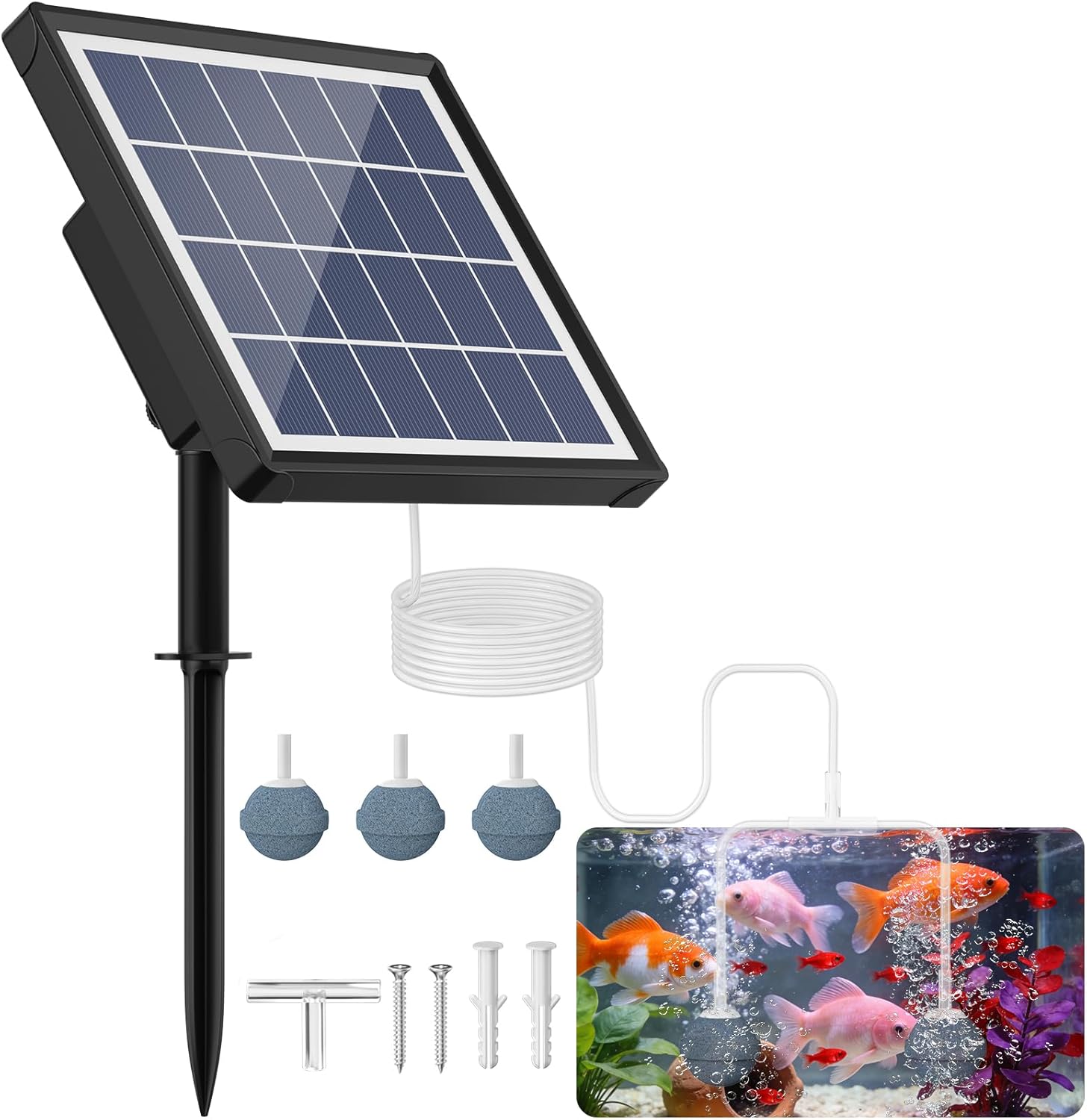
| Included Components | 3 Air Stones, 8.9ft PVC Tube, T connector, Ground Stake, Solar Air Pump |
The NFESOLAR 3W Solar Pond Aerator is an integrated solar air pump designed to keep small ponds, fish tanks, and hydroponic systems oxygenated without wiring. The unit combines a solar panel and 2200mAh battery backup in one housing and includes 8.9 ft of tubing, three air stones, and T-connectors for quick installation. It offers three modes — strong, soft, and intermittent — so you can choose maximum bubble production, gentle continuous aeration, or a duty cycle to conserve battery during extended cloudy spells. The compact ABS construction and quiet operation make it unobtrusive in garden settings, and portability lets you move it to optimize sun exposure. Important limitations are its modest 3W power rating and kit orientation for small water features only; it will not deliver the airflow needed for larger ponds or heavy stocking. For gardeners on a budget, this unit delivers straightforward, low-maintenance aeration where a simple, solar-ready solution is required.
Best for: Gardeners or hobbyists who need an inexpensive, easy-to-install aeration solution for small ponds, stock tanks, or hydroponic tubs and prioritize low operating cost and simple setup.
Less Ideal for: Owners of medium to large ponds, koi ponds with heavy stocking, or users who need high-volume circulation and professional-grade durability should consider larger wired or higher-wattage systems.
- Built-in 2200mAh battery enables 24/7 operation through night and cloudy periods
- Three adjustable modes (strong, soft, intermittent) let you balance airflow and battery life
- All-in-one solar design installs quickly without wiring or external panels
- Includes tubing and three air stones so it is ready to deploy for small ponds or tanks
- 3W power output is intended for small ponds and will struggle with larger or heavily stocked ponds
- ABS plastic construction may be less durable than heavier-duty outdoor housings over many seasons
Verdict: A budget-friendly, all-in-one solar aerator that provides reliable 24/7 oxygenation for small ponds and tanks without wiring.
My Natural Pond 100W Floating Solar Fountain Pump Kit

| Power Source | Solar Powered |
|---|---|
| Maximum Lifting Height | 10 feet |
| Horsepower | 100 watts |
| Material Type | Plastic |
This kit supplies a self-contained solar fountain and aeration solution for larger ponds. The floating pump mounts on the water surface so it rises and falls with changes in level, and the twin 50W solar panels deliver enough power in direct sun to push an 8–10 foot spray and circulate up to roughly 1,300 GPH. The kit includes panel stands, a long 32 ft cable, an anchor kit and three interchangeable nozzles so you can prioritize aeration or visual spray pattern. Because it is solar only the pump runs reliably when sunlight is available and requires the optional battery pack for overnight operation. The plastic components keep weight and cost down but may weather sooner than metal alternatives. Setup is fast and largely tool-free, and the simple modular design makes maintenance and nozzle swaps straightforward. For anyone wanting a low-maintenance, off-grid aerator that avoids running grid power, this kit provides a strong, practical option with clear limits around sunlight dependence and material longevity.
Best for: Buyers who prioritize a reliable, low-maintenance solar aeration solution for medium to large ponds and want a kit that runs off sunlight without grid connections.
Less Ideal for: If you need continuous aeration through nights or extended cloudy periods without adding a battery, or if you prefer heavy-duty metal components for long-term durability, choose a different system.
- High solar output from two 50W panels powers a strong 8–10 ft spray and up to 1,300 GPH circulation in direct sun
- Floating design automatically adjusts to changing water levels and avoids complex mounting
- Includes long 32 ft cable, panel stands, anchor kit, and three nozzles for flexible placement and spray patterns
- Quick, tool-free setup and simple nozzle swaps make maintenance straightforward
- Requires direct sunlight to operate and will not run continuously without purchasing the optional battery pack
- Major components are plastic which may show wear faster than metal alternatives
Verdict: A complete, easy-to-install solar kit that reliably aerates larger ponds during sunny hours without needing grid power.
POPOSOAP 8W Solar Pond Aerator with 3 Modes and Built-in Battery

| Power Source | Solar Powered |
|---|---|
| Horsepower | 8 watts |
| Material Type | Acrylonitrile Butadiene Styrene (ABS) |
| Included Components | Air tube, connectors, air stones, ground stake, solar panel |
This POPOSOAP 8W solar pond aerator is designed to keep oxygen levels up in small outdoor ponds and tanks without running mains power. The solar panel charges a 4400mAh internal battery during the day and the unit can run through the night, with three modes: strong continuous, softer continuous, and an intermittent 10s on/off setting for extended runtime. The kit includes air tubing, three air stones, connectors and a ground stake so you can mount the panel and route air to diffusers around the pond. In practice the separated pump body and panel make outdoor installation straightforward and reduce exposure of the electronics to water. The built-in indicator lights clarify charging and mode status. Expect useful aeration for small ponds and fishkeeping, though the output is targeted at modest volumes rather than large ornamental lakes. Some users report variable runtime depending on sun exposure, so placement and panel angle matter for consistent night operation.
Best for: Buyers who want a low-maintenance, off-grid aeration solution for small ponds or water gardens and who prioritize continuous aeration without running electrical wiring.
Less Ideal for: People managing larger ornamental lakes, high-stock fish ponds, or installations that require very high continuous airflow should look at more powerful wired or larger solar systems.
- Solar plus 4400mAh built-in battery enables daytime charging and night-time aeration
- Three working modes (strong, soft, intermittent) let you balance airflow versus runtime
- Includes tubing, air stones and mounting stake for easy out-of-the-box installation
- Separate solar panel and pump housing suited for outdoor placement and reduced water exposure
- Designed for small ponds and tanks so airflow may be insufficient for larger ponds
- Performance depends on sun exposure and panel placement which can reduce advertised runtime
Verdict: A convenient, self-contained solar aerator that reliably adds oxygen to small ponds and tanks without mains power.
Choosing the Right Solar Pond Aerator: Key Factors to Consider
Airflow Capacity and Diffuser Match
Airflow capacity determines how much oxygen a solar pond aerator can deliver. Measured in liters per minute or cubic feet per minute, higher airflow moves more water through diffusers and increases oxygen exchange across the water column. Consider the size and shape of your pond when matching airflow to diffuser placement. A unit rated for a small round pond may be insufficient for a long, narrow pond unless you add additional diffusers or units.
Diffuser match matters because a powerful pump paired with a small or clogged diffuser will not distribute air evenly. Look for systems that provide clear guidance on number and type of diffusers supported so you can plan tubing runs and placement to avoid dead zones.
Solar Panel Output and Run-Time Under Cloud Cover
Panel wattage and efficiency determine how much power is available during peak sun. More wattage generally means more consistent performance, but panel angle and placement are equally important. Consider seasonal sun angles and nearby shade from trees or structures when evaluating a system.
Many solar aerators include battery or capacitor backup for low-light periods. Understand the stated run-time at partial sun or cloudy conditions rather than peak output alone. A system that shuts off at the first overcast will not maintain oxygen levels during extended cloudy spells, so battery capacity or intelligent power management can be decisive for reliable operation.
Durability and Weatherproofing
Outdoor pond equipment faces constant exposure to moisture, temperature swings, and UV. Durable housings, corrosion-resistant fittings, and sealed electrical connections reduce failure risk. Check that panels have tempered glass or similar protection and that junction boxes and pump housings are rated for outdoor use.
Fittings and tubing should resist UV embrittlement and kinking, and diffusers should be easy to clean or replace. A weatherproof design reduces maintenance visits and extends useful life, which matters when units are sited away from easy access.
Ease of Installation and Maintenance
Installation practicality affects whether the system performs as intended. Consider how tubing is routed, the weight and mounting options for panels, and whether the pump sits on the pond bottom or floats. Simpler installations with clear instructions lower the chance of poor placement that reduces effectiveness.
Maintenance access for cleaning diffusers, replacing tubing, or inspecting panels should be straightforward. Systems with modular parts and standard tubing sizes make future repairs easier. Also review how straightforward it is to winterize or remove components if you shut down the system seasonally.
Noise, Vibration, and Wildlife Interactions
Noise and vibration levels can affect enjoyment of outdoor spaces and the behavior of fish and wildlife. Some aerator pumps produce noticeable vibration when mounted directly on rigid surfaces, which transmits sound. Choose units with rubber mounts or floating designs if quiet operation matters.
Consider how birds or curious animals interact with above-water components. Low-profile panels and secure cabling reduce the chance of wildlife damage. Also think about splash and surface disturbance if you want a gentle circulation rather than a fountain-like churn.
Sizing a Solar Aeration System for Your Pond
Estimate your pond volume and shape before choosing a solar aerator. Volume, more than surface area alone, governs how much oxygen the water holds and how quickly it depletes. Use approximate depth and surface area to calculate gallons or liters so you can match an aerator's stated airflow to the pond's needs.
Place diffusers where natural circulation is weakest. For rectangular or irregular ponds, multiple diffuser locations are often better than one central diffuser. Sizing also means considering seasonal extremes when oxygen demand rises, such as hot summer days or heavy fish stocking.
- Calculate volume from average depth and surface area
- Plan diffuser spacing to cover low-circulation zones
- Allow capacity margin for hot weather and plant loading
Panel Placement and Wiring Best Practices
Mount panels with a clear view of the sun for most of the day and avoid morning or afternoon shade that reduces output. Fixed mounts angled toward your latitude work well for year-round performance, while adjustable mounts can help maximize summer output if you only run the system seasonally.
Use weatherproof junctions and elevate connections above likely flood lines. Keep wiring runs short when possible to minimize voltage drop, or use appropriately sized cable for longer distances. Secure panels against wind uplift and run conduit where animals or lawn equipment might damage exposed wires.
- Angle panels toward the sun for steady output
- Protect electrical connections from splash and pests
- Use cable rated for outdoor, direct-burial, or conduit runs
Seasonal Care and Winterizing
Plan how you will manage the aerator through winter if you live in freezing climates. Some gardeners remove solar panels and pumps for winter storage, while others use systems designed to tolerate ice as long as diffusers remain submerged and functional. Know whether components should stay in the water or be taken indoors to avoid freeze damage.
During the off-season, clean diffusers and inspect tubing for brittleness. A pre-season check of panel output and backup battery health prevents surprises when sunlight returns.
- Decide on removal versus winter operation by local freeze risk
- Clean and inspect parts before storage
- Test battery and panel output early in spring
Using Multiple Units Versus One Larger Unit
Multiple smaller solar aerators offer redundancy and flexible placement across a pond, which can be advantageous for irregular shapes or shaded areas. If one unit underperforms or fails, others continue aerating. Placement flexibility also helps target specific dead zones.
A single larger unit can be simpler to install and may offer higher total airflow, but it concentrates risk in one system and may be harder to site where it gets adequate sun. Match system topology to your pond layout and consider future maintenance access.
- Multiple units provide redundancy and targeted coverage
- One larger unit may simplify wiring and mounting
- Balance redundancy with installation complexity
Troubleshooting Common Performance Issues
If you notice low bubbling or uneven coverage, first check panel alignment and cleanliness. Dirt, bird droppings, or shade can reduce output significantly. Next inspect tubing for kinks or leaks and verify diffusers are not blocked by silt or biofilm.
If the system runs only intermittently, evaluate battery health or wiring connections. For persistent low output even with good sunlight, test panel voltage with a multimeter to confirm the expected power is available to the pump.
- Clean and realign panels before inspecting pumps
- Check tubing runs and diffuser condition
- Test electrical output to isolate power issues
How We Chose the Best Solar Pond Aerator
We focused on practical performance metrics that matter for keeping ponds oxygenated with solar power. Primary evaluation criteria included measured airflow capacity and diffuser coverage to determine how much water column turnover a unit can realistically supply. We tested power reliability factors such as panel wattage, battery storage or capacitor backup, and how well the system sustains run time under variable sunlight. Weather resistance and build quality were assessed for outdoor exposure to moisture, UV, and temperature swings. Installation flexibility and tubing or diffuser compatibility were considered because ease of siting affects real-world effectiveness. Noise and vibration levels were included since low disturbance matters for backyard settings. We excluded systems that rely solely on grid power or that are designed only for decorative fountains rather than aeration. Units with unclear specifications or lacking basic weatherproofing were not shortlisted. The list favors systems with clear airflow figures, documented run-time under partial sun, and durable outdoor components.
FAQ
Will a solar pond aerator work on cloudy days?
It often depends on panel size and whether the system has battery backup. Many solar aerators operate at reduced capacity on cloudy days and use stored energy to continue running. Systems without storage may shut down during extended overcast periods.
Can I use a solar aerator in winter?
Some systems tolerate winter use if diffusers stay submerged and panels are clear of snow and ice, but many gardeners remove components to avoid freeze damage. The right approach depends on local freeze depth and whether the unit has winter-ready components.
How many diffusers do I need for a medium pond?
That usually depends on pond shape and volume. Medium, irregular ponds often benefit from two or more diffusers spaced to promote cross circulation. Use diffuser coverage guidance from the product specifications to plan placement.
Are floating solar panels effective for pond aeration?
Floating panels can work but are more exposed to waves and wildlife. They offer flexible placement but may be harder to secure and maintain. Fixed shore mounts generally provide steadier output and easier access for cleaning.
How often should diffusers and tubing be cleaned?
Typically annual cleaning is sufficient, but ponds with heavy silt or plant material may need more frequent attention. Inspect diffusers seasonally and clean or replace them when flow becomes uneven or reduced.
Final Verdict
Prioritize steady airflow and reliable power delivery when choosing a solar pond aerator. Match airflow and diffuser layout to your pond volume and shape, and weigh the benefits of battery-backed systems if you need continuous overnight or overcast operation. Durable, weatherproof components and straightforward installation reduce maintenance headaches. Focus on the tradeoffs between redundancy and simplicity so you end up with a system that keeps oxygen levels stable and supports healthy pond ecology.
