

Note: This article contains affiliate links. If you click on these links and make a purchase, I may earn a small commission at no extra cost to you. This helps support my research and content. Read my full affiliate disclosure here.
If you are establishing a new lawn or overseeding thin areas, choosing the right starter weed and feed matters because young grass has different nutrient and herbicide tolerances than established turf. A starter formula with weed control aims to feed seedlings and reduce pressure from common annual and broadleaf weeds without overwhelming tender shoots. In this guide we shortlisted seven top starter weed and feed products suited for early lawn care and light weed suppression. We evaluate application ease, safety for new seedlings, and nutrient balance to help you pick an option that promotes healthy establishment. Below are the picks and the criteria we used to assess them.
Top Picks at a Glance
| Best Overall The best all-around choice for most situations | Scotts Turf Builder Triple Action 14.1 lb |  |
| Best Quality Built to a higher standard if you want something more solid | The Andersons Surge Weed & Feed 16-0-9 Granular Lawn Fertilizer (40 lb) |  |
| Best Value The sweet spot between price and what you get | BioAdvanced 5-in-1 Weed and Feed Granules, Fertilizer and Crabgrass Killer, 24 lb |  |
| Best Budget The cheapest option that still gets the job done reliably | Bonide Liquid Weed & Feed 20-0-0 Ready-to-Spray, 32 oz |  |
| Highest Rated A top-rated pick with lots of positive feedback | Scotts LawnPro Step 2 Weed Control Plus Lawn Fertilizer (14.63 lb) |  |
| Most Popular A crowd favorite that many people choose with confidence | Scotts Turf Builder WinterGuard Fall Weed & Feed, 11.43 lb |  |
| Best Seller A high-volume bestseller chosen again and again | Scotts Turf Builder Weed & Feed 5, 11.32 lb. | 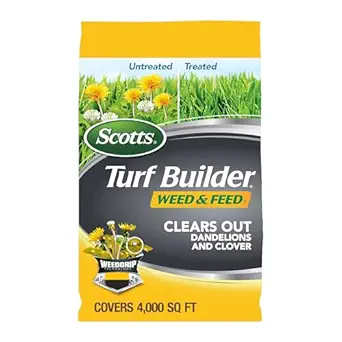 |
Scotts Turf Builder Triple Action 14.1 lb

| Item Form | Granule |
|---|---|
| Coverage | 5,000 sq. ft. |
| Active Ingredients | Pendimethalin 1.22%, 2,4-D 1.22%, Dicamba 0.081% |
Scotts Turf Builder Triple Action combines weed control, crabgrass prevention, and fertilizer in one granular bag to simplify spring lawn care. You apply it with a broadcast spreader when dandelions are actively growing and the grass is wet so granules stick to weed leaves, then water 24 hours later to move the preventative ingredient into the soil. The formula lists active herbicides (pendimethalin, 2,4-D, and dicamba) plus nutrients, so it both removes many common broadleaf weeds and establishes a barrier against new grassy weeds like crabgrass for up to four months while feeding the grass. In practice this reduces the number of separate products and applications needed across a 5,000 sq. ft. lawn. Important limitations are the restricted application window and safety precautions: follow label directions, avoid use on sensitive grass types or newly seeded lawns, and keep people and pets off treated areas until dust settles. Also it will not kill existing crabgrass, only prevent future germination.
Best for: Homeowners who prioritize strong seasonal performance and want a single product to reduce application steps while improving lawn density and weed suppression.
Less Ideal for: Those with newly seeded or very young lawns, people who prefer organic-only products, or gardeners treating areas near ponds or sensitive aquatic life.
- Three-in-one formula combines fertilizer, broadleaf weed control, and crabgrass prevention
- Covers up to 5,000 sq. ft. from a single 14.1 lb bag
- Designed for use with a Scotts spreader for even application
- Provides up to four months of crabgrass prevention when applied correctly
- Contains herbicides that require careful handling and re-entry restrictions
- Does not kill existing crabgrass, only prevents new germination
Verdict: If you want a performance-focused, all-in-one spring treatment to feed your lawn while preventing crabgrass and controlling common broadleaf weeds, this product delivers in a single application.
The Andersons Surge Weed & Feed 16-0-9 Granular Lawn Fertilizer (40 lb)

| Item Form | Granule |
|---|---|
| Coverage | 16000 square_feet |
| Unit Count | 640 Ounce |
| Active Ingredients | Herbicide |
The Andersons Surge Weed and Feed is a professional four‑way granular treatment that combines herbicide action with a 16-0-9 fertilizer to feed lawns while eliminating broadleaf weeds. It is applied with a broadcast spreader to established turf when broadleaf weeds are actively growing; best results come from mowing 1–2 days before application, applying to a damp lawn so granules adhere, and avoiding irrigation for at least 24 hours afterward. The product claims control of more than 250 common weeds and uses relatively small granules for wider coverage per square inch. In practice this means you can treat a large yard quickly and expect both greening and weed suppression over the season, including cooler spring and fall windows. Important limitations are that it is not suitable for certain turf types such as Floratam St. Augustine, dichondra, carpetgrass, creeping bentgrass, or lawns with desirable clovers, and you must follow timing and watering instructions to avoid reduced effectiveness or damage to new grass. For a homeowner focused on strong seasonal performance, this delivers broad control and fertilizer in one application.
Best for: Buyers who prioritize strong, season‑long weed control and want a professional‑grade product that also feeds established lawns and can treat a large area efficiently.
Less Ideal for: People with sensitive or excluded turf species, newly seeded/sodded lawns, or those who prefer spot treatments rather than whole‑lawn broadcast applications.
- Combines broadleaf weed control with fertilizer (16-0-9) for two functions in one application
- Covers up to 16,000 square feet, suitable for medium to large lawns
- Small granule size increases coverage per square inch for more uniform application
- Formulated to work through a wide part of the growing season, including cooler spring and fall conditions
- Not safe for specific turf types including Floratam St. Augustine, dichondra, carpetgrass, and creeping bentgrass
- Requires careful timing and withholding irrigation for at least 24 hours to be effective
- Not recommended for newly seeded or recently sodded lawns without reduced rates and waiting periods
Verdict: Choose this if you want a professional, large‑area weed‑and‑feed that delivers broadleaf control plus fertilizer in a single application.
BioAdvanced 5-in-1 Weed and Feed Granules, Fertilizer and Crabgrass Killer, 24 lb

| Item Form | Granule |
|---|---|
| Coverage | 10000 square_feet |
| Unit Count | 384 Ounce |
BioAdvanced 5-in-1 Weed and Feed is a single-application granular product that combines fertilizer with herbicides to kill over 200 listed broadleaf weeds and large crabgrass while feeding turf for several months. You apply it with a broadcast or drop spreader across established lawns in spring or early summer; granules create a soil barrier that helps prevent listed weeds and crabgrass from emerging for up to six months while the fertilizer greens and thickens turf for about three months. Notable features include multi-target weed control (including dandelion and clover), crabgrass control to the root, and coverage rated for roughly 10,000 square feet from the 24 pound bag. The practical benefit is fewer follow-up treatments because the formula acts as both a killer and a preventer, and the granular form makes even application straightforward with a spreader. Important limitations are state sale restrictions and the need to follow label safety directions closely since it is a concentrated pesticide product that requires protective clothing and careful handling.
Best for: Homeowners who want a practical, once-or twice-a-season solution to both feed their lawn and reduce weed pressure without separate products, and who are comfortable using a granular pesticide with a spreader.
Less Ideal for: People with small lawn areas who prefer spot treatments, organic lawn stewards, or anyone in states where this product is restricted should look for alternatives.
- Controls over 200 listed broadleaf weeds plus large crabgrass
- Prevents listed weeds and crabgrass from emerging for up to six months
- Feeds and greens lawn for up to three months
- Granular formula works with broadcast or drop spreaders for even coverage
- Not available for sale in certain states
- Requires protective clothing and careful handling due to pesticide ingredients
Verdict: If you want a simple, single granular product that both kills a wide range of weeds and feeds your lawn for months, this 5-in-1 weed-and-feed is an efficient seasonal pick.
Bonide Liquid Weed & Feed 20-0-0 Ready-to-Spray, 32 oz

| Liquid Volume | 32 fluid ounces |
|---|---|
| Coverage | 2,500 square feet |
| Item Form | Spray |
| Active Ingredients | Nitrogen |
This Bonide Liquid Weed & Feed is a straightforward lawn treatment that mixes fertilizer with broadleaf weed control in a hose-end ready bottle. You connect your garden hose to the attached sprayer, flip the on/off switch and apply without measuring or mixing. The formula delivers 20% nitrogen for quick green-up while including 2,4-D and 2,4-DP to target common broadleaf weeds like dandelion, clover, and plantain. A single 32 oz bottle covers about 2,500 square feet, which makes it useful for small to medium yards or spot treating larger lawns. Notable perks are the convenience of the integrated sprayer and the dual-action fertilizer plus herbicide in one pass. Important limitations: it is selective for turf but still requires care around desirable ornamentals and water, and safety precautions are needed for pets and children. Also it contains standard phenoxy herbicides, so it is not suitable where those active ingredients are restricted. For budget-focused buyers it is easy to use and can reduce time compared with separate products, but you should follow label directions closely to avoid off-target damage.
Best for: Budget-minded homeowners who want a quick, no-mix solution to green up St. Augustine lawns while knocking back common broadleaf weeds with a single application.
Less Ideal for: Specialty lawn stewards who need herbicide-free or organic options, or properties with sensitive ornamentals and water features where phenoxy herbicides are prohibited.
- Ready-to-spray bottle with attached hose-end sprayer for no-mix application
- Combines 20-0-0 nitrogen fertilizer and broadleaf herbicides in one treatment
- One quart treats up to 2,500 square feet, useful for small to medium lawns
- Targets a wide list of common broadleaf weeds found in turf
- Contains 2,4-D and 2,4-DP which can harm nearby ornamentals and is not appropriate near water sources
- Not formulated for non-target plants and requires protective gear and careful application
Verdict: A convenient, low-cost ready-to-spray weed-and-feed that treats up to 2,500 sq ft and simplifies broadleaf control and nitrogen feeding in one step.
Scotts LawnPro Step 2 Weed Control Plus Lawn Fertilizer (14.63 lb)

| Item Form | Granules |
|---|---|
| Specific Uses For Product | Treating lawns with broadleaf weeds |
| Coverage | Full |
| Target Species | lawn grasses |
This Scotts LawnPro Step 2 product combines a granular fertilizer with broadleaf weed control to both feed lawn grasses and reduce dandelions and similar weeds. It is applied with a broadcast or drop spreader according to package rates and is intended as the middle step in Scotts Best Annual Program for overall turf health. Notable features include a granule form that spreads evenly and explicit instructions to avoid use on dichondra, St. Augustinegrass, creeping bentgrass, bahia, and centipedegrass. In practice the fertilizer helps thicken turf from the roots up while the weed control targets common broadleaf species, so lawns with mixed grassy turf and surface weeds will see visible improvement after proper timing and application. Important limitations are the species exclusions and standard safety precautions for chemical lawn treatments; follow label directions for pet and child safety and do not use on incompatible grass types. This product is best used on full-coverage lawns where you can follow a seasonal program and application schedule.
Best for: Buyers who prioritize a dependable, program-based lawn care approach and want a single product to both feed turf and reduce common broadleaf weeds.
Less Ideal for: Homeowners with dichondra, St. Augustinegrass, creeping bentgrass, bahia, or centipedegrass lawns or those seeking an organic or nonchemical weed control method.
- Combines fertilization and broadleaf weed control in one application
- Granular form spreads evenly with common broadcast or drop spreaders
- Designed to thicken turf by feeding from the roots up
- Includes clear usage guidance as part of a seasonal lawn program
- Not safe for several grass types listed on the label
- Contains chemicals that require keeping product away from children and pets
Verdict: A reliable, program-friendly weed-and-feed that thickens turf while knocking back broadleaf weeds on compatible lawns.
Scotts Turf Builder WinterGuard Fall Weed & Feed, 11.43 lb

| Item Form | Granule |
|---|---|
| Coverage | 4000 square feet |
Scotts Turf Builder WinterGuard is a fall granular weed-and-feed formulated to kill common broadleaf weeds such as clover and dandelion while feeding cool- and warm-season grasses. It is applied with a broadcast or drop spreader to a moist lawn on a calm day when temperatures are between 60°F and 90°F. Notable features include WeedGrip Technology to improve granule adhesion to weed leaves, instructions tuned for Scotts spreaders, and coverage sized for about 4,000 square feet per 11.43 lb bag. In practice it simplifies a seasonal task by combining weed control and fertilization in one application, which helps build root strength and recover summer stress heading into winter. Important limitations are that it is labeled for specific grass types only and must not be used on St. Augustinegrass, bentgrass, or several groundcover species, and you must avoid watering for 24 hours after application for best effect. For homeowners who want a dependable, single-step fall treatment for typical lawn weeds, this performs as advertised; those with unsupported grass types or very large lawns will need a different product or multiple bags.
Best for: Homeowners who prioritize a reliable, low-effort fall solution to eliminate clover and other broadleaf weeds while feeding their lawn for winter hardiness.
Less Ideal for: Properties planted with unsupported turf species or buyers who need coverage for very large lawns without buying multiple bags.
- Kills over 50 listed lawn weeds including clover and dandelion
- Combined fertilizer and weed control saves an extra application
- WeedGrip Technology helps granules stick to moist weed leaves for better uptake
- Clear application guidance for use with Scotts spreaders and recommended timing
- Labeled for specific grass types only and should not be used on St. Augustinegrass, bentgrass, or certain groundcovers
Verdict: Choose this product if you want a dependable one-step fall treatment that both kills clover and feeds your lawn to build stronger roots for spring.
Scotts Turf Builder Weed & Feed 5, 11.32 lb.

| Item Form | Granule |
|---|---|
| Coverage | 4000 square feet |
| Unit Count | 1 Count |
Scotts Turf Builder Weed & Feed 5 is a granular lawn treatment that mixes broadleaf weed control with lawn fertilizer to both kill visible weeds and help the turf fill in. You apply it to a wet lawn when dandelions and other broadleaf weeds are actively growing and temperatures are in the recommended 60°F to 90°F range, using a broadcast, drop, or hand spreader for even coverage; one 11.32 lb. bag treats about 4,000 sq. ft. The formula uses WeedGrip technology and contains 2,4-D and dicamba to target more than 50 listed weeds including dandelion and clover, while delivering nitrogen and potassium to promote greener, thicker grass. Practical benefits are straightforward: weed suppression plus feeding in a single application and clear spreader settings are provided for consistent results. Important limitations to note are application restrictions for certain grass types such as St. Augustine and bentgrass, a requirement to keep the lawn dry for 24 hours after treatment, and that it should not be applied more than twice per year. As with any herbicide, follow label directions and keep people and pets off the treated area until granules settle.
Best for: Buyers who want a dependable, single-application solution to reduce dandelions while feeding their lawn and who prefer clear instructions for consistent application.
Less Ideal for: Those with St. Augustine, bentgrass, carpetgrass, dichondra, or Lippia lawns or gardeners seeking an organic weed control approach should consider alternatives.
- Controls common broadleaf weeds including dandelions and clover
- Includes fertilizer to thicken turf while treating weeds
- Clear spreader settings and coverage guidance for uniform application
- Covers 4,000 sq. ft. per 11.32 lb. bag
- Contains synthetic herbicides (2,4-D and dicamba) so it may not suit organic-only gardens
Verdict: A reliable one-step product to kill dandelions and feed the lawn for buyers who want straightforward, proven results.
Choosing the Right Starter Weed and Feed with Weed Control: Key Factors to Consider
Starter Nutrient Balance
Young lawns need a nutrient mix that promotes root growth more than rapid top growth. A starter fertilizer typically has a higher phosphorus content relative to nitrogen so seedlings develop strong root systems. Too much fast-release nitrogen can push lush top growth at the expense of roots and increase susceptibility to drought or transplant shock.
When choosing a starter weed and feed, look for clear N-P-K ratios and a mix of quick- and slow-release nitrogen. That combination feeds emerging blades without a single growth surge that could stress seedlings. Also consider the micronutrient profile; small amounts of iron and magnesium can help new grass green up without forcing excessive leaf length.
Seedling Safety and Timing
Timing and labeled tolerance are critical because many herbicides and concentrated nutrient applications can burn tender seedlings. Products designed for seeded lawns will include application windows measured in days after seeding or after germination. Follow those intervals closely to avoid damaging young turf.
Seedling safety also depends on water and mowing practices after application. Excessive irrigation immediately after applying some formulations can leach nutrients or activate herbicides prematurely. Conversely, not watering when required can leave granules on leaf surfaces and increase burn risk. Read and follow label timing for the safest results.
Weed Control Spectrum
Starter weed-and-feed formulations vary in which weeds they suppress. Some target a broad range of common broadleaf weeds while others are limited to specific annual grasses or seedling-stage competitors. For new lawns you usually want control of common annuals and tiny broadleaf weeds that compete with emerging grass.
Understanding the active ingredient classes helps set expectations. Post-emergent broadleaf herbicides are common in these mixes because they act on visible weeds, but certain pre- and post-emergent combinations may not be safe for seedlings. Look for clear labeling on what weeds are controlled and whether control is contact-only or systemic, as systemic herbicides can affect non-target plants if misapplied.
Application Method and Equipment Compatibility
How easy a product is to apply matters for establishment success. Granular starter weed-and-feed that flows evenly through a broadcast spreader gives more consistent results than uneven hand application. Compatibility with common spreader settings and clear coverage rate instructions reduce the risk of over- or under-applying.
Also consider whether the product requires calibration or has specific spreading patterns. Some formulations recommend overlapping passes or a single direction for best coverage. If a product requires a liquid tank sprayer, make sure its label provides detailed mixing and nozzle guidance to avoid streaks.
Watering and Aftercare Requirements
Post-application care influences both nutrient uptake and herbicide efficacy. Some starter mixes require light watering to activate the fertilizer granules but instruct gardeners to delay heavy irrigation to allow herbicide uptake by weeds. Other products require no immediate watering to prevent runoff.
Beyond initial irrigation, mower height, foot traffic limits, and follow-up feeding are part of the aftercare plan. Maintaining higher mower settings for the first few cuts protects seedlings while allowing root development. Knowing the recommended watering frequency and when to perform the first mow will help the starter product perform as intended.
Environmental and Safety Considerations
Starter weed-and-feed products can affect non-target plants, waterways, and pollinators when misapplied. Look for labels that provide buffer zone guidance near ponds, flower beds, and vegetable gardens. Some formulations specify rainfast windows and pet-safe intervals.
Choose products that include clear disposal and storage instructions and that list precautions for avoiding runoff. For gardeners concerned about pollinators, avoid applying to blooming ornamentals and follow timing guidance to minimize exposure.
When to Use a Starter Weed and Feed
Starter weed-and-feed is appropriate during lawn establishment phases such as right after seeding or laying sod when young grass needs phosphorus and steady, gentle nitrogen. Use these products only when labels explicitly state they are safe for newly seeded or sprigged turf.
Avoid using ordinary weed-and-feed meant for mature lawns during the establishment window. The wrong timing or an aggressive herbicide mix can stunt seedlings or kill young plants, so coordinate application with seeding dates and germination estimates.
- Apply only within the labeled post-seeding interval
- Match starter feeding to soil test recommendations when possible
- Delay broad applications if weather threatens heavy rain
Preparing Soil Before Application
Good establishment starts with soil preparation. Rake to level, remove debris, and address compaction before seeding. A soil test that checks phosphorus and pH will inform whether a starter with additional phosphorus is necessary or if lime or amendments are a better first step.
If phosphorus levels are already adequate, a starter product with a lower P value or a standard starter fertilizer without herbicide may be a better fit. Conditioning the soil first reduces the need for corrective applications after seedlings emerge.
- Correct pH if outside recommended range for your grass type
- Incorporate organic matter in compacted spots
- Use seed-to-soil contact techniques for better germination
Application Tips for Even Coverage
Calibrate your spreader and follow the labeled rate to avoid stripes or missed areas. Many starter weed-and-feed granules require a single-pass broadcast pattern; overlap slightly to prevent gaps but avoid heavy double coverage that can burn grass.
Practice the walk speed and spreader setting on a driveway first to observe distribution. After application, follow any specified watering instructions to activate the fertilizer without washing herbicides away from target weeds.
- Test spreader settings with a measured area
- Apply when wind is low to prevent drift
- Store and handle granules in dry conditions to prevent clumping
Managing Expectations for Weed Control
Starter weed-and-feed can reduce pressure from many common annual and small broadleaf weeds, but it is not a cure-all. Expect slower, visible results for perennial or deeply rooted weeds and be prepared to follow up with targeted controls once turf is established and labels allow broader herbicide use.
For heavy weed pressure, integrated practices such as hand removal, mulching in bordering beds, and improving turf density with overseeding may work better than relying on a single product.
- Track which weeds persist after establishment to plan follow-up
- Use cultural controls to reduce recurring weed invasion
- Plan targeted post-establishment treatments if necessary
Safety and Environmental Best Practices
Keep granules off driveways and patios where runoff can carry them into storm drains. Maintain buffer zones around water features and avoid applying before heavy rain. Follow pet and child reentry intervals that appear on the product label.
Wear gloves and a dust mask if handling dusty granules, and clean spreaders after use to prevent cross-contamination with other garden products.
- Follow label directions for buffer zones and reentry times
- Dispose of leftover product according to local regulations
- Rinse equipment in a controlled area away from garden beds
How We Chose the Best Starter Weed and Feed with Weed Control
We focused on products formulated for newly seeded or recently sodded turf that combine a starter nutrient profile with controlled weed suppression. Our editorial filters prioritized nutrient ratios that favor root development, herbicide selections labeled as safe for new grass, and application guidance that minimizes seedling burn risk. We also screened for clear spreader compatibility and mixing instructions so gardeners can apply accurately. Key evaluation criteria included nutrient composition and release rate, labeled tolerance for new seedlings, spectrum and mode of weed control, and user-facing application guidance such as recommended timing and watering windows. We excluded granular products intended only for mature lawns or those that lack explicit instructions for seeded turf. Liquid concentrates were considered only if they were explicitly marketed for starter use and included seedling-safe herbicides. We relied on label-based specifications, formulation details, and common horticultural practice to determine which items are genuinely appropriate for establishment-phase care. Products without clear seedling safety guidance or with broad, aggressive herbicides were removed from consideration.
FAQ
Can I apply starter weed and feed right after seeding?
It depends on the product label. Some starter formulations are safe to apply at seeding or within a short window after sowing, while others require waiting until seedlings reach a certain size. Always follow the labeled interval to avoid harming young grass.
Will a starter weed and feed prevent all weeds during establishment?
No. These products reduce many common annual and small broadleaf weeds but are not effective against every species or heavy infestations. Cultural practices and targeted follow-up controls are often necessary for stubborn weeds.
How soon can I mow after applying a starter weed and feed?
Mowing timing usually depends on seedling height and any label guidance. Wait until seedlings reach the recommended mowing height for your grass type and avoid scalping. Some labels advise waiting a set number of days after application before the first mow.
Is a soil test necessary before using a starter product?
A soil test is recommended because it reveals phosphorus and pH levels that affect seedling success. If phosphorus is already sufficient, you may not need a high-phosphorus starter, and selecting the right formula avoids excess nutrient buildup.
Can starter weed and feed harm nearby flowers or vegetables?
Yes, if granules drift or runoff reaches sensitive plants, they can be harmed. Maintain buffer zones, avoid application on windy days, and take care near ornamental beds and vegetable gardens to prevent accidental exposure.
How should I water after applying a starter weed and feed?
Follow the product label. Some formulas require light watering to activate nutrients, while others ask you to delay irrigation to allow herbicides to be absorbed by weeds. Proper watering schedules improve efficacy and reduce leaching risk.
Final Verdict
When establishing turf, prioritize products that support root development and explicitly state safety for seeded or recently sodded lawns. Balance the need for early weed suppression with gentle nutrient release and clear application guidance to avoid stressing seedlings. Focus on starter nutrient balance, seedling-safe herbicide choices, and application consistency. With careful timing and correct spreader technique, a starter weed-and-feed can give young turf a healthier start while reducing early weed competition. Choose based on labeled seedling tolerance and the specific weed challenges you expect.
