

Note: This article contains affiliate links. If you click on these links and make a purchase, I may earn a small commission at no extra cost to you. This helps support my research and content. Read my full affiliate disclosure here.
Indoor plants face a different set of pest pressures than outdoor gardens. You need treatments that move through a plant quickly, control sap-feeders and chewing pests, and pose minimal risk in a home environment. This guide highlights seven shortlisted systemic options chosen for their reliable uptake, labeled indoor use, and clear application directions. We focus on how fast each product acts, how long protection lasts, and what safety steps matter when treating houseplants. Read on to compare the key performance and safety traits that matter most for indoor growers.
Top Picks at a Glance
| Best Overall The best all-around choice for most situations | Bonine Systemic House Plant Insect Control (Imidacloprid, 32 fl oz) |  |
| Best Quality Built to a higher standard if you want something more solid | Bonide Systemic Houseplant Insect Control Granules, 8 oz |  |
| Best Value The sweet spot between price and what you get | Bonide Systemic Granules Insect Killer, 1 lb. |  |
| Best Budget The cheapest option that still gets the job done reliably | Bonide Systemic Insect Control Granules, 8 oz. |  |
| Highest Rated A top-rated pick with lots of positive feedback | Bonide Systemic Houseplant Insect Control Granules, 3 Pack |  |
| Most Popular A crowd favorite that many people choose with confidence | Bonide Systemic Houseplant Insect Control Granules, 8 oz |  |
| Best Seller A high-volume bestseller chosen again and again | Bonide Houseplant Systemic Insect Control Granules, 8 oz |  |
Bonine Systemic House Plant Insect Control (Imidacloprid, 32 fl oz)

| Unit Count | 32 Fluid Ounces |
|---|---|
| Item Form | Granules, Spray |
| Target Species | Insects |
| Active Ingredients | Imidacloprid |
This Bonine systemic insect control delivers a systemic active ingredient, imidacloprid, in a liquid formulation intended for treating insects on houseplants. It is typically applied as a drench or spray so the plant takes up the insecticide and distributes it through the vascular system, which helps control sap-feeding pests that are hard to reach with contact sprays. The 32 fluid ounce size covers multiple applications for several plants and the product lists both granule and spray forms, indicating flexible use methods. Practical benefits include long residual activity inside the plant and fewer repeat surface treatments for persistent infestations. Important limitations are that it targets insects susceptible to imidacloprid and will not control non-sucking pests or diseases, and it must be used according to label directions to avoid harm to beneficial insects and prevent overapplication. Users should follow safety guidance and avoid applying to blooming plants that attract pollinators.
Best for: Houseplant owners who want a dependable internal treatment for recurring sap‑feeding pests and prefer fewer repeat surface sprays. Good for people managing multiple indoor plants who follow label directions and safety precautions.
Less Ideal for: Growers who prioritize organic, pollinator‑safe methods or who need a broad-spectrum solution for fungal or chewing pest problems should consider alternative products.
- Systemic imidacloprid penetrates plant tissue for internal control of sap‑feeding insects
- Large 32 fl oz volume suitable for treating many houseplants or repeat treatments
- Available in spray-compatible form for easy application to pots and foliage
- Longer residual activity reduces the need for frequent reapplication
- Does not control non-target problems such as fungal diseases or some chewing insects
- Contains a neonicotinoid active ingredient that requires careful use to avoid impacting beneficial insects
Verdict: Choose this product if you need a reliable systemic treatment to control sap‑feeding insects across many houseplants with fewer repeat applications.
Bonide Systemic Houseplant Insect Control Granules, 8 oz
| Item Form | Granules |
|---|---|
| Target Species | Insects |
| Active Ingredients | Imidacloprid |
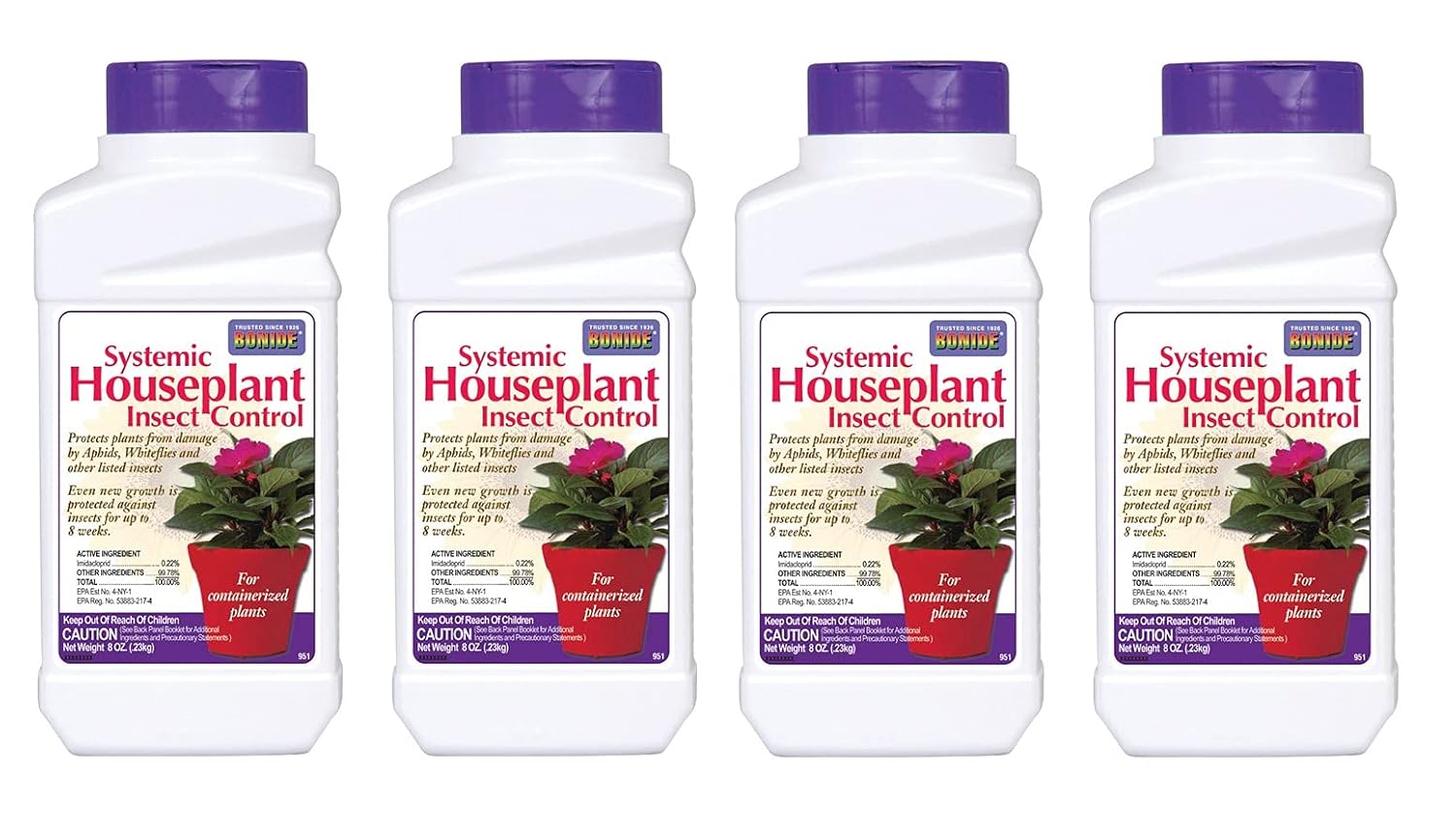
Bonide Systemic Houseplant Insect Control is a granular systemic treatment that you mix or shake into potting soil to protect indoor plants from pests for an extended period. It contains imidacloprid, a systemic active ingredient that is taken up by roots and protects new growth, so you do not need to reapply after every infestation. Typical use is to work the granules into the topsoil around each plant or apply as directed for container plants; it targets fungus gnats, mealybugs, whitefly, thrips and aphids and claims protection lasting up to about eight weeks. The product is convenient for treating multiple plants quickly and is especially useful when you want hands-off, longer-lasting control rather than repeated foliar sprays. Limitations to consider are that systemic neonicotinoids are broad-acting against insects and are not suitable where beneficial predatory insects are relied on, and this format is not an immediate knockdown like contact sprays for heavy infestations. For growers focused on reliable, low-effort suppression of common houseplant pests, this delivers practical, measurable control.
Best for: Buyers who prioritize dependable, low-maintenance pest control for indoor plants and prefer a root-absorbed treatment that protects new growth for weeks.
Less Ideal for: People relying on biological control with predatory insects or those who need instant knockdown should choose contact treatments or alternative methods.
- Systemic action with imidacloprid protects new growth and reduces need for frequent reapplication
- Granular form is easy to apply directly to potting soil for many plants
- Claims up to about eight weeks of residual control per application
- Effective against a broad range of common houseplant pests including gnats, mealybugs, whitefly, thrips and aphids
- Contains a neonicotinoid active ingredient which can affect non-target beneficial insects
- Not a fast-acting contact spray so it may not provide immediate knockdown of heavy infestations
Verdict: A practical, low-effort granular systemic that delivers weeks of reliable control of common houseplant pests.
Bonide Systemic Granules Insect Killer, 1 lb.

| Brand Name | Bonide |
|---|---|
| Included Components | Bonide Systemic Granules Insect Killer 1 lb. |
| Target Species | Insects |
Bonide Systemic Granules are a soil-applied insecticide in convenient, ready-to-use granule form that moves into a plant and controls sap-sucking pests from the inside. For houseplants and container-grown specimens you sprinkle the granules on the potting mix and water them in so the active ingredient is taken up by the roots and distributed through the foliage. The formulation targets insects such as aphids, whiteflies, leafminers and scales, making it useful for ongoing control when direct spray is impractical or when pests hide in crevices. Practical benefits include ease of application, no spray drift, and suitability for hanging baskets and small containers. Limitations are that it works systemically so effects take days to appear and it will not control pests not affected by systemic chemistry; repeated use may be needed for heavy infestations. Follow label directions carefully, especially for indoor use and sensitive or edible plants.
Best for: Practical houseplant owners who want a low-mess, soil-applied option to manage common sap-feeding pests in containers and hanging baskets without frequent foliar spraying.
Less Ideal for: Growers who need fast knockdown for large indoor outbreaks or who prefer contact sprays for mixing and immediate knockdown should consider other methods.
- Ready-to-use granules that are simple to apply to potting mix
- Systemic action controls sap-feeding pests inside the plant where sprays may miss
- Suitable for containers and hanging baskets where foliar sprays are inconvenient
- Takes several days to move through the plant and show visible control
- Will not affect pests that are not susceptible to systemic insecticides
Verdict: A low-mess, soil-applied systemic granule that helps container and hanging-basket owners control common sap-sucking pests without foliar spraying.
Bonide Systemic Insect Control Granules, 8 oz.

| Item Form | Granules |
|---|---|
| Target Species | Insects |
| Liquid Volume | 227.3 ml |
| Unit Count | 12 Count |
Bonide Systemic Insect Control Granules deliver a systemic treatment that is taken up by a plant and kills sap-feeding insects such as aphids, whiteflies, miners and scales from the inside. The product comes as ready-to-use granules you sprinkle or mix according to label directions, and it is intended to provide protection for roughly 6 to 8 weeks per application. For houseplant use this means fewer foliar sprays and less need to treat every insect you see by hand. The 2% di-syston active ingredient targets a broad range of pests, and the granular format makes measuring and applying straightforward. Limitations to consider are that systemics are not instantaneous contact killers, so visible populations may persist for days, and some plants or beneficial insects can be affected if label directions are not followed. Also the listing indicates the item is sold by the case of 12 which may be more than a casual plant owner needs. Read and follow safety and application instructions for indoor use.
Best for: Houseplant owners who want a low-effort, longer-lasting way to control sap-feeding pests and prefer treating plants systemically rather than frequent foliar sprays.
Less Ideal for: Small households with young children or pets who cannot follow strict indoor safety precautions or growers who need an immediate knockdown for large infestations.
- Systemic action kills sap-feeding pests from inside the plant so fewer foliar treatments are needed
- Ready-to-use granules simplify measuring and application compared with concentrates
- Provides residual control for about 6 to 8 weeks per application
- Targets a broad range of common sap-sucking insects including aphids, whiteflies, miners and scales
- Not an immediate contact spray so visible insects can linger for several days after treatment
- Contains an organophosphate active ingredient which requires careful handling and strict adherence to label directions
Verdict: Buy this if you want a simple, longer-lasting systemic granule that reduces the need for repeated foliar treatments on houseplants.
Bonide Systemic Houseplant Insect Control Granules, 3 Pack

| Item Form | Granules |
|---|---|
| Target Species | Insects |
| Active Ingredients | Imidacloprid |
| Unit Count | 3 Count |
This Bonide product is a systemic granular insecticide designed for containerized indoor plants and is supplied as three ready-to-use packs. You work it into the potting mix and water it in so the active ingredient, imidacloprid, is taken up by the roots and distributed through the plant; insects that feed on the plant ingest the chemical and are controlled. It targets common pests such as mealybugs, aphids, and scale and advertises up to eight weeks of protection, which reduces the need for frequent spot treatments. The low-odor granules mean no spraying and minimal mess, making it convenient for use around houseplants. Important limitations are that it is for non-edible plants only and it will not affect pests that do not feed on plant tissue, so identification of the pest is important before use. Also systemic insecticides can have broader environmental effects, so use only on the labeled indoor plants and follow all safety directions.
Best for: Buyers seeking a dependable, low-maintenance solution for persistent sap-feeding houseplant pests who prioritize long-lasting protection and minimal application fuss.
Less Ideal for: People who grow edible container crops, organic-only gardeners, or anyone needing contact control for non-feeding pests should choose a different product.
- Systemic mode of action controls sap-feeding pests through ingestion rather than surface contact
- Ready-to-use granules are low odor and avoid spraying or messy mixes
- Advertised protection lasts up to eight weeks after application
- Pack of three provides multiple treatments or coverage for several plants
- Not labeled for use on edible plants such as herbs, vegetables, or fruiting species
- Will not control pests that do not feed on plant tissue
Verdict: A convenient, low-odor systemic granule treatment that reliably controls mealybugs and other sap-feeding houseplant insects with up to eight weeks of protection.
Bonide Systemic Houseplant Insect Control Granules, 8 oz

| Unit Count | 8 Ounce |
|---|---|
| Item Form | Granules |
| Target Species | Insects |
| Liquid Volume | 227.3 ml |
Bonide Systemic Houseplant Insect Control is a granular, ready-to-use systemic treatment designed for potted and container houseplants. You apply the granules to the soil surface, mix them into the potting mix, then water to activate the systemic uptake so the active ingredient moves through the plant and controls pests that feed on plant tissue. It is labeled to control mealybugs, aphids, scale and whiteflies and provides protection that persists for up to eight weeks between applications. Because it works systemically, it can reach insects that hide on stems and undersides of leaves where contact sprays miss. The product is low-odor and intended for ornamental, non-edible plants only. Important limitations are that it only affects insects that ingest plant sap and will not control nonfeeding pests, and it must be used according to label safety precautions to keep children and pets away; it is not for edible plants. For indoor growers dealing with recurring mealybug outbreaks this granule formula offers a hands-off, multi-week control option when used as directed.
Best for: Buyers who want a low-effort, multi-week control for mealybugs and similar sap-feeding pests on indoor ornamental and container plants and who prioritize proven product performance.
Less Ideal for: Gardeners seeking treatments for edible plants or for pests that do not ingest plant sap should choose a different product or control method.
- Systemic action controls sap-feeding pests that hide on stems and leaf undersides.
- Ready-to-use granules are simple to apply to potting soil without measuring concentrates.
- Provides up to eight weeks of protection per application.
- Low odor formulation suited to indoor use on ornamental plants.
- Not labeled for edible plants such as herbs or vegetables.
- Only effective against insects that feed on plant tissue and will not control nonfeeding pests.
Verdict: If you need a simple, low-odor, systemic option to reduce mealybug infestations on potted ornamentals, this ready-to-use granular treatment delivers multi-week protection.
Bonide Houseplant Systemic Insect Control Granules, 8 oz

| Item Form | Granules |
|---|---|
| Target Species | Insects |
Bonide Houseplant Systemic Insect Control Granules are a user-friendly, granular systemic treatment designed to protect indoor potted plants from aphids, whitefly, fungus gnats and similar pests. You sprinkle the measured granules into the topsoil following package directions and the active ingredient moves into the plant so pests that feed on sap or soil are exposed without spraying. The product is marketed as odorless and mess-free, which makes it suitable for use in living spaces where you do not want aerosols or repeated applications. One practical benefit is the extended control window of up to eight weeks, reducing the need for frequent retreatment. Important trade-offs are that it requires careful application around pets and pollinators and it will not control pests that are not affected by systemic products or those that require contact knockdown. It is best used as part of an integrated approach with cultural controls and monitoring rather than as a single long-term solution for severe infestations.
Best for: Buyers who prioritize conservative, low-mess indoor pest control and want a simple, infrequent-treatment option to protect potted houseplants from common sap-feeding and soil pests.
Less Ideal for: Gardeners seeking instant contact knockdown for heavy infestations or those who prefer non-chemical approaches should consider alternative or supplementary methods.
- Systemic action treats pests that feed on plant sap or in the soil without spraying
- Ready-to-use granules are easy to apply and leave no odor
- Provides up to eight weeks of control, reducing frequency of reapplication
- Effective against common houseplant pests listed by the manufacturer such as aphids, whitefly and fungus gnats
- Must be applied carefully around pets and in areas where pollinators could access treated soil
- Won't provide immediate knockdown for pests that require contact insecticides
Verdict: A convenient, low-odor granular systemic treatment that gives up to eight weeks of protection for indoor potted plants against common sap-feeding and soil pests.
Choosing the Right Systemic Insecticide for Houseplants: Key Factors to Consider
Speed of Uptake and Visible Control
How quickly the active ingredient moves from soil or foliage into the plant affects how fast pests stop feeding and symptoms decline. Faster uptake is important when you are treating heavily infested specimens or plants near people and pets. Slow-acting systemics can still work but may allow pests to continue damaging new growth for days.
Measure uptake expectations against your urgency. For small potted plants under heavy attack, choose a product known to translocate in a few hours to a day. For low-level, chronic infestations, longer-acting options with sustained release may be acceptable.
Pest Spectrum and Mode of Action
Different systemic actives target different insect groups. Some are especially effective against sucking pests like aphids and whiteflies, while others also control chewing insects or beetles. Understanding which pests are common on your houseplants guides the choice of active ingredient.
Also consider mode of action to avoid resistance buildup. Rotating products with different modes of action or combining cultural controls helps maintain long-term efficacy in indoor collections.
Duration of Residual Protection
Residual protection defines how long a plant remains defended after treatment. A longer residual period reduces reapplication frequency, which is useful for busy indoor gardeners or for plants in hard-to-reach spots. However, longer persistence can complicate propagation or feeding of beneficial insects if plants move outdoors temporarily.
Balance the convenience of longer residual control against the need for clean cuttings or repotting. Check label guidance on how long residues remain effective and when it is safe to take cuttings or place treated plants near pollinator-attractive outdoor areas.
Indoor Safety and Exposure Mitigation
Safety considerations are vital when treating houseplants because treatments are used inside living spaces with people and pets. Look for products with explicit indoor-use instructions, clear personal protective equipment guidance, and measures to limit inhalation or surface residues. Application method also affects exposure; soil drenches may minimize aerosol exposure compared with fogs or sprays.
Follow label precautions about reentry intervals, ventilation after application, and whether to remove pets or cover food and water dishes. Select formulations that reduce drift and are easily confined to potting media when indoor safety is a priority.
Formulation and Application Convenience
Systemic insecticides come as ready-to-use drenches, soluble concentrates, granules, or root feeders. For small pots and frequent treatments, premeasured or low-volume options reduce the chance of overdosing. Soluble concentrates offer dosing flexibility but require careful measuring and mixing.
Consider the dispenser and how precisely you can apply to individual pots. Ease of measuring, minimal mess, and compatibility with common indoor watering routines improve consistent, safe use.
Impact on Beneficials and Propagation Plans
Although indoor gardens have fewer beneficial insects than outdoor beds, many hobbyists maintain biological controls or occasionally move plants outside where pollinators are present. Some systemic actives are broad-spectrum and may harm beneficial predators or pollinators if residues transfer outdoors.
If you take cuttings or plan to place plants on a balcony, choose products with shorter residual mobility or follow label guidance on safe intervals before exposing treated plants to outdoor pollinators. Integrate nonchemical controls where possible to minimize overall impact.
How Systemic Insecticides Work in Container Plants
Systemic actives are absorbed through roots or foliage and translocated to leaves and stems where sap-feeding or chewing pests ingest them. In potted plants, uniform root distribution can be affected by pot size, media texture, and recent watering.
Soil drenches move differently in peat- or bark-based mixes than in heavy commercial mixes. For consistent uptake, water the potting medium beforehand if it is dry, then apply the labeled drench volume so the active reaches the root zone without excessive leaching.
- Roots are the main uptake point for most drenches; compaction or hydrophobic media can slow absorption
- Foliar systemic sprays can be faster for foliar uptake but may increase indoor exposure risk
- Repotting soon after treatment can dilute systemic concentration and reduce effectiveness
Best Practices for Applying Systemics Indoors
Prepare treated plants in a well-ventilated area away from food preparation zones and cover nearby surfaces. Use the smallest effective dose and apply directly to the potting mix when possible to limit residues on leaves and surrounding surfaces.
Time applications to avoid peak household activity, and keep pets and children away until labeled reentry intervals or when the product has dried or been watered in. Label directions take precedence over general advice and provide necessary safety steps.
- Pre-wet pots with water to improve distribution of a drench
- Measure concentrates carefully and avoid splashing
- Record application dates to track residual periods and reapplication windows
Managing Specific Houseplant Pests with Systemics
Sap-feeders such as mealybugs, aphids, and whiteflies are often the easiest to control with systemic treatments because they ingest the active when feeding. Scale insects can be more challenging if they are armored and feed intermittently.
For infestations that include both sucking and chewing pests, pair systemic use with spot treatments or physical removal of heavily infested material. Monitor new growth after treatment; visible declines in pest numbers usually appear on treated plants within a few days to a week depending on uptake speed.
- Inspect undersides of leaves and new shoots regularly after treatment
- Combine cultural controls like isolation and pruning with chemical controls for faster recovery
- Use sticky traps to monitor flying pests and measure treatment efficacy
When to Avoid Systemic Treatments
Avoid systemic insecticides when you plan to take cuttings for propagation immediately, unless the label permits it. Residues can be present in new growth and cuttings, which may affect rooting or transfer residues to soil or other plants.
Also avoid systemics if you keep beneficial predators indoors or frequently move plants outside where pollinators may forage. In those cases, emphasize physical removal, targeted sprays, or soap-based treatments until active pest pressure is lower.
- Delay propagation for the interval recommended on the product label
- Use spot treatments for single-plant infestations to limit house-wide exposure
- Consider non-systemic options for plants that are regularly visited by pollinators
Integrating Systemics Into an Indoor Pest Management Plan
Systemic insecticides are a tool within an integrated approach. Start with inspection and isolation of infested specimens, then choose a systemic if the infestation is widespread or persistent. Follow up with monitoring and complementary cultural controls to reduce reinfestation risks.
Keep a treatment log and rotate modes of action when repeatedly treating the same plants over multiple seasons. Relying solely on one chemistry increases the chance that pest populations will develop reduced sensitivity.
- Combine sanitation, quarantine, and environmental adjustments with chemical controls
- Record modes of action to plan rotation strategies
- Use lower-toxicity options first for minor infestations
How We Chose the Best Systemic Insecticide for Houseplants
We selected systemic insecticides that are suitable for indoor ornamental plants and that demonstrate reliable translocation through stems and leaves. Our editorial filters favored products with clear indoor use instructions, measurable uptake speed, and specified residual protection durations. We prioritized formulations that offer multiple labeled target pests common on houseplants, such as aphids, mealybugs, whiteflies, and scale. Evaluation criteria included speed of uptake into plant tissue, breadth of pest control spectrum, duration of residual protection, application simplicity for container-grown plants, and labeled indoor safety or mitigation directions. We excluded products intended only for outdoor use, treatments lacking systemic action, and concentrates with unclear dosing instructions for small pots. We also filtered out options without clear guidance on reapplication intervals or indoor exposure precautions. The result is a set of products that balance efficacy, indoor suitability, and practical application for typical houseplant settings.
FAQ
Are systemic insecticides safe to use around pets indoors?
Safety depends on the product and how it is applied. Some formulations applied as a soil drench minimize airborne exposure, but labels will specify precautions for pets. Keep animals away from treated plants until the product has been watered in and the label reentry interval is passed.
How long after applying a systemic will I see fewer pests?
Response times vary by active ingredient and plant uptake but many systemics show reduced feeding within a few days. Full control of an established infestation can take longer, so monitor plants and repeat applications only as the label allows.
Can systemic insecticides affect plant propagation or cuttings?
Yes. Residues may be present in new growth and cuttings. The label usually states whether cuttings are safe and how long to wait after treatment before taking them. If you plan to propagate, follow label intervals or avoid systemics until after rooting.
Will soil type or pot size change how well a systemic works?
Often it does. Very small pots have limited root volume and may absorb the treatment quickly, while heavy or hydrophobic media can slow redistribution. Adjust application technique according to pot size and media and follow label dilution guidance.
Are there nonchemical alternatives for common houseplant pests?
Yes. Isolating infested plants, manual removal, pruning, increased humidity or misting for certain pests, and beneficial insects in enclosed greenhouse setups are all options. These methods are useful for light infestations or when chemical use is not appropriate.
Final Verdict
Choose a systemic insecticide based on the pests you are targeting, the urgency of control, and indoor safety needs. Prioritize products with a proven uptake speed and clear indoor-use directions when treating container-grown houseplants. Balance residual length against propagation plans and potential exposure to people or pets. Used thoughtfully and as part of an integrated plan, systemics can quickly regain leafy health in indoor collections while minimizing repeat treatments.
