

Note: This article contains affiliate links. If you click on these links and make a purchase, I may earn a small commission at no extra cost to you. This helps support my research and content. Read my full affiliate disclosure here.
Getting the feeding right makes a measurable difference once tomato plants start setting fruit. The right fertilizer supports blossom development, reduces blossom drop, and helps fruit fill out with good size and flavor while avoiding excessive leafy growth. This guide focuses on tomato fertilizers for fruiting and presents seven shortlisted options suited to gardeners who want more and better tomatoes from garden beds, containers, or small hoophouses. We evaluated products for their nutrient ratios, ease of application, and compatibility with common garden soils and watering routines. Below are practical notes and the factors that matter when choosing a feed for fruit production.
Top Picks at a Glance
| Best Overall The best all-around choice for most situations | Espoma Organic Tomato-tone 3-4-6 Organic Tomato Fertilizer (4 lb) |  |
| Best Quality Built to a higher standard if you want something more solid | FoxFarm Tiger Bloom Liquid Plant Food (16 fl oz) |  |
| Best Value The sweet spot between price and what you get | Miracle-Gro Water Soluble Tomato Plant Food, 3 lb |  |
| Best Budget The cheapest option that still gets the job done reliably | Jobe's Tomato Fertilizer Spikes, 18 Count |  |
| Highest Rated A top-rated pick with lots of positive feedback | FoxFarm Happy Frog Tomato & Vegetable Fertilizer, 5-7-3, 4 lb |  |
| Most Popular A crowd favorite that many people choose with confidence | Miracle-Gro Water Soluble Tomato Plant Food, 1.5 lb |  |
| Best Seller A high-volume bestseller chosen again and again | Miracle-Gro Shake 'N Feed Tomato, Fruit & Vegetable Plant Food, 4.5 lb |  |
Espoma Organic Tomato-tone 3-4-6 Organic Tomato Fertilizer (4 lb)

| Mixing Ratio | 3:4:6 |
|---|---|
| Item Form | Granules or Pellets |
| Target Species | tomatoes and vegetables |
| Unit Count | 64 Ounce |
Espoma Organic Tomato-tone is a ready-to-use granular fertilizer formulated specifically for tomatoes and other vegetables. Applied to the soil around the plant drip line every two weeks during the growing season, it delivers a 3-4-6 NPK balance with an added 8% calcium that supports fruit set and can reduce blossom end rot. The granule form is easy to spread by hand and requires watering in rather than mixing, making it convenient for in-ground beds and large containers. Because it is an OMRI-approved organic input and made from natural ingredients, it is a good fit for organic gardeners who want continuous feeding without synthetic products. Limitations include the need for regular reapplication every two weeks and that granular feeding gives slower nutrient release than some liquid or water-soluble options, so results develop over time rather than immediately. It is not a complete soil amendment if your garden has other nutrient deficiencies, so occasional soil testing and supplementing may still be necessary.
Best for: Gardeners focused on producing consistent, flavorful tomato harvests who prefer organic inputs and an easy granular application routine.
Less Ideal for: Growers who need fast, immediate correction of nutrient deficiencies or those who prefer precise, frequent dosing via liquid fertilizers for hydroponics or rapid-response feeding.
- Formulated specifically for tomatoes and vegetables to promote flowering and fruiting.
- Contains 8% calcium to help prevent blossom end rot.
- OMRI-approved organic input suitable for certified organic production.
- Granular, ready-to-use form is easy to apply around the plant drip line without mixing.
- Requires reapplication every two weeks during the growing season for best results.
- Slower nutrient availability compared with water-soluble or liquid fertilizers.
Verdict: A convenient organic granular fertilizer designed to boost tomato fruiting and reduce blossom end rot with built-in calcium.
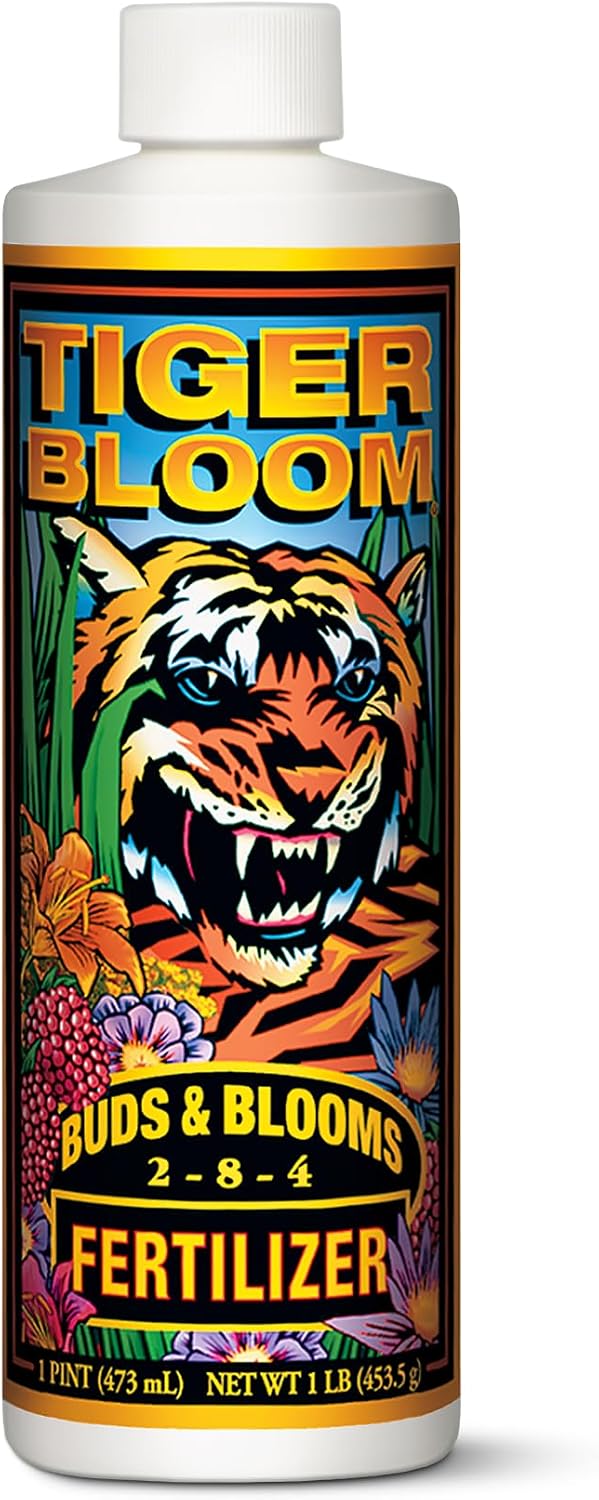
FoxFarm Tiger Bloom Liquid Plant Food (16 fl oz)
| Item Form | Liquid |
|---|---|
| Specific Uses For Product | Hydroponic |
| Application Method | Watering; Foliar spraying |
| Liquid Volume | 16 fluid ounces |
| Mixing Ratio | 1:200 or 1:300 (1 part fertilizer to 200 or 300 parts water) |
FoxFarm Tiger Bloom is a phosphorus‑weighted liquid fertilizer designed for the flowering and fruiting phase of plants. It is typically mixed into irrigation water (2–3 teaspoons per gallon for regular feeding, up to 4 teaspoons for heavy feeding) or applied as a diluted foliar spray every other week. The 2‑8‑4 N‑P‑K ratio and added micronutrients aim to promote bud set, bigger blooms and better fruit production, making it useful for tomatoes during the transition to and throughout fruiting. Because it is a concentrated liquid it absorbs quickly and is compatible with both soil and hydroponic setups, and the low pH helps keep micronutrients available. Practical limitations are that it is bloom‑stage specific so it should be paired with a balanced grow‑stage nutrient program, and phosphorus‑containing fertilizers can be restricted in some areas due to runoff concerns. Follow the mixing directions carefully to avoid overfeeding and consider flushing or reservoir changes for recirculating hydroponic systems.
Best for: Serious tomato growers who prioritize maximum fruit set and larger yields during flowering and fruiting and who follow a stage‑specific feeding schedule.
Less Ideal for: Casual gardeners wanting an all‑in‑one, year‑round fertilizer or anyone restricted from using phosphorus‑containing products on outdoor turf in their area.
- Bloom‑focused 2‑8‑4 formula targets bud and fruit development
- Concentrated liquid mixes quickly for fast nutrient uptake
- Works in both soil and hydroponic systems for flexible use
- Low pH formulation helps keep micronutrients available during storage and use
- Designed for flowering stage so not a complete all‑stage fertilizer
- Contains phosphorus which may be restricted for outdoor lawn/turf use in some jurisdictions
Verdict: Pick this if you want a concentrated, bloom‑stage fertilizer that pushes stronger bud set and bigger tomato fruit during flowering.
Miracle-Gro Water Soluble Tomato Plant Food, 3 lb

| Item Form | Liquid |
|---|---|
| Application Method | Water Soluble |
| Specific Uses For Product | Plant Food |
| Mixing Ratio | 18:18:21 |
| Target Species | Great for use on all vegetables |
Miracle-Gro Water Soluble Tomato Plant Food is a water-soluble vegetable fertilizer designed to feed tomato plants and other edible crops quickly and regularly. It dissolves easily in a watering can or can be used with the Miracle-Gro Garden Feeder for hose-end application, and the label recommends feeding every 7 to 14 days during the growing season. The 18-18-21 NPK formula supplies balanced nitrogen, phosphorus, and potassium with slightly higher potassium to support fruit development, and the product is guaranteed not to burn plants when used as directed. Practical benefits include fast uptake for visible improvement versus unfed plants and straightforward mixing ratios for outdoor and indoor use. Limitations are that it requires frequent reapplication to maintain nutrients and does not replace soil amendments that improve long-term soil structure and microbiology. This is a conventional soluble fertilizer, so gardeners preferring organic or slow-release options will want to consider alternatives.
Best for: Gardeners who want a straightforward, fast-acting fertilizer to increase tomato and vegetable yields and who prefer predictable, scheduled feeding during the growing season.
Less Ideal for: Growers looking for organic-only nutrition plans or those who prefer one-time slow-release fertilizers that build soil fertility over months.
- Water-soluble formula for quick nutrient uptake
- 18-18-21 NPK ratio tailored to promote fruiting in tomatoes and vegetables
- Works with watering can or Miracle-Gro Garden Feeder for easy application
- Clear mixing instructions for outdoor and indoor use and frequent feeding
- Requires repeated applications every 1 to 2 weeks to maintain results
- Not an organic or slow-release fertilizer for long-term soil improvement
Verdict: A reliable, fast-acting water-soluble fertilizer that makes it easy to boost tomato fruiting with regular, predictable feedings.
Jobe's Tomato Fertilizer Spikes, 18 Count

| Unit Count | 18 Count |
|---|---|
| NPK | 6-18-6 |
| Application Method | Insert spikes around the plants |
| Target Species | Tomato |
Jobe's Tomato Fertilizer Spikes are simple root-feeding sticks designed to deliver balanced nutrients directly to tomato roots over several weeks. Use one or more spikes inserted into the soil around each plant at planting or early in the season and the slow-release formula releases phosphate-heavy nutrition aimed at supporting flowering and fruit set. The pre-measured spikes eliminate guesswork and reduce mess compared with granular or liquid feeds, and the waterproof pouch helps keep leftovers dry. Practical benefits include targeted feeding that is less likely to wash away and an easy schedule—reapply roughly every eight weeks during the growing season. Limitations are that spikes provide a fixed NPK (6-18-6) so you cannot fine-tune ratios mid-season, and the fixed dose may not match very large or very small plants exactly. Also phosphorus-containing fertilizers are regulated in some areas, so check local guidance before use.
Best for: Gardeners who want a low-effort, no-mess way to support tomato flowering and fruiting and who prefer simple, periodic feeding over frequent applications.
Less Ideal for: Growers who need precise control over nutrient ratios, those managing large-scale production, or gardeners in jurisdictions restricting phosphorus use.
- Slow-release spikes deliver nutrients directly to the root zone for up to eight weeks
- Pre-measured sticks remove mixing and measuring errors and reduce mess
- High phosphorus (18) supports flower development and fruit set
- Waterproof resealable packaging keeps unused spikes dry
- Fixed 6-18-6 formula does not allow adjusting nutrient ratios for specific plant needs
- Single-dose spikes may be too strong or too weak for unusually large or small plants
Verdict: An easy, budget-friendly root-feeding option that reliably boosts tomato flowering and fruit set with pre-measured slow-release spikes.
FoxFarm Happy Frog Tomato & Vegetable Fertilizer, 5-7-3, 4 lb

| Item Form | Granules |
|---|---|
| Specific Uses For Product | Vegetables, Tomatoes, Soft Fruits, and Berries |
| Mixing Ratio | 5:7:3 |
| Unit Count | 64 Ounce |
FoxFarm Happy Frog Tomato & Vegetable Fertilizer is a granular, OMRI-listed 5-7-3 mix designed to feed fruiting vegetables and berries through vegetative and flowering stages. You apply it to containers, in-ground beds, or rows following the package directions; the granules supply nitrogen for foliage, higher phosphorus and potassium for bloom and fruit set, plus calcium aimed at reducing blossom end rot. Included mycorrhizal fungi can improve root nutrient and water uptake, which is helpful for young and established plants alike. Practical benefits include straightforward application, suitability across planting systems, and a formulation tuned for “vigorous feeders” like tomatoes and peppers. Limitations are that the bag is a single 4 lb unit so larger plots will need multiple bags and granular fertilizers require soil incorporation or watering to become available unlike ready-to-use liquid feeds. For gardeners prioritizing consistent fruit production and root health, this product is an easy, reliable seasonal feeder.
Best for: Gardeners who want a dependable, organic-friendly granular fertilizer to promote consistent fruit set and healthier root function in tomatoes and other fruiting vegetables.
Less Ideal for: People managing very large vegetable acres or those who need instant, foliar or drip-feedable nutrition should consider bulk granular options or liquid fertilizers instead.
- Balanced 5-7-3 N-P-K ratio tuned for vegetative growth and fruiting
- Contains calcium to help reduce blossom end rot in fruiting crops
- Includes mycorrhizal fungi to support root nutrient and water uptake
- OMRI-listed for organic gardening and safe for use in edible plantings
- 4 lb bag may be small for large vegetable plots requiring repeated applications
- Granular form needs incorporation and watering to activate, so not as fast-acting as liquid feeds
Verdict: Choose this OMRI-listed 5-7-3 granular fertilizer when you want a reliable, fruit-focused feed that supports blossom end rot prevention and stronger root uptake.
Miracle-Gro Water Soluble Tomato Plant Food, 1.5 lb

| Item Form | Liquid |
|---|---|
| Application Method | Water Soluble |
| Specific Uses For Product | Plant Food |
| Target Species | Tomatoes and vegetables |
| Mixing Ratio | 18-18-21 |
This water-soluble tomato plant food is designed to deliver quick, regular nutrition to tomatoes and other vegetables. Mix the powder into a watering can or use with the Miracle-Gro Garden Feeder and apply every 7 to 14 days; the label gives separate mixing ratios for outdoor and indoor use so you can avoid overfeeding. The product’s 18-18-21 analysis provides a balanced feed with a slightly higher potassium level to support fruit development, and users will notice faster greening and more vigorous growth compared with unfed plants. It is easy to use, works instantly when dissolved, and covers a medium area from a single 1.5 lb container. Important limitations are that it is a soluble chemical fertilizer so it must be reapplied frequently during the season and requires careful measuring to prevent nutrient burn if misused. Also it is formulated for regular feeding rather than a slow-release schedule, so it is not a low-maintenance option.
Best for: A gardener who wants predictable, fast-acting nutrition for tomatoes and vegetables and who follows label directions and schedules regular feedings.
Less Ideal for: Growers seeking a low-maintenance or organic slow-release fertilizer or those who prefer one-time seasonal feeding instead of regular applications.
- Water-soluble formula mixes easily for instant feeding when applied with a watering can or feeder
- Balanced N-P-K with higher potassium to support fruit set and ripening
- Clear label instructions with separate indoor and outdoor mixing rates to reduce misuse
- Works quickly so results are noticeable within the growing season
- Requires frequent reapplication every 7–14 days compared with slow-release fertilizers
- As a concentrated soluble fertilizer it must be measured carefully to avoid overfeeding
Verdict: Choose this water-soluble tomato feed when you want a fast-acting, easy-to-mix fertilizer that promotes bigger fruit with regular applications.
Miracle-Gro Shake 'N Feed Tomato, Fruit & Vegetable Plant Food, 4.5 lb

| Item Form | Granules |
|---|---|
| Specific Uses For Product | Growing tomatoes, fruits, and vegetables |
| Application Method | Dry application |
| Target Species | Tomato, Fruit & Vegetable |
| Mixing Ratio | 10:5:15 |
Miracle-Gro Shake 'N Feed Tomato, Fruit & Vegetable is a ready-to-use granular fertilizer intended to feed vegetable and fruit plants for extended periods without frequent applications. You apply it dry to the soil surface and work it into the top inch or two for in-ground plants, or mix it into potting soil at planting for containers; watering activates the nutrients. The 10-5-15 N-P-K balance and added calcium target leafy growth, fruit development and cell-wall strength to reduce common calcium-related disorders. Because it feeds for up to three months, it reduces how often you need to fertilize during the growing season. The formula is aimed at typical home gardens and containers and contains natural ingredients to support soil microbes. Limitations to note are that it is a granular dry feed so timing and even application matter to avoid over- or under-feeding, and it is not a fast-acting liquid for immediate nutrient correction. For gardeners who prefer low-maintenance, predictable feeding for fruiting crops, this product is practical and straightforward.
Best for: Gardeners who want a low-maintenance, reliable fertilizer for tomato and other fruiting vegetable beds or containers and prefer scheduled, infrequent feeding over frequent liquid applications.
Less Ideal for: Growers seeking immediate correction of nutrient problems or precise, adjustable feeding programs for commercial production should consider liquid or targeted fertilizer options instead.
- Feeds plants for up to three months, reducing application frequency
- Includes calcium to help reduce blossom end rot and improve fruit quality
- Granular dry formula is simple to apply to in-ground beds and containers
- 10-5-15 N-P-K ratio targets both foliage and fruit development
- Granules are not a quick fix for acute nutrient deficiencies compared with liquid feeds
- Requires correct placement and watering to activate nutrients and avoid uneven feeding
Verdict: A dependable, low-effort granular fertilizer with calcium that keeps tomato and other fruiting vegetable plants fed for up to three months.
Choosing the Right Tomato Fertilizer for Fruiting: Key Factors to Consider
Nutrient Ratio and Timing
The balance of nitrogen, phosphorus, and potassium matters differently during development and fruiting. Excess nitrogen late in the season encourages leafy growth and can reduce blossom set, so look for formulations that lower nitrogen relative to phosphorus and potassium once flowers form.
Timing matters as much as ratio. A fertilizer intended for fruiting should have clear guidance on when to switch from a vegetative feed to a fruiting feed. Slow-release options and controlled-timing soluble feeds let you match nutrient delivery to flowering and early fruit development, reducing the risk of nutrient surges that harm fruit quality.
Micronutrients and Blossom Health
Trace elements like calcium, magnesium, and boron play outsize roles in blossom retention and fruit integrity. Calcium helps reduce blossom-end rot, magnesium supports photosynthesis and sugar transport, and boron assists pollination and pollen tube growth.
A feed that includes or pairs well with a calcium supplement can prevent common physiological disorders. Read labels for guaranteed analysis of micronutrients and consider whether the product recommends foliar sprays or soil applications for specific deficiencies.
Application Method and Frequency
How you apply fertilizer determines how consistently plants receive nutrients. Granular slow-release products reduce labor by feeding over weeks, while water-soluble feeds let you correct deficiencies quickly and tailor strength for containers or heavy feeders.
Frequency affects risk and convenience. Frequent light feedings maintain steady nutrient levels and reduce salt buildup in pots, whereas infrequent concentrated feedings can cause spikes and stress plants. Choose a method that fits your watering habits and the scale of your planting.
Soil Type and pH Compatibility
Soil texture and pH influence nutrient availability. Sandy soils drain quickly and often require more frequent feeding, while heavy clay holds nutrients but may hold them out of reach when compacted. pH affects how well plants access phosphorus and micronutrients.
A fertilizer that lists pH guidance or pairs with lime or acidic amendments is helpful. If your soil test shows extremes, prioritize formulations that compensate for common deficiencies or that recommend complementary soil adjustments.
Suitability for Containers and Small Spaces
Container-grown tomatoes have different nutrient dynamics than in-ground plants. Pots dry and deplete nutrients faster, and soluble feeds or tailored slow-release granules made for containers reduce the chance of deficiency or salt buildup.
Choose products with clear container dosing and consider lower-concentration, more frequent feedings for hanging baskets and patio pots. Also consider media compatibility if you use soilless mixes since those retain nutrients and water differently than garden soil.
Environmental and Handling Considerations
How a fertilizer behaves when spilled or washed matters, especially in small gardens near water or where pets and children play. Water-soluble feeds can leach, while coated slow-release granules reduce runoff but may be harder to incorporate into planting mixes.
Look for clear storage and handling instructions, whether the product requires personal protective equipment, and whether it recommends buffer zones to reduce runoff. Organic or mineral-based options also differ in how they release nutrients and how they affect soil biology over time.
When To Start Fruiting Feeds
Shift your feeding when plants begin forming flowers or when the first blossoms open. At that point, reducing nitrogen while increasing phosphorus and potassium helps channel plant energy into fruit set and development rather than new leaf growth.
For indeterminate varieties, maintain a regular schedule throughout the fruiting season. For determinate types that set a single larger crop, concentrate feeding in the weeks leading up to and during fruit set to support uniform ripening.
- Begin fruiting feed at first bloom or just before the main set of flowers.
- For ongoing harvests, feed on a regular light schedule to avoid nutrient spikes.
- Adjust for weather and water availability; hot, dry spells may require more frequent light feedings.
Foliar Feeding Versus Soil Application
Foliar sprays can correct micronutrient shortages quickly because leaves absorb some nutrients faster than roots can take them up from soil. Use foliar feeding sparingly and only for specific deficiencies or to treat blossom drop events.
Soil applications remain the principal route for macro nutrients and sustainable feeding. They provide a reservoir of phosphorus and potassium that supports fruit growth over weeks. Combine approaches when you need both fast correction and steady supply.
- Use foliar sprays for rapid correction of boron or calcium shortages.
- Rely on soil feeding for steady macronutrient supply and root health.
- Avoid foliar feeding during the heat of the day to reduce leaf scorch risk.
Managing Blossom-End Rot and Other Disorders
Blossom-end rot is often a calcium availability issue triggered by inconsistent moisture or root damage rather than a lack of calcium in the soil. Consistent watering and attention to soil structure reduce the problem more effectively than heavy calcium applications alone.
If blossom-end rot persists, choose fertilizers that supply calcium in plant-available forms and consider soil amendments to improve moisture retention. Also check rootzone health and avoid excessive pruning that stresses water transport.
- Water evenly and mulch to keep soil moisture stable.
- Supplement with available calcium sources if problems continue.
- Inspect roots for girdling or damage and improve soil structure where needed.
Feeding Tomatoes in Containers Versus In-Ground
Containers require more frequent, lighter feedings because potting mixes hold less nutrient and flush more quickly with frequent watering. Many container-specific feeds list per-gallon or per-liter dosing to make this easy.
In-ground plants benefit from both a starter application at planting and follow-up feedings during fruit set. Slow-release granules work well in beds, while soluble feeds let you adjust strength for heavy fruiting seasons or after heavy rains that leach nutrients.
- Use dilute, frequent liquid feeds for containers to avoid salt build-up.
- In gardens, combine a baseline slow-release with targeted soluble applications.
- Always follow label guidance for application rates to avoid nutrient burn.
Organic Options and Soil Biology
Organic fertilizers release nutrients more slowly and depend on soil biology to make nutrients plant-available. They support long-term soil health and microbial activity but may not correct acute deficiencies quickly.
If you prefer organic feeds, combine them with soil-building practices such as adding compost, maintaining ground cover, and avoiding excessive tillage to support steady nutrient cycling during fruiting.
- Expect slower but more sustained nutrient release from organic products.
- Use compost and mulches to enhance microbial activity and nutrient availability.
- Topdress with organic amendments in early season and supplement with soluble organics if needed during heavy fruiting.
How We Chose the Best Tomato Fertilizer for Fruiting
We filtered and shortlisted fertilizers that are explicitly formulated to support tomato fruiting rather than general growth. Selection emphasized nutrient profile, application flexibility, and real-garden practicality. Key evaluation criteria included the primary macronutrient balance and timing effects on fruit set, micronutrient inclusion that supports blossom health, concentration and dilution options for different garden scales, and whether the product integrates with common watering and soil management practices. We excluded general-purpose lawn or starter formulas that prioritize vegetative growth at the expense of flowering, products intended only for seedlings or transplant shock, and any feeds lacking clear directions for fruiting stages. We also prioritized formulations with clear labeling about N-P-K and trace elements, straightforward application rates, and options suitable for soil and container tomatoes. The result is a set of picks focused on improving fruit set, sizing, and flavor while fitting typical small-scale garden routines.
FAQ
How often should I feed tomatoes during fruiting?
It depends on the feed type. Soluble fertilizers often work best as weekly or biweekly light feedings, while slow-release granules can be applied once at planting and again midseason. Containers typically need more frequent, diluted feedings.
Can I use a high-nitrogen feed while my tomatoes are fruiting?
High nitrogen encourages vegetative growth and can reduce flowering and fruit set. Switch to a lower-nitrogen, higher phosphorus and potassium feed when plants begin to bloom to support fruit development.
Will foliar feeding prevent blossom-end rot?
Foliar feeding can deliver calcium quickly to leaves and developing fruit, but blossom-end rot is usually linked to uneven soil moisture and root uptake. Consistent watering, proper soil structure, and available calcium in the rootzone are the primary fixes.
Are organic fruiting fertilizers as effective as synthetic options?
Organic fertilizers provide steady nutrient release and improve soil biology, which benefits long-term fertility. They may act more slowly and might need to be combined with targeted supplements if you need quick correction during peak fruiting.
How do I avoid salt buildup in pots when feeding frequently?
Use lower concentration feedings more often and flush the potting mix with clean water periodically to leach excess salts. Choosing feeds formulated for container use and monitoring plant leaf health helps prevent salt stress.
Final Verdict
Pick a tomato fruiting feed that matches the way you grow tomatoes and the problems you most need to solve. Prioritize a nutrient ratio that reduces late-season nitrogen while supplying phosphorus and potassium for blossom set and fruit fill. Also consider micronutrient content, how you plan to apply the feed, and whether the product fits container or in-ground culture. Balancing these tradeoffs will help you choose a fertilizer that improves fruit set and quality without creating excess leafy growth or management headaches. Focus on consistent application and soil health for the best long-term results.
