

Note: This article contains affiliate links. If you click on these links and make a purchase, I may earn a small commission at no extra cost to you. This helps support my research and content. Read my full affiliate disclosure here.
If you grow food, pest control matters differently than it does in ornamental beds. You need treatments that knock back motile pests without leaving long residues, harming pollinators, or wrecking soil biology. This guide looks at seven top options suitable for vegetable beds and container vegetables, shortlisted for predictable control, plant safety, and ease of use. We evaluate candidates on how well they control common chewing and sap-sucking insects, how safe they are around edible foliage and flowers, and how easy they are to apply in small or large plots. Read on for practical guidance that helps you choose the right approach for your vegetable garden.
Top Picks at a Glance
| Best Overall The best all-around choice for most situations | Bonide Captain Jack's Deadbug Brew 16 oz Concentrate |  |
| Best Quality Built to a higher standard if you want something more solid | BioAdvanced Vegetable & Garden Insect Spray Concentrate, 32 fl oz |  |
| Best Value The sweet spot between price and what you get | Garden Safe Insecticidal Soap Ready-to-Use Spray, 32 oz |  |
| Best Budget The cheapest option that still gets the job done reliably | GardenTech Sevin Insect Killer Dust, 1 lb |  |
| Highest Rated A top-rated pick with lots of positive feedback | Monterey Spinosad Insecticide, 32 oz (concentrate) |  |
| Most Popular A crowd favorite that many people choose with confidence | Bonide Captain Jack's Bt Thuricide Ready-to-Use Spray, 32 oz |  |
| Best Seller A high-volume bestseller chosen again and again | Sevin Insect Killer Ready-to-Use, 1 Gallon |  |
Bonide Captain Jack's Deadbug Brew 16 oz Concentrate

| Unit Count | 16 Ounce |
|---|---|
| Item Form | Spray |
| Target Species | Insects |
| Active Ingredients | Spinosad (Mixture of Spinosyn A and Spinosad D) |
Bonide Captain Jack's Deadbug Brew is a concentrated spinosad insecticide designed for use on vegetables, fruits, ornamentals, and other garden plants. You mix the 16 fl oz concentrate with water and apply it with a trigger, hand-held, backpack, or hose-end sprayer to target caterpillars, beetles, borers, leaf miners, and similar chewing pests. Because the active ingredient is spinosad, the product is approved for organic gardening and is selective enough that it does not significantly impact many predatory beneficial insects and mites when used as directed. In practical use it provides quick knockdown of listed pests and is suitable for protecting squash and other cucurbits from feeding damage. The main limitations are that it must be mixed and applied correctly following label rates and safety instructions and that repeated broad use can still affect non-target insects if timing and coverage are not careful. For gardeners focused on protecting food crops, it is a straightforward, effective option when integrated with scouting and spot treatments.
Best for: Gardeners who prioritize practical, effective pest control for edible gardens and want an organic-approved concentrate they can mix and apply themselves to protect squash and other crops.
Less Ideal for: Gardeners seeking a ready-to-use spray or those unwilling to follow label mixing and safety instructions should consider alternative formats or professional application.
- Contains spinosad, an active ingredient approved for organic gardening and effective against caterpillars and beetles
- Concentrate mixes with water for use with trigger, backpack, hand-held, or hose‑end sprayers
- Labeled for use on a wide range of vegetables, fruits, and ornamentals including cucurbits
- Designed to minimize impact on many predatory beneficial insects and mites when used as directed
- Requires careful mixing and application per label to avoid harming non-target insects
- Not a residual solution for all pests so repeat applications or scouting are often necessary
Verdict: A practical, organic-approved spinosad concentrate that reliably controls chewing pests on squash and other garden crops when mixed and applied correctly.
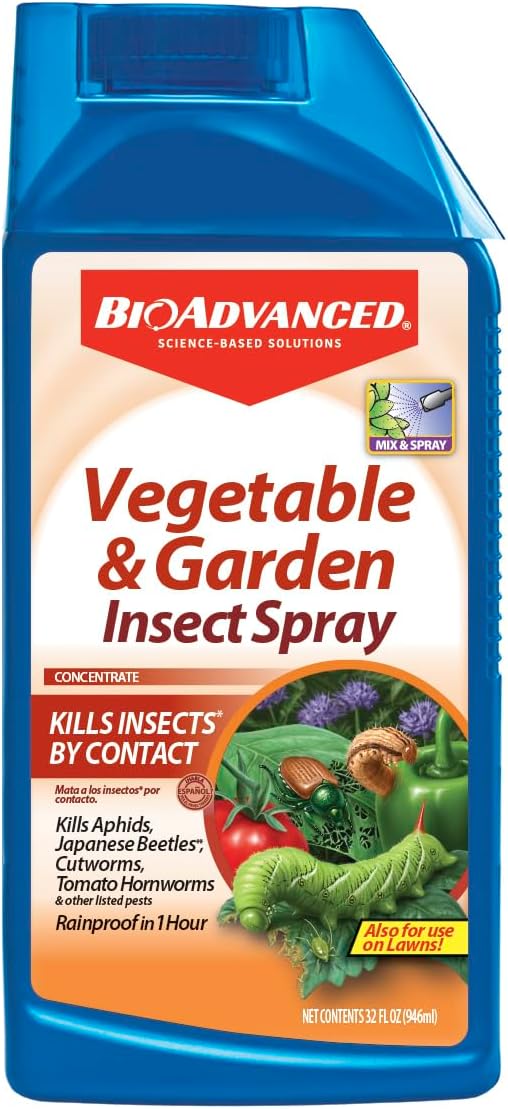
BioAdvanced Vegetable & Garden Insect Spray Concentrate, 32 fl oz
| Item Form | Spray |
|---|---|
| Target Species | Insects |
| Liquid Volume | 32 fluid ounces |
| Active Ingredients | Cyfluthrin |
This BioAdvanced concentrate is designed for gardeners who need a versatile, broad-spectrum insect control for outdoor plants. The bottle mixes into a ready spray that kills common pests on contact, including aphids, caterpillars, whiteflies, and tomato hornworms, and the formula becomes rainproof in about an hour so treatments hold up to light rain. Because it is a concentrate, one 32-ounce bottle makes up to 64 gallons of spray, which is convenient for treating larger beds or multiple plantings without frequent repurchasing. Typical use is diluting to label rates, filling a garden sprayer, and coating leaves until wet but not dripping. The main limitation is that it uses a synthetic pyrethroid active ingredient so it will also affect nontarget insects including beneficials if oversprayed, and label precautions must be followed for edible crops and pollinators. It is not a selective or organic option, but for balanced gardeners wanting an effective, easy-to-apply contact insecticide for outdoor plants, it provides strong, reliable control.
Best for: Gardeners who want a single, effective contact insecticide to protect vegetables, fruits, and ornamentals across a typical backyard garden and value ease of use and wide pest coverage.
Less Ideal for: Growers who prioritize organic methods, pollinator-safe selective controls, or those managing very small container plantings where concentrate dilution is inconvenient.
- Concentrate mixes to make up to 64 gallons, suitable for treating large areas
- Kills a wide range of listed garden pests on contact, including common vegetable pests
- Rainproof protection within one hour helps treatments withstand light rain
- Can be applied with most common garden sprayers for straightforward use
- Contains a synthetic pyrethroid (cyfluthrin) that can harm beneficial insects if not used carefully
- Not an organic or selective option for gardeners seeking softer pest control
Verdict: A productive, rainproof concentrate that delivers broad, contact insect control for gardeners who need reliable protection across vegetable and outdoor plantings.
Garden Safe Insecticidal Soap Ready-to-Use Spray, 32 oz

| Item Form | Spray |
|---|---|
| Target Species | Insects |
| Liquid Volume | 32 fluid ounces |
| Active Ingredients | Potassium Salts Of Fatty Acids |
Garden Safe Insecticidal Soap is a ready-to-use contact spray formulated with potassium salts of fatty acids to control aphids, mealybugs, mites, whiteflies and similar soft-bodied pests. You use it like a normal garden spray: thoroughly coat insects and all plant surfaces including undersides of leaves, ideally in calm weather and not in full sun. It is safe for use on vegetables, fruit trees, ornamentals, shrubs, flowers and in greenhouses and may be applied to edibles up to the day of harvest, which simplifies timing for vegetable growers. The spray works on direct contact so thorough coverage is essential and multiple applications may be needed for heavy infestations. The product is convenient because no mixing is required, but it can be washed off by rain and is hazardous to aquatic invertebrates so care is needed to avoid runoff into water. For routine control of common garden pests this soap is a practical, low-toxicity option when used as part of an integrated pest management approach.
Best for: Gardeners who prioritize practical, low-toxicity pest control and want a ready-made spray that can be used on edible crops without pre-harvest delays.
Less Ideal for: People needing a long-residual or systemic pesticide for heavy infestations or for pests hidden inside plant tissues should consider other control methods.
- Ready-to-use formula requires no mixing for quick spot treatments
- Labeled for use on vegetables and may be applied up to the day of harvest
- Controls a broad list of soft-bodied pests including aphids, mites and whiteflies
- Plant-safe when used as directed and usable indoors, outdoors and in greenhouses
- Only kills pests by direct contact so it has limited residual or systemic activity
- Can be washed off by rain and must be reapplied after watering or heavy rainfall
- Harmful to aquatic invertebrates so it requires careful application near water
Verdict: A convenient, low-toxicity ready-to-use soap spray that gives effective contact control of common soft-bodied garden pests and is safe to use up to harvest.
GardenTech Sevin Insect Killer Dust, 1 lb

| Item Form | Dust |
|---|---|
| Target Species | Insects |
| Active Ingredients | Bifenthrin |
| Unit Count | 1 Count |
Sevin Insect Killer Dust is a handheld dust formulation of bifenthrin for spot and perimeter treatment of garden pests, including Japanese beetles. You apply it by shaking a thin, uniform layer onto leaves, stems and around plants as a preventative or when you first see damage. The product kills by contact and lists more than 150 target insects, so it works across vegetables, fruit, ornamentals and turf. Practical features include a flip-open cap for easy dispensing and a 1 pound container sized for small-to-medium beds; the manufacturer states one pound treats about 2,000 sq. ft. The dust does not require mixing and settles quickly so treated areas can be reoccupied after it dries. Important limitations are typical for contact insecticides: it should not be applied to open blooms to protect pollinators and it provides little residual control if plants are watered or receive heavy rain within 24 hours of application. Users must follow label safety steps like avoiding the eyes and washing hands after use.
Best for: Gardeners who want a straightforward, no-mix contact treatment to quickly reduce visible beetle and chewing insect pressure in mixed vegetable, fruit and ornamental plantings.
Less Ideal for: People prioritizing pollinator-safe or long-residual biological controls should choose targeted or non-chemical methods instead.
- Kills by contact a wide range of garden pests including Japanese beetles and aphids
- Ready-to-use dust needs no mixing and is simple to apply with a flip-open cap
- Label lists use on vegetables, fruits, ornamentals and lawns so it fits mixed garden beds
- Contains bifenthrin which can harm beneficial insects if applied to open blooms or overused
Verdict: If you need a simple, ready-to-use contact treatment to quickly knock down Japanese beetles and other common garden pests, Sevin dust delivers fast, broad-spectrum control.
Monterey Spinosad Insecticide, 32 oz (concentrate)

| Unit Count | 32 Fluid Ounces |
|---|---|
| Item Form | Oil |
| Target Species | Insects |
Monterey Spinosad is a concentrated, spinosad‑based insecticide designed for home garden use to control caterpillars, leafminers, borers, thrips and many other chewing and crawling pests. Mixed into a trigger, backpack, or hose‑end sprayer, it can be applied to ornamentals, vegetables, lawns, citrus and fruit trees; the concentrate format makes it easy to cover larger areas on a schedule. The product is OMRI listed, fast acting, and practically odorless since spinosad is derived from naturally occurring bacteria. Safety directions on the label are clear and recommend protective clothing and thorough washing after handling. Limitations are that it is a broad contact toxin so beneficial insects like bees and predatory insects can be affected if applied during bloom or while pollinators are active, and you must follow label rates and reentry intervals for edible crops. For gardeners who prioritize reliable, organic‑approved control of chewing insects, this concentrate is a practical tool; those wanting an ant‑specific baiting strategy or systemic option will need a different product.
Best for: Gardeners who want a reliable, organic‑approved concentrate to quickly reduce chewing and boring insect populations across vegetables, ornamentals and fruit trees and who are comfortable following label safety and mixing instructions.
Less Ideal for: People seeking a targeted ant bait or a systemic insecticide for soilborne pests or those who need a product safe to spray during active bloom are better off with specialist ant baits or systemic products.
- OMRI listed for use in organic gardening
- Effective against a wide range of chewing and boring insects including caterpillars and leafminers
- Concentrate format works with trigger, backpack, or hose‑end sprayers for flexible coverage
- Fast acting and essentially odorless when applied properly
- Contact action can harm beneficial insects if applied when pollinators are active
- Requires mixing and careful adherence to label instructions for safe use
Verdict: Choose this OMRI‑listed spinosad concentrate when you need dependable, fast control of chewing garden pests across vegetables, ornamentals and fruit trees.
Bonide Captain Jack's Bt Thuricide Ready-to-Use Spray, 32 oz

| Unit Count | 32 Ounce |
|---|---|
| Item Form | Spray |
| Target Species | Insects |
| Active Ingredients | Bacillus Thuringiensi,Lapidapteran Active Toxins |
Bonide Captain Jack's Bt Thuricide is a ready-to-use biological spray that delivers Bacillus thuringiensis (Bt) to control caterpillars and worm-stage insects. You apply it with the trigger sprayer directly to the tops and undersides of leaves when you first see feeding damage; it is labeled for use on vegetables, fruit, shade trees and ornamentals and can be used up to the day of harvest on edibles. Because it kills by ingestion, treated pests stop feeding within a couple of days while birds, earthworms and many beneficial insects are largely unharmed. The product is convenient for small-to-medium infestations since it needs thorough coverage and repeat applications for new larvae. It is approved for organic gardening and comes in a 32-ounce bottle that is easier to use than concentrates for spot treatments, but using a ready-to-use bottle across a large property can become time consuming compared with hose-end or pressurized sprayers.
Best for: Gardeners who prioritize proven, low-risk biological control and want an easy spray for spot treating caterpillars on edible and ornamental plants; ideal for those who value safety around beneficials and pets.
Less Ideal for: People needing fast-contact knockdown for a large-scale outbreak or who must treat many acres quickly should consider concentrates or professional application methods instead.
- Targets caterpillars and worm-stage pests with a proven Bt active ingredient
- Safe for use on edible plants up to day of harvest when label directions are followed
- Ready-to-use trigger bottle requires no mixing for quick spot treatments
- Labeled for a wide range of plants including vegetables, ornamentals and shade trees
- Requires insects to ingest product so results are not immediate and depend on good spray coverage
- Ready-to-use bottle is less efficient for treating large areas compared with concentrates or hose-end applicators
Verdict: A convenient, organic-ready Bt spray that reliably controls caterpillars and worm pests while protecting beneficials, ideal for careful gardeners treating spot infestations.
Sevin Insect Killer Ready-to-Use, 1 Gallon

| Unit Count | 127.82 Fluid Ounces |
|---|---|
| Item Form | Liquid |
| Target Species | Insects |
| Active Ingredients | Lambda-Cyhalothrin |
Sevin Insect Killer Ready-to-Use is a one-gallon, ready-to-spray insecticide formulated to kill hundreds of common garden pests on contact. It comes with an attachable nozzle and adjustable stream settings so you can target foliage, vegetables, ornamental plants, shrubs, and lawns without mixing concentrates. Typical use is simple: connect the nozzle, select a spray pattern, and hold about one foot from the plant while evenly covering the treatment area. The product lists lambda-cyhalothrin as the active ingredient and advertises fast visible results against pests such as aphids, Japanese beetles, hornworms, whiteflies, and many more. Practical benefits include broad-spectrum control for early-season infestations and convenience of a pre-mixed sprayer for homeowners who want quick application. Important limitations are that it is a conventional insecticide so you should avoid spraying open blooms to protect pollinators and follow label wait times before watering or re-entry; it is not an organic option and requires careful handling per safety directions.
Best for: Home gardeners who want a straightforward, effective ready-to-spray solution to quickly control insect outbreaks on vegetables and ornamentals and prefer a low-effort product they can apply immediately.
Less Ideal for: Gardeners seeking organic or insect-friendly pest management or those who prioritize preserving pollinators in bloom should consider alternative products or targeted cultural controls.
- Ready-to-use formulation with an attachable nozzle for quick application
- Broad-spectrum control that targets over 700 listed insect pests on contact
- Fast-acting visible results suitable for early interventions in vegetable and flower gardens
- Contains a synthetic pyrethroid active ingredient so it is not organic and can harm beneficial pollinators if applied to open blooms
Verdict: Buy this if you want a convenient, ready-to-spray insecticide that delivers fast, broad-spectrum control for vegetable and ornamental garden pests.
Choosing the Right Vegetables Insect Killer: Key Factors to Consider
Pest Spectrum and Targeting
Different insect control options work against different pest types. Some are broad-contact insecticides that knock down caterpillars, beetles, and aphids on contact, while others are more selective for sap-sucking insects or specific larval stages. Knowing the pests you most commonly see in your beds lets you choose a product with the right mode of action and reduces wasted applications.
Targeting also matters for timing and placement. Products that act on contact require thorough coverage of affected foliage and are best for visible infestations. Systemic options can protect new growth but may have implications for pollinator exposure and harvest safety, so weigh the tradeoffs depending on whether plants are flowering or fruiting.
Plant Safety and Crop Residue
When treating vegetables, plant safety is critical. Some formulations can scorch tender leaves, stunt growth, or interfere with fruit set when applied during hot weather or on certain crop families. Readability of labels about safe application intervals before harvest and any temperature-related restrictions is essential for edible crops.
Residue persistence determines how long you must wait between application and harvest. Shorter residual options reduce harvest delays but may need repeat applications to maintain control. Balance residue concerns with the level of pest pressure and the crop growth stage to minimize both risk and work.
Impact on Pollinators and Beneficial Insects
Vegetable gardens rely on pollinators and natural enemies to keep pest pressure manageable. Many insect control methods differ widely in how they affect bees, predatory beetles, lacewings, and parasitoid wasps. Broad-contact sprays can decimate beneficials if used when flowers are open, while targeted baits, soaps, or biologicals tend to be kinder.
Timing applications to avoid bloom, using spot treatments, and choosing selective options help preserve beneficial populations. Consider integrated strategies that combine physical controls and habitat for beneficials to reduce reliance on chemical knockdowns.
Application Method and Garden Scale
The practical way you apply a treatment affects whether it fits your garden. Hand-sprayers and pump sprayers work well for small beds and containers, while hose-end applicators speed coverage in larger plots. Some formulations require mixing, protective equipment, or multiple repeat applications, which changes the labor and safety profile.
Think about tank-mixing needs, nozzle types for even coverage, and whether a product can be applied as a spot treatment versus blanket spray. Ease of cleanup and storage also matter for backyard gardeners.
Timing and Frequency of Use
Effective pest control depends on matching timing to pest life cycles. Some measures are most effective against larvae or early-instar pests, while others target adults. Regular monitoring and early intervention can reduce the need for heavy treatments.
Frequency matters because repeated applications increase exposure risks and can stress beneficial populations. Choose options that fit your desired management rhythm and plan follow-up actions such as reapplication intervals that align with crop stages and label guidance.
Environmental Persistence and Soil Impact
How long a treatment persists in soil and on foliage affects both safety and ecological footprint. High-persistence options may offer longer control but can accumulate in soil or harm soil invertebrates and microbes, affecting long-term soil health. Shorter-residual or biodegradable options reduce persistence concerns but may require more frequent application.
For food gardens, prefer options with minimal soil carryover or those labeled safe for use in vegetable production. Consider non-chemical alternatives where possible to reduce cumulative impacts.
Identifying the Culprits
Before choosing a treatment, confirm which pests are causing damage. Look for chewing evidence like holes and ragged edges, which points to caterpillars or beetles, versus stippling and honeydew that indicate sap-suckers such as aphids or whiteflies. Search undersides of leaves and check for frass or silk when caterpillars are suspected.
Accurate ID narrows your options and helps you pick a product with the right mode of action. It also informs timing because some controls work only against eggs or larvae, while others target adults. Scouting regularly during the growing season is the most cost-effective way to reduce unnecessary applications.
- Check new growth and the undersides of leaves for early infestations
- Use a hand lens or phone macro to spot small pests like aphids and mites
- Note whether flowers are present to protect pollinators during treatment
Low-Residue and Organic-Compatible Options
For edible beds, many gardeners prefer options that break down quickly and have minimal pre-harvest intervals. These include botanical extracts, insecticidal soaps, horticultural oils, and certain biologicals. They are usually contact-based and work well when applied thoroughly at low to moderate pest levels.
These options are often safer for beneficials when used properly, but they require good coverage and repeat applications. Use them as part of a program that emphasizes monitoring and targeted spot treatments to conserve beneficial insects and limit residue on harvestable parts.
- Apply in the cooler part of the day to reduce plant stress
- Avoid spraying when pollinators are active on flowers
- Repeat at label intervals until pest pressure drops
When Systemic Action Is Useful
Systemic treatments move inside plant tissues and can protect new growth and roots after a single application. They are useful for pests that feed in sheltered spots or for crops where thorough foliar coverage is difficult. However, systemic options can appear in nectar, pollen, or edible tissues, so review any harvest interval and pollinator risk before using them on flowering vegetable crops.
Use systemic options sparingly and only when monitoring indicates persistent pest pressure that cannot be managed with contact or cultural controls. For many small-scale vegetable gardens, targeted systemic use on non-flowering or heavy-feeding crops is a practical compromise.
- Consider systemics for root-feeding or hard-to-reach pests
- Avoid systemics on crops in full bloom to protect pollinators
- Follow label directions for pre-harvest intervals
Integrated Cultural and Mechanical Controls
Non-chemical tactics reduce reliance on insect killers and lower spray frequency. Row covers, hand-picking, trap cropping, and removing infested foliage cut pest populations without chemical exposure. Good sanitation between crops and diverse plantings encourage natural enemies that keep pests below damaging levels.
Combine cultural tactics with judicious use of insect control products. For example, use physical barriers early in the season and switch to targeted treatments only when monitoring shows thresholds have been exceeded. That approach reduces environmental impact and can improve long-term garden resilience.
- Rotate crops and avoid planting the same family in the same bed year after year
- Use floating row covers to protect young seedlings from beetles and moths
- Encourage beneficials with flowering plants and habitat
Safe Spray Practices and Timing
When you spray, aim for thorough but precise coverage of affected parts rather than blanket broadcasting. Apply in the early morning or late evening when temperatures are cooler and pollinators are less active. Avoid spraying during wind or peak sun to reduce drift and plant scorch.
Calibrate sprayers for droplet size and coverage and clean equipment after use. Wear appropriate protective gear per label instructions and never apply treatments to ripening produce unless the product explicitly allows it.
- Spot-treat high-infestation areas instead of whole-bed applications
- Do not spray flowering plants when bees are visiting
- Record application dates and conditions for future reference
How We Chose the Best Vegetables Insect Killer
We focused on products and formulations that are commonly used in edible gardens and that match practical grower priorities. Selection prioritized demonstrated control of key vegetable pests such as aphids, caterpillars, whiteflies, flea beetles, and leaf miners. Safety around edible foliage and pollinators ranked highly because withdrawal times, contact risk, and residue on harvestable parts matter for food crops. Ease of application and suitability for different garden scales was another filter: candidates had to be usable in hand-sprayers, hose-end systems, or targeted spot treatments. Environmental persistence and impact on beneficial insects and soil life were evaluated to favor shorter-residual or selective options. We excluded broad-spectrum, long-residual pesticides that are generally recommended only for non-food ornamentals or large-scale commercial operations. Also omitted were products that require specialized equipment or applicator licensing. The criteria that actually mattered in selection were pest control spectrum, contact versus systemic action, plant safety on common vegetable families, pollinator and beneficial insect risk, and practicality of application for small-scale gardeners.
FAQ
Are vegetable-safe insect killers harmful to pollinators?
It depends. Many low-residue, contact-based options have lower risk to pollinators when applied correctly, especially if you avoid spraying open flowers and apply outside peak foraging times. Broad-contact or systemic treatments can pose higher risks, so timing and product choice matter.
How long after treatment can I harvest vegetables?
Pre-harvest intervals vary by formulation. Organic-compatible contact options often have minimal wait times, while systemic or longer-residual products may require several days to weeks before harvest. Always follow label directions for safe harvest intervals.
Will insect killers kill beneficial insects in my garden?
Some will, particularly non-selective contact sprays used broadly. You can reduce collateral damage by using spot treatments, choosing selective agents, applying in the evening, and preserving habitat that supports beneficials so populations recover quickly.
Can I use the same insect control across all vegetable types?
Not always. Some crops are more sensitive to certain formulations and weather conditions can increase phytotoxicity risk. Match the treatment to both the pest and the crop, and check label guidance for any crop-specific restrictions.
How often should I reapply treatments?
Reapplication depends on product residual activity and pest pressure. Short-residual contact options often need reapplication every 5 to 14 days during active infestations, while longer-lasting products require fewer passes. Base frequency on scouting results and label instructions.
Final Verdict
Select an insect control approach that fits the pests you see, the vegetables you grow, and how much you want to protect beneficial insects. Prioritize plant-safe, short-residual options for crops near harvest and use systemics selectively when other methods fail. Combine chemical or biological controls with cultural practices and careful timing to minimize risk and keep pest pressure under control. A clear monitoring plan and thoughtful application schedule let you balance effectiveness with safety, so you protect both yields and the garden ecosystem while managing common vegetable pests.
