

Note: This article contains affiliate links. If you click on these links and make a purchase, I may earn a small commission at no extra cost to you. This helps support my research and content. Read my full affiliate disclosure here.
Picking the right soil matters more for carnivorous plants than for ordinary houseplants. Venus fly traps need a growing medium that holds moisture without providing the dissolved minerals that damage root systems. The wrong mix encourages rot, weak traps, and mineral buildup that is hard to reverse. This guide covers seven top shortlisted soils suitable for growing Venus fly traps in pots and trays. We evaluated mixes for moisture retention, drainage, and nutrient purity so you can choose a substrate that supports strong trap formation and healthy roots. Read on to see the traits that matter and which soil characteristics match your growing setup.
Top Picks at a Glance
| Best Overall The best all-around choice for most situations | Leaves & Soul Carnivorous Plant Soil Mix, 2.2 Quarts |  |
| Best Quality Built to a higher standard if you want something more solid | Josh's Frogs Sprig & Stone Carnivorous Plant Soil, 4 Quart |  |
| Best Value The sweet spot between price and what you get | Gardenera Professional Carnivorous Plant Soil — Ready-to-Use 1 Qt |  |
| Best Budget The cheapest option that still gets the job done reliably | Yilotuce 2 QT Carnivorous Plant Soil Mix (Perlite + Sphagnum Moss) |  |
| Highest Rated A top-rated pick with lots of positive feedback | Perfect Plants Carnivorous Plant Soil, 4 qt (Peat Moss and Perlite Mix) |  |
| Most Popular A crowd favorite that many people choose with confidence | Organic Earth Carnivorous Plant Soil Mix (32 oz) |  |
| Best Seller A high-volume bestseller chosen again and again | Omitgoter Carnivorous Plant Soil Mix, 1 qt |  |
Leaves & Soul Carnivorous Plant Soil Mix, 2.2 Quarts

| Brand | Leaves and Soul |
|---|---|
| Volume | 2.2 quarts |
| Unit Count | 70.4 Fluid Ounces |
| Made in | USA |
Leaves & Soul Carnivorous Plant Soil Mix is a small, ready-to-use growing medium designed for species that need consistently moist but low-nutrient root conditions, such as pitcher plants. The blend pairs peat moss and coco coir for water retention with perlite for aeration and drainage, while dolomite provides a buffering element. In practice this mix makes repotting and seedling work straightforward because it does not require further amendments and holds moisture without compacting. It is intended for indoor and outdoor use across Venus flytraps, sundews, Nepenthes and Sarracenia when paired with appropriate containers and water quality. For growers focused on plant performance the formula supports healthy root airflow and reduces the risk of mineral buildup that can stress carnivores. Limitations include the small 2.2 quart volume, which means frequent purchases or mixing for larger specimens, and the need for growers to manage water source and species-specific humidity and dormancy needs separately because the soil alone does not control those factors.
Best for: Serious growers who prioritize plant performance and root health for pitcher plants and other carnivores and who will control water quality, humidity, and species-specific care.
Less Ideal for: Casual gardeners who want an all-in-one, low-maintenance potting solution or anyone needing large volumes of soil for multiple or large specimens without blending their own mix.
- Ready-to-use low-nutrient blend tailored for carnivorous species
- Peat moss and coco coir retain consistent moisture without compaction
- Perlite improves aeration and drainage to protect roots
- Includes dolomite to help buffer the root environment
- Only 2.2 quarts per bag, which is small for repotting larger or multiple plants
- Requires careful water quality and environmental control from the grower for best results
Verdict: Choose this mix when you want a performance-minded, ready-to-use low-nutrient soil that supports healthy roots for pitcher plants and other carnivores.
Josh's Frogs Sprig & Stone Carnivorous Plant Soil, 4 Quart

| Volume | 4 quarts |
|---|---|
| Unit Count | 148 Ounce |
| Item Type Name | Terrarium Substrate |
| Item Highlight | Venus Fly Traps/Pitchers/Sundews |
Josh's Frogs Sprig & Stone Carnivorous Plant Soil is a ready-to-use blend of peat and perlite made specifically for bog-type carnivorous plants. In practice you use it for potting, repotting, or germinating Venus fly traps, sundews, and pitcher plants where standard potting mixes would supply too many nutrients. The high peat content helps retain the saturated moisture these species need while the perlite provides aeration so roots do not stay waterlogged. The mix is fertilizer-free and acidic, which reduces the risk of nutrient burn and supports healthier traps and leaves. Because it is pre-mixed, it saves the time and guesswork of blending your own medium and is convenient for seed germination as well. Limitations are that the product is a single basic formula without added drainage layers or specialized grain sizes, so highly custom growers who prefer exact particle fractions or automated irrigation setups may want to amend the mix themselves. For routine potting and seed starts of carnivorous plants this mix performs reliably and simplifies setup.
Best for: Serious hobbyists focused on plant performance who want a proven, low-nutrient substrate that removes the guesswork when potting or germinating carnivorous plants.
Less Ideal for: Users seeking a highly customized substrate with exact particle grading or integrated drainage components should consider mixing their own media or using specialized amendments.
- Formulated specifically for carnivorous plants with peat and perlite for moisture retention and aeration
- Fertilizer-free and acidic pH suitable for Venus fly traps, sundews, and pitcher plants
- Pre-mixed and ready to use, saving time over DIY blends
- Appropriate for seed germination as well as potting and transplanting
- Single basic formula may require amendment for growers who want precise particle size or extra drainage
Verdict: Buy this premixed peat and perlite blend when you want a performance-focused, ready-to-use soil that reliably recreates the low-nutrient, wet conditions carnivorous plants need.
Gardenera Professional Carnivorous Plant Soil — Ready-to-Use 1 Qt

| Item Type Name | Professional Carnivorous Plant Soil |
|---|---|
| Unit Count | 1 Count |
| Volume | 1 quarts |
| Brand Name | Gardenera |
This premixed carnivorous plant soil is designed to give Venus flytraps, sundews, pitcher plants, and butterworts a consistent growing medium without mixing your own components. The bag combines peat moss, coco coir, and perlite to balance moisture retention and aeration so pots stay damp but not waterlogged. Because it arrives ready to use you save time and avoid measuring ratios, and the resealable bag helps preserve the mix between uses. Practical benefits include good root oxygenation from perlite and steady moisture-holding from peat and coir, which supports healthy trap development and sensible watering intervals. Limitations are the small 1 quart volume which suits seedlings or single small pots but means frequent repurchases for larger collections, and the presence of peat that can be dusty and should be handled carefully. This is a convenient, reliable option for growers who prefer a proven premix rather than blending their own carnivorous substrate.
Best for: Ideal for growers who want a reliable, no-mix soil that saves time and delivers consistent results for individual Venus flytraps or a small collection.
Less Ideal for: Not a great choice for hobbyists with large collections or those who prefer custom peat-free mixes or bulk quantities.
- Premixed blend of peat moss, coco coir, and perlite ready to use out of the bag
- Good balance of moisture retention and drainage for carnivorous species
- Resealable packaging helps keep remaining mix fresh between uses
- Small 1 quart volume requires more frequent replacement for multiple plants
- Contains peat moss which can be dusty and should be handled with care
Verdict: Buy this if you want a convenient, professionally blended carnivorous-plant mix that works straight from the bag for small numbers of Venus flytraps.
Yilotuce 2 QT Carnivorous Plant Soil Mix (Perlite + Sphagnum Moss)

| Brand Name | Yilotuce |
|---|---|
| Volume | 1.76 quarts |
| Item Weight | 3.36 ounces |
This Yilotuce kit supplies compressed sphagnum moss crumbs and individually wrapped perlite so you can quickly prepare a carnivorous-plant potting mix. You rehydrate the compressed moss, fluff it, add the perlite, squeeze out excess water and pot—an approach that keeps preparation simple and minimizes mess. The moss provides high water retention while the perlite improves drainage and aeration, which helps roots stay healthy in consistently damp conditions typical for pitcher plants. Packaging is compact and handpicked components are screened for dust and debris, so you get a clean, uniform mix. Expect only 2 quarts total, which is convenient for repotting individual plants or starting seedlings but not for larger collections. Perlite dust can be present if bags are compressed, and because the product is packaged small you will need to repeat purchases for multiple pots. For budget-conscious growers wanting a purpose-formulated, no-additives medium to pot one or two pitcher plants, this is an easy, low-waste option.
Best for: Buyers repotting one or two pitcher plants or starting seedlings who prioritize an affordable, ready-formulated medium and low-prep potting steps.
Less Ideal for: Not a good fit for collectors who need bulk volumes or for outdoor beds where larger quantities of soil are required.
- Designed specifically for carnivorous plants with a sphagnum-perlite ratio for moisture retention and aeration
- Compressed moss and pre-measured perlite make mix-up fast and low-mess
- Handpicked components with visible low debris for a cleaner planting medium
- Total volume is small so you will need multiple packs for several plants
- Perlite may produce dust or powder if bags are squeezed during shipping
Verdict: A compact, low-prep sphagnum-and-perlite mix that gives pitcher plants the right moisture plus aeration without extra additives, ideal for budget-conscious single-plant repots.
Perfect Plants Carnivorous Plant Soil, 4 qt (Peat Moss and Perlite Mix)

| Unit Count | 128 Fluid Ounces |
|---|---|
| Item Type Name | Carnivorous Plant Soil 4qt |
| Item Highlight | Organic sphagnum peat moss and perlite blend for flytraps, sundews, pitcher varieties and Nepenthes |
| Volume | 4 quarts |
This 4-quart Perfect Plants mix is made from sphagnum peat moss blended with perlite to give pitcher plants and other carnivores the acidic, well-watered rooting medium they need. Use it straight from the resealable bag for potted Venus flytraps, sundews, and pitcher species; the peat provides steady acidity while the perlite improves drainage and keeps the mix from compacting. The bag is labeled as professionally mixed in the US and sized to fill several small containers, which makes it convenient for repotting or topping up pots. Practical benefits include consistent moisture retention without sogginess, low nutrient content suitable for carnivores, and easy storage in the heavy-duty resealable bag. Limitations are that it is a basic peat-perlite blend with no added long-term amendments and the volume is modest for larger collections, so serious collectors may need multiple bags or to blend with extra perlite for larger Nepenthes or to customize drainage. Follow basic safety advice to avoid inhaling dust and wash hands after handling.
Best for: Buyers who want a reliable, ready-made potting medium for pitcher plants and other carnivores and prefer a hassle-free product that delivers appropriate acidity and moisture control.
Less Ideal for: Growers with large Nepenthes, commercial batches, or those who prefer to customize their mixes with additional amendments should look for larger or more customizable options.
- Formulated for carnivorous plants with low acidity appropriate for pitchers and flytraps
- Peat and perlite balance offers moisture retention without heavy compaction
- Resealable heavy-duty bag for convenient storage and freshness
- Ready-to-use mix suitable for repotting or filling multiple small pots
- Modest 4 quart volume may require multiple bags for larger plants or collections
- No listed long-term amendments or specific nutrient buffering for specialty species
Verdict: A dependable, ready-mixed peat and perlite soil that gives pitcher plants the low-pH, moisture-retentive medium they need for consistent repotting results.
Organic Earth Carnivorous Plant Soil Mix (32 oz)

| Unit Count | 32 Ounce |
|---|---|
| Brand Name | Organic Earth |
| Volume | 1 quarts |
| Style Name | Peat Moss,Potting,Soil Mix |
This ready-to-use mix combines Canadian sphagnum peat moss and horticultural-grade perlite in a roughly 1:1 ratio to give carnivorous plants a balance of moisture retention and aeration. It is designed for planting and repotting Venus flytraps, pitcher plants, and sundews and includes basic instructions, which removes the need to measure and mix your own peat and perlite. In practice the peat holds water without becoming nutrient-rich potting soil that can harm carnivores, while the perlite helps prevent waterlogging and root rot. The package size is convenient for small pots and terrariums used by hobby growers. Important limitations are that distilled water or rainwater is still required to avoid mineral buildup and that a single 32-ounce bag only covers a few small plants, so frequent repurchase is likely for larger collections. Also follow basic dust-avoidance and handling precautions listed on the label.
Best for: Buyers who want a dependable, ready-made carnivorous plant substrate and prefer evidence of good results from other hobbyists rather than experimenting with custom mixes.
Less Ideal for: Large-scale growers or those who maintain many plants will find the bag size impractical and should consider bulk soil or mixing their own components.
- Pre-mixed 1:1 peat to perlite ratio eliminates the need to blend components yourself
- Uses Canadian sphagnum peat moss suitable for carnivorous plant moisture needs
- Horticultural-grade perlite improves drainage and reduces risk of root rot
- Includes planting and repotting directions for beginners
- Small 32 oz volume only covers a few small pots so repeat purchases are necessary for larger collections
- Must be used with distilled water or rainwater to maintain proper pH and avoid mineral buildup
Verdict: A convenient, correctly balanced peat-and-perlite mix that saves time and gives reliable growing conditions for hobby Venus flytraps and other carnivores.
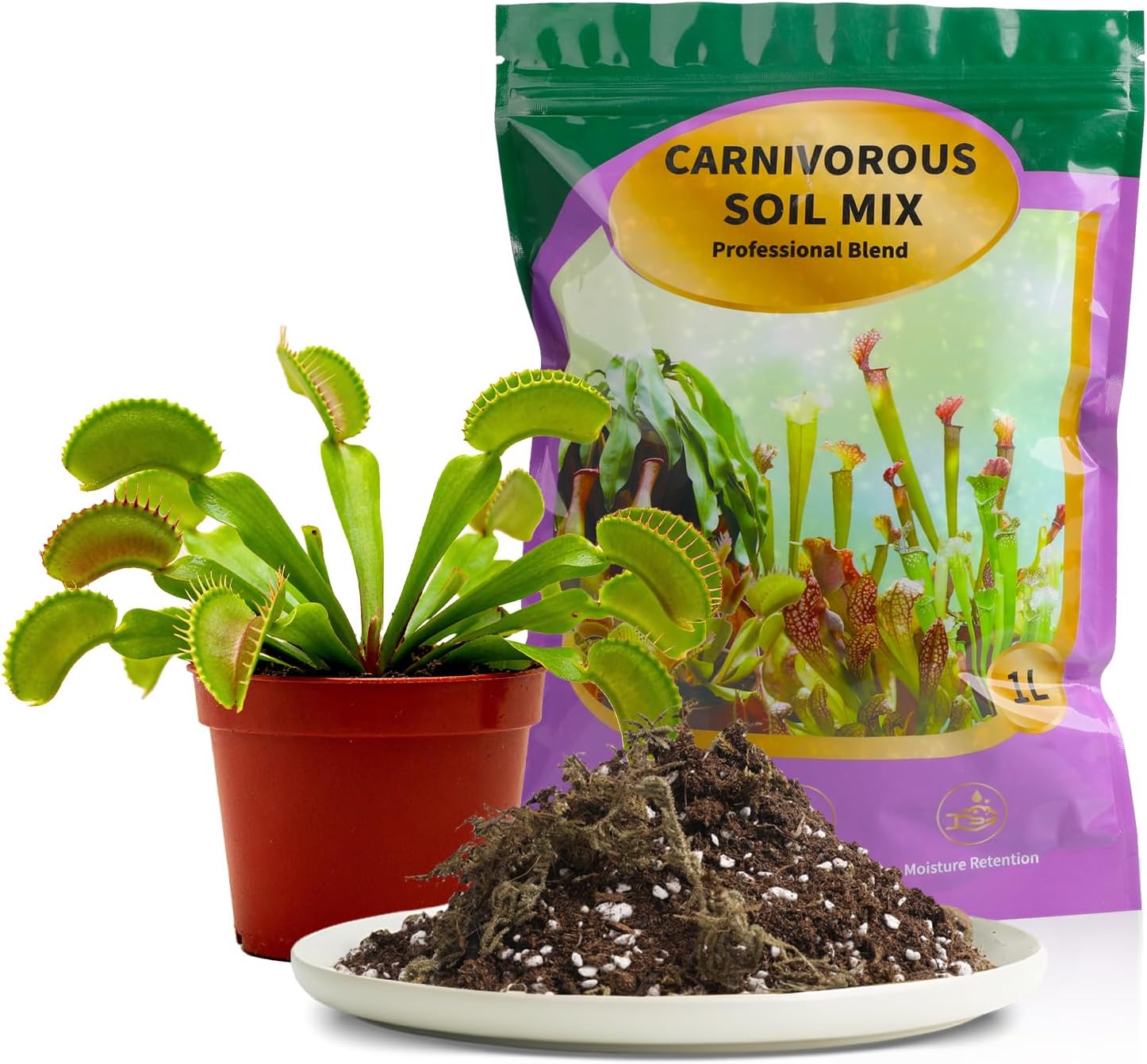
Omitgoter Carnivorous Plant Soil Mix, 1 qt
| Brand Name | Omitgoter |
|---|---|
| Unit Count | 32 Ounce |
| Volume | 1 quarts |
| Style Name | Carnivorous Plant Soil |
This 1 qt Omitgoter carnivorous plant soil is a pre-mixed blend of peat moss, perlite, sphagnum moss, and horticultural sand formulated to mimic the low-nutrient, fast-draining substrate Venus fly traps and other insectivorous plants prefer. It is intended for direct potting or repotting without additional mixing, which makes it convenient for growers who want reliable results with minimal fuss. The mix’s high porosity supports rapid drainage and good air circulation around roots, reducing risk of waterlogging and root rot common in peat-heavy pots. Because the blend is low in nutrients and designed to keep pH in an appropriate range, it helps maintain the plant’s trapping behavior and overall health. The small 1 quart volume is handy for single plants or trial pots but means you may need multiple bags for collections. Also, peat-based mixes will slowly compress over time and may require occasional top-up or repotting to preserve the intended texture.
Best for: Buyers who want a straightforward, ready-to-use soil that matches the low-nutrient, fast-draining needs of Venus fly traps and prefer a low-risk option that simplifies potting.
Less Ideal for: Growers who need large quantities for many pots or who avoid peat for environmental reasons should consider larger bulk mixes or peat-free alternatives.
- Pre-mixed formula tailored for carnivorous species so no additional blending is required
- High drainage and aeration from perlite and sand to reduce root rot risk
- Low-nutrient, peat-based composition that supports natural trapping behavior
- 1 quart size is convenient for repotting a single Venus fly trap or small collection
- Small volume may require purchasing multiple bags for several plants
- Peat-based substrate can compress over time and may need topping up or repotting
Verdict: A convenient, ready-to-use peat-perlite mix that makes safe, low-effort potting of Venus fly traps simple for risk-averse growers.
Choosing the Right Venus Fly Trap Soil: Key Factors to Consider
Moisture Balance
Venus fly traps require a consistently damp substrate that is not waterlogged. A medium that holds moisture at root level supports growth and trap function, but standing water reduces oxygen and invites root rot. Look for mixes that retain moisture evenly while allowing excess to move away from the crown.
In practice this means a mix with a fibrous component such as long-fiber sphagnum peat or sphagnum moss combined with an open material. When you water, the root zone should stay evenly moist for days rather than alternating between soggy and bone dry.
Nutrient and Mineral Purity
Carnivorous plants capture nutrients from prey and are adapted to very low-mineral soils. Tap water and many commercial soils contain dissolved salts and minerals that accumulate and harm roots. Choose a substrate that is naturally low in soluble salts and free from added fertilizers, lime, or compost.
Purity matters because once minerals build up they are difficult to flush without frequent repotting. Many growers use distilled, reverse-osmosis, or rainwater along with low-mineral media to maintain the proper chemical environment.
Aeration and Drainage
Good air exchange at the root surface prevents anaerobic conditions and root diseases. Even while holding moisture, the ideal soil has structure that resists compaction and allows oxygen-rich pockets to persist. Coarse components such as perlite, horticultural sand, or coarse sphagnum pieces are often blended in small proportions to improve drainage and aeration.
A balance is essential. Too much coarse material dries the soil quickly and stresses the plant. Too little creates dense, poorly aerated substrate that compacts over time.
Longevity and Compaction
Some substrates compress or decompose over a single growing season, reducing drainage and changing moisture behavior. Durable components maintain their volume and structure longer, which means less frequent repotting and more consistent conditions for trap development.
Consider how the mix performs after repeated watering cycles. Materials that shed fines or compress will need topping up or replacement. If you plan to keep plants in the same container for multiple seasons, choose a longer-lasting mix.
pH Suitability
Venus fly traps prefer acidic conditions typical of bog soils. A substrate that trends neutral to slightly acidic supports nutrient uptake and microbial balance appropriate to carnivorous species. Avoid mixes with liming agents or high-alkaline additives that push pH upward.
While minor pH adjustments are possible with water choice, starting with a suitably acidic medium reduces the need for interventions and keeps traps healthy.
Handling and Preparation
Ease of use matters for gardeners who repot often or manage multiple plants. Some media require pre-rinsing to remove fines, while others need rehydration before use. Consider whether you prefer a ready-to-pot mix or a component-based blend you assemble.
Also factor in how the soil behaves when saturated for trays versus deeper pots. A mix that performs well in shallow trays might compact differently in tall containers, so match handling expectations to your chosen growing method.
Why Low Minerals Are Essential
Venus fly traps evolved in nutrient-poor bogs and obtain most minerals from captured insects. When substrate or water supplies dissolved salts, roots suffer osmotic stress, leaf tip dieback, and reduced trap performance. Minimizing mineral load in the soil is one of the most impactful steps you can take.
Using distilled or rainwater combined with a low-mineral medium keeps soluble salts from building up. If you reuse tap water, plan for regular flushes and occasional repotting to remove accumulated minerals.
- High dissolved salts cause leaf burn and weak traps
- Flushing can help but is not a substitute for low-mineral starting media
- Choose peat or sphagnum-based mixes that avoid added fertilizers
Mixes Versus Single-component Approaches
Some growers prefer ready-made mixes designed for carnivorous plants while others blend components like long-fiber sphagnum moss, peat, and perlite themselves. Preblended mixes offer convenience and consistent ratios. Component blends let you tailor drainage and moisture retention to your microclimate and container size.
If you mix your own, measure by volume and avoid additives. A common base is a high proportion of sphagnum peat with a smaller fraction of coarse perlite for aeration.
- Ready mixes are convenient and reduce prep work
- Custom blends give control over water holding and air space
- Avoid adding compost, bark, or fertilizer-containing components
Best Practices for Watering and Container Choice
Watering technique affects how a given soil performs. Bottom-watering from a tray keeps the crown drier and allows the substrate to wick moisture up to the roots. Overhead watering can leave the crown soggy if the soil remains saturated on top.
Container depth also matters. Shallow trays dry more quickly and suit communal displays, while deeper pots hold more water and require mixes with better aeration. Ensure pots have drainage and avoid pots that trap water beneath the root ball.
- Use tray watering to maintain consistent moisture without saturating the crown
- Match container depth to your chosen mix's drainage properties
- Allow the top inch to remain slightly less wet in deeper pots to reduce crown sogginess
Reusing and Refreshing Soil
Soil can be refreshed by removing the top few inches and replacing it with fresh low-mineral media, but long-term mineral buildup often requires full repotting. Inspect roots and check for compacted layers or foul odors that indicate anaerobic breakdown.
When repotting, gently tease roots and replace the substrate without disturbing the crown excessively. Fresh media restores aeration and chemical balance, which helps traps regenerate.
- Partial top-dressing can extend the life of a container for a season
- Full repotting is the reliable way to remove accumulated salts and decomposed material
- Repot during spring dormancy break or early active growth for fastest recovery
Choosing Water for Watering and Flushing
Water source interacts with soil chemistry. Rainwater, distilled, or reverse-osmosis water are low in dissolved minerals and best for carnivorous plants. If you must use tap water, test for hardness and pH and consider periodic flushing with pure water to reduce accumulation.
Consistency matters. Frequent small top-ups with mineral-containing water slowly elevate substrate salts. Plan watering to maintain stable moisture while minimizing mineral input.
- Prefer low-mineral water sources whenever possible
- Flush containers occasionally to remove soluble salts if tap water is used
- Monitor plant foliage for signs of mineral stress such as brown tips or weak traps
How We Chose the Best Venus Fly Trap Soil
We focused on attributes that directly affect the health and feeding behavior of Venus fly traps. Key evaluation criteria included moisture balance, mineral and nutrient purity, peat or sphagnum quality, physical structure and drainage, and suitability for container culture. Each product had to use low-mineral inputs and avoid added fertilizers, lime, or composted materials that release dissolved salts. We excluded any mixes formulated for general houseplants, seed starting with added nutrients, or blends containing slow-release fertilizers. We also screened out substrates with high sand or clay content that impair water flow and oxygen around the roots. Practical considerations such as ease of rewetting, compaction over time, and suitability for either tray or pot culture were included. The result is a shortlist of soils and mixes that prioritize safe moisture retention and the chemical environment carnivorous plants require.
FAQ
Can I use garden soil for a Venus fly trap?
Garden soil is usually too rich in minerals and often compacts, reducing aeration. This combination stresses roots and invites rot. Use a fibrous, low-mineral substrate instead.
Is sphagnum moss or peat better for Venus fly traps?
Both long-fiber sphagnum and high-quality peat are commonly used. Sphagnum tends to hold structure and resist compaction more, while peat can retain moisture well. Choose based on availability and whether you plan to blend in aeration components.
Do I need to fertilize Venus fly trap soil?
No. Venus fly traps obtain nutrients from prey and do not need added fertilizers. Fertilizing the soil can harm roots and should be avoided.
How often should I repot Venus fly trap soil?
Repotting frequency depends on mix longevity and mineral buildup. Many growers repot every one to three years, or sooner if the mix compresses, drains poorly, or shows signs of accumulated salts.
Can I use tap water if it is soft?
Soft tap water may be acceptable if it has low dissolved mineral content. Testing water for hardness and occasional flushing with purified water helps prevent slow buildup of salts in the substrate.
Final Verdict
Choose a soil that prioritizes low dissolved minerals and stable moisture balance. Favor fibrous peat or sphagnum-based media with modest coarse material to maintain aeration and reduce compaction. Match the mix to your container depth and watering method to keep the crown dry and roots oxygenated. Accept tradeoffs between moisture retention and drainage when selecting a substrate. Prioritize nutrient purity and structural longevity for the best long-term results, and plan routine refreshing or repotting to maintain a healthy growing environment.
