

Note: This article contains affiliate links. If you click on these links and make a purchase, I may earn a small commission at no extra cost to you. This helps support my research and content. Read my full affiliate disclosure here.
If you care about uniform fertilizer, seed, and amendment application over a lawn or large garden, the right walk behind garden spreader makes the job faster and more consistent than hand application. This guide focuses on spreaders suited to lawns, large beds, and property maintenance where even distribution and durability matter. You will find seven shortlisted options chosen for common gardener needs, from heavier-duty jobs to lighter seasonal use. We evaluated capacity, distribution accuracy, durability, and handling so you can pick a spreader that matches your yard size and the materials you use. Read on for practical guidance and the criteria we used to build this list.
Top Picks at a Glance
| Best Overall The best all-around choice for most situations | Agri-Fab 130-lb Walk-Behind Broadcast Spreader (Model 45-0462) |  |
| Best Quality Built to a higher standard if you want something more solid | EarthWay 2170 Commercial 100 lb Walk-Behind Broadcast Spreader |  |
| Best Value The sweet spot between price and what you get | VEVOR 60 lb Push Broadcast Spreader with Pneumatic Wheels |  |
| Best Budget The cheapest option that still gets the job done reliably | Amazon Basics Broadcast Fertilizer Spreader, Multi-Gear, 5000 sq ft Coverage |  |
| Highest Rated A top-rated pick with lots of positive feedback | John Deere 130 lb Push Broadcast Spreader |  |
| Most Popular A crowd favorite that many people choose with confidence | Scotts Turf Builder EdgeGuard DLX Broadcast Spreader |  |
| Best Seller A high-volume bestseller chosen again and again | CHAPIN 88000A SaltPro 80 lb Walk-Behind Salt Spreader |  |
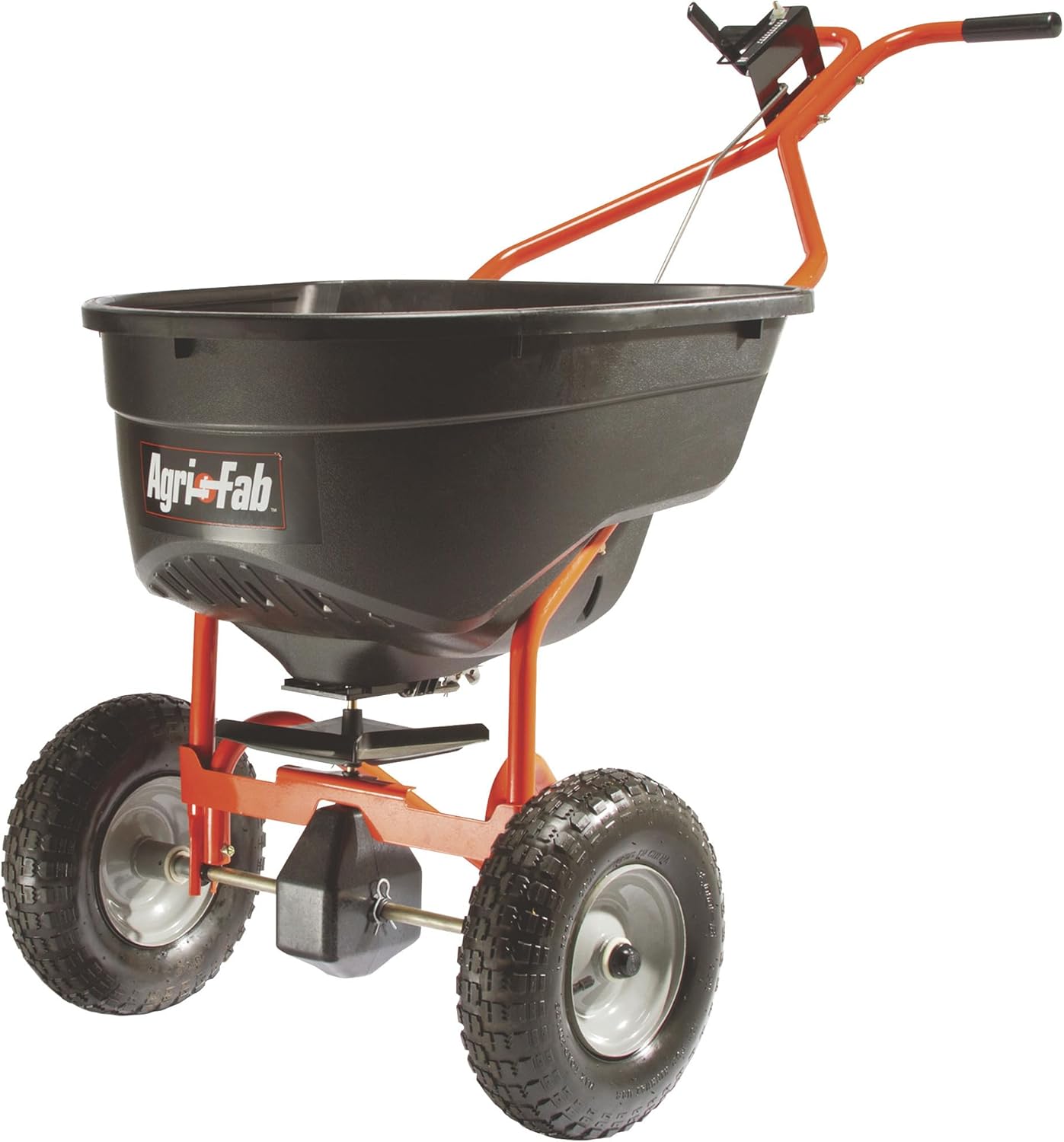
Agri-Fab 130-lb Walk-Behind Broadcast Spreader (Model 45-0462)
| Weight Capacity Maximum | 130 pounds |
|---|---|
| Number of Wheels | 2 |
| Tire Type | Tubeless |
| Material Type | Poly and steel |
The Agri-Fab 130-lb walk-behind broadcast spreader is a straightforward, high-capacity tool for spreading fertilizer, grass seed, or ice melt over lawns up to about half an acre. It uses a large polyethylene hopper and pneumatic tires to move smoothly over uneven turf, while a direct rod control makes adjusting and engaging the spread pattern simple during use. The wide broadcast pattern covers more ground per pass, reducing time spent spreading compared with lawn-size handheld options. Construction mixes poly and steel for a balance of durability and lighter weight, and the ergonomic handle improves comfort during longer passes. Expect reliable performance for routine residential lawn care, though assembly is required and the unit is a push-style spreader so it is physically demanding on larger sites. Controls are basic rather than precision-calibrated, so granular control for very small application rates may require extra care. For seasonal tasks from spring seeding to winter deicing, this model delivers consistent, no-frills coverage for homeowners focused on efficiency and capacity.
Best for: Homeowners who want a no-nonsense, high-capacity spreader to finish lawn tasks faster and who prioritize durability and ease of use over precision metering.
Less Ideal for: Owners of very large properties who prefer tow-behind or tractor-mounted spreaders and users who need highly precise, small-rate fertilizer application.
- Large 130 lb hopper reduces refills and speeds work on medium lawns
- Pneumatic tires and simple frame roll well over uneven yards
- Direct rod control is easy to use and intuitive while walking
- Polyethylene hopper and steel components provide a durable yet reasonably light build
- Push operation can be tiring on larger properties
- Controls are basic and may require testing to dial in precise spread rates
Verdict: A rugged, high-capacity push spreader that saves time on medium residential lawns by covering large areas with one hopper load.
EarthWay 2170 Commercial 100 lb Walk-Behind Broadcast Spreader

| Capacity | 100 lb |
|---|---|
| Tire type | 13 inch pneumatic |
| Frame | Tube steel |
| Gearbox | Enclosed heavy-duty |
The EarthWay 2170 is a contractor-focused broadcast spreader designed to handle large jobs with a 100 pound hopper and a heavy-duty gearbox that keeps the agitator and metering consistent under load. It is used by pushing across turf or open areas while the pneumatic 13 inch tires and steel frame provide stable rolling over uneven ground. Notable features include side spread control for reducing waste along borders, a sturdy tube steel frame with enclosed gears for durability, and an adjustable handle for operator comfort. In practice the spread pattern is noticeably more even than economy models, which reduces respreading and striping. The reinforced controls and metal components mean less maintenance and fewer broken plastic parts in frequent use. The main compromises are size and weight that make it overbuilt for very small yards and the plastic hopper material which may be vulnerable to prolonged UV exposure without storage. For anyone maintaining large lawns, rental fleets, or commercial turf, this spreader emphasizes reliable, repeatable coverage and long-term durability.
Best for: Buyers who need a durable, professional-grade spreader for regular large-area lawn care, rental fleets, or contractor use and who prioritize consistent, even coverage over compact size.
Less Ideal for: Casual homeowners with small lawns or limited storage space should consider smaller, lighter spreaders that are easier to maneuver and store.
- 100 lb hopper capacity reduces refill frequency on large jobs
- Heavy-duty gearbox with enclosed gears for longer component life
- 13 inch pneumatic tires and steel frame provide stable movement over rough turf
- Side spread control helps reduce waste and improves edge accuracy
- Plastic hopper may degrade if left in sun long term
- Large and heavy for small residential yards
Verdict: Choose the EarthWay 2170 when you need a tough, professional spreader that delivers even, repeatable coverage on large lawns and job sites.
VEVOR 60 lb Push Broadcast Spreader with Pneumatic Wheels

| Load capacity | 60LB |
|---|---|
| Wheels | 8-inch pneumatic |
| Frame | Powder-coated steel |
This VEVOR push broadcast spreader is built for straightforward, frequent lawn jobs where speed and coverage matter. It holds up to 60 pounds of seed or fertilizer in a plastic hopper mounted on a powder-coated steel frame and rolls on 8-inch pneumatic tires for easier movement across grass, gravel, and uneven ground. The unit offers multiple adjustable settings and a disc-style pellet controller to fine-tune spread width and flow, which helps achieve even coverage and reduces missed strips. Assembly is tool-free and quick, and the large hopper cuts down on how often you need to refill during a typical yard run. Practical buyers will appreciate the rugged frame and all-terrain wheels for year-round tasks from seeding to fertilizing. Limitations to note are that the spreader is a push model without motorized assistance, so it requires physical effort on larger properties, and the plastic hopper, while durable, is not as impact-resistant as metal for heavy-duty farm use.
Best for: Homeowners who want a reliable, no-frills spreader to speed up regular seeding and fertilizing on small to medium lawns while keeping setup and maintenance simple.
Less Ideal for: People who need a motorized or tow-behind spreader for large acreage or commercial operations should look at heavier duty or powered models.
- Large 60 lb hopper reduces refill frequency for medium-sized lawns
- Adjustable spread settings and disc pellet controller for precise coverage
- 8-inch pneumatic wheels ease movement over uneven terrain
- Powder-coated steel frame offers corrosion resistance for outdoor use
- Manual push design can be tiring on larger properties
- Plastic hopper is less impact-resistant than an all-steel construction
Verdict: Choose this spreader if you want a durable, large-capacity push unit that delivers controlled, even coverage for routine lawn seeding and fertilizing.
Amazon Basics Broadcast Fertilizer Spreader, Multi-Gear, 5000 sq ft Coverage

| Coverage per load | 5000 square feet |
|---|---|
| Hopper volume | 0.5 cubic feet |
| Item weight | 8.86 pounds |
| Construction | Steel frame with plastic hopper |
| Operation | Multi-gear precision control |
This Amazon Basics broadcast spreader is a straightforward, value-focused tool for treating small to medium lawns. It features a plastic hopper on a steel frame and a multi-gear control that lets you adjust the opening for different granular materials including seed, fertilizer, salt, and ice melt. Use it for one-pass coverage up to about 5,000 square feet per fill; the pre-installed release cable and simple assembly mean you can get working quickly. The steel frame provides durability for seasonal outdoor use while the plastic bin keeps weight down and resists corrosion. Because it is a broadcast model, it throws material over a wide swath which speeds coverage but requires careful overlap management to avoid uneven application. The unit is best for homeowners who want a reliable, no-frills spreader for routine lawn feeding and winter deicing. If you need pinpoint placement, heavy-duty commercial capacity, or advanced calibration markings for very precise application rates, you will likely want a different style of spreader.
Best for: A practical homeowner who wants a durable, easy-to-use spreader to speed routine fertilizing and occasional ice-melt work without overcomplicating setup or operation.
Less Ideal for: Not a great fit for contractors or landscapers who need high-capacity commercial equipment or for gardeners who require exact, spot-specific placement.
- Multi-gear control for adjustable flow and material types
- Covers up to 5,000 sq ft per load for efficient one-pass work
- Steel frame with plastic hopper resists seasonal wear
- Easy assembly with release cable pre-installed
- Suitable for spread of seed, fertilizer, salt, and ice melt
- Broadcast pattern can make precise, narrow placement difficult
- Less suitable for very large or commercial lawns due to single-load capacity
Verdict: A durable, no-frills broadcast spreader that efficiently treats medium lawns and simplifies routine fertilizing and deicing tasks.
John Deere 130 lb Push Broadcast Spreader

| Capacity | 130 lbs. |
|---|---|
| Approximate coverage | Up to 25,000 sq ft |
| Spread width | 10 – 12 ft |
| Wheels | 13" x 4" pneumatic tires |
This John Deere push broadcast spreader is built for larger lawns and frequent use. The 130 lb rust-proof poly hopper lets you cover roughly half an acre between refills, while the broadcast plate delivers a 10 to 12 ft spread that speeds application and reduces passes. Control is simple: a direct rod gate and adjustable flow stop let you dial output for seed, fertilizer, weed control products, or ice melt so you get more even coverage and less waste. Durability is focused on practical longevity rather than lightweight portability — heat-treated steel gears are enclosed to resist corrosive materials and large turf-tread pneumatic tires make it easy to push across uneven turf. Assembly is required and the unit is substantial to maneuver compared with compact hand spreaders, but that heft contributes to stability and capacity. For performance-focused gardeners with mid-size to large lawns, it reduces refill frequency and produces consistent spreading; casual users with very small yards may find it larger than necessary.
Best for: Gardeners and property owners who prioritize efficient, consistent coverage across mid-size to large lawns and want a durable spreader that reduces refill interruptions.
Less Ideal for: People with very small yards, limited storage space, or who need a lightweight, highly portable seed spreader.
- Large 130 lb poly hopper reduces refills for up to 25,000 sq ft of coverage
- Wide 10–12 ft broadcast spread speeds application and improves uniformity
- Direct rod control and adjustable flow stop for precise output with different materials
- Enclosed heat-treated steel gears and turf-tread pneumatic tires improve durability and maneuverability
- Substantial size and weight make it less convenient for very small yards or frequent transport
- Some assembly required before first use
Verdict: Choose this spreader if you need high-capacity, consistent broadcast coverage for mid-size to large lawns without frequent refilling.
Scotts Turf Builder EdgeGuard DLX Broadcast Spreader

| Brand | Scotts |
|---|---|
| Item Type | EdgeGuard DLX Broadcast Spreader |
| Additional Features | EdgeGuard Technology, Pre-calibrated |
| Capacity Coverage | Up to 15,000 sq. ft. |
The Scotts Turf Builder EdgeGuard DLX is a straightforward broadcast spreader for homeowners who need even coverage across medium to large lawns. It arrives pre‑calibrated and uses a curved hopper with a dual‑bladed agitator to keep granular seed and fertilizer flowing smoothly while the EdgeGuard side shield blocks product from driveways, flower beds, and sidewalks. Settings are matched to Scotts product recommendations so setup is quick: pick the dial setting, pour in the product, and walk at a steady pace. The large capacity covers up to 15,000 sq. ft. per fill, and the robust hopper and agitator help prevent clumping with common lawn products. Downsides are that it is a broadcast spreader, so fine tuning application rate beyond the preset settings is limited and it requires steady walking speed for uniform results. It is also a single‑model design without specialty attachments for precision corridors or narrow strips. For routine seeding, fertilizing, or winter ice melt, it delivers consistent, reliable performance for the typical homeowner.
Best for: Homeowners who want a reliable, easy-to-use spreader for regular seeding, fertilizing, and winter salt tasks and who value convenience and consistent coverage across medium to large lawns.
Less Ideal for: Users who need highly precise application rates, professional landscapers, or those who work mainly in very tight or narrow planting areas.
- Pre-calibrated dial matched to Scotts product settings for quick setup
- EdgeGuard side shield prevents spread onto sidewalks, driveways, and beds
- Curved hopper and dual-bladed agitator reduce clumping and ensure smooth flow
- Large capacity covers up to 15,000 sq. ft. per fill for fewer refills
- Limited fine-tune control beyond preset calibration for precise application
- Not optimized for very narrow strips or beds where a drop spreader is better
Verdict: A user-friendly, pre-calibrated broadcast spreader that delivers consistent coverage and protects borders, making it a strong all-round choice for home lawn care.
CHAPIN 88000A SaltPro 80 lb Walk-Behind Salt Spreader

| Capacity (lbs.) | 80 |
|---|---|
| Tire type | 10" pneumatic |
| Frame | Powder-coated steel |
| Auger | Spiked plastic |
The Chapin 88000A SaltPro is a residential walk-behind spreader made to apply pelletized or small ice-melt materials across driveways and sidewalks. You load the 80 lb polyethylene hopper, use the U-shaped flip-up handle to push, and control flow with the gate lever and adjustable side baffles to direct product where you need it. A plastic spiked auger reduces clumping and helps keep material moving, and the 10" pneumatic tires plus powder-coated steel frame make it reasonably easy to push over uneven surfaces. The included rain cover protects the hopper contents during use. This model is intended for ice-melt and similar pelletized products and is not recommended for rock salt, sand, or lime, so material compatibility limits what you can apply. For homeowners who want a durable, no-frills spreader that minimizes refills and keeps product dry, it is a practical choice; those needing professional contractor capacity or compatibility with coarser materials should consider other equipment.
Best for: Homeowners who prioritize predictable, low-maintenance winter care and want a straightforward spreader to cover driveways and walkways without frequent refills or fiddly setup.
Less Ideal for: Users who need a spreader for heavy commercial or contractor use or who plan to apply coarse materials like rock salt or sand should choose a more heavy-duty, compatible model.
- Large 80 lb rust-resistant polyethylene hopper reduces refills for typical residential areas
- Adjustable side baffles and gate offer directional control for sidewalks and driveways
- Spiked plastic auger breaks up clumps to reduce blockages at the gate
- 10" pneumatic tires and powder-coated steel frame make it easier to push over uneven surfaces
- Not compatible with rock salt, sand, or lime so material options are restricted
- Item is geared for residential use rather than heavy contractor workloads
Verdict: A dependable, homeowner-focused spreader that holds a large load, controls material direction, and reduces clogs for easy residential winter maintenance.
Choosing the Right Walk Behind Garden Spreader: Key Factors to Consider
Hopper Capacity and Construction
Hopper size directly affects how often you stop to refill when covering lawns or large beds. Larger hoppers let you complete more area per load but increase weight, which can make the spreader harder to push on slopes or in soft soil.
Material matters because some hoppers crack or warp after seasons of UV exposure and contact with corrosive fertilizers. Look for sturdy plastics or powder-coated metals and consider whether replacement parts or reinforcements are available. If you use heavy amendments like coarse compost or wet sand mixes, a reinforced hopper and sturdier frame will reduce long-term wear.
Distribution Control and Calibration
Accurate spread pattern adjustment and simple calibration are crucial for applying fertilizer, seed, or salt at the correct rates. A spreader that is hard to calibrate can lead to over-application in some areas and thin coverage in others, which affects plant health and can waste materials.
Check for clear numbered settings, an easy-to-access calibration procedure, and a consistent drop mechanism. The ability to fine-tune spread width and flow rate helps you adapt to different granular sizes and recommended application rates printed on product labels.
Feed Mechanism and Agitation
The feed mechanism controls how evenly material exits the hopper. Poor agitation leads to clogging or uneven bursts, especially with damp or irregular granules. A reliable agitator or wide-mouth hopper minimizes bridging and keeps material flowing under varied moisture conditions.
Consider models with replaceable agitator parts or simple access to the feed for cleaning. If you regularly apply mixes that include fines or sticky ingredients, a spreader with an active agitation system will save time and reduce the need to break clogs by hand.
Frame, Wheels, and Traction
The frame and wheel design determine how the spreader travels across different surfaces. Wide, treaded wheels roll more easily over turf without tearing and provide better traction on slopes and uneven ground. Metal axles and reinforced frames resist bending when the hopper is full.
Lightweight frames are easier to handle but may flex under heavy loads. If you use the spreader on gravel, compacted soil, or sloped lawns, prioritize robust wheels and a rigid frame to maintain consistent flow and prevent tipping.
Maneuverability and Comfort
How a spreader feels in use affects how quickly you can cover an area and how fatigued you become. Ergonomic handles, balanced weight distribution, and easy-turning wheels reduce strain during long runs. Some spreaders have adjustable handle heights to match operator comfort and reduce back strain.
Also consider how the spreader behaves in tight spaces and around obstacles. A nimble unit with a narrower wheelbase can navigate garden beds and walkways more easily than a bulkier model.
Maintenance, Parts, and Storage
Routine maintenance keeps a spreader accurate and functional over multiple seasons. Simple cleaning access, rust-resistant components, and available replacement parts extend usable life. Bearings, agitators, and feed gates are wear points that benefit from being replaceable.
Storage footprint and disassembly options matter if you only have limited shed or garage space. Models that fold or have removable hoppers are easier to stow during the off-season and often last longer because you can inspect and service critical components.
Choosing the Right Spreader Size for Your Yard
Match hopper capacity and wheel robustness to the size and terrain of your property. For half-acre lawns or larger, a medium to large hopper reduces refill frequency. For smaller yards, a compact spreader is easier to maneuver and store.
Account for terrain. If your yard has slopes, inclines, or soft soil, prioritize wheel traction and frame strength over maximum capacity. Smaller hoppers that keep the center of gravity low can be safer on hills.
- Large yards benefit from high-capacity hoppers to reduce stops
- Small or tight gardens need compact, easy-turning spreaders
- Slopes require good wheel traction and a low center of gravity
How to Calibrate and Test Spread Patterns
Calibration ensures you apply the right rate for seed or fertilizer. Start by checking the manufacturer settings against the product label you intend to spread, then perform a short test run over a measured distance to confirm actual output.
Use a flat, clean surface and collect the material over a measured swath to see how evenly the spreader deposits. Adjust the setting incrementally and repeat until you match the target rate. Repeat calibration with different materials, because salt, seed, and granular fertilizer flow differently.
- Test on a measured strip to confirm application rate
- Adjust settings in small steps and retest
- Calibrate for each material type you plan to use
Material Compatibility and What You Can Spread
Walk behind spreaders handle a variety of granular materials, but not all spreaders work equally well with every product. Fine powders, wet or clumping mixes, and very large pellets may require specific feed designs or wider spreader openings.
If you plan to use salt, choose a unit with corrosion-resistant components. For heavy garden amendments, verify that the hopper and frame will tolerate the extra weight without premature wear.
- Confirm feed opening size for pellet or coarse mixes
- Choose corrosion-resistant parts for salt use
- Consider agitation features for damp or mixed materials
Maintenance Tips to Keep a Spreader Working Season After Season
After each use, empty remaining material and rinse the hopper if the spreader design allows. Dry all parts thoroughly to prevent corrosion and check the feed gate for clogs. Lubricate moving parts as recommended and inspect wheels and axles for wear.
Before winter storage, run the agitator and feed gate to remove trapped material and consider a light protective coating on metal parts. Replace worn bearings or agitator paddles to preserve spread pattern consistency for the next season.
- Clean and dry the hopper after use
- Lubricate axles and check for wear annually
- Replace consumable agitation or feed parts promptly
Adjusting Application Rates for Different Materials
Application rates vary by material density and particle size. Use the calibration procedure to translate manufacturer settings into your measured output. Start with lower settings when using new materials and increase slightly as you confirm distribution behavior.
Remember that environmental factors like humidity can change flow characteristics. On humid days, materials may clump and require a higher agitation setting or drier storage before use.
- Always test new materials before full-area application
- Increase agitation in damp conditions to avoid bridging
- Adjust settings conservatively and retest
How We Chose the Best Walk Behind Garden Spreader
We selected spreaders that match common gardener tasks and excluded specialty broadcasters or tow-only commercial equipment. Our editorial filters prioritized practical features that matter in everyday garden use and in real outdoor conditions. Evaluation criteria included hopper capacity and material, because larger hoppers reduce refill stops but add weight; spread pattern adjustment and calibration ease, since accurate control avoids waste and patchy results; drive and wheel durability, as tougher axles and tread improve performance on uneven turf; agitation and feed reliability, because clogged or inconsistent feeds ruin application rates; and handling and maneuverability, which determine how comfortably you can cover beds, slopes, and tight spaces. We also considered how easy each spreader is to set up, maintain, and store. We excluded products intended only for commercial contractors, hand-held broadcasters, or models without clear calibration mechanisms. The shortlisted spreaders balance capacity, accuracy, and durability for homeowners and property managers who need predictable application across medium to large outdoor spaces.
FAQ
Can I use a walk behind spreader for both seed and fertilizer?
Often yes. Many walk behind spreaders handle both seed and fertilizer but may need separate calibration for each. Use a test strip to confirm the application rate and check that the feed opening suits the particle size.
How do I prevent clogging when using damp or fine materials?
Prevent clogging by increasing agitation, using a wider feed opening when possible, and avoiding damp material. Store granular products dry and perform a quick shake or stirring during application to reduce bridging.
What maintenance keeps spread pattern consistent over time?
Regular cleaning, drying, and inspecting the feed gate and agitator maintain consistent patterns. Lubricate axles, replace worn agitator components, and check wheel alignment to prevent uneven distribution.
Is a larger hopper always better for big properties?
A larger hopper reduces refill frequency but adds weight, which can make the spreader harder to push and increase strain on wheels and axles. Balance capacity with handling and terrain when choosing size.
Do I need special parts to spread salt safely?
Salt is corrosive, so choose a spreader with corrosion-resistant components or plan for more frequent maintenance. Rinse and dry the spreader after salt use and inspect metal parts for corrosion regularly.
Final Verdict
Choose a walk behind garden spreader by matching hopper capacity and the feed system to the materials and area you will treat. Prioritize models with simple calibration, reliable agitation, and durable wheels if you cover medium to large lawns or tackle varied terrain. Accept tradeoffs between capacity and maneuverability: larger hoppers save time but increase weight and stress on components. Focus on a spreader that offers clear settings, easy maintenance, and parts you can service so you get consistent results season after season.
