

Note: This article contains affiliate links. If you click on these links and make a purchase, I may earn a small commission at no extra cost to you. This helps support my research and content. Read my full affiliate disclosure here.
Wasp infestations are a common nuisance around patios, eaves, and garden structures, and choosing the right wasp spray changes how quickly you can restore outdoor comfort. The correct spray will stop aggressive adults on contact, penetrate nest material, and leave a residual long enough to limit reinfestation without creating extra risk for non-target areas. This guide covers seven top-rated wasp sprays selected for outdoor use in typical residential settings. We shortlisted options that balance immediate knockdown, residual protection, ease of application, and practical safety for gardens and patios. Below you will find the buying factors we used, helpful application tips, and clear guidance for different infestation scenarios.
Top Picks at a Glance
| Best Overall The best all-around choice for most situations | HOT SHOT Wasp & Hornet Killer Aerosol Spray, 14 oz, 3 Pack |  |
| Best Quality Built to a higher standard if you want something more solid | BASF PT Wasp-Freeze II Wasp, Hornet & Spider Insecticide Spray, 14 oz |  |
| Best Value The sweet spot between price and what you get | Spectracide Wasp & Hornet Killer Aerosol Spray, 18.5 oz (12-Pack) |  |
| Best Budget The cheapest option that still gets the job done reliably | Spectracide PRO Wasp & Hornet Killer Spray, 18 oz |  |
| Highest Rated A top-rated pick with lots of positive feedback | Raid Wasp & Hornet Killer Spray, 14 oz, 2‑Pack |  |
| Most Popular A crowd favorite that many people choose with confidence | Raid Wasp & Hornet Killer Spray, 17.5 oz |  |
| Best Seller A high-volume bestseller chosen again and again | Raid Wasp and Hornet Killer, 17.5 oz (12-pack) |  |
HOT SHOT Wasp & Hornet Killer Aerosol Spray, 14 oz, 3 Pack

| Unit Count | 14 Fluid Ounces |
|---|---|
| Included Components | 14 Fl Oz (3 Pack) |
| Item Form | Spray |
| Target Species | Insects |
This HOT SHOT Wasp & Hornet Killer is an aerosol insecticide designed for killing wasps, hornets, yellow jackets and similar outdoor pests and for treating nests. It sprays a focused jet up to about 27 feet so you can stand back while soaking a nest at dusk when insects are least active. The water-based formula is marketed as non-staining to most siding and is intended for outdoor use only. In practice the long-range spray and soak action make it effective for knocking down flying attackers and for treating nests so returning insects are eliminated over a few days. Because it is an aerosol, application is fast and requires no mixing or equipment, but run time is limited by the 14 ounce can size and repeated treatments may be needed for large or multiple nests. Users should follow label directions for safety, avoid spraying under eaves where runoff could occur, and test surfaces first if staining is a concern. For routine backyard nest control this product is a convenient, easy-to-use option with a strong directed spray.
Best for: Homeowners who want a straightforward, no-fuss spray for occasional outdoor wasp or hornet problems and who prioritize distance and ease of use when treating nests.
Less Ideal for: People managing large or frequent infestations or professional pest controllers who need bulk capacity or targeted non-aerosol solutions should consider alternative products.
- Powerful jet spray reaching up to 27 feet for treating nests from a safe distance
- Kills on contact and continues to affect returning insects after treatment
- Ready-to-use aerosol is convenient with no mixing or extra tools required
- Water-based formula reported as non-staining to most siding when tested first
- 14 ounce can size limits run time and may require multiple cans for large infestations
- Aerosol delivery can drift in windy conditions, reducing accuracy and increasing overspray risk
Verdict: A convenient, long‑range aerosol that makes quick backyard nest control easy for typical homeowners.
BASF PT Wasp-Freeze II Wasp, Hornet & Spider Insecticide Spray, 14 oz

| Item Form | Aerosol |
|---|---|
| Target Species | Insects, Wasp, Hornet, Spiders |
| Special Features | Fast-Acting, Long-Lasting |
| Active Ingredients | Prallethrin 0.1% |
The BASF PT Wasp-Freeze II is a 14 ounce pressurized aerosol made for tackling wasp, hornet, yellowjacket and spider nests from a distance. It sprays a concentrated knockdown formulation that reaches up to about 15 feet so you can treat nests without getting close, and the product reports both instant knockdown and residual activity to help prevent re-infestation. Practical features include a long spray reach and quick action that reduce the chance of provoking more stings during treatment. It is intended for outdoor and some indoor uses when label directions allow, but users should follow safety guidance carefully since it can cause eye irritation and may stain surfaces like asphalt or shingles. The can is single-use and aerosol delivery means you get fast results, but you will need additional cans for multiple or very large infestations and to follow label restrictions in some states.
Best for: Gardeners and homeowners who prioritize quick, professional-strength control of stinging insects and want a spray that lets them treat nests from a distance with minimal delay.
Less Ideal for: People who need repeated long-term perimeter protection without reapplication or who prefer non-aerosol or DIY trapping methods for insect management.
- Long spray reach (up to about 15 feet) keeps applicator at a safer distance from nests
- Fast-acting formula provides near-instant knockdown of wasps, hornets and yellowjackets
- Residual activity helps reduce chance of re-infestation after treatment
- EPA-specified product with a known active ingredient (Prallethrin 0.1%)
- Aerosol can is single-use so multiple cans are needed for several or large nests
- May stain surfaces such as asphalt or shingles if oversprayed
Verdict: Choose this spray when you want fast, professional-strength knockdown and residual control of wasps and hornets while treating nests from a safe distance.
Spectracide Wasp & Hornet Killer Aerosol Spray, 18.5 oz (12-Pack)

| Item Form | Spray |
|---|---|
| Target Species | Insects |
| Included Components | 12 Pack |
| Liquid Volume | 0.52 kg |
This Spectracide aerosol is designed for homeowners who need a straightforward way to remove wasps, hornets, and yellow jackets from yards and structures. The product delivers a focused jet spray advertised to reach up to 27 feet, letting you treat nests from a safer distance at dawn or dusk when insects are less active. It is labeled for outdoor use only and is formulated to be non-staining to most siding when used as directed. Typical use is to stand clear of a nest, spray until the nest is soaked, then wait 24 hours before removing it. The pack comes as a multipack, which is useful if you have several active nests or want spares for the season. Limitations include the need to follow safety timing and distance guidelines and to avoid spraying on sensitive plants such as evergreen and holly. This is not an indoor product and does not provide long residual protection on its own, so expect follow-up checks for returning insects.
Best for: Homeowners who prioritize a practical, no-fuss solution for removing outdoor stinging insect nests and want the option to treat from a safer distance.
Less Ideal for: People who need an indoor-safe product or long-lasting residual protection should consider alternative approaches.
- Jet spray reaches nests up to 27 feet, allowing treatment from a greater distance
- Kills wasps, hornets, and yellow jackets on contact and is intended to eliminate nests
- Non-staining formula for most siding when used according to directions
- Multipack supply reduces the need to repurchase during active season
- Outdoor use only and not suitable for indoor infestations
- No advertised long-term residual control, so repeat checks may be needed
Verdict: Choose this spray if you want a dependable outdoor wasp and hornet killer that lets you treat nests from a long distance and comes in a multipack for seasonal use.
Spectracide PRO Wasp & Hornet Killer Spray, 18 oz

| Liquid Volume | 18 fluid ounces |
|---|---|
| Item Form | Spray |
| Target Species | Insects |
| Specification Met | EPA |
Spectracide PRO Wasp & Hornet Killer is an 18-ounce aerosol designed to stop aggressive stinging insects from a safe distance. The product shoots a focused jet spray that the manufacturer says can reach nests up to 20 feet away, which makes it useful for treating nests high under eaves or in trees without close approach. It is formulated to kill the entire nest and claims residual control that deters returning wasps and hornets for up to four weeks. Typical use is at sunrise or sunset and involves soaking the nest while standing well back, then waiting at least 24 hours before removing the nest. Notable features include the long spray reach and an EPA specification listed on the label. Limitations are that it is for outdoor use only and requires careful handling and adherence to label directions; its aerosol format means it is a single-use canister sized for spot treatments rather than large-scale infestations.
Best for: Buyers who want an inexpensive, ready-to-use spray to quickly eliminate a single nest or occasional wasp problems around a yard or patio.
Less Ideal for: Homeowners facing multiple large nests, commercial pest controllers, or anyone wanting a non-chemical or long-term integrated control solution should consider alternatives.
- Long jet spray that can reach nests up to 20 feet away
- Claims residual activity that reduces returning wasps and hornets for up to four weeks
- Aerosol format allows quick spot treatment without mixing or equipment
- Intended for outdoor, spot use only so not suitable for indoor infestations
- Single 18 oz can is limited for large or multiple nests
- Requires careful handling and timing (apply at dawn or dusk) due to active ingredients
Verdict: A low-cost, ready-to-use aerosol that lets you spray nests from a safe distance for fast, targeted wasp and hornet control.
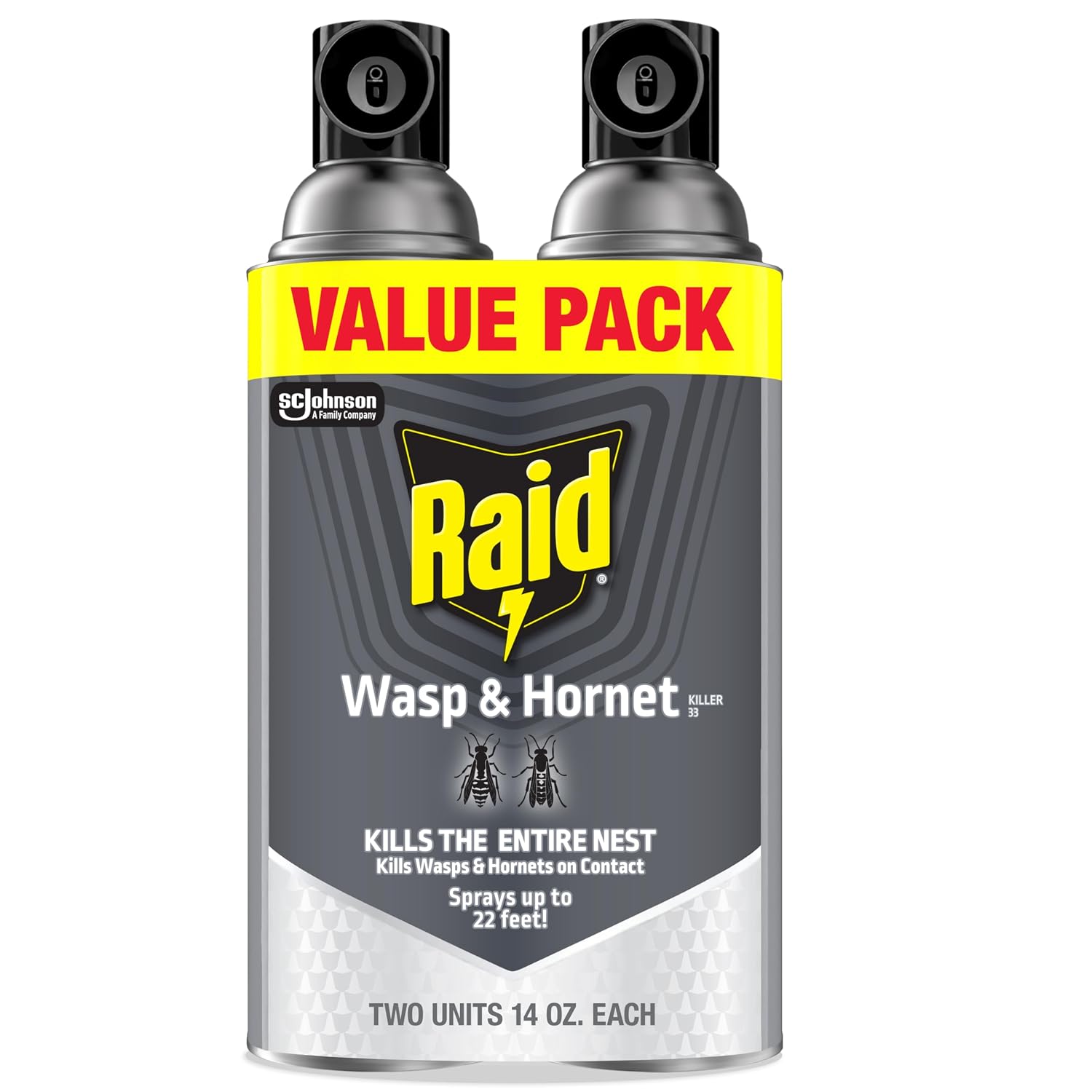
Raid Wasp & Hornet Killer Spray, 14 oz, 2‑Pack
| Unit Count | 28 Ounce |
|---|---|
| Included Components | Two 14 oz cans |
| Item Form | Spray |
| Active Ingredients | Prallethrin, Cypermethrin |
Raid Wasp & Hornet Killer is a straightforward outdoor aerosol for quickly dealing with stinging flying insects and nests. Each 14 oz canister sprays up to about 22 feet so you can treat nests from a safe distance, and the formula is designed to kill paper wasps, yellow jackets, mud daubers and bald‑face hornets on contact. It is electrically non‑conducting up to 32,500 volts, which can be helpful if nests are near electrical equipment. Typical use is to spray a saturated stream at the nest in early morning or evening when insects are less active, then wait 24 hours before removing the nest. The product includes common active ingredients (prallethrin and cypermethrin) and comes as a two‑pack so you have a backup or enough coverage for multiple nests. Important limitations are that it is for outdoor use only, is extremely flammable and toxic to aquatic life, and requires careful handling to avoid exposure to people and pets. Follow label directions closely and avoid spraying vegetation or water sources.
Best for: Buyers who prioritize a reliable, no‑nonsense solution to quickly eliminate outdoor wasp and hornet nests and who follow label safety instructions.
Less Ideal for: People looking for non‑chemical, pet‑safe, or aquatic‑safe options or those who need an indoor insecticide should consider alternative approaches.
- Sprays up to 22 feet to allow treatment from a safer distance
- Kills common stinging wasps and hornets on contact for fast results
- Two 14 oz cans provide extra coverage or a spare for larger problems
- Non‑conducting formulation reduces electrical hazard when treating nests near power equipment
- Contains flammable propellants and petroleum distillates so it must be stored and used with caution
- Extremely toxic to fish and aquatic invertebrates so not safe near water
- Intended for outdoor use only and not for use on edible crops or around pets
Verdict: Choose this if you want a proven, distance‑spraying aerosol that quickly kills wasps and hornets so you can remove nests with confidence.
Raid Wasp & Hornet Killer Spray, 17.5 oz

| Unit Count | 17.5 Ounce |
|---|---|
| Item Form | LIQUID |
| Target Species | Insects |
| Active Ingredients | Prallethrin, Cypermethrin |
| Specification Met | EPA |
Raid Wasp & Hornet Killer is an aerosol spray formulated to eliminate wasps, hornets and yellow jackets and to treat their nests. You use it from a safe distance to spray nests or individual insects; the formulation claims both instant knockdown and a residual effect that kills returning insects. Notable features are the long spray canister for reach, EPA-listed active ingredients (prallethrin and cypermethrin), and a 17.5 ounce ready-to-use volume that suits multiple treatments. Practically, it makes nest removal simpler without needing specialized equipment and is useful for quick outdoor spot treatments around eaves, patios and garbage areas. Limitations are that it is a chemical aerosol with petroleum distillates so users should follow label safety instructions, avoid use near edible plantings or open food, and expect that heavily built or very large colonies may require repeat treatments or professional removal. For buyers weighing effectiveness and safety, this product pairs well with careful application and protective precautions.
Best for: Buyers who prioritize a proven, fast-acting chemical solution and want a product with strong user feedback and recognized active ingredients for outdoor nest control.
Less Ideal for: People seeking organic, nonchemical or plant-safe options, or those who prefer a professional pest-removal service for very large or hard-to-reach nests.
- Kills wasps and hornets on contact and treats the entire nest for residual control.
- EPA-listed active ingredients provide recognized insecticidal efficacy.
- Generous 17.5 oz ready-to-use aerosol suitable for multiple treatments.
- Aerosol delivery gives extended reach for treating nests from a safer distance.
- Contains petroleum distillates and synthetic insecticides requiring careful handling and strict adherence to label safety directions.
- Not intended for use near food or edible crops and not a nonchemical or organic option.
Verdict: A reliable, ready-to-use aerosol that quickly knocks down wasps and treats nests, making it a solid choice for homeowners who want fast, proven outdoor control.
Raid Wasp and Hornet Killer, 17.5 oz (12-pack)

| Unit Count | 210 Ounce |
|---|---|
| Item Form | Spray |
| Target Species | Insects |
Raid Wasp and Hornet Killer is a high‑reach aerosol spray intended to let you attack nests from a distance and kill stinging insects on contact. In practice you hold the can and spray up to about 22 feet to coat a nest entrance or flying insects, which reduces close exposure when removing nests on your property. The formula also claims residual action so returning insects that contact treated surfaces can be killed after the initial spray. Notable features are the long spray range and the electrical nonconductivity rating, which is intended to reduce the risk if spraying near energized equipment. This product is simple to use and works quickly on visible nests, but like all sprays it requires an appropriate approach at night or when insects are less active to avoid provoking them. Also it treats the nest surface rather than removing structural nest material, so repeat treatments or physical removal may be needed for full cleanup. For someone looking for a familiar, powerful wasp spray that prioritizes distance and fast knockdown, this performs as expected.
Best for: Buyers who want a straightforward, effective wasp spray that lets them treat nests from a distance and prefer a recognizable brand with a long track record.
Less Ideal for: People who need a long‑term nest removal solution or who prefer non-chemical control methods should consider professional removal or traps instead.
- Long spray reach allows treatment from a safer distance
- Kills wasps, hornets, yellow jackets and mud daubers on contact
- Residual action can kill insects returning to a treated nest
- Electrically nonconducting formulation reduces risk near energized equipment
- Spray treats nest surfaces but does not remove nest material, so cleanup is still required
- Effectiveness depends on proper timing and technique and may need repeat applications
Verdict: A reliable long‑reach wasp and hornet spray for buyers who prioritize safety through distance and quick knockdown.
Choosing the Right Wasp Spray: Key Factors to Consider
Knockdown Speed and Immediate Control
How quickly a spray incapacitates adult wasps matters for safety and reducing stinging risk. Fast-acting active ingredients will collapse flying or guarding adults on contact, making it safer to retreat or remove nests. Rapid knockdown is especially important for nests in high-traffic areas such as patios, doorways, and children's play spaces.
Consider that contact performance can vary with nest size and exposure. A product that lists fast knockdown in label claims does not remove the need to follow safe approach distances and timing recommendations.
Residual Duration Around Nests
Residual activity determines how long treated surfaces remain repellent or lethal to returning wasps after application. Longer residuals reduce the chance of reinfestation and cut down on follow-up treatments, but no residual is permanent and environmental factors reduce effectiveness over time.
Sunlight, rain, and the treated substrate affect longevity. Sprays applied to rough wood, soffits, or protected eaves typically retain residual activity longer than treatments on exposed foliage. Match expected residual duration to the severity and timing of your infestation.
Spray Reach and Application Method
Reach and delivery determine how close you must get to a nest to treat it safely. Aerosol sprays with an extended jet let you stand farther back when treating high soffits, attic vents, or hedgerow nests. Pump or hose-end applicators may require closer approach or different technique.
Also think about the nozzle type and whether the product offers a narrow jet for direct nest penetration or a fan pattern for broader coverage. A tool that delivers a focused stream reduces drift and hits the nest structure more effectively.
Safety for Plants, Pollinators, and Pets
Many wasp sprays are designed to kill stinging insects but can also affect beneficial insects or be phytotoxic to sensitive plants. Read label directions about spray-to-plant contact and restrictions near flowering plants to avoid harming pollinators.
Consider the placement of nests relative to garden beds, potted plants, and pet pathways. Treatments that permit targeted application or have guidance minimizing off-target exposure are preferable in active garden areas.
Application Timing and Weather Considerations
When you apply a wasp spray strongly affects effectiveness and safety. Evening or early-morning treatments often catch worker wasps at the nest and limit exposure to foraging pollinators. Avoid application during windy conditions or before rain is expected because drift reduces accuracy and rain shortens residual life.
Also consider temperature extremes; very hot conditions may increase volatilization, while cold weather can reduce insect activity and slow control results.
Label Clarity and Ease of Use
Clear instructions and practical application guidance make treatments safer and more effective for home gardeners. Labels should explain recommended approach distances, protective equipment, reentry intervals, and disposal instructions.
Products that include visible instructions for near-plant, near-structure, or high-eave applications reduce guesswork. Simple trigger or aerosol controls and clear mixing directions help avoid under- or over-application.
Where Wasps Nest Around Homes and Gardens
Wasps commonly build nests on eaves, under decking, inside attic vents, on tree branches, and tucked beneath patio furniture or play equipment. Ground-nesting species choose compacted soil, under pavers, or abandoned burrows. Recognizing common nest locations helps you choose a spray with the appropriate reach and delivery mechanism.
- Above-ground nests: eaves, soffits, porch ceilings, and shrubs – these favor sprays with strong reach.
- Ground nests: patio pavers, soil cavities – focus on products designed for ground treatment and safe soil contact.
- Protected nests: inside cracks or vents – targeted jet sprays that penetrate crevices work best.
Safe Application Practices
Always approach nest treatment from an escape-safe angle and keep children and pets far away. Wear basic protective clothing: long sleeves, pants, closed shoes, and eye protection. If a product label requires gloves or respirators, follow those directions. Apply treatments at dusk or dawn when wasps are less active and fewer pollinators are foraging.
Plan an escape route before you start. Stand off to the side rather than directly beneath a nest and use tools or extension wands to increase distance. If a nest is large or in a risky spot, consider non-chemical options or professional assistance rather than close-range treatment.
- Treat low-activity times such as dusk or dawn.
- Keep bystanders and pets inside and at a safe distance.
- Read and follow label protective equipment and reentry instructions.
Integrating Sprays with Non-Chemical Measures
Sprays are effective for rapid control, but combining treatments with non-chemical measures reduces future problems. Seal wall openings, repair soffits and vents, and remove food sources like exposed garbage and open compost bins. Trimming back branches and reducing sheltered spots under decks can make your property less attractive for nest building.
After treating and removing a nest, inspect nearby structures for secondary starts. A treated nest may need removal once activity ceases because the paper material can still attract pests or interfere with maintenance.
- Seal gaps and screens to prevent indoor activity.
- Remove attractants such as sweet residues and accessible trash.
- Trim vegetation that provides sheltered nest sites.
Special Considerations for Pollinator-Friendly Gardens
If you maintain pollinator plantings, avoid broad-spray applications when flowers are open. Target nest structures directly and time applications for periods when bees and other pollinators are inactive. Some sprays include explicit instructions for minimizing pollinator exposure; follow them to balance control with ecological care.
When possible, temporarily cover nearby flowering pots or delay treatment until blooms fade. Keep in mind that many beneficial insects are active during the day, so evening treatments reduce non-target impacts.
- Avoid spraying flowering plants during the day.
- Use targeted jet sprays rather than broadcast patterns near pollinator plantings.
- Follow label guidance to minimize off-target exposure.
Disposal and Post-Treatment Follow-Up
After a successful treatment, wait the recommended period and then remove the nest material using gloves and a sealed bag. Dispose of empty containers according to label and local waste guidance. Inspect the treated area periodically for signs of returning activity and reapply only if label directions permit.
Document where treatments occurred and note any weather events that could have reduced residual life, such as heavy rain. That record helps you plan follow-up actions and spot potential hotspots before they become severe.
- Wait the recommended time before removing nest material.
- Follow container disposal and local waste rules.
- Monitor treated areas for at least several weeks after treatment.
How We Chose the Best Wasp Spray
We evaluated candidates using criteria that reflect real gardener needs when dealing with wasps around yards, gardens, and outdoor living spaces. Our review prioritized products with fast knockdown so homeowners can address active adults quickly, and with measurable residual control to reduce return visits by new wasps. Spray reach and delivery was assessed to ensure safe distance from nests on eaves, trees, and shrubs. We also considered formulation behavior near plants and pollinator areas, including whether a product is designed for targeted spot treatments versus broad-spray use. Ease of use and clarity of application instructions were important because correct technique reduces exposure and improves results. Exclusions: we excluded specialty agricultural formulations, products intended solely for indoor use, and non-spray control methods. The final shortlist focuses on ready-to-use or tank-mix sprays appropriate for residential outdoor pest control that can be applied safely around common garden structures when label directions are followed.
FAQ
When is the best time of day to apply wasp spray?
Early morning or evening are often best because worker wasps are less active, reducing the risk of being mobbed. These times also reduce exposure to foraging pollinators.
Can I spray near flowering plants without harming bees?
Targeted, direct nest treatments at low-activity times reduce risk, but avoid broad sprays onto open blooms. When possible, cover nearby flowers or delay treatment until blooms are not open.
How far away should I stand while spraying a nest?
Stand as far back as the product label and spray reach allow. Extended-jet aerosols and wand attachments enable safer distance; always plan an escape route in case wasps become agitated.
Will one treatment usually eliminate a wasp nest?
Often a single properly applied treatment is sufficient for small nests, but larger or established nests may require follow-up. Residual duration and weather affect whether additional treatments are needed.
Is it safe to remove a treated nest right away?
Wait the interval specified on the product label to ensure worker activity has ceased. Removing a nest too soon increases sting risk and can hamper cleanup safety.
Are there situations where I should call a professional?
Yes. Large colonies in hard-to-reach places, nests inside walls or vents, or severe allergic reactions in household members are reasons to seek professional assistance rather than DIY spray.
Final Verdict
Prioritize sprays that match the location and size of the nest: choose extended-reach delivery for high eaves, targeted jets for crevice nests, and ground-specific formulations for soil colonies. Balance immediate knockdown with an appropriate residual duration, and plan applications to reduce pollinator exposure and plant contact. Tradeoffs are unavoidable: stronger residuals reduce repeat visits but increase the need for careful placement. Use the evaluation factors above to match a spray to your situation and follow label directions for safe, effective control.
