

Note: This article contains affiliate links. If you click on these links and make a purchase, I may earn a small commission at no extra cost to you. This helps support my research and content. Read my full affiliate disclosure here.
Fence rows concentrate weeds, brush, and vines along property lines where quick control and lasting suppression both matter. The right weed and brush killer for fence rows makes spot treatments efficient, reduces the need for repeated manual clearing, and helps keep fences, posts, and gates accessible. This guide covers seven shortlisted products that work well in confined fence-line situations and explains the practical strengths gardeners should weight when choosing a solution. We evaluate each option on spray reach, residual activity, application safety around structures, and suitability for the common species found in fence rows. Read on for garden-tested decision criteria and clear, actionable guidance to pick a fence-row treatment that fits your site and maintenance rhythm.
Top Picks at a Glance
| Best Overall The best all-around choice for most situations | Remedy Ultra Concentrated Herbicide for Pasture and Brush Control, 1 Gallon |  |
| Best Quality Built to a higher standard if you want something more solid | Roundup Pro Weed Killer, 2.5 Gallon Concentrate |  |
| Best Value The sweet spot between price and what you get | RM43 Total Veg Control Glyph Imazapyr Weed Preventer, 32 oz |  |
| Best Budget The cheapest option that still gets the job done reliably | Pulverize Weed & Grass Killer, Ready-to-Use 1 Gallon (Messinas) |  |
| Highest Rated A top-rated pick with lots of positive feedback | Southern Ag Crossbow Specialty Herbicide, 1 Gallon |  |
| Most Popular A crowd favorite that many people choose with confidence | RM43 Total Vegetation Control 43% Glyphosate Plus Weed Preventer, 2.5-Gallon |  |
| Best Seller A high-volume bestseller chosen again and again | Roundup Weed & Grass Killer with Comfort Wand, 1.33 gal. |  |
Remedy Ultra Concentrated Herbicide for Pasture and Brush Control, 1 Gallon

| Unit Count | 128 Fluid Ounces |
|---|---|
| Item Form | Liquid |
| Coverage | Selective coverage for brush and mid-size trees |
| Liquid Volume | 1 gallons |
Remedy Ultra is a concentrated triclopyr-based herbicide intended to kill brush and mid-size trees while helping restore pasture and maintain fence rows. It is used as a broadcast or spot treatment following label directions, and can be applied alone or tank-mixed with other professional pasture herbicides. The formula targets both top growth and roots, which improves long-term control compared with contact-only products, and the product description emphasizes low odor and low residual impact. For practical use it covers larger areas economically thanks to the 1 gallon size and is designed for pasture regeneration rather than ornamental garden use. Important limitations are that it is a specialized agricultural herbicide requiring careful adherence to safety and label instructions and is not appropriate for broad-spectrum residential weed control or use on desirable trees and plants. Users should plan for proper protective equipment and follow timing and mixing guidelines to get reliable results.
Best for: Buyers who need a dependable pasture and rangeland herbicide for reclaiming brush and maintaining fence lines and who prioritize consistent, long-term control over quick-contact solutions.
Less Ideal for: Home gardeners seeking a general-purpose lawn weed killer or anyone who needs a nonselective orchard or ornamental tree treatment.
- Targets both foliage and roots for longer-lasting control of brush and mid-size trees
- Concentrated 1 gallon formulation gives economical coverage for pasture and fence-line work
- Designed for pasture regeneration and selective brush control rather than nonselective blanket kill
- Requires strict adherence to label directions and safety precautions for safe use
- Not suitable for general residential weed control or for use near desirable trees and ornamentals
Verdict: Choose Remedy Ultra when you need a reliable, concentrated herbicide that kills brush and mid-size trees for pasture restoration and fence-line maintenance.
Roundup Pro Weed Killer, 2.5 Gallon Concentrate

| Item Form | Liquid |
|---|---|
| Liquid Volume | 2.5 gallons |
| Coverage | non-selective broad spectrum coverage |
| Active Ingredients | Glyphosate |
| Unit Count | 320 Fluid Ounces |
Roundup Pro is a professional-strength glyphosate concentrate intended for large-area weed control in landscaping and vegetation management. It mixes with water in handheld or tractor-mounted sprayers and is used for broadcast, spot, or brush applications; label directions specify rates for annuals, perennials, and woody brush. The formula lists 50.2% glyphosate and is rainfast in about an hour, which helps ensure uptake in typical outdoor conditions, and the 2.5 gallon container treats many acres when diluted. Practical advantages include strong systemic control of grasses and broadleaf weeds and flexible application rates for different targets. Important limitations are that it is non-selective so it will kill desirable plants on contact and it requires careful handling, correct mixing, and appropriate sprayer materials. Because it contains a high glyphosate concentration, users must follow label safety and local regulations when applying in landscaped or public settings.
Best for: Landscapers, groundskeepers, and homeowners managing large turf or landscape areas who prioritize powerful, economical weed control and are comfortable following professional application procedures.
Less Ideal for: Gardeners who need selective control around ornamentals or small-scale users who prefer ready-to-use sprays and minimal handling of concentrated chemicals.
- High glyphosate concentration (50.2%) for strong systemic control of tough weeds and grasses
- Concentrated 2.5 gallon size treats large areas, reducing refill frequency for professional jobs
- Rainfast in about one hour which improves efficacy in changing outdoor conditions
- Flexible label application rates for annual weeds, perennial weeds, and woody brush
- Non-selective herbicide that will damage or kill desirable plants if not applied precisely
- Requires careful mixing, appropriate sprayer materials, and adherence to safety precautions
Verdict: Choose Roundup Pro when you need a concentrated, professional-strength glyphosate product to quickly and economically control large areas of weeds and brush.
RM43 Total Veg Control Glyph Imazapyr Weed Preventer, 32 oz

| Unit Count | 32 Ounce |
|---|---|
| Item Form | Spray |
| Coverage | 4324 square foot |
| Liquid Volume | 0.25 gallons |
RM43 Total Veg Control combines two herbicides plus a surfactant to deliver long-lasting bare-ground control for noncrop areas. It is formulated for spot treatments around fence rows, gravel driveways, farm buildings and other places where no vegetation is desired. A 32 oz bottle makes up to about 5 gallons of spray solution and is labeled to treat roughly 4,324 square feet. The formula is rainfast in two hours and the product claims prevention of new growth for up to 12 months, which is useful for low-maintenance driveway and roadside applications. Important practical points are clear directions to avoid desirable plants and to apply only where you want no vegetation; there are no post-application entry restrictions once the spray has dried. On the downside this is a nonselective, persistent herbicide so it is not suitable for areas adjacent to turf or ornamentals and requires careful application to avoid runoff or drift. Protective handling and adherence to label directions are essential when using it on gravel driveways and similar sites.
Best for: Buyers who need a high-performance, long-lasting solution to keep gravel driveways and other noncrop areas free of weeds and brush with minimal repeat applications.
Less Ideal for: Homeowners who need selective control near lawns, gardens, trees or ornamentals should choose a more targeted product or consult a professional applicator.
- Combination of two active herbicides plus surfactant for strong, long-lasting control
- Covers approximately 4,324 sq ft per bottle when mixed as directed
- Rainfast in about two hours so treated areas are less affected by short-term rain
- Labeled for use on noncrop areas and makes up to about 5 gallons of spray solution for spot work
- Nonselective and persistent so it can damage desirable plants if misapplied
- Contains concentrated active ingredients that require careful protective handling
Verdict: Choose RM43 Total Veg Control when you want a powerful, long-lasting bare-ground herbicide to keep gravel driveways and similar noncrop areas clear of vegetation for up to a year.
Pulverize Weed & Grass Killer, Ready-to-Use 1 Gallon (Messinas)

| Unit Count | 128 Fluid Ounces |
|---|---|
| Item Form | Spray |
| Liquid Volume | 1 gallons |
| Active Ingredients | Maleic hydrazide |
| Coverage | Up to 250 sq.ft. (Gallon Ready to Use) |
This ready-to-use Pulverize Weed & Grass Killer is designed for homeowners who need a fast, no-mix solution for weeds on patios, driveways, and garden edges. You spray directly onto foliage and the formula begins drying weeds within hours, making it useful for spot treatments and clearing hardscape cracks. The product is non-selective so it will kill any plant it contacts, and the label highlights control of common annual weeds, moss, algae, and lichens. The formula is described as made from naturally derived ingredients and approved for organic gardening, which reduces concerns about heavy synthetic chemicals and makes it easier to use around family areas once treated surfaces have dried. Important trade-offs are that it will damage desirable plants if oversprayed and that repeat applications every 2 to 3 weeks are recommended for new growth; rain within a few hours can require reapplication. For small to medium problem areas this gallon size gives broad coverage without mixing, but users should follow safety directions to avoid skin or eye contact.
Best for: Homeowners who need an affordable, easy-to-use herbicide for spot-treating driveways, patios, and edges and who prioritize friendlier, naturally derived ingredients around pets.
Less Ideal for: Gardeners wanting a selective lawn-safe product to preserve turf or those who need a systemic, long-term single-application control for deep perennial roots.
- Ready-to-use spray requires no measuring or mixing
- Fast-acting formula shows visible weed dieback within hours
- Naturally derived active ingredient intended for pet- and family-friendlier use once dry
- Effective on a broad range of annual weeds plus moss, algae, and lichens
- Non-selective formula will kill desirable plants if contacted
- May require repeat applications every 2–3 weeks for new growth
Verdict: A convenient, pet-friendlier ready-to-use herbicide for quickly clearing weeds and hardscape growth without mixing.
Southern Ag Crossbow Specialty Herbicide, 1 Gallon

| Unit Count | 128 Fluid Ounces |
|---|---|
| Item Form | Liquid |
| Coverage | Unwanted trees, brush, annual and perennial broadleaf weeds, grasses |
| Manufacturer | Southern Ag |
Southern Ag Crossbow is a one-gallon, post-emergent liquid herbicide designed for broad use on unwanted trees, brush, perennial and annual broadleaf weeds, and many grasses. It is typically mixed and applied to fence rows, rangeland, non-irrigation ditch banks, roadsides, permanent grass pastures, and other non-crop or industrial sites where selective control is needed. The formula contains 2,4-D and triclopyr BEE, which gives it strong activity on woody plants and tough broadleaves while leaving established grasses largely intact when used as directed. Practical benefits include wide site approval, concentrated volume for treating larger areas, and a reputation for dependable knockdown of brush and persistent weeds. Important limitations are that it is a chemical control requiring careful mixing and application, it must be kept off desirable broadleaf plants and sensitive crops, and proper protective gear and timing are necessary to avoid drift and off-target damage.
Best for: Buyers who prioritize a dependable, broad-spectrum chemical solution for managing brush and persistent weeds across pastures, rangeland, fence lines, and other non-crop sites where selective grass preservation matters.
Less Ideal for: Home gardeners seeking spot treatments in mixed planting beds or anyone wanting an organic or non-chemical option should consider different products or methods.
- Selective control of woody plants and a wide range of broadleaf weeds and grasses
- Suitable for large or non-crop areas thanks to one-gallon concentrated formulation
- Contains triclopyr plus 2,4-D for reliable activity on tough brush
- Label allows use on common sites like pastures, fence rows, roadsides, and rangeland
- Requires careful handling, mixing, and personal protective equipment
- Not safe for use around desirable broadleaf ornamentals or many crops due to drift risk
- Not formulated for close-up use in garden beds where non-target plants are present
Verdict: Choose Crossbow when you need a proven, concentrated herbicide to reliably remove woody plants and tough broadleaf weeds across pastures and non-crop sites.
RM43 Total Vegetation Control 43% Glyphosate Plus Weed Preventer, 2.5-Gallon
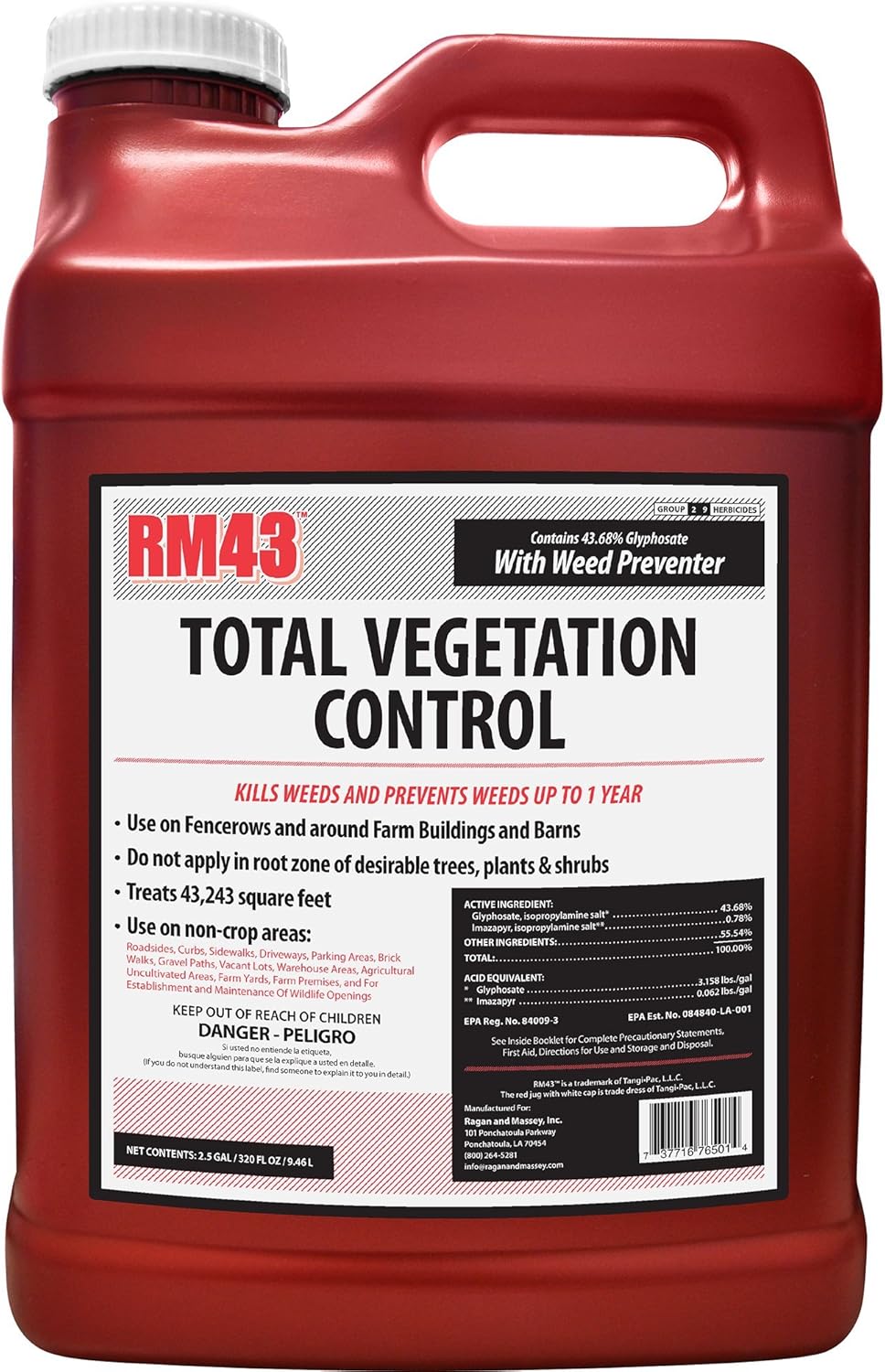
| Unit Count | 320 Fluid Ounces |
|---|---|
| Liquid Volume | 320 fluid ounces |
| Coverage | 243 243 square feet |
| Active Ingredients | Glyphosate isopropylamine salt, Imazapyr isopropylamine salt |
RM43 Total Vegetation Control is a concentrated 2.5‑gallon herbicide intended for killing existing growth and preventing regrowth for up to a year on areas where no vegetation is desired. You mix it into spray solution and apply to hardscape edges, gravel driveways, fence rows, and around buildings as either spot treatments or blanket applications on bare ground. The formula pairs glyphosate and imazapyr with a surfactant so it kills grasses, broadleaf weeds, vines, brush and some woody growth and becomes rainfast in about two hours. Practical benefits for driveway use include long residual control that reduces repeat spraying and a large coverage rate that treats many square feet from one container. Important limitations are that it is for non‑crop areas only and will damage desirable plants if sprayed over roots or drift occurs, and the active ingredient blend makes it persistent so care is required where you may later want vegetation to return. Follow label directions for mixing, application timing and safety precautions when using near soil that will be planted later.
Best for: Gardeners, property owners, and maintenance crews who prioritize strong, long‑lasting weed eradication on gravel driveways and other non‑crop hardscape areas and want to minimize repeat applications.
Less Ideal for: Homeowners planning to replant treated areas soon or those needing selective weed control near desirable plants should choose a less persistent or more targeted product.
- Combination of glyphosate and imazapyr for both knockdown and long residual control
- Concentrated 2.5‑gallon container covers large areas without frequent refills
- Rainfast in about two hours so light rain soon after application is less likely to reduce effectiveness
- Suitable for total vegetation control on gravel driveways, fence rows and other non‑crop areas
- Persistent active ingredients that can prevent desirable vegetation from reestablishing for an extended period
- Not safe for use where desirable plant roots may be exposed or where drift could contact nearby plants
Verdict: Choose RM43 when you need a single, heavy‑duty application that delivers broad spectrum kill and up to a year of weed prevention on gravel driveways and other non‑crop surfaces.
Roundup Weed & Grass Killer with Comfort Wand, 1.33 gal.

| Item Form | Liquid |
|---|---|
| Coverage | 400 sq. ft. |
| Liquid Volume | 1.33 gallons |
This Roundup package pairs a 1.33 gallon liquid formulation with a Comfort Wand for easier spraying around beds, walkways, and foundations. It is formulated to kill common broadleaf weeds and grasses down to the root, with visible wilting in hours and rainfast protection in about 30 minutes, so treated areas are less likely to wash away after a brief rain. The wand offers one-touch continuous spray, which reduces hand fatigue during spot treatments and makes edging and targeted applications simpler than using a separate sprayer. Coverage is listed at about 400 sq. ft., appropriate for small yards, beds, or multiple spot-treatment sessions. Important limitations are that this is a nonselective herbicide so it will damage desirable plants if contacted and the product directions include replanting wait times of 1 to 30 days depending on use. Users should follow label precautions about keeping people and pets away until spray has dried and applying only in calm conditions to avoid drift.
Best for: Buyers who want a straightforward, ready-to-use herbicide for targeted spot treatments and edging where quick, reliable weed control is the priority and minimizing application fuss matters.
Less Ideal for: Large properties or users who need selective lawn-safe control should consider professional application methods or products formulated specifically for turf.
- Fast visible results in hours and rainproof in as fast as 30 minutes
- Comfort Wand with one-touch continuous spray reduces hand fatigue and improves targeting
- Kills a wide range of broadleaf weeds and grasses to the root
- Ready-to-use liquid requires no mixing and covers up to 400 sq. ft.
- Nonselective formula will damage desirable plants if contacted
- Container and wand limit treatment area per refill compared with larger tank sprayers
Verdict: A convenient, ready-to-use herbicide with a Comfort Wand that delivers fast, reliable spot control of broadleaf weeds and grasses for homeowners who want an easy, low-fuss solution.
Choosing the Right Weed and Brush Killer for Fence Rows: Key Factors to Consider
Application Delivery and Spray Control
How you apply a weed and brush killer along a fence row determines speed, safety, and accuracy. A wand with adjustable nozzles or a backpack sprayer with a long-reach lance helps you target stems and avoid desirable shrubs or lawn adjacent to the fence. Pump sprayers and hose-end applicators each have tradeoffs: pump sprayers give more control for spot treatments, while hose-end tools cover more ground quickly but can increase drift.
Pay attention to nozzle types and included accessories. A narrow-cone or jet nozzle concentrates product on woody stems, improving contact and reducing off-target deposition. Also consider the ergonomics for repetitive tasks; lightweight, balanced sprayers reduce fatigue when treating long fence lines.
Residual Activity and Re-treatment Interval
Residual control varies widely between formulations and determines how often you return to the fence line. Some products provide quick contact kill but little residual suppression, which means you will need to retreat if roots resprout or seedlings emerge. Others leave a soil-active residue that reduces regrowth for weeks to months, which can be useful under and immediately beside fences.
Longer residuals can reduce labor but also increase the risk to desirable plants and to soil health near structural posts. Consider how often you want to inspect and re-treat the area, and whether the fence adjacency demands shorter residuals to protect nearby plantings.
Effectiveness on Woody Brush and Vines
Fence rows often have woody species that respond slowly to herbicides. Effective brush control requires products or mixes formulated to penetrate woody stems and translocate to roots. Look for options known to produce visible stem collapse on brush within days to weeks and to reduce resprouting from root crowns.
For vines and climbing plants, contact coverage is critical. Thorough wetting of leaves and the stem base helps active ingredients move into the plant. Sometimes a cut-stem or basal bark technique is more reliable for larger woody stems than foliar spray alone.
Selectivity and Safety Near Structures
Fence lines are rarely isolated: posts, gates, adjacent lawns, and ornamental beds are common. Selectivity matters to avoid harming non-target plants near the fence. A product that is nonselective when applied as a broadcast spray can be safe if applied carefully with a shielded nozzle or by targeted wicking on individual stems.
Also evaluate label directions for setbacks from structures, and look for guidance on protecting masonry, painted surfaces, and irrigation systems. Personal protective equipment requirements and reentry intervals are practical safety considerations for regular fence-line maintenance.
Mixing, Handling, and Cleanup
Practical mixing and cleanup reduce the chance of spills, accidental overapplication, and equipment damage. Concentrated formulations that require precise measuring demand good measuring gear and stable mixing containers, while premeasured or ready-to-use options simplify fence-line work.
Easy-to-clean sprayers and clear rinsing protocols are important when switching between herbicides or when other household users might access the equipment. Consider how well product residues rinse from plastic pump parts and whether the label requires triple rinsing or disposal steps that affect your workflow.
Environmental Persistence and Local Restrictions
Some active ingredients bind tightly in soil and persist, affecting nearby plantings and soil organisms. Other chemistries break down faster but may require more frequent treatments. Understand the persistence profile so you can anticipate impacts on groundcovers, bulbs, and established shrubs next to the fence.
Also check for local regulations or guideline restrictions on certain herbicide classes in your area. Even if a product is labeled for fence-line use, municipal rules or HOA policies may limit which active ingredients you can apply, influencing your choice.
Application Techniques for Tight Fence Lines
Treating a narrow strip along a fence calls for techniques that balance coverage and control. For small stems and low weeds, spot-spraying with a fine-stream nozzle or using a hand-held wick applicator reduces drift and limits harm to adjacent plants. For heavier brush, consider a targeted basal-bark or cut-stump method; these concentrate active ingredient where the plant will absorb it and reduce spray exposure to the surroundings.
When working near gates, posts, or painted surfaces, use a shielded nozzle or a small cup to catch overspray. Walk the line at a steady pace and overlap short bursts of spray to ensure even coverage. If you must use a hose-end sprayer for long runs, choose calm wind conditions and test spray patterns on a disposable surface before treating the fence row.
- Use narrow-stream or jet nozzles for stem-directed sprays.
- Employ basal-bark or cut-stump techniques on larger woody stems.
- Shield sprayer nozzles near structures to avoid contact with paint or masonry.
Timing Treatments for Best Results
Timing affects how well herbicides move through plants. Many woody species take up chemicals best during active growth in late spring through summer. Annual weeds and seedlings are often most susceptible when small and actively growing, so early-season treatments can reduce competition before plants become woody.
Avoid spraying during drought stress or at temperatures above label-recommended ranges because uptake may be reduced and damage to non-target plants can increase. Similarly, do not spray if rain is expected within the short window specified on the label, which can wash away contact products before they act.
- Treat woody growth during active growth periods for best translocation.
- Target seedlings early when they are most vulnerable.
- Follow label guidance on temperature and rainfall windows.
Protecting Nearby Plantings and Soil
Fence rows often border desirable plantings. Use physical barriers, shields, or selective application methods to prevent drift and root uptake in nearby beds. If a product has a long soil residual, avoid treating immediately upslope of flower beds or vegetable gardens where root exposure could harm desirable species.
Consider mulching or installing edging after treatment to reduce wash-in of residues and to keep treated vegetation from reestablishing quickly. Hand-pulling or mechanical removal of dead stems after herbicide application can further reduce resprouting and make follow-up visits more effective.
- Use shields or wicks when spraying adjacent to ornamentals.
- Avoid treating upslope of sensitive beds with soil-residual products.
- Remove dead material after control to limit resprout.
Managing Regrowth Without Excessive Retreatments
Long-term fence-line control often requires a combination of chemical and cultural approaches. After an initial herbicide treatment, monitor the line and spot-treat seedlings before they establish deep roots. Periodic mechanical trimming combined with selective herbicide spot treatments can reduce reliance on broadcast applications.
Plan a maintenance schedule based on the residual profile of your chosen product. Short-residual options may call for seasonal follow-up, while longer-residual chemistries let you manage the line with one treatment and occasional spot applications.
- Combine herbicide use with mechanical trimming for cleaner results.
- Schedule spot treatments based on the product's residual profile.
- Inspect fence lines regularly to catch small regrowth early.
Safety Gear and Environmental Precautions
Personal protective equipment reduces exposure during mixing and application. Even for spot treatments, wear gloves, eye protection, and long sleeves as recommended on the product label. Keep pets and children away from treated sections until the reentry interval has passed.
Be mindful of water sources, storm drains, and ditches near fence rows. Prevent runoff during application and rinsing. When rinsing equipment, follow label disposal instructions and avoid releasing rinse water into areas where it could contact desirable plants or enter waterways.
- Use label-specified PPE for mixing and application.
- Prevent runoff into drains and waterways.
- Keep treated areas off-limits until safe per label directions.
How We Chose the Best Weed and Brush Killer for Fence Rows
We started by focusing on products and formulations that are practically useful along narrow fence lines and property edges. Key evaluation criteria included spray reach and delivery options, because a wand or adjustable nozzle makes fence-line work faster and safer; residual control duration to limit follow-up treatments; selectivity and impact on desirable plants near fences; and application safety around structures, pets, and utility lines. We also assessed compatibility with common fence-row species such as woody brush, vines, and perennial grasses, plus ease of mixing and cleanup for backyard use. We excluded general-purpose lawn-only herbicides, products intended strictly for crop fields, and formulations requiring commercial licensing. Also omitted were options that lack any labeled instructions for spot treatment or that present unusually high drift risk for use near buildings. The result is a list focused on fence-row practicality: effective delivery, manageable residual activity, safe application practices, and real-world suitability for the plants you usually encounter along fences.
FAQ
Can I use a brush killer near wooden fence posts without damaging the wood?
Often you can if you avoid direct contact with the wood and use targeted application methods. Shielded spraying or a wick applicator prevents overspray on posts. If the product has solvents or surfactants that may affect paint or sealants, take extra care and rinse accidental contacts quickly per label guidance.
How soon after treatment can I trim or remove dead brush along the fence?
You can usually remove dead tops a few days to a couple of weeks after visible wilting, but wait until herbicide has translocated for best rootkill. Cutting too early may interrupt the chemical's movement; consult the product label for specific timing recommendations.
Is it better to use a residual product or a contact-only spray on a fence row?
It depends on goals and proximity to desirable plants. Residual products reduce reemergence and labor but increase risk to nearby plantings. Contact-only sprays are safer near ornamentals but often require more frequent treatments. Choose based on how much follow-up you can do and how close sensitive plants are.
What method works best for large woody stems and saplings in a fence line?
Basal-bark or cut-stump applications are more reliable for larger stems because they place the active ingredient where the plant will absorb it, minimizing drift and non-target exposure. These methods are often quicker and more effective than foliar sprays on thick-barked stems.
How should I protect nearby turf and garden beds when treating a fence line?
Use shields, apply with a narrow stream, and avoid broadcasting sprays when turf or beds are adjacent. If using a soil-residual product, create a physical barrier or avoid treating the upslope edge to reduce root-zone exposure. Rinse equipment away from planted areas following label disposal instructions.
Can weather affect how well a weed and brush killer works on fence rows?
Yes. Wind increases drift risk and reduces accuracy, while rain soon after application can wash away contact products. Very hot or drought-stressed plants may absorb chemicals less effectively. Apply in calm, moderate weather and follow label windows for best results.
Final Verdict
For fence-row work, prioritize application control, appropriate residual profile, and methods that reliably reach woody stems. Balance the convenience of longer residual activity with the need to protect nearby ornamental beds and structures. Focus on delivery tools, timing of application, and a maintenance plan that uses spot treatments and mechanical control to limit repeated full-line applications. With those priorities in mind, you can choose a weed and brush approach that keeps fence lines clear while minimizing unintended impacts.
