

Note: This article contains affiliate links. If you click on these links and make a purchase, I may earn a small commission at no extra cost to you. This helps support my research and content. Read my full affiliate disclosure here.
Centipedegrass has a low nutrient need and reacts differently to fertilizers and herbicides compared with other warm-season turfs. Choosing the right weed and feed matters because the wrong balance of nitrogen or the wrong herbicide can scorch crowns, encourage excessive thatch, or fail to control the broadleaf weeds common in centipede stands. This guide looks at seven shortlisted weed and feed options tailored for centipede lawns, and explains how each was evaluated for turf safety, weed spectrum, and ease of application. Use this overview to match a product to your lawn's fertility needs and weed pressure before moving on to the individual product details below.
Top Picks at a Glance
| Best Overall The best all-around choice for most situations | ferti-lome St. Augustine Weed & Feed 15-0-4 (12.8 lb) |  |
| Best Quality Built to a higher standard if you want something more solid | Jonathan Green Veri-Green Southern Weed & Feed Fertilizer (5,000 sq ft) |  |
| Best Value The sweet spot between price and what you get | Ferti-Lome Centipede Weed & Feed Lawn Fertilizer 15-0-15 (2 × 16 lb bags) |  |
| Best Budget The cheapest option that still gets the job done reliably | GreenView Weed & Feed Lawn Fertilizer, 13 lb Bag |  |
| Highest Rated A top-rated pick with lots of positive feedback | The Andersons Premium Weed and Feed 24-0-16 (18 lb) |  |
| Most Popular A crowd favorite that many people choose with confidence | Scotts Turf Builder Bonus S Southern Weed & Feed, 17.24 lb (covers 5,000 sq ft) |  |
| Best Seller A high-volume bestseller chosen again and again | Scotts Turf Builder Bonus S Southern Weed & Feed2, 13.79 lb |  |
ferti-lome St. Augustine Weed & Feed 15-0-4 (12.8 lb)

| Item Form | Granules |
|---|---|
| Coverage | Lawns (St. Augustine), 2,500 sq. ft.; 5,000 sq. ft. |
| Target Species | Lawn Grass |
| Mixing Ratio | 15:0:4 |
This granulated weed-and-feed packages pre-emergent and post-emergent herbicide with a 15-0-4 fertilizer aimed at warm-season grasses like Centipede, St. Augustine and Zoysia. It is typically broadcast across the lawn in early spring and as directed on the label to prevent crabgrass and treat existing broadleaf weeds while feeding turf. The product lists coverage options appropriate for common yard sizes and uses atrazine as the active weed-control ingredient, so it delivers both season-long suppression and an extra boost of nitrogen and potassium. Practical benefits include simplified lawn care by combining feeding and weed control in one application and a formulation matched to the named grass types. Important limitations are that it should not be used on Bermuda or northern grasses and that herbicide-containing weed-and-feeds can restrict seeding or overseeding windows, so follow label directions for timing and any lawn recovery steps.
Best for: Homeowners with warm-season lawns who want a single product to both suppress common weeds and feed Centipede or similar turf without managing separate treatments.
Less Ideal for: Those planting or overseeding cool-season or Bermuda lawns, or gardeners who prefer organic-only products, should consider other fertilization or weed-control options.
- Combines pre-emergent and post-emergent weed control with fertilizer for fewer separate applications
- Formulated specifically for warm-season lawns including Centipede, St. Augustine and Zoysia
- Granular form is easy to apply with a broadcast spreader for even coverage
- Provides a balanced 15-0-4 NPK blend to support turf color and root strength
- Contains atrazine so it is not suitable for all turf types and requires careful adherence to label restrictions
- Herbicide content limits overseeding or reseeding timing after application
Verdict: A convenient all-in-one granular weed-and-feed designed to simplify weed control and feeding for Centipede and other warm-season lawns.
Jonathan Green Veri-Green Southern Weed & Feed Fertilizer (5,000 sq ft)

| Item Form | Granule |
|---|---|
| Coverage | 5000 square foot |
| Unit Count | 184 Ounce |
| N-P-K Ratio | 30-0-3 |
Jonathan Green Veri-Green Southern Weed & Feed combines a 30-0-3 fertilizer with a post-emergent broadleaf weed control designed for warm-season turf. You spread the granules across an established St. Augustine lawn (or other southern grasses) to feed the turf and actively kill more than 40 common weeds such as dollarweed and dandelions. The product is intended for spring or fall application and is most effective when applied to actively growing weeds and watered in or applied to dew-covered grass so granules adhere. The high-nitrogen formula promotes quick greening and denser growth while helping the lawn better withstand heat. Because it is a granular, coverage is easy to measure and the single bag treats up to 5,000 sq ft. Limitations to note are that it is not labeled for cool-season grasses and it is a combined weed-and-feed approach, so you cannot target weeds without also applying fertilizer; follow label directions to avoid overapplication or use on newly seeded areas until safe per instructions.
Best for: Homeowners with established St. Augustine or other southern warm-season lawns who want a single, practical product to both feed turf and reduce broadleaf weeds without complex scheduling.
Less Ideal for: People maintaining cool-season lawns, those seeding new turf where selective fertilization is required, or gardeners who prefer spot-treating weeds rather than treating the entire lawn.
- Formulated specifically for southern warm-season grasses including St. Augustine
- 30-0-3 NPK promotes rapid greening and denser turf
- Controls over 40 common broadleaf weeds
- Granular formula covers up to 5,000 sq ft for straightforward application
- Not suitable for cool-season lawns or where selective weed-only treatment is preferred
Verdict: A convenient, purpose-built weed-and-feed for St. Augustine and other southern warm-season lawns that feeds turf while controlling a wide range of broadleaf weeds across 5,000 sq ft.
Ferti-Lome Centipede Weed & Feed Lawn Fertilizer 15-0-15 (2 × 16 lb bags)

| Item Form | Granules |
|---|---|
| Application Method | Broadcast or drop spreader |
| Target Species | Lawn Grass |
| Mixing Ratio | 15:0:15 |
This granular weed-and-feed combines a slow-release 15-0-15 fertilizer with iron to help thicken turf and improve color on centipede and other warm-season lawns. It is applied with a broadcast or drop spreader, making it practical for routine seasonal feeding across larger areas; the two 16 lb bags are marketed to cover up to about 10,000 sq ft in total. The slow-release nitrogen promotes steadier growth rather than a quick flush, which helps avoid spiking maintenance needs, and the added iron aids in a deeper green appearance. As a value bundle from a hardware-brand label it is useful for homeowners who want a straightforward, no-frills feed-and-weed step that fits into scheduled lawn care. Limitations to note are that the formulation lists 15-0-15 without a labeled herbicide mix on the product page, so users seeking a specific prepackaged broadleaf weed control should verify weed-control claims before use; also the product is designed for warm-season lawns and is not intended for cool-season turf varieties. Follow label directions and spreader calibration for even application and avoid off-target application to ornamentals.
Best for: Homeowners who want a simple, low-fuss seasonal feed to maintain centipede and other warm-season lawns and who prioritize steady growth and color improvement over targeted weed control.
Less Ideal for: Gardeners who need a confirmed, specific broadleaf or grassy weed treatment or those managing cool-season turf should choose a product formulated and labeled for those needs.
- Slow-release 15-0-15 formula provides steady nutrient availability for consistent growth
- Includes iron to help deepen lawn color without additional supplements
- Granular form works with standard broadcast or drop spreaders for easy application
- Two-bag bundle supplies a practical quantity for multiple feedings or larger lawns
- Product description emphasizes fertilizer formula but does not clearly list specific herbicide ingredients or labeled weed-control spectrum
Verdict: Choose this granular 15-0-15 value bundle if you want a straightforward slow-release feed that supports steady growth and improved color on centipede and other warm-season lawns.
GreenView Weed & Feed Lawn Fertilizer, 13 lb Bag

| NPK | 27-0-4 |
|---|---|
| Form | Granule |
| Coverage | 5000 square_feet |
| Active ingredient | Nitrogen |
GreenView Weed & Feed is a combined granular fertilizer and selective herbicide designed to feed established turf while controlling broadleaf weeds. You apply it to a dry, established lawn when weeds are actively growing, then water to activate the product and avoid mowing for two days. It uses a controlled-release nitrogen formulation to deliver steady feeding for up to eight weeks, which helps green-up without pushing surge growth and supports deeper roots for better drought tolerance. The herbicide component targets more than 250 common lawn weeds such as dandelion, clover, and plantain, so one application handles both nutrition and weed pressure across many cool- and warm-season grasses. Practical benefits include long feeding duration, wide weed control, and coverage suitable for medium to large yards. Important limitations are that it is for established turf only, it can damage certain grasses like St. Augustine (in Florida), dichondra, and carpetgrass, and timing matters because weeds must be actively growing for best control.
Best for: Homeowners who want a single, budget-friendly product to both feed and reduce broadleaf weeds on established lawns and prefer less frequent applications over the season.
Less Ideal for: Gardeners establishing new turf, owners of sensitive or excluded grass types, or those seeking an organic or granular fertilizer without herbicide.
- Controlled-release nitrogen feeds lawns for up to eight weeks, reducing the need for frequent applications
- Provides selective control of over 250 broadleaf weeds alongside fertilization
- Covers approximately 5,000 square feet from a single 13 lb bag, suitable for medium to large yards
- Zero phosphate formulation to reduce risk of waterway runoff
- Not safe for certain turf types such as St. Augustine in Florida, dichondra, and carpetgrass
- Requires correct timing and watering after application for effective weed control
- Intended only for established lawns and can harm seedlings or sensitive grasses
Verdict: A cost-effective all-in-one weed-and-feed that delivers eight weeks of controlled-release nitrogen while knocking back a wide range of common broadleaf weeds.
The Andersons Premium Weed and Feed 24-0-16 (18 lb)

| Item Form | Granule |
|---|---|
| Coverage | 5,000 sq ft |
| Unit Count | 288 Ounce |
| Active Ingredients | Herbicide, Iron, Nitrogen, Sulfur |
The Andersons Premium Weed and Feed 24-0-16 is a granular lawn product designed to kill broadleaf weeds while feeding turf with a mix of quick- and slow-release nitrogen plus iron for deeper greening. You apply it with a rotary or drop spreader to a dry lawn, following the label spreader settings and the two-step application schedule for best control. It targets over 250 broadleaf weeds and lists compatibility with St. Augustine and other common warm- and cool-season grasses, making it useful for seasonal lawn program maintenance. Practical benefits include combined weed control and extended feeding in one pass and improved lawn color from added iron. Important limitations are geographic restrictions and the need to follow the two-application procedure and post-application watering to activate herbicide; it is also not suitable for dichondra or carpet grass. For performance-focused users, correct spreader calibration and adherence to timing will determine results more than the product alone.
Best for: Homeowners who prioritize visible lawn performance and want a combined weed-control plus feeding product for regular seasonal maintenance of St. Augustine and similar grasses.
Less Ideal for: People managing sensitive or restricted lawns such as dichondra or carpet grass or those located in states where this product is not approved.
- Combines herbicide and fertilizer so you kill weeds while feeding grass in one application
- Includes both quick- and slow-release nitrogen for immediate green-up and longer-lasting feeding
- Contains iron for deeper, faster greening of turf
- Covers up to 5,000 sq ft per bag, suitable for medium-sized yards
- Not approved for sale or use in some states which limits availability
- Requires specific spreader settings and a two-step application schedule for full effectiveness
Verdict: Choose this product if you want a single granular treatment that controls broadleaf weeds and delivers both quick and extended feeding for a noticeably greener St. Augustine lawn.
Scotts Turf Builder Bonus S Southern Weed & Feed, 17.24 lb (covers 5,000 sq ft)

| Item Form | Granule |
|---|---|
| Coverage | 5000 square feet |
| Active Ingredients | Atrazine |
| Guaranteed Analysis (N-P-K) | 29-0-10 |
Scotts Turf Builder Bonus S Southern Weed & Feed is a dual-action granular product designed for southern lawns such as St. Augustine, centipede, zoysia, and carpetgrass. You apply it with a broadcast or drop spreader to a dry, actively growing lawn and then water it in immediately; one 17.24 lb bag covers about 5,000 sq ft and the label gives spreader-settings to simplify application. The fertilizer portion (29-0-10 with slowly available nitrogen) feeds the turf to encourage deeper roots and greener color, while the active herbicide atrazine targets more than 25 common southern weeds including dollarweed and clover. Practical benefits include simplified two-in-one treatment and clear timing guidance for late spring or when soil temperatures reach 60 to 85°F. Important limitations: it is not labeled for bermudagrass and must be used only on the specified southern species, and it requires careful handling and watering-in to work as intended. Also, atrazine is a persistent herbicide so follow local regulations and label safety precautions when using near water or sensitive areas.
Best for: Homeowners with St. Augustine, centipede, zoysia, or carpetgrass lawns who want a straightforward, proven two-in-one treatment to reduce broadleaf weeds while feeding turf and who prefer products with broad user feedback.
Less Ideal for: Owners of bermudagrass lawns or gardeners who need an herbicide-free or organic approach should look for alternative products.
- Two-in-one formula that controls listed southern broadleaf weeds while feeding turf.
- Clear application instructions with spreader settings and a coverage figure of 5,000 sq ft.
- Slow-release nitrogen in the fertilizer promotes sustained greening and stronger roots.
- Targets 25+ weeds common to warm, humid southern lawns including dollarweed and clover.
- Not safe for bermudagrass and limited to specific southern grass types.
- Contains atrazine which requires careful handling and attention to local environmental restrictions.
- Requires watering in immediately after application for effectiveness and safety precautions during windy conditions.
Verdict: Choose this if you have a listed southern grass and want a single granular product that reliably kills common southern broadleaf weeds while feeding your lawn.
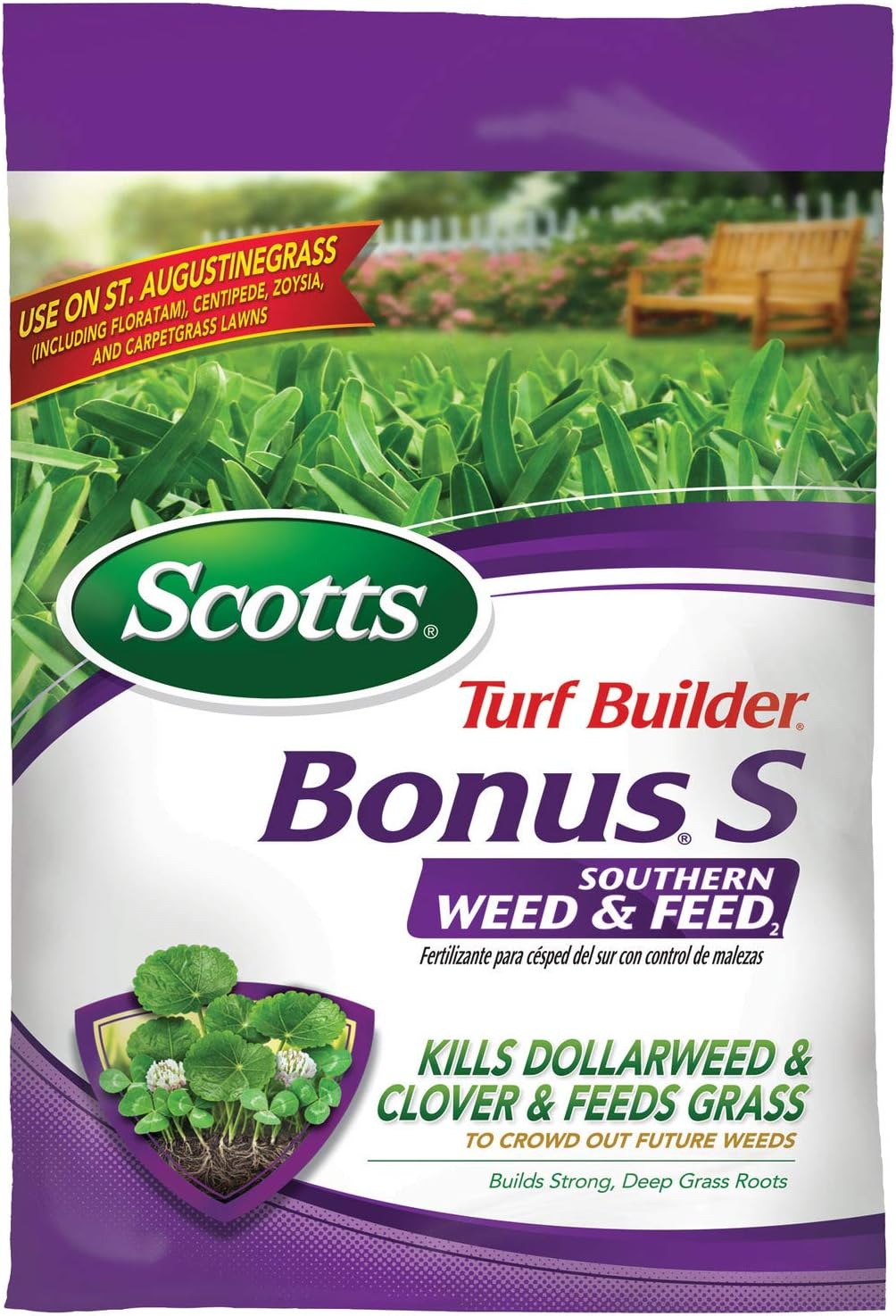
Scotts Turf Builder Bonus S Southern Weed & Feed2, 13.79 lb
| Item Form | Granule |
|---|---|
| Coverage | 4000 square feet |
| Unit Count | 220.64 Ounce |
This Scotts Turf Builder Bonus S Southern Weed & Feed2 combines a broadleaf weed killer with a slow-release fertilizer made specifically for southern lawns. It is designed for spot-to-whole-lawn applications with a broadcast or drop spreader and must be applied to a dry, actively growing lawn and watered in immediately. Notable features include a formula that targets more than 25 southern weed species, including clover, and guidance for spreader settings to ensure even coverage. Practical benefits are twofold: it reduces existing broadleaf weeds while providing nutrients that encourage grass to fill in and compete with future weeds, helping create a denser turf. Important limitations are that it is labeled only for St. Augustine, Centipede, Zoysia, and Carpetgrass and should not be used during winter dormancy or on other grass types, and timing matters—apply after the third mowing when soil temperatures reach the recommended range. Coverage per 13.79 lb bag is 4,000 square feet, so larger yards will need multiple bags or a larger size option.
Best for: Homeowners with southern-style lawns who want a single product to control clover and other broadleaf weeds while feeding the turf, and who follow label timing and application guidance.
Less Ideal for: Those with cool-season lawns, mixed-grass yards, or users who prefer spot-treating weeds with herbicide-only products should look elsewhere.
- Kills a wide range of southern broadleaf weeds including clover
- Feeds grass while killing weeds to encourage thicker turf
- Formulated for common southern grasses so label directions are targeted
- Includes recommended spreader settings for even application
- Restricted to specific southern grass types and not safe for all lawns
- Must be applied when grass is actively growing and watered in immediately which requires correct timing
Verdict: Choose this if you have a southern grass lawn and want one granular product that kills clover and other broadleaf weeds while feeding the turf to promote a denser lawn.
Choosing the Right Weed and Feed for Centipede: Key Factors to Consider
Nitrogen Rate and Release
Centipedegrass prefers lower nitrogen than many warm-season turfgrasses. A weed and feed that delivers a modest total nitrogen amount with a controlled-release component helps avoid rapid, succulent growth that invites disease and thatch.
Look for products that list both immediate-release and slow-release nitrogen sources so you can estimate short-term greening versus longer-term feeding. Pay attention to the percent nitrogen per bag and match it to your lawn size and the season to prevent overapplication.
Herbicide Type and Selectivity
Not all herbicides are safe on centipedegrass. Selective broadleaf herbicides that are labeled for centipede lawns are preferred because they target weeds without injuring the turf.
Identify the active ingredient(s) and confirm they have a history of safe use on centipede or explicit label instructions. Some herbicides control woody or difficult weeds but can stress centipede under heat or drought, so timing and label rates matter.
Timing and Seasonal Use
Weed and feed timing affects both efficacy and safety. Apply during active weed growth but when centipedegrass is not under heat or drought stress.
Spring applications often target winter annuals and stimulate growth, while fall applications may handle perennial broadleaves. Avoid application during midsummer peak heat and when the turf is newly established or recovering from injury.
Spreader Calibration and Application Ease
Even the best formula can damage turf if spreader settings are wrong. A product with clear spreader settings for common broadcast or drop spreaders reduces the risk of overapplication.
Also consider physical characteristics such as granule size and dust content. Uniform granules distribute more evenly and minimize streaking, while low-dust formulas reduce inhalation exposure during application.
Lawn Condition and Thatch Considerations
Thick thatch and compacted soil change how both fertilizer and herbicide act in the turf. A heavy thatch layer can hold herbicide near the surface, increasing contact with crowns and risk of injury.
Assess thatch and soil before application. Some weed and feed products work better after dethatching or aeration to ensure nutrients reach roots and herbicides move where they will contact target weeds rather than linger in the canopy.
Label Instructions and Safety Restrictions
Labels contain critical details about safe use on centipedegrass, reentry intervals, watering requirements, and tolerant grass stages. Follow label directions exactly to reduce legal and plant-health risks.
Check for explicit notes about newly sodded or seeded areas, watering after application, and any temperature or moisture restrictions. Products with clear, readable labels reduce user error and improve outcomes.
Preparing Your Centipede Lawn Before Application
Inspect your turf for stress, recent repairs, or heavy thatch before applying any weed and feed. Address watering needs and delay treatment if the lawn is wilted, recently aerated, or recovering from insect pressure.
If thatch is thicker than about one half inch, consider dethatching lightly or aerating a few weeks before application so nutrients and herbicide move into the canopy rather than sit on top of a thatch mat.
- Water deeply two to three days before application if the turf is dry.
- If seeding or sodding occurred within the last 6 to 8 weeks, postpone treatment until the turf is established per label guidance.
- Mow to recommended height and remove clippings if the label advises.
Best Application Timing for Weed Control
Target applications when the predominant weeds are actively growing and temperatures are moderate. For winter annuals in warm climates, an early spring application works best, while summer broadleaves often respond to late spring or early fall treatments.
Avoid applying during heat waves or drought. Herbicide activity can increase under stress, raising the risk of turf injury. Follow label temperature windows and consider weather forecasts for at least 48 hours after application.
- Apply on calm, dry days to reduce drift and improve granule pickup.
- Do not irrigate immediately unless the label requires watering in the product.
Spreader Settings and Application Technique
Calibrate your spreader before you start by running a short test over a measured area and collecting granules. Confirm the product's recommended setting for your spreader model and adjust to match even distribution.
Walk at a steady pace and overlap passes slightly to avoid missed strips. If the product gives settings for both broadcast and drop spreaders, use the one that matches your equipment and follow the calibration instructions carefully.
- Clean the spreader after use to prevent cross-contamination with other lawn chemicals.
- Wear gloves and a dust mask if handling dusty granules.
Post-Application Care and Watering
Some weed and feed products require watering-in to activate herbicides or move fertilizer to roots, while others advise keeping the granules dry for a set period. Read the label for the specific watering window and follow it closely.
Avoid heavy irrigation that could wash herbicide off the lawn and into non-target areas. For centipedegrass, light, frequent watering after the specified waiting period can help nutrients penetrate without stressing the turf.
- Keep children and pets off the treated area for the interval stated on the label.
- Monitor the lawn for signs of stress in the days following application and be prepared to provide shade or supplemental moisture if recommended.
Managing Common Weeds in Centipede Lawns
Different weeds respond differently to herbicides included in weed and feed products. Broadleaf weeds such as clover and dandelion are commonly targeted, while grassy weeds may not be controlled by broadleaf-specific formulas.
For persistent or perennial weeds, a single application may not be sufficient. Combine cultural practices like improved mowing, overseeding where appropriate, and spot-treating with targeted herbicide options that are labeled safe for centipede when necessary.
- Identify the dominant weeds before treating to choose a product with the right spectrum.
- Use spot treatments for escaped patches rather than blanket reapplication across the whole lawn.
How We Chose the Best Weed and Feed for Centipede
We prioritized products that balance low-to-moderate nitrogen with herbicides known to be safe on centipedegrass at label rates. Centipede is sensitive to high nitrogen and to certain postemergent herbicides, so formulations designed for low-maintenance warm-season lawns scored higher. We evaluated four to six concrete dimensions relevant to real-world centipede care: controlled nitrogen release profile, herbicide spectrum and selectivity for broadleaf weeds, application flexibility and spreader compatibility, label clarity and turf safety instructions, and packaging sizes suitable for typical yard sizes. Exclusions were explicit: any product lacking clear centipedegrass labeling or with nitrogen rates that exceed recommended seasonal doses for centipede was removed. Experimental mixes, unregistered herbicide blends, and products without clear spreader calibration guidance were not considered. The result is a shortlist focused on formulations and instructions that reduce scorch risk while delivering practical weed control for established centipede lawns.
FAQ
Can I use a standard weed and feed on centipedegrass?
It depends. Only use products that list centipedegrass on the label or have a nitrogen rate and herbicide profile known to be safe for low-nitrogen turf. Products formulated for high-maintenance lawns often contain too much nitrogen or incompatible herbicides.
How often should I apply weed and feed on a centipede lawn?
Centipede typically needs fewer feeds than other turfgrasses. Often one light application in spring and possibly another in fall is sufficient. Follow label maximums and avoid frequent high-nitrogen applications that can weaken centipede over time.
Will weed and feed fix a lawn with lots of bare spots?
Weed and feed helps control weeds and provides nutrients but will not replace the need to repair bare spots. Address soil contact, seed or sod the bare areas per centipede establishment guidelines, and avoid herbicide applications on newly repaired patches until they are established.
Is it safe to apply weed and feed during hot weather?
Usually it is not recommended. High temperatures and drought stress increase the risk of turf injury from some herbicides and high nitrogen. Choose cooler, stable weather windows and follow label temperature guidance for the safest results.
Can I water my lawn after applying weed and feed?
That depends on the product. Some formulas require immediate light irrigation to activate and move fertilizer to roots, while others instruct you to wait to avoid washing off the herbicide. Read and follow the specific label instructions regarding watering.
Final Verdict
Choosing the right weed and feed for centipede means prioritizing low to moderate nitrogen rates, herbicides labeled for centipede, and clear application instructions that match your lawn size and calendar. Balance the need for weed control with the grass's sensitivity by timing applications for active weed growth and avoiding stress periods. Focus on spreader calibration, label compliance, and cultural practices like dethatching and correct mowing height to get the best, safest results for centipede turf.
