

Note: This article contains affiliate links. If you click on these links and make a purchase, I may earn a small commission at no extra cost to you. This helps support my research and content. Read my full affiliate disclosure here.
If you grow Kentucky bluegrass, choosing the right weed-and-feed can make the difference between patchy turf and a uniform, resilient lawn. A blend that matches the grass nutritional needs while controlling common broadleaf weeds will help thicken turf, improve color, and reduce bare spots over the growing season. This guide looks at five top Weed and Feed options suited for Kentucky bluegrass and explains why each type of formulation may work better in certain conditions. We shortlisted products that fit cool-season lawn care, emphasizing fertilizer ratios, weed-control spectrum, and application timing. Read on to understand the practical tradeoffs and which product features matter most for a durable bluegrass stand.
Top Picks at a Glance
| Best Value The sweet spot between price and what you get | Spectracide Weed & Feed 20-0-0, Dual Action Liquid, 32 fl oz (3-Pack) |  |
| Best Budget The cheapest option that still gets the job done reliably | GreenView Weed & Feed Lawn Fertilizer, 13 lb Bag |  |
| Highest Rated A top-rated pick with lots of positive feedback | The Andersons Premium Weed and Feed 24-0-16 (18 lb) |  |
| Most Popular A crowd favorite that many people choose with confidence | Scotts Turf Builder Weed & Feed5 Granular Lawn Fertilizer (33.95 lb) |  |
| Best Seller A high-volume bestseller chosen again and again | Scotts Turf Builder Triple Action Weed Killer, Preventer and Fertilizer, 50 lb. |  |
Spectracide Weed & Feed 20-0-0, Dual Action Liquid, 32 fl oz (3-Pack)

| Item Form | Liquid |
|---|---|
| Coverage | 7,500 square feet |
| Unit Count | 96 Ounce |
| Number of Packs | 3 |
Spectracide Weed & Feed 20-0-0 is a hose-end liquid that combines fertilizer and a broadleaf herbicide so you can treat weeds and feed the lawn in one pass. You attach the QuickFlip sprayer to a garden hose and spray the product over actively growing weeds; one 32 fl oz bottle is rated to cover up to 7,500 square feet and the three-pack supplies multiple applications. The 20% nitrogen formulation helps green up grass while the active ingredient targets dandelion, clover, chickweed and similar broadleaf weeds. It requires no measuring or mixing, and application typically takes about 20 minutes per bottle depending on water pressure. Important limits to note are timing and temperature restrictions you must follow to avoid turf injury, and very tough weeds may need a follow-up spot treatment after a few weeks. Also the hose-end delivery depends on household water pressure for spray quality and coverage consistency.
Best for: Buyers who want a simple, low-effort way to control common broadleaf weeds while feeding their lawn and who prefer products with straightforward application instructions and predictable results.
Less Ideal for: Users needing selective control of grass weeds or professional landscapers seeking granular, high-precision fertilization plans should consider specialized products or professional services instead.
- Two-in-one action fertilizes lawn while killing many common broadleaf weeds
- QuickFlip hose-end sprayer for no-mix, easy application
- One 32 fl oz bottle covers up to 7,500 sq ft, and the 3-pack gives multiple treatments
- Formulated with 20% nitrogen to visibly green turf after application
- Should not be applied when air temperatures exceed 85°F to avoid grass damage
- Effectiveness on very tough or persistent weeds may require additional spot treatments
Verdict: If you want an easy, no‑mix hose-end solution to kill common broadleaf weeds while feeding your lawn, this Spectracide three-pack delivers fast, convenient coverage.
GreenView Weed & Feed Lawn Fertilizer, 13 lb Bag

| NPK | 27-0-4 |
|---|---|
| Form | Granule |
| Coverage | 5000 square_feet |
| Active ingredient | Nitrogen |
GreenView Weed & Feed is a combined granular fertilizer and selective herbicide designed to feed established turf while controlling broadleaf weeds. You apply it to a dry, established lawn when weeds are actively growing, then water to activate the product and avoid mowing for two days. It uses a controlled-release nitrogen formulation to deliver steady feeding for up to eight weeks, which helps green-up without pushing surge growth and supports deeper roots for better drought tolerance. The herbicide component targets more than 250 common lawn weeds such as dandelion, clover, and plantain, so one application handles both nutrition and weed pressure across many cool- and warm-season grasses. Practical benefits include long feeding duration, wide weed control, and coverage suitable for medium to large yards. Important limitations are that it is for established turf only, it can damage certain grasses like St. Augustine (in Florida), dichondra, and carpetgrass, and timing matters because weeds must be actively growing for best control.
Best for: Homeowners who want a single, budget-friendly product to both feed and reduce broadleaf weeds on established lawns and prefer less frequent applications over the season.
Less Ideal for: Gardeners establishing new turf, owners of sensitive or excluded grass types, or those seeking an organic or granular fertilizer without herbicide.
- Controlled-release nitrogen feeds lawns for up to eight weeks, reducing the need for frequent applications
- Provides selective control of over 250 broadleaf weeds alongside fertilization
- Covers approximately 5,000 square feet from a single 13 lb bag, suitable for medium to large yards
- Zero phosphate formulation to reduce risk of waterway runoff
- Not safe for certain turf types such as St. Augustine in Florida, dichondra, and carpetgrass
- Requires correct timing and watering after application for effective weed control
- Intended only for established lawns and can harm seedlings or sensitive grasses
Verdict: A cost-effective all-in-one weed-and-feed that delivers eight weeks of controlled-release nitrogen while knocking back a wide range of common broadleaf weeds.
The Andersons Premium Weed and Feed 24-0-16 (18 lb)

| Item Form | Granule |
|---|---|
| Coverage | 5,000 sq ft |
| Unit Count | 288 Ounce |
| Active Ingredients | Herbicide, Iron, Nitrogen, Sulfur |
The Andersons Premium Weed and Feed 24-0-16 is a granular lawn product designed to kill broadleaf weeds while feeding turf with a mix of quick- and slow-release nitrogen plus iron for deeper greening. You apply it with a rotary or drop spreader to a dry lawn, following the label spreader settings and the two-step application schedule for best control. It targets over 250 broadleaf weeds and lists compatibility with St. Augustine and other common warm- and cool-season grasses, making it useful for seasonal lawn program maintenance. Practical benefits include combined weed control and extended feeding in one pass and improved lawn color from added iron. Important limitations are geographic restrictions and the need to follow the two-application procedure and post-application watering to activate herbicide; it is also not suitable for dichondra or carpet grass. For performance-focused users, correct spreader calibration and adherence to timing will determine results more than the product alone.
Best for: Homeowners who prioritize visible lawn performance and want a combined weed-control plus feeding product for regular seasonal maintenance of St. Augustine and similar grasses.
Less Ideal for: People managing sensitive or restricted lawns such as dichondra or carpet grass or those located in states where this product is not approved.
- Combines herbicide and fertilizer so you kill weeds while feeding grass in one application
- Includes both quick- and slow-release nitrogen for immediate green-up and longer-lasting feeding
- Contains iron for deeper, faster greening of turf
- Covers up to 5,000 sq ft per bag, suitable for medium-sized yards
- Not approved for sale or use in some states which limits availability
- Requires specific spreader settings and a two-step application schedule for full effectiveness
Verdict: Choose this product if you want a single granular treatment that controls broadleaf weeds and delivers both quick and extended feeding for a noticeably greener St. Augustine lawn.
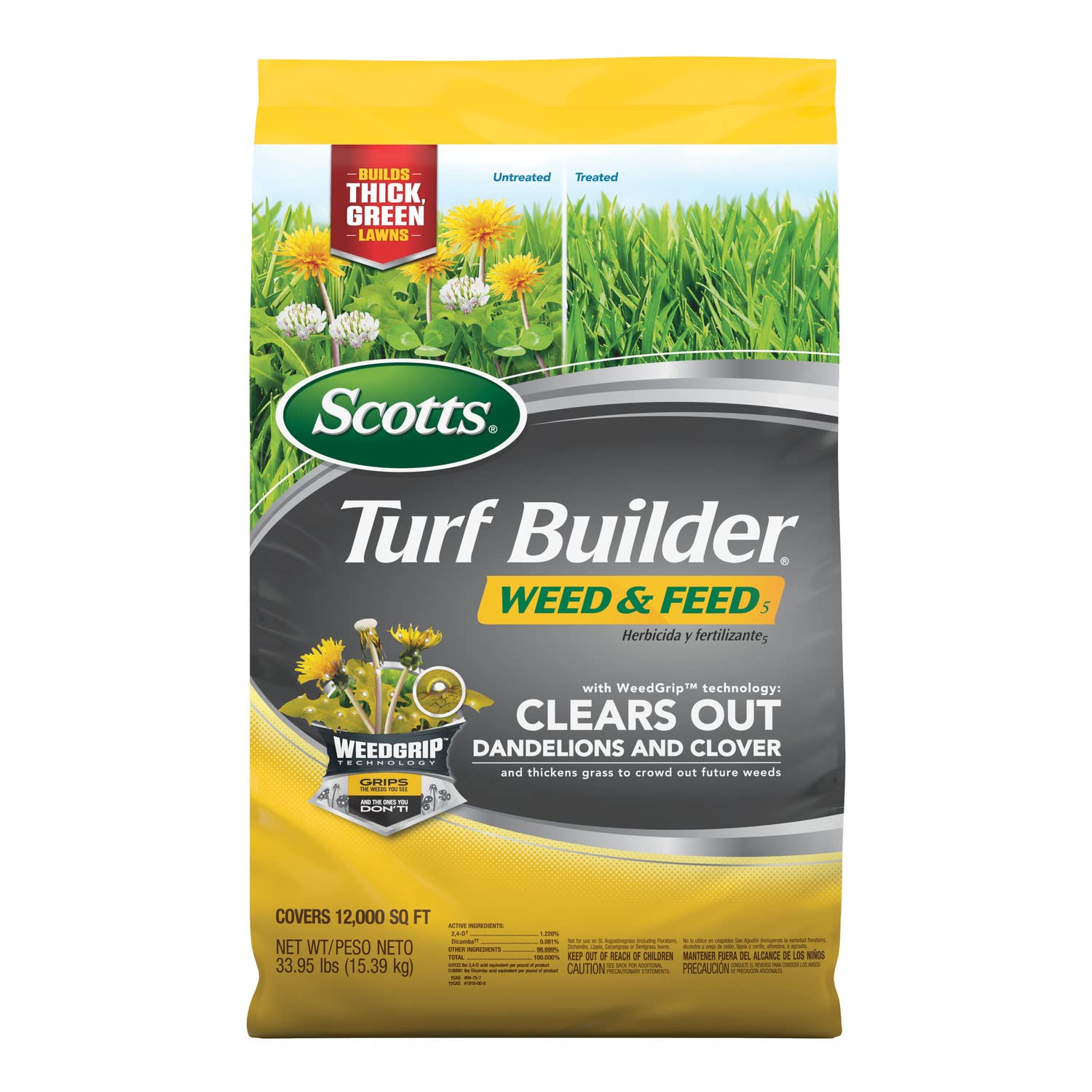
Scotts Turf Builder Weed & Feed5 Granular Lawn Fertilizer (33.95 lb)
| Item Form | Granule |
|---|---|
| Coverage | 12000 square feet |
| Active Ingredients | 2.4‑D and Dicamba |
| Unit Count | 1 Count |
Scotts Turf Builder Weed & Feed5 is a combined granular weed killer and lawn fertilizer intended for use when broadleaf weeds are actively growing and daytime temperatures are between 60°F and 90°F. You apply it to a wet lawn with a broadcast, drop, or hand spreader (Scotts publishes spreader settings) and then avoid watering for 24 hours to let granules stick to weed leaves. The formula uses WeedGrip technology and active ingredients 2,4‑D and dicamba to target common lawn weeds such as clover and dandelion while the fertilizer portion delivers nitrogen and potassium to thicken turf. A single 33.95 lb. bag is sized to cover about 12,000 square feet, making it convenient for medium to large yards. Important limits: do not use on St. Augustine, bentgrass, dichondra, carpetgrass, or lippia and do not apply if rain is expected within 24 hours; the product can also require keeping people and pets off treated turf until dust settles. For homeowners seeking a combined weed control plus feeding step, this simplifies late‑spring applications, but those with excluded grass types or who need precise spot treatments should consider alternatives.
Best for: Homeowners with warm‑season Bahia and other listed grass types who want a single late‑spring application to control broadleaf weeds while feeding the lawn and prefer products with established brand usage guidance.
Less Ideal for: Anyone growing St. Augustine, bentgrass, dichondra, carpetgrass, or lippia or gardeners who need spot treatments, organic options, or year‑round fertilization plans.
- Kills a wide range of listed broadleaf lawn weeds including clover and dandelion using WeedGrip technology
- Feeds lawn while treating weeds so it both reduces weeds and promotes thicker turf
- Large 33.95 lb. bag covers up to 12,000 sq ft, suitable for medium to large lawns
- Published application guidance and spreader settings make it straightforward to apply evenly
- Not safe for use on several turf types including St. Augustine and bentgrass
- Requires dry window after application and restriction on people and pets until dust settles
- Contains synthetic herbicides that require careful handling and label compliance
Verdict: A convenient, proven weed‑and‑feed option for Bahia and other compatible lawns that combines broadleaf weed control with feeding in one late‑spring application.
Scotts Turf Builder Triple Action Weed Killer, Preventer and Fertilizer, 50 lb.

| Item Form | Granule |
|---|---|
| Coverage | 10000 square_feet |
| Unit Count | 800 Ounce |
Scotts Turf Builder Triple Action combines weed control, crabgrass prevention, and fertilizer in a single 50 lb. granular bag intended for large lawns. You apply it with a broadcast or drop spreader in spring (before crabgrass emerges or after dandelions sprout); the directions ask for a moist lawn and a follow-up watering to activate the product. Notable features include targeted broadleaf weed control, up to four months of crabgrass prevention when applied at the right time, and a fertilizer formula suited for common cool- and warm-season grasses including Kentucky Bluegrass. In practice this simplifies spring applications by handling multiple tasks at once and covering up to 10,000 sq. ft., so you can treat large lawns quickly with a recommended spreader setting. Important limitations are timing sensitivity and the need to avoid application to newly seeded turf or nearby desirable seedlings, and the product can stain hard surfaces if spilled. For homeowners who prefer a single, proven regimen to protect and feed established Kentucky Bluegrass, this product reduces guesswork but requires following timing and watering instructions for best results.
Best for: Homeowners with established Kentucky Bluegrass who want a low-hassle, single-application solution to control common broadleaf weeds, prevent crabgrass, and feed their lawn at springtime.
Less Ideal for: Do not use this on newly seeded lawns or for lawns with young grass where separate starter fertilizer or specialized weed control is needed.
- Three-in-one formula kills listed broadleaf weeds, prevents crabgrass, and fertilizes in a single application
- Covers up to 10,000 sq. ft. per 50 lb. bag, making it efficient for larger lawns
- Recommended spreader settings and application instructions simplify even distribution
- Formulated for use on Kentucky Bluegrass and other common turfgrass varieties
- Effectiveness depends on precise timing and moist lawn conditions for activation
- Can stain hard surfaces and requires careful handling to avoid tracking
Verdict: A convenient all-in-one weed control and fertilizer made to simplify spring treatment of established Kentucky Bluegrass over large lawns.
Choosing the Right Weed and Feed for Kentucky Bluegrass: Key Factors to Consider
Fertilizer Ratio and Seasonal Needs
Kentucky bluegrass benefits from a fertilizer ratio that supplies enough nitrogen for color and tillering without forcing overly rapid top growth. Look for formulations with a higher nitrogen component appropriate for cool-season grasses, and consider the timing of applications-spring and early fall are key growth periods. Slow-release nitrogen helps sustain color and reduces the risk of mowing stress, while a burst of quick-release nitrogen can be useful when rapid greening is desired.
Understanding the potassium and phosphorus levels is also important. Potassium supports root strength and winter hardiness, which matters for bluegrass in cold climates. Avoid high-phosphorus mixes unless soil tests indicate a deficiency, because excess phosphorus can runoff and cause environmental issues.
Herbicide Spectrum and Selectivity
A Weed and Feed must control the broadleaf weeds common to bluegrass lawns, such as clover, dandelion, plantain, and chickweed. Check that the herbicide component targets these species and is labeled safe for use on Kentucky bluegrass. Some formulations are more selective and will leave desirable grasses unharmed, while others have a narrower spectrum or restrictions that limit use during certain temperature ranges or growth stages.
Also consider residual activity and how long the herbicide persists in the soil. Longer residual control can reduce future spot treatments but may interfere with overseeding or damage desirable seedlings. Read label guidance on when you can reseed after application to coordinate weed control with lawn renovation plans.
Release Type and Application Timing
Granules can be formulated for immediate release, controlled release, or a combination. Controlled-release granules feed gradually, producing steadier growth and fewer burn incidents, which is helpful for maintaining a dense Kentucky bluegrass stand. Quick-release nitrogen produces faster greening but increases mowing frequency and can stress turf in hot or drought conditions.
Timing matters because herbicide activity and fertilizer uptake depend on turf growth and temperature. Apply when bluegrass is actively growing so it can absorb nutrients and tolerate the herbicide stress. Avoid applications during dormancy, extreme heat, or drought to reduce the risk of injury.
Spreader Compatibility and Coverage
Even distribution is critical with combined products because missed areas can leave weeds or fertility gaps. Choose a product with granule size and flow characteristics that match common broadcast or drop spreaders. Many labels include spreader settings that help achieve the correct application rate; following those settings and overlapping passes slightly will improve uniformity.
Consider how long the granules remain free-flowing in humid conditions and whether they clump during storage. Clumping leads to uneven application and variable results across the lawn. Practical handling traits like dustiness and wind drift also affect how easily the product applies to a large or windy yard.
Turf Safety and Environmental Considerations
Weed-and-feed formulations must balance effective weed control with safety for the turf and the environment. Herbicides that burn or yellow leaves under stress conditions are riskier on bluegrass. Follow label warnings about mowing, irrigation, and temperature constraints to minimize phytotoxicity. When using any product, avoid application near water features and follow runoff-prevention practices to protect local waterways.
Also consider pet and child re-entry intervals and whether the product requires irrigation to activate the herbicide. Choosing a formulation with lower volatilization and clear re-entry guidelines helps reduce accidental exposure and environmental harm.
Reseeding and Renovation Compatibility
If you plan to overseed or renovate patches in your bluegrass lawn, check the label for recommended wait times before seeding. Some herbicides inhibit seed germination for weeks, which can be a problem when trying to thicken turf with new seed. Other formulations are compatible with immediate overseeding or have shorter withholding periods.
Plan your lawn renovation schedule around the product's reseeding window to avoid delays that leave bare soil exposed to erosion and weed invasion. Where frequent overseeding is part of the maintenance plan, favor options that allow quicker return to seeding or use spot-herbicide strategies instead of broad application.
Timing Applications for Best Results
Apply a combined weed-and-feed when Kentucky bluegrass is actively growing and soil temperatures support root uptake. Early fall is often the best single window because the grass is building carbohydrate reserves and weeds are still actively translocating herbicide to root systems.
Avoid treating during summer heat stress or prolonged drought, when the herbicide can cause scorch and fertilizer uptake is limited. For spring applications, wait until the turf has broken dormancy and shows consistent growth to ensure both nutrient uptake and effective weed control.
- Fall applications generally improve root recovery and winter hardiness.
- Spring treatments work for early weed control but time them after green-up.
- Do not apply during hot, dry spells or during frost events.
Preparing the Lawn Before Application
Mow to a normal height and remove clippings before applying a weed-and-feed product. A recent mow helps granules contact the turf canopy and soil more evenly. Raking lightly to break up thatch can improve herbicide contact with weed foliage.
Water management matters: do not irrigate immediately before application if leaves are wet, and follow label guidance for post-application watering to activate the fertilizer and herbicide without washing them away.
- Mow first and bag or remove clippings if heavy.
- Avoid application on wet turf to reduce clumping.
- Follow label irrigation timing to activate without runoff.
Spot Treatments Versus Whole-Lawn Applications
If weeds are concentrated in patches, spot-treating with a targeted herbicide and using a plain fertilizer for the rest of the lawn can minimize herbicide use and allow earlier reseeding. Whole-lawn weed-and-feed is efficient for widespread weed pressure but may be unnecessary where weeds are limited.
Spot strategies let you choose higher-strength chemistries only where needed and protect newly seeded or delicate areas from herbicide exposure.
- Use whole-lawn products for uniform weed problems.
- Choose spot treatment for isolated infestations or when planning overseeding.
- Combining approaches can optimize control while reducing chemical load.
Coordinating Mowing and Irrigation After Treatment
Follow label directions on mowing after application; many products ask you to wait a few days before mowing to allow herbicide uptake. Mowing too soon can remove treated foliage and reduce effectiveness. Similarly, irrigation timing depends on whether the product needs water to activate or requires dry contact time.
Plan your regular mowing cadence and irrigation schedule around the treatment window to preserve both fertilizer benefits and herbicide performance.
- Delay mowing when instructed to ensure herbicide absorption.
- Use light irrigation only when recommended to activate granules.
- Avoid heavy watering that could cause runoff and reduce efficacy.
Integrating Weed-and-Feed Into a Year-Round Program
Weed-and-feed is one tool within a broader bluegrass management plan. Combine it with proper mowing height, aeration, overseeding, and targeted spot control to maintain dense turf that outcompetes weeds. Timing products to match your seasonal cultural practices yields the best long-term results.
Keep records of application dates, weather conditions, and observed results to refine future choices. Rotating herbicide modes of action and varying fertilizer timing helps reduce resistance and improves overall lawn health.
- Use cultural practices to reduce reliance on herbicides.
- Record treatments and outcomes to improve scheduling.
- Rotate chemistries and vary feeding schedules for sustainability.
How We Chose the Best Weed and Feed for Kentucky Bluegrass
We focused on attributes that matter to people maintaining Kentucky bluegrass lawns in cool-season climates. Evaluation emphasized fertilizer formulation tailored to bluegrass needs, herbicide spectrum and selectivity against common broadleaf weeds, release type and application timing, and ease of use including spreader calibration and granule consistency. We also considered turf safety factors such as burn risk, stain potential, and recommended mowing/watering windows after application. Practical performance in establishing density, reducing weed pressure, and compatibility with overseeding schedules guided inclusion. We excluded products intended primarily for warm-season turf or those that rely on non-selective herbicides unsuitable for Kentucky bluegrass. We also filtered out formulations with unclear nutrient analysis or lacking clear label instructions for cool-season grasses. The resulting shortlist reflects options that balance targeted nutrition with safe, reliable broadleaf control under typical bluegrass management practices.
FAQ
Can I apply weed-and-feed when overseeding Kentucky bluegrass?
It depends on the product. Many herbicides in combined products will prevent seed germination for a specified period, so check the label for the recommended wait time before seeding. If you plan immediate overseeding, use a fertilizer-only product and treat weeds selectively after seedlings establish.
How often should I use a weed-and-feed on a bluegrass lawn?
Frequency depends on lawn condition and product formulation. Usually one to two targeted applications per year are sufficient for general weed suppression, often timed in spring and/or early fall. Overuse increases risk of turf stress and environmental impact, so follow label limits on annual application rates.
Will weed-and-feed harm my Kentucky bluegrass during hot weather?
Applying during heat stress raises the risk of burn or yellowing because herbicide activity and fertilizer uptake are affected. It is usually better to wait for cooler conditions and active growth to reduce the chance of damage.
What should I do if a lawn shows burn after application?
Stop further applications and follow label first-aid and recovery guidance. Light irrigation can help dilute surface salts if the label permits, and avoid mowing until the turf begins to recover. Note the weather and application timing to avoid repeating the same mistake next season.
Can I use the same weed-and-feed product on other cool-season grasses?
Some products are labeled for multiple cool-season species, but formulations differ. Verify the label for each grass type before applying. If in doubt, test a small area first and monitor for adverse reactions.
Final Verdict
Prioritize a weed-and-feed that matches Kentucky bluegrass seasonal needs, balancing a fertilizer ratio that promotes tillering with a herbicide spectrum that targets your prevalent weeds. Slow-release nitrogen reduces stress and feeding peaks, while selective herbicides and correct timing protect turf health. Decide based on your lawn schedule: choose products compatible with overseeding plans, easy to apply uniformly, and safe under local climate conditions. Following label directions and integrating cultural practices will give you the most consistent, long-term improvements in density and weed suppression.
