

Note: This article contains affiliate links. If you click on these links and make a purchase, I may earn a small commission at no extra cost to you. This helps support my research and content. Read my full affiliate disclosure here.
If you grow St. Augustine grass, choosing the right weed and feed matters because this grass is sensitive to some herbicide chemistries and needs balanced fertility to recover. The wrong product can cause yellowing, thinning, or patchy growth, while the right formula suppresses broadleaf weeds and supports a dense turf canopy. This guide covers seven top weed and feed products selected specifically for use with St. Augustine grass and explains the practical tradeoffs gardeners face. We evaluated each option for turf safety, weed control spectrum, and nutrient balance to help you pick a product that fits your lawn schedule and maintenance style. Read on for what to look for and how to use these picks effectively.
Top Picks at a Glance
| Best Overall The best all-around choice for most situations | BioAdvanced 3-in-1 Weed & Feed Granules for Southern Lawns, 10 lb |  |
| Best Quality Built to a higher standard if you want something more solid | The Andersons Surge Professional Weed & Feed 16-0-9 (40 lb) |  |
| Best Value The sweet spot between price and what you get | The Andersons Premium Weed and Feed 24-0-16 (18 lb) – Granules |  |
| Best Budget The cheapest option that still gets the job done reliably | Bonide Liquid Weed & Feed 20-0-0 Ready-to-Spray, 32 oz |  |
| Highest Rated A top-rated pick with lots of positive feedback | Scotts Turf Builder Bonus S Southern Weed & Feed2, 27.59 lb |  |
| Most Popular A crowd favorite that many people choose with confidence | GreenView Weed & Feed Lawn Fertilizer, 39 lb (Covers 15,000 sq ft) |  |
| Best Seller A high-volume bestseller chosen again and again | Ferti-lome St. Augustine Weed & Feed 15-0-4 (25.6 lb) |  |
BioAdvanced 3-in-1 Weed & Feed Granules for Southern Lawns, 10 lb

| Item Form | Granule |
|---|---|
| Coverage | 4,000 square feet |
| Active Ingredients | Dicamba acid, Indaziflam, Penoxsulam |
| Unit Count | 160 Fluid Ounces |
This 3-in-1 granule combines selective herbicides with a slow-release fertilizer for one-step care of St. Augustine and other southern warm-season lawns. Use it with a broadcast or drop spreader when temperatures are 50 to 90 degrees and weeds are actively growing; a single 10 lb bag covers about 4,000 sq ft at the recommended rate. The product kills common southern broadleaf weeds such as dandelion, dollarweed, and clover while feeding and greening turf for roughly three months, and it claims up to six months of prevention against listed grassy and broadleaf weeds. Practical benefits include easy application, targeted chemistry for southern species, and reduced need for separate weed control and fertilizing products. Limitations: it is formulated only for southern turfs (not for northern lawns or edible plants), is restricted from sale in many states, and requires attention to temperature and spreader calibration to avoid damage to sensitive turf or non-target plants.
Best for: Homeowners with St. Augustine or other southern warm-season lawns who want a single-product solution to kill listed weeds, green the turf, and reduce repeat applications during the growing season.
Less Ideal for: Gardeners with cool-season or mixed turf, vegetable gardens, or who need a product approved for use in states where this formulation is restricted should look elsewhere.
- Combined weed control and slow-release fertilizer simplifies seasonal maintenance
- Formulated specifically for southern warm-season grasses including St. Augustine
- Granular form works with broadcast or drop spreaders for even coverage
- Provides up to six months prevention of listed weeds and feeds the lawn for up to three months
- Not intended for northern turf or edible plants and is restricted for sale in many states
- Requires correct application timing and spreader calibration to be safe and effective
Verdict: Choose this product if you want a convenient, single-step granular treatment to kill common southern lawn weeds and feed St. Augustine turf through the season.
The Andersons Surge Professional Weed & Feed 16-0-9 (40 lb)

| Item Form | Granule |
|---|---|
| Coverage | 16000 square_feet |
| Unit Count | 640 Ounce |
| Active Ingredients | Herbicide |
The Andersons Surge Professional Weed & Feed combines a four-way herbicide with a 16-0-9 fertilizer in granule form to treat broadleaf weeds while feeding established turf. It is applied with a broadcast spreader to damp grass, where the small granules stick to weed leaves for better uptake; instructions recommend mowing and watering 1–2 days before application and avoiding irrigation for at least 24 hours after. The formula claims control of more than 250 common weeds and supplies nitrogen to promote thicker, greener lawns through the growing season, including cooler spring and fall conditions. Practical benefits include wide coverage per bag and small particle size for even distribution. Important limitations for the St. Augustine context are that it is not labeled for Floratam St. Augustine grass, so it should not be used on those varieties, and the herbicide nature means timing and lawn condition matter to avoid damage to new or sensitive turf. Follow label directions closely for safe, effective results.
Best for: Buyers who prioritize strong, season-long weed control and lawn feeding for established turf and who will follow label timing and application steps for best performance.
Less Ideal for: Homeowners with Floratam St. Augustine or newly seeded/sodded lawns should avoid this product and choose a St. Augustine–safe or starter-friendly fertilizer instead.
- Professional four-way herbicide plus fertilizer in one granular product
- Small particle size for more uniform coverage per square inch
- Covers a large area per bag suitable for mid-to-large lawns
- Works in cooler temperatures, extending seasonal application windows
- Not labeled for Floratam St. Augustine and several other turf types
- Requires careful timing and dry period after application to be effective
Verdict: Choose this product when you want professional-strength, broad-spectrum weed control paired with fertilizer for established lawns covering large areas.
The Andersons Premium Weed and Feed 24-0-16 (18 lb) – Granules

| Item Form | Granule |
|---|---|
| Coverage | 5,000 sq ft |
| Active Ingredients | Herbicide, Iron, Nitrogen, Sulfur |
| Unit Count | 288 Ounce |
This granular weed-and-feed combines a herbicide for broadleaf weed control with both quick- and slow-release nitrogen and added iron to green up turf and provide extended feeding. It is applied with a rotary or drop spreader to a dry lawn, following label spreader settings, and the directions recommend splitting the first application into two halves 4 to 6 weeks apart before watering to activate weed control. The formula lists activity on over 250 broadleaf weeds and names St. Augustine among the compatible grasses, so it can both reduce dandelions and other broadleaves and improve color and vigor. Practical benefits include longer feeding from the mixed nitrogen sources and quicker visual greening from the iron. Limitations to consider are state sales restrictions and the need to avoid use on certain turf types such as dichondra and carpet grass, plus the requirement to follow spacing and timing instructions carefully to avoid turf damage or ineffective control.
Best for: Gardeners who want a single-product approach to reduce broadleaf weeds and boost lawn color on St. Augustine turf and who value predictable, schedule-based maintenance.
Less Ideal for: Do not choose this if you manage turf types explicitly listed as incompatible or if you need products approved for sale in restricted states.
- Combined herbicide and fertilizer treats weeds while feeding the lawn in one application
- Blend of quick- and slow-release nitrogen provides fast greening and extended feeding
- Contains iron for deeper, faster turf greening
- Label lists compatibility with St. Augustine grass and control of over 250 broadleaf weeds
- Not available for sale in several states which restricts purchase and use
- Not suitable for dichondra and carpet grass and requires careful adherence to application timing
Verdict: A practical, all-in-one granular weed-and-feed that controls broadleaf weeds and greens St. Augustine lawns with both fast and extended fertilizer action.
Bonide Liquid Weed & Feed 20-0-0 Ready-to-Spray, 32 oz

| Liquid Volume | 32 fluid ounces |
|---|---|
| Coverage | 2,500 square feet |
| Item Form | Spray |
| Active Ingredients | Nitrogen |
This Bonide Liquid Weed & Feed is a straightforward lawn treatment that mixes fertilizer with broadleaf weed control in a hose-end ready bottle. You connect your garden hose to the attached sprayer, flip the on/off switch and apply without measuring or mixing. The formula delivers 20% nitrogen for quick green-up while including 2,4-D and 2,4-DP to target common broadleaf weeds like dandelion, clover, and plantain. A single 32 oz bottle covers about 2,500 square feet, which makes it useful for small to medium yards or spot treating larger lawns. Notable perks are the convenience of the integrated sprayer and the dual-action fertilizer plus herbicide in one pass. Important limitations: it is selective for turf but still requires care around desirable ornamentals and water, and safety precautions are needed for pets and children. Also it contains standard phenoxy herbicides, so it is not suitable where those active ingredients are restricted. For budget-focused buyers it is easy to use and can reduce time compared with separate products, but you should follow label directions closely to avoid off-target damage.
Best for: Budget-minded homeowners who want a quick, no-mix solution to green up St. Augustine lawns while knocking back common broadleaf weeds with a single application.
Less Ideal for: Specialty lawn stewards who need herbicide-free or organic options, or properties with sensitive ornamentals and water features where phenoxy herbicides are prohibited.
- Ready-to-spray bottle with attached hose-end sprayer for no-mix application
- Combines 20-0-0 nitrogen fertilizer and broadleaf herbicides in one treatment
- One quart treats up to 2,500 square feet, useful for small to medium lawns
- Targets a wide list of common broadleaf weeds found in turf
- Contains 2,4-D and 2,4-DP which can harm nearby ornamentals and is not appropriate near water sources
- Not formulated for non-target plants and requires protective gear and careful application
Verdict: A convenient, low-cost ready-to-spray weed-and-feed that treats up to 2,500 sq ft and simplifies broadleaf control and nitrogen feeding in one step.
Scotts Turf Builder Bonus S Southern Weed & Feed2, 27.59 lb
| Item Form | Granule |
|---|---|
| Coverage | 8000 square feet |
| Item Highlight | Weed Killer Plus Lawn Fertilizer, Covers 8,000 sq. ft. |
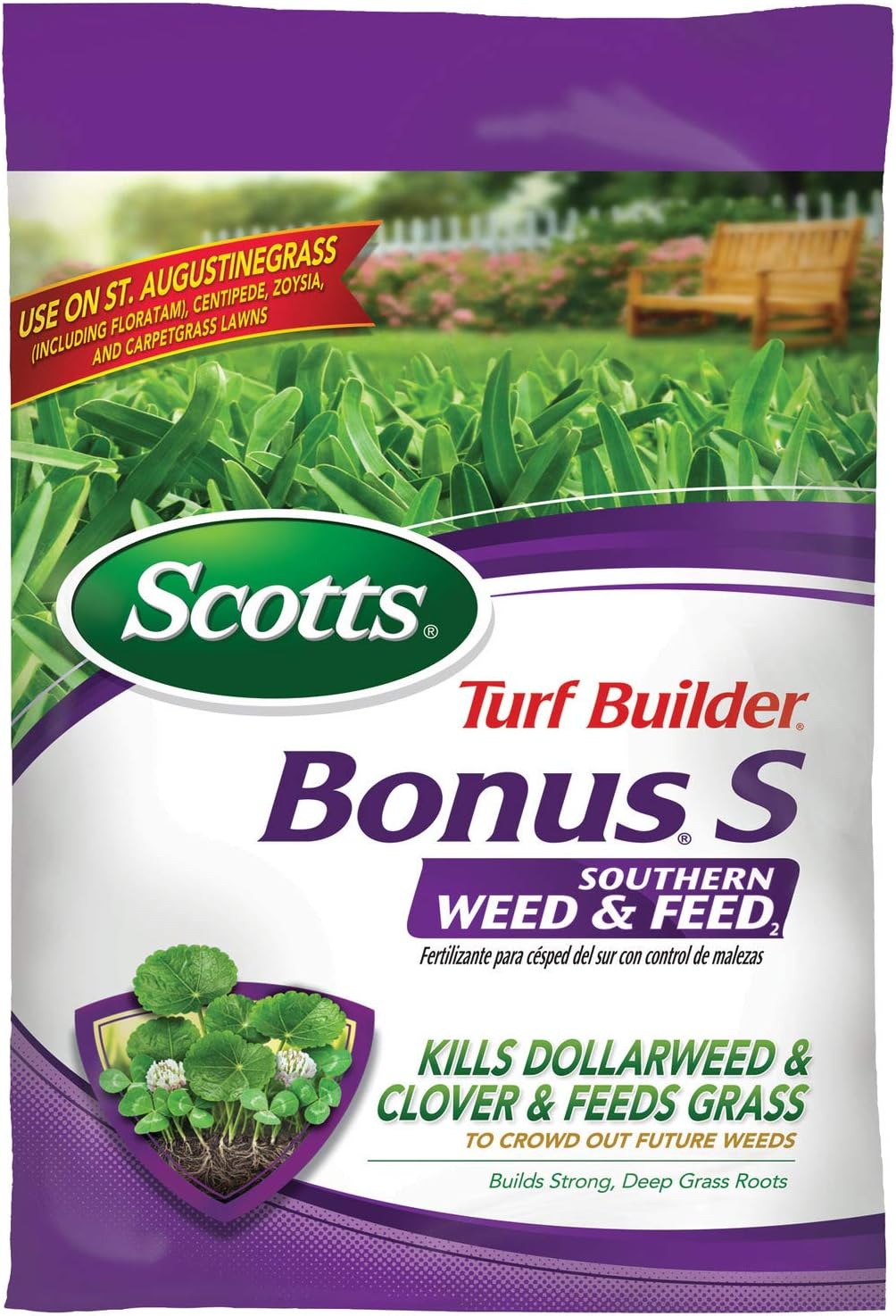
This Scotts Turf Builder Bonus S Southern Weed & Feed2 is a granular weed-and-feed designed specifically for southern turf varieties. It combines a weedkiller that targets 25+ common southern lawn weeds with a fertilizer intended to feed grass and promote deeper roots. Typical use is a late-spring or active-growing-season application to St. Augustine, Centipede, Zoysia, or Carpetgrass on a dry lawn, applied with a broadcast or drop spreader and watered in immediately. Notable features include coverage for up to 8,000 sq ft per 27.59 lb bag and explicit spreader settings to help ensure even application. In practice it can simplify seasonal lawn care by treating weeds and feeding in one step, helping grass fill in as weeds die off. Important limitations are the narrow grass compatibility—do not use on Bermudagrass—and safety precautions due to the atrazine-containing herbicide, so follow label directions and keep people and pets off treated areas until safe. It is intended for twice-yearly use when soil temperatures are appropriate and grass is actively growing.
Best for: Buyers who prioritize a dependable, one-step seasonal treatment for southern lawns and want clear application guidance to get consistent results.
Less Ideal for: Homeowners with Bermudagrass, people seeking organic or non-chemical weed control, or those who need year-round treatment options.
- Targets 25+ common southern broadleaf weeds while supplying fertilizer in the same application
- Formulated for southern grasses including St. Augustine, Centipede, Zoysia, and Carpetgrass
- One bag covers up to 8,000 sq ft, reducing trips to buy multiple bags
- Provides clear application instructions and spreader settings for even coverage
- Contains atrazine so it has safety and environmental restrictions and requires careful handling and adherence to label
- Not safe for Bermudagrass or lawns in winter dormancy
Verdict: A reliable, single-bag weed-and-feed made for southern grasses that simplifies seasonal weed control and feeding for an 8,000 sq ft lawn.
GreenView Weed & Feed Lawn Fertilizer, 39 lb (Covers 15,000 sq ft)

| NPK | 27-0-4 |
|---|---|
| Form | Granule |
| Coverage | 15000 sq ft |
| Active Ingredient | Nitrogen |
| Unit Count | 624 Ounce |
GreenView Weed & Feed is a single-application granular product that combines a slow-release nitrogen fertilizer with a broadleaf herbicide to feed turf and control common lawn weeds. It is typically applied to established lawns when weeds are actively growing, using the recommended rate and watering in afterward; the bag covers up to 15,000 square feet at the stated application rate. Notable features include MESA controlled-release nitrogen for up to eight weeks of steady feeding and labeled control of over 250 weeds such as dandelion and clover. Practical benefits are faster, uniform green-up without a surge of growth, improved root development for heat and drought tolerance, and convenience from a combined weed-control plus fertilizer approach. Important limitations are that it is intended only for established turf and specific grass species, requires careful timing (do not mow two days before or after application) and is not suitable for some grasses like dichondra or certain St. Augustine varieties in Florida, so checking the label for species compatibility is essential.
Best for: A cautious buyer who values proven results and wants a convenient, evidence-backed product to maintain and improve established warm- or cool-season lawns while reducing application frequency.
Less Ideal for: Do not choose this if you are overseeding, establishing a new lawn, or managing grass types listed as incompatible such as certain Floratam St. Augustine selections or non-turf groundcovers.
- Combines fertilizer and herbicide so you treat weeds while feeding in one application
- MESA controlled-release nitrogen provides up to 8 weeks of steady feeding
- Labeled to control over 250 common broadleaf lawn weeds
- Large 39 lb bag covers up to 15,000 sq ft at the recommended rate
- Formulation is for established turf only and can harm non-listed species
- Requires precise timing and watering instructions to work effectively
Verdict: Choose this if you want a single, proven weed-and-feed product that delivers steady feeding and broadleaf weed control across common established turf.
Ferti-lome St. Augustine Weed & Feed 15-0-4 (25.6 lb)

| Item Form | Granules |
|---|---|
| Specific Uses For Product | Lawns (Centipede, Zoysia, St. Augustine) |
| Coverage | 5,000 sq. ft. |
| Mixing Ratio | 15-0-4 |
This granulated weed-and-feed combines a 15-0-4 fertilizer with atrazine-based weed control aimed at warm-season lawns such as St. Augustine, Centipede, and Zoysia. Apply it with a broadcast spreader in early spring or as directed on the label to treat up to about 5,000 sq ft per bag; the fertilizer component feeds turf while the active ingredient prevents and knocks back many broadleaf and grassy weeds. The product is convenient for homeowners who want a two-in-one seasonal treatment rather than separate fertilizer and herbicide steps, and the granular form is easy to store and apply. Important limitations include that it is not labeled for Bermuda or northern grasses and contains atrazine, so follow label restrictions and local regulations; timing and even spreading matter for effectiveness. For cautious buyers who prioritize predictable seasonal weed control on labeled grass types, this provides a straightforward, familiar option with clear coverage guidance.
Best for: Homeowners with St. Augustine, Centipede, or Zoysia lawns who want a single seasonal product to both fertilize and control common weeds and who prefer clear label instructions and predictable results.
Less Ideal for: People maintaining Bermuda or cool-season lawns or gardeners who need an organic or atrazine-free weed control approach.
- Combined fertilizer and herbicide saves time by addressing nutrition and many common weeds in one application
- Formulated specifically for St. Augustine, Centipede, and Zoysia turf types to reduce risk of grass damage when used as directed
- Granular form provides predictable coverage for up to 5,000 sq ft per bag
- Contains both pre-emergent and post-emergent activity for season-long weed defense
- Contains atrazine which is restricted in some areas and requires following label precautions
- Not suitable for Bermuda or cool-season/northern grasses
Verdict: An easy, single-application weed-and-feed tailored to St. Augustine and similar warm-season lawns for dependable seasonal fertilizing and weed control.
Choosing the Right Weed and Feed for St. Augustine Grass: Key Factors to Consider
Turf Safety and Herbicide Compatibility
St. Augustine grass is more sensitive to certain herbicide chemistries than many cool-season or other warm-season grasses. Choosing a weed and feed that lists St. Augustine explicitly on the label or uses herbicides with a demonstrated safety record reduces the chance of scorch, yellowing, or stand thinning.
Read label warnings about drought, cold, and recent renovation. Timing matters because stressed grass is more likely to show damage. When in doubt, test a small area or choose a fertilizer-only application until conditions are ideal.
Weed Spectrum and Targeted Control
Identify the dominant weeds in your lawn before selecting a product. Many weed and feed formulas target broadleaf weeds such as clover, dandelion, chickweed, and plantain, but not all formulations handle difficult perennial weeds or grassy weeds well.
If grassy weeds or nutsedge are a primary concern, you may need a separate spot treatment. Conversely, if your lawn is mainly battling broadleaf invaders, choose a product specifying those targets for more predictable results.
Fertilizer Analysis and Release Timing
Fertilizer labels list three numbers that tell you nitrogen, phosphorus, and potassium percentages. For St. Augustine, a balanced nitrogen application that avoids excessive soluble nitrogen helps encourage steady growth without forcing weak, disease-prone blades.
Consider slow-release versus quick-release nitrogen. Slow-release provides longer feeding with less risk of rapid top growth that increases mowing and stress. Think about your seasonal schedule: spring and early summer feeds can aid recovery and density, while late-fall applications should be gentler.
Application Timing and Weather Considerations
Timing applications for active weed growth and healthy turf conditions maximizes efficacy and safety. Most weed and feed products are most effective when weeds are actively growing and not stressed by drought or heat.
Avoid applying before heavy rain that could wash granules off or when temperatures are above the label's recommended maximum. For St. Augustine grass, follow label guidance about minimum soil temperatures and avoid applications when the lawn is actively stressed from cold or dry spells.
Spreader Calibration and Coverage
Even coverage is essential for predictable results and to avoid hotspots that can scorch turf. Calibrate your broadcast or rotary spreader to match the product label rate, and overlap passes in a controlled pattern to maintain uniform distribution.
Pay attention to granule size and flow characteristics; some mixes clump in humid conditions and may require agitation or a different spreader setting. Accurate measuring and consistent walking speed reduce the risk of under- or over-application.
Label Restrictions, Safety, and Environmental Notes
Always read and follow the product label for personal protective equipment, reentry intervals, and watering restrictions. Labels also include environmental precautions about runoff and buffer zones near water features.
If you have pollinators or desirable flowering plants near the lawn, check the label for pollinator guidance and avoid drift onto ornamental beds. Proper storage and disposal instructions protect people and pets and reduce environmental impact.
When to Apply Weed and Feed on St. Augustine
Apply weed and feed when St. Augustine is actively growing and weeds are young and green. In most warm climates this means late spring through early summer for the primary application window, with a potential second application in mid-summer if the label allows.
Avoid treatment during extreme heat, drought, or when the lawn is recovering from recent renovation. If rain is expected within 24 hours, delay application to prevent granule displacement. Follow label guidance on the minimum number of days after irrigation before mowing or watering.
- Target active weed growth stages for best control
- Skip applications during drought or heat stress
- Wait for calm weather to reduce drift and wash-off
Spot Treatments and Integrated Approaches
Weed and feed works well as a baseline treatment for widespread broadleaf pressure, but it is not always the best tool for isolated patches or grassy weeds. Use targeted spot herbicides for tough perennials or localized infestations to limit overall chemical use.
Combine cultural practices such as core aeration, overseeding in compatible seasons, and proper mowing height to reduce weed reinvasion. Dense, healthy St. Augustine turf tolerates fewer weeds and reduces the need for repeated chemical interventions.
- Use spot treatments for isolated problem areas
- Improve lawn health culturally to suppress weeds long-term
- Rotate modes of action on repeated herbicide use to reduce resistance risk
Watering and Mowing After Application
Follow label directions for post-application watering. Some formulations require a light irrigation to activate herbicides, while others specify waiting to water for a set period. Correct timing ensures herbicide uptake by weeds and helps the fertilizer reach roots.
Delay mowing for the label-recommended interval to avoid removing treated leaf tissue before the herbicide translocates. Mowing height for St. Augustine should be maintained at the recommended range to promote shade over the soil and crowd out young weeds.
- Check label instructions for irrigation timing
- Avoid mowing too soon after application
- Maintain appropriate mowing height for St. Augustine
Safety Tips for Pets and Children
Keep pets and children off treated areas for the reentry time listed on the label. Store products securely and out of reach, and clean spreaders after use to prevent cross-contamination with other lawn or garden treatments.
If accidental exposure occurs, follow first-aid instructions on the label and contact poison control or a medical professional if symptoms develop. Use gloves and eye protection when handling granular formulations to avoid skin or eye irritation.
- Observe label reentry intervals for health safety
- Store products in a cool, dry place away from living areas
- Rinse equipment thoroughly after application
Managing Expectations and Follow-up Care
Weed and feed helps reduce broadleaf competition but rarely eliminates deep-rooted perennials in a single application. Plan follow-up monitoring and spot treatments where weeds persist. Expect some weeds to require multiple tactics over the season.
Prioritize recovery by overseeding or plugging thin areas, adjusting irrigation to encourage deep roots, and using appropriate fertilization timing. A consistent maintenance rhythm reduces the need for repeated chemical controls.
- Monitor treated areas and retreat selectively if needed
- Reinforce turf density through cultural practices
- Accept that some persistent weeds need repeated attention
How We Chose the Best Weed and Feed for St. Augustine Grass
We focused on formulations and attributes that matter for St. Augustine lawns. Primary evaluation criteria included turf safety with St. Augustine grass, the herbicide spectrum against common broadleaf weeds found in warm-season lawns, and the fertilizer analysis and release profile to promote recovery and sustained growth. We also assessed application flexibility, including recommended timing windows and spreader calibration guidance, plus any label precautions related to temperature, drought stress, or overseeding. Products were excluded if their labels explicitly warned against use on St. Augustine grass or if active ingredients are known to commonly injure this species. We omitted granular mixes lacking clear herbicide-fertilizer balance or those without labeled rates for home lawn applications. The goal was to surface options that offer measurable weed control while minimizing turf injury risk and giving clear, usable application instructions for homeowners and landscape pros alike.
FAQ
Is weed and feed safe to use on St. Augustine grass?
It depends on the formulation. Choose products labeled for St. Augustine grass and follow timing and temperature guidance. Avoid application when the lawn is stressed to reduce the risk of injury.
How often can I apply weed and feed to a St. Augustine lawn?
Follow the label, which typically limits the number of applications per year. Many programs recommend one or two targeted applications during active growth, supplemented by spot treatments when necessary.
Will weed and feed control nutsedge or grassy weeds in St. Augustine?
Most broadleaf-targeted weed and feed products are not effective against nutsedge or grassy weeds. Use a product or spot treatment specifically labeled for those species if they are a problem.
Can I water immediately after spreading granular weed and feed?
Label instructions vary. Some granular formulas recommend light irrigation to activate herbicide, while others advise waiting. Check the product label to determine the correct post-application watering interval.
What mowing height should I maintain after applying weed and feed?
Maintain the recommended mowing height for St. Augustine, typically on the higher side for this species. Delay mowing for the interval specified on the label to allow herbicide translocation.
Are there environmental precautions I should take when using weed and feed?
Yes. Avoid application before heavy rain to prevent runoff, keep granules out of storm drains, and respect buffer zones near water bodies. Read label guidance on pollinator exposure and avoid drifting onto flowering plants.
Final Verdict
Prioritize turf safety and the herbicide spectrum when selecting a weed and feed for St. Augustine grass. Choosing a product labeled for this grass and timing applications for active growth reduces injury risk and improves weed suppression. Combine chemical control with cultural practices such as proper mowing height, watering, and overseeding to build a dense stand that resists weeds. Use spot treatments for stubborn or grassy weeds and follow label limits on frequency to keep your lawn healthy over the long term.
