

Note: This article contains affiliate links. If you click on these links and make a purchase, I may earn a small commission at no extra cost to you. This helps support my research and content. Read my full affiliate disclosure here.
When clover and creeping charlie invade turf or garden beds they compete for nutrients, spread rapidly, and create uneven patches. Picking the right weed killer for clover and creeping charlie matters because some products damage desired grasses or ornamentals while others simply suppress regrowth temporarily. This guide walks you through seven shortlisted options chosen for their ability to target these broadleaf weeds, reduce reseeding, and limit harm to surrounding plants when used correctly. We evaluate selectivity, persistence in the soil, application ease, and safety considerations so you can match a product to your lawn type and treatment schedule.
Top Picks at a Glance
| Best Overall The best all-around choice for most situations | Bonide Chickweed, Clover & Oxalis Killer Ready-to-Use Spray, 128 oz |  |
| Best Quality Built to a higher standard if you want something more solid | Albaugh Sublime Selective Weed Killer, 1 Quart |  |
| Best Value The sweet spot between price and what you get | Ortho WeedClear Ready-To-Spray Lawn Weed Killer, 32 fl. oz. |  |
| Best Budget The cheapest option that still gets the job done reliably | Spectracide Weed Stop for Lawns Plus Crabgrass Killer, Ready-to-Use, 1 Gal |  |
| Highest Rated A top-rated pick with lots of positive feedback | T-Zone Turf Herbicide (1 Quart) by PBI Gordon |  |
| Most Popular A crowd favorite that many people choose with confidence | Ortho Chickweed, Clover & Oxalis Killer for Lawns Concentrate, 16 fl. oz. |  |
| Best Seller A high-volume bestseller chosen again and again | Roundup Weed & Grass Killer with Comfort Wand, 1.33 gal. |  |
Bonide Chickweed, Clover & Oxalis Killer Ready-to-Use Spray, 128 oz

| Item Form | Spray |
|---|---|
| Coverage | 10000 square feet |
| Liquid Volume | 128 fluid ounces |
| Active Ingredients | Dicamba, triclopyr |
This 128 oz Bonide ready-to-use spray is a broadleaf herbicide designed for residential turf that claims systemic action to kill weeds down to the roots. It is used by simply shaking and spraying affected broadleaf weeds while they are actively growing and when temperatures are under 90 F. Notable features include a large ready-to-use volume that covers up to 10,000 square feet and active ingredients dicamba and triclopyr, which are effective against many tough weeds and begin working overnight. Practical benefits for a budget-focused gardener are clear: you get a lot of product without mixing concentrates, which saves time and reduces the need for extra equipment. The product is rainproof within hours and labeled to control over 100 broadleaf weeds. Important limitations are that it is selective for broadleaf weeds and will not control grassy weeds, and spray drift can harm nearby flowers or vegetables so careful application on calm days is required. Also, dicamba and triclopyr are potent herbicides, so follow label precautions for safety and turf compatibility.
Best for: Savvy home lawn owners who want an affordable, large-volume ready-to-use herbicide to tackle broadleaf weeds across a lawn without mixing concentrates.
Less Ideal for: Gardeners needing a product targeted specifically at grassy weeds or those who must treat areas immediately adjacent to vegetables and ornamentals where drift would be unacceptable.
- Large ready-to-use container covers up to 10,000 square feet without mixing
- Systemic formulation targets roots for longer-term control of broadleaf weeds
- Works on a wide range of broadleaf species and begins acting overnight
- Rainproof within hours so treatments are less likely to be washed away
- Not effective on grassy weeds or non-broadleaf species
- Contains dicamba and triclopyr which can damage nearby desirable plants if it drifts
- Ready-to-use format can be bulky to store and harder to transport than concentrates
Verdict: A cost-effective, large ready-to-use broadleaf herbicide for homeowners who need widespread root-killing control of tough lawn weeds.
Albaugh Sublime Selective Weed Killer, 1 Quart

| Unit Count | 32 Ounce |
|---|---|
| Item Form | Liquid |
| Coverage | 16000 to 32000 square feet |
| Active Ingredients | Triclopyr, Dicamba, Mesotrione |
Albaugh Sublime is a concentrated post-emergent selective herbicide designed for turf use that combines triclopyr, dicamba, and mesotrione to tackle difficult broadleaf weeds and some grassy invaders. You apply it by shaking the bottle, spraying directly on targeted weeds and avoiding desirable turfgrass and direct sunlight; it is intended for large lawns, athletic fields, and institutional turf where broad-spectrum control is needed. The key benefit is its three-way active ingredient blend, which extends the spectrum of weeds controlled and reduces the bleaching symptoms that mesotrione-alone products can cause. Coverage is substantial for a quart-sized product, and directions emphasize keeping people and pets away until treated areas are dry. Important limitations are typical of strong selective herbicides: it can damage desirable turf if misapplied, requires careful timing and application technique, and its active ingredients have environmental and safety considerations that call for protective measures. For gardeners focused on performance, correct mixing and targeted spraying are essential to get the promised control without collateral damage.
Best for: Gardeners and grounds managers who prioritize fast, wide-spectrum control of persistent broadleaf weeds in turf and are comfortable following label directions and safety precautions.
Less Ideal for: Casual gardeners seeking organic or low-toxicity solutions or those with mixed plantings where drift or misapplication could damage desirable ornamentals.
- Broad spectrum control from three active ingredients for tougher broadleaf and some grassy weeds
- Formulated to reduce bleaching symptoms associated with mesotrione alone
- Liquid form allows targeted spot treatment for individual patches
- High labeled coverage for a quart makes it suitable for large lawns and institutional turf
- Contains potent herbicides that can harm non-target plants and require strict safety precautions
- Must not be sprayed on desired turfgrass and needs precise application to avoid damage
- No organic or non-chemical option included
Verdict: Choose Albaugh Sublime when you need high-performance, broad-spectrum post-emergent control of stubborn turf weeds and are prepared to apply it carefully according to the label.
Ortho WeedClear Ready-To-Spray Lawn Weed Killer, 32 fl. oz.

| Item Form | Liquid |
|---|---|
| Coverage | 16000 square_feet |
| Liquid Volume | 32 fluid ounces |
| Active Ingredients | Herbicide |
Ortho WeedClear Ready-To-Spray is a hose-attach liquid herbicide designed to kill common broadleaf lawn weeds, including clover and dandelions, down to the root. You use it by connecting the bottle to a garden hose, switching the sprayer on, and sweeping the spray over affected areas; the formula produces visible results within hours and becomes rainproof about an hour after drying. Notable features include a three-ingredient herbicide blend targeted at turf weeds and a coverage claim that one 32 fl. oz. bottle treats up to 16,000 sq. ft. (Southern lawns) or 8,000 sq. ft. (Northern lawns). The ready-to-use hose connection and fast activity make spot treatments and larger-area applications straightforward for typical homeowners. Limitations to keep in mind are that it targets broadleaf weeds rather than grassy weeds and it must be used when weeds are actively growing for best results, so timing matters. Follow label directions closely to protect desirable grass and to know when people and pets can safely re-enter treated areas.
Best for: Homeowners who want a simple, fast way to remove clover and other broadleaf weeds from established lawns without complex mixing or equipment.
Less Ideal for: People seeking a product to control grassy weeds or those who need season-long residual prevention should consider other specialized products.
- Ready-to-spray hose connection makes application quick and easy for homeowners
- Kills over 250 common broadleaf weeds, including clover and dandelions, down to the root
- Visible results in hours and becomes rainproof about one hour after drying
- One 32 fl. oz. bottle covers a large area (up to 16,000 sq. ft. for Southern lawns)
- Formulation is for broadleaf weeds only and will not control grassy weeds
- Effectiveness depends on applying when weeds are actively growing, so seasonal timing is required
Verdict: Choose this ready-to-spray bottle if you want a fast, easy way to kill clover and other broadleaf weeds in your lawn with minimal prep.
Spectracide Weed Stop for Lawns Plus Crabgrass Killer, Ready-to-Use, 1 Gal

| Item Form | Spray |
|---|---|
| Coverage | Up to 5,000 sq ft |
| Liquid Volume | 1 gallons |
Spectracide Weed Stop for Lawns Plus Crabgrass Killer is a one-gallon, ready-to-use spray formulated to kill a wide range of lawn weeds by contact down to the root. You use it by spraying affected areas after mowing and when daytime temperatures are between 45 and 90 degrees F; the label warns about possible temporary discoloration on Bermudagrass at higher temperatures. Notable features include a no-mix formulation, advertised coverage up to 5,000 square feet, and a contact-action formula that produces visible wilting in about five hours. For clover in lawns this product is effective because it is designed to kill broadleaf weeds without harming turf when applied as directed. Important limitations are that it kills on contact, so complete coverage of foliage is necessary, and timing and temperature restrictions must be followed to avoid lawn stress on certain grass types. Also, as a spray it treats only visible weeds and does not provide residual preemergent control.
Best for: Buyers who want a simple, ready-to-use spray to remove visible clover and other broadleaf weeds quickly without mixing chemicals, and who prefer following label directions to protect their lawn.
Less Ideal for: People seeking long-term prevention of new weed growth or a solution for large commercial turf areas where broadcast application and residual control are needed should consider alternative products.
- Ready-to-use spray requires no mixing and is easy to apply to spot infestations
- Claims visible results in about five hours, so you can confirm effectiveness quickly
- Broad spectrum label lists 470+ weed types including clover and crabgrass
- Advertised coverage up to 5,000 sq ft from the one-gallon container
- Kills by contact so it requires thorough leaf coverage to be effective
- Temperature restrictions and potential temporary yellowing on Bermudagrass limit when it can be used safely
- No residual or preemergent activity so it will not prevent new weed germination
Verdict: A user-friendly, ready-to-use spray that quickly kills clover and other listed broadleaf weeds when applied carefully and at the right temperatures.
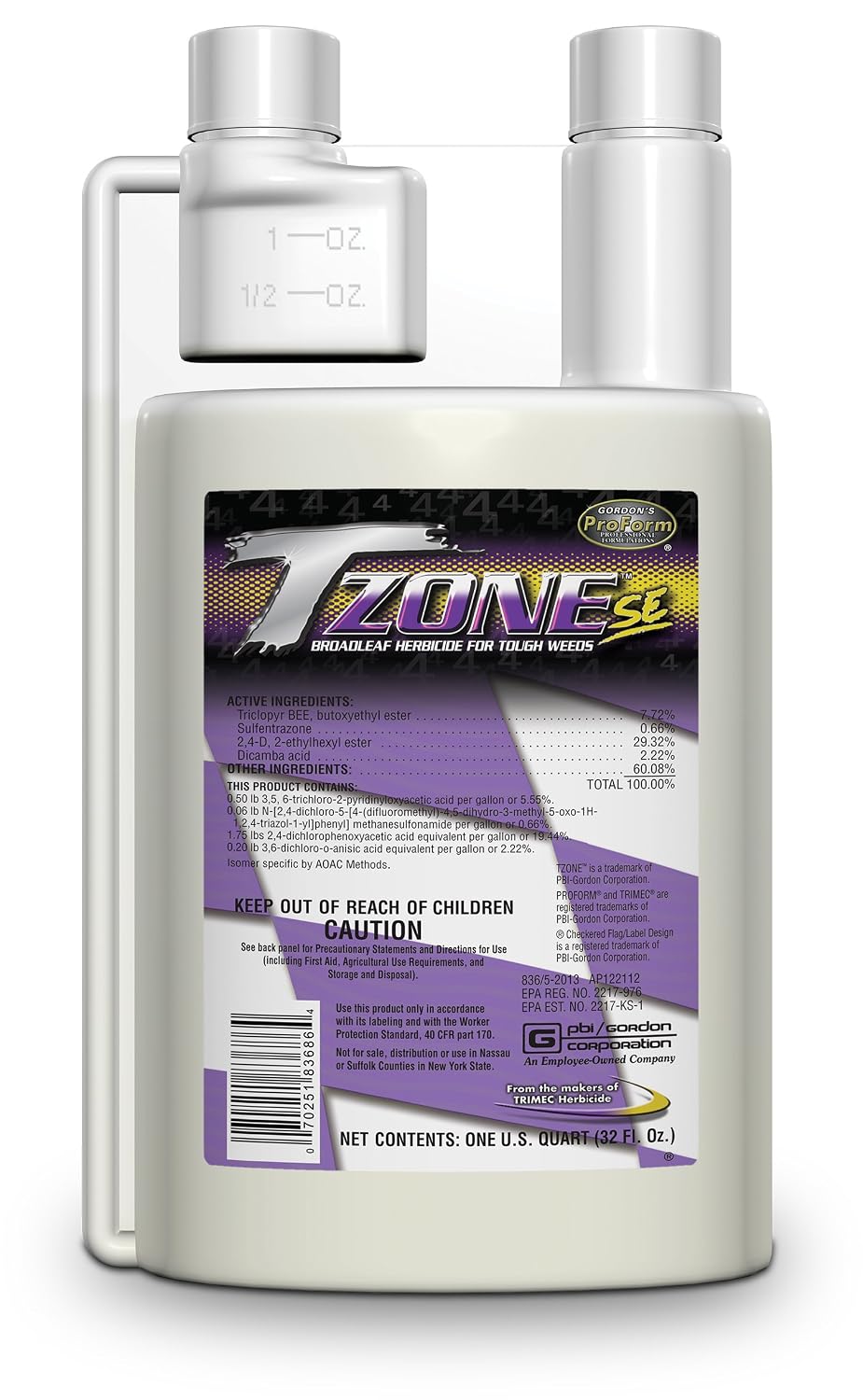
T-Zone Turf Herbicide (1 Quart) by PBI Gordon
| Unit Count | 32 Fluid Ounces |
|---|---|
| Item Form | Liquid |
| Coverage | broad-leaf weeds, grassy weeds |
| Active Ingredients | Dicamba, triclopyr, others |
T-Zone Turf Herbicide is a concentrated liquid formula intended for spot and broadcast treatment of tough broadleaf and grassy weeds in lawns and turf areas. It contains multiple active ingredients including triclopyr and dicamba that give a fast visual response and help suppress difficult targets such as yellow nutsedge and oxalis when used according to label directions. Typical use is mixing to label rates and applying with a handheld sprayer or professional equipment on cool, calm days to avoid off-target movement. Notable features include suitability for residential, commercial, and golf sites and effectiveness at lower temperatures down to about 50°F. Practical benefits are reliable performance on persistent broadleaf weeds and a multi-ingredient formula that reduces the need for repeat applications. Important limitations are the need for protective gear during handling, restrictions and careful timing to prevent damage to desirable plants, and the potential for off‑target drift, so precise application technique is required.
Best for: Buyers who prioritize reliable, professional-strength control of persistent lawn weeds and who are comfortable following label directions and using proper protective equipment. Ideal for property owners or groundskeepers who need a solution that performs in cool weather and on challenging species.
Less Ideal for: Casual gardeners who want an all‑purpose, low‑risk product for mixed plantings or those unwilling to follow pesticide safety practices should consider gentler, selective options.
- Multi‑ingredient formulation targets a broad spectrum of stubborn broadleaf and grassy weeds
- Works in cool conditions (around 50°F) so seasonal timing is more flexible
- Fast visible weed control that can reduce repeat treatments
- Suitable for use on residential, commercial, and golf turf sites
- Contains potent active herbicides that require careful handling and PPE
- Risk of off‑target movement means application must be precise and weather‑aware
Verdict: Choose T-Zone when you need a dependable, professional-strength herbicide to knock back stubborn oxalis and other persistent turf weeds.
Ortho Chickweed, Clover & Oxalis Killer for Lawns Concentrate, 16 fl. oz.

| Item Form | Liquid |
|---|---|
| Coverage | 3,200 sq. ft. |
| Unit Count | 16 Fluid Ounces |
This Ortho concentrate is designed for homeowners who need a targeted post-emergent solution for tough broadleaf lawn weeds including wild violet. You dilute 1 fl. oz. per gallon of water and apply with a tank sprayer or compatible Ortho Dial 'N Spray; one 16 fl. oz. bottle treats up to 3,200 sq. ft. The formula is rainproof in six hours and is labeled safe for common cool-season grasses such as fescue, Kentucky bluegrass, ryegrass and zoysia when used exactly as directed. Practical advantages include focused control of creeping charlie and wild violet without killing turfgrass listed on the label, and straightforward mixing instructions for DIY lawn care. Important limitations are the host-range restrictions and temperature limit—do not use on Bahiagrass, bermudagrass, centipedegrass, kikuyugrass or St. Augustinegrass and do not apply above 90°F. As with any herbicide, careful calibration of your sprayer and strict adherence to label directions are required to avoid damage to non-target plants and to get consistent results on persistent patches of wild violet.
Best for: Homeowners who want a reliable, label-backed herbicide to remove wild violets and other broadleaf weeds from cool-season or listed lawns while minimizing risk to turf when used correctly.
Less Ideal for: Gardeners with warm-season lawns such as bermudagrass or St. Augustinegrass, or those unwilling to mix and apply a concentrate should consider alternative products or professional help.
- Targets a broad list of tough lawn broadleaf weeds including wild violet and creeping charlie.
- Concentrated liquid mixes for use in tank sprayers and treats up to 3,200 sq. ft. per bottle.
- Rainproof in about six hours so treatments are less likely to be washed away by light rain.
- Label explicitly lists compatible turfgrass types, reducing risk when used as directed.
- Not labeled for use on several warm-season turfgrasses so it can harm those lawns.
- Requires dilution and proper sprayer calibration which adds a step vs ready-to-use products.
Verdict: A concentrated, homeowner-friendly broadleaf herbicide that reliably targets wild violet and similar lawn weeds when diluted and used on labeled turfgrass.
Roundup Weed & Grass Killer with Comfort Wand, 1.33 gal.

| Item Form | Liquid |
|---|---|
| Coverage | 400 sq. ft. |
| Liquid Volume | 1.33 gallons |
This Roundup package pairs a 1.33 gallon liquid formulation with a Comfort Wand for easier spraying around beds, walkways, and foundations. It is formulated to kill common broadleaf weeds and grasses down to the root, with visible wilting in hours and rainfast protection in about 30 minutes, so treated areas are less likely to wash away after a brief rain. The wand offers one-touch continuous spray, which reduces hand fatigue during spot treatments and makes edging and targeted applications simpler than using a separate sprayer. Coverage is listed at about 400 sq. ft., appropriate for small yards, beds, or multiple spot-treatment sessions. Important limitations are that this is a nonselective herbicide so it will damage desirable plants if contacted and the product directions include replanting wait times of 1 to 30 days depending on use. Users should follow label precautions about keeping people and pets away until spray has dried and applying only in calm conditions to avoid drift.
Best for: Buyers who want a straightforward, ready-to-use herbicide for targeted spot treatments and edging where quick, reliable weed control is the priority and minimizing application fuss matters.
Less Ideal for: Large properties or users who need selective lawn-safe control should consider professional application methods or products formulated specifically for turf.
- Fast visible results in hours and rainproof in as fast as 30 minutes
- Comfort Wand with one-touch continuous spray reduces hand fatigue and improves targeting
- Kills a wide range of broadleaf weeds and grasses to the root
- Ready-to-use liquid requires no mixing and covers up to 400 sq. ft.
- Nonselective formula will damage desirable plants if contacted
- Container and wand limit treatment area per refill compared with larger tank sprayers
Verdict: A convenient, ready-to-use herbicide with a Comfort Wand that delivers fast, reliable spot control of broadleaf weeds and grasses for homeowners who want an easy, low-fuss solution.
Choosing the Right Weed Killer for Clover and Creeping Charlie: Key Factors to Consider
Active Ingredient and Mode of Action
Knowing the active ingredient is central to predictable control. Different chemistries target biochemical pathways in broadleaf plants and vary in speed and completeness of kill. A systemic active ingredient moves inside the weed to reach roots and underground stems, which helps control creeping species that spread by stolons or roots. Contact-only actives will brown foliage fast but often fail to stop regrowth from crowns or root fragments.
Matching mode of action to the weed's growth habit reduces repeat treatments. For creeping charlie, which has creeping stems and deep-rooted crowns, systemic options that translocate to root structures are generally more effective. Read product labels to confirm which weeds are listed and whether multiple modes of action are combined to reduce the chance of resistance.
Selectivity and Risk to Desired Plants
Selectivity determines whether a product kills the target weeds while leaving turf grasses and ornamentals intact. Some herbicides are formulated to spare common lawn grasses but will injure many garden flowers or vegetables. Knowing your lawn type and any nearby desirable plants informs safe choices.
Application technique also influences selectivity. Spot-treating reduces exposure to surrounding plants, while broadcast applications require careful timing and label adherence to avoid damage. Always check labeled turf types and ornamental safety listings before treating mixed landscapes.
Persistence and Environmental Impact
Residual activity can be a double-edged sword. Longer soil persistence helps prevent re-establishment from seed or root fragments but increases the risk of off-target movement through runoff or leaching. Short-residual products may require repeated applications but lower long-term soil loading.
Consider local weather and irrigation patterns because heavy rain soon after application can move active ingredients off-target. In settings near water bodies or pollinator habitat, favor options with lower mobility and clear instructions to protect non-target organisms.
Timing and Application Conditions
Effective control depends on applying at the right time in the weed's growth cycle. Many broadleaf weeds absorb foliar-applied herbicides most readily during active growth in spring and fall. Applying during drought, extreme heat, or when weeds are dormant reduces uptake and efficacy.
Follow label guidance on optimal temperatures, recent mowing, and irrigation timing. Some treatments require the foliage to be dry and not recently treated with surfactants or fertilizers. Proper timing reduces wasted product and the need for follow-up treatments.
Formulation and Ease of Use
Herbicides come as concentrates, ready-to-use sprays, granules, or wipes. Concentrates typically offer lower per-unit cost and flexibility but need accurate measuring and mixing. Ready-to-use sprays are convenient for spot control. Granules can simplify broadcast applications on lawns but may be less effective on dense groundcovers unless watered in properly.
Choose a formulation that matches the treated area size and your comfort with mixing chemicals. Consider whether you need a sprayer that produces fine droplets for foliar contact or a spreader for granular options. Practical ease affects treatment consistency and overall success.
Safety, Handling, and Re-entry
Herbicide labels include safety directions for mixing, personal protective equipment, re-entry intervals, and pet access. Some effective chemistries have longer re-entry or grazing restrictions and specific buffer requirements near water. Others have minimal restrictions and are better for gardens where children or pets frequent the area.
Evaluate the tradeoffs between stronger chemistry and additional handling precautions. For high-traffic yards or edible gardens, prioritize products with clear, manageable safety instructions and short re-entry times.
When To Treat Clover And Creeping Charlie
Treat during active growth when plants are producing new leaves and roots. For many climates that means spring and fall windows when temperatures are moderate and soil moisture is available. Treatments applied during these periods are more likely to be translocated to root structures and reduce regrowth.
Avoid treating during drought stress or extreme heat because uptake is reduced. If you recently fertilized heavily, wait until new growth has hardened off since lush, rapidly growing plants can sometimes dilute herbicide concentrations and reduce effectiveness.
- Spring or fall applications typically work best
- Avoid treatment during drought or heat waves
- Do not apply immediately after heavy rainfall
Spot Treatment Versus Broadcast Applications
Decide between spot treatment and broadcast application based on infestation size and proximity to desirable plants. Small patchy outbreaks are usually best handled with targeted sprays to limit collateral damage and chemical use. Broadcast treatments are appropriate for widespread lawn infestations but require careful adherence to label rates and turf compatibility.
For spot treatments, use a wand or hand sprayer with a coarse nozzle to reduce drift. For broadcast work, calibrate spreaders and sprayers so you apply consistent doses across the entire area to avoid streaking and uneven control.
- Spot treatment reduces exposure to ornamentals
- Broadcast requires strict adherence to labeled rates
- Use coarse droplets to limit drift
Combining Cultural Controls With Chemical Options
Cultural practices strengthen desired turf and reduce weed pressure over time. Improve soil fertility and pH where needed, overseed thin areas to close canopy space, and maintain appropriate mowing height to shade out creeping groundcovers. Healthy, dense turf is the first line of defense against recurring clover and creeping charlie.
Chemical control is most effective when paired with cultural fixes. Use herbicide treatments to knock back large infestations, then follow up with overseeding, targeted fertilization, and proper irrigation to prevent reinvasion.
- Overseed thin patches after control to prevent re-establishment
- Adjust soil pH and fertility to support grasses over weeds
- Maintain mowing height that favors turf species
Safe Use Around Pollinators And Edibles
Many lawns and beds attract pollinators. Avoid spraying flowering plants and follow label restrictions regarding application near pollinator-attractive plants. If treating near vegetable gardens, observe any specified withholding periods before harvesting and avoid drift onto edible foliage.
When in doubt, perform spot treatments with shields or apply products after flowering periods to reduce pollinator exposure. Consider non-chemical removal in small beds where pollinator activity is high.
- Do not spray flowering plants
- Observe harvest withholding intervals for edibles
- Use drift control measures near pollinator areas
Monitoring Results And Planning Follow-up
Expect to monitor treated areas for several weeks. Systemic control of creeping weeds often shows slow decline as translocation takes effect and root systems die back. Record application dates, weather conditions, and observed results to refine future treatments.
If regrowth occurs, wait the recommended interval before reapplying. Multiple light treatments timed during active growth can be more effective and safer for turf than a single heavy application.
- Keep treatment records to improve timing
- Allow label-specified intervals before reapplication
- Combine follow-up cultural care to reduce recurrence
How We Chose the Best Weed Killer for Clover and Creeping Charlie
We focused on products that are specifically labeled for clover and creeping charlie control or that include active ingredients known to be effective against broadleaf groundcovers. Selection criteria emphasized selectivity to avoid undue harm to cool- and warm-season turf grasses and common ornamentals. Persistence and residual activity were important because short-lived contact burns often lead to quick regrowth, while excessive soil persistence raises reuse and runoff concerns. Ease of application and formulation variety mattered for gardeners who treat large lawns, small patches, or mixed beds. Safety and restrictions were considered, including re-entry intervals, pet and child precautions, and limits around pollinator-attractive plants. We excluded products without clear labeling for these weeds, unregistered formulations, and home remedies lacking consistent efficacy data. The final shortlist balances targeted effectiveness, manageable persistence, user safety, and practical application options.
FAQ
Will a general-purpose lawn herbicide kill clover and creeping charlie?
Many general-purpose broadleaf herbicides will suppress these weeds, but effectiveness depends on the active ingredient and selectivity to your turf. Some products brown foliage quickly but do not move into roots, resulting in regrowth. Check labels for specific listings and recommended application timing.
Can I treat clover and creeping charlie without harming my grass?
You can reduce grass injury by choosing selective formulations labeled for your lawn type and by using spot treatments. Timing during active weed growth and avoiding applications in stressful conditions also improves selectivity. Always follow label directions for turf compatibility.
How long before I see results after applying a weed killer?
Contact herbicides may show foliage damage within days, while systemic products can take one to several weeks as translocation occurs and roots die. Full control of creeping species often requires monitoring and possibly a follow-up treatment during the next active growth window.
Is it safe to apply these herbicides around children and pets?
Safety varies by product. Labels specify re-entry times and precautions for children and pets. For high-traffic yards, choose options with shorter re-entry intervals and follow label instructions about drying times and any necessary barriers to access.
Will repeated use of the same herbicide cause resistance?
Repeated use of a single mode of action can increase resistance risk. Rotate chemistries and combine chemical control with cultural practices to reduce selection pressure. Using different active ingredients over seasons helps maintain long-term effectiveness.
Can I overseed immediately after applying a weed killer?
Timing depends on the product. Some residual herbicides require waiting periods before introducing new seed to avoid germination issues. Follow label guidance on reseeding intervals to ensure new grass establishes without injury.
Final Verdict
Focus on matching active ingredient and formulation to the infestation size and the plants you want to protect. Prioritize selective, systemic options for creeping groundcovers and combine treatments with good cultural practices like overseeding and proper mowing to reduce recurrence. Balance persistence and environmental safety based on nearby pollinators, edibles, and water features. With careful timing, application technique, and follow-up care, you can regain turf and bed health while minimizing off-target effects.
