

Note: This article contains affiliate links. If you click on these links and make a purchase, I may earn a small commission at no extra cost to you. This helps support my research and content. Read my full affiliate disclosure here.
If you manage patios, walkways, driveways, or other paved areas, weeds in concrete cracks are a persistent nuisance that can damage surfaces and spoil curb appeal. Picking the right weed killer for concrete cracks matters because treatments face tight spaces, variable sun exposure, and visible surfaces where residues and runoff are concerns. This guide covers our shortlisted top picks tailored for concrete gaps and similar hardscape uses and explains the traits that make them effective. We evaluate each option for how well it kills roots, how long it prevents regrowth, and how simple and safe it is to apply in narrow cracks. Read on for practical guidance before the product list.
Top Picks at a Glance
| Best Overall The best all-around choice for most situations | Spruce Snap & Spray Weed & Grass Killer Powered Starter Kit, 64 oz |  |
| Best Quality Built to a higher standard if you want something more solid | Ortho GroundClear Weed & Grass Killer with Comfort Wand, 1 gal. |  |
| Best Value The sweet spot between price and what you get | Spruce 64 oz Snap & Spray Weed and Grass Killer Refill |  |
| Best Budget The cheapest option that still gets the job done reliably | Spectracide Weed & Grass Foaming Edger Aerosol, 17 oz |  |
| Highest Rated A top-rated pick with lots of positive feedback | Roundup Pro Weed Killer 2.5 Gallon |  |
| Most Popular A crowd favorite that many people choose with confidence | Spectracide Weed & Grass Killer with AccuShot Sprayer, 1.33 gal |  |
| Best Seller A high-volume bestseller chosen again and again | Roundup Weed & Grass Killer4 Refill, 1.25 gal. |  |
Spruce Snap & Spray Weed & Grass Killer Powered Starter Kit, 64 oz

| Unit Count | 64 Fluid Ounces |
|---|---|
| Coverage | 1 bottle treats up to 400 weeds |
| Item Form | Spray |
| Active Ingredients | Sodium Lauryl Sulfate, Geraniol, Cornmint Oil |
The Spruce Snap & Spray Starter Kit combines a 64 oz ready-to-use herbicide with a reusable powered wand for precise, no-mix spot treatment of weeds and grass. It is formulated from water, essential oils and a surfactant and works on contact to dehydrate plant tissue, with visible leaf darkening or wilting within an hour and complete kill often by 24 hours. Typical use is on driveways, pavers, sidewalks, mulch beds and garden edges where you aim the wand about 12 inches from the plant and spray until the foliage is thoroughly wet. The powered wand and EZ-AIM options make it easier to hit cracks and narrow edges without bending or over-spraying nearby plants. Practical benefits include quick results, a refillable sprayer to reduce mess, and a formula marketed as safe around people and pets when used as directed. Limitations to note are that it is for spot treatment rather than large-area lawn control, it requires 60°F+ and dry weather for best results, and repeated applications may be needed for persistent or deeply rooted weeds.
Best for: Buyers who need a convenient, targeted solution for weeds in concrete cracks, pavers and landscape edges and who value fast visible results and an easy-to-aim sprayer.
Less Ideal for: Gardeners who want broad lawn herbicide coverage or long-term residual weed control across large turf areas should choose a different product.
- Ready-to-use 64 oz formula for fast spot treatments without mixing
- Reusable powered wand and EZ-AIM options for precise spraying in cracks and edges
- Visible results within an hour and full plant death often by 24 hours
- Formulated with essential oils and surfactant and labeled safe around people and pets when used as directed
- Not intended for broadcast lawn treatment or large acreage control
- Performance depends on applying in warm, dry conditions and may require reapplication on stubborn weeds
- Contains active ingredients that require following safety directions and keeping off desirable plants
Verdict: A practical, ready-to-use spray kit with a precision wand that makes fast, targeted weed control in concrete cracks and hardscape edges straightforward and low-mess.
Ortho GroundClear Weed & Grass Killer with Comfort Wand, 1 gal.

| Item Form | Spray |
|---|---|
| Coverage | 5120 square feet |
| Liquid Volume | 128 fluid ounces |
| Active Ingredients | Ammonium Nonanoate |
Ortho GroundClear is a one-gallon ready-to-use weed and grass killer designed for spot treatment on hard surfaces like concrete cracks, patios, and driveways. You apply it with the included Comfort Wand to directly target weeds such as dandelions, crabgrass, chickweed and moss; the spray absorbs on contact and shows visible browning in as little as 15 minutes. The formula becomes rainproof about two hours after drying so treated cracks are less vulnerable to runoff shortly after application. Because it is OMRI listed, it is positioned for organic-compatible use in landscapes. Practical benefits include a large coverage claim and an ergonomic wand that helps reach low, narrow cracks without bending over constantly. Important limitations are that perennial or well-established roots may need repeat applications and you must avoid contact with desirable plants because it kills on contact. Follow safety directions to keep children and pets away until surfaces are dry.
Best for: Homeowners who need a fast, easy way to clear weeds growing out of concrete cracks and other hardscapes and who prioritize quick visible results and straightforward application.
Less Ideal for: Gardeners who need selective control within planted beds or those who require systemic long-term control of deep perennial roots should consider alternative products or professional services.
- Ready-to-use spray with included wand for precise spot treatment
- Fast visible results in about 15 minutes on susceptible weeds
- Becomes rainproof roughly two hours after drying to protect treatment
- OMRI listed for compatibility with organic production practices
- May require multiple applications on perennial or deeply rooted weeds
- Not selective so it will damage or kill desirable plants on contact
Verdict: If you want a fast, no-mix spray for targeted weed control in concrete cracks and hardscapes, this ready-to-use Ortho product delivers quick visible results with a convenient wand.
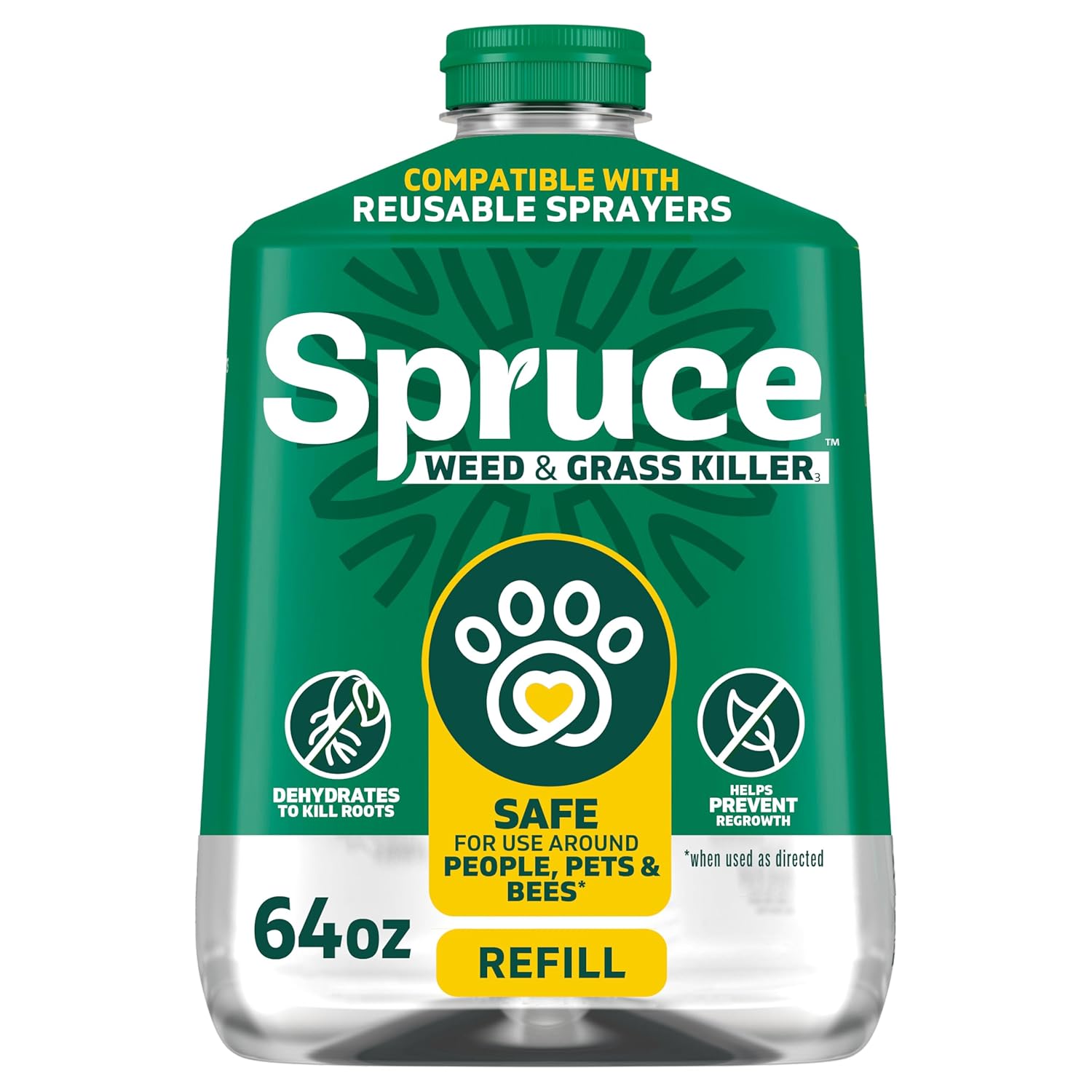
Spruce 64 oz Snap & Spray Weed and Grass Killer Refill
| Unit Count | 64 Fluid Ounces |
|---|---|
| Coverage | 1 bottle treats up to 400 weeds |
| Item Form | Spray |
| Active Ingredients | Sodium Lauryl Sulfate, Geraniol, Cornmint Oil |
This 64 oz Spruce refill is a ready-to-use, no-mix weed and grass killer meant to replace empty Snap & Spray bottles for quick spot treatments. It uses sodium lauryl sulfate, geraniol and cornmint oil to work on contact and dehydrate plants, with visible leaf darkening or wilting often within an hour and full death by 24 hours when used as directed. Typical use is aimed at cracks, pavers, driveways and mulch beds where you want fast results without handling concentrated chemicals. The bottle is formulated for the brand’s snap-in sprayer system, so you just swap tops and start spraying from about 12 inches until weeds are wet; it becomes rainproof within roughly 10 minutes. Practical benefits include a large refill volume that can treat many spot weeds and a formula marketed as safe around people and pets when applied correctly. Limitations are that it is non-selective and should not be used on lawn turf or desired plants, and it is intended for spot applications rather than broadcast lawn control.
Best for: Buyers who want a low-fuss, efficient solution for spot-treating weeds in concrete cracks, pavers and beds and prefer refills that attach to a reusable sprayer.
Less Ideal for: People seeking a selective lawn herbicide or someone needing a product for wide-area lawn treatment should look for turf-specific solutions.
- Ready-to-use refill eliminates mixing and pouring
- Visible results often within 1 hour and full effect by 24 hours
- Large 64 oz volume treats up to 400 weeds for extended use
- Formulated for the Snap & Spray system for fast, low-mess swapping
- Rainproof within 10 minutes so brief showers are less likely to wash it off
- Non-selective formula will damage desirable plants if oversprayed
- Designed for spot treatments only and not suitable for broadcast lawn application
Verdict: A large, no-mix refill made for the Snap & Spray system that delivers fast, low-mess spot control for weeds in cracks, pavers and driveways.
Spectracide Weed & Grass Foaming Edger Aerosol, 17 oz

| Item Form | Spray |
|---|---|
| Coverage | 200 linear feet |
| Liquid Volume | 17 fluid ounces |
| Active Ingredients | Diquat Dibromide 0.18%, Fluazifop-p-butyl 0.06%, Dicamba 0.04% |
The Spectracide Foaming Edger is a ready-to-use aerosol that applies a thick foam to weeds in cracks and along hardscape edges so the spray clings to leaves instead of running off. You use it by aiming the foam directly into gaps or onto target foliage and fully covering the plants so the active ingredients can be absorbed. The formula is rainproof after about 15 minutes and manufacturers claim yellowing starts within three hours with full root kill in one to two weeks. A single 17 oz can is rated to cover up to 200 linear feet, which makes it convenient for spot treatment of driveways, sidewalks and around foundations. Important limitations are that it is non-selective so nearby lawn or ornamental plants will be harmed if drift or overspray occurs, and the product is a pressurized aerosol that requires careful handling and protective clothing. Because it is intended for quick, local control rather than broad landscape treatment, expect to reapply or use additional cans for large or heavily infested areas.
Best for: Buyers who need a low-effort, spot-treatment solution to clear weeds from concrete cracks, walkways and edges and who prioritize quick, visible results over treating large areas at once.
Less Ideal for: Homeowners who need a selective lawn-safe product or who want to treat large expanses of turf or landscape beds without multiple cans should consider alternative formats.
- Foaming spray clings to foliage and cracks for more effective coverage than liquid sprays
- Rainproof in about 15 minutes so light rain shortly after application does not wash it away
- Fast visible activity with yellowing in hours and root kill within one to two weeks
- Compact aerosol can and coverage up to 200 linear feet makes it convenient for spot edging tasks
- Non-selective formula can damage nearby desirable plants if drift or overspray occurs
- Aerosol pressurized container requires careful storage and protective gear during application
Verdict: A fast-acting, clingy foaming aerosol that makes quick spot removal of weeds from concrete cracks and edges easy and convenient.
Roundup Pro Weed Killer 2.5 Gallon

| Unit Count | 320 Fluid Ounces |
|---|---|
| Liquid Volume | 2.5 gallons |
| Item Form | Liquid |
| Coverage | non-selective broad spectrum coverage |
| Active Ingredients | Glyphosate |
Roundup Pro is a professional-strength glyphosate concentrate formulated to kill broad-spectrum weeds, grasses, woody brush, and volunteer plants. It is typically mixed with water and applied with a stainless steel or plastic sprayer; label rates vary by target from light annual weeds to woody brush. The product’s high glyphosate content and large 2.5 gallon container make it economical for treating extensive areas and persistent infestations, and it becomes rainfast in about an hour which helps when working outdoors. Practical benefits include predictable, non-selective control and flexible application rates for spot treatment or broadcast use. Important limitations are that it is non-selective so it will damage desirable plants if contacted and it requires careful handling and PPE because of the active ingredient. For concrete cracks it will control the weeds growing there but care is needed to minimize runoff and to follow label mixing and surfactant guidance for best uptake on tough growth.
Best for: Gardeners or property managers who prioritize dependable, professional-grade control of persistent weeds and need a concentrated product that covers many cracks or large areas reliably.
Less Ideal for: Casual users who need a selective product for landscaped beds or who prefer low-toxicity, non-glyphosate options for small ornamental areas.
- High glyphosate concentration for reliable kill of weeds and woody vegetation
- Large 2.5 gallon volume suitable for treating multiple cracks or larger areas without frequent refills
- Rainfast within about one hour which reduces the risk of wash-off after application
- Flexible mix rates allow spot treatments or broadcast applications depending on weed type
- Non-selective formulation will damage or kill desirable plants on contact
- Requires careful handling, proper personal protective equipment, and strict adherence to label directions
Verdict: Choose this concentrated Roundup Pro when you want a dependable, professional-strength glyphosate solution to quickly and reliably clear weeds from concrete cracks and large outdoor areas.
Spectracide Weed & Grass Killer with AccuShot Sprayer, 1.33 gal

| Unit Count | 170 Fluid Ounces |
|---|---|
| Liquid Volume | 1.33 gallons |
| Coverage | 1 gallon |
| Active Ingredients | Diquat Dibromide 0.12%, Fluazifop-p-butyl 0.06%, Dicamba 0.04% |
Spectracide Weed & Grass Killer is a ready-to-use, non-selective herbicide packaged with an AccuShot continuous-power sprayer that makes treating concrete cracks, patios and walkways straightforward. The formula contains multiple active ingredients and is absorbed through leaves to move to the root, producing visible dieback in as little as three hours and becoming rainproof in about 15 minutes. The battery-powered extendable wand improves reach and accuracy so you can target weeds in tight cracks without bending and without manual pumping. It covers roughly 300 sq ft per gallon, and the manufacturer notes you can replant in treated areas after a short waiting period. Important limits are that the product will kill any vegetation it contacts so careful aiming and personal protective equipment are required, and the sprayer uses four AA batteries that will need replacement over time. Also avoid using near desirable plants or water features since the ingredients are toxic to aquatic life. For clearing weeds from concrete cracks this delivers fast, reliable control when used according to label directions.
Best for: Homeowners who want fast, demonstrable weed control on hardscapes like concrete cracks and prefer a simple, ready-to-use product with an integrated sprayer.
Less Ideal for: Gardeners who need selective weed control around lawns, edible plants, or sensitive water features should choose a targeted or selective product instead.
- Ready-to-use formula with included AccuShot power sprayer for continuous flow and less hand fatigue
- Fast visible results in about three hours and rainproof in 15 minutes
- Extendable wand improves accuracy for targeting weeds in cracks and along edges
- Kills vegetation down to the root for longer-lasting control
- Non-selective formula can damage desirable plants if accidentally sprayed
- Sprayer requires four AA batteries and may need maintenance or replacement over time
Verdict: If you need fast, no-fuss removal of weeds growing in concrete cracks, this ready-to-use kit with an extendable power sprayer delivers reliable, root-killing results.
Roundup Weed & Grass Killer4 Refill, 1.25 gal.

| Unit Count | 160 Fluid Ounces |
|---|---|
| Coverage | 375 square feet |
| Item Form | Spray |
| Active Ingredients | Triclopyr; Fluazifop P-Butyl; Diquat Dibromide |
This 1.25 gallon Roundup Weed & Grass Killer4 refill is designed to be poured into a compatible sprayer or refill container to treat weeds and grasses on hard surfaces and around plantings. It contains a mix of active ingredients that target tough broadleaf weeds and many grasses, producing visible browning in hours and becoming rainproof in about 30 minutes. Use it in concrete cracks, along driveways, walkways, patios, gravel and mulch beds; the refill format is convenient for regular spot treatments without buying new spray bottles. The product directions note to spray when weeds are actively growing and when wind is calm to reduce drift to desirable plants. Limitations include the need for careful handling and keeping people and pets away until treated areas are dry, plus following label timing before replanting nearby flowers or shrubs. It is a practical choice when you want a fast, no-nonsense chemical option for persistent weeds on hardscape surfaces and edges.
Best for: Homeowners who want a reliable chemical solution for persistent weeds growing in concrete cracks, driveways, and along hard edges and who prefer a ready-to-refill jug for repeated spot treatments.
Less Ideal for: People seeking nonchemical or organic weed control methods or those who need a product safe for immediate pet or child access to treated areas.
- Fast-acting with visible results in hours and rainproof in about 30 minutes
- Formulated to kill both broadleaf weeds and many grasses down to the root
- Refill jug reduces the need to buy multiple spray bottles and is convenient for spot treatment
- Labelled for use on concrete, driveways, walkways, gravel, and mulch beds
- Contains strong active herbicides that require careful handling and strict adherence to label safety instructions
- Must avoid drift onto desirable plants and wait before replanting nearby per label guidance
Verdict: A fast, refillable herbicide jug that reliably kills weeds and grasses on concrete and hardscape areas when handled according to label directions.
Choosing the Right Weed Killer for Concrete Cracks: Key Factors to Consider
Root Kill Effectiveness
How deeply the product penetrates and kills roots matters because many crack weeds regrow from taproots or rhizomes. A product that only burns foliage will give a quick cosmetic fix but allow regrowth from remaining root tissue. For concrete cracks you want an active ingredient and formulation that moves into root tissue with minimal dilution so a single targeted treatment can suppress reemergence.
Consider how quickly browning appears after treatment and whether the label specifies systemic action. Systemic actives tend to be more effective on perennial weeds and tough grasses that hide root reserves down in compacted material under the slab.
Residual Control Duration
Residual control is how long a treated crack stays weed-free before new seedlings take hold. In hardscapes, seeds blow in constantly and moisture can collect in joints, so a longer residual period reduces repeat work. Residual action depends on active chemistry and how it persists on hot, sun-exposed surfaces.
Keep in mind that very long-lasting residues may limit planting next to treated areas for a period, so balance the desire for long intervals between treatments with any nearby desirable vegetation or planting plans.
Application Precision
Concrete cracks are narrow and often bordered by desirable plants, lawn, or decorative gravel. Precision matters to avoid off-target damage and to conserve product. Look for formulations and applicators designed for spot work: narrow-spray nozzles, foam applicators, gel sticks, or low-volume concentrate instructions that let you treat only the gap.
Good precision also reduces runoff onto paved surfaces where staining or residue buildup can occur. Consider how steady a hand must be, whether a wand or brush is required, and whether protective tips or droppers help place chemical only inside the joint.
Surface Safety
Products used on concrete must not stain, etch, or leave a visible residue on the slab. Some herbicides or delivery solvents can discolor light-colored pavers or damage sealants. Check whether formulations are labeled for use on sealed or decorative concrete and whether they recommend rinsing after a set period.
Also consider how the product behaves in runoff. Treatments applied on a slope or before rain can carry onto surrounding plantings or into drains. Choosing options with low staining risk and clear cleanup guidance reduces unintended damage.
Compatibility With Surrounding Plants
Often cracks sit beside ornamental beds, lawn, or groundcover. Drift, splash, or runoff from treatments can harm desirable plants. Look for products with low vapor drift and directions for shielding adjacent vegetation during application. Some formulations require temporary barriers or moistening surrounding soil before application to limit uptake by nearby roots.
Also review replanting and irrigation guidance. If you plan to replace a treated crack with mortar or a planted groundcover later, check label timelines for safe planting to avoid harming new plantings.
Ease Of Use
Home gardeners value simple routines for routine hardscape maintenance. Ease of use covers mixing requirements, storage stability in hot sheds, frequency of reapplication, and how straightforward the label makes spot treatments. Concentrates that require precise dilution can be tricky in narrow joints, while ready-to-use applicators eliminate guesswork.
Consider ergonomics for repetitive work in a large driveway or long pathway. Lightweight bottles, comfortable wands, and clear rate tables reduce user error and speed up maintenance tasks.
Choosing an Application Method for Narrow Joints
Different delivery formats suit different crack sizes and workload. Ready-to-use trigger bottles and narrow-stream wands are handy for scattered patches, while gel or foam applicators are better when you need the product to cling inside vertical or very wide joints.
For long runs of weeds between pavers, a low-volume spray wand keeps drift down and lets you treat many joints quickly. For single stubborn tufts, a brush-on gel or a foam tip can place active material exactly where it is needed without spraying adjacent surfaces.
- Trigger sprayers: good for quick spot treatments and small areas
- Narrow-stream wands: useful for longer runs and reduced drift
- Gels and foams: best for vertical or very narrow cracks
- Concentrates: cost-efficient for large areas but need accurate mixing
Timing Treatments Around Weather and Season
Apply herbicides on calm, dry days with several hours of sunlight forecast to allow uptake. Rain within a few hours of treatment can wash products out of cracks and reduce effectiveness. Extreme heat can speed drying on the surface before the product moves into roots, so aim for moderate temperatures when possible.
Season matters too. Spring and early summer are effective for actively growing weeds as plants are moving sugars to roots. Late-season applications can reduce winter regrowth for perennial species but may take longer to show visible results.
- Avoid windy days to reduce drift
- Delay application if heavy rain is expected within 12 hours
- Target actively growing plants for best systemic uptake
Nonchemical Alternatives and Complementary Practices
Mechanical and physical methods can reduce dependence on chemicals and are often used alongside spot herbicide treatments. Pulling, scraping, or using a narrow hoe can remove most material, especially when soil and organic matter in the joint are shallow. Hot water, steam, or flame weeding tools can be effective in certain settings but require caution and are labor intensive.
After removing weeds, consider repacking joints with polymeric sand, mortar, or coarse gravel to reduce seed accumulation and stabilize the gap. Regular sweeping and prompt removal of debris lower the seed bank and reduce the frequency of future treatments.
- Manual removal for small infestations
- Use heat or steam for organic-only spaces away from flammable materials
- Refill joints to reduce seed lodging and soil build-up
Protecting Nearby Plants and Runoff Management
When treating cracks next to gardens or turf, shield desirable plants with plastic or damp cloth and avoid spraying uphill from vegetation. Work from the down-slope edge so any accidental runoff moves away from sensitive roots. If the product label recommends rinsing after a set time, follow that guidance to minimize residue transfer.
Keep an eye on paved drainage paths. Treatments should not enter storm drains or water features. If needed, block drains temporarily or delay application until you can prevent runoff.
- Shield adjacent plants during application
- Apply from down-slope to reduce off-target flow
- Avoid treating before irrigation or heavy rain
Preparing Cracks for Treatment
Remove loose debris and excess soil from joints before applying any product so the active ingredient reaches root tissue rather than being absorbed by organic matter. Pull or cut back visible foliage to allow direct contact with stems and crowns. For dense moss or compacted seedbeds, a quick scraping or brushing helps expose roots.
If you plan to use a residual product, ensure the joint is dry unless the label specifies otherwise. Some residuals require moisture activation while others need dry placement to adhere to hard surfaces.
- Clear debris to expose root zones
- Trim foliage to improve contact
- Check label for moisture requirements
How We Chose the Best Weed Killer for Concrete Cracks
We focused on real-world performance in paved areas and narrow gaps rather than general garden use. Selection criteria prioritized root-killing effectiveness in shallow but established cracks, residual action that reduces repeat treatments, accuracy and ease of application in confined joints, and safety considerations for nearby plants, pets, and hard surfaces. Materials and formulation stability were considered to ensure products remain effective when exposed to sun and heat on sealed surfaces. We excluded broad garden herbicides that are impractical to apply in tight hardscape joints or that require large-volume watering to activate. Products were screened for demonstrable crack-focused performance, a range of application methods suited to narrow gaps, and clear label instructions for hardscape use. We also filtered out formulations that depend on heavy dilution or specialized equipment not typical for homeowners. The resulting list balances residual control, spot application precision, and user safety for concrete crack management.
FAQ
Can I use garden herbicide in concrete cracks?
Often garden herbicides can work, but many are formulated for broadcast use and are hard to apply precisely in narrow joints. Choose formulations or applicators intended for spot treatment to avoid off-target damage and waste.
How soon after treatment will weeds brown and die?
Visible browning can occur within a few days for contact herbicides and within 1 to 3 weeks for systemic products that translocate to roots. Timing depends on species, weather, and how actively the plant is growing.
Will a weed killer stain or damage concrete?
Some formulations and solvents can discolor or leave residues on light-colored pavers. Use products labeled safe for hardscapes and avoid spraying excess onto the slab; rinse according to label instructions when recommended.
How often will I need to reapply treatments?
Reapplication frequency depends on residual duration and seed pressure in the area. For nonresidual contact treatments you may need seasonal repeats, while residual options can extend control for months. Regular inspection and spot treatments usually keep cracks clear.
Are there safe methods for weed control near plants and pets?
Yes. Use low-drift applicators, shield nearby plants during application, and consider nonchemical removal when pets or children frequent the area. Follow label safety intervals for reentry and keep pets away until the product settles or dries.
What should I do before filling a crack after treating it?
Allow the treated area to sit for the label-recommended interval and ensure weeds are dead. Remove dead material and debris, then refill with mortar, polymeric sand, or gravel. Confirm any planting timelines on the product label if you intend to add plants nearby.
Final Verdict
For concrete cracks prioritize products and methods that deliver root-level control with application precision and surface safety. Expect tradeoffs between longer residual control and the need to protect nearby plantings. If you have many runs of jointed pavement, favor applicators and formulations designed for low-drift, narrow placement to save time and reduce off-target risk. For isolated weeds, gels or foam applicators give precise results. Focus on practicality: protect desirable plants, prepare joints before treatment, and choose a control interval that fits how often you want to maintain tidy hardscapes.
