

Note: This article contains affiliate links. If you click on these links and make a purchase, I may earn a small commission at no extra cost to you. This helps support my research and content. Read my full affiliate disclosure here.
Creeping Charlie can quickly turn a healthy lawn or garden bed into a patchy, low-growing mat that competes for moisture and nutrients. Picking the right weed killer for Creeping Charlie matters because some treatments injure desirable turf or require repeated applications to reach roots. This guide covers seven shortlisted products chosen for their weed control approach, selectivity in lawns, and ease of use. We evaluate options across effectiveness against regrowth, turf safety, application ease, and residual control so you can pick a solution that matches whether you need spot treatment, broad-area control, or a plan for long-term suppression.
Top Picks at a Glance
| Best Overall The best all-around choice for most situations | Ortho WeedClear Lawn Weed Killer Ready-to-Use with Comfort Wand, 1 gal. |  |
| Best Quality Built to a higher standard if you want something more solid | Albaugh Sublime Selective Weed Killer, 1 Quart |  |
| Best Value The sweet spot between price and what you get | Ortho WeedClear Lawn Weed Killer Ready-to-Spray, 32 fl. oz. (2-Pack) |  |
| Best Budget The cheapest option that still gets the job done reliably | Bonide Chickweed, Clover & Oxalis Killer Concentrate, 16 oz |  |
| Highest Rated A top-rated pick with lots of positive feedback | Ortho Weed B Gon Chickweed, Clover & Oxalis Killer for Lawns Concentrate, 16 fl. oz. |  |
| Most Popular A crowd favorite that many people choose with confidence | Ortho WeedClear Lawn Weed Killer Ready-to-Spray, 32 fl. oz. |  |
| Best Seller A high-volume bestseller chosen again and again | Roundup Weed & Grass Killer with Comfort Wand, 1.33 gal |  |
Ortho WeedClear Lawn Weed Killer Ready-to-Use with Comfort Wand, 1 gal.

| Unit Count | 128 Fluid Ounces |
|---|---|
| Item Form | Liquid |
| Coverage | 20480 sq. ft. |
| Liquid Volume | 1 gallons |
Ortho WeedClear is built for spot-treating broadleaf and grass weeds in lawns without broadcasting chemicals across the yard. The one-gallon bottle comes with an attachable battery-powered Comfort Wand that helps you aim and lightly cover individual weed leaves, which is especially useful for precision work on creeping charlie patches. The formula lists active ingredients effective against many common lawn weeds and is rainproof in about an hour, so treated spots set quickly. It is labeled for use on a variety of turfgrass types and promises root-level control with a single application when applied to young, actively growing weeds. Important limitations are that it is intended only for spot treatment rather than whole-lawn use and some grass types have temperature restrictions for application. As with any synthetic herbicide, you must keep people and pets off the treated area until sprays have dried and follow label safety directions to avoid off-target damage.
Best for: Homeowners who want a straightforward, precise solution for persistent lawn weeds and prefer a ready-to-use product that lets them spot-treat small to medium infestations without mixing chemicals.
Less Ideal for: Property owners seeking a whole-lawn broadcast herbicide, organic weed control, or a long-season preventive program should consider alternative products or methods.
- Comfort Wand for targeted application reduces overspray and makes it easier to treat tight patches like creeping charlie.
- Rainproof in about one hour so treatment is less likely to be washed away by light rain.
- Ready-to-use liquid requires no mixing and covers a large area per bottle according to label coverage.
- Broad spectrum formula that lists over 200 broadleaf and grassy weeds controlled, including creeping charlie.
- Designed for spot treatment only and not intended for broadcast use across an entire lawn.
- Contains synthetic active ingredients that require safety precautions and restricted timing for some grass types and temperatures.
Verdict: Choose this ready-to-use option when you need an easy, targeted treatment to remove creeping charlie and other common lawn weeds without treating the whole yard.
Albaugh Sublime Selective Weed Killer, 1 Quart

| Unit Count | 32 Ounce |
|---|---|
| Item Form | Liquid |
| Coverage | 16000 to 32000 square feet |
| Active Ingredients | Triclopyr, Dicamba, Mesotrione |
Albaugh Sublime is a concentrated, selective post-emergent weed killer designed for turf applications where control of persistent broadleaf and grassy weeds is needed. It is typically mixed and sprayed directly onto target weeds such as Creeping Charlie, dandelions, and other difficult broadleaf species while avoiding desirable turf. The formulation combines triclopyr, dicamba, and mesotrione to expand the spectrum of activity and provide residual control without the bleaching commonly seen with mesotrione alone. Practical benefits include strong performance on hard-to-kill weeds, coverage suitable for large areas, and explicit directions for application and safety. Important limitations are that it is not turf-safe if misapplied and requires careful spot treatment or precise spraying to avoid drift onto ornamentals or desirable grass. Users must follow safety instructions, avoid application in direct sunlight, and keep people and pets away until treated areas are dry. For performance-focused users, Sublime offers a potent option for reclaiming infested turf when applied correctly.
Best for: Gardeners and groundskeepers who prioritize powerful, reliable control of persistent turf weeds and are comfortable following label directions for targeted applications.
Less Ideal for: Casual users who prefer low-risk, non-chemical options or those unwilling to take precautions to prevent drift and off-target exposure.
- Combination of three active ingredients broadens control of both broadleaf and grassy weeds
- Formulated to reduce bleaching symptoms associated with mesotrione alone
- Liquid concentrate covers large areas when mixed and applied correctly
- Selective post-emergent action targets weeds in turf without blanket vegetation kill when applied properly
- Requires careful application to avoid damaging desirable turf and nearby ornamentals
- Contains active ingredients that pose risks to people, pets, and the environment if mishandled
Verdict: If you need strong, professional-grade post-emergent control of Creeping Charlie and other stubborn turf weeds, Albaugh Sublime delivers broad-spectrum performance when applied carefully.
Ortho WeedClear Lawn Weed Killer Ready-to-Spray, 32 fl. oz. (2-Pack)

| Unit Count | 64 Fluid Ounces |
|---|---|
| Number of Packs | 2 |
| Coverage | 5000 square feet |
| Item Form | Liquid |
| Active Ingredients | 2,4-D; Quinclorac; Dicamba |
Ortho WeedClear Ready-to-Spray is a hose-end weed killer formulated to remove common lawn broadleaf weeds and certain grassy weeds, including creeping Charlie when used as directed. You attach the garden hose, turn the water on, set the sprayer to on, and spray evenly until the lawn surface is wet. The product claims visible results in hours and becomes rainproof in about one hour, which makes timing applications easier. It lists active ingredients including 2,4-D, quinclorac, and dicamba, and is labeled safe for many turf types such as fescues, Kentucky bluegrass, ryegrass, zoysia, and bermudagrass (with temperature caveats). The ready-to-use format removes measuring and mixing, speeding treatment of large areas, and this two-pack gives extra coverage for repeat applications or multiple small lawns. Important limitations are the turf and timing restrictions: do not use on certain grasses like St. Augustine or centipede, and avoid applying to bermudagrass above specified temperatures; safety precautions require keeping people and pets off the treated area until sprays dry and wearing protective gear during application.
Best for: Gardeners who want a time-saving, broadcast treatment to control creeping Charlie and other common lawn weeds across medium to large lawns and who prioritize convenience and rapid results.
Less Ideal for: Homeowners with sensitive turf varieties like St. Augustine or centipedegrass, or those seeking organic or non-synthetic weed control methods should look elsewhere.
- Hose-end ready-to-spray design eliminates mixing and speeds application for large areas
- Fast-acting and rainproof within about one hour so results show quickly and light rain is less likely to ruin treatment
- Active ingredient blend targets a wide range of broadleaf weeds and some grassy weeds including creeping Charlie
- Each 32 fl. oz. bottle covers up to 5,000 sq. ft., and the two-pack gives extra coverage for follow-up treatments
- Not safe for use on a number of turf types and should not be applied to certain grasses or near ornamentals
- Contains synthetic herbicides so users must follow protective measures and restrict access to treated areas until dry
Verdict: For fast, no-mix spot-to-broadcast control of creeping Charlie and other listed lawn weeds, this ready-to-spray two-pack gets the job done quickly across large areas.
Bonide Chickweed, Clover & Oxalis Killer Concentrate, 16 oz

| Unit Count | 16 Ounce |
|---|---|
| Item Form | Spray |
| Coverage | 5000 square_feet |
| Included Components | Concentrate, 16 oz |
This 16 oz Bonide concentrate mixes with water to create a sprayable herbicide intended for spot or broadcast treatment of broadleaf weeds in lawns. It uses a concentrated formula called Horsepower that the label says kills weeds down to the roots, and the stated coverage makes a small bottle stretch across a large area when mixed correctly. Typical use is to spray actively growing weeds on calm days under 90°F and to avoid applying right before mowing. Practical benefits include selective control of many tough species found in turf and an economy of use because the concentrate covers a lot of lawn compared with ready-to-use sprays. Important limitations are that it is a chemical herbicide so care is needed to avoid drift onto ornamentals or vegetable beds and you must follow safety and mixing instructions; it also requires manual mixing and proper application timing for best results. For creeping Charlie, consistent applications during active growth will give the best chance of control, but expect to repeat treatments for heavy infestations.
Best for: Gardeners who need an affordable, concentrated treatment to reduce broadleaf weeds in established lawns and who are comfortable following label mixing and safety directions.
Less Ideal for: People who prefer nonchemical or organic control methods or who need immediate knockdown without mixing and precise application control.
- Concentrated formula covers a large area when mixed, improving value for money.
- Selective action formulated to kill broadleaf weeds without harming lawn grass when used as directed.
- Label claims root-killing performance for tougher, persistent weeds.
- Clear usage guidance for timing and precautions to reduce off-target damage.
- Requires mixing and careful application to avoid damaging desirable plants.
- Chemical herbicide that requires safety precautions and repeat applications for severe infestations.
Verdict: A budget-friendly concentrated herbicide that gives targeted, root-killing control of broadleaf lawn weeds like creeping Charlie when mixed and applied correctly.
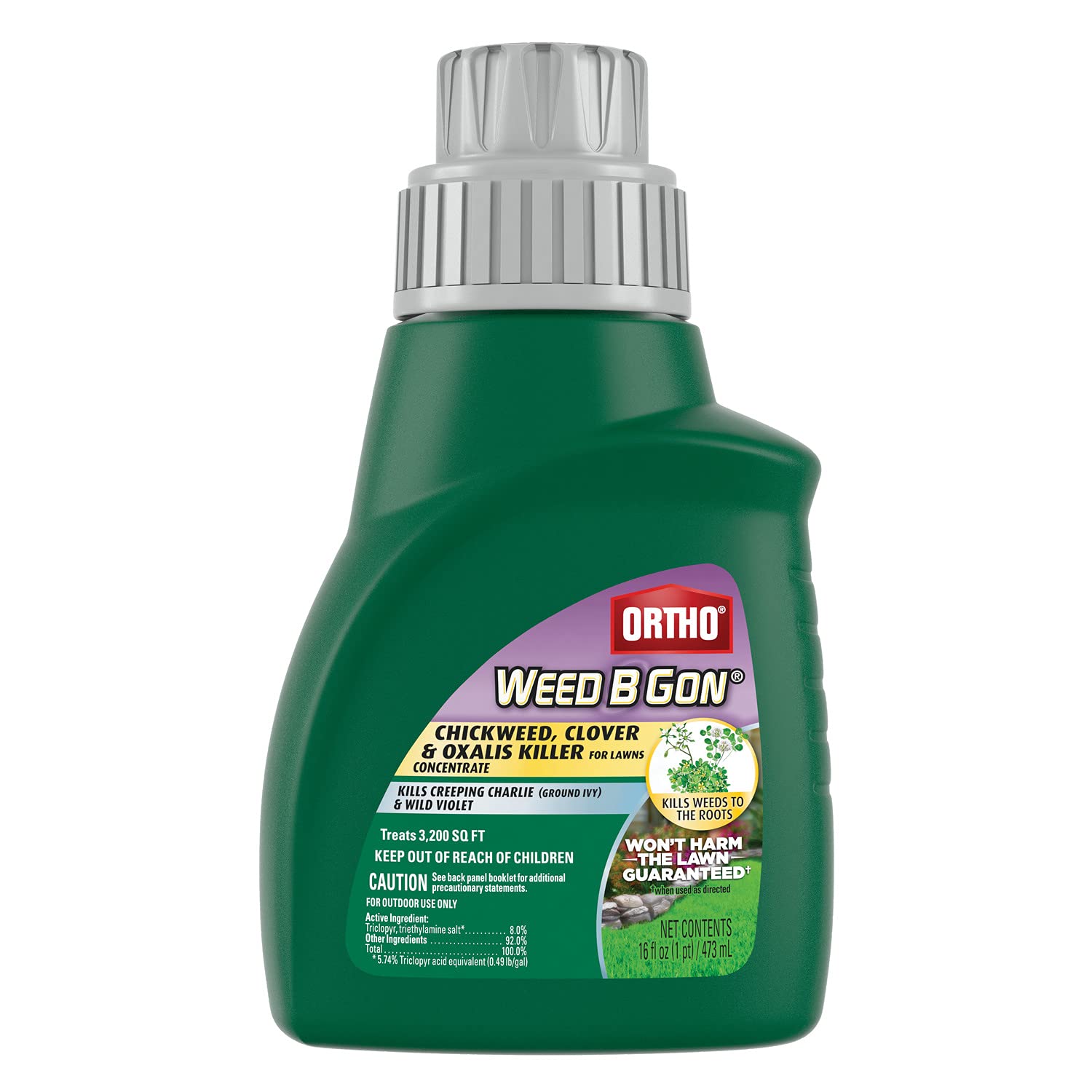
Ortho Weed B Gon Chickweed, Clover & Oxalis Killer for Lawns Concentrate, 16 fl. oz.
| Item Form | Concentrate, Liquid |
|---|---|
| Coverage | 3200 square_feet |
| Active Ingredients | Triclopyr, Triethylamine salt |
| Liquid Volume | 16 fluid ounces |
Ortho Weed B Gon Chickweed, Clover & Oxalis Killer is a liquid concentrate designed to treat lawn broadleaf weeds, including creeping Charlie. You mix the 16 fl. oz. bottle with water and apply with a tank sprayer or a compatible hose-end sprayer to wet the lawn surface; one bottle treats up to about 3,200 sq. ft. The formula contains triclopyr and is labeled to kill weeds to the root and become rainproof in six hours, which helps ensure effective control after a single properly timed application. It is intended for use on several common grass types when label directions are followed, and the product notes avoid mowing for one to two days after treatment and not applying above 90°F. Practical benefits are targeted control of persistent broadleaf weeds and compatibility with common sprayers, but you must follow safety guidance, avoid application in windy conditions to prevent drift, and keep people and pets off treated areas until dry. Also this is a concentrate, so you need to mix correctly and have a sprayer to use it effectively.
Best for: Buyers who prioritize reliable, proven weed control for persistent broadleaf weeds in turf and who are comfortable measuring and applying a concentrate with a sprayer.
Less Ideal for: Users who want a ready-to-spray product or who need a non-chemical approach; also not suited for people unwilling to follow safety and mixing instructions.
- Targets creeping Charlie and other tough broadleaf weeds down to the root
- Concentrate treats up to 3,200 sq. ft., reducing frequency of purchases
- Becomes rainproof in six hours, allowing faster window to resume outdoor activities
- Compatible with common tank and hose-end sprayers for flexible application
- Requires careful mixing and a sprayer; not ready-to-use
- Contains triclopyr which requires following protective measures to avoid drift and exposure
Verdict: A dependable concentrated herbicide that delivers targeted control of creeping Charlie and other tough broadleaf lawn weeds when mixed and applied correctly.
Ortho WeedClear Lawn Weed Killer Ready-to-Spray, 32 fl. oz.

| Item Form | Spray |
|---|---|
| Coverage | 5000 square_feet |
| Liquid Volume | 32 fluid ounces |
| Active Ingredients | 2,4-D; Quinclorac; Dicamba |
Ortho WeedClear Ready-to-Spray is a hose-end weed killer designed for homeowners who want a fast, easy way to remove broadleaf and grassy weeds from lawns. You attach the sprayer to a garden hose, flip it on, and spray evenly until the turf surface is wet. The product lists activity against over 200 weeds, including creeping charlie, dandelion, clover and crabgrass, and is formulated to be rainproof within an hour so treatments are less likely to wash away. It is marketed as safe for many common northern lawn grasses when used according to directions and treats up to 5,000 square feet from one 32 oz. bottle. Practical benefits include quick visible results, no mixing measured concentrate, and the convenience of a hose-end applicator for even coverage. Important limitations are the chemical active ingredients, which require protective clothing and drying time before people or pets re-enter the area, and explicit restrictions on certain grass types and ornamentals where it should not be applied. Also avoid use in very hot conditions on sensitive grasses as directed.
Best for: Gardeners who want a quick, low-effort solution to eliminate creeping charlie and other common lawn weeds and who prioritize clear product performance and convenience.
Less Ideal for: Those seeking organic or non-chemical weed control or owners of sensitive turf types and ornamental beds where the product is contraindicated should consider alternatives.
- Hose-end ready-to-spray design for fast, no-mixing application
- Claims control of over 200 listed weeds including creeping charlie
- Rainproof within 1 hour to reduce wash-off risk
- Treats up to 5,000 sq. ft. from a single 32 fl. oz. bottle
- Contains synthetic herbicide active ingredients that require protective clothing and care during application
- Not safe for use on several turf and ornamental species and has temperature restrictions
Verdict: If you need a fast, easy hose-end treatment that targets creeping charlie and many other lawn weeds across a typical yard, this ready-to-spray formulation delivers reliable, visible control.
Roundup Weed & Grass Killer with Comfort Wand, 1.33 gal

| Item Form | Liquid |
|---|---|
| Liquid Volume | 1.33 gallons |
| Coverage | 400 sq. ft. |
| Unit Count | 170.24 Fluid Ounces |
This ready-to-use Roundup product is a liquid weed-and-grass killer packaged with a Comfort Wand for continuous one-touch spraying. It is formulated to kill broadleaf weeds and grasses down to the root, and the label highlights fast visible results in hours and rainproof performance within about 30 minutes. Typical use is spot-treating infested areas around flower beds, patios, driveways, fence lines, and mulch where unwanted plants like dandelions, crabgrass, and common broadleaf weeds appear. The Comfort Wand simplifies application and reduces hand fatigue for small to medium jobs, and the 1.33 gallon jug covers up to about 400 sq. ft. Practical benefits include quick knockdown and the ability to replant according to label timing. Important limitations are that it is a nonselective herbicide so it will damage desirable plants if oversprayed, and treated areas must stay clear of people and pets until dry. Also, while effective on many broadleaf weeds, label guidance should be checked for specific species like creeping Charlie and replanting intervals after treatment.
Best for: Buyers who want a straightforward, easy-to-use spray to quickly eliminate visible weeds around hardscapes and beds and who prefer minimal mixing or equipment setup.
Less Ideal for: Gardeners who need a selective product to protect lawn grasses or ornamental plantings or those who prefer organic or nonchemical control methods.
- Ready-to-use liquid with built-in Comfort Wand for continuous spray and easier spot application
- Fast acting with visible results in hours and rainproof in as fast as 30 minutes
- Covers up to about 400 sq. ft., suitable for small to medium treatment areas
- Label lists broadleaf weeds and grasses controlled to the root, enabling longer-lasting control
- Nonselective formula will kill desirable plants if not applied carefully
- Not a targeted solution for specific species without consulting label directions for timing and repeat applications
Verdict: A convenient ready-to-use herbicide with a comfort wand that delivers fast, effective spot control of broadleaf weeds and grasses.
Choosing the Right Weed Killer for Creeping Charlie: Key Factors to Consider
Mode of Action and Systemic Uptake
Creeping Charlie spreads by stolons and establishes persistent root systems, so a weed killer that moves systemically through foliage to roots is often more effective than a contact-only product. Systemic herbicides are absorbed by leaves and transported to growing points and roots, which helps reduce regrowth from runners and buried root fragments.
Understanding the active ingredient class also helps you plan resistance management. Alternating modes of action over seasons reduces the chance of tolerant populations developing. For spot treatments, a systemic with good translocation will often give longer control from fewer applications.
Lawn Safety and Selectivity
Many lawns contain desirable grasses that are sensitive to certain broadleaf herbicides. A product labeled for broadleaf control in your specific turf type is essential to avoid yellowing or permanent turf injury. Readability of labeling for cool-season versus warm-season grasses matters because application windows and tolerance can vary.
If you plan spot treatment around desirable plants, choose formulations and application tools that allow precise targeting. Some formulations are designed for foliar spray only and can cause off-target drift, while others pair with surfactants or shields to improve selectivity.
Application Method and Equipment Needs
Products come as ready-to-use sprays, concentrates for hose-end or pump sprayers, and granular options. Concentrates require mixing and a sprayer that delivers an even fan; ready-to-use bottles are convenient for small patches. Granular products are easier to broadcast but generally less precise for isolated Creeping Charlie patches.
Consider whether you have or want to use a handheld pump sprayer, a hose-end applicator, or a wand with adjustable nozzle. Good application technique reduces waste, avoids drift onto desirable plants, and improves contact with the target foliage for systemic uptake.
Timing, Reapplication, and Lawn Care Integration
Creeping Charlie is most responsive in active growth. Applying herbicide during warm, moist conditions when the plant is photosynthesizing increases uptake and effectiveness. Many products require follow-up applications several weeks apart for full control because single treatments may not reach all root fragments.
Integrate chemical control with cultural practices: hand removal of heavy patches, mowing at the correct height to favor turf, and improving turf vigor through fertilization and overseeding reduce space for reinfestation. Timing applications so you can avoid overseeding windows or heavy rainfall improves results.
Environmental Persistence and Off-Target Risk
Consider how long a product remains active in soil and plant debris. Some herbicides have longer environmental persistence and may affect seedlings or adjacent plantings if applied improperly. Shorter residual products reduce long-term off-target risk but may require more frequent treatments for persistent infestations.
Think about runoff potential and nearby vegetable beds, pollinator plantings, or water features. Choosing products with lower persistence and following buffer recommendations minimizes unintended damage to beneficial plants and aquatic life.
Spot Treatment Vs. Broadcast Applications
Deciding whether to treat only visible patches or to apply broadly depends on how established Creeping Charlie is. Spot treatment is ideal for small, isolated patches and preserves surrounding turf and ornamentals. Use a targeted spray or a dab applicator and apply on calm days to avoid drift.
Broadcast applications make sense when infestations are widespread or when trying to suppress seed sources across a lawn. A broadcast approach can reduce the need for frequent spot work but increases the importance of choosing a turf-safe product and following label rates.
- Spot treatment reduces chemical exposure to non-target plants and pollinators.
- Broadcasting requires attention to turf type and reseeding timelines.
- For large stands, combining broadcast work with follow-up spot treatments often gives best control.
Integrating Cultural Control with Herbicide Use
Herbicides are most effective when combined with cultural practices that strengthen desirable turf. Raising mowing height slightly can shade out Creeping Charlie, which prefers low, compact growth. Regular fertilization and proper irrigation help dense grass compete with broadleaf weeds.
After control, consider overseeding bare patches with an appropriate grass blend to deny space for reinfestation. Manual removal of thick mats before applying a herbicide can improve contact with remaining foliage and reduce the number of follow-up treatments needed.
- Improve soil fertility and drainage to reduce weed pressure.
- Overseed thin areas to restore turf density after treatment.
- Hand-pull or rake dense mats where practical before applying chemicals.
Safe Practices Around Ornamentals and Vegetable Beds
Creeping Charlie often grows at the edge of beds and lawns, so take precautions to prevent drift or runoff into ornamentals and vegetables. Use shields or spray wands for targeted applications and avoid spraying on windy days. Rinsing equipment away from garden beds and following buffer zone instructions on the label reduces contamination risk.
If treating near desirable perennials, consider using a nonselective option only for immediate spot removal of isolated runners followed by replanting, or use physical removal where possible. Read label directions for plant restrictions and recommended distances from edible gardens and pollinator plantings.
- Keep sprayers clean and dispose of rinse water according to local guidance.
- Avoid treating when rain is expected within 24 hours to reduce runoff.
- Use mechanical barriers or hand removal for sensitive border areas.
When to Retreat and How to Monitor Results
Creeping Charlie can require multiple treatments. Monitor treated areas for new stolon growth or regrowth from root fragments. Wait the label-recommended interval before re-treating, and look for signs such as wilting followed by browning that indicate a successful application.
Record application dates and weather conditions to learn what timing gave the best results in your garden. If regrowth persists after two properly timed applications, reassess cultural conditions and consider rotating modes of action to improve long-term control.
- Check treated spots weekly for the first two months after application.
- Avoid reseeding or major turf renovation until the label permits to prevent injury to new grass.
- Rotate active ingredient classes across seasons to reduce the chance of tolerance.
How We Chose the Best Weed Killer for Creeping Charlie
We focused on real gardener needs when picking weed killers for Creeping Charlie. Selection prioritized products with documented activity on perennial broadleaf weeds and modes of action suited to creeping, rooting mat-formers. We evaluated systemic absorption and root-killing potential because Creeping Charlie regrows from stolons and root fragments. Lawn safety was another key filter. We favored chemistries and formulations that allow selective treatment in common cool- and warm-season turf types when used at recommended rates or that are intended for spot treatment in ornamental beds. Ease of application and clear instructions were required so gardeners can target infestations without overapplying. Other criteria included residual activity and how soon repeat treatments are typically needed, plus compatibility with common turf care practices like mowing and overseeding. We excluded products lacking clear guidance for Creeping Charlie control, items intended only for nonselective landscape-wide use without spot-application options, and any treatments with unrealistic application complexity for typical home gardeners.
FAQ
Will one application usually eliminate Creeping Charlie?
Often one application is not enough for established stands. Creeping Charlie spreads from stolons and roots, so systemic uptake and follow-up treatments are usually needed to exhaust regrowth sources.
Can I use a broad-spectrum weed killer on my lawn to kill Creeping Charlie?
Broad-spectrum products can kill Creeping Charlie but also risk damaging desirable turf and nearby plants. Use only formulations labeled for your specific grass type and consider spot-treating to limit turf injury.
Is it safe to treat Creeping Charlie near vegetable gardens or pollinator plantings?
You should avoid drift and runoff into vegetable or pollinator areas. Use targeted application techniques, apply on calm days, and follow label buffer recommendations to reduce off-target exposure.
When is the best time of year to apply weed killer for Creeping Charlie?
Apply during periods of active growth, typically in spring and fall, when the plant is actively photosynthesizing. Warm, moist conditions increase herbicide uptake and improve systemic movement to roots.
Will mowing help control Creeping Charlie after treatment?
Mowing at the correct height can help reduce competition and improve turf vigor, but avoid mowing immediately before or right after foliar treatment so the herbicide has time to be absorbed. Follow label guidance on mowing intervals after application.
Can I overseed my lawn after treating Creeping Charlie?
You can overseed, but timing matters. Many products require a waiting period before reseeding to avoid injury to seedlings. Check label intervals for safe overseeding timing and plan treatments accordingly.
Final Verdict
Choose a weed killer for Creeping Charlie based on the size of the infestation, whether you need spot or broadcast control, and how safe the product is for your turf type. Prioritize systemic activity and clear labeling for the grasses in your lawn if you are treating broadly. Combine chemical control with cultural practices like proper mowing, fertilizing, and overseeding to reduce reinfestation risk and achieve the most durable results. If you face a small patch, target it precisely to protect adjacent plants. For larger stands, accept that multiple applications and integrated lawn care will deliver the best long-term outcome.
