

Note: This article contains affiliate links. If you click on these links and make a purchase, I may earn a small commission at no extra cost to you. This helps support my research and content. Read my full affiliate disclosure here.
Foxtails are grassy, bristly weeds that compete with lawns, vegetable beds, and newly seeded turf. Choosing the right weed killer for foxtails matters because these grassy weeds respond differently than broadleaf species and because some herbicides can damage desirable grasses or newly sown seed. This guide covers seven top options shortlisted for reliable foxtail control across common yard situations. We evaluate products on how quickly they knock down foxtails, how safe they are for established turf and ornamentals, and practical use factors like application method and replanting restrictions. Read on to pick a targeted approach that fits your lawn, garden bed, or renovation plan.
Top Picks at a Glance
| Best Overall The best all-around choice for most situations | Monterey Grass Getter & Herbicide Helper Combo Pack, 8 oz each |  |
| Best Quality Built to a higher standard if you want something more solid | BASF Drive XLR8 Crabgrass Killer Concentrate, 64 oz |  |
| Best Value The sweet spot between price and what you get | Atticus Vendra II SRX Fluazifop Herbicide (4 fl oz) |  |
| Best Budget The cheapest option that still gets the job done reliably | BioAdvanced All-in-One Lawn Weed & Crabgrass Killer Concentrate, 32 oz |  |
| Highest Rated A top-rated pick with lots of positive feedback | Quali-Pro Prodiamine Pre-Emergent Herbicide, 5 lb Granules |  |
| Most Popular A crowd favorite that many people choose with confidence | Ortho WeedClear Lawn Weed Killer Ready-to-Spray, 32 fl. oz. |  |
| Best Seller A high-volume bestseller chosen again and again | Bonide Sedge Ender Concentrate 16 oz |  |
Monterey Grass Getter & Herbicide Helper Combo Pack, 8 oz each

| Item Form | Liquid |
|---|---|
| Coverage | Grassy Weeds |
| Active Ingredients | surfactant |
| Unit Count | 16 Ounce |
This Monterey combo pairs a grass-targeting herbicide with a surfactant helper to speed up and improve kill on tough grassy weeds. It is typically mixed and applied to grassy weeds like crabgrass, goosegrass, foxtails, and other annuals and perennials; the helper improves foliage wetting so the active ingredient adheres and works faster. The product is sold as two 8-ounce liquids for a total 16 ounces of treatment, and is intended for spot or area applications where grassy weeds are present among desirable plants. Practical benefits include stronger performance against hard-to-kill grasses and fewer repeat applications when used correctly. Important limitations are that it is formulated specifically for grassy weeds so broadleaf weeds will not be controlled, and it must be applied carefully to avoid contact with plants you want to keep. Read and follow label directions for mixing rates, timing, and safety precautions to get consistent, reliable results.
Best for: Gardeners and lawn stewards who need a dependable, grass-specific herbicide to remove persistent grassy weeds and prefer a product designed to improve uptake for faster, consistent control.
Less Ideal for: People seeking a broad-spectrum weed solution or who want an all-in-one product for both grassy and broadleaf weeds should look for a different formulation.
- Formulated specifically to control tough grassy weeds including goosegrass and crabgrass
- Includes a surfactant helper to improve foliage wetting and speed up herbicide action
- Sold as a two-pack totaling 16 ounces for multiple spot treatments
- Liquid formulation allows dilution and precise application for targeted control
- Does not control broadleaf weeds so separate products may be needed
- Requires careful application to avoid injuring desirable turf or ornamentals
Verdict: Use this combo when you want a reliable, grass-targeted herbicide plus a surfactant to speed up and strengthen control of persistent grassy weeds like goosegrass.
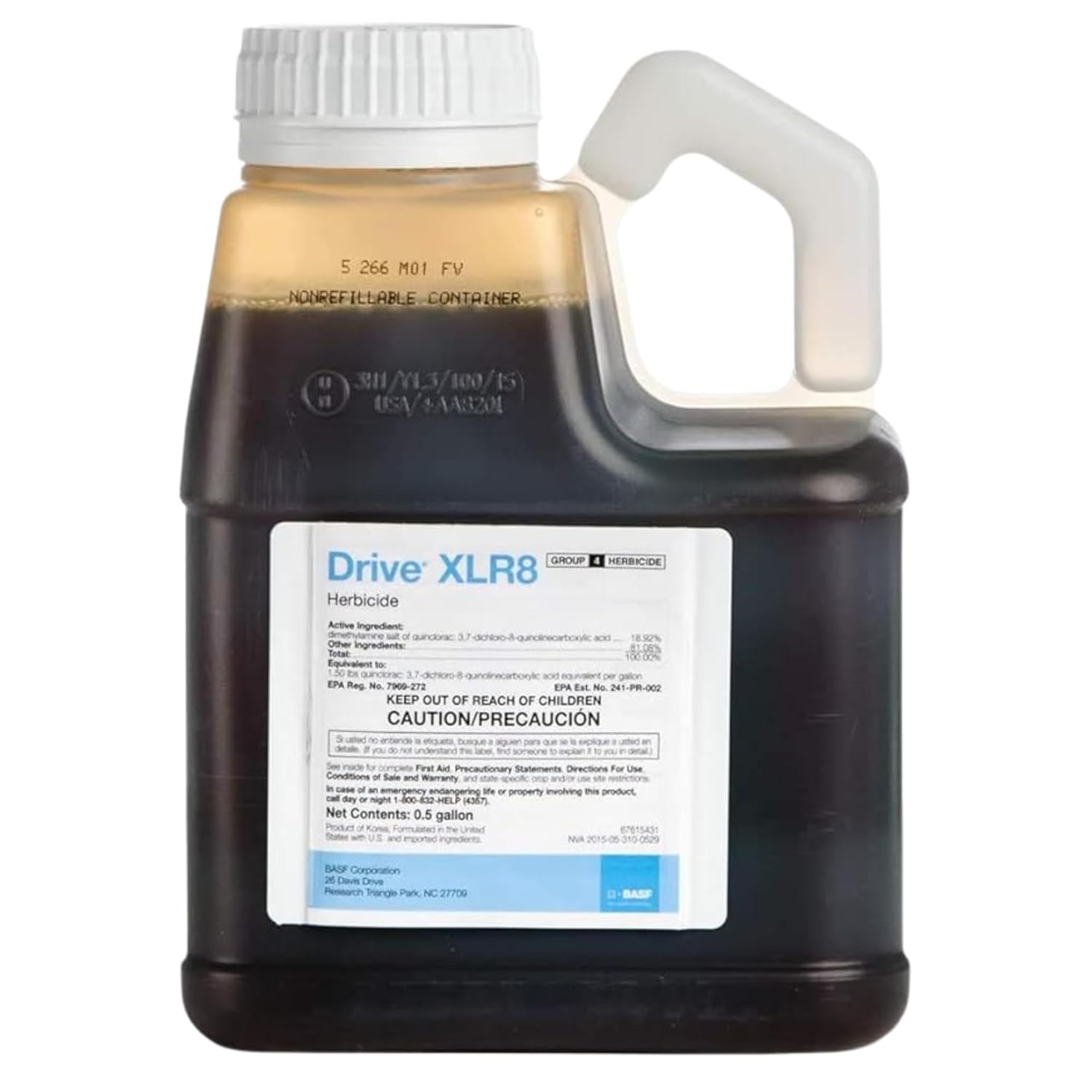
BASF Drive XLR8 Crabgrass Killer Concentrate, 64 oz
| Unit Count | 64 Ounce |
|---|---|
| Item Form | Liquid |
| Active Ingredients | Quinclorac 18.92% |
| Coverage | Full |
Drive XLR8 is a concentrated liquid herbicide built mainly to knock down crabgrass and other grassy and broadleaf weeds in turf. You mix a small measured amount with water and a methylated seed oil adjuvant and spray over the turf for spot or broadcast treatment. Its water-based formulation and quinclorac active ingredient deliver relatively fast uptake and labeled rainfast protection within about an hour, and the product advertises up to 30 days of residual control, which reduces how often you need to reapply. It is labeled for both warm- and cool-season turf and can be tank-mixed with other turf herbicides when label directions allow, giving flexibility for complicated weed problems. Important limitations are that it is a chemical herbicide that requires careful PPE and strict adherence to label directions, and some local restrictions apply, including reduced use patterns in certain states and spot-application limits. For gardeners who follow the label, it offers reliable, professional-strength control of crabgrass and many common lawn weeds.
Best for: Homeowners and groundskeepers who want a strong, professional-style postemergent solution to quickly reduce crabgrass and mixed weed populations and who are comfortable following label safety and application steps.
Less Ideal for: People seeking an organic or nonchemical approach to crabgrass control or users who prefer no-handling of concentrated herbicides should consider alternative cultural or nonchemical options.
- Concentrated 64 oz formula covers large areas when mixed per label directions
- Water-based formulation for faster plant uptake and rainfast protection in under an hour
- Provides up to 30 days of residual control against crabgrass and several grassy weeds
- Labeled for use on both warm-season and cool-season turf and compatible with some tank mixes
- Requires careful handling and PPE because it is a chemical herbicide
- Some state-specific use restrictions and label limitations apply
Verdict: Choose Drive XLR8 when you want a concentrated, fast-acting postemergent herbicide that delivers reliable crabgrass control and multi-week residual protection.
Atticus Vendra II SRX Fluazifop Herbicide (4 fl oz)

| Active Ingredients | Fluazifop-p-butyl |
|---|---|
| Unit Count | 4 Fluid Ounces |
| Item Form | Liquid |
| Coverage | Grassy weeds |
Vendra II SRX is a selective, systemic fluazifop-based herbicide formulated to target grassy weeds while leaving tolerant turfgrass like zoysiagrass and fescue intact when used correctly. It is typically mixed at low rates with water and a nonionic surfactant and sprayed over lawns, landscape beds, or around ornamentals for spot or broadcast control of bermudagrass, crabgrass, foxtail, quackgrass and similar grassy pests. Notable features include a concentrated emulsifiable formulation for small treatment areas, compatibility with over-the-top applications on many ornamentals, and quick rainfastness of about one hour. In practice it offers effective translocation from leaf to root so perennial grasses can be knocked back rather than just browned on the blades. Important limitations are that rates must be adjusted by turf type and season, it can injure stressed grass so avoid hot or drought-stressed periods, and a surfactant is required for best results. The small 4 fl oz bottle is convenient for homeowners treating patches or small yards, but professionals treating large acreages will need larger containers and careful measurement to get labeled rates right.
Best for: Homeowners and groundskeepers who want a targeted solution to remove grassy weeds from zoysiagrass or fescue lawns and prefer a concentrated product for spot treatments and occasional use.
Less Ideal for: People needing a broad-spectrum weed killer that controls broadleaf weeds or those managing very large turf areas who would prefer gallon-sized commercial formulations.
- Selective control of many grassy weeds without harming tolerant zoysiagrass and fescue when used per label
- Systemic action translocates to roots for more complete kill of perennial grassy weeds
- Rainfast in about one hour so brief showers are less likely to reduce effectiveness
- Sized-right 4 fl oz bottle convenient for spot treatments and easy storage
- Requires addition of a nonionic surfactant for best performance
- Not safe to apply to stressed turf or during peak summer heat for some grasses
- Small bottle size means frequent purchases or dilution for larger areas
Verdict: A concentrated, selective grass herbicide geared to homeowners and turf managers who need reliable control of bermudagrass and other grassy weeds in zoysiagrass and fescue stands.
BioAdvanced All-in-One Lawn Weed & Crabgrass Killer Concentrate, 32 oz

| Unit Count | 32 Fluid Ounces |
|---|---|
| Item Form | Liquid |
| Coverage | Broad-spectrum coverage (over 90 listed weeds) |
| Active Ingredients | Topramezone 0.104%, Sodium Salt of Bentazon 4.13% |
This BioAdvanced concentrate mixes into spray to tackle a wide range of lawn weeds including foxtail, crabgrass, dandelion, clover, and yellow nutsedge. You dilute 2.5 fl oz per gallon to cover about 1,000 sq ft and apply to established Kentucky bluegrass, ryegrass, or fescue lawns; the formula contains two active ingredients that act quickly and claim rainproofing after one hour and up to three months of control. In practice it is straightforward to measure and spray with a pump or hose sprayer, and reports of visible burn-down on contact are common for susceptible weeds. Important limitations are turf restrictions — it should not be used on warm-season grasses — and typical safety precautions for concentrated herbicides, including gloves and avoiding windy applications. For budget-conscious users, the 32 oz concentrate makes multiple gallons of spray so cost per application can be reasonable, but success depends on correct dilution and using it only on the listed grass types.
Best for: Homeowners with cool-season lawns who want an affordable, concentrated product to control foxtail and other common weeds without frequent reapplication.
Less Ideal for: Owners of warm-season grass lawns, small ornamental beds, or those who prefer organic or nonchemical weed-control methods should look elsewhere.
- Broad-spectrum control listed for over 90 weeds including foxtail and mature crabgrass
- Concentrated formula makes multiple gallons of spray, lowering cost per treatment
- Fast-acting and claims to be rainproof one hour after application
- Targets weeds to the root through dual active ingredients
- Limited to use on Kentucky bluegrass, ryegrass, and fescue lawns only
- Contains concentrated chemicals requiring protective gear and careful handling
Verdict: A concentrated, cost-effective chemical option for homeowners with cool-season turf who need reliable control of foxtail and other listed lawn weeds.
Quali-Pro Prodiamine Pre-Emergent Herbicide, 5 lb Granules

| Item Form | Granule |
|---|---|
| Coverage | Pre-emergent grass and broadleaf weed control, season long crabgrass control |
| Active Ingredients | Prodiamine 65% |
Quali-Pro Prodiamine is a granular pre-emergent herbicide designed to prevent germination of common annual grassy and broadleaf weeds across lawns and landscape beds. You apply it before weed seeds germinate in spring or as a fall treatment to build residual control through the growing season. The product contains 65% prodiamine, which is widely used for reliable, long-lasting control of crabgrass, annual bluegrass and several broadleaf weeds, and it mixes readily when tank-mixed with fertilizers or iron. In real-world use it offers predictable, season-long suppression when applied at the labeled rate and incorporated by irrigation or rainfall. Important practical limits are that it is preventive only and will not kill established weeds, and proper timing and rate are essential to avoid reduced effectiveness. For larger areas the 5 lb package covers moderate lawn acreage but may require multiple bags for extensive turf.
Best for: Homeowners and lawn care professionals who prioritize a dependable, season-long preventive solution to keep crabgrass and annual weeds from establishing in turf.
Less Ideal for: Gardeners needing a post-emergent solution for existing weeds or those who prefer liquid ready-to-use products for spot treatments.
- High active ingredient concentration (Prodiamine 65%) for long residual control
- Granular form allows easy broadcast application and tank mixing with fertilizers
- Effective season-long crabgrass and annual weed suppression when applied correctly
- Suitable for spring or fall applications to build preventive control
- Pre-emergent only and will not control established weeds
- 5 lb bag may be insufficient for large lawns without purchasing additional quantity
Verdict: Choose this prodiamine granule when you want a proven, season-long preventive herbicide to reliably stop crabgrass and other annual weeds before they start.
Ortho WeedClear Lawn Weed Killer Ready-to-Spray, 32 fl. oz.

| Coverage | 5000 square_feet |
|---|---|
| Item Form | Spray |
| Liquid Volume | 32 fluid ounces |
| Active Ingredients | 2,4-D; Quinclorac; Dicamba |
Ortho WeedClear Ready-to-Spray is a hose-attached weed killer made for treating common lawn weeds without mixing concentrates. Attach the sprayer to a garden hose, switch it on, and spray evenly until the lawn surface is wet; the formula is rainproof in about an hour and claims visible results within hours. It lists active ingredients including 2,4-D, quinclorac, and dicamba, which target broadleaf species such as dandelion, clover, chickweed and creeping charlie as well as some grassy weeds like crabgrass. The product covers up to 5,000 sq. ft. from a 32 fl. oz. bottle, so one container treats a typical medium lawn in a single pass. Practical benefits are ease of use, fast action, and compatibility with many northern lawn grasses when used as directed. Important limits are that it is not labeled for several turf types (for example St. Augustine and centipedegrass) and there are temperature restrictions for safe bermudagrass use; following safety directions to keep people and pets off treated areas until dry is necessary. For persistent infestations multiple applications or a targeted spot treatment may still be needed.
Best for: Homeowners who want a simple, ready-to-use spray to quickly knock back creeping charlie and other broadleaf weeds across a typical lawn and prefer an easy hose-end application.
Less Ideal for: People with warm-season lawns not listed on the label, organic-only gardeners, or those wanting a long-term preemergent solution should consider other approaches.
- Ready-to-use hose-end applicator for quick, no-mixing treatment
- Fast-acting formula that becomes rainproof within about one hour
- Targets common broadleaf weeds including creeping charlie and crabgrass
- Covers up to 5,000 sq. ft. from a single 32 fl. oz. bottle
- Works on many northern lawn grasses when directions are followed
- Not safe for several turf types and restricted on some grasses like St. Augustine and centipedegrass
- Contains synthetic herbicides requiring careful handling and keeping people and pets off until dry
- May require repeat or spot treatments for heavy or mature infestations
Verdict: If you need a fast, no-mix hose-end spray to reduce creeping charlie and common broadleaf weeds across a medium lawn, this product delivers quick, easy coverage.
Bonide Sedge Ender Concentrate 16 oz

| Unit Count | 16 Ounce |
|---|---|
| Item Form | Spray |
| Liquid Volume | 16 fluid ounces |
| Active Ingredients | Herbicide |
Bonide Sedge Ender is a concentrated lawn herbicide designed specifically to control sedges and other grassy weeds such as yellow nutsedge, crabgrass, goosegrass, and foxtail. Sold as a 16 oz concentrate, it is mixed according to label rates and applied with a sprayer for spot or broadcast treatments across warm and cool season lawns. Notable features include pre- and post-emergent activity, a formula that starts working on contact, and rainproofing within hours after drying so treatments remain effective through light weather. The concentrate format makes it economical for treating areas from a few hundred to several thousand square feet depending on dilution. Important limitations are that it is labeled for lawn use only so it should not be used on ornamental beds, and users must follow safety directions for protective clothing and keep children and pets away until treated areas are dry; handling a concentrated herbicide also requires careful measuring and mixing. For someone managing stubborn grassy weeds in turf, it offers targeted control without killing desirable grasses when applied correctly.
Best for: Homeowners focused on getting rid of persistent grassy weeds in established lawns who prefer a concentrated, economical product with proven effectiveness.
Less Ideal for: Gardeners who need a non-lawn solution for ornamental beds or those unwilling to handle a concentrated chemical or follow protective and mixing instructions.
- Concentrated formula yields economical coverage when mixed properly
- Effective against hard-to-kill grassy weeds including yellow nutsedge and goosegrass
- Works both pre-emergent and post-emergent for flexible timing
- Becomes rainproof within hours after drying so treatments are less likely to wash away
- Labeled for use on lawns only so not suitable for flower beds or many ornamentals
- Requires careful mixing and protective gear because it is a concentrated herbicide
Verdict: Choose Bonide Sedge Ender when you need a concentrated, lawn-safe herbicide that reliably kills goosegrass and other grassy weeds down to the root.
Choosing the Right Weed Killer for Foxtails: Key Factors to Consider
Active Ingredient and Mode of Action
Knowing the active ingredient and how it works is the most direct way to predict effectiveness on foxtails. Some herbicides target broadleaf weeds and will do little on grassy species, while others are formulated specifically for annual grasses. The mode of action determines whether a product will kill the above-ground shoots only or translocate to roots and seedheads. That affects whether foxtails regrow from seedbanks or persistent crowns.
Different chemistries also carry different risks to desirable turf and ornamentals. Selective grassy herbicides can remove foxtails while leaving many lawn grasses intact, but nonselective herbicides will kill any green plant they contact. Read and match the active ingredient to the grass type in your yard to avoid unintended damage.
Turf and Plant Safety
How safe an herbicide is for your lawn and nearby plants will influence when and where you can use it. Established cool-season and warm-season grasses vary in tolerance to grassy-selective products. Some products are safe on certain turf varieties but will injure others or newly emerged seedlings.
Safety also covers drift risk to ornamentals, vegetables, and native perennials. Consider buffer distances, nozzle choices, and weather conditions at application. If you have flower beds or newly seeded areas nearby, choose formulations and timing that minimize harm and allow reseeding when needed.
Residual Activity and Seeding Restrictions
Residual soil activity describes how long a herbicide remains active in the soil and can affect germinating seeds. Residual products can help suppress foxtail seedlings for weeks but may prevent reseeding lawns or planting sensitive transplants for a specified interval.
If you're renovating turf or planning to overseed, check the label for replanting windows. For vegetable beds, pick products with minimal soil persistence or schedule treatments so that the restriction period has passed before planting. Balancing residual control against flexibility to reseed is critical in renovation projects.
Application Method and Coverage
How you apply a product affects both its effectiveness and safety. Options include ready-to-use sprayers, hose-end concentrates, and granular formulations. Sprays allow spot treatment and better coverage on weedy patches, while granules can be easier to broadcast over larger areas but may be less targeted.
Consider nozzle type, droplet size, and recommended spray volumes. Accurate mixing and even coverage matter for consistent foxtail control. Ease of rinsing equipment and clear instructions also reduce user error and accidental damage to desirable plants.
Timing and Seasonal Considerations
Foxtails are most vulnerable at specific growth stages, usually when seedlings are small and actively growing. Applying a grassy herbicide early in the life cycle often gives better control than treating mature, seed-producing plants. Seasonal timing also ties to turf health: treating during peak growth of your turf reduces the chance of scorch or stress.
Factor in local climate, recent lawn care activities like fertilizing or irrigation, and upcoming seeding plans. Multiple applications may be necessary for successive flushes of foxtail seedlings, so plan your maintenance calendar accordingly.
Safety, Handling, and Environmental Concerns
Herbicides vary in personal protective equipment recommendations, re-entry intervals, and environmental fate. Some require gloves and eye protection and advise avoiding applications near water or during windy conditions. Responsible use reduces risk to pollinators, pets, and water features.
Consider buffer zones, containment methods for runoff, and integrated strategies like hand removal or cultural controls to reduce reliance on chemicals. Review label directions for disposal and emergency instructions before using any product.
When to Treat Foxtails in Lawns
Treat foxtails when seedlings are actively growing but still small. Early intervention prevents them from setting seed and replenishing the soil seedbank. In cool-season lawns expect the first flush in spring and again in late summer, while warm-season areas may see different timing.
Avoid treating during turf stress from heat, drought, or recent heavy fertilization. Wait until the lawn is actively recovering so the grass can tolerate the herbicide and recover quickly.
- Spot-spray patches when foxtails are under 3 inches tall for best control
- Delay treatment in newly seeded lawns until label replant intervals are met
- Apply on calm, dry days to reduce drift and maximize uptake
Spot Treatment Versus Broadcast Application
Spot treatments let you target foxtail clumps and reduce exposure to nearby desirable plants. Use a hand sprayer or a foam applicator for small areas to avoid overspray. Spot applications are often sufficient for isolated patches.
Broadcast applications may be more efficient for widespread infestations but require careful calibration and timing to protect turf. Granular options can be simpler for large lawns but check whether granules are intended for grassy weeds and follow watering instructions if required.
- Spot treatment: lower chemical use, precise control, ideal for small infestations
- Broadcast spraying: covers larger infestations but needs even coverage and correct rates
- Granular: convenient but may be less precise for patchy foxtail growth
Nonchemical and Cultural Control Methods
Cultural practices reduce foxtail pressure over time. Improving lawn density through proper mowing, fertilization, and overseeding makes it harder for annual grasses to establish. Raising mowing height slightly can favor desirable turf and shade out some seedlings.
Manual removal is effective for isolated plants before they set seed. In beds, a shallow cultivation and hand-pulling when soil is moist removes root systems and prevents seed spread. Combining cultural tactics with targeted herbicide use lowers long-term reliance on chemicals.
- Overseed thin areas in the appropriate season to close bare ground
- Maintain correct mowing height for your grass type to suppress foxtails
- Remove seedheads before they mature to limit reseeding
Protecting Ornamentals, Vegetables, and Pollinators
Keep applications away from flowering plants and vegetable beds unless the label permits safe use. Drift and spray-contaminated soil can harm sensitive plants and beneficial insects. Create buffer zones and use shielded spray techniques near desirable plants.
Time treatments to avoid active bloom periods and follow label directions regarding pollinator exposure and re-entry intervals. Where possible, use targeted spot treatments rather than broad sprays in mixed planting areas.
- Use shields or wipers to reduce off-target drift
- Avoid spraying on breezy days or when pollinators are active
- Rinse equipment thoroughly away from garden beds after use
Replanting and Renovation Planning
If you plan to overseed or renovate turf, account for the herbicide's replant window. Some products with long soil persistence will prevent germination for weeks to months. Schedule treatments so the restriction period ends before seeding or choose nonresidual options.
For garden beds being converted or planted with vegetables, opt for products labeled safe for preplant use or those with short residual activity. In many renovation scenarios, a combination of timed herbicide use and mechanical seedbed preparation yields the best results.
- Check label for exact days to wait before seeding or transplanting
- Plan herbicide applications several weeks in advance of renovation
- Consider spot treatment during renovation to preserve soil health
How We Chose the Best Weed Killer for Foxtails
We focused on herbicides and selective grass-control products that reliably suppress or remove foxtail species without relying on anecdote. Selection began by filtering for formulations specifically labeled or known to work on annual grassy weeds and foxtails, then prioritizing options suitable for home gardens and lawns. Key evaluation dimensions included active ingredient efficacy against grassy weeds, selectivity for common turfgrasses and ornamentals, residual soil activity and replanting interval, and user-facing factors like application method and safety precautions. We excluded products that are restricted to agricultural or commercial use only, those lacking clear label guidance for home settings, and any systemic solutions unrelated to grasslike weed control. We also considered how easy each product is to apply accurately, the clarity of re-entry and seeding restrictions, and compatibility with common lawn maintenance practices. The final shortlist balances strong foxtail control with manageable risk to desirable plants and practical instructions for typical gardeners.
FAQ
Will a broadleaf herbicide kill foxtails?
Broadleaf herbicides usually have little or no effect on foxtails because foxtails are grassy species. For grassy weeds you need products labeled for annual grass control or formulations that target grasses specifically.
Can I overseed my lawn right after treating foxtails?
It depends on the product. Some herbicides have short soil persistence and allow overseeding within days, while others require several weeks or longer. Always follow the label replanting interval before seeding.
Are granular weed killers effective against foxtails?
Granular products can be effective when designed for grassy weed control, but they are typically less targeted than spot sprays. Proper application rate and even distribution are important for reliable results.
How many applications will I need to control foxtails?
Often multiple treatments are necessary because foxtails germinate in flushes. Treat early-season seedlings first, then monitor and spot-treat subsequent flushes as they appear. Follow label directions for safe reapplication intervals.
Will treating foxtails harm my flower beds or vegetable garden?
There is a risk if drift or overspray reaches sensitive plants. Use spot treatments, shields, and calm weather to minimize off-target exposure, and select products labeled safe for use around desired plants.
Can cultural practices eliminate foxtails without herbicides?
Cultural methods like improving turf density, overseeding, correct mowing height, and hand-pulling seedheads reduce foxtail pressure but may not fully eliminate heavy infestations quickly. Combining cultural control with targeted herbicide use is often most effective.
Final Verdict
Choose a foxtail control approach that balances quick knockdown with protection of desirable turf and plantings. Prioritize products with active ingredients proven on grassy weeds, check label guidance for turf compatibility, and time treatments for young seedlings when possible. For renovation or overseeding projects, favor options with short replant windows or plan treatments so seedings occur after the residual period. Combining cultural practices with targeted applications will give the most durable reduction in foxtail pressure and reduce the need for repeated chemical use.
