

Note: This article contains affiliate links. If you click on these links and make a purchase, I may earn a small commission at no extra cost to you. This helps support my research and content. Read my full affiliate disclosure here.
If you are managing big lawns, long driveways, or open field edges, the wrong product wastes time and leaves weeds returning. Choosing the right weed killer for large area work matters because coverage rate, mode of action, and persistence determine how quickly treated acreage clears and how soon regrowth appears. This guide covers the top shortlisted weed killers suited to larger plots and evaluates them on coverage efficiency, residual control, and application ease. Read on to see which options earned a spot on our list and what tradeoffs to expect when treating large areas.
Top Picks at a Glance
| Best Overall The best all-around choice for most situations | RM43 Total Vegetation Control 43% Glyphosate Plus Weed Preventer, 2.5-Gallon |  |
| Best Quality Built to a higher standard if you want something more solid | Remedy Ultra Concentrated Herbicide for Pasture and Brush Control, 1 Gallon |  |
| Best Value The sweet spot between price and what you get | Spectracide Large Plot Weed Stop for Lawns Concentrate, 1 Gal |  |
| Highest Rated A top-rated pick with lots of positive feedback | Roundup Pro Concentrate Herbicide (2.5 gal) |  |
| Most Popular A crowd favorite that many people choose with confidence | Hi-Yield Super Concentrate Killzall Weed & Grass Killer, 1 gal |  |
RM43 Total Vegetation Control 43% Glyphosate Plus Weed Preventer, 2.5-Gallon
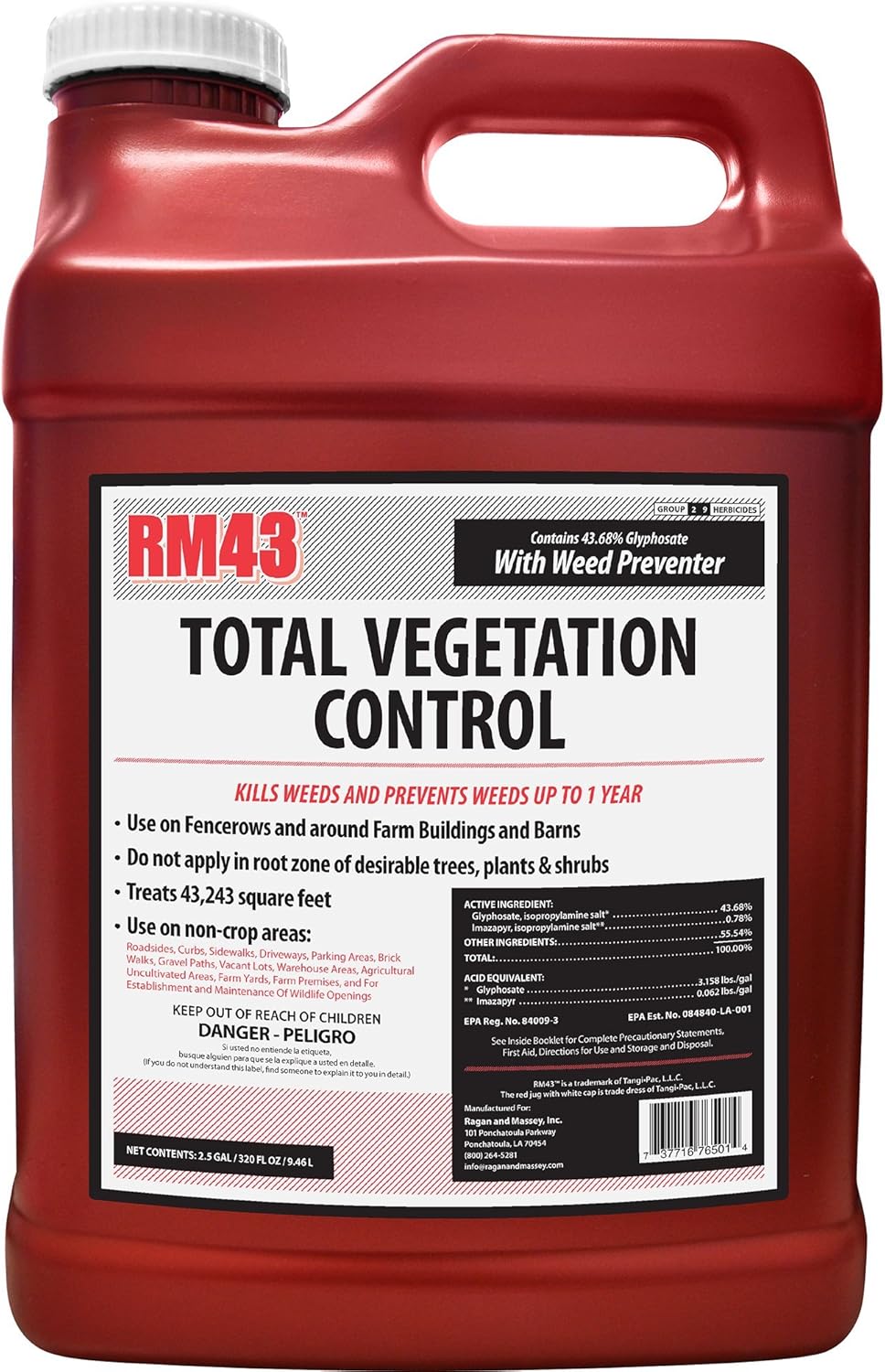
| Unit Count | 320 Fluid Ounces |
|---|---|
| Liquid Volume | 320 fluid ounces |
| Coverage | 243 243 square feet |
| Active Ingredients | Glyphosate isopropylamine salt, Imazapyr isopropylamine salt |
RM43 Total Vegetation Control is a concentrated 2.5‑gallon herbicide intended for killing existing growth and preventing regrowth for up to a year on areas where no vegetation is desired. You mix it into spray solution and apply to hardscape edges, gravel driveways, fence rows, and around buildings as either spot treatments or blanket applications on bare ground. The formula pairs glyphosate and imazapyr with a surfactant so it kills grasses, broadleaf weeds, vines, brush and some woody growth and becomes rainfast in about two hours. Practical benefits for driveway use include long residual control that reduces repeat spraying and a large coverage rate that treats many square feet from one container. Important limitations are that it is for non‑crop areas only and will damage desirable plants if sprayed over roots or drift occurs, and the active ingredient blend makes it persistent so care is required where you may later want vegetation to return. Follow label directions for mixing, application timing and safety precautions when using near soil that will be planted later.
Best for: Gardeners, property owners, and maintenance crews who prioritize strong, long‑lasting weed eradication on gravel driveways and other non‑crop hardscape areas and want to minimize repeat applications.
Less Ideal for: Homeowners planning to replant treated areas soon or those needing selective weed control near desirable plants should choose a less persistent or more targeted product.
- Combination of glyphosate and imazapyr for both knockdown and long residual control
- Concentrated 2.5‑gallon container covers large areas without frequent refills
- Rainfast in about two hours so light rain soon after application is less likely to reduce effectiveness
- Suitable for total vegetation control on gravel driveways, fence rows and other non‑crop areas
- Persistent active ingredients that can prevent desirable vegetation from reestablishing for an extended period
- Not safe for use where desirable plant roots may be exposed or where drift could contact nearby plants
Verdict: Choose RM43 when you need a single, heavy‑duty application that delivers broad spectrum kill and up to a year of weed prevention on gravel driveways and other non‑crop surfaces.
Remedy Ultra Concentrated Herbicide for Pasture and Brush Control, 1 Gallon

| Unit Count | 128 Fluid Ounces |
|---|---|
| Item Form | Liquid |
| Coverage | Selective coverage for brush and mid-size trees |
| Liquid Volume | 1 gallons |
Remedy Ultra is a concentrated triclopyr-based herbicide intended to kill brush and mid-size trees while helping restore pasture and maintain fence rows. It is used as a broadcast or spot treatment following label directions, and can be applied alone or tank-mixed with other professional pasture herbicides. The formula targets both top growth and roots, which improves long-term control compared with contact-only products, and the product description emphasizes low odor and low residual impact. For practical use it covers larger areas economically thanks to the 1 gallon size and is designed for pasture regeneration rather than ornamental garden use. Important limitations are that it is a specialized agricultural herbicide requiring careful adherence to safety and label instructions and is not appropriate for broad-spectrum residential weed control or use on desirable trees and plants. Users should plan for proper protective equipment and follow timing and mixing guidelines to get reliable results.
Best for: Buyers who need a dependable pasture and rangeland herbicide for reclaiming brush and maintaining fence lines and who prioritize consistent, long-term control over quick-contact solutions.
Less Ideal for: Home gardeners seeking a general-purpose lawn weed killer or anyone who needs a nonselective orchard or ornamental tree treatment.
- Targets both foliage and roots for longer-lasting control of brush and mid-size trees
- Concentrated 1 gallon formulation gives economical coverage for pasture and fence-line work
- Designed for pasture regeneration and selective brush control rather than nonselective blanket kill
- Requires strict adherence to label directions and safety precautions for safe use
- Not suitable for general residential weed control or for use near desirable trees and ornamentals
Verdict: Choose Remedy Ultra when you need a reliable, concentrated herbicide that kills brush and mid-size trees for pasture restoration and fence-line maintenance.
Spectracide Large Plot Weed Stop for Lawns Concentrate, 1 Gal

| Unit Count | 128 Fluid Ounces |
|---|---|
| Item Form | Liquid |
| Coverage | 32000 square feet |
Spectracide Large Plot Weed Stop is a concentrate lawn herbicide you mix with water and apply with a sprayer to control broadleaf weeds across large areas. It targets more than 200 listed weeds, including common offenders like dandelion, chickweed and clover, and is formulated to kill weeds down to the root for visible results in hours. The bottle links to hose-end or tank sprayers and includes settings for concentrate or ready-to-spray use, which makes covering up to tens of thousands of square feet practical for homeowners with large yards. It is rainproof within hours and is labeled for both northern and southern grass types when applied at recommended rates. Important limitations are the temperature window for safe application and safety precautions for people, pets and water features; do not apply when air temperatures exceed 85°F and keep off treated areas until dry. For persistent or isolated tough weeds you may need targeted repeat spot treatments.
Best for: Homeowners who need an effective, large‑area solution for common broadleaf weeds and prefer a concentrated product they can mix and spray themselves.
Less Ideal for: Small-plot gardeners who prefer spot-only, non-chemical methods or anyone who cannot follow temperature and safety application restrictions.
- Concentrate treats large areas—label lists coverage up to 32,000 sq ft for northern grasses
- Kills over 200 listed broadleaf weeds and works down to the root for longer control
- Rainproof within hours so light rain soon after application is less likely to wash it away
- Works with common sprayers and has a built-in hose connector for easier mixing and application
- Must not be applied when air temperatures exceed 85°F to avoid turf damage
- Contains chemicals that require safety precautions and keeping people and pets off treated areas until dry
Verdict: Choose this concentrated sprayer-ready formula if you need a practical, large‑area herbicide that kills common broadleaf weeds down to the root while preserving lawn when used as directed.
Roundup Pro Concentrate Herbicide (2.5 gal)

| Unit Count | 300 Fluid Ounces |
|---|---|
| Liquid Volume | 2.5 gallons |
| Coverage | Up to 435,600 sq. ft |
| Item Form | Liquid |
Roundup Pro Concentrate is a liquid herbicide intended for mixing in sprayers to treat large lawns, fields, and commercial areas. The 2.5 gallon jug is a concentrate that dilutes at rates from about 1 to 10.5 ounces per gallon of water, letting you cover up to the manufacturer-stated area without frequent refills. It is formulated to be rainfast in roughly an hour and is best applied when weeds are actively growing and temperatures are above 60°F. Practical benefits include high coverage per container and compatibility with stainless steel or plastic sprayers for standard application workflows. Important limitations are the need for careful dilution and protective handling, strict restrictions around water and runoff, and regulatory or local sale limitations in some states. Users should follow label directions for safety, keep people and pets away until spray dries, and expect that effective use requires proper equipment and basic pesticide handling practices.
Best for: Buyers who need a high‑coverage, performance-oriented herbicide for treating large yards, fields, or commercial properties and who are comfortable following pesticide mixing and safety instructions.
Less Ideal for: Casual gardeners with small beds or people unwilling to handle concentrated pesticides should choose ready-to-use alternatives or nonchemical methods.
- Concentrated formula covers very large areas from a single container
- Rainfast within about one hour which reduces loss from light rain
- Compatible with standard stainless steel or plastic sprayers for easy mixing and application
- Requires precise dilution and proper protective equipment during mixing and application
- Not for use near water or where runoff may occur and restricted in some jurisdictions
Verdict: Choose this concentrate when you need a professional-strength herbicide that treats very large areas with fewer refills.
Hi-Yield Super Concentrate Killzall Weed & Grass Killer, 1 gal

| Active Ingredients | Glyphosate |
|---|---|
| Liquid Volume | 128 fluid ounces |
| Coverage | 25600 square feet |
| Item Form | Liquid |
This Hi-Yield super concentrate is a glyphosate-based liquid concentrate designed to kill grasses, broadleaf weeds, and woody brush down to the root. It mixes with water and is applied with a sprayer, and the double-surfactant formula helps the solution stick and dry on foliage for faster uptake. The 1 gallon concentrate covers up to 25,600 square feet, making it a practical choice for treating large lawns, fence lines, driveways, or commercial sites when you need broad control rather than spot treatments. Notable features are the high glyphosate concentration and the surfactant system that improve performance on tougher weeds. Important limitations are that it is not for use on lawns and requires a separate spraying accessory and careful handling because it is a nonselective herbicide. For users focused on reliably clearing large areas of unwanted vegetation, this bottle gives concentrated, professional-strength coverage but demands careful mixing, application timing, and protective equipment.
Best for: Buyers who need a powerful, professional-strength herbicide to clear large areas of weeds and brush and who prioritize reliable, fast-acting performance over selective application.
Less Ideal for: Home gardeners seeking a lawn-safe or selective spot treatment or users uncomfortable handling concentrated chemical herbicides should consider gentler or targeted alternatives.
- High-concentration glyphosate formula for strong, systemic weed control
- Double-surfactant mix improves coverage and uptake on foliage
- Large coverage per bottle (up to 25,600 sq ft) suitable for big areas
- Liquid concentrate mixes to desired volume so you carry less product
- Nonselective herbicide so it will damage desirable plants if contacted
- Requires separate sprayer and careful mixing and protective gear
- Not labeled for use on lawns, limiting some residential uses
Verdict: Choose this concentrated glyphosate formula when you need powerful, large-area weed and grass control delivered in a single 1-gallon bottle.
Choosing the Right Weed Killer for Large Area: Key Factors to Consider
Coverage Efficiency
Coverage efficiency measures how much area a single container or concentrate will treat. For large areas this directly affects labor and refilling frequency because products with higher treated-acreage per gallon reduce downtime and equipment handling.
Consider product concentration, suggested dilution rates, and recommended spray volumes. A high-concentration formulation may cost more per unit but treat far more square footage, lowering hands-on time when you are covering lawns, fields, or long fence lines.
Residual Control and Persistence
Residual control describes how long a product prevents new weeds from emerging after treatment. Longer persistence reduces the number of repeat applications needed across a season, which is valuable on large sites where each pass is time-consuming.
Balance persistence against crop rotation or planting plans. Strong residuals can restrict when you can reseed turf or plant cover crops, so check labeled plant-back intervals and match persistence to your landscape schedule.
Mode of Action and Target Spectrum
Mode of action determines which weed types a product will control and how it kills them. Systemic herbicides move inside plant tissue and are better for deep-rooted perennials, while contact herbicides scorch exposed foliage quickly but may need repeat passes for regrowth.
On large areas expect mixed weed populations. Choose products with a broad spectrum or plan for a tank mix strategy that targets both grasses and broadleaf weeds. Alternating modes of action can also reduce the chance of resistance developing over repeated seasons.
Application Method and Equipment Compatibility
Large-area work favors equipment like boom sprayers, ATV-mounted units, or calibrated boom-less broadcast sprayers. Check that a product is label-approved for your application method and compatible with common nozzle types and carrier volumes.
Consider how easy the product is to measure, mix, and rinse from equipment. Bulk concentrates that handle well and rinse clean can save time during field refills. Also verify any required surfactants or adjuvants and whether they are included or must be added separately.
Environmental and Soil Considerations
Soil type, moisture, and temperature at application influence efficacy and off-site movement. Sandy soils and high rainfall can increase leaching risk, while dry, dormant plants may reduce uptake for systemic products.
Look at label recommendations for ideal conditions, buffer requirements near water, and any seasonal restrictions. For large sites with sensitive zones such as wetlands or pollinator habitats, choose products and timing that minimize drift and run-off risk.
Safety, Reentry, and Plant-Back Restrictions
On large jobs safety planning matters because more people and machinery are usually involved. Labels list personal protective equipment, reentry intervals, and how long treated areas should be off-limits for livestock or recreation.
Plant-back restrictions tell you when it is safe to reseed or plant other species. Review these before applying a long-residual product on areas you may want to renovate soon. Clear labeling and conservative restrictions reduce the chance of accidental harm to people, pets, or desirable plants.
Planning a Large-Area Application
Start by mapping the acreage and noting sensitive features like wells, waterways, gardens, or pollinator hotspots. Break the site into manageable swaths that match the capacity of your sprayer so you can calculate time, product needs, and refill points.
Plan for weather windows with low wind and appropriate temperatures for the chosen active ingredient. On large sites you may need to stage work across several days; scheduling contiguous blocks reduces overlap and missed spots.
- Measure total square footage before calculating required product.
- Mark no-spray buffers and sensitive zones on a field map.
- Choose calm, cool parts of the day to reduce drift and volatilization.
Mixing and Calibrating for Accurate Coverage
Calibrating your sprayer ensures you apply the intended rate across the entire area. For large areas a small percentage error scales up into significant over- or under-application, so test spray volumes and adjust nozzle selection and pressure accordingly.
Follow label directions for mixing order and carrier volume. Use clean water and measure concentrates precisely. If you plan to add surfactant or fertilizer carriers, confirm compatibility and adjust rates following the product label.
- Perform a test pass to confirm spray width and output.
- Record gallons per acre so you can estimate total product needs.
- Rinse and flush equipment after use to avoid cross-contamination.
Timing and Seasonal Strategies
The best timing depends on the target weeds. Apply systemic products when plants are actively growing and translocating carbohydrates to roots for maximum uptake. Contact products are most effective on small, actively growing weeds with exposed foliage.
Consider a combined seasonal plan: early-season residuals to suppress germinating annuals, followed by targeted late-season systemic treatment for deep-rooted perennials. Rotating modes of action across seasons reduces resistance risk.
- Target new seedlings in spring for easier control.
- Tackle perennial stands in late summer when carbohydrates move to roots.
- Avoid application before heavy rain to prevent wash-off and runoff.
Minimizing Environmental Impact
On large properties the aggregate environmental risk increases with treated acreage. Use buffer zones, low-drift nozzles, and weather-appropriate timing to limit off-target movement. Read label instructions for water protection measures and vegetative buffers.
When possible, integrate mechanical control and mowing to reduce reliance on chemical passes. Combining methods often reduces total chemical volume needed and slows resistance development.
- Select low-drift nozzles and adjust boom height to minimize spray drift.
- Avoid spraying near pollinator foraging times and known habitats.
- Collect and store washwater according to local disposal guidance.
Managing Resistance and Long-Term Weed Pressure
Repeated use of the same active ingredient across large acres can select for resistant populations. Rotate products with different modes of action and incorporate nonchemical tactics to keep pressure off any single method.
Monitor treated areas and keep records of treatments and outcomes. Scouting after applications lets you spot escaping or resistant weeds early and adapt your strategy before infestations spread.
- Alternate modes of action between seasons.
- Keep treatment logs with dates, rates, and conditions.
- Combine chemical control with cultural practices like overseeding and targeted cultivation.
How We Chose the Best Weed Killer for Large Area
We focused on products that perform reliably across multi-acre and large residential settings rather than spot treatments. Our primary filters prioritized coverage efficiency, measured as treated area per unit; mode of action, to ensure both contact and systemic options were represented; and persistence, meaning how long a product controls regrowth after application. We also evaluated application flexibility, including compatible delivery methods for broadcast sprayers, hose-end applicators, and boom sprayers, plus temperature and soil conditions that affect efficacy. Safety and label clarity were a consideration, emphasizing clear reentry intervals, plant-back restrictions, and protective equipment guidance. We excluded formulations intended only for small-scale spot work, indoor use, or products labeled solely for ornamental beds where drift risk is unacceptable. We also filtered out products with incomplete usage directions or unclear coverage claims. The remaining selections were judged against the same practical gardener criteria listed above to create a consistent comparison framework.
FAQ
How much product do I need to treat a large lawn or field?
Required volume depends on product concentration and recommended gallons-per-acre rate. Measure the area precisely and use the label's treated-area calculations to estimate total product. Always include a margin for equipment losses and multiple passes.
Can I apply large-area herbicides with a homeowner sprayer?
Homeowner sprayers can work on small large-area jobs, but for multiple acres consider larger-capacity or vehicle-mounted sprayers for efficiency. Ensure your equipment is rated for the product and calibrated to deliver the correct rate.
When is the best time of year to treat perennial weeds across a big site?
Late summer to early fall is often ideal because perennials are translocating sugars to roots, improving uptake of systemic herbicides. Exact timing depends on species and local climate, so plan treatments when plants are actively moving resources belowground.
Will a residual weed killer prevent all future weeds?
Residual products suppress germinating weeds for a period but do not guarantee permanent weed-free ground. Seed banks, erosion, and untreated edges can reintroduce weeds, so plan follow-up scouting and spot treatments as needed.
How do I protect nearby desirable plants when treating a large area?
Create no-spray buffers, use low-drift nozzles, and spray during calm weather. For sensitive borders, consider shielded application or spot treating with a selective formulation to avoid off-target damage.
Final Verdict
For large-area weed control prioritize coverage efficiency, appropriate mode-of-action, and application methods that match your equipment. Accept tradeoffs between long residual control and planting flexibility, and plan timing around target species and site conditions. Maintain good records and rotate modes of action to reduce resistance risk. With careful planning and the right product attributes you can treat large areas more quickly and keep weed pressure manageable over the season.
