

Note: This article contains affiliate links. If you click on these links and make a purchase, I may earn a small commission at no extra cost to you. This helps support my research and content. Read my full affiliate disclosure here.
Nutsedge is one of the most persistent summer weeds in lawns, beds, and irrigated landscapes, and choosing the right weed killer for nutsedge changes how quickly you regain control. You want an option that attacks sedge tubers and shoots rather than stressing established turf or ornamentals. This guide covers seven shortlisted weed control solutions chosen for their effectiveness against nutsedge and for real-garden practicality. We evaluate each option for how it kills sedge, how safe it is for common lawn grasses and garden plants, and how easy it is to apply. Read on to understand the tradeoffs and pick the best fit for your lawn or planting areas.
Top Picks at a Glance
| Best Overall The best all-around choice for most situations | Atticus Empero Nutsedge Killer, Halosulfuron Herbicide Concentrate (1.33 oz) |  |
| Best Quality Built to a higher standard if you want something more solid | PBI/Gordon Arkon Nutsedge and Kyllinga Killer Liquid Concentrate, 32 fl oz |  |
| Best Value The sweet spot between price and what you get | Sedgehammer Plus Turf Herbicide Nutsedge Killer, 13.5 g Packet (1 Pack) |  |
| Best Budget The cheapest option that still gets the job done reliably | Spectracide Weed Stop for Lawns Concentrate, 32 oz Ready-to-Spray |  |
| Highest Rated A top-rated pick with lots of positive feedback | Sedgehammer Nutsedge Herbicide 1.33 oz (makes ~40 gal) |  |
| Most Popular A crowd favorite that many people choose with confidence | Ortho Nutsedge Killer for Lawns Ready-To-Spray, 32 fl. oz. |  |
Atticus Empero Nutsedge Killer, Halosulfuron Herbicide Concentrate (1.33 oz)

| Item Form | Granule |
|---|---|
| Coverage | 1 Acre |
| Active Ingredients | halosulfuron-methyl |
| Unit Count | 1 Count |
Empero is a concentrated granular herbicide that dissolves in water to make a spray for targeted nutsedge control. You measure one level scoop per 1,000 sq ft, mix with water and a nonionic surfactant, then spray actively growing nutsedge in lawns, golf turf, sports fields, and woody landscape areas. The formulation contains halosulfuron-methyl, which moves to the plant tubers for root-level control so treated nutsedge deteriorates from the root up rather than just burning foliage. Practical benefits include a small, easy-to-store bottle with a measuring scoop, rapid-dissolve granules for convenient mixing, and label directions that allow reentry by pets and people once spray has dried. Limitations are that it is a selective herbicide so it will not control every weed type, repeat applications may be needed for heavy infestations, and it should not be used on newly seeded or stressed turf. Users must add their own surfactant and follow label restrictions about turf types and site approvals.
Best for: Gardeners and turf managers who want a reliable, selective solution to remove nutsedge from established lawns and landscape turf while preserving desirable grasses.
Less Ideal for: People seeking a broad-spectrum, one-step weed killer for mixed broadleaf and grassy weeds or for treating newly seeded or stressed lawns should look elsewhere.
- Selectively targets yellow and purple nutsedge and Kyllinga for root-level control
- Rapid-dissolve granules mix easily for fast preparation of spray solution
- Includes a measuring scoop for consistent, repeatable dosing
- Approved for use on many established warm- and cool-season turf species and several non-crop sites
- Requires addition of a nonionic surfactant which is sold separately
- May require repeat applications for large or established nutsedge infestations
Verdict: Buy this if you need a focused, professional-strength nutsedge treatment that works down to the tubers while being safe on most established turf.
PBI/Gordon Arkon Nutsedge and Kyllinga Killer Liquid Concentrate, 32 fl oz
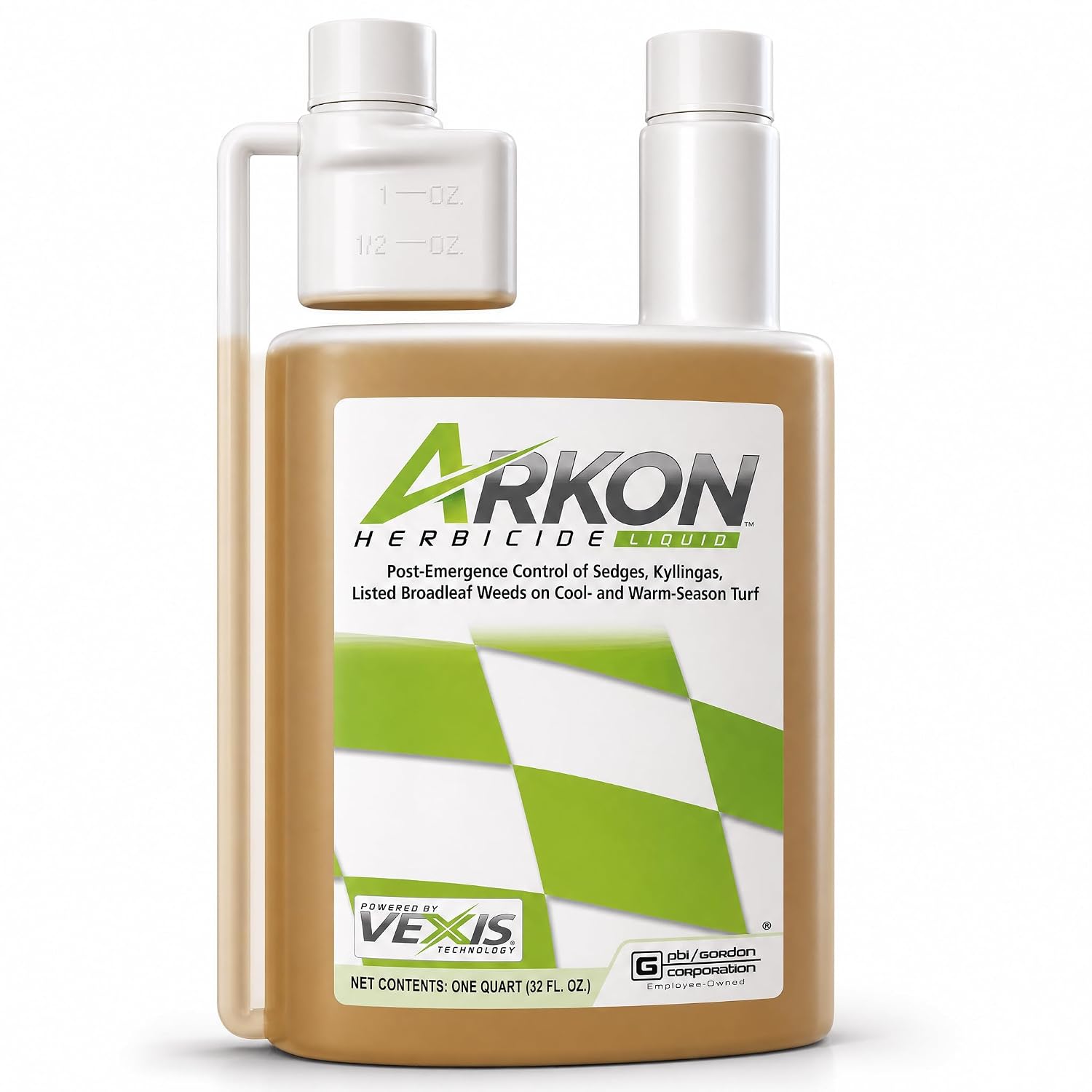
| Unit Count | 32 Fluid Ounces |
|---|---|
| Coverage | Up to 26,600 sq. ft. |
| Formulation | Liquid |
| Active Ingredients | Pyrimisulfan |
PBI/Gordon Arkon is a concentrated liquid herbicide designed specifically to get at nutsedge and kyllinga by reducing underground tubers and rhizomes rather than only burning back foliage. It is mixed in a pump or backpack sprayer at 1.2–1.7 fl oz per 1,000 sq ft and can treat large areas from a single quart. Typical use is one application for yellow nutsedge or two applications 4–6 weeks apart for tougher purple nutsedge and kyllinga. Notable features include a formulation that stays suspended in the tank to avoid settling or clogged nozzles, labeled tolerance for common cool- and warm-season turfgrasses, and university trial data showing substantial reductions in tuber counts and rhizome regrowth. Practical benefits are durable suppression of re-sprouting sedges, broad site labels that include residential lawns and athletic fields, and tank-mix compatibility with many partners. Important limitations are that it is a selective chemical requiring careful mixing and application within label rates, treated areas must be kept off until dry, and it is not registered for sale in certain states so local availability may vary.
Best for: Gardeners and turf managers who prioritize high-performance, long-term control of nutsedge and kyllinga in lawns and sports turf and who are comfortable following label mixing and application procedures.
Less Ideal for: Casual users seeking a nonchemical or spot-only solution or those unwilling to follow safety and re-entry precautions or to manage herbicide resistance.
- Targets underground tubers and rhizomes for longer-lasting control of nutsedge and kyllinga
- Concentrated liquid treats large areas from one quart when mixed at label rates
- Formulation stays mixed in tank to reduce settling and nozzle clogging
- Labeled for use on many common cool- and warm-season turfgrasses and a variety of sites
- Requires precise mixing and follow-up timing for toughest weeds
- Contains an ALS-inhibitor active ingredient so rotation with different modes of action is needed to manage resistance
Verdict: Choose Arkon when you need professional-strength, tuber-targeting control of nutsedge and kyllinga across large lawns and turf areas.
Sedgehammer Plus Turf Herbicide Nutsedge Killer, 13.5 g Packet (1 Pack)

| Item Form | Liquid |
|---|---|
| Coverage | 1000 square feet |
| Liquid Volume | 1 gallons |
| Item Highlight | Surfactant Built In |
Sedgehammer Plus is a packetized post‑emergent herbicide designed specifically to target purple and yellow nutsedge by moving into tubers and nutlets as well as foliage. You pour one 13.5 g packet into a gallon of water, spray actively growing nutsedge (3–8 leaf stage) and expect yellowing in 10–14 days with full control in 3–4 weeks. The packet includes a built‑in non‑ionic surfactant so no additional additive is required, and one prepared gallon treats about 1,000 sq ft. It is labeled for use on many common warm‑ and cool‑season grasses when applied as directed, and it also controls a range of other weeds. Practical users will appreciate the premeasured dosing and selective action that reduces impact on established turf. Limitations: you must spray in the correct growth window, avoid mowing 2 days before and after treatment, do not apply if rain is expected within 4 hours, and reapplication every 6–10 weeks may be needed for stubborn infestations. Keep people and pets off treated areas until spray is dry.
Best for: Gardeners who want a practical, no‑fuss solution to remove nutsedge from established lawns and prefer premeasured dosing and predictable, selective control.
Less Ideal for: Large commercial applicators who need bulk concentrated formulations or users who require treatment for turf types not listed on the label such as putting greens.
- Premeasured packet with built‑in surfactant eliminates measuring and extra additives
- Systemic activity reaches tubers and nutlets for more complete nutsedge control
- Covers 1,000 sq ft per packet when mixed as directed
- Selective on a wide range of established turfgrass species when used per label
- Also controls about 19 additional broadleaf and grassy weeds
- Requires application at specific growth stages and timing rules for best results
- Mixed solution should be sprayed immediately and cannot be stored
- Not labeled for use on golf course putting greens
Verdict: If you want a simple, premeasured post‑emergent that reaches nutsedge tubers and treats 1,000 sq ft per gallon, Sedgehammer Plus is a practical choice.
Spectracide Weed Stop for Lawns Concentrate, 32 oz Ready-to-Spray

| Coverage | 8,000 square feet |
|---|---|
| Liquid Volume | 32 fluid ounces |
| Item Form | Liquid |
| Active Ingredients | 2,4-D, Mecoprop-P, Dicamba, Sulfentrazone |
Spectracide Weed Stop for Lawns is a hose-attach ready-to-spray concentrate designed to control broadleaf weeds across common turf types. It kills by contact and down to the root, listing over 460 weeds such as clover, dandelion and chickweed, and promises visible browning in around three hours. The QuickFlip sprayer makes treatment fast for larger yards and the formula is labeled for use on bluegrass, fescue, Bermuda and perennial rye, though you should avoid zoysiagrass coming out of dormancy and not spray above 90°F. Practical benefits include quick application without mixing and one-hour rainproofing so treatments are less weather-dependent. Important limitations are temperature restrictions for safe use, the need to keep people and pets off the lawn until dry, and the usual reseeding wait time of three to four weeks. For homeowners focused on routine clover control, this product offers a straightforward, time-saving option, but follow label directions closely to protect desirable turf and nearby plants.
Best for: Homeowners who want an inexpensive, no-mix solution to knock back clover and other broadleaf weeds quickly across a typical lawn and value fast application.
Less Ideal for: Gardens that need constant reseeding, very young lawns or yards with delicate ornamentals close to treatment areas should consider more targeted options.
- Ready-to-spray QuickFlip hose attachment speeds up application for medium to large lawns
- Kills broadleaf weeds including clover, dandelion and chickweed with visible results in about three hours
- Rainproof in one hour which reduces the chance of losing treatment to light rain
- Works on a variety of common turf types when used as directed
- Should not be applied when daytime temperatures exceed 90°F which limits use in hot weather
- Requires waiting 3–4 weeks before reseeding treated areas
Verdict: A convenient ready-to-spray concentrate that quickly controls clover and other broadleaf weeds for budget-minded homeowners who want fast, low-effort treatments.
Sedgehammer Nutsedge Herbicide 1.33 oz (makes ~40 gal)

| Unit Count | 1.33 Ounce |
|---|---|
| Item Form | Granule |
| Coverage | 1,000 sq ft per gallon of mix |
| Active Ingredients | Halosulfuron-methyl |
Sedgehammer is a concentrated post-emergent herbicide designed specifically for nutsedge control in lawns and large turf areas. You mix a measured scoop into a gallon of water (measuring spoon included), add a non-ionic surfactant, and spray to cover about 1,000 sq ft per gallon; one 1.33 oz bottle makes roughly 40 gallons of spray. The active ingredient, halosulfuron-methyl, translocates to tubers and nutlets so treated nutsedge typically yellows in 10 to 14 days with full decline in about 3 to 4 weeks. It is labeled for many common turfgrasses and is suitable for homeowner and commercial use where selective control of nutsedge is needed. Practical benefits include low use rate for treating large areas, clear mixing and timing guidance, and reasonable rainfastness once dry. Important limitations are that the product must be mixed fresh and used the same day, needs a surfactant to work properly, and requires careful timing around mowing and rain; it is not intended for putting greens or non-listed turf types.
Best for: Buyers who prioritize a reliable, turf-safe solution for persistent nutsedge across medium to large lawns or commercial turf and value a product with proven, targeted activity.
Less Ideal for: People with very small yards who prefer ready-to-use sprays or those treating sensitive turf types not listed on the label should consider other options.
- Formulated to reach nutsedge tubers and nutlets for longer-term control
- Very concentrated so one bottle makes about 40 gallons of spray, covering large areas
- Includes measuring scoop and has clear mixing directions for consistent application
- Selective on many established turfgrass species when used as directed
- Rainfast after about 4 hours, allowing some scheduling flexibility
- Must be mixed fresh and will degrade within 24 hours so leftover spray cannot be stored
- Requires adding a non-ionic surfactant for effective uptake through waxy leaves
- Not labeled for golf course putting greens and may be unsuitable for unlisted turf types
Verdict: Choose Sedgehammer when you need a concentrated, turf-safe nutsedge killer that reaches tubers for dependable long-term control across large lawns.
Ortho Nutsedge Killer for Lawns Ready-To-Spray, 32 fl. oz.

| Unit Count | 32 Fluid Ounces |
|---|---|
| Coverage | 5000 square_feets |
| Item Form | Spray |
| Active Ingredients | Sulfentrazone |
Ortho Nutsedge Killer for Lawns is a hose-end ready-to-spray herbicide designed to target nutsedge, kyllinga and a long list of other sedge and broadleaf weeds while leaving established turfgrass intact. You connect your garden hose to the built-in sprayer, flip the thumb activation on and apply evenly over the affected area; a 32 fl. oz. bottle treats up to about 5,000 sq. ft. The active ingredient is sulfentrazone, which is effective on stubborn sedges and several broadleaf weeds such as spurge, dandelion and plantain. Practical benefits include the convenience of a no-mix hose applicator, clear directions for common lawn grasses and coverage suitable for medium lawns. Important limitations are that it must not be used on newly planted or sodded turf, and it should not be sprayed on ornamentals, flowers or vegetables; treated areas must stay off-limits to children and pets until dry and application in windy conditions is discouraged. For homeowners who prefer an easy hose-end solution, this product simplifies spot and area treatments for spurge and similar weeds.
Best for: Homeowners who want a convenient, low-effort spray to control nutsedge and spurge in established lawns and who prioritize products with clear label directions and documented performance.
Less Ideal for: Gardeners establishing new turf, those who need a herbicide for ornamentals or edible beds, and users wanting a granular or non-chemical option for spurge control.
- Ready-to-spray hose-end applicator for simple, no-mix application
- Active ingredient sulfentrazone targets nutsedge, kyllinga and many broadleaf weeds including spurge
- Covers up to 5,000 sq. ft. from one 32 fl. oz. bottle
- Label lists both cool- and warm-season turfgrasses where product is safe to use
- Not safe for newly planted, plugged or sodded turf or for use on ornamentals, flowers or vegetable beds
- Requires keeping children and pets off treated areas until sprays have dried
Verdict: A convenient hose-end sulfentrazone formula that makes targeting nutsedge and spurge in established lawns quick and easy.
Choosing the Right Weed Killer for Nutsedge: Key Factors to Consider
Mode of Action Against Sedge
Nutsedge responds differently to herbicides than broadleaf weeds or grassy weeds because of its tuberous root system and C4 physiology. Understanding whether a product is systemic or contact matters. Systemic herbicides move into underground tubers and rhizomes and offer longer-term control if allowed time to translocate, while contact products only kill exposed foliage and often require repeated applications.
Pick formulations with a documented effect on sedge physiology when your goal is long-term control. If you need rapid visible knockdown for near-term cleanup, a contact option can help, but expect to follow up with a systemic treatment to reduce regrowth from tubers.
Turf and Landscape Safety
Lawns and planting beds contain desirable grasses and ornamentals that can be sensitive to sedge treatments. Choose products labeled safe for your turfgrass species and for nearby ornamentals. Some effective sedge herbicides are selective for certain warm-season or cool-season grasses, while others carry a risk of temporary discoloration or thinning if environmental stress is present.
Application timing and weather also influence safety. Avoid treating during drought stress, heat spikes, or immediately after other surfactant or fertilizer applications. Always follow label directions for application rates and lateral drift precautions to protect sensitive plants.
Application Method and Timing
How you apply a weed killer affects results. Many nutsedge treatments work best when applied to actively growing sedge, typically in warm months when foliage is expanding. Follow label guidance on nozzle selection, spray volume, and whether to apply with a surfactant. Handheld sprayers, pump-up units, and hose-end applicators each deliver different levels of coverage control.
Timing between applications matters too. Some treatments require a single application with a long uptake window, while others need repeat treatments spaced days or weeks apart. Consider your ability to monitor the lawn and reapply when planning control efforts.
Residual Control and Reinfestation Risk
Nutsedge spreads from tubers and can reinfest treated areas if residual activity is short. Products with residual soil activity can suppress new shoots emerging from nearby tubers for a period after application, reducing the frequency of repeat treatments. However, residual herbicides may have constraints near water or desirable plants and can limit replanting choices.
Weigh the benefit of longer residual control against any restrictions on seeding, sod installation, or planting after treatment. In high-infestation sites, residual protection can be a major advantage for minimizing repeated labor.
Environmental and Label Restrictions
Label restrictions are practical limits that affect where and when a treatment can be used. Look for setbacks from water bodies, limits on aquatic use, required personal protective equipment, and re-entry intervals. Some effective sedge herbicides cannot be used in or near irrigation ditches, ponds, or storm drains.
Regulatory or environmental constraints can make an otherwise effective product unsuitable for certain gardens or properties. Read label directions for protective measures to reduce off-target movement and protect pollinators and aquatic life when relevant.
Cost and Repeat Application Burden
Cost matters less as a product trait than how often you must apply. A lower-cost contact spray that needs frequent follow-ups can cost more in time and materials than a single, slightly pricier systemic treatment. Consider the labor and materials cost of follow-up applications, tank-mixing needs, and equipment wear.
Also factor in how much treated area you have. Some products are sold in concentrated form and cover large areas economically, while ready-to-use options are convenient for small spots but scale poorly to large lawns.
When to Treat Nutsedge in Lawns
Treat nutsedge when plants are actively growing and producing visible shoots. For many regions that means warm-season months when sedge foliage is most vigorous and herbicide translocation to tubers is effective. Applications during dormancy or severe stress usually produce poor control.
For spot treatments, treat individual clumps as soon as they appear and monitor for regrowth. For larger infestations, plan a treatment sequence that includes initial knockdown followed by follow-up applications or cultural adjustments to reduce moisture and shading that favor sedge.
- Apply on warm, calm days when turf is not heat or drought stressed.
- Avoid mowing immediately before or after application to allow leaves to uptake herbicide.
- Mark treated areas to track regrowth and timing for any follow-up sprays.
Cultural Practices That Reduce Nutsedge Pressure
Cultural controls lower the workload for chemical treatments. Nutsedge thrives in compacted, poorly drained, or overwatered soils. Improving drainage, reducing irrigation frequency, and correcting low spots can make the site less hospitable to sedge tuber sprouting.
Improving turf density through proper fertilization, overseeding, and timely mowing height reduces space available for nutsedge to establish. In beds, a thicker layer of mulch and attention to irrigation timing can limit sedge emergence and reduce the need for repeated herbicide use.
- Improve drainage by aerating compacted lawns and filling low areas.
- Irrigate deeply and infrequently rather than frequent shallow watering.
- Maintain appropriate mowing height for your grass species to shade out seedlings.
Safe Application Near Ornamental Beds
When treating nutsedge near ornamentals, protect non-target plants by using shielded sprayers or low-drift nozzles and by applying products labeled for ornamentals. Avoid broadcast spraying where drift could damage leaf tissue on sensitive species.
For edge treatments, consider spot-spraying sedge clumps rather than blanket applications. Rinse sprayers after use and avoid tank mixes unless the label explicitly permits them to prevent accidental phytotoxicity.
- Use a targeted hand wand for clump treatments adjacent to ornamentals.
- Keep a water source on hand to rinse accidental spray from plant foliage quickly.
Integrating Chemical and Nonchemical Controls
Combine treatments with cultural fixes for better long-term results. Use herbicide applications to reduce existing nutsedge populations, then reinforce that control with improved drainage, adjusted irrigation, and turf management to prevent reinfestation. Nonchemical measures reduce dependence on repeated chemical use and lower environmental risk.
Monitor treated areas for new shoots and act quickly with spot treatments when necessary. Over time, a mix of approaches will typically reduce the density of tubers and the frequency of interventions required.
- After chemical treatment, reseed or overseed thin areas to improve competition against nutsedge.
- Use mulches in beds to suppress small sedge shoots that escape treatment.
Application Safety and Personal Protection
Follow label instructions for protective equipment and application precautions. Many effective sedge herbicides require gloves and eye protection during mixing and application. Avoid application on windy days and take care to prevent runoff into storm drains and water features.
Store concentrates securely and keep pets and children off treated areas until the re-entry interval has passed. Proper handling reduces the risk of accidental exposure and off-target damage in the landscape.
- Wear protective gloves and eye protection when mixing concentrates.
- Do not apply before heavy rain is expected to avoid runoff.
How We Chose the Best Weed Killer for Nutsedge
We focused on products and formulations with documented activity specifically against nutsedge rather than broad-spectrum herbicides only. Priority went to treatments with a clear mode of action that targets sedge physiology and to formulations that allow accurate, repeatable application in lawns, beds, and container plantings. We evaluated turf and ornamental safety based on common landscape grasses and bedding plants, emphasizing options that limit yellowing or thinning when used at recommended rates. Practicality in the field was important. We favored treatments that deliver reliable coverage, have manageable reapplication windows, and can be applied by homeowners with typical garden equipment. Persistence and residual activity were considered separately from immediate knockdown so gardeners understand when follow-up treatments are likely needed. Environmental and user-safety characteristics also informed selection, including label constraints for water proximity and re-entry intervals. Exclusions: products intended only for agricultural row-crop use, experimental formulations without public label guidance, and non-chemical control measures were not included in the shortlist. The resulting criteria focused on mode of action against sedges, turf safety, application practicality, persistence, and safety/label restrictions.
FAQ
Can I treat nutsedge without harming my lawn?
Often you can if you choose a product labeled for use on your turf species and follow application rates and timing. Turf safety depends on grass type, environmental stress, and correct application. Doing spot treatments and avoiding application during heat or drought reduces risk to the lawn.
How soon will I see results after applying a nutsedge treatment?
Visible foliar yellowing or dieback can appear within days for contact products and within one to three weeks for systemic options as the herbicide translocates to tubers. Full control may require additional follow-up treatments depending on infestation severity.
Will one treatment get rid of the tubers?
Not always. Tubers can survive and resprout, so systemic products that translocate to underground storage organs increase the likelihood of tuber mortality. In heavier infestations multiple treatments and cultural measures are usually necessary to reduce tuber populations over time.
Is it safe to use sedge herbicides near water features?
Some sedge-active herbicides have restrictions near water and require specific buffer distances or are not labeled for aquatic use. Check label directions for setbacks and runoff precautions before treating near ponds, streams, or storm drains.
Can I reseed or lay sod after using a nutsedge control product?
It depends on the product. Some residual treatments impose waiting periods before seeding or sodding. Read the label for replanting intervals and follow recommendations to avoid herbicide carryover that could inhibit establishment of new turf.
What cultural steps reduce nutsedge reinfestation?
Improving drainage, reducing overwatering, aerating compacted soil, and maintaining dense, healthy turf are effective cultural steps. In beds, use a thicker mulch layer and adjust irrigation timing to make conditions less favorable for sedge growth.
Final Verdict
Choosing the right weed killer for nutsedge requires balancing immediate control with long-term site management and plant safety. Prioritize products with a proven mode of action against sedge and that are labeled safe for your turf and nearby ornamentals. Combine chemical treatments with cultural practices such as improved drainage, proper irrigation, and overseeding to reduce reinfestation. Decide based on how much area you need to treat, how quickly you need visible knockdown, and whether residual soil activity fits your landscape plans. With targeted selection and careful application, you can reduce nutsedge pressure while protecting desirable plants.
