

Note: This article contains affiliate links. If you click on these links and make a purchase, I may earn a small commission at no extra cost to you. This helps support my research and content. Read my full affiliate disclosure here.
If you share your yard with dogs, cats, or other animals, weed control becomes a health as well as a landscape issue. Using the wrong herbicide can expose curious pets to toxic residues, so choosing an option formulated or appropriate for pet areas matters. This guide covers six shortlisted weed killers for pets, selected for lower acute toxicity, clear use instructions, and real-world effectiveness on common lawn and garden weeds. We evaluate safety profiles and weed control performance to help you pick a product that protects both your plants and your animals. Below are our top picks followed by practical guidance on application, timing, and pet-safe yard care.
Top Picks at a Glance
| Best Overall The best all-around choice for most situations | Natural Elements Ready-to-Use Weed Killer (1 Gallon) |  |
| Best Quality Built to a higher standard if you want something more solid | ECO Garden PRO Organic Vinegar Ready‑to‑Use Weed Killer (1 Gallon) |  |
| Best Value The sweet spot between price and what you get | Spruce Snap & Spray Weed & Grass Killer Starter Kit, 64 oz |  |
| Best Budget The cheapest option that still gets the job done reliably | Pulverize Weed & Grass Killer, Ready-to-Use 1 Gallon (Messinas) |  |
| Highest Rated A top-rated pick with lots of positive feedback | Spruce Weed & Grass Killer Kit with Power Wand and 64 oz Refill |  |
| Most Popular A crowd favorite that many people choose with confidence | Spruce Weed & Grass Killer Refill, Ready-to-Use 64 oz |  |
Natural Elements Ready-to-Use Weed Killer (1 Gallon)

| Unit Count | 128 Fluid Ounces |
|---|---|
| Item Form | Spray |
| Coverage | Most broadleaf weeds and grasses |
| Active Ingredients | Sodium Chloride, Salt Water, Commercial Vinegar, Soap |
This one-gallon ready-to-use bottle is a vinegar- and salt-based herbicide intended for spot treatment of unwanted weeds, grasses, moss and algae on hardscape and landscaped areas. You spray targeted plants until wet and they wilt within a short period, which makes it useful for patios, driveways, gravel, fence lines and mulched beds. The formula contains commercial vinegar, sodium chloride and soap, so there is no synthetic herbicide to mix and no special application equipment required. Practical benefits include immediate ease of use, a large volume for treating multiple areas, and a product description that highlights pet and child safety after the treated surface has dried. Important limitations are that it will also kill desirable grass and can damage nearby plants if oversprayed, and it is not an EPA‑registered conventional herbicide which may affect expectations for long-term control compared with systemic products.
Best for: People who want a simple, low-chemical option to remove visible weeds from hard surfaces and non-lawn areas and who prioritize quick results and ease of use.
Less Ideal for: Homeowners seeking long-term root-level control of weeds in lawns or gardeners who need a selective herbicide for beds with desirable plants should consider alternative products or targeted mechanical removal.
- Ready-to-use spray requires no mixing or special equipment
- Large one-gallon volume covers multiple treatment areas
- Active ingredients are vinegar and salt rather than synthetic herbicides
- Works on a broad range of broadleaf weeds, grasses, moss and algae
- Non-selective and will damage desirable turf and nearby plants if not applied carefully
- Provides contact burn rather than long-term systemic control
Verdict: Choose this ready-to-use vinegar-based spray when you need an easy, pet-friendly option to quickly remove visible weeds from driveways, patios and non-lawn areas.
ECO Garden PRO Organic Vinegar Ready‑to‑Use Weed Killer (1 Gallon)

| Unit Count | 128 Fluid Ounces |
|---|---|
| Item Form | Liquid |
| Coverage | 1000 square_feet |
| Active Ingredients | Sodium Chloride |
This 1-gallon ECO Garden PRO formula is a ready-to-use, contact herbicide that combines white vinegar and sodium chloride to rapidly desiccate weed foliage. It is applied with a sprayer directly to leaves on warm sunny days and typically shows visible browning within 24–48 hours. The product is useful for clearing weeds on driveways, sidewalks, mulch beds, and around hardscapes where root kill is not required. Its main strengths are ease of use and an organic-lean ingredient list that avoids synthetic glyphosate, making it a practical choice for outdoor areas where pets and children frequent. Coverage is listed at about 1000 square feet per gallon, so one container handles small to medium jobs without mixing. Limitations are that it is a foliar contact killer rather than a systemic herbicide, so deep-rooted or perennial weeds may regrow and repeat applications or mechanical removal may be needed. Also it should not be applied to desirable lawn or garden plants because it will damage foliage on contact, and it requires warm, dry conditions to work best.
Best for: Buyers who prioritize fast, non-synthetic weed control around patios, driveways, and high‑traffic areas where pet and child safety matters and who plan to spot-treat rather than manage deep-rooted perennials.
Less Ideal for: Home gardeners seeking a long‑term systemic solution for perennial weeds or those who need a selective herbicide safe for lawns and desirable plants should consider different products.
- Ready-to-use sprayable liquid for immediate application with no dilution required
- Organic-lean active ingredients (vinegar and sodium chloride) avoid synthetic herbicides
- Works quickly on contact with visible results in 24–48 hours under recommended conditions
- Suitable for hard surfaces and non‑plant areas around homes where pet and child safety is a priority
- Contact-only action so it does not reliably kill roots of perennial weeds
- Performance depends on warm, sunny, and dry weather for best results
Verdict: Choose this product if you want a quick, ready-to-use, non‑synthetic contact weed killer for spot treatments in pet- and child‑frequent outdoor areas.
Spruce Snap & Spray Weed & Grass Killer Starter Kit, 64 oz

| Unit Count | 64 Fluid Ounces |
|---|---|
| Item Form | Spray |
| Coverage | 1 bottle treats up to 400 weeds |
| Active Ingredients | Sodium Lauryl Sulfate, Geraniol, Cornmint Oil |
This Spruce Snap & Spray starter kit pairs a 64 oz refill bottle with a reusable snap-on wand to deliver a no-mess, ready-to-use weed and grass killer for spot treatment. It works on contact, dehydrating plants so you can see darkening or wilting within an hour and complete dieback often by 24 hours. Use it on driveways, pavers, walkways, mulch beds and garden edges by holding the nozzle about a foot from the weed and thoroughly wetting leaves and stems. The formula is water-based and uses sodium lauryl sulfate, geraniol and cornmint oil instead of glyphosate, and the brand states it is safe around people and pets when used as directed. The powered wand and EZ-AIM options make precision spraying easier for cracks and tight spots, and one bottle claims coverage for up to 400 weeds. Limitations include the need to avoid desirable plants and lawns, follow temperature and dry-weather application guidance, and the spray may take extra priming on first use or between uses.
Best for: Buyers who prioritize a pet-conscious, practical approach to spot-treating weeds around yards and hardscapes and want an easy-to-use, ready-made spray system for targeted applications.
Less Ideal for: People looking for a lawn-wide systemic herbicide or a long-term preemergent solution should consider other products; those needing broadcast treatment of large turf areas will find this kit unsuitable.
- Ready-to-use kit with a reusable snap-on wand for no-mix, no-pour application
- Plant-based active ingredients reduce reliance on harsh synthetic herbicides
- Visible results often within one hour and full effect by 24 hours when used as directed
- Designed for precision spot treatments on hardscapes, mulch beds and garden edges
- One 64 oz bottle claims coverage up to about 400 weeds
- Not labeled for broadcast use on lawns so it is for spot treatment only
- Must be applied in dry, warm conditions and may require reapplication for persistent weeds
- Sprayer can take time to prime on first use or between applications
Verdict: A convenient, pet-conscious ready-to-use spray kit ideal for precise spot treatment of weeds on hardscapes and beds.
Pulverize Weed & Grass Killer, Ready-to-Use 1 Gallon (Messinas)

| Unit Count | 128 Fluid Ounces |
|---|---|
| Item Form | Spray |
| Liquid Volume | 1 gallons |
| Active Ingredients | Maleic hydrazide |
| Coverage | Up to 250 sq.ft. (Gallon Ready to Use) |
This ready-to-use Pulverize Weed & Grass Killer is designed for homeowners who need a fast, no-mix solution for weeds on patios, driveways, and garden edges. You spray directly onto foliage and the formula begins drying weeds within hours, making it useful for spot treatments and clearing hardscape cracks. The product is non-selective so it will kill any plant it contacts, and the label highlights control of common annual weeds, moss, algae, and lichens. The formula is described as made from naturally derived ingredients and approved for organic gardening, which reduces concerns about heavy synthetic chemicals and makes it easier to use around family areas once treated surfaces have dried. Important trade-offs are that it will damage desirable plants if oversprayed and that repeat applications every 2 to 3 weeks are recommended for new growth; rain within a few hours can require reapplication. For small to medium problem areas this gallon size gives broad coverage without mixing, but users should follow safety directions to avoid skin or eye contact.
Best for: Homeowners who need an affordable, easy-to-use herbicide for spot-treating driveways, patios, and edges and who prioritize friendlier, naturally derived ingredients around pets.
Less Ideal for: Gardeners wanting a selective lawn-safe product to preserve turf or those who need a systemic, long-term single-application control for deep perennial roots.
- Ready-to-use spray requires no measuring or mixing
- Fast-acting formula shows visible weed dieback within hours
- Naturally derived active ingredient intended for pet- and family-friendlier use once dry
- Effective on a broad range of annual weeds plus moss, algae, and lichens
- Non-selective formula will kill desirable plants if contacted
- May require repeat applications every 2–3 weeks for new growth
Verdict: A convenient, pet-friendlier ready-to-use herbicide for quickly clearing weeds and hardscape growth without mixing.
Spruce Weed & Grass Killer Kit with Power Wand and 64 oz Refill

| Unit Count | 64 Fluid Ounces |
|---|---|
| Coverage | 1 bottle treats up to 400 weeds. |
| Item Highlight | Pet Safe Weed Killer Spray, Reusable Weed Sprayer, 2 AA Batteries Included |
This Spruce kit pairs a 64 oz ready-to-use herbicide with a rechargeable-style battery powered wand for easy spot treatment of broadleaf and grassy weeds. It is designed for precision spraying around driveways, pavers, mulch beds, and garden edges rather than broadcast application on lawns. The formula uses water, essential oils, and a surfactant and starts showing leaf darkening or wilting within an hour, with complete weed death often by 24 hours. The included power wand and two AA batteries make it simple to prime and spray from a 12-inch distance, and the wand is intended to be reusable for multiple seasons. Practical benefits include no mixing or measuring, clear directions for rainproofing after about 10 minutes, and labeling that says it is safe around people, pets, and bees when used as directed. Limitations are that the product is non-selective so it will damage desirable plants if oversprayed and it should not be applied on lawns; weather conditions and careful aim are important to avoid drift and accidental contact with wanted vegetation.
Best for: Buyers who prioritize consistent, easy spot control of weeds around patios, pavers, and garden beds and who want a simple, ready-to-use solution they can rely on without mixing chemicals.
Less Ideal for: People who need a selective lawn treatment or who want to treat large turf areas should consider products designed specifically for lawns or professional services.
- Ready-to-use formula requires no mixing or measuring for quick spot treatments
- Visible effects within about 1 hour and full kill often by 24 hours
- Comes with a battery-powered wand for controlled, precision spraying
- Formulated to be rainproof within roughly 10 minutes for greater reliability after application
- Non-selective formula will harm desirable plants if sprayed accidentally
- Not intended for broadcast lawn use so larger infestations may require many applications or other methods
Verdict: A dependable, ready-to-use spot-treatment kit that delivers fast visible results and pet-friendly labeling when used as directed.
Spruce Weed & Grass Killer Refill, Ready-to-Use 64 oz
| Unit Count | 64 Fluid Ounces |
|---|---|
| Coverage | 1 bottle treats up to 400 weeds |
| Item Form | Spray |
| Active Ingredients | Sodium Lauryl Sulfate, Geraniol, Cornmint Oil |
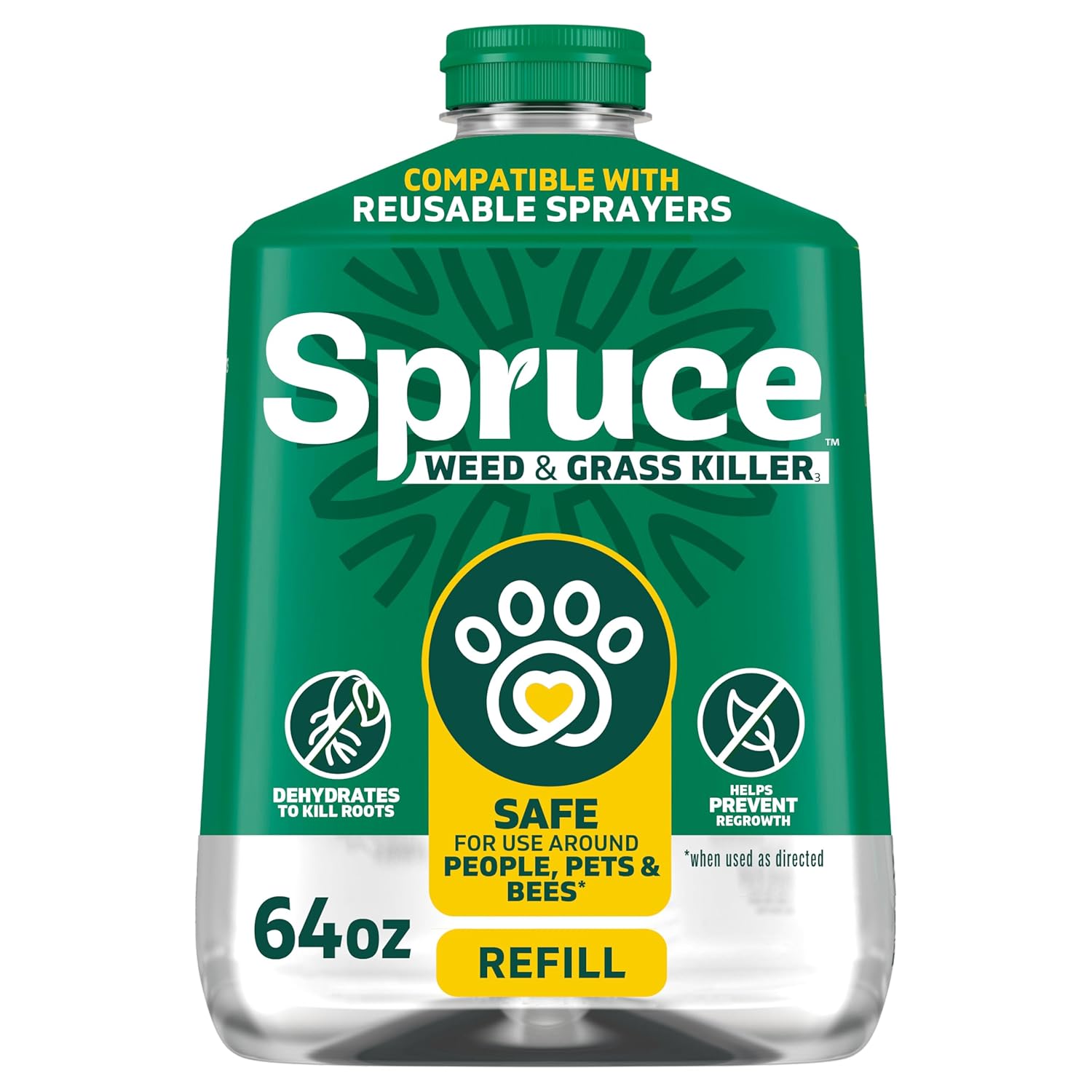
This 64 oz Spruce refill is a no-mix, snap-on replacement for the brand's Snap & Spray system that makes spot treatment fast and simple. It is formulated with water, essential oils (geraniol and cornmint oil) and a surfactant so it works on contact to dehydrate and kill broadleaf and grassy weeds, with visible leaf damage within an hour and expected death by 24 hours. Typical use is spraying individual weeds in mulch beds, driveways, pavers and walkways or refilling the powered wand for precision shots into cracks and edges. The product is designed to be rainproof within 10 minutes and is supplied ready-to-use so you avoid pouring or mixing. Practical benefits include a large refill volume that treats many weeds, reduced handling of concentrated chemicals, and compatibility with Spruce applicators for targeted application. Limitations are that it is nonselective so you must avoid desirable plants and lawn areas, and it is intended for spot treatments rather than broadcast lawn control.
Best for: Homeowners who prioritize safer-feeling, easy-to-use spot weed control around patios, driveways and beds and who prefer products with visible social proof of effectiveness.
Less Ideal for: People seeking a selective lawn herbicide or a product for large-scale broadcast weed control should look for lawn-specific solutions instead.
- Ready-to-use refill eliminates mixing and pouring, reducing user exposure
- Visible results in about one hour and full effect often by 24 hours
- Formulated with water and essential oils rather than synthetic herbicides
- Compatible with Spruce Snap & Spray and EZ-AIM applicators for precise targeting
- Nonselective formula can damage nearby desirable plants if oversprayed
- Designed for spot treatment and hardscapes, not for whole-lawn application
Verdict: Choose this refill if you want a large ready-to-use, pet-friendly-feeling spot weed killer that connects to Spruce applicators for fast, targeted results.
Choosing the Right Weed Killer for Pets: Key Factors to Consider
Active Ingredient and Toxicity
Understanding the active ingredient is the first step toward a safer choice. Different herbicides have different modes of action and toxicity to animals. Some active ingredients have lower acute toxicity but still require precautions; others may be highly effective yet carry significant risk if pets contact treated foliage or ingest residues.
Look for products with transparent labeling about animal toxicity and avoid options that explicitly warn against use in areas where pets roam. Keep in mind that 'natural' or botanical ingredients are not automatically safe for animals, so read the MSDS or label safety statements when available.
Residual Hazard and Re-Entry Time
Residual hazard refers to how long treated surfaces remain unsafe after application. Some herbicides bind to soil or leave residues on plant material that can persist for days. Re-entry times are often specified on labels and should be followed strictly to prevent pet exposure.
Shorter residual periods reduce the time you must restrict pet access. For pets that frequently patrol the yard, choose products with minimal residual hazard or ones that have clear guidance for rinsing or sheltering animals until it is safe.
Target Weeds and Spectrum of Control
Different products control different types of weeds. Broadleaf weed controls are useful for dandelion and clover, while grassy weed controls target crabgrass and foxtail. Some formulations are selective for lawns, others are nonselective and will damage desirable plants.
Match the product spectrum to the weeds you actually have. A selective herbicide that spares turf but knocks back broadleaf weeds can reduce the need for spot treatments that raise exposure risk.
Application Method and Equipment
Application method dictates how easy it is to get consistent coverage and how much risk there is of accidental exposure. Ready-to-use sprayers and granular formulations minimize mixing errors but may offer less flexibility. Concentrates require dilution and careful measuring.
Consider what equipment you already own and how comfortable you are with measuring and applying liquids. Also think about drift risk when spraying near pet areas, and whether spot treatment tools could reduce unnecessary coverage.
Label Instructions and Safety Steps
Labels provide specific instructions on pet re-entry, cleanup, and what to do if animals contact treated areas. Clear, practical label directions make a product easier and safer to use. Important label details include recommended waiting periods, wash-down instructions if pets contact treated vegetation, and instructions for disposing of containers.
Products with ambiguous or overly technical labels are harder for home gardeners to use safely. Favor options that give straightforward, actionable steps for keeping pets safe after treatment.
Environmental Persistence and Soil Movement
Some herbicides move in soil or persist long enough to affect roots of nearby desirable plants and occasionally create contact risks for pets digging in treated soil. Persistence influences how often you need to retreat problem areas and whether applications near garden beds or playground areas are appropriate.
Evaluate whether the chemistry is known to leach or bind to soil, and choose products with minimal mobility if your yard has many pet-activity hotspots or if you plan to replant treated areas soon.
When to Use Spot Treatment Versus Whole-Lawn Applications
Spot treatment limits exposure by targeting only the weeds you can see, which reduces the amount of herbicide used and the number of places pets might contact residue. Use spot treatment for isolated patches or single weeds in the lawn or garden beds.
Whole-lawn applications can be practical for large, uniform weed problems but require more planning to keep pets away during the hazard period. If you choose a broadcast approach, schedule treatment for times when you can confine animals until the labeled safe interval has passed.
- Spot treatment is best for small, scattered weeds and busy pet households.
- Broadcast treatment is efficient for widespread infestations but needs stricter re-entry control.
Timing Applications Around Pet Routines
Plan weed control when you can keep pets indoors for the recommended re-entry period. Early morning or late evening treatments are common, but the key is being able to restrict access for the time specified on the product label.
Avoid treating just before heavy rain if the label warns against it, and consider that some drying times are necessary for residues to settle. Also, do not let pets into treated areas until surfaces are dry if the label specifies this condition.
- Treat when you can monitor and control pet movement for the required interval.
- Check weather to avoid rain that might spread or wash residues unpredictably.
Rinsing, Washing, and Reducing Contact Risk
If pets contact treated foliage, rinse fur and paws with water promptly. Many labels suggest washing exposed animals after contact, and doing so can reduce ingestion risk if pets groom themselves later.
For granular products, brush granules off fur or paws before washing. Keep a garden hose or pet-safe wipes handy when you expect pets to re-enter treated areas soon after application.
- Rinse animals that contact treated plants as soon as practical.
- Wipe paws after walks in recently treated turf to reduce incidental ingestion.
Combining Cultural Controls with Herbicides
Cultural practices such as overseeding thin patches, maintaining correct mowing height, and improving soil fertility reduce weed pressure and the need for herbicide applications. Strong, dense turf competes better with weeds and lowers repeat treatments.
Use herbicides as a targeted tool alongside these practices rather than as the sole approach. Over time, cultural care can reduce reliance on chemical controls and therefore reduce potential exposure for pets.
- Improve turf density to crowd out weeds and minimize treatments.
- Use mulches and hand-weeding in garden beds to reduce herbicide use near pet areas.
Safe Storage, Mixing, and Disposal
Store all herbicides out of reach of pets in locked cabinets or high shelves and in their original containers. Mixing concentrates should be done away from pet areas and in well-ventilated spaces to avoid accidental spills.
Rinse application equipment according to label instructions and dispose of rinse water responsibly. Never leave mixed spray or open containers within reach of animals.
- Keep products locked and out of reach when not in use.
- Follow label guidance for rinsing and container disposal to limit accidental exposures.
How We Chose the Best Weed Killer for Pets
We filtered candidates by safety profile first, prioritizing products with documented low acute toxicity to dogs and cats or formulations designed for pet-accessible lawns. We then assessed real-world effectiveness against common weeds such as dandelion, clover, crabgrass, and chickweed, looking for reliable control within a practical timeframe. Additional evaluation criteria included residual risk after application, meaning how long treated areas remain hazardous to pets; clarity and realism of label directions for re-entry and pet exposure reduction; and suitability across typical turf and garden situations, from established lawns to mulched beds. We excluded any herbicides with clear labeling that prohibits use where pets will roam or that carry high acute toxicity warnings. We also screened out products that require complex application equipment beyond a homeowner sprayer or granular spreader. The result is a set of options that balance lower-risk chemistry, documented efficacy on common weeds, and practical instructions gardeners can follow to reduce pet exposure.
FAQ
Are natural or vinegar-based weed killers safe for pets?
Natural ingredients are sometimes lower in persistent toxicity but are not always safe. High-concentration vinegar and certain botanical oils can irritate skin and mucous membranes. Follow label directions and keep pets away until surfaces dry or as instructed.
How long should I keep my pet off the grass after applying a weed killer?
Re-entry times vary by product and formulation. Many pet-safer options have short waiting periods of a few hours after drying, while others recommend 24 hours or more. Always follow the label for the specific product you use.
Can I let my pet eat grass in areas recently treated with a weed killer?
It usually depends on the product and the re-entry instructions. Avoid allowing pets to graze or eat vegetation in treated areas until the label says it is safe. If ingestion is suspected, contact a veterinarian.
Is spot spraying safer than using a spreader for granular herbicides?
Spot spraying can reduce overall chemical use and limit treated area, which may lower exposure risk for pets. Granular products have lower drift risk but granules can stick to paws or fur, so both methods require care and post-application monitoring.
What should I do if my pet walks through a freshly treated area?
If the label advises washing after contact, rinse paws and any soiled fur with water as soon as possible. If the product label recommends veterinary attention after exposure, follow that guidance. Monitor the animal for signs of distress.
Can I use the same weed control product around vegetable gardens and pet areas?
Many herbicides are not intended for use where food crops are grown. Choose products labeled for use near ornamentals and pet areas, and maintain separation between edible gardens and treated turf or beds to avoid accidental contamination.
Final Verdict
When choosing a weed killer for pets, prioritize products with lower toxicity and short residual hazards, clear label directions, and suitability for the specific weeds in your yard. Match the application method to your household routines and combine chemical control with cultural practices to reduce the frequency of treatments. By balancing safety, effectiveness, and practical use instructions, you can manage weeds while minimizing risks to animals and family members.
