

Note: This article contains affiliate links. If you click on these links and make a purchase, I may earn a small commission at no extra cost to you. This helps support my research and content. Read my full affiliate disclosure here.
If you want a tidy, weed-free lawn without harming turf, choosing a selective weed control product matters. The right weed killer removes unwanted broadleaf and grassy weeds while leaving desirable grass types healthy, and it behaves predictably across common lawn and edge conditions. This guide covers six shortlisted weed killers that kill weeds not grass and explains how they perform in real garden use. We evaluate selectivity, speed of action, application safety, and ease of use so you can pick the option that matches your lawn type and maintenance style.
Top Picks at a Glance
| Best Overall The best all-around choice for most situations | BioAdvanced All‑In‑One Lawn Weed and Crabgrass Killer Concentrate, 40 oz |  |
| Best Quality Built to a higher standard if you want something more solid | Roundup For Lawns Ready-to-Use Weed Killer with Extended Wand, 1.33 gal |  |
| Best Value The sweet spot between price and what you get | Spectracide Weed Stop for Lawns Concentrate, 40 fl oz |  |
| Best Budget The cheapest option that still gets the job done reliably | Spectracide Weed Stop for Lawns Plus Crabgrass Killer, Ready-to-Use, 1 Gal |  |
| Highest Rated A top-rated pick with lots of positive feedback | Tenacity Turf Herbicide, 8 fl oz |  |
| Most Popular A crowd favorite that many people choose with confidence | Scotts Liquid Turf Builder Plus 2 Weed Control, Ready-to-Spray, 32 fl. oz. |  |
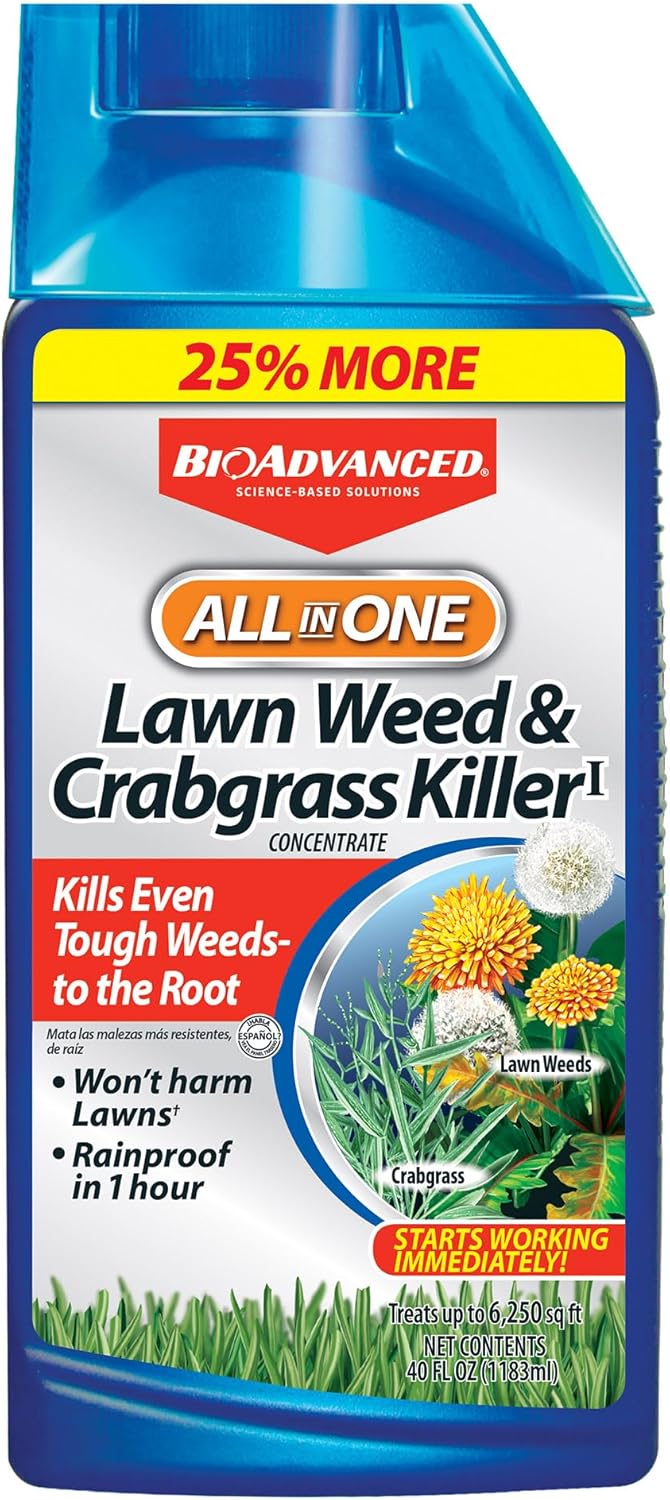
BioAdvanced All‑In‑One Lawn Weed and Crabgrass Killer Concentrate, 40 oz
| Unit Count | 40 Fluid Ounces |
|---|---|
| Item Form | Spray |
| Coverage | 6250 square_feet |
| Liquid Volume | 40 fluid ounces |
| Active Ingredients | Herbicide |
This BioAdvanced concentrate is designed to be mixed with a hose-end sprayer and applied across lawns to target broadleaf weeds and crabgrass down to the root. It combines three active herbicides to control more than 200 listed weeds including dandelions, clover, foxtail and crabgrass, and the formula becomes rainproof in about one hour which helps protect treatments from light rain after application. Typical use is applying 3.2 fl oz per 1,000 sq ft on small actively growing weeds at temperatures below 90°F and avoiding certain grass types named on the label. The main practical benefits are wide weed coverage from a single product and concentrated packaging that treats large areas (listed coverage ~6,250 sq ft). Important limitations are label restrictions for some warm‑season grasses and the need for careful mixing and nozzle setup; it is not for use on St. Augustine, Bahiagrass, Carpetgrass, Centipedegrass or Dichondra and requires following safety directions to keep children and pets away.
Best for: Gardeners who want a single, broad‑spectrum product to remove common lawn weeds and crabgrass across medium to large lawns and who follow label directions carefully.
Less Ideal for: Owners of lawns made of St. Augustinegrass, Bahiagrass, Carpetgrass, Centipedegrass or Dichondra, or anyone unwilling to mix and apply a concentrated herbicide per label instructions.
- Concentrated formula covers large areas with a single bottle (listed coverage ~6,250 sq ft).
- Kills a wide range of weeds and crabgrass down to the root thanks to multiple active ingredients.
- Becomes rainproof in about one hour so light rain soon after application is less likely to wash it away.
- Designed for hose‑end application which simplifies treating an entire lawn.
- Not safe for several grass types listed on the label so must be avoided on those lawns.
- Requires precise dilution and application timing to avoid turf injury and to be effective.
Verdict: A concentrated, hose‑applied formula that kills a broad range of lawn weeds and crabgrass while protecting many grass types when used exactly as directed.
Roundup For Lawns Ready-to-Use Weed Killer with Extended Wand, 1.33 gal

| Unit Count | 170.24 Fluid Ounces |
|---|---|
| Item Form | Spray |
| Coverage | Lawn Weeds & Bugs |
| Active Ingredients | MCPA, Quinclorac, Dicamba, Sulfentrazone |
Roundup For Lawns Ready-to-Use is a spot‑treatment weed killer designed for homeowners who want fast, targeted control without harming established turf. The unit attaches to a garden hose and the extended wand lets you treat weeds without bending, making it convenient for spot applications across a lawn. The formula targets more than 250 weeds including crabgrass, dandelions, clover and yellow nutsedge and begins working on contact; the label states treated areas become rainproof in about three hours. Active ingredients include MCPA, quinclorac, dicamba and sulfentrazone, which together control a broad mix of broadleaf and grassy weeds down to the root. Practical benefits are ease of use, quick action and the ability to treat small patches without broadcasting chemicals over the whole yard. Limitations are that it is a ready‑to‑use hose product so it is best for spot treatment rather than large acreage, and users should follow safety and application directions carefully because it contains multiple herbicides that require precise use around desirable plants.
Best for: Homeowners who prioritize fast, effective lawn weed control and want a convenient spot‑treatment solution that leaves turf intact.
Less Ideal for: People managing very large lawns who need broadcast or tank-mixed solutions or those seeking an organic or non-chemical approach.
- Ready-to-use hose attachment with extended wand for easy spot treatment without bending
- Formulated to control over 250 lawn weeds including hard-to-kill species like crabgrass and nutsedge
- Starts working on contact and is rainproof in about 3 hours for reliable short-term performance
- Combination of active ingredients addresses both broadleaf and grassy weeds for broad-spectrum control
- Designed primarily for spot treatments so not efficient for treating very large lawns
- Contains multiple strong herbicides so careful application is required to avoid damage to nearby plants
Verdict: Choose this ready-to-use, extended-wand weed killer when you want fast, targeted elimination of tough lawn weeds without harming the turf.
Spectracide Weed Stop for Lawns Concentrate, 40 fl oz

| Unit Count | 40 Fluid Ounces |
|---|---|
| Item Form | Liquid |
| Coverage | 20000 square_feet |
Spectracide Weed Stop for Lawns is a concentrated liquid herbicide designed to be mixed with water and applied with a garden sprayer to control more than 200 listed broadleaf weeds. It is typically used in spring or fall and works by contact to kill weeds down to the root, with visible results in hours and rainfast protection after six hours. The 40 fl oz bottle treats a large area, letting you spot-treat tough patches or cover up to 20,000 square feet when mixed at label rates. Practical points: it is fast-acting, targets common lawn invaders such as dandelion, chickweed and clover, and is intended to spare turf when applied according to directions. You should mow before treating and follow mix rates and temperature guidance for best results. Important limitations are standard for concentrates: you need a separate sprayer, correct mixing and careful application to avoid contact with desirable plants and skin, and some very persistent weeds may require a repeat spot treatment after a few weeks.
Best for: Homeowners who want an efficient, fast-acting solution to remove broadleaf weeds while preserving their lawn and who are comfortable mixing and applying a concentrate with a sprayer.
Less Ideal for: People who prefer ready-to-use products or who cannot handle mixing chemicals and using a sprayer should consider simpler pre-mixed options.
- Kills over 200 listed broadleaf weeds down to the root with visible results in hours
- Formulated to avoid harming established lawns when used as directed
- Rainproof after six hours so recent watering or light rain won’t wash it away
- Large coverage from a concentrate lets you treat up to 20,000 sq ft when mixed per label
- Requires a separate garden sprayer and correct mixing which adds setup time
- Some tough weeds may need a repeat spot treatment after several weeks
Verdict: A concentrated, fast-acting lawn herbicide that reliably kills broadleaf weeds without harming turf when mixed and applied correctly.
Spectracide Weed Stop for Lawns Plus Crabgrass Killer, Ready-to-Use, 1 Gal

| Item Form | Spray |
|---|---|
| Coverage | Up to 5,000 sq ft |
| Liquid Volume | 1 gallons |
Spectracide Weed Stop for Lawns Plus Crabgrass Killer is a one-gallon, ready-to-use spray formulated to remove more than 470 listed weed types by contact, with visible results in as little as five hours. You use it straight from the bottle to spot-treat or broadcast-spray weeds across the lawn after mowing and when temperatures are between 45 and 90°F. The formula targets both broadleaf weeds and grassy weeds such as crabgrass and yellow nutsedge and is designed to kill down to the root so regrowth is reduced. Practical benefits include no mixing, coverage up to 5,000 square feet per gallon under ideal conditions, and clear label directions about temperature limits and bermudagrass precautions. Important limitations are its contact mode of action, which works best on actively growing weeds so repeat applications may be needed for large or established patches, and the temperature restrictions that make timing important to avoid lawn stress. Follow the label for safety and timing to get the best lawn-safe results.
Best for: Homeowners who want an affordable, easy-to-use product to remove common lawn weeds quickly without complex mixing or equipment.
Less Ideal for: People with very large properties who need long‑term systemic control or professional-level blanket treatments should consider concentrated or professional products instead.
- Ready-to-use spray requires no mixing and is simple to apply
- Claims visible weed dieback in as fast as five hours
- Targets a wide range of weeds including crabgrass and yellow nutsedge
- Coverage listed up to 5,000 sq ft from one gallon under recommended use
- Kills by contact so very large or deep-rooted infestations may need repeat treatments
Verdict: A convenient, budget-friendly ready-to-use spray that quickly knocks down common lawn weeds while being simple to apply.
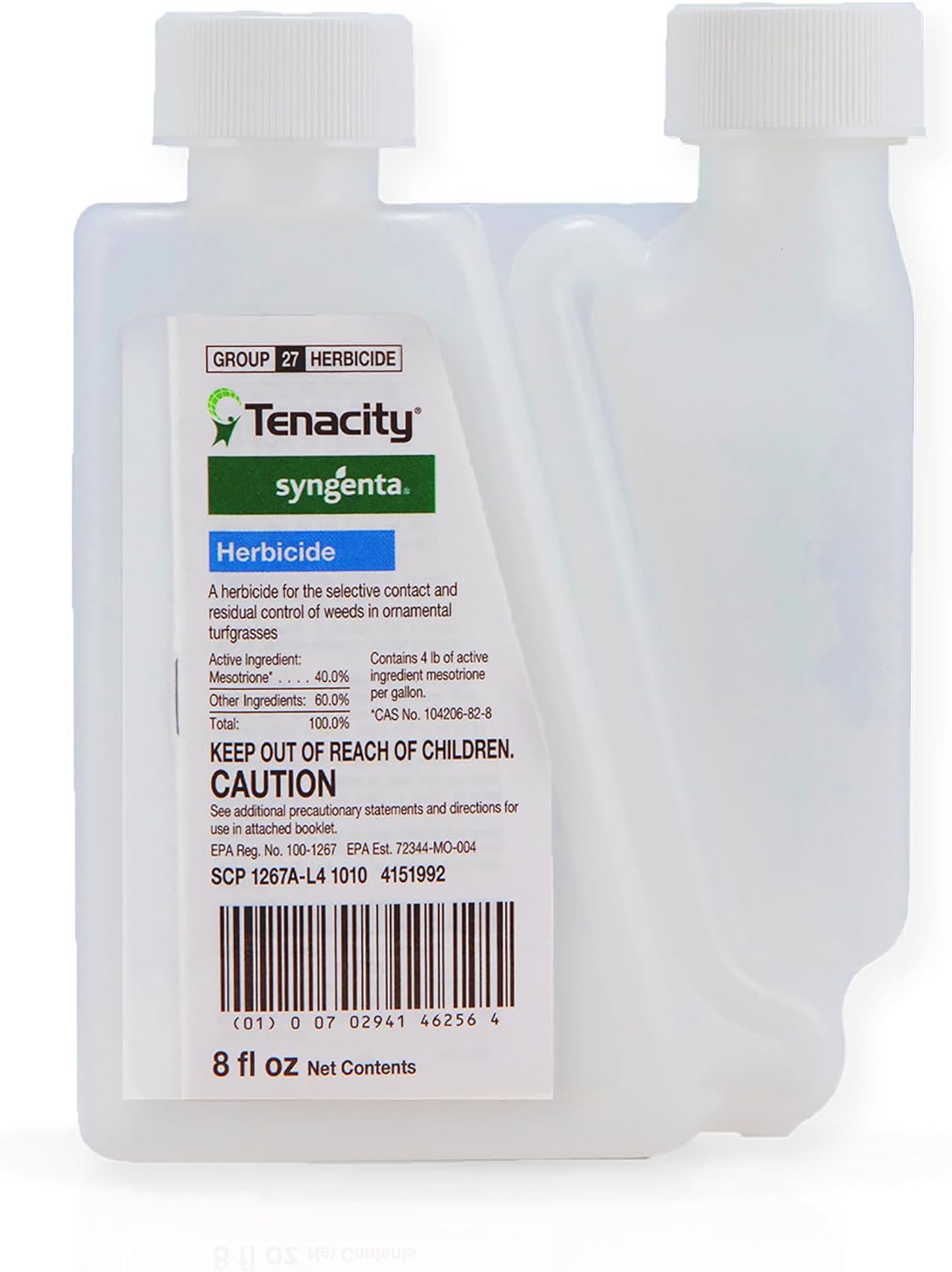
Tenacity Turf Herbicide, 8 fl oz
| Unit Count | 8 Fluid Ounces |
|---|---|
| Item Form | Liquid |
| Coverage | 2000 ft^2 per 1sp of product |
| Active Ingredients | Mesotrione |
Tenacity is a systemic turf herbicide designed to control a wide range of grassy and broadleaf weeds while preserving desirable turf. It is supplied as an 8 fluid ounce liquid that can be mixed for broadcast or spot treatments and works both as a pre-emergent and a post-emergent, so you can prevent emerging weeds and treat existing infestations. The active ingredient mesotrione provides selective control of targets like crabgrass, dandelion, clover, chickweed and goosegrass without damaging many warm- and cool-season turf species when used according to label directions. A notable practical benefit is its residual activity, which extends control after application and reduces how often you need to treat. Important limitations are that it requires careful mixing and application timing, may not be labeled for every turf type or setting, and selective safety depends on following turf-specific rates and local label restrictions. Store away from direct sunlight and extreme temperatures to maintain shelf life.
Best for: Buyers who prioritize reliable, long-lasting weed control in maintained lawns and are comfortable following label directions for selective applications. It fits homeowners or grounds managers who want a product that prevents and treats common turf weeds with fewer repeat applications.
Less Ideal for: Gardeners seeking an all-purpose, nonselective weed killer or those unwilling to follow specific turf labeling and application rates should consider alternatives. It is not the best choice for use outside labeled turf species or for broad brush clearing of vegetation.
- Works as both a pre-emergent and post-emergent for flexible timing
- Selective action on many common lawn weeds while preserving turf when used per label
- Contains mesotrione, a systemic active ingredient that provides residual control
- Concentrated 8 fl oz bottle covers a large area when mixed according to directions
- Requires precise mixing and label-rate application for turf safety
- Not universally labeled for all turfgrass species and uses
- Effectiveness depends on correct timing and environmental conditions
Verdict: Choose Tenacity when you need a dependable, selective herbicide that prevents and controls common lawn weeds while protecting established turf when applied correctly.
Scotts Liquid Turf Builder Plus 2 Weed Control, Ready-to-Spray, 32 fl. oz.

| Liquid Volume | 32 fluid ounces |
|---|---|
| Item Form | Spray |
| Coverage | 6000 square_feet |
| Active Ingredients | Nitrogen |
Scotts Liquid Turf Builder Plus 2 Weed Control is a hose-end ready-to-spray lawn fertilizer combined with selective broadleaf weed control. You connect the bottle to a garden hose and spray when weeds are actively growing; the product begins working on contact and weeds typically curl within a few days. It supplies a quick nitrogen boost and targets common lawn weeds such as dandelions, clover, chickweed, and ground ivy while being formulated for both warm- and cool-season turf. The hose-end applicator makes coverage fast and convenient for spot or whole-lawn treatments and one 32 fl. oz. bottle claims coverage up to 6,000 sq ft on warm-season lawns (4,000 sq ft on cool-season lawns). Important limitations are that it only controls listed broadleaf weeds, some tough weeds may need a repeat application in 3 to 4 weeks, and it should not be used on garden beds or non-listed grasses; do not water the treated area for 48 hours. Best results require applying under calm conditions and below 85°F to reduce plant stress and drift.
Best for: Homeowners who want a quick, low-effort solution to improve lawn color while eliminating common broadleaf weeds across typical warm- and cool-season lawns and who prefer visible results fast.
Less Ideal for: People who need herbicide control for grassy weeds, a product safe for vegetable beds, or who require treatment for non-listed or specialist turf types should look elsewhere.
- Ready-to-spray hose-end applicator for fast, easy coverage without measuring
- Provides a quick nitrogen boost while simultaneously controlling many common broadleaf weeds
- Formulated for use on both warm- and cool-season turf varieties with stated coverage estimates
- Works on contact with visible weed curling within a few days for many species
- Only controls listed broadleaf weeds and may require repeat applications for stubborn weeds
- Not safe for garden beds or unlisted grass types and must be applied under temperature limits
Verdict: A convenient ready-to-spray lawn feed that quickly greens turf while killing many common broadleaf weeds for homeowners who want fast, visible results.
Choosing the Right Weed Killer That Kills Weeds Not Grass: Key Factors to Consider
Active Ingredients and Turf Compatibility
Different active ingredients target weeds in different ways, and not every herbicide is safe on all grass species. Some actives target broadleaf weeds with minimal effect on common turfgrasses, while others are formulated to control grassy weeds without harming specific lawn types. Knowing the grass species in your yard matters because a product labeled safe for cool-season grasses may injure warm-season lawns, and vice versa.
Always check labeled turf compatibility before buying. The label also indicates rates and timing that reduce the risk of turf damage, such as avoiding application during heat stress or when soils are saturated.
Selectivity Versus Nonselective Action
Selectivity determines whether the product will remove weeds while leaving turf unharmed. Selective herbicides exploit physiological differences between weeds and desirable grass, but selectivity can be narrow. A product that spares most broadleaf weeds may still affect young grass or stressed turf.
If you need to treat only isolated patches, spot-treating with a selective formula is often safer than broadcast spraying. For larger infestations, choose a product with clear instructions for broadcast application on your grass type and follow recommended rates to avoid scorch.
Timing and Turf Stress
When you apply matters almost as much as what you apply. Lawn grasses under drought, heat, or recent transplant stress are more vulnerable to injury from herbicides. Apply selective weed control when the lawn is actively growing and not heat-stressed to help turf recover quickly.
Timing also affects weed control efficacy. Many broadleaf weed herbicides work best on young, actively growing weeds. Treating at the right weed growth stage improves control and reduces the need for repeat applications.
Application Method and Equipment Needs
Different formulations require different application equipment and skills. Ready-to-use sprayers are convenient for spot treatment and small areas, while concentrated formulas require a pump sprayer and careful measuring for larger lawns. Some products allow spot wicking or foam applicators to minimize contact with desirable plants.
Equipment choice influences accuracy and drift risk. A well-calibrated sprayer, low-pressure nozzle, and calm weather reduce off-target movement and help protect surrounding plants and garden beds.
Persistence, Replanting Windows, and Follow-up Care
Residue persistence affects how quickly a lawn can recover and whether you can reseed or overseed after treatment. Some selective herbicides break down quickly, allowing replanting within a short window, while others remain in the soil longer and can inhibit new grass establishment.
Plan follow-up maintenance like watering, mowing, and reseeding around the product's replanting and irrigation guidance. Proper aftercare helps desirable turf outcompete any surviving weeds and reduces the need for repeated herbicide use.
Safety, Label Instructions, and Environmental Considerations
Labels provide essential directions for safe use around people, pets, and water features. Some selective weed controls have restrictions near edible gardens, water bodies, or storm drains. Mixing, storage, and disposal instructions are also on the label and prevent accidental contamination.
Consider environmental factors like nearby pollinator habitat and water runoff. Use methods and timings that limit off-target exposure and follow disposal rules for rinse water and leftover solution.
Matching Product Type to Lawn Situation
Different lawns and weed problems call for different approaches. For small patches or isolated dandelions, a spot-applied selective formula minimizes turf exposure. For older lawns with mixed weed species and uniform turf, a broadcast application may be more efficient but demands strict adherence to labeled rates.
Decide whether you need a product suited for cool-season or warm-season grasses, and whether you will apply by hand sprayer, ready-to-use bottle, or hose-end applicator. Each method changes the level of control you can expect and how much prep and equipment are required.
- Spot treatment is best for isolated plants and reduces turf exposure
- Broadcast spray suits widespread infestations but requires accurate mixing
- Hose-end applicators are fast but can be less precise than pump sprayers
When To Treat for Best Results
Treat weeds when they are actively growing, usually in cool mornings or during mild temperatures for cool-season weeds, and in similar active growth periods for warm-season weeds. Avoid applications during drought, extreme heat, or when rain is expected within 24 hours unless the label permits it.
Early-season treatments often stop weeds before they set seed, reducing future pressure. For perennial weeds with deep roots, plan for repeated management and integrate mechanical removal where practical.
- Apply on calm, dry days to reduce drift
- Target young, actively growing weeds for better uptake
- Avoid treating stressed turf to minimize damage
Spot Treatment Techniques to Protect Turf
Spot application reduces the amount of herbicide your turf is exposed to, lowering the chance of scorch and limiting chemical load in the lawn. Use a wand or foam applicator to limit contact with grass blades, and apply only to the weed foliage until it is wet but not dripping.
For weeds close to ornamental beds or desired plants, consider wicking tools or shields to block spray. Rinse the sprayer outside of the lawn area and follow label guidance for buffer zones.
- Use low-pressure settings and fine control wands for precision
- Wicking applicators reduce drift near flowers and shrubs
- Clean equipment thoroughly after use to prevent accidental damage
Integrating Herbicide Use With Cultural Practices
Herbicides are most effective when combined with good lawn care. Regular mowing at recommended heights, proper fertilization, overseeding thin areas, and correct irrigation reduce opportunities for weeds to establish and re-establish.
Strengthening turf through cultural practices lowers long-term chemical reliance and provides a healthier, denser lawn that outcompetes weeds after treatment.
- Mow at the height suited to your grass species to shade out weeds
- Overseed bare spots after herbicide persistence allows reseeding
- Maintain balanced fertility to avoid encouraging weed-prone conditions
Minimizing Environmental Risk
Protect nearby water bodies and pollinator plants by following label buffer recommendations and avoiding application before heavy rain. Use spot treatments where possible and limit broad broadcast applications near sensitive areas.
Store and dispose of products responsibly and follow disposal guidelines for rinse water to prevent unintended contamination.
- Maintain buffer zones from water features and edible gardens
- Avoid spraying during windy conditions to prevent drift
- Follow label disposal instructions for leftover concentrate and rinse water
How We Chose the Best Weed Killer That Kills Weeds Not Grass
We evaluated products that specifically claim selective control of weeds while minimizing turf injury. Our selection criteria prioritized demonstrated selectivity across common turfgrasses, consistent control of typical lawn weeds, and straightforward application methods suitable for homeowners. Concrete evaluation points included active ingredient profile and labeled turf grass compatibility, documented speed of visible control, application flexibility for spot treatment versus broadcast use, and safety instructions for pets and family. We also checked product persistence to avoid prolonged turf stress and assessed compatibility with mowing and irrigation schedules. We excluded nonselective herbicides, generic broad-spectrum products intended for hardscapes, and industrial formulations designed only for non-turf areas. Products without clear turfgrass labeling or that required specialized licensing were also removed. The remaining picks balance effective weed control with practical, everyday lawn care considerations.
FAQ
Will selective weed killers harm my grass if I apply at the wrong time?
Timing affects turf sensitivity. Applying during heat stress, drought, or when grass is newly seeded can increase the risk of injury. Follow labeled timing guidance and avoid treating stressed lawns to reduce damage.
How long after treatment can I mow or water my lawn?
Mowing and irrigation guidance depends on the product. Many selective herbicides recommend waiting 24 hours before watering and 24 to 48 hours before mowing to allow foliage uptake. Always follow the label for precise intervals.
Can I overseed or reseed after using a selective weed killer?
Replanting windows vary by active ingredient. Some herbicides permit seeding within a few weeks, while others require longer waits. Check the label for reseeding intervals and plan overseeding around those recommendations.
Are selective weed killers safe around pets and children?
Safety varies by formulation and application method. Many products have re-entry intervals and drying times that reduce exposure risk. Read and follow label precautions and keep people and pets off treated areas until the product has dried or the recommended re-entry time has passed.
Can I use a selective weed killer to control crabgrass and grassy weeds?
Some selective products target broadleaf weeds only and will not control grassy weeds like crabgrass. Look for formulations or active ingredients labeled for grassy weed control if that is your target. Preemergent strategies are often more effective for crabgrass prevention.
What should I do if a selective herbicide accidentally contacts desirable plants?
Rinse off affected foliage with water as soon as possible to reduce plant uptake. For more severe contact, follow label emergency instructions and consider temporary shading and watering to help the plant recover.
Final Verdict
Choose a selective weed control product that matches your lawn species and the types of weeds you need to remove, and plan applications during periods of active turf growth to minimize injury. Prioritize selectivity, proper timing, and precise application methods to protect grass while controlling weeds. Balance chemical control with cultural practices like correct mowing height, overseeding, and irrigation. When you align product choice with good lawn care, you get reliable weed suppression with less risk to turf and the environment.
