

Note: This article contains affiliate links. If you click on these links and make a purchase, I may earn a small commission at no extra cost to you. This helps support my research and content. Read my full affiliate disclosure here.
If you share your yard with dogs, cats, or outdoor poultry, choosing a weed control method requires extra care. Pet-safe approaches reduce acute poisoning risk, limit lingering residues in grass and soil, and help you keep high-traffic areas safe for play and grazing. This guide looks at six shortlisted weed-control options suited to gardens and lawns where animals are present, and it explains how we evaluated safety, speed of action, and persistence in the environment. You will find practical notes on application timing, containment, and cleanup so you can pick a solution that fits your landscape and pet habits. Read on to see the top options and the criteria we used to evaluate them.
Top Picks at a Glance
| Best Overall The best all-around choice for most situations | Natural Elements Ready-to-Use Weed Killer (1 Gallon) |  |
| Best Quality Built to a higher standard if you want something more solid | Natural Armor Weed & Grass Killer, 1 Gallon (128 oz) |  |
| Best Value The sweet spot between price and what you get | Earth's Ally Weed & Grass Killer Spray, 32 fl oz |  |
| Best Budget The cheapest option that still gets the job done reliably | Spruce EZ-AIM Weed & Grass Killer₃, Precision Spray 3-pack (10 oz each) |  |
| Highest Rated A top-rated pick with lots of positive feedback | Natural Elements Ready-to-Use Weed Killer, 4 Gallons |  |
| Most Popular A crowd favorite that many people choose with confidence | Spruce Weed & Grass Killer Power Wand Kit with 64 oz Refill |  |
Natural Elements Ready-to-Use Weed Killer (1 Gallon)

| Unit Count | 128 Fluid Ounces |
|---|---|
| Item Form | Spray |
| Coverage | Most broadleaf weeds and grasses |
| Active Ingredients | Sodium Chloride, Salt Water, Commercial Vinegar, Soap |
This one-gallon ready-to-use bottle is a vinegar- and salt-based herbicide intended for spot treatment of unwanted weeds, grasses, moss and algae on hardscape and landscaped areas. You spray targeted plants until wet and they wilt within a short period, which makes it useful for patios, driveways, gravel, fence lines and mulched beds. The formula contains commercial vinegar, sodium chloride and soap, so there is no synthetic herbicide to mix and no special application equipment required. Practical benefits include immediate ease of use, a large volume for treating multiple areas, and a product description that highlights pet and child safety after the treated surface has dried. Important limitations are that it will also kill desirable grass and can damage nearby plants if oversprayed, and it is not an EPA‑registered conventional herbicide which may affect expectations for long-term control compared with systemic products.
Best for: People who want a simple, low-chemical option to remove visible weeds from hard surfaces and non-lawn areas and who prioritize quick results and ease of use.
Less Ideal for: Homeowners seeking long-term root-level control of weeds in lawns or gardeners who need a selective herbicide for beds with desirable plants should consider alternative products or targeted mechanical removal.
- Ready-to-use spray requires no mixing or special equipment
- Large one-gallon volume covers multiple treatment areas
- Active ingredients are vinegar and salt rather than synthetic herbicides
- Works on a broad range of broadleaf weeds, grasses, moss and algae
- Non-selective and will damage desirable turf and nearby plants if not applied carefully
- Provides contact burn rather than long-term systemic control
Verdict: Choose this ready-to-use vinegar-based spray when you need an easy, pet-friendly option to quickly remove visible weeds from driveways, patios and non-lawn areas.
Natural Armor Weed & Grass Killer, 1 Gallon (128 oz)

| Unit Count | 128 Fluid Ounces |
|---|---|
| Item Form | Spray |
| Active Ingredients | Vinegar |
| Coverage | Hardscapes, beds, driveways, foundations and similar areas |
Natural Armor Weed & Grass Killer is a concentrated, vinegar-based herbicide supplied in a one-gallon ready-to-use bottle with a sprayer connection. It is intended for spot-treating unwanted vegetation around driveways, patios, mulch beds, gravel, foundations and other hardscape areas where you do not want plant growth. The product uses high-strength vinegar as the active ingredient so you get fast visible wilting often within an hour and broader dieback over the following days. Practical benefits include easy application with no mixing, a formula marketed as all-natural and glyphosate-free, and coverage recommendations that list many common outdoor use areas. Limitations are that it is non-selective so it will damage desirable plants on contact and may require repeat applications for persistent perennial weeds because vinegar-based products typically burn foliage but do not always kill deep roots. Also follow safety directions to keep children and pets away during use and avoid application around vegetation you want to keep.
Best for: Gardeners who want a non-glyphosate, easy-to-use herbicide for spot-treating driveways, patios and other areas where no vegetation is desired and who prioritize natural active ingredients over systemic control.
Less Ideal for: Homeowners who need selective weed control near ornamental plants or who require a systemic herbicide that reliably kills deep-rooted perennials across large turf areas.
- Ready-to-use formula requires no mixing and connects to a sprayer for straightforward application
- Vinegar-based, glyphosate-free formulation for buyers seeking non-synthetic active ingredients
- Fast-acting foliage burn with visible results often within an hour
- Large one-gallon volume reduces the need for frequent repurchase for larger yards
- Non-selective action will harm any plants it contacts rather than targeting weeds only
- May need multiple treatments to control deeply rooted perennial weeds
Verdict: A large ready-to-use, vinegar-based herbicide for buyers who want a fast, non-glyphosate option to spot-treat weeds on hardscapes and unwanted areas.
Earth's Ally Weed & Grass Killer Spray, 32 fl oz
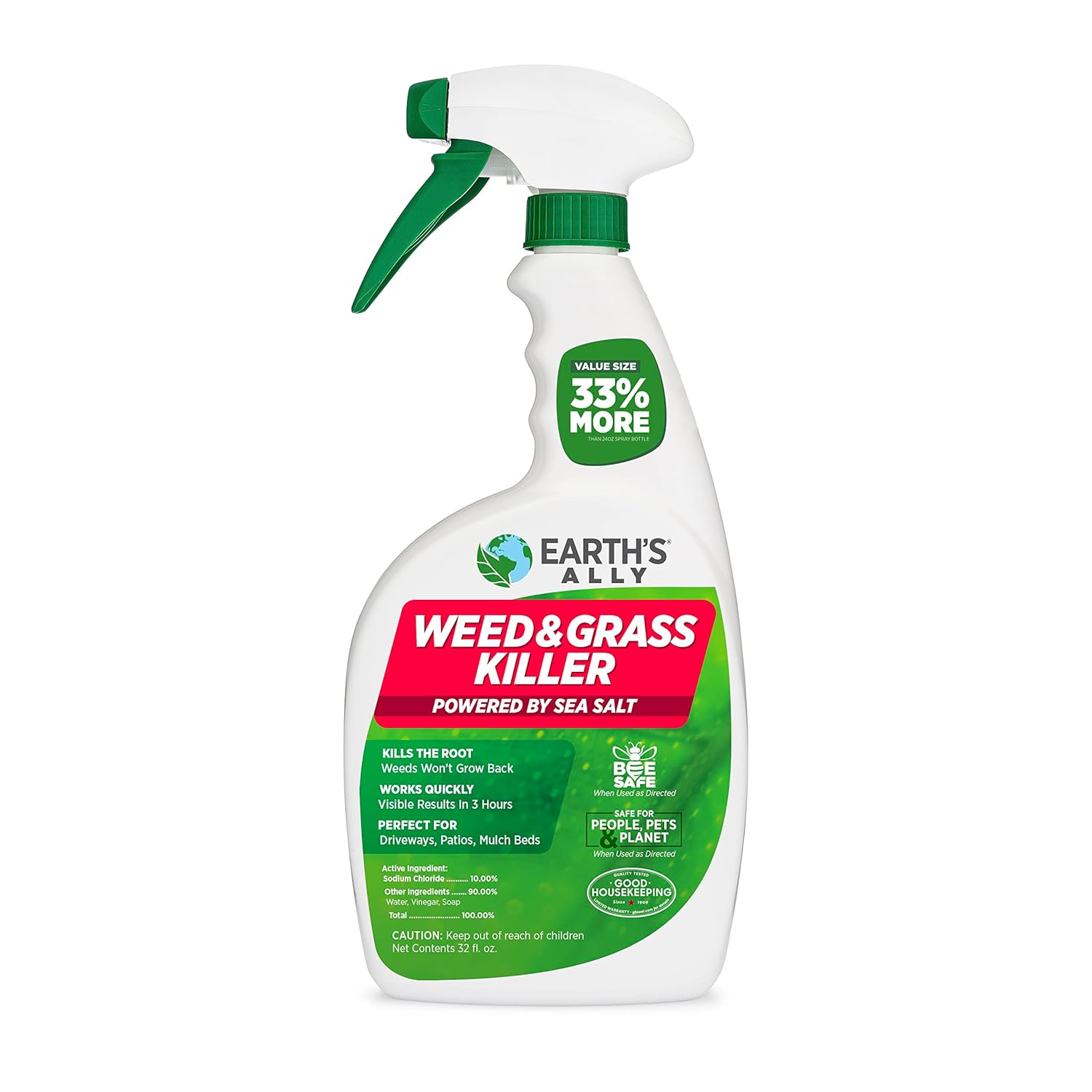
| Unit Count | 32 Fluid Ounces |
|---|---|
| Active Ingredient | Sodium Chloride (10.00%) |
| Item Form | Spray |
| OMRI Listed | Yes |
| Safe for Bees | Yes |
Earth's Ally Weed & Grass Killer is a ready-to-use spray that relies on sea salt, vinegar, and soap to kill common broadleaf and grassy weeds on contact and to the root when applied generously. It is typically used on hardscape and high-traffic areas such as patios, driveways and sidewalks; for larger beds the brand recommends mixing in a pump or backpack sprayer. Notable features include an OMRI-listed formulation, pet- and pollinator-safe testing when used as directed, and visible wilting often within a few hours. Practical benefits are straightforward: no mixing of toxic concentrates, safer handling around people and pets, and an easy spray application that requires saturating leaves and base to reach roots. Important limitations are that it is non-selective so it will damage desirable plants if oversprayed, it requires repeat saturating applications compared with synthetic herbicides, and results depend on dry, sunny conditions for best effect rather than working in wet or overcast weather.
Best for: Buyers who prioritize a safer, low-toxicity option for spot-treating weeds on patios, driveways, sidewalks and other high-traffic hardscape areas and who prefer convenience over industrial-strength persistence.
Less Ideal for: Gardeners who need a selective lawn herbicide or long-term residual control across large turf areas should consider products formulated for those specific uses.
- Ready-to-use spray requires no measuring or harsh concentrate handling
- Sea-salt based formula avoids glyphosate and other synthetic herbicides
- Shown to produce visible wilting within hours when applied on a sunny, dry day
- OMRI-listed and independently tested for pollinator and pet safety
- Non-selective formula will harm any plant it contacts so careful application is required
- Less persistent than some synthetic herbicides so repeated or saturated applications may be necessary
Verdict: Choose this product if you want an easy, ready-to-use weed killer that avoids harsh synthetics and is designed for safe spot treatment on hard surfaces.
Spruce EZ-AIM Weed & Grass Killer₃, Precision Spray 3-pack (10 oz each)

| Unit Count | 30 Fluid Ounces |
|---|---|
| Number of Packs | 3 |
| Item Form | Spray |
| Coverage | 1 bottle treats up to 60 weeds |
| Active Ingredients | Sodium Lauryl Sulfate, Geraniol, Cornmint Oil |
The Spruce EZ-AIM 3-pack is a spot-treatment weed and grass spray designed for cracks, edges, mulch beds, driveways and pavers. Each lightweight can is nitrogen-pressurized and dispenses a precision stream intended to wet leaves and stems until they wilt; visible leaf darkening or wilting can appear within an hour and complete death often follows by 24 hours. The formula relies on water, essential oils (geraniol and cornmint) and a surfactant (sodium lauryl sulfate), so it kills on contact without synthetic glyphosate. It is easy to use: unlock the nozzle, hold 12 to 24 inches from the target, spray until wet and relock when finished. Practical benefits include fast visible results, a precision applicator for small spaces, and a formula marketed as safe around people, pets and bees when directions are followed. Important limitations are that it is nonselective so avoid spraying desirable plants or lawns, effectiveness requires direct leaf contact and warm dry conditions above 60°F, and one can treats roughly 60 weeds so larger areas will need multiple cans or a refillable system.
Best for: Buyers who want a fast, easy, lower-toxicity option to spot-treat weeds around walkways, patios and beds without mixing concentrates and who prioritize straightforward, grab-and-spray convenience on a budget.
Less Ideal for: Homeowners needing to clear large lawns or heavy infestations should consider concentrated or larger-capacity solutions rather than single-use aerosol cans.
- Visible results often within one hour and full kill by 24 hours when used as directed
- Precision EZ-AIM nozzle for spot treating cracks, edges and small spaces
- Formulated with essential oils and surfactant as a non-glyphosate, ready-to-use spray
- Pack of three cans increases coverage without needing dilution or mixing
- Nonselective contact formula requires careful aim to avoid desirable plants
- Limited coverage per can—about 60 weeds—so not suited for large infestations
Verdict: A convenient, lower-toxicity ready-to-use spray that quickly kills individual weeds and is budget-friendly for spot treatments.
Natural Elements Ready-to-Use Weed Killer, 4 Gallons

| Item Form | Liquid |
|---|---|
| Coverage | Broad Spectrum Coverage |
| Active Ingredients | Acetic Acid (concentrated vinegar-based formula) |
| Unit Count | 512 Fluid Ounces |
This ready-to-use Natural Elements weed killer uses commercial-grade acetic acid to burn foliage on contact, causing rapid wilting and browning often visible within an hour and substantial dieback within 24 hours. It is typically applied with a garden sprayer directly onto unwanted weeds, driveways, patios, gravel and fence lines where you want vegetation removed rather than saved. The product arrives in four gallons of liquid, so it suits repeated treatments across a medium to large property without mixing. Key features include a concentrated vinegar formula that adheres to leaves and a broad-spectrum label covering grasses, broadleaf weeds, moss and algae. Practical benefits are quick visual results, no complex mixing, and a formula that is described as biodegradable and safe for people and pets after the spray dries. Limitations are that it is a contact herbicide so it does not translocate into roots for long-term control of perennial weeds, will damage desirable turf if misapplied, and the concentrated acetic acid can irritate skin and eyes during handling so protective gear and good ventilation are required.
Best for: Buyers who prioritize a reliable, fast-acting nonselective weed control for hard surfaces, landscaping edges, and repeat spot treatments and who want a ready-to-use product that covers a lot of ground between purchases.
Less Ideal for: Those seeking a systemic long-term solution for deep-rooted perennial weeds or a selective lawn-safe herbicide should consider alternative products.
- Fast contact action with visible wilting within an hour and heavier damage by 24 hours
- Large 4-gallon volume supports multiple treatments without reordering
- Derived from acetic acid so formula breaks down quickly and is described as biodegradable
- Ready-to-use liquid requires no mixing or dilution before application
- Contact-only action does not reliably kill deep-rooted perennials or prevent regrowth
- Will kill grass and desirable plants if sprayed casually near lawns or garden beds
- Concentrated acetic acid can irritate skin and eyes and requires protective handling
Verdict: Choose this product if you need a large-volume, ready-to-use vinegar-based weed killer that delivers fast, reliable contact control across hardscape and landscape areas.
Spruce Weed & Grass Killer Power Wand Kit with 64 oz Refill

| Unit Count | 64 Fluid Ounces |
|---|---|
| Coverage | 1 bottle treats up to 400 weeds |
| Item Form | Multiple |
| Liquid Volume | 64 fluid ounces |
This kit combines a 64 oz ready-to-use herbicide with a battery-powered Power Wand for fast, targeted spot treatments. The formula is non-mixing and designed to work on contact, dehydrating leaves so you can see darkening or wilting within an hour and complete die-off by about 24 hours when used as directed. The wand is reusable and comes with two AA batteries so you can spray cracks, edges, mulch beds, driveways, and walkways without pouring or measuring. Practical benefits include ease of use, rainproofing within 10 minutes, and a formula advertised as safe around people, pets, and bees when directions are followed. Limitations are that it is non-selective so it must be applied carefully to avoid desirable plants and grass, it is intended for spot treatment rather than broadcast lawn application, and best results require spraying in dry, warm conditions above 60°F with no immediate rain forecast.
Best for: Buyers who want a fast, easy-to-use spot weed killer for driveways, cracks, mulch beds, and edges and who prioritize quick visible results and minimal setup.
Less Ideal for: Those needing large-area lawn herbicide or selective weed control within turf should look for products made for broadcast lawn treatments or selective formulas.
- Ready-to-use 64 oz refill eliminates measuring or mixing
- Visible results in about one hour and full effect around 24 hours
- Includes battery-powered reusable wand for precision spot treatments
- Rainproof within 10 minutes so light showers are less likely to wash it off
- Formulated for use around people, pets, and bees when directions are followed
- Non-selective formula can damage desirable plants if oversprayed
- Designed for spot treatments not for broadcasting over large lawns
- Performance depends on spraying in recommended weather conditions
Verdict: A convenient, no-mix spot-treatment kit that delivers fast visible weed kill with a reusable powered wand for precise, low-fuss applications.
Choosing the Right Weed Killer with Pets: Key Factors to Consider
Toxicity and Pet Safety
Toxicity to pets varies widely between active ingredients. Some herbicides have low acute toxicity to mammals when used according to label directions, while others can cause gastrointestinal or neurological symptoms if ingested. Consider both the immediate risk of contact and the chance that a curious animal will lick grass or dig in treated soil.
Read product safety information for common domestic species and follow label directions about dilution, protective equipment, and cleanup. Even with lower-toxicity options, avoid allowing pets on treated surfaces until the label-specified re-entry interval has passed or the surface is fully dry if the label allows shorter waits.
Residual Activity and Soil Persistence
Residual activity determines how long a product continues to affect plants and whether it lingers in soil where pets might dig. Short-residual products break down faster and reduce the window of potential exposure, while long-residual formulations can offer longer weed control but increase the chance of pet contact with active compounds.
If pets regularly dig or eat vegetation, prioritize products with low soil persistence and clear guidance on when it is safe to let animals back on treated areas. Also consider how runoff and rain can move residues into planting beds or water features.
Formulation and Application Method
The physical form matters for safety and precision. Ready-to-use sprays allow spot treatment without mixing, reducing handling risk. Concentrates require dilution and present a higher handling risk if pets are nearby during preparation. Granules can be easier to control in mulch beds but may be attractive to pets if scented or if they resemble food.
Choose a formulation that fits how you manage your yard and how closely pets interact with treated zones. Use targeted application tools like wand sprayers or shielded spreaders to limit drift and accidental contact.
Speed of Action and Visible Results
Faster-acting products show visible damage sooner, which helps you know the treatment worked and guides follow-up actions. However, rapid wilting can increase the likelihood that a pet will investigate dying plants. Slower-acting herbicides may be less obvious to animals while still controlling weeds.
Balance the need for quick control with the behavior of your pets. If your animals are likely to sniff or nibble at wilting foliage, choose slower-acting or contained application methods and restrict access until plants have browned and dried.
Target Weed Spectrum
Weeds differ in life stage and species, and not every product controls all types. Some options are designed for broadleaf weeds in lawns, while others target grassy weeds or work in garden beds. Choose a solution that matches the species you face to avoid repeated treatments and extra exposure risk.
Confirm label guidance for common targets in your area, and adjust timing to hit weeds when they are most vulnerable. A more targeted choice reduces overuse of chemicals around pets.
Minimizing Pet Exposure During Treatment
Plan applications when pets are indoors or can be kept away from treated areas for the recommended re-entry time. If you cannot keep animals off the property, schedule spot treatments for small areas you can block with temporary barriers until the product dries.
Clean up spills promptly and store all concentrates and unused product in locked cabinets out of reach. If a pet touches treated grass, rinse paws and fur with water according to label first-aid guidance and contact a veterinarian if symptoms appear.
- Apply on calm days to reduce drift
- Use gloves and wash hands after handling
- Cover nearby water bowls and food during application
Nonchemical and Mechanical Alternatives
Physical removal, hand weeding, flame weeding, and mulching can reduce the need for chemical controls around pets. These methods typically pose lower acute risk to animals, though they require more labor and may not be practical for large infestations.
Mulches and landscape fabric suppress seed germination and limit digging behavior by making soil less accessible. Combined with targeted manual removal, these cultural approaches are useful for vegetable gardens, play areas, and flower beds where pets spend time.
- Hand pulling after rain lifts roots more easily
- Use a hoe for annual weeds in open beds
- Mulch to block light and reduce seedlings
Timing Treatments Around Pet Routines
Consider your pet's daily patterns when planning applications. Morning treatments that dry by midday may be suitable if pets are outside later in the day. Evening applications risk longer wet periods and higher exposure if dew forms overnight.
For busy households, mark treated areas and set timers or notifications to remind you when it is safe to allow pets back. This reduces accidental early re-entry and gives treatments time to adhere or degrade as specified.
- Avoid treating before scheduled walks or outdoor play
- Record re-entry times where the family will see them
- Rinse pet paws after outdoor time if they frequent treated zones
Protecting Water Features and Pollinators
Runoff from treated turf can contaminate ponds, streams, and bird baths. Keep products away from water and avoid treatments before heavy rain. Use physical barriers or choose nonmobile formulations to reduce movement into aquatic areas.
Many pet-friendly strategies also reduce risk to pollinators by limiting spray drift and choosing spot treatments. Avoid flowering plants when applying sprays and prefer spot control in garden beds frequented by bees and butterflies.
- Keep water containers covered during application
- Do not apply to blooming plants visited by pollinators
- Rinse tools away from water bodies
Post-Treatment Cleanup and Monitoring
After treatment, remove any dead plant material that pets might chew on and rake up visible granules or crusted residues. Monitor treated spots for re-germination and plan follow-up controls that minimize additional chemical use.
Watch pets for signs of gastrointestinal upset, lethargy, or unusual behavior after they first return to treated areas. Early detection reduces the risk of severe issues and helps you adjust future application choices.
- Collect and dispose of plant debris away from pet areas
- Keep a log of treatments and observed pet reactions
- Adjust future plans if pets show sensitivity
How We Chose the Best Weed Killer with Pets
We narrowed the field to products and approaches that balance plant control with reduced risk to household pets. Our evaluation prioritized measurable safety and performance dimensions relevant to gardens used by animals. Key filters included documented toxicity or safety guidance for common pet species; formulation type and whether it requires dilution or special handling; how long residues remain active on treated surfaces and in soil; labeled re-entry or pet-return intervals; and actual effectiveness against a range of common lawn and garden weeds. We excluded approaches that are impractical for pet households, such as treatments requiring long total area quarantines or methods that consistently leave toxic residues for days. We also filtered out products without clear, publicly available safety data. The final picks emphasize low-to-moderate environmental persistence, low acute toxicity to mammals when used correctly, and straightforward application protocols that help reduce accidental exposure. These criteria align with our scoring metrics for safety profile, pet re-entry time, control effectiveness, ease of use, and environmental persistence.
FAQ
How long after application can pets go on treated grass?
It depends on the product and formulation. Many spot sprays are safe once the treated surface is dry, while some products specify a longer pet re-entry interval. Always follow the label instructions for re-entry times and, when in doubt, keep pets off the area for the longest recommended period.
Are natural or vinegar-based options safe for my dog or cat?
Natural or acetic-acid solutions can still irritate skin and eyes and may cause stomach upset if ingested. They often burn foliage on contact but can require repeat treatments. Treat these as active chemicals: avoid pet contact during application and rinse animals if exposure occurs.
What should I do if my pet eats treated grass?
Rinse the pet's mouth and paws with water and check the product label for first-aid guidance. Contact your veterinarian promptly and provide them with the product information. Monitor the animal for vomiting, drooling, weakness, or other abnormal signs.
Can I use granular weed control in an area where my pets dig?
Granules can be problematic if pets ingest them. If you must use granules, apply them to areas pets cannot access until they have been watered in and are no longer visible. Prefer alternative methods in high-digging zones.
Do organic-certified products mean they are safe for pets?
Organic certification pertains to ingredient origin and production practices, not toxicity. Some organic herbicides still pose risks to animals. Check safety and re-entry instructions rather than assuming safety based on certification alone.
How can I protect shared spaces like a backyard used for play and pets?
Focus on targeted spot treatments, physical barriers, and cultural controls such as dense turf, edging, and mulch. Restrict pets from freshly treated areas until surfaces meet re-entry recommendations and maintain a cleanup routine to remove debris and residues.
Final Verdict
When selecting a weed-control approach for a household with pets, prioritize a low-toxicity profile, short environmental persistence, and application methods that limit accidental exposure. Tradeoffs are unavoidable: faster-acting or longer-lasting products can give better weed suppression but require stricter access controls and monitoring. Decide based on how your animals use the space, whether they dig or graze, and how much time you can commit to barriers and cleanup. Favor targeted, low-residue options and clear application routines to keep both your landscape and your pets safe.
