

Note: This article contains affiliate links. If you click on these links and make a purchase, I may earn a small commission at no extra cost to you. This helps support my research and content. Read my full affiliate disclosure here.
Mosquitoes, ticks, and other biting pests can ruin time spent outdoors and create real health concerns. Choosing the right whole yard bug spray matters because coverage, residual control, and how you apply it determine whether your lawn, beds, and play areas stay usable through the season. This guide covers seven shortlisted whole yard bug sprays chosen for their backyard-scale coverage, application options, and season-long persistence. We explain the practical tradeoffs gardeners face, from how long treatments last to safety around people, pets, and planted areas. Read on for the evaluation criteria used and the key factors to weigh before you treat your outdoor space.
Top Picks at a Glance
| Best Overall The best all-around choice for most situations | Ortho Home Defense Insect Killer Refill, 1.33 gal (Indoor & Perimeter) |  |
| Best Quality Built to a higher standard if you want something more solid | Cedarcide Outdoor Bug Spray Gallon |  |
| Best Value The sweet spot between price and what you get | Cutter Essentials Bug Control Spray Concentrate, 32 fl oz |  |
| Best Budget The cheapest option that still gets the job done reliably | Spectracide Triazicide Insect Killer for Lawns & Landscapes, 32 oz |  |
| Highest Rated A top-rated pick with lots of positive feedback | Talstar One Insecticide Concentrate, 1 Gallon |  |
| Most Popular A crowd favorite that many people choose with confidence | Cutter Backyard Bug Control Spray Concentrate, 32 oz (2 pack) |  |
| Best Seller A high-volume bestseller chosen again and again | Ortho Home Defense Insect Killer for Indoor & Perimeter, 1.33 gal. with Comfort Wand |  |
Ortho Home Defense Insect Killer Refill, 1.33 gal (Indoor & Perimeter)

| Unit Count | 170.24 Fluid Ounces |
|---|---|
| Item Form | Spray |
| Target Species | Insects |
| Liquid Volume | 1.33 gallons |
This Ortho Home Defense refill is made for homeowners who want a high-capacity solution for indoor and perimeter pest control. The concentrate is intended to be poured into the reusable Comfort Wand applicator so you can treat entry points, baseboards, doorframes, and foundation perimeters without repeated small bottles. Its formula claims an invisible, fast-drying barrier that provides up to 12 months of residual control for ants, roaches, and spiders when applied on non-porous indoor surfaces, and it targets a broad list of common household insects. In practice the refill reduces trips to the store and lowers per-application cost compared with single-use sprayers, and the continuous-spray wand reduces user fatigue for larger jobs. Important limitations are that the long-residual claim applies mainly to certain pests and non-porous surfaces, and precise coverage requires following the spray distance and band-width directions to avoid overapplication. This product is best used as part of a preventive or follow-up treatment routine rather than a one-time knockdown for heavy infestations.
Best for: Homeowners who prioritize effective, long-lasting perimeter and indoor protection and who want a refillable, economical option for routine pest control.
Less Ideal for: People who need immediate, heavy-duty knockdown treatments or who prefer single-use ready-to-spray bottles for spot treatments.
- Large 1.33 gallon refill reduces frequency of repurchasing and is economical for whole-home or perimeter treatments
- Compatible with the Comfort Wand reusable applicator for continuous spray and less hand fatigue during larger jobs
- Invisi-Shield formula dries clear with no noticeable fumes, allowing people and pets to re-enter once dry
- Broad-spectrum label covers many common indoor and perimeter pests, including ants, roaches, spiders and mosquitoes
- Residual protection claim is specific to ants, roaches and spiders on non-porous indoor surfaces and may not apply equally to all listed insects
- Requires a compatible applicator wand or transfer container since it is a refill rather than a ready-to-use spray
Verdict: Buy this refill if you want an economical, high-capacity solution to maintain a long-lasting indoor and perimeter insect barrier using a reusable comfort-wand applicator.
Cedarcide Outdoor Bug Spray Gallon

| Ingredients | Natural essential oils including Cedarwood and Lemongrass |
|---|---|
| Coverage | Treats up to 4 acres |
| Directions | Spray on lawns, landscaping, patios, and around the perimeter of your home |
Cedarcide Outdoor Bug Spray is a gallon concentrated treatment designed to cover large areas of turf and landscaping with natural essential oils, primarily cedarwood and lemongrass. It is typically applied with a pump or hose sprayer around yards, patios, and home perimeters and the label states one gallon treats up to four acres, making it suitable for whole‑yard applications. The formula is exempt from EPA registration under the minimum risk pesticide rule and emphasizes family and pet safety compared with conventional synthetic pesticides. In practice the product provides a pleasant citrus‑cedar aroma while reducing populations of mosquitoes, fleas, ticks, chiggers and similar pests when applied regularly. Expect to reapply as directed after heavy rain or for seasonal pest pressure since botanical repellents do not provide the longer residual of some synthetic alternatives. The product is a good fit when you prioritize lower toxicity and wide coverage, but users seeking long‑lasting single treatments may need to plan for repeat applications.
Best for: Buyers who prioritize effective broad‑area control without harsh synthetic chemicals and who are prepared to apply treatments periodically across a whole yard.
Less Ideal for: People who need a single, long‑lasting season treatment or who require labeled control for specific regulated pests where EPA‑registered synthetics are preferred.
- Plant‑based formula using cedarwood and lemongrass oils that is labeled family and pet safe
- Large coverage claim suitable for whole‑yard treatment—one gallon treats up to 4 acres
- Designed for use on lawns, landscaping, patios, and home perimeters for flexible application
- Exempt from EPA registration under the FIFRA 25(b) minimum risk pesticide rule
- Botanical active ingredients generally have shorter residual control than many synthetic pesticides and require more frequent reapplication
Verdict: Choose Cedarcide when you want wide‑area, family‑friendly pest control using plant‑based oils for whole‑yard protection.
Cutter Essentials Bug Control Spray Concentrate, 32 fl oz

| Unit Count | 32 Fluid Ounces |
|---|---|
| Item Form | Liquid |
| Target Species | Insects |
| Liquid Volume | 32 fluid ounces |
Cutter Essentials Bug Control Spray Concentrate is a garden hose‑attachable liquid designed to treat lawns, landscaping and outdoor play areas for mosquitoes, ticks and other listed insects. You mix it on a hose-end sprayer and spray evenly over the treatment area; the manufacturer says one bottle covers up to 5,000 square feet. Notable features include a convenient hose-end applicator and a formula that uses plant-derived oils such as cinnamon, peppermint and cornmint, which the brand positions as mindful ingredients and safe around children and pets when used and stored as directed. In practice this product is best for broad perimeter treatments and spot applications where contact kill is acceptable. Expect fast knockdown of visible insects but remember it works by contact so it will not provide long‑term systemic control. Follow label directions about pollinators and avoid spraying blooming plants. The hose‑end application makes coverage quick for larger yards, though users who need residual, long‑lasting protection or indoor use will want a different approach.
Best for: Buyers who prioritize practical, fast yard treatments and want a pet- and family-conscious option for knocking down mosquitoes across a medium to large outdoor area.
Less Ideal for: Gardeners seeking long‑term residual pest control, indoor insect solutions, or a product safe to spray on blooming plants frequented by pollinators should look elsewhere.
- Hose‑end sprayer connects to a garden hose for quick, even coverage
- Covers up to 5,000 square feet for treating lawns and landscaping
- Formulated with plant-derived oils and described as safe around children and pets when used and stored as directed
- Kills mosquitoes and other listed insects by contact for immediate knockdown
- Kills by contact and does not provide systemic or long-lasting residual control
- Should not be applied when pollinators are foraging and may harm ornamental foliage if overapplied
Verdict: A practical hose‑end concentrate for fast, large‑area knockdown of mosquitoes that prioritizes family and pet safety when used as directed.
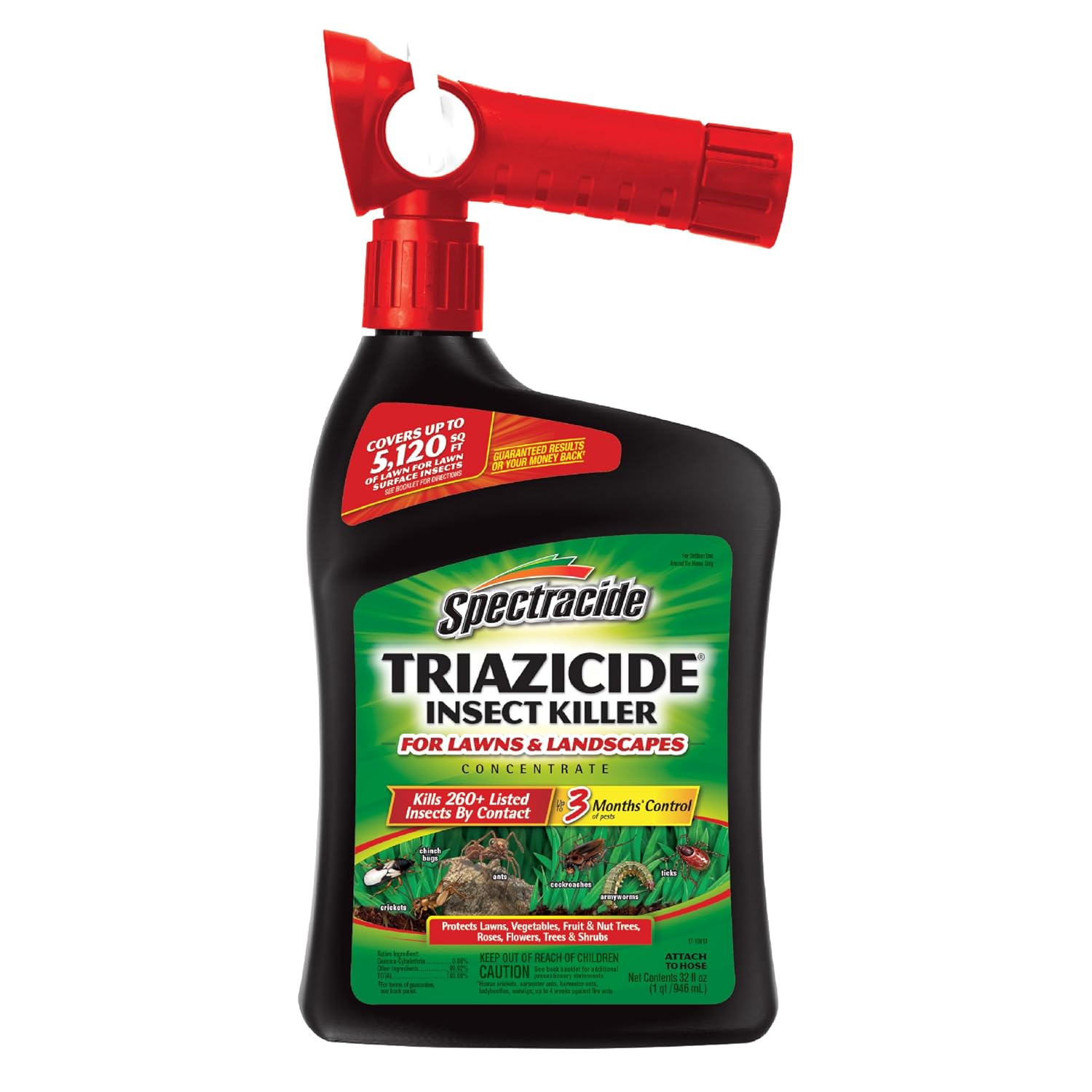
Spectracide Triazicide Insect Killer for Lawns & Landscapes, 32 oz
| Unit Count | 32 Ounce |
|---|---|
| Item Form | Spray |
| Target Species | Insects |
| Active Ingredients | Gamma-Cyhalothrin (0.08%) |
Spectracide Triazicide is a 32-ounce concentrate formulated to control more than 260 listed insects on lawns, flower beds, trees, shrubs and around vegetables. You mix the concentrate with water and apply it with a tank or hose-end sprayer; the ready-to-spray variant can attach to a garden hose for quicker application. The active ingredient, gamma-cyhalothrin, delivers fast contact kill for pests such as fleas, ticks, Japanese beetles and many surface insects, and the label claims protection for up to three months in some uses. It is non-staining when used as directed and can treat large areas, making it practical for whole-yard applications and targeted mound treatments like fire ants. Important limitations include toxicity to fish and bees, so it must not be applied near water or blooming plants, and the product requires careful handling and adherence to safety directions. Follow mixing rates and timing recommendations for best results and to minimize environmental risk.
Best for: Buyers who need an affordable, large-area solution to knock down common lawn and landscape pests and prefer a concentrate that stretches coverage when mixed.
Less Ideal for: People with small ornamental gardens near ponds, homeowners who prioritize pollinator-safe products, or those unwilling to follow pesticide safety precautions should consider gentler or targeted alternatives.
- Concentrate covers large areas so a single bottle treats many square feet when mixed correctly
- Fast-acting contact kill for a wide range of listed insects including fleas, ticks and Japanese beetles
- Versatile use on lawns, flower beds, trees, shrubs and around vegetables
- Non-staining when used as directed and available in hose-end ready-to-spray format for easier application
- Highly toxic to aquatic life and bees so it cannot be used near water or blooming plants
- Requires careful mixing and protective handling due to chemical toxicity
Verdict: A cost-effective, fast-acting concentrate for treating broad lawn and landscape pest problems when used with care and proper precautions.
Talstar One Insecticide Concentrate, 1 Gallon

| Active ingredient | Bifenthrin 7.9% |
|---|---|
| Formulation | Concentrate, water-based |
| Coverage intent | Perimeter and structural applications |
| Pest range | Controls 75+ pests including ticks |
Talstar One is a professional-strength bifenthrin concentrate designed to provide broad-spectrum control of ants, spiders, roaches, fleas, ticks, mosquitoes, and many other pests. You mix the concentrate with water and apply it as a perimeter spray around foundations, doors, and windows or to targeted cracks and crevices indoors. Notable features include a water-based, low-odor formula that dries clear and a residual effect that reduces the need for frequent reapplications on lawns, ornamentals, shrubs, and structural surfaces. For yards with tick pressure, treating perimeters and vegetation provides a dependable barrier that helps reduce tick encounters when applied according to label directions. The product is concentrated so one gallon treats large areas, which makes it efficient for seasonal maintenance across multiple structures. Important limitations are that it is a pesticide that requires careful handling and strict adherence to label rates and application restrictions, and it is not a ready-to-use spray so you will need appropriate mixing and application equipment for safe, effective coverage.
Best for: Buyers who prioritize reliable, residual pest control for yards and perimeters and who are comfortable using concentrated pesticides with proper safety practices.
Less Ideal for: Casual users who want a ready-to-use product or those unwilling to follow pesticide label precautions and use appropriate application equipment.
- Broad-spectrum control that includes ticks and common yard pests
- Concentrated formula covers large areas and is cost-efficient for seasonal treatments
- Water-based, low-odor formula dries clear and is suitable for outdoor living spaces
- Suitable for both perimeter and targeted indoor/structural applications
- Concentrate requires proper mixing and application equipment for safe use
- Contains bifenthrin so users must follow label precautions to protect people, pets, and beneficial insects
Verdict: Choose Talstar One when you need a concentrated, long-lasting perimeter treatment that reliably reduces tick pressure across yards and structures.
Cutter Backyard Bug Control Spray Concentrate, 32 oz (2 pack)

| Unit Count | 64 Fluid Ounces |
|---|---|
| Item Form | Spray |
| Target Species | Insects |
| Active Ingredients | Lambda Cyhalothrin |
This Cutter Backyard Bug Control Spray Concentrate is a hose‑end applicator concentrate designed to treat lawns, shrubs and other outdoor surfaces to reduce mosquitoes and a range of listed insects. You attach the QuickFlip hose‑end sprayer, walk the area and apply as a cover spray; the ready‑to‑mix nozzle meters water automatically so you do not need separate measuring. The formula lists lambda‑cyhalothrin as an active ingredient and claims up to 12 weeks of control and coverage for up to 5,000 sq ft per bottle, which makes it suitable for seasonal perimeter treatments and spot landscape applications. Practical benefits include easy application with the flip‑on nozzle, thorough foliar coverage when used as directed, and long residual control that reduces repeat treatments. Important limitations are that it is a pesticide so you must keep children and pets out of treated areas until dry, follow label restrictions for vegetables and sensitive areas, and avoid applications before rain or near drains or water bodies.
Best for: Buyers who want a simple, ready‑to‑use perimeter treatment to reduce mosquitoes and common yard insects across lawns and landscaped beds without frequent reapplication.
Less Ideal for: People who need an organic, pet‑safe, or water‑safe option for insect control or those who require frequent spot treatments in small container gardens.
- Hose‑end QuickFlip sprayer for fast, no‑mix application over large areas
- Claims up to 12 weeks of residual control, reducing the need for frequent reapplications
- Covers up to 5,000 sq ft per bottle for single‑treatment perimeter protection
- Works on lawns, shrubs and outdoor surfaces for flexible use around the yard
- Contains a synthetic pesticide ingredient and requires strict adherence to safety and label restrictions
- Not intended for use where runoff could reach water bodies or drains
Verdict: A convenient hose‑end concentrate that delivers broad yard coverage and long‑lasting mosquito and insect control with minimal setup.
Ortho Home Defense Insect Killer for Indoor & Perimeter, 1.33 gal. with Comfort Wand

| Item Form | Spray |
|---|---|
| Target Species | Insects |
| Liquid Volume | 1.33 gallons |
| Active Ingredients | Bifenthrin 0.05%, Zeta-Cypermethrin 0.0125% |
This 1.33 gallon Ortho Home Defense spray is designed to treat both indoor problem spots and the outdoor perimeter of a home to reduce ants, roaches, spiders and many other crawling and flying insects. It comes with a battery-powered Comfort Wand that delivers a continuous spray so you can apply a uniform band around foundations, patios and entry points without bending or pumping. The formula with bifenthrin and zeta-cypermethrin is intended to kill on contact and establish a barrier that the manufacturer says lasts up to 12 months for ants, roaches and spiders on non-porous indoor surfaces. In real-world use that means fewer repeat treatments in busy yard perimeters and around doors and windows. The spray dries clear with minimal fumes which helps for indoor use near kitchens and living areas. Limitations are that this is a chemical insecticide so users should follow safety directions around children, pets and plants and it is not a specific solution for pests not listed on the label. For homeowners focused on strong, perimeter-level protection this product simplifies application and covers a large area per container.
Best for: Homeowners who want a performance-focused perimeter treatment to reduce recurring yard and entry-point insect problems and prefer a ready-to-use product that is easy to apply.
Less Ideal for: People seeking organic or non-chemical control methods or those who need a targeted solution for pests not listed on the label should consider alternative products.
- Includes battery-powered Comfort Wand for continuous, fatigue-free application
- Ready-to-use 1.33 gallon container covers large perimeters without mixing
- Formula creates a barrier claimed to provide up to 12 months protection against ants, roaches and spiders on non-porous indoor surfaces
- Dries clear and gives off minimal fumes, making indoor use more practical
- Contains synthetic insecticides so precautions are required around children, pets and ornamentals
- Protection claims are specific to certain species and surfaces so results vary by pest and conditions
Verdict: A powerful, ready-to-use perimeter and indoor spray for homeowners who want long-lasting, performance-oriented protection against common yard and household insects.
Choosing the Right Whole Yard Bug Spray: Key Factors to Consider
Coverage and Application Rate
Coverage determines how much product you need and how often you must treat. A product listed for high square‑footage per gallon reduces labor but may require larger spray equipment to distribute evenly. Pay attention to the labeled application rate and how that translates into real passes across turf, shrub beds, and foundation perimeters.
Coverage affects scheduling because treatments intended for light infestation differ from those designed to protect entire yards for several weeks. If you have complex landscaping with thick shrubs or tall grasses, plan for additional targeted passes since dense vegetation can shield pests and reduce effective coverage.
Residual Effect and Reapplication Interval
Residual control is how long treated surfaces remain hostile to pests after application. Longer residuals mean fewer repeat treatments, but actual longevity depends on rainfall, irrigation, and UV exposure. Look for products that specify residual duration under outdoor conditions and follow label guidance on reapplication after weather events.
Shorter residual products can still be useful if you prefer spot treating high‑use areas frequently. If you expect heavy pest pressure or want season‑long protection, choose a spray with a longer labeled interval and factor in midseason touchups for areas exposed to sun and water.
Target Pests and Pest Spectrum
Whole yard sprays vary in which pests they control. Some are optimized for mosquitoes and biting flies, others for ticks and fleas, and a few include caterpillars, ants, or beetles. Match the product to your primary pest problem rather than assuming broad control.
Knowing the pest biology helps you time applications more effectively. For example, treating mosquito resting sites and shaded vegetation is different from perimeter band treatments for ticks. Check whether the product lists specific life stages controlled, such as adults versus larvae, to plan supplemental measures like source reduction.
Application Method and Equipment Compatibility
Consider how you will apply the spray. Gardeners may prefer ready‑to‑use hose‑end applicators, concentrated liquids for backpack sprayers, or granular formulations that broadcast over turf. Each method affects labor, accuracy, and non‑target exposure.
Equipment compatibility matters for reach and evenness of application. Backpack sprayers and professional units provide better penetration into shrubs. Hose‑end or pump sprayers are easier for quick perimeter treatments but may not deliver uniform coverage in dense plantings. Always use label‑recommended equipment settings for droplet size and pressure.
Safety, Restrictions, and Reentry Intervals
Safety instructions protect you, your family, pets, and beneficial wildlife. Labels specify personal protective equipment, reentry intervals for treated areas, and whether treatments are safe near edible plants. Respecting these restrictions reduces risk and legal exposure.
If you have pets or children, look for products with shorter reentry times and clear guidance on when it is safe to use play areas again. Also consider runoff risk to nearby ponds or pollinator plantings and follow label instructions to minimize exposure to non‑target organisms.
Environmental Persistence and Non‑Target Impact
Some active ingredients bind to soil or degrade rapidly under sunlight, affecting how long they persist and whether they move offsite. Persistence can be good for long control but raises concerns about impacts on beneficial insects, soil organisms, and aquatic life.
Choose products with clear mitigation instructions if you have water features or pollinator gardens. Consider using targeted perimeter treatments or barrier bands around living spaces rather than blanketing flower beds to reduce non‑target exposure while still suppressing pest populations.
Timing Treatments for Best Results
When planning whole yard applications, align timing with the life cycle of the primary pests. Early‑season applications can reduce population buildup, while late‑season treatments may protect outdoor events or reduce overwintering numbers. For mosquitoes, target adult resting spots and shaded vegetation just before peak activity times. For ticks, schedule treatments when nymphs and adults are active in your region.
- Apply in the evening or early morning for mosquitoes to maximize contact when they are resting.
- Avoid applying before heavy rain; follow reapplication guidance if significant precipitation occurs.
- Stagger treatments in spring and midsummer if residual duration is short to maintain coverage.
Safe Use Around Landscaped and Edible Areas
If you treat near flower beds, vegetable gardens, or pollinator plantings, take precautions to protect beneficial insects and food crops. Read the label for restrictions on edible plants and recommended buffers. Consider barrier treatments along property lines and around seating areas rather than spraying flowering plants that attract pollinators.
- Cover or remove garden produce during application if the label requires.
- Delay treating flowering ornamentals when pollinators are active and choose product options with lower non‑target toxicity.
- Rinse or follow label guidance for irrigation after application when necessary.
Integrating Non‑Chemical Controls
Whole yard sprays work best as one component of an integrated pest management plan. Reduce standing water, maintain lawn height to limit tick habitat, and trim dense vegetation where mosquitoes rest. Using traps, larval control in water features, and habitat modification lowers overall pest pressure and reduces the number of chemical treatments needed.
- Eliminate pooled water and improve drainage to cut mosquito breeding sites.
- Create a tidy border between lawn and wooded areas to reduce tick migration into high‑use zones.
- Encourage natural predators such as birds and beneficial insects by providing habitat away from treated areas.
Application Tips for Consistent Coverage
Uniform application prevents untreated refuges where pests can persist. Walk at a steady pace, overlap passes slightly, and use the recommended nozzle and pressure settings. For shrubs and tall grass, use a directed spray to penetrate canopy rather than a blanket mist that settles on top of foliage.
- Calibrate sprayers before use to match labeled gallons per 1,000 square feet.
- Mix only the amount you need for the job and follow label timing for agitation requirements.
- Wear appropriate protective gear and wash application equipment after use to avoid residue buildup.
Post‑Application Care and Monitoring
After treatment, monitor for pest activity and note how long suppression lasts in different yard zones. Keep records of application dates, weather conditions, and any observed pest return so you can refine timing and product choice next season. Be alert to signs of non‑target impact such as declines in pollinator visits and adjust future plans accordingly.
- Inspect shaded areas and dense plantings a week after treatment to assess control.
- Record reapplication intervals that were effective under your local conditions.
- Maintain landscape hygiene to reduce the need for frequent chemical treatments.
How We Chose the Best Whole Yard Bug Spray
We evaluated products that are specifically intended for treating entire yards and comparable outdoor spaces, focusing on factors gardeners care about in real use. Our selection criteria prioritized documented area coverage per application, length of residual activity under typical yard conditions, and the range of pests controlled. We also considered application method flexibility so gardeners can use handheld sprayers, broadcast hose attachments, or professional-style equipment safely and effectively. Safety and environmental impact were measured by labeled precautions and suitability for areas frequented by people and pets. Ease of mixing and clarity of label directions mattered because complex dilution or unclear instructions increase the risk of improper application. Finally, we excluded products intended only for spot treatments, indoor use, or those lacking clear outdoor labeling. Excluded items include foggers, bait-only products, and lawn fertilizers with incidental insect control. The resulting list emphasizes whole-yard performance, practical application, and safety guidance that gardeners can rely on when planning seasonal pest control.
FAQ
How often should I reapply whole yard bug spray?
Reapplication depends on the product residual and local weather. Many treatments list intervals from two to eight weeks; heavy rain or irrigation may require earlier reapplication. Follow the labeled schedule and adjust based on observed pest activity.
Can I spray when there are flowering plants in the yard?
It often depends on the label. Some products advise avoiding blooms to protect pollinators, while others allow targeted treatments if you avoid spraying flowers directly. Delay application when pollinators are most active and use barrier treatments where possible.
Are whole yard sprays safe for pets and children?
Safety varies by product and label instructions. Many sprays have specific reentry intervals and require pets to be kept away until the treatment has dried or until the label permits reentry. Read and follow all precautions to reduce exposure.
Will yard sprays stop mosquitoes that breed in standing water?
Adulticides reduce adult mosquito numbers but do not address larvae in breeding sites. Combine whole yard sprays with source reduction or larval control where water collects for best results.
Can I apply whole yard spray with a home pump sprayer?
Yes if the product label allows that application method. Make sure your pump sprayer is calibrated, use the recommended nozzle and pressure, and follow mixing instructions to ensure correct coverage and droplet size.
Final Verdict
Choosing the right whole yard bug spray means balancing how much area you need to treat, which pests are your priority, and how you will apply the product. Prioritize clear label directions, an appropriate residual interval for your climate, and application methods that fit your equipment and landscape. Weigh tradeoffs between long residual control and potential non‑target impact, and integrate chemical treatments with habitat management to reduce overall pest pressure. With those priorities in mind, you can select a spray approach that delivers reliable backyard protection while managing safety and environmental concerns.
