

Note: This article contains affiliate links. If you click on these links and make a purchase, I may earn a small commission at no extra cost to you. This helps support my research and content. Read my full affiliate disclosure here.
If wild violets have taken over patches of lawn or flower beds, choosing the right wild violet weed killer makes the difference between a quick fix and ongoing battles. You want a solution that targets violets without harming desirable turf or ornamentals, fits your application style, and matches the size of the infestation. This guide presents seven shortlisted options chosen for real garden use and explains how they perform for spot treatments, larger infestations, and follow-up control. Below we summarize how each entry scored on practical criteria gardeners care about, then outline what to consider before you pick a product.
Top Picks at a Glance
| Best Overall The best all-around choice for most situations | Monterey Spurge Power Herbicide Concentrate, 1 Pint |  |
| Best Quality Built to a higher standard if you want something more solid | T-Zone Turf Herbicide Broadleaf Weed Killer — 1 Quart |  |
| Best Value The sweet spot between price and what you get | Spectracide Large Plot Weed Stop for Lawns Concentrate, 1 gal |  |
| Best Budget The cheapest option that still gets the job done reliably | Ortho WeedClear Lawn Weed Killer Concentrate, 32 fl. oz. |  |
| Highest Rated A top-rated pick with lots of positive feedback | Monterey Spurge Power Herbicide, 1 Pint (2-Pack) with Measuring Spoon |  |
| Most Popular A crowd favorite that many people choose with confidence | Ortho Nutsedge Killer for Lawns Ready-To-Spray, 32 fl. oz |  |
| Best Seller A high-volume bestseller chosen again and again | Roundup Weed & Grass Killer with Comfort Wand, 1.33 gal |  |
Monterey Spurge Power Herbicide Concentrate, 1 Pint

| Unit Count | 16 Fluid Ounces |
|---|---|
| Included Components | Measuring Spoon |
| Item Form | Liquid |
| Coverage | 16000 square feet |
Monterey Spurge Power is a concentrated lawn herbicide designed to target a range of stubborn broadleaf weeds such as spurge, wild violet, dandelion, oxalis, creeping Charlie and clover. It is mixed and applied over turf and is labeled for use on both warm- and cool-season grasses, making it suitable for most home lawns. The formula combines three active ingredients, which improves efficacy against hard-to-control species and increases the chance of knocking back persistent patches. A single pint is concentrated enough to treat a large area when diluted properly, and the included measuring spoon helps with accurate mixing. Practical benefits include broad species coverage and compatibility with common lawn types. Important limitations are that it is a chemical herbicide so users must follow safety directions and avoid treating desirable plants, and repeat applications may be needed for established infestations. Proper timing and careful application are required to protect sensitive turf and nearby ornamentals.
Best for: Gardeners who want a single, effective product to treat common and stubborn broadleaf weeds across different lawn types and who are comfortable following label safety and mixing instructions.
Less Ideal for: People who prefer nonchemical or organic weed control methods or who need a spot treatment that avoids any risk to nearby ornamental plants.
- Targets a wide range of broadleaf weeds including wild violet and spurge
- Contains three active ingredients for stronger control against stubborn weeds
- Labeled for use on both warm- and cool-season turfgrass
- Concentrated formula covers up to 16,000 square feet when mixed correctly
- Requires careful mixing and application to avoid damage to desirable plants
- Chemical formulation means safety precautions and buffer zones are necessary
Verdict: A concentrated, multi‑ingredient liquid herbicide that delivers broadleaf weed control, including wild violet, for homeowners wanting dependable lawn-wide results.
T-Zone Turf Herbicide Broadleaf Weed Killer — 1 Quart
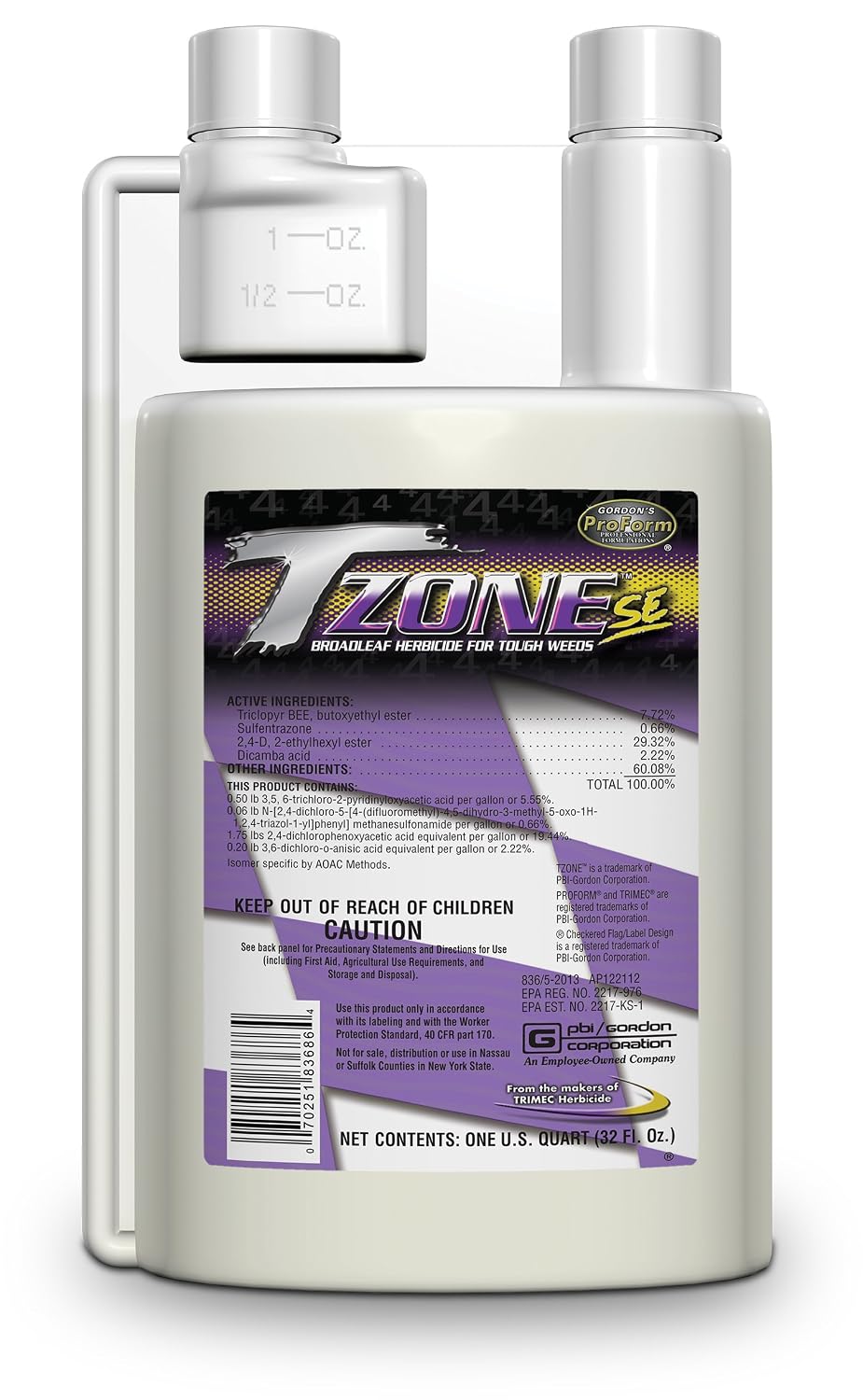
| Unit Count | 32 Fluid Ounces |
|---|---|
| Item Form | Liquid |
| Coverage | broad-leaf weeds, grassy weeds |
| Active Ingredients | Dicamba, triclopyr, 2,4-D, sulfentrazone |
T-Zone Turf Herbicide is a liquid formulation built to kill a wide range of broadleaf weeds and suppress tough targets like yellow nutsedge. You mix and apply it to turf areas where unwanted broadleaf plants are established; it contains active ingredients including triclopyr, dicamba, 2,4-D, and sulfentrazone for both fast visible results and cool-weather activity down to about 50°F. In practice it delivers quick foliar burn on susceptible species and is labeled for use on residential, commercial, and golf sites, which makes it suitable for higher-performance lawn care. Notable features are its multi-active ingredient blend for broad-spectrum control and its explicit suppression of yellow nutsedge. Important limitations are that it requires careful handling and PPE because of the active chemistries, and it must be applied according to label restrictions to avoid injury to desirable ornamentals or sensitive grasses. Expect effective knockdown of many broadleaf weeds but plan applications around mowing, weather, and any nearby desirable plants.
Best for: Gardeners and turf managers who prioritize fast, reliable control of broadleaf weeds and need a product that works in cool conditions and on challenging targets like nutsedge.
Less Ideal for: Casual or organic-minded gardeners who prefer nonchemical methods or who will be applying near sensitive ornamentals or mixed-species plantings where off-target injury is unacceptable.
- Multi-active formula (triclopyr, dicamba, 2,4-D, sulfentrazone) for broad-spectrum control
- Provides visible weed decline quickly, useful for fast results
- Labeled for residential, commercial, and golf course use
- Effective cool-weather performance down to about 50°F and suppresses yellow nutsedge
- Contains strong herbicides that require protective equipment and careful handling
- Risk of damage to desirable ornamentals or sensitive turf if applied improperly
Verdict: Choose T-Zone when you need a potent, multi-ingredient herbicide that produces fast, reliable control of broadleaf weeds and suppresses tough targets like yellow nutsedge.
Spectracide Large Plot Weed Stop for Lawns Concentrate, 1 gal

| Unit Count | 128 Fluid Ounces |
|---|---|
| Item Form | Liquid |
| Coverage | 32000 square feet |
| Kills | 200+ listed weeds |
Spectracide Large Plot Weed Stop is a garden-strength concentrate designed for treating large lawn areas against broadleaf weeds. You mix the concentrate with water and apply it with a tank or hose-end sprayer to target weeds such as dandelion, chickweed and clover; the formula claims visible results in hours and kills weeds down to the root. It covers large areas—listed coverage for northern and southern grasses—so it is suited to whole-yard applications rather than spot treatments. The product is rainproof within hours and includes directions and a built-in hose connector for straightforward application. Important use limits include temperature guidance and safety precautions: do not apply when daytime temps exceed 85°F and keep people and pets off treated areas until dry. Because it is a non-selective broadleaf killer if misused, careful mixing, correct sprayer calibration and adherence to label directions are necessary to avoid lawn damage or off-target contact.
Best for: Buyers who need an economical, large-area solution to remove broadleaf weeds across a lawn and who are willing to follow label directions for mixing and timing to protect turf.
Less Ideal for: Not a good choice for gardeners who only need small spot treatments or who prefer an organic or non-chemical approach to individual weed removal.
- Concentrated formula treats very large areas so one bottle covers many applications for big yards
- Kills over 200 listed broadleaf weeds and targets roots for longer control
- Rainproof in hours so light rain shortly after application is less likely to reduce effectiveness
- Works with standard tank or hose‑end sprayers and includes a built-in hose connector for easy setup
- Requires careful mixing and sprayer setup to avoid overapplication or lawn damage
- Not safe to apply above 85°F which limits use on hot days
Verdict: A cost-effective concentrate for tackling broadleaf weeds across large lawns when used carefully and according to the label.
Ortho WeedClear Lawn Weed Killer Concentrate, 32 fl. oz.

| Unit Count | 32 Fluid Ounces |
|---|---|
| Coverage | 5000 square_feet |
| Item Form | Spray |
| Active Ingredients | Herbicide |
Ortho WeedClear Lawn Weed Killer Concentrate is a tank-sprayer formula designed to target broadleaf and grassy weeds in lawns. You dilute the 32 fl. oz. bottle per label instructions, apply with a garden tank sprayer or Ortho Dial N Spray, and expect visible dieback within hours on many species. It is labeled for common turfgrasses such as fescue and Kentucky bluegrass and claims to control tough weeds down to the root, including dandelion, clover, crabgrass and other listed species. The concentrate treats up to 5,000 sq ft, so a single bottle covers a typical small-to-medium yard when mixed correctly. Practical benefits include fast action, rainproofing within an hour, and compatibility with several northern lawn grasses when directions are followed. Limitations are that it must be diluted and applied carefully with proper protective gear, it is not safe on all grass types so you must check the label, and it is a nonselective herbicide for some applications so spot treatment is recommended for targeting small patches like wild violets.
Best for: Homeowners who want a cost-effective, concentrated weed control product to treat an entire small-to-medium lawn and prefer buying a single bottle that covers multiple applications.
Less Ideal for: Gardeners with sensitive or excluded turf types, those who need a ready-to-use spot treatment only, or people who prefer non-chemical control methods for isolated wild violet patches.
- Concentrate treats up to 5,000 sq ft from one 32 fl. oz. bottle
- Fast-acting formula with visible results in hours and rainproof within one hour
- Labeled for use on several common lawn grasses when diluted and used as directed
- Kills a wide range of broadleaf and grassy weeds down to the root
- Requires dilution and a sprayer which adds prep time and equipment needs
- Not safe for all grass types and some ornamental areas so label restrictions limit use
- May require spot treatment strategy for isolated weeds like wild violets to avoid harming desirable turf
Verdict: A budget-friendly concentrate that covers a typical yard and delivers fast, broad-spectrum weed control when diluted and applied correctly.
Monterey Spurge Power Herbicide, 1 Pint (2-Pack) with Measuring Spoon

| Unit Count | 16 Fluid Ounces |
|---|---|
| Number of Packs | 2 |
| Included Components | Measuring Spoon |
| Item Form | Spray |
| Coverage | 16000 square feet |
Monterey Spurge Power is a concentrated post-emergent herbicide designed to control persistent broadleaf weeds, including spurge and wild violet, across common lawn grasses. It arrives as two 1‑pint bottles with a measuring spoon for accurate mixing. The formula contains three active ingredients aimed at hard-to-control species so you can treat patches without reapplying frequently. Typical use is spot treatment or broadcast application over an affected lawn following label directions and safety precautions. Practical benefits include broad species coverage, suitability for both warm and cool season turf, and a high claimed coverage area that makes it efficient for medium to large yards. Important limitations are that it is a nonselective chemical for target weeds only after proper mixing and timing, so accidental contact with desirable plants or food crops must be avoided; protective gear and careful application are required. Also, results depend on correct application timing and following safety instructions for disposal and storage.
Best for: Buyers who prioritize a dependable, broad-spectrum post-emergent solution for persistent lawn broadleaf weeds and want a product that covers medium to large areas with a single package.
Less Ideal for: Gardeners who need an organic or non-chemical approach or those treating vegetable beds or ornamentals where off-target damage is unacceptable.
- Targets a wide range of tough broadleaf weeds including spurge and wild violet
- Suitable for both warm and cool season lawns so it works on common turf types
- Concentrated formula with included measuring spoon for accurate dosing
- Large claimed coverage up to 16,000 square feet reduces the need for multiple purchases
- Requires careful handling and protective equipment due to chemical formulation
- Not for use on areas where food crops are grown and can damage non-target plants if misapplied
Verdict: A concentrated, multi‑ingredient post-emergent herbicide built to reliably tackle stubborn broadleaf weeds like wild violet across large lawn areas.
Ortho Nutsedge Killer for Lawns Ready-To-Spray, 32 fl. oz

| Item Form | Spray |
|---|---|
| Coverage | 5000 square_feets |
| Liquid Volume | 32 fluid ounces |
| Active Ingredients | Sulfentrazone |
Ortho Nutsedge Killer is a ready-to-use hose-end sprayer designed for homeowners who want a targeted solution for stubborn lawn weeds like nutsedge and wild violet. You attach the sprayer to a garden hose, flip the thumb-activation to ON and spray evenly over the affected area; the manufacturer recommends treating weeds under about 3 inches tall and keeping children and pets off treated areas until dry. The formula contains sulfentrazone and is labeled for use on many common cool- and warm-season turfgrasses, so it aims to kill listed sedges and broadleaf weeds without harming established lawns when used as directed. Practical benefits include easy hose-end application that covers up to 5,000 sq ft per bottle and a selective action that reduces the need for spot-pulling. Important limitations are that it cannot be used on newly sodded or plugged turf, must not be sprayed on ornamentals or vegetable beds, and it requires careful handling and timing for safe, effective results.
Best for: Homeowners who want a proven, easy-to-apply solution to remove wild violet and other tough lawn weeds without complex mixing or professional equipment, and who follow label safety guidance.
Less Ideal for: Gardeners with newly installed lawns, beds with ornamentals or vegetables, or those who prefer non-chemical or organic weed control methods.
- Ready-to-use hose-end sprayer for simple, no-mix application
- Selectively targets nutsedge, wild violet and many listed sedge and broadleaf weeds
- Covers a large area up to 5,000 sq ft per 32 fl oz bottle
- Label permits use on a wide range of established cool- and warm-season turfgrasses
- Contains sulfentrazone so requires safety precautions and drying time before re-entry
- Not safe for newly planted, plugged or sodded turf or for ornamentals and vegetable beds
- Effectiveness depends on treating weeds when small and may require repeat applications
Verdict: A user-friendly hose-end treatment that makes removing wild violet and nutsedge from established lawns quick and straightforward.
Roundup Weed & Grass Killer with Comfort Wand, 1.33 gal

| Item Form | Liquid |
|---|---|
| Coverage | 400 sq. ft. |
| Liquid Volume | 1.33 gallons |
This Roundup Weed & Grass Killer arrives as a 1.33 gallon liquid jug with an integrated Comfort Wand for one-touch continuous spraying, making spot treatment of persistent weeds straightforward. It is formulated to kill common broadleaf weeds and grasses to the root, with visible wilting in hours and rainproof protection in about 30 minutes, which helps reduce reapplication after light showers. The product is intended for targeted use around flower beds, walkways, driveways, mulch and along fences where you need quick eradication of plants such as violets, dandelions, crabgrass and clover. The Comfort Wand reduces hand fatigue during multiple spot treatments and the stated coverage (about 400 sq. ft.) is useful for small yards or patchy infestations. Important considerations are standard herbicide precautions: avoid drift to desirable plants, keep people and pets out until sprays dry, and follow planting wait times in the label. This is a tactical, easy-to-use option when you want reliable, fast knockdown of wild violet patches without mixing concentrated chemicals yourself.
Best for: Buyers who want a straightforward, ready-to-use solution to remove patches of wild violets and other broadleaf weeds quickly and with minimal fuss, especially for small lawns, beds, and hardscape edges.
Less Ideal for: Gardeners with large acreage, those who need a selective lawn-safe product for turf areas, or people who prefer non-chemical control methods should consider alternatives.
- Built-in Comfort Wand with one-touch continuous spray reduces hand fatigue and simplifies spot application
- Kills a wide range of broadleaf weeds and grasses to the root for longer control
- Fast visible results in hours and becomes rainproof in about 30 minutes
- Ready-to-use jug avoids measuring or mixing concentrated herbicide
- Stated coverage of approximately 400 sq. ft. suitable for treating small infestations
- Not selective for desirable plants so requires careful application to avoid damage
- Single container size limits efficiency for large properties
- Label restrictions on replanting and access require following safety wait times
Verdict: Choose this ready-to-use Roundup when you need fast, reliable spot removal of wild violets and other tough broadleaf weeds without mixing concentrated products.
Choosing the Right Wild Violet Weed Killer: Key Factors to Consider
Active Ingredient and Mode of Action
Knowing the active ingredient helps predict how well a product will control wild violets and whether it will harm nearby plants. Some active ingredients provide quick foliar knockdown while others translocate into roots for longer control. For perennial violets, a translocating ingredient that moves to the root system often reduces regrowth.
Rotation of modes of action also matters if you plan repeated applications over seasons. Using products with the same mode repeatedly can select for tolerant plants, so mix application types and integrate nonchemical control when possible.
Lawn and Garden Safety
Label directions determine whether a product is safe to use on turf, around ornamentals, or in garden beds. Safety depends on concentration, formulation, and timing relative to turf health. Choosing a product labeled for the specific turfgrass or ornamental species around the violets reduces the risk of unintended damage.
Consider the season and stress on nearby plants. Applying a strong herbicide during drought or heat can increase turf injury. Also review re-entry and mowing intervals to plan landscape maintenance after treatment.
Application Method and Equipment
Different formulations require different application tools and techniques. Ready-to-use sprayers are convenient for small patches, while concentrate formulations let you treat larger areas but need proper mixing. Some products work better with spot-spraying and shielded wands to protect desirable plants.
Evaluate whether you will use a pump sprayer, hose-end sprayer, or handheld bottle. Proper nozzle selection and spray pressure affect coverage and drift. For targeted control in mixed beds, choose an option that minimizes overspray and allows precise placement.
Timing and Frequency of Applications
Wild violets respond best to treatment at certain growth stages. Applications when plants are actively growing, with good leaf area for uptake, typically produce faster control. Treating too early in spring or late in dormancy reduces efficacy.
Perennial violets may require repeat applications or mowing/hand removal before treatment to improve contact. Check label guidance for intervals between treatments and seasonal use limits to plan a control schedule that minimizes repeat effort.
Residual Activity and Regrowth Prevention
Some products offer residual soil activity that suppresses new seedlings, while others only affect emerged foliage. For violets that spread from persistent root systems, residual soil activity has limited benefit unless it targets vegetative reproduction. Understand whether the product suppresses regrowth or mainly manages visible plants.
Combine residual control with cultural measures such as improving drainage, increasing turf density, and addressing shade to reduce conditions that favor violet reestablishment.
Environmental and Safety Considerations
Consider runoff potential, pollinator exposure, and safety for pets and children when selecting a control method. Choose formulations with application instructions to reduce drift and off-target contact. Some products require precautions like avoiding application during bloom or to wet foliage.
Read label instructions for personal protective equipment and storage. Minimizing overall chemical use through targeted spot treatments and mechanical removal reduces environmental exposure while still achieving control.
When to Treat Wild Violets
Treat wild violets when they are actively growing and have developed several leaves to maximize herbicide uptake. Late spring through early summer often provides ideal conditions because plants are out of dormancy and leaf area is sufficient for contact or translocation.
Avoid treating during drought stress or extreme heat because uptake is reduced and the risk of turf damage increases. Also consider timing around desirable flowering periods if pollinator protection is a concern; targeted spot treatments outside bloom times reduce non-target exposure.
- Best uptake when plants have full leaf rosettes
- Avoid application during drought or heat stress
- Time treatments to minimize pollinator exposure
Cultural Controls That Complement Herbicide Use
Herbicides perform best when combined with cultural practices that reduce violet-favoring conditions. Improve lawn density through correct mowing height, balanced fertilization, and overseeding thin areas to limit the bare ground violets exploit.
Increase sunlight and reduce shade where possible because wild violets thrive in shady, damp spots. Improving surface drainage and reducing compaction also make the environment less hospitable to violets and reduce the need for repeated chemical treatments.
- Mow at appropriate height to encourage turf competition
- Overseed thin areas in fall or spring depending on grass type
- Aerate compacted soil and improve drainage where water collects
Spot Treatment Techniques
For small patches, spot treating limits chemical use and protects surrounding plants. Use a handheld sprayer with a narrow spray or a shielded nozzle to place product only on violet foliage. Apply on calm days to reduce drift.
When treating mixed beds, consider wiping methods or a targeted brush applicator to avoid contact with desirable ornamentals. After application, monitor treated plants for decline and plan follow-up applications only as label allows.
- Use calm conditions and low-pressure spray settings
- Protect nearby plants with cardboard shields or selective wands
- Record application dates and follow label reapplication intervals
Safe Practices Around Lawns and Gardens
Read and follow label instructions to protect turf and ornamentals. Many products list specific turfgrass species and recommended rates; apply only within those guidelines. Keep children and pets off treated areas for the recommended period.
Avoid applying before heavy rain unless the label indicates rainfastness to prevent runoff. Store concentrates securely and rinse equipment responsibly after use to prevent unintended exposure to plants or water bodies.
- Check turfgrass compatibility before broadcast applications
- Observe re-entry and watering restrictions on labels
- Clean sprayers and dispose of rinsate per local guidance
Managing Persistent or Large Infestations
Large or long-established violet populations often need a multi-season approach. Start with spot treatments to reduce the bulk of plants, then repair bare patches with overseeding and cultural improvements to prevent reinvasion. Repeated applications across seasons may be necessary where root systems persist.
Mechanical removal can be effective for small sections when combined with soil disturbance minimization. Digging can spread fragments if not done carefully, so combine mechanical work with follow-up chemical or cultural controls as appropriate.
- Combine chemical control with overseeding and cultural fixes
- Use mechanical removal cautiously to avoid spreading roots
- Plan control efforts across seasons for persistent populations
How We Chose the Best Wild Violet Weed Killer
We focused on products and formulations that are practical for home gardeners dealing with wild violets in lawns, beds, and edges. Our selection filtered for products with clear labeled uses for perennial broadleaf weeds and lawn-safe instructions when used as directed. We preferred formulations that allow targeted spot treatment and those offering residual control to reduce repeat applications. Evaluation criteria included mode of action and documented effectiveness against perennial broadleaf weeds, lawn and ornamental safety when applied correctly, application ease and equipment compatibility, and long-term control potential including follow-up treatment guidance. We excluded products lacking clear labeling for lawn or bed use, household home remedies without supporting efficacy guidance, and formulations that require specialized licensing or commercial applicators. The shortlisted options represent tools and chemistries gardeners can reasonably use themselves, balanced across ease, safety, and expected control duration.
FAQ
Will a single application usually eliminate wild violets?
Often a single application reduces visible growth but may not eliminate deep roots. Many gardeners need follow-up treatments timed by the product label and improved cultural practices to stop regrowth.
Is it safe to use violet-specific herbicides on a lawn?
It depends on the product and the grass species. Some formulations are labeled for use on common turfgrasses when applied at specified rates, while others are for spot treatment only. Always check label directions for turf compatibility.
Can I use household vinegar or boiling water to kill wild violets?
Acidic home remedies may injure above-ground foliage but usually do not kill perennial roots and can damage surrounding turf or desirable plants. They are not typically as reliable as products labeled for perennial broadleaf control.
How long after treatment can I reseed or overseed?
Reseed timing depends on the active ingredient and label guidance. Some products recommend waiting several weeks to months before reseeding. Follow the label instructions to avoid poor germination or seedling injury.
Are there nonchemical options that work for violets?
Yes. Improving turf vigor, increasing sunlight, hand-pulling small patches, and careful digging can reduce violet prevalence. These methods usually take longer and are best combined with targeted chemical control for large infestations.
Final Verdict
For most gardeners, the best approach to wild violets combines a product suited to perennial broadleaf control with targeted application techniques and cultural fixes that reduce the conditions violets prefer. Prioritize products labeled for turf or beds where you will apply them, choose application methods that protect desirable plants, and plan follow-up treatments as allowed by the label. Expect tradeoffs between speed of visible knockdown and longer-term root control. Focus on a clear plan: reduce the existing population, repair the site to prevent reinfestation, and monitor for new growth so you can apply follow-up treatments when needed.
